
Would you like to save this?
The plate glass was polished to invisibility, and the trim inside caught the fluorescent tubes and threw light clear across the floor. You could smell the new-car scent from the parking lot before you ever stepped inside. Fathers straightened their ties before walking in. Kids pressed their noses against the window before anyone could stop them. What waited beyond the glass was part theater, part cathedral, part Main Street event of the year. These are the touches that gave it that feeling.
The Rotating Platform That Spun a Two-Tone Fairlane Like It Was the Only Car on Earth
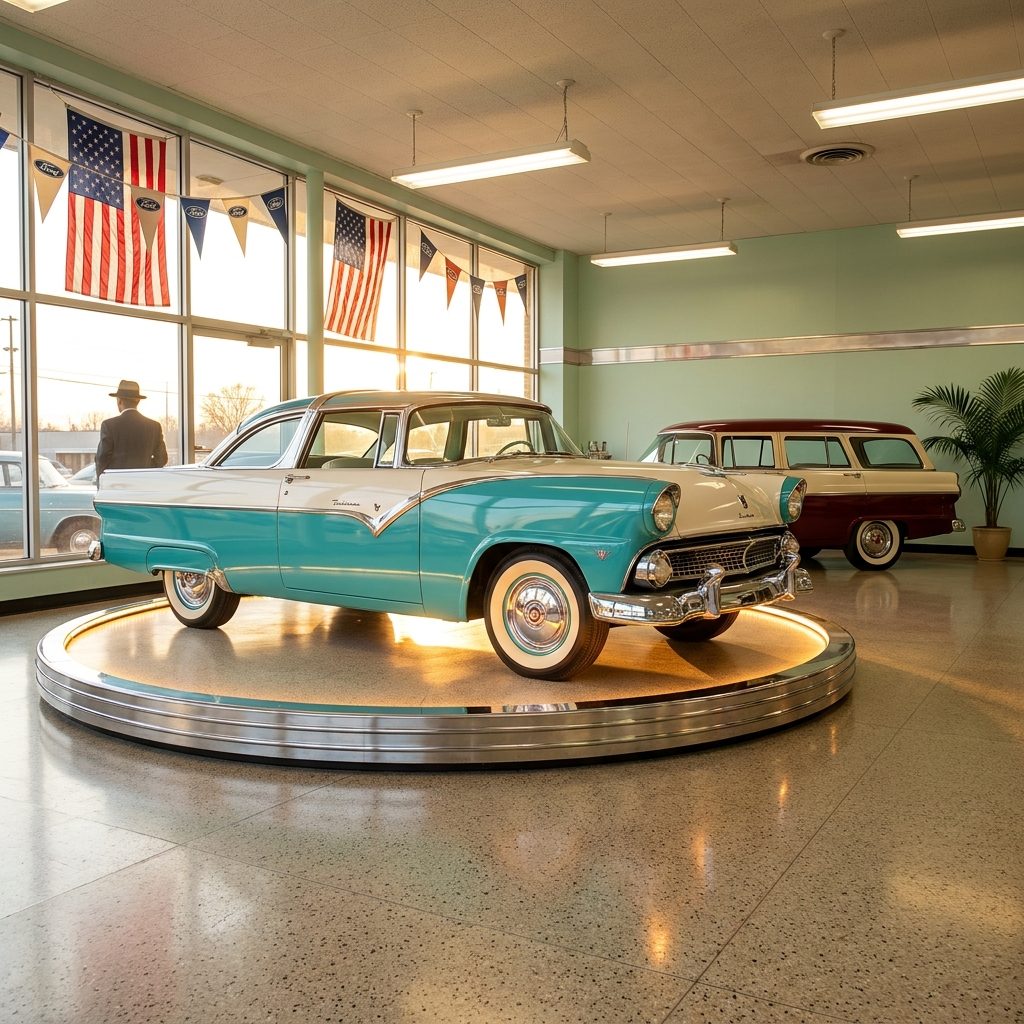
The turntable moved so slowly you could barely tell it was moving — and that restraint was the whole trick. You’d walk through those plate glass doors and there it sat, a two-tone Fairlane Crown Victoria catching the light from a new angle every few seconds, chrome flashing, the paint shifting from turquoise to something almost silver depending on where you planted your feet.
Nobody rushed you. The car just turned, and you turned with it. You circled it the way people circle sculpture in a museum, except this sculpture had a 272 cubic inches under the hood and whitewall tires.
The Brochure Rack by the Door With Every Color Combination Laid Out Like Paint Chips at the Hardware Store
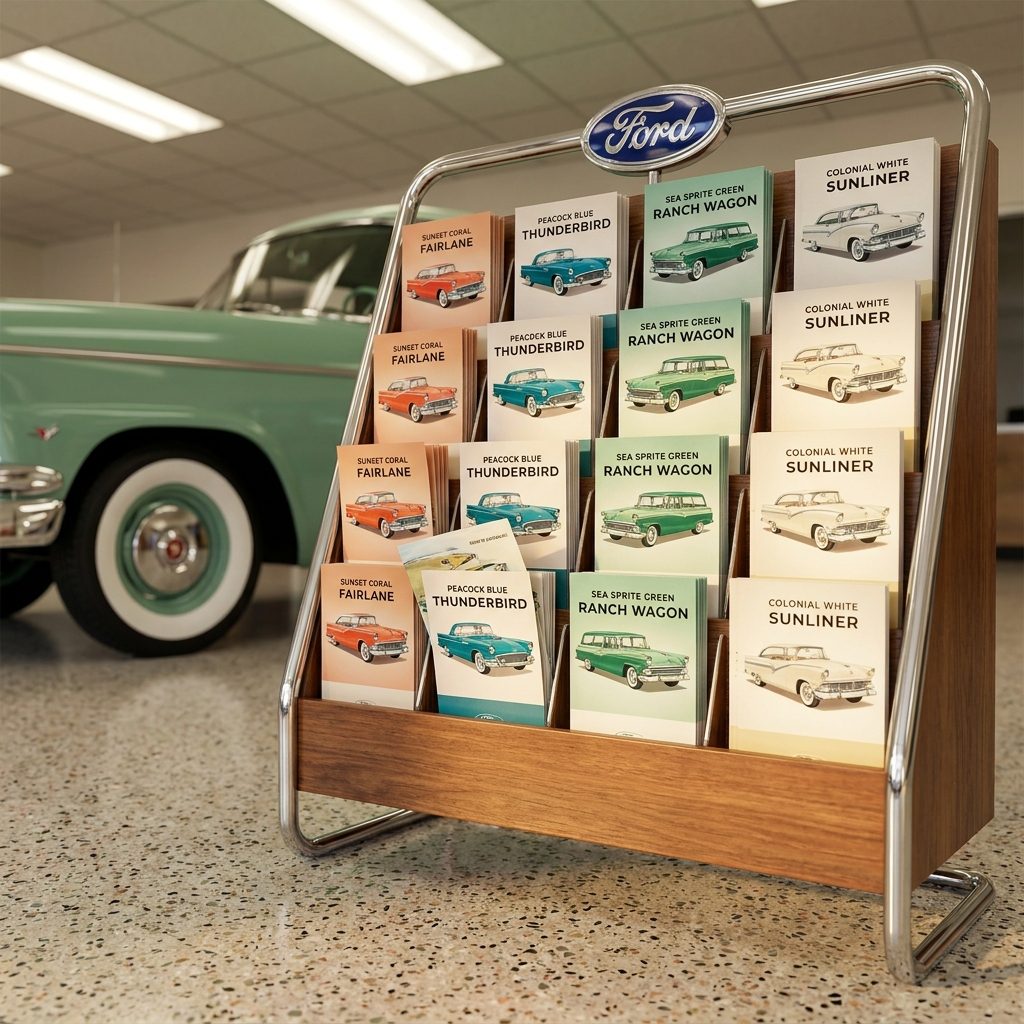
Sunset Coral. Peacock Blue. Sea Sprite Green. Colonial White over Raven Black. Ford’s color names in the fifties read like somebody in the marketing department was secretly writing poetry on company time, and the brochure rack was where the spell took hold.
Chrome tubing, a little Ford crest on top, standing right inside the door. You’d pull one out and unfold it and suddenly you weren’t browsing cars — you were furnishing a life. Your driveway. Your Saturday morning. That brochure went home with you, lived on the kitchen table for a week, got folded and refolded until the creases went soft as cloth. Nobody threw them away. Not right away.
The Terrazzo Floor Polished So Hard You Could See the Undercarriage Reflected in It
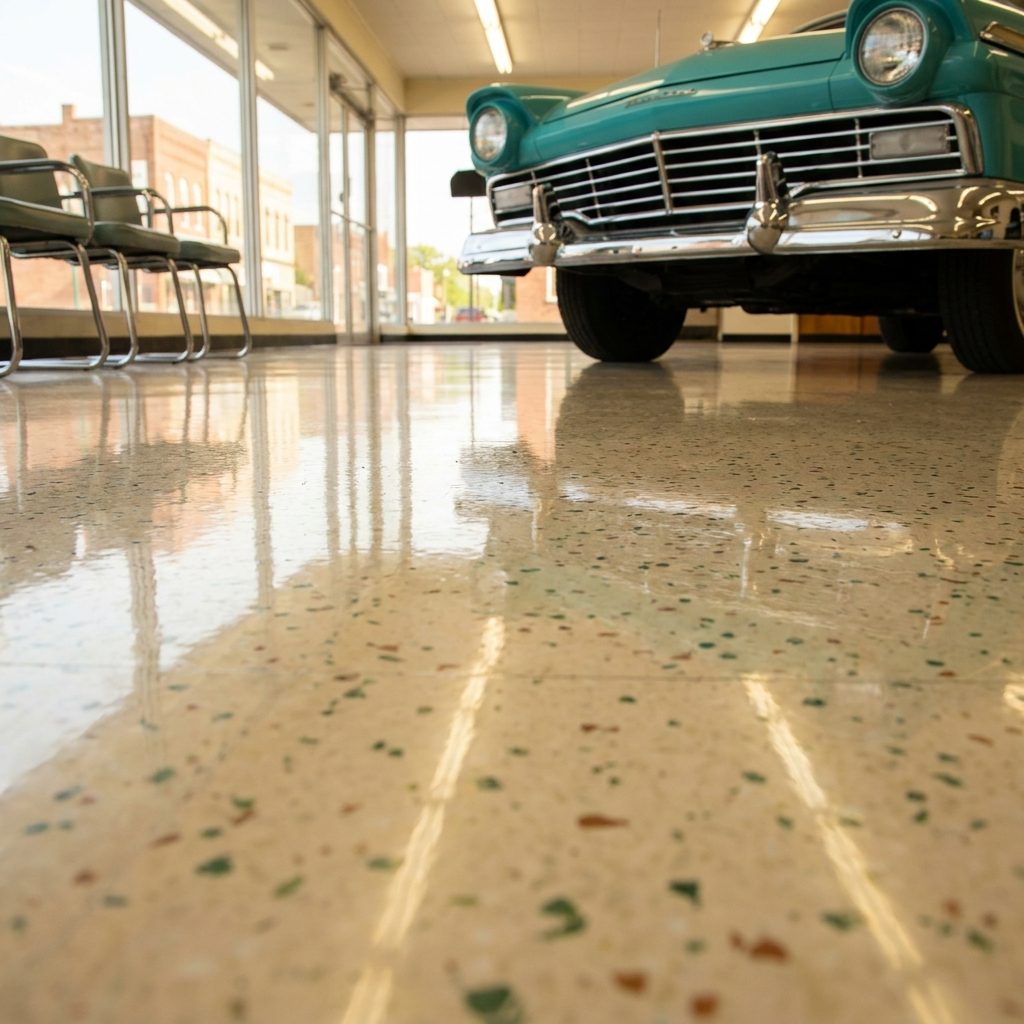
You could check your haircut in that floor. Cream with little green and rust flecks, polished to the point of vanity, shining like wet stone after a rainstorm — the terrazzo in a Ford showroom told you something before a single salesman opened his mouth. Chrome bumpers reflected downward into it. Your shoes clicked on it. Every surface, every sound, every gleam said the same thing: this is not a garage. Something important happens here. Act accordingly.
The Cutaway V-8 Engine on the Pedestal, Painted Ford Blue and Slowly Turning Over With a Little Electric Motor
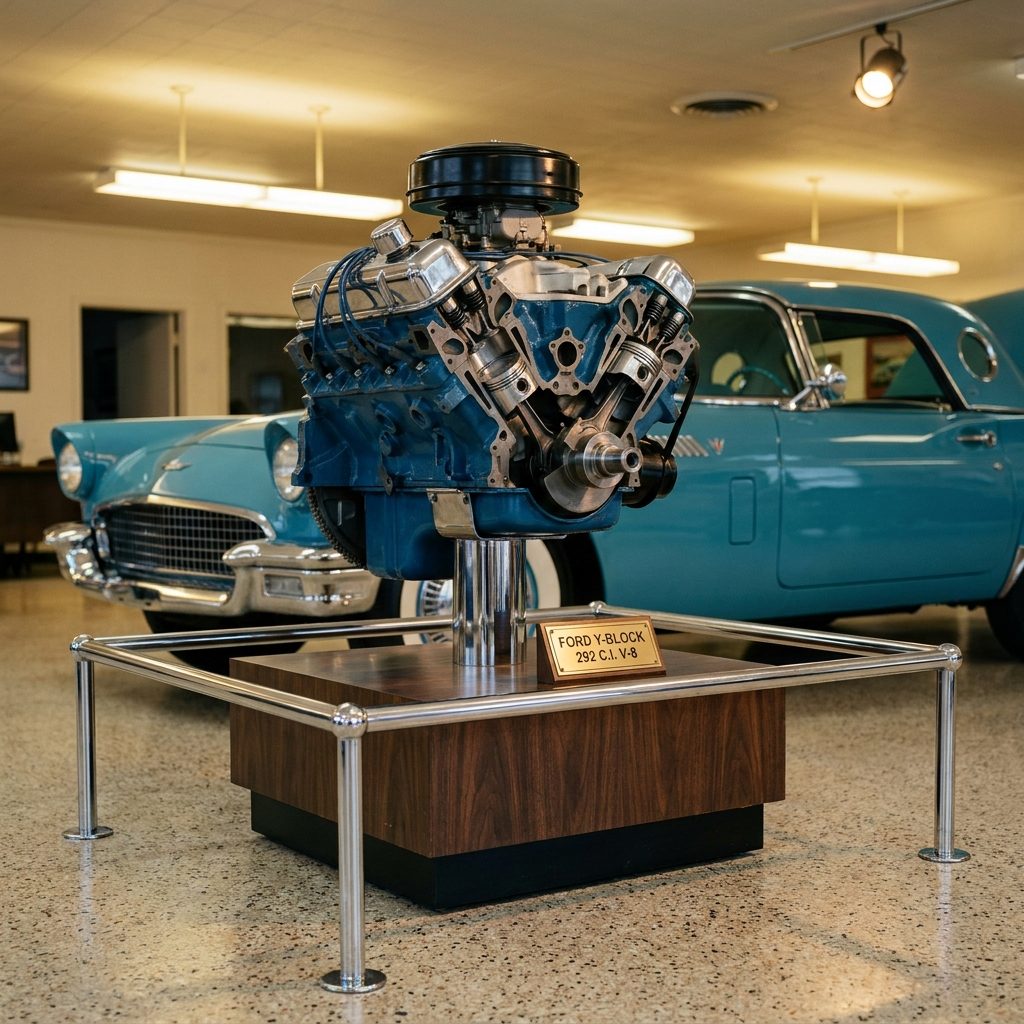
Silent on its little electric motor, the crankshaft rotating, pistons rising and falling behind the cutaway section, all of it painted that unmistakable Ford engine blue. You could stand there for ten minutes. Your father did.
Ford’s way of saying: look inside. Nothing to hide. Valves opened and closed. The oil pump spun. Mechanical theater — and it worked on every kid who wandered over and most of the dads who pretended they were just keeping an eye on the kid. The chrome guardrail around the pedestal existed because people genuinely couldn’t stop themselves from reaching in to touch the moving parts.
The Glass-Walled Service Bay Visible From the Showroom So You Could Watch Your Car Get Worked On
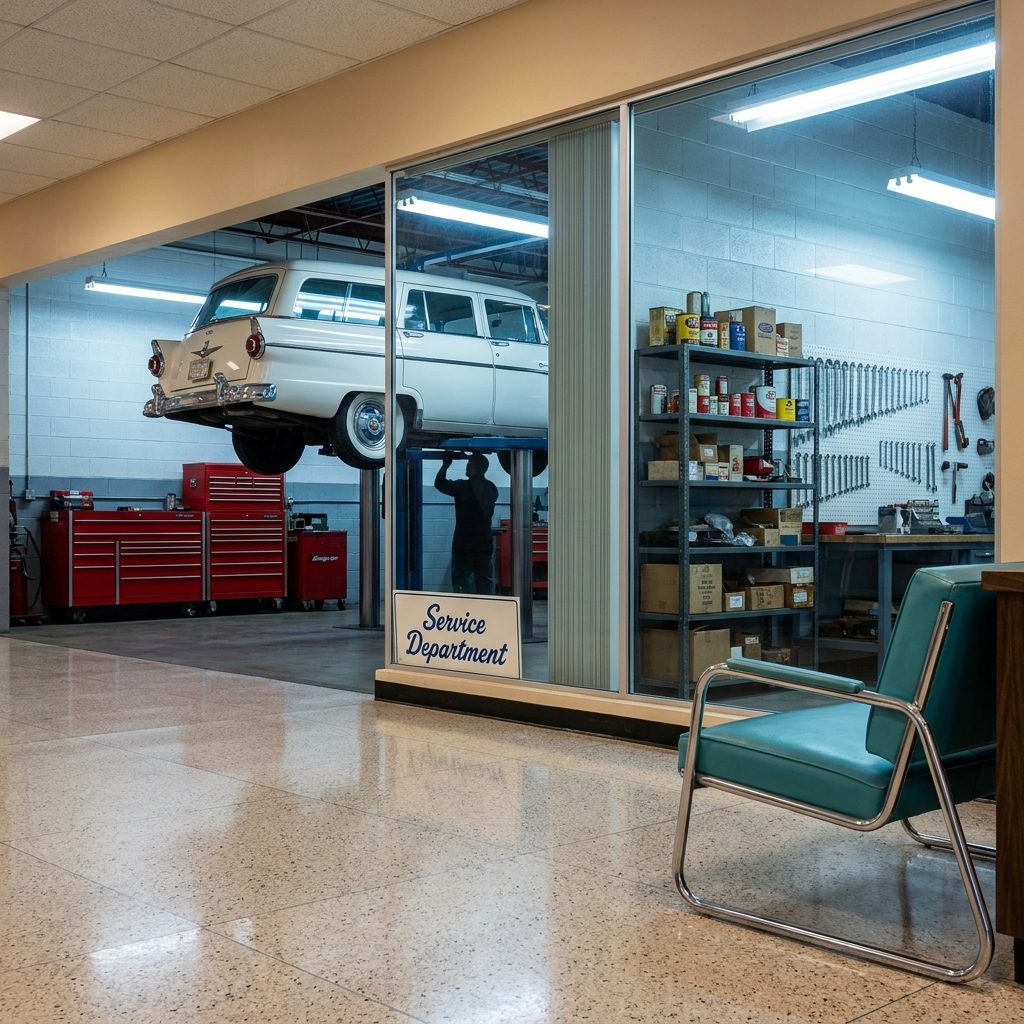
Some Ford dealerships in the fifties put plate glass between the showroom and the service bay. Genius. You sat in a turquoise vinyl chair on the showroom side, drank free coffee from a paper cup, and watched your car get its oil changed like you were observing surgery. The mechanic on the other side of the glass became a performer whether he liked it or not — and the good ones leaned into it.
That glass wall pulled double duty. It made the service department feel transparent, honest, because you could see everything. But it also trapped you in the showroom, surrounded by new cars, for the full duration of your wait. The new Fairlane was right there, fifteen feet away, glinting. You had forty minutes. Ford understood what proximity does to a person who’s already thinking about cars.
The Little Desk Calendar With the Ford Crest and the Salesman’s Name Embossed in Gold
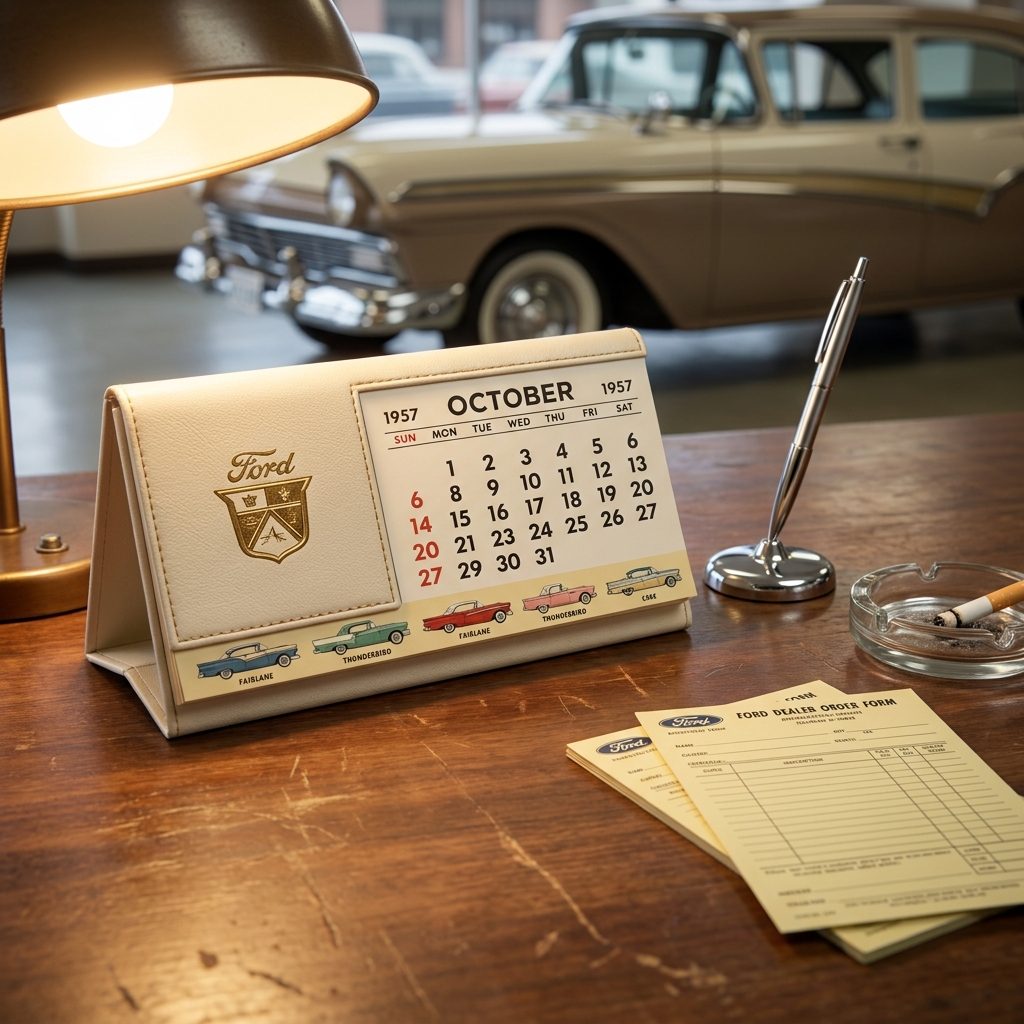
A small thing. Cream leatherette, the Ford crest in gold, the salesman’s name stamped below it. Sat on his desk between the ashtray and the pen holder, and when the deal closed, he’d slide it across to you like a parting gift. Yours to keep.
So it went on your desk at home or at the office. January through December, that little Ford logo caught the lamplight every morning. Twelve months of advertising that cost the dealership almost nothing — a quiet reminder, day after day, of where you bought your car and exactly who sold it to you. Brilliant, really, in the laziest possible way.
The Smell of New Vinyl and Floor Wax and Cigarette Smoke That Hit You the Second You Walked In
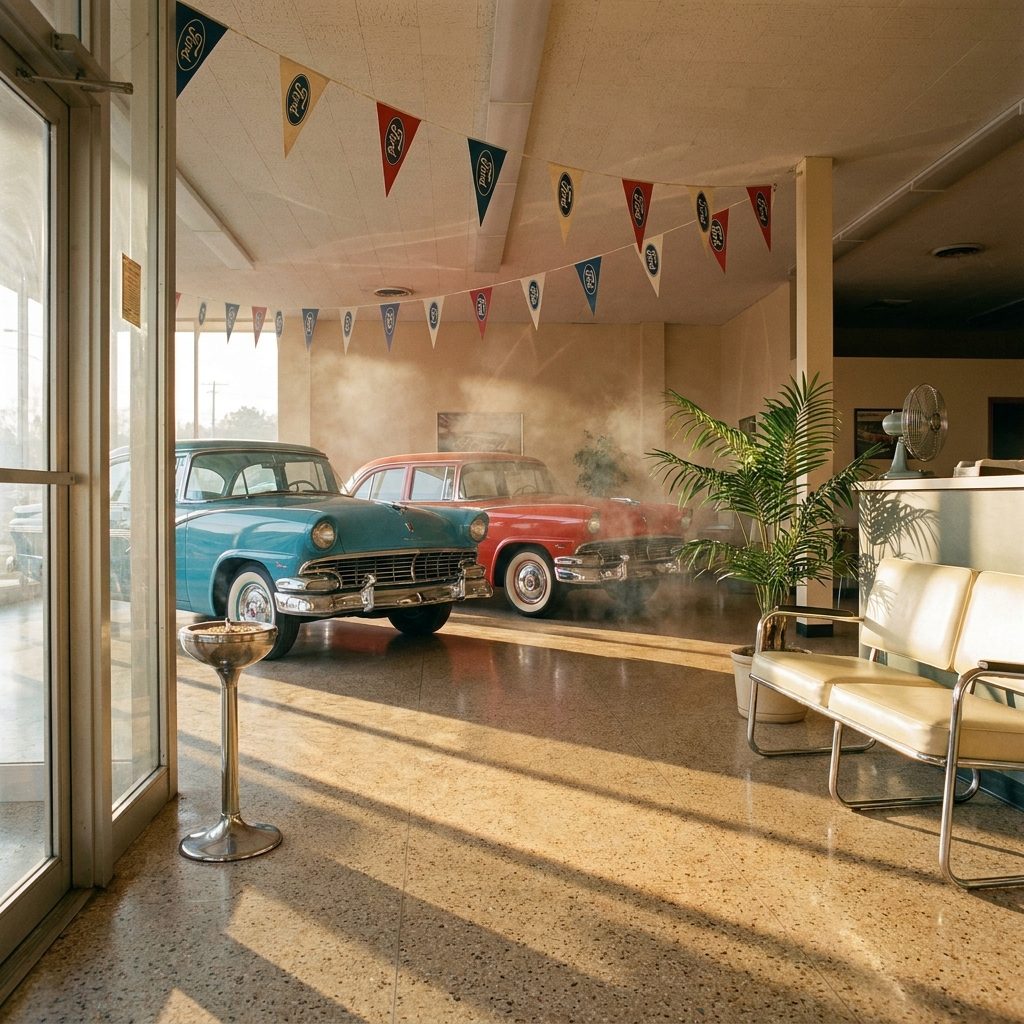
Three smells told you exactly where you were before you saw a single car. Vinyl off the bench seats. Floor wax off the terrazzo. Cigarette smoke drifting from the chrome ashtray by the door. That was the signature of a Ford showroom in 1956.
Nobody designed it. Fresh wax from the night crew, new-car smell radiating off the stock, and smoke because everybody smoked and ashtrays were furniture — it all just converged. Together those three things made something no candle company could ever bottle, and honestly, why would they try? You walk into a restored dealership at a car show where they’ve waxed the floor and parked a fresh-upholstery car inside, and it hits you like a time machine. Some memories live in the nose more than anywhere else.
The Big Board on the Wall With Every Model Lined Up in Miniature Like a Menu at a Diner
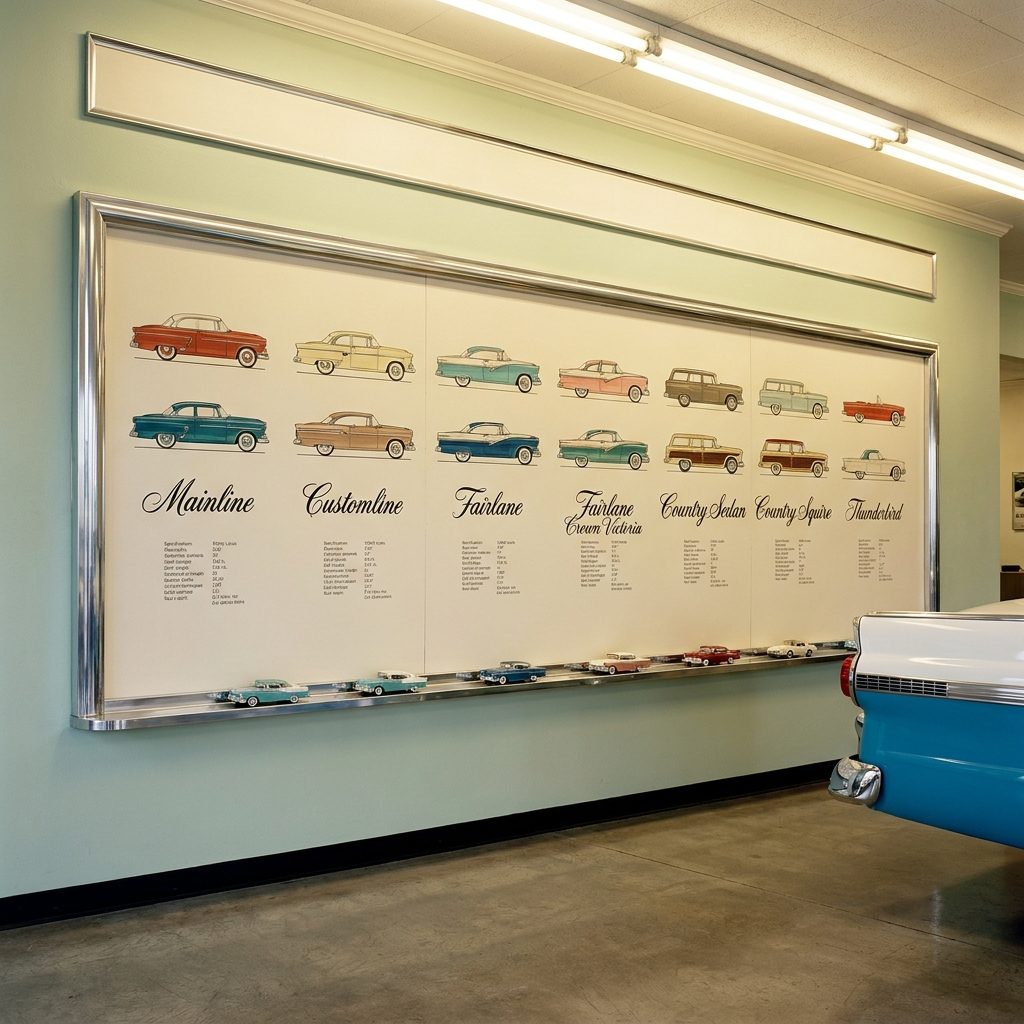
Mainline. Customline. Fairlane. Crown Victoria. Country Sedan. Country Squire. Thunderbird. Every model drawn in profile and mounted on a cream board with a chrome border — the whole lineup readable in a glance, left to right, bottom of the range to the top. Your eyes always drifted right.
What made the board clever wasn’t the information. It was the ladder. You could see where you were and where you could be, laid out spatially, each step a little longer and a little shinier than the last. And the Thunderbird sat at the far end like something you’d earn someday. Maybe next year. Maybe the year after. The board was patient. It could wait.
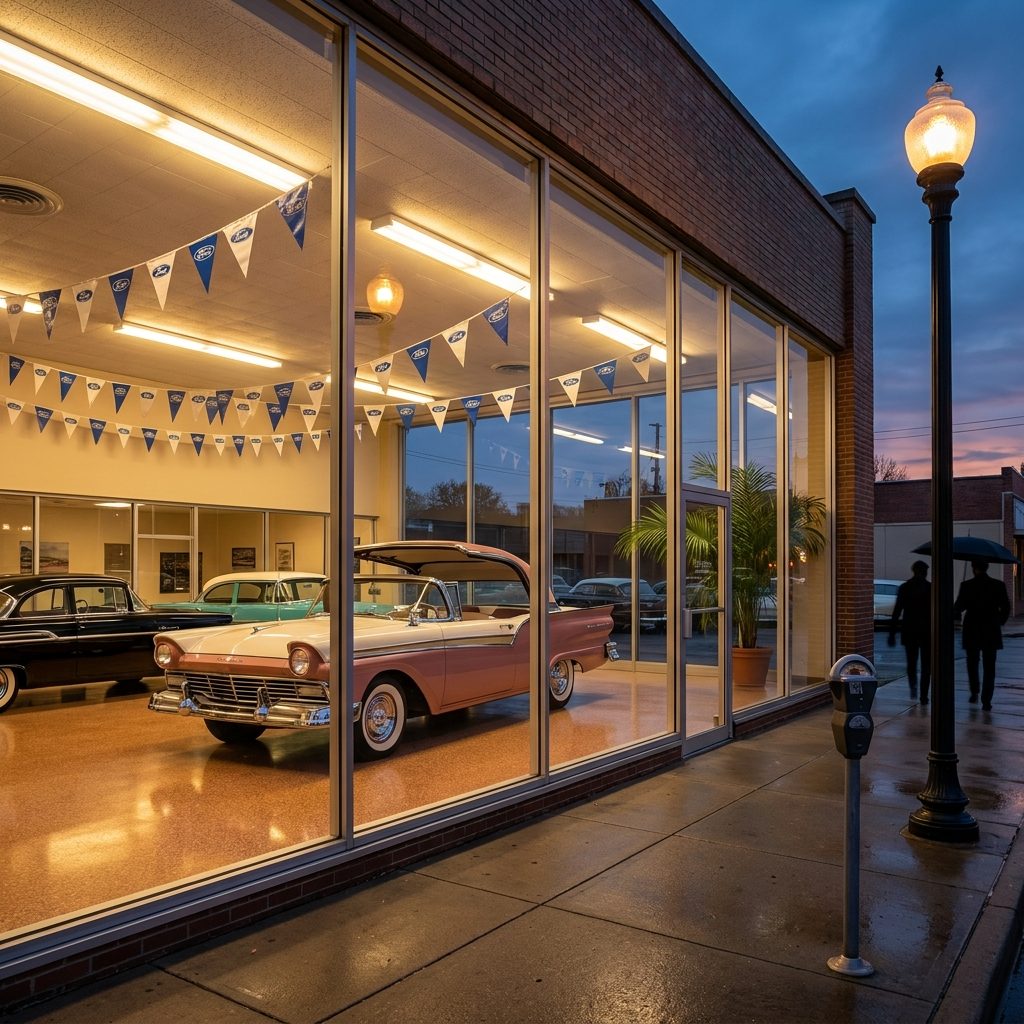
The Plate Glass Front Windows That Turned the Showroom Into a Stage Set Visible From the Sidewalk
Would you like to save this?
After dark is when it happened. Fluorescents stayed on, cars glowed behind all that glass, and you could be walking home from the drugstore when a Fairlane 500 Skyliner in Dusk Rose stopped you dead on the sidewalk. Lit up, just sitting there, placed behind glass like a museum piece — except this one had a price tag.
Ford’s dealer-design guidelines in the fifties called for maximum glass frontage, and the reasoning was ruthlessly simple. They wanted the showroom visible from the street at all hours, especially after closing. A dealership that went dark at six was wasting the entire evening. The ones that left the lights burning sold cars to people who weren’t even shopping — people who were just walking past, tired, on their way home, suddenly imagining a different driveway.
The Kids’ Corner With a Little Pedal Car and Some Coloring Books So Mom and Dad Could Talk Numbers in Peace
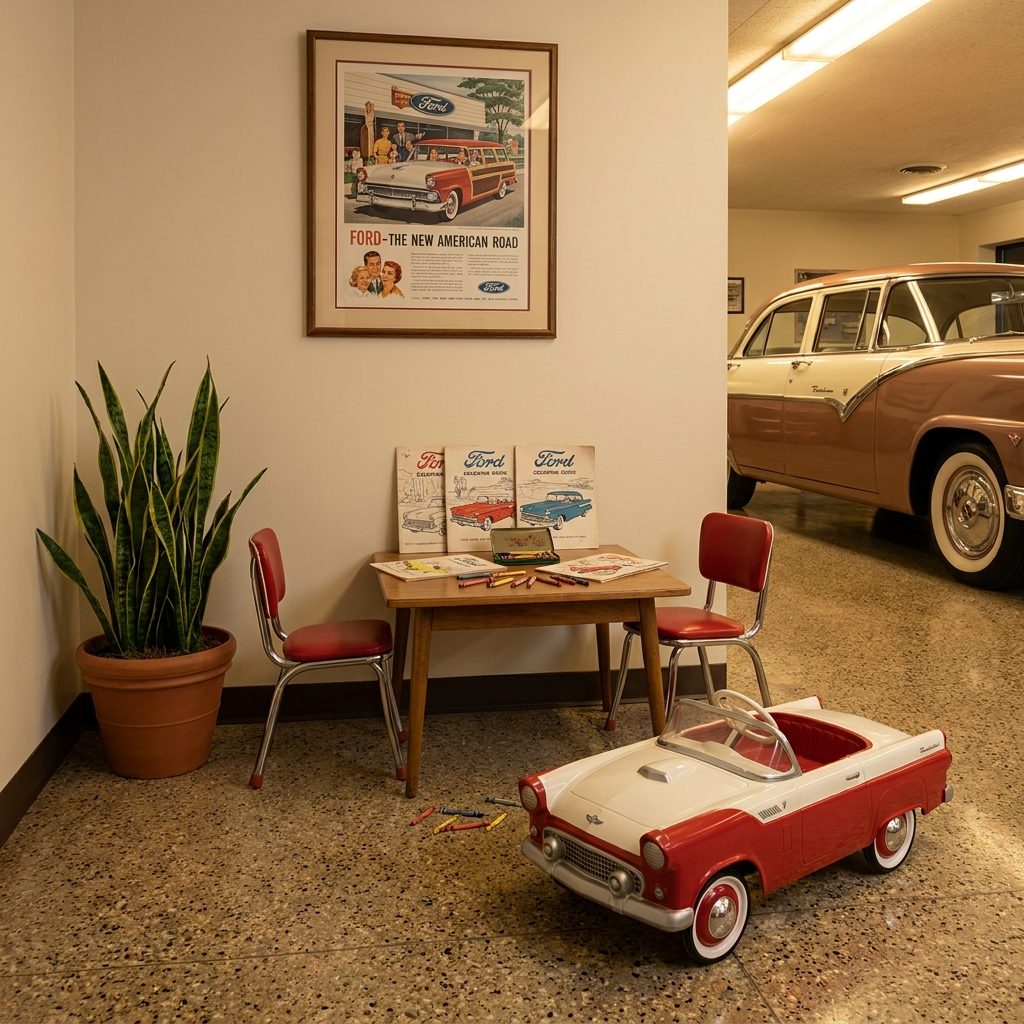
A red-and-white pedal Thunderbird, a stack of coloring books with Fords on every page, a tin of crayons, two little chairs. Maybe forty square feet of showroom space. Most strategically valuable real estate in the building.
What it bought was time. Twenty uninterrupted minutes where Dad could sit at the desk and haggle over options packages without a five-year-old yanking his sleeve. And here’s the sneaky part — the coloring books had Fords on every page, the pedal car was a miniature Ford, and the framed ad on the wall showed a family loading up a Country Squire. Those kids were being recruited, gently, before they could read a price sticker. They had no idea. They were having the time of their lives.
The Coffee Urn on the Counter That Never Ran Out and Never Tasted Good
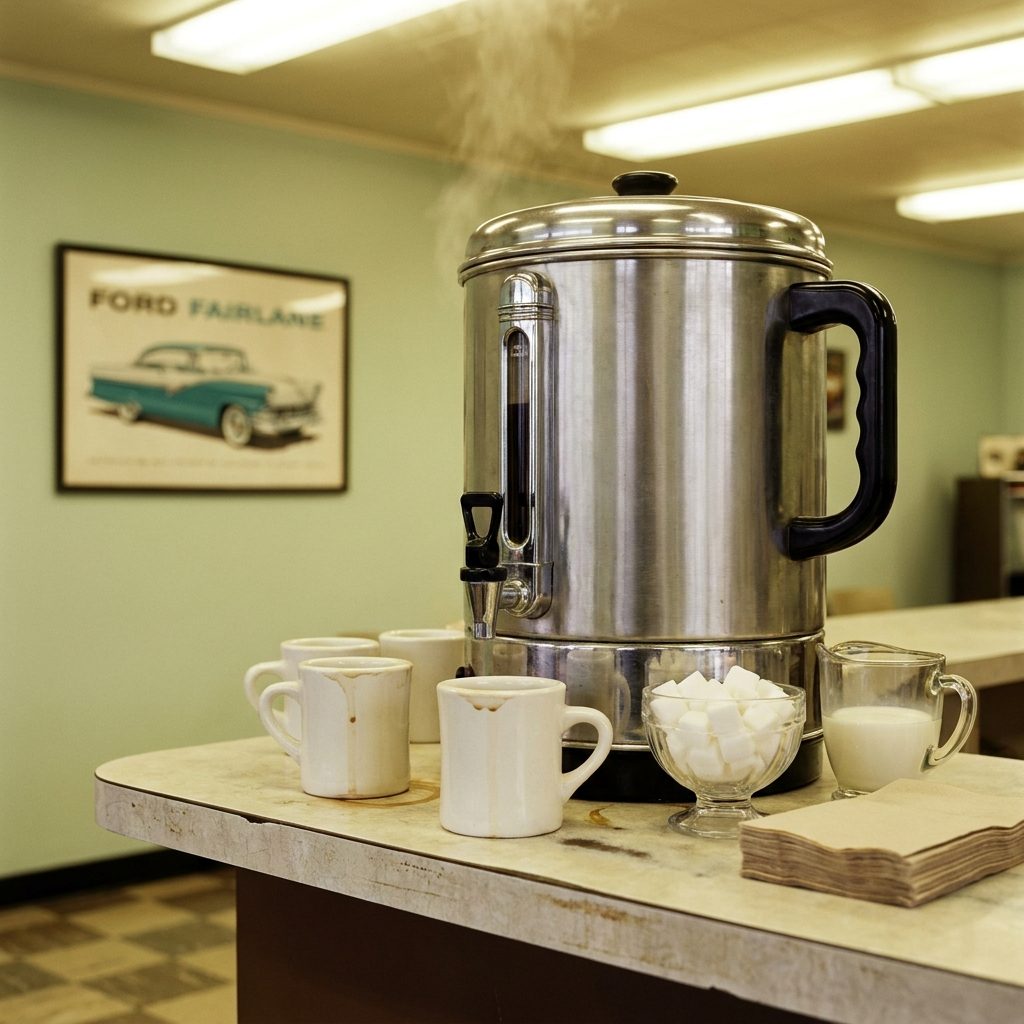
That coffee was terrible. Every single time. Burnt, sitting on the heating element since seven in the morning, strong enough to strip chrome — and nobody cared, because you took the cup they offered. Sitting in a dealership without something in your hand felt like standing at a party where you don’t know anyone.
The urn was always the same model, chrome with a black spigot, parked on a counter next to a dish of sugar cubes going yellow at the edges. The cream lived in a glass pitcher nobody had washed since Eisenhower’s first term. You drank it anyway. Cost of doing business.
The Salesman’s Two-Tone Shoes That Matched the Car He Was Trying to Sell You
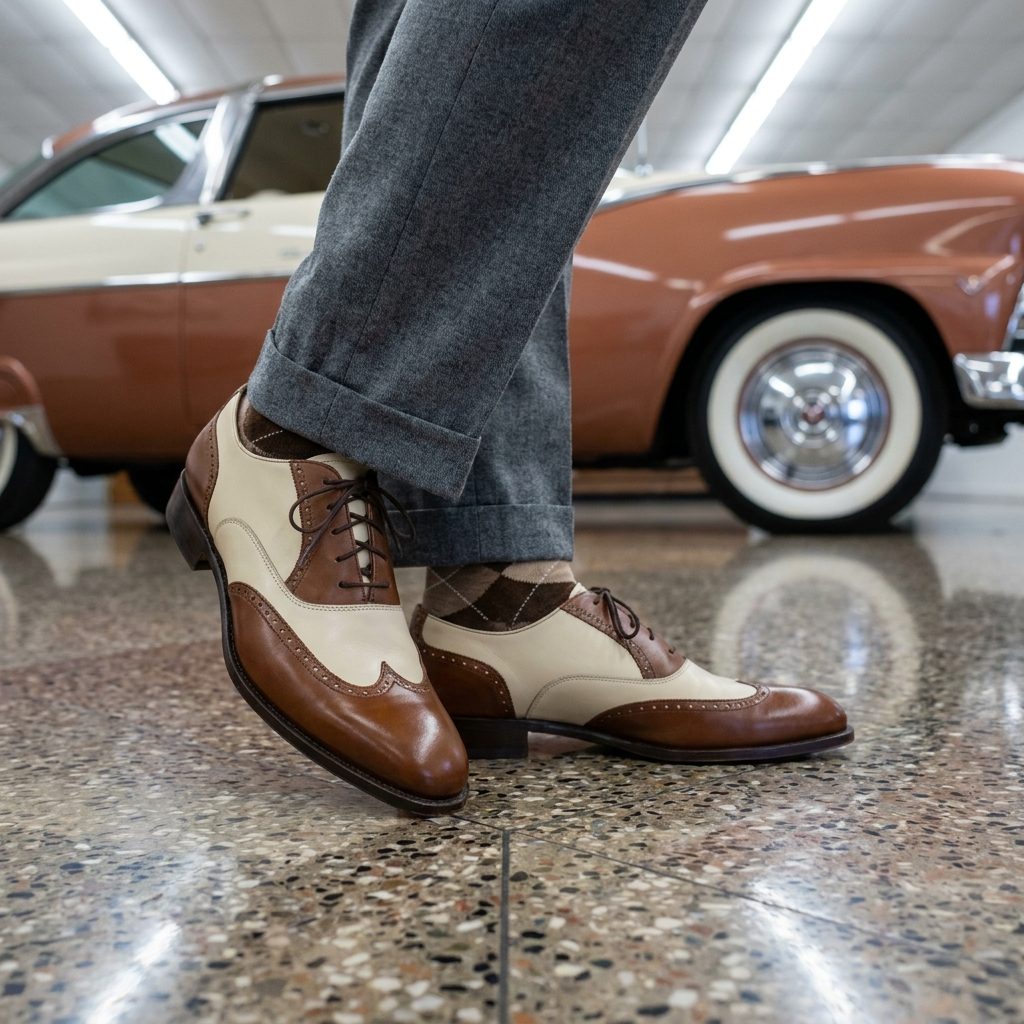
The good ones dressed like they belonged next to the merchandise. Two-tone wingtips. Pressed slacks with a crease you could cut paper on. A tie that somehow picked up the exact shade of Colonial White on the new Crown Victoria in the corner — and none of it was accidental.
Selling a car in 1956 meant selling a version of a life, and these men were the walking preview. You trusted the guy whose shoes were shinier than the bumper. Simple as that. He looked like he already lived the way you wanted to, and you figured the car was how he got there.
The Price Sticker on the Windshield That Listed Every Option Like a Poem You Couldn’t Afford
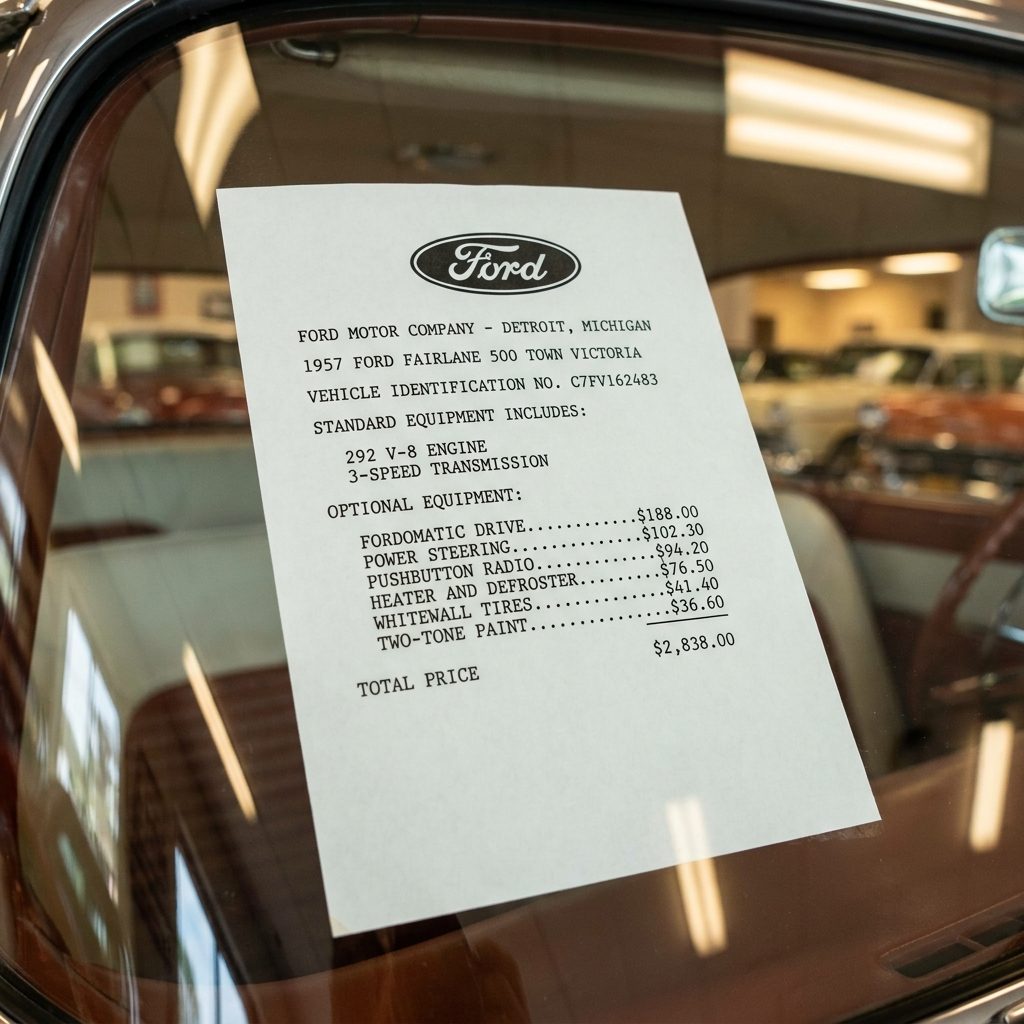
Fordomatic Drive. Power Steering. Pushbutton Radio. Heater and Defroster. Whitewall Tires. Two-Tone Paint, Thunderbird Rose over Colonial White. Every line item had a dollar figure next to it, and every dollar figure made your stomach tighten a little more.
But you read the whole thing. Top to bottom. Twice. The way those options stacked up turned a car into a story about the life you were about to have — power windows meant you’d arrived, and the continental kit on the back meant you really had. You kept reading even after you knew the total, because reading it felt like holding the future in your hands for a minute before someone asked you to pay for it.
The Finance Manager’s Office in the Back With the Door That Was Always Closed
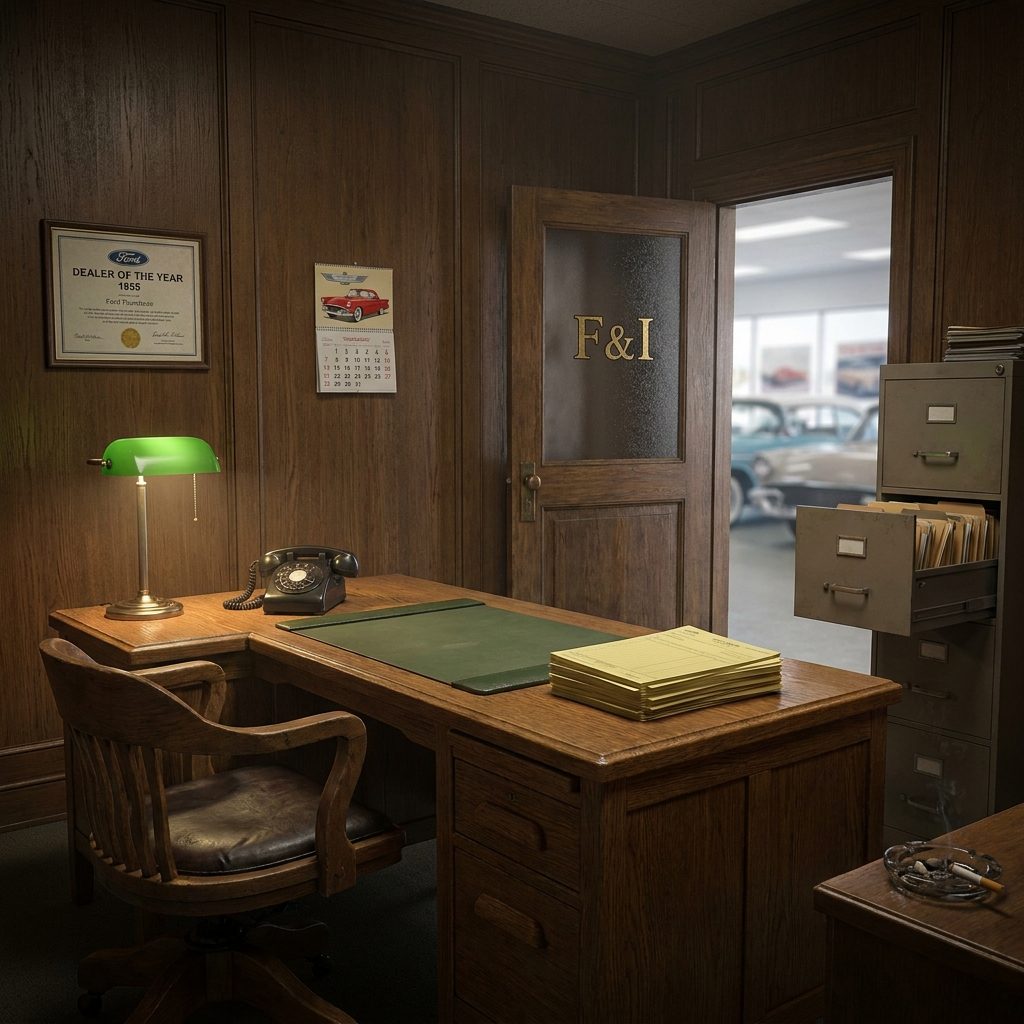
The showroom was the party. This office was where the bill came due.
You’d been out there touching chrome and sitting in seats that smelled like a future you wanted badly, and then somebody walked you back here — past the parts counter, past the service-bay door — into a small room with a wooden desk, a green lamp, and a man with a different energy than the salesman. Quieter. More numbers. The desk pad had a calculator and a stack of carbon forms thick enough to insulate a wall.
The monthly payment appeared for the first time here, written in pencil so it could be changed. It always started too high. Of course it did.
The Salesman Who Knew Every Option Code by Heart and Made You Feel Like You Were Designing the Car Yourself
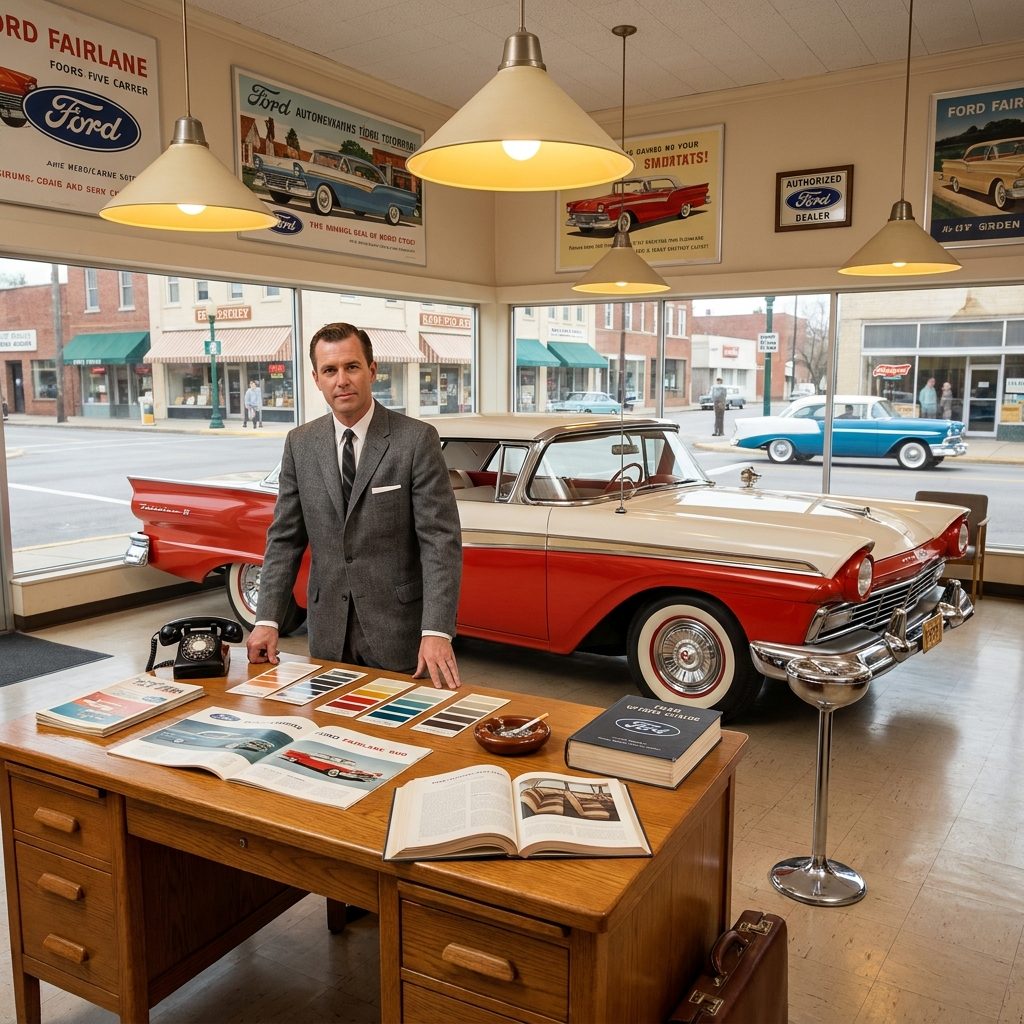
The option sheet alone could take twenty minutes. Fordomatic or three-on-the-tree? Lifeguard padding on the dash? The Custom or the Customline or the Fairlane? Ford’s 1950s salesmen weren’t reading from a script, they had the whole matrix in their heads, color codes and upholstery combinations rattled off without blinking. You came in thinking you’d look around and left having made seventeen decisions you didn’t know you needed to make.
That feeling of authorship was deliberate. Ford’s postwar marketing understood something the big lots of later decades forgot: a car you helped specify felt like yours before you signed anything. The salesman was the interface, and the good ones made every customer feel like the car on that showroom floor had been waiting specifically for them.
The Pushbutton AM Radio Playing Patti Page While You Sat in a Fairlane That Wasn’t Yours Yet
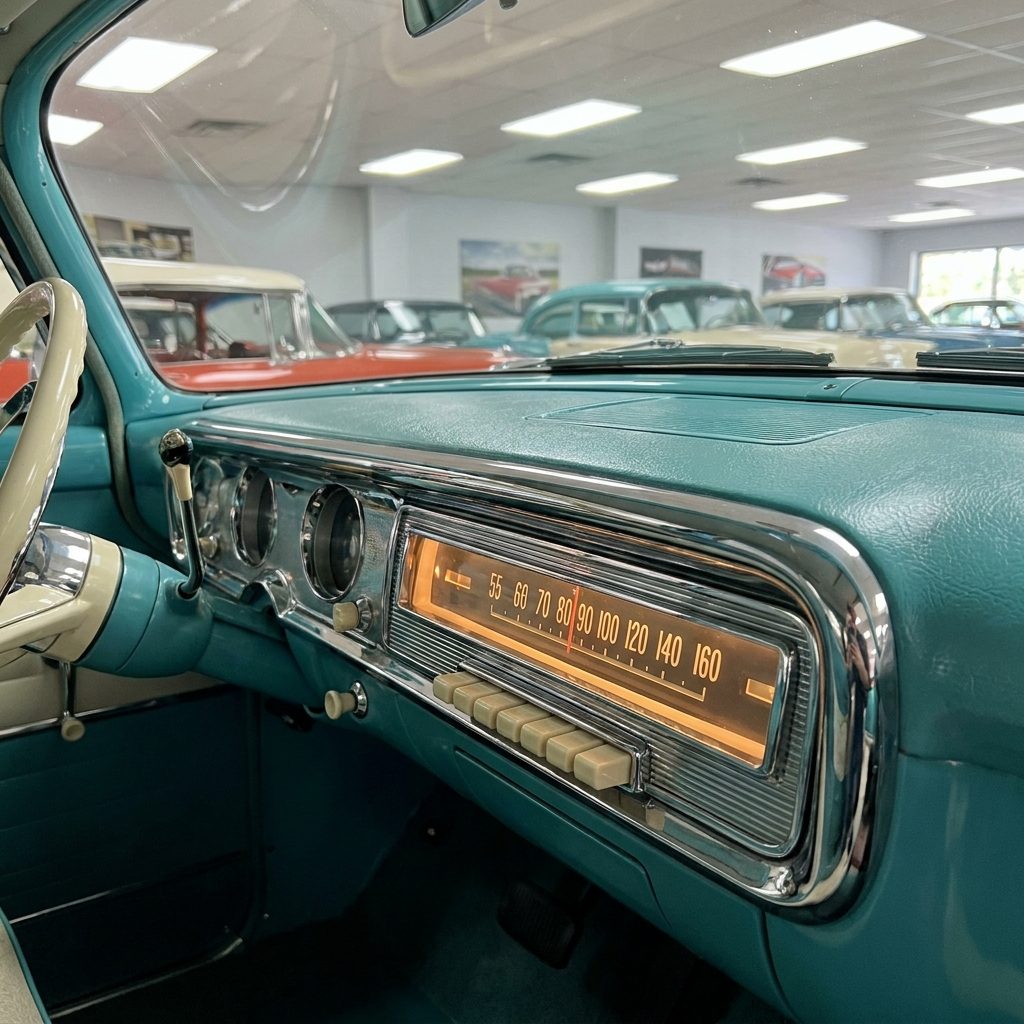
The salesman turned the key one click — just enough to power the accessories — and suddenly the dashboard was alive. That little radio glowed amber behind its dial, and whatever was on the local AM station filled the car. Patti Page. The Four Aces. Perry Como singing something your mother hummed while she cooked.
You were sitting in a car you hadn’t bought yet, on a showroom floor, hearing music through a speaker that was clearly better than anything in your living room. Right there, the car stopped being a thing you were looking at. It became somewhere you already belonged. The salesman knew it. He didn’t say a word. He just let the radio play, which was the smartest selling move he’d make all afternoon.
The Thunderbird in the Corner That Nobody Was Allowed to Touch
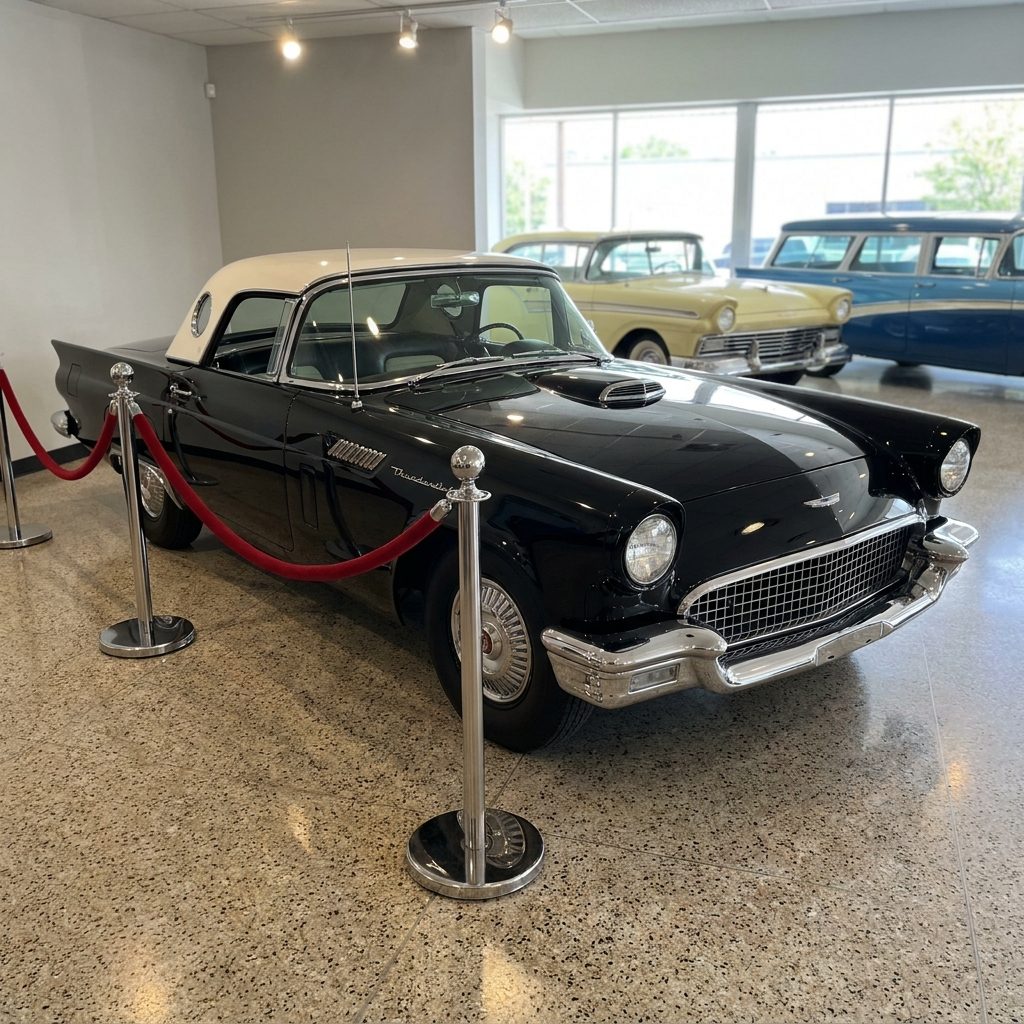
Every showroom had one. The car that wasn’t really for sale, even though technically it was.
The ’55, ’56, or ’57 Thunderbird sat in its own corner, sometimes roped off, always with a shine that suggested someone polished it every morning before the doors opened. You walked in because of it — not because you could afford it, but because being near it felt like standing close to something that understood speed and Saturday nights and a kind of freedom you’d been reading about in magazines but hadn’t yet touched. The salesman would let you sit in it if you asked. He’d open the door like he was introducing you to someone worth meeting. And then, gently, he’d steer you toward the Fairlane.
The Delivery Day Handshake and the Polaroid Taken in Front of Your New Car
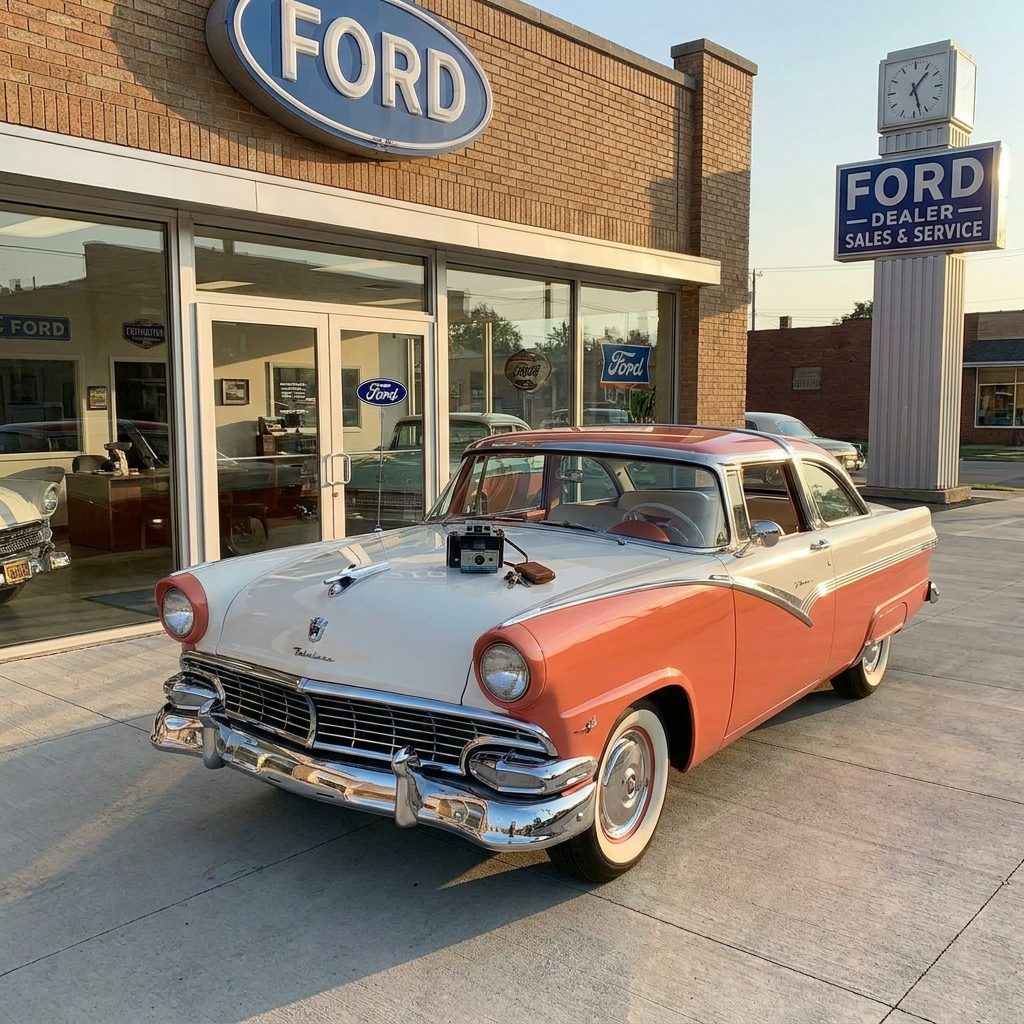
They washed it one more time before you took it. Even though it had never been dirty.
Then someone brought a camera out — a Polaroid, usually. You stood next to the car with your wife, or your family, or just by yourself, and they snapped the picture. One copy for you, one for the dealership wall. You shook the salesman’s hand. He gave you the keys on a little leather fob with the Ford crest stamped into it, and that was that.
It felt like a ceremony because it was one. You’d just made the second-largest purchase of your life, and the dealership understood — instinctively, or maybe through decades of doing this — that the last five minutes mattered as much as the first. Maybe more. Those last five minutes decided whether you’d come back in three years.
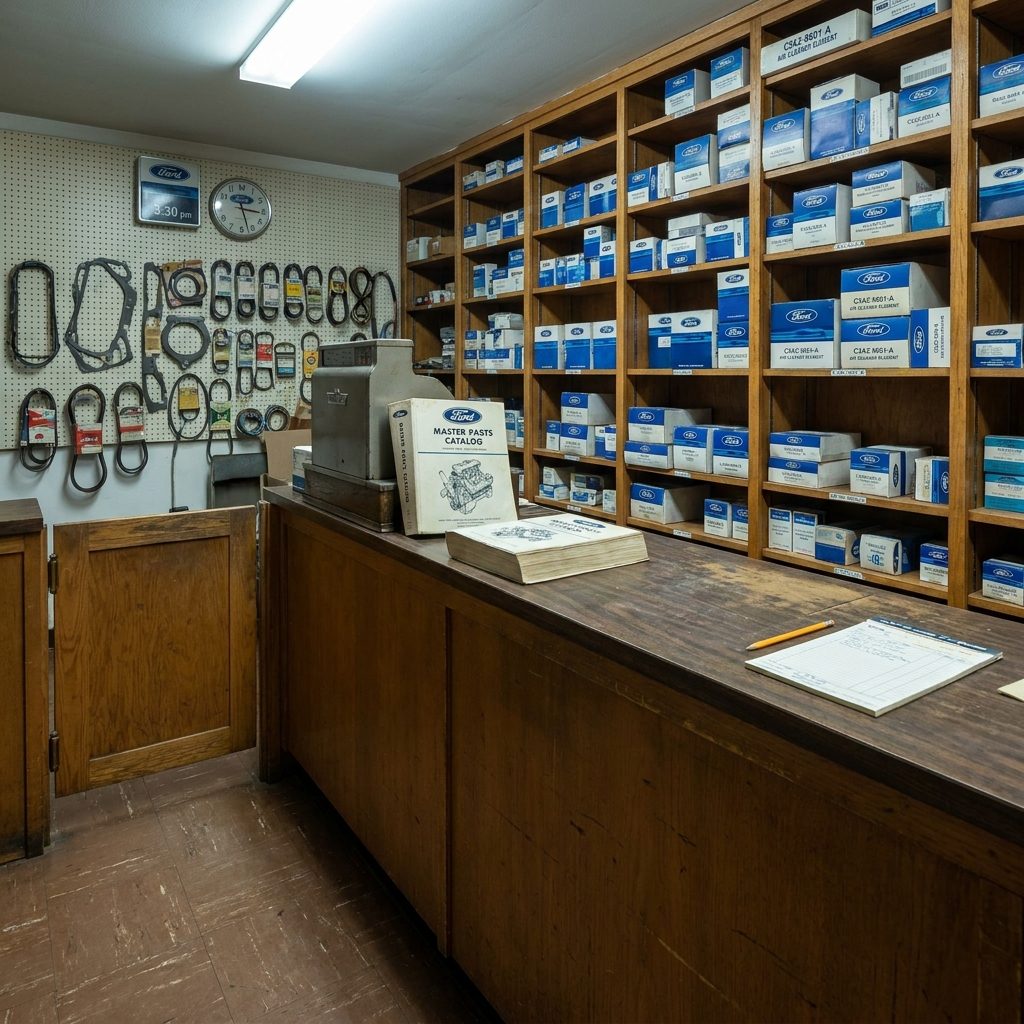
The Parts Counter Behind the Swinging Half-Door Where the Real Guys Worked
Would you like to save this?
The showroom was theater. Back here was the engine room.
Past the swinging half-door with the brass kick plate, the parts counter ran along a wall of blue-and-white Ford Genuine Parts boxes stacked floor to ceiling. The man behind it could find a water-pump gasket for a ’53 Customline in under a minute, flipping through a catalog the size of a phone book without looking up. He didn’t sell you anything. He found what you needed, slid it across the counter, wrote the part number on a carbon slip, and moved on.
No small talk. No upsell. Just a man who knew where ten thousand parts lived and could put his hand on any one of them. Honestly? He was the most competent person in the building, and everyone on both sides of that half-door knew it.
The Wax Smell of the Showroom Floor at Eight in the Morning Before the First Customer Walked In
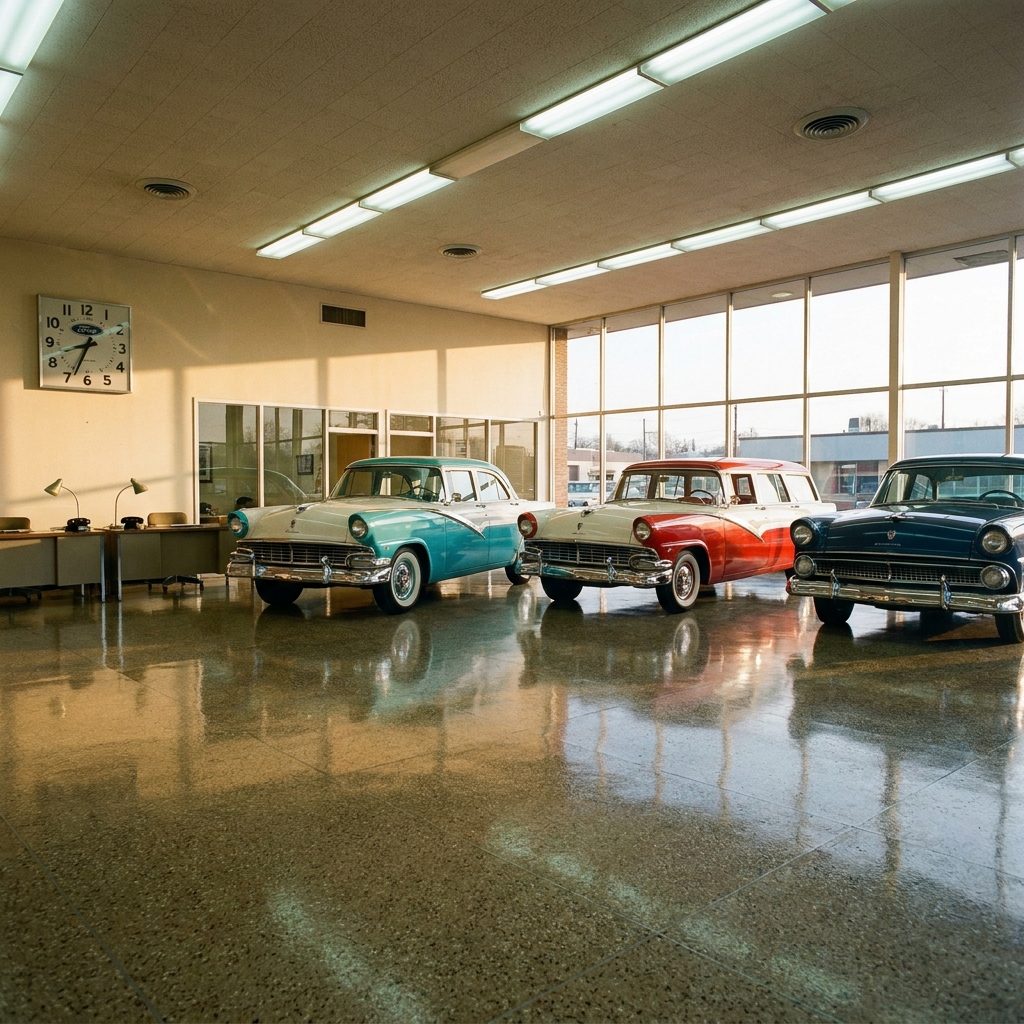
Before the doors opened, the showroom belonged to nobody.
The janitor had finished the floors an hour ago, and the wax was still settling into the terrazzo. The whole room smelled like floor polish and new vinyl and the faint metallic sweetness of fresh chrome. Cars sat under fluorescent light and early sun, perfectly still, perfectly aligned, every hood ornament pointed the same direction like birds on a wire. There’s something about a room full of brand-new cars with no people in it — it has a weight, a quiet seriousness, like a stage before the curtain goes up.
The Trade-In Parked Out Back That Told the Whole Story of the Family Who Just Drove Off in Something New
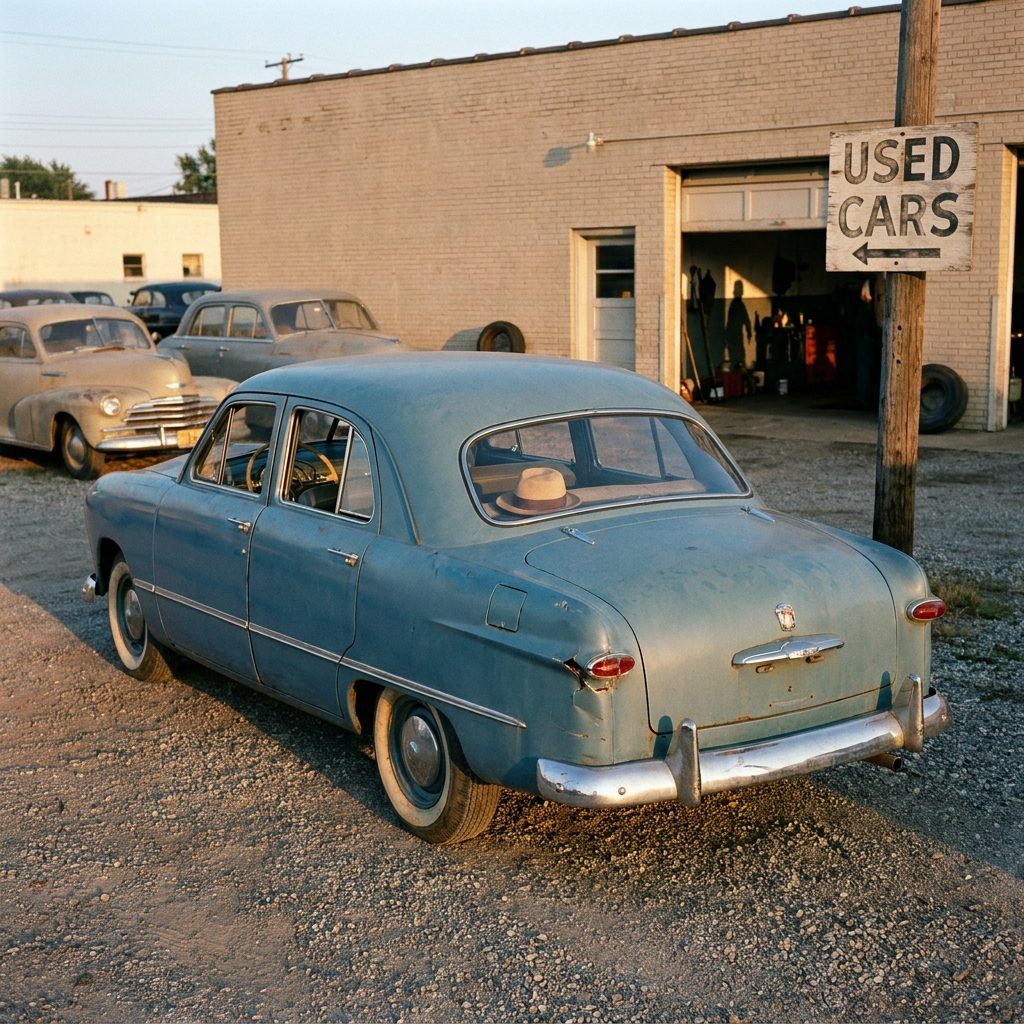
Someone loved that car once. Washed it on Saturdays. Drove it to the hospital when the second kid came. Took it across three states to a lake where the family rented the same cabin every August.
Now it sat on the gravel out back with a number soaped on the windshield, waiting for a high-school kid or a young couple just starting out. The seats were worn in the shape of the people who’d sat in them — the ashtray full, a gas-station map of Pennsylvania still folded wrong in the glovebox.
The family who traded it in was already two miles down the road in something that smelled like a fresh start. They didn’t look back. Nobody ever did. And the old car just sat there in the late-afternoon light, holding all that history, waiting for someone who didn’t know any of it yet.
The Pennant Flags Strung Across the Lot That Snapped in the Wind Like a Carnival Had Come to Stay
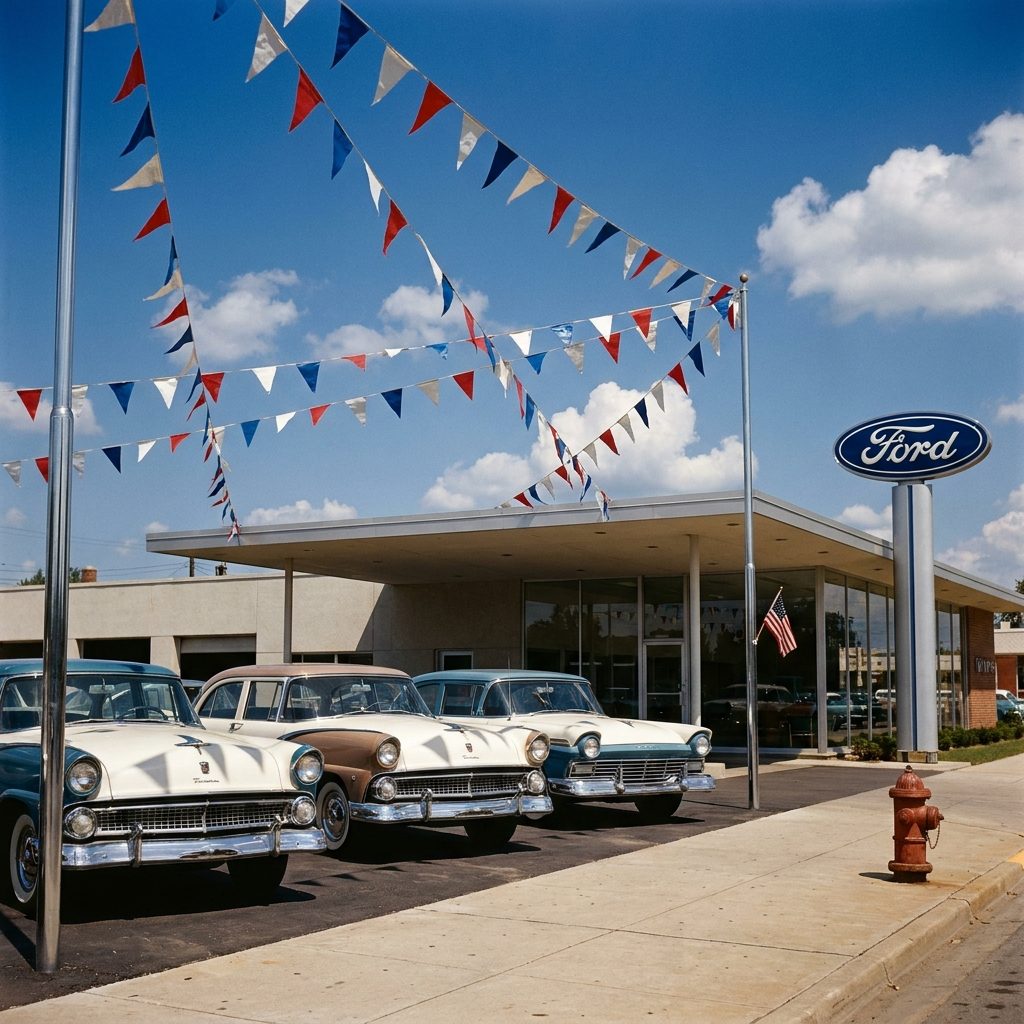
You could hear them before you ever saw the cars. Three blocks off, that rhythmic plastic snap carried on the wind and you knew the Ford lot was open. Red, white, and blue triangles strung on wire so thin it vanished against the sky — they didn’t advertise a single thing, didn’t have to. They just announced: something is happening here.
Every dealer ran them. Every kid on a bicycle coasted a little slower when that sound hit. The pennants turned a parking lot into an occasion, a county fair that never bothered packing up.
The Salesman’s Jacket Hung Over the Back of His Chair Because He’d Been There Since Seven
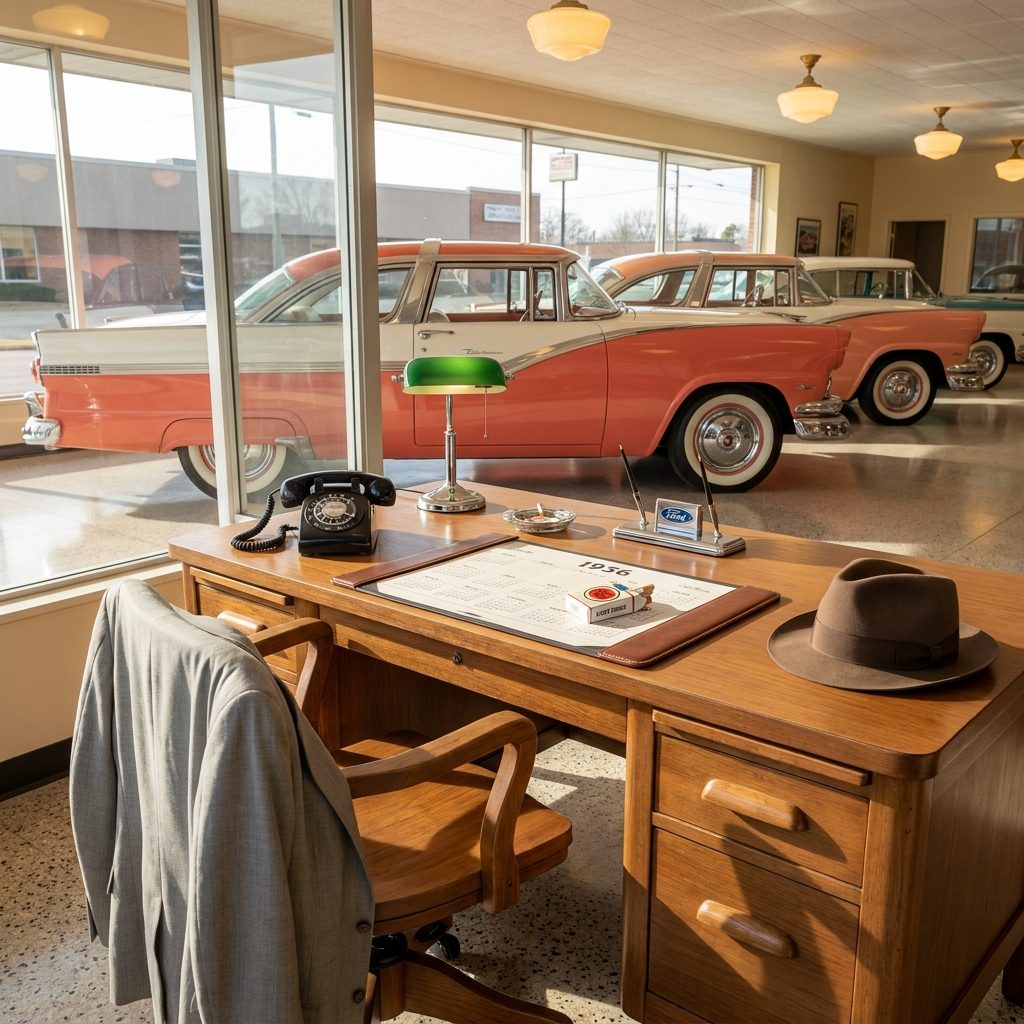
The jacket told you everything. Not draped carefully — tossed. The man who wore it had been on his feet since the lot opened, walking customers through Fairlanes and Mainlines, and by ten-thirty it was dead weight hanging off the back of a swivel chair.
Underneath: a white shirt with the sleeves rolled once at the cuff, a tie loosened just enough to mean business was good. His desk had a rotary phone, an ashtray with one stubbed Lucky, a pen set he got for hitting quota in April. That rumpled sport coat slung over the chair was shorthand everybody recognized — this guy is selling cars, and he’s been at it a while.
The Accessory Wall With the Fender Skirts and Continental Kits Displayed Like Jewelry in a Case
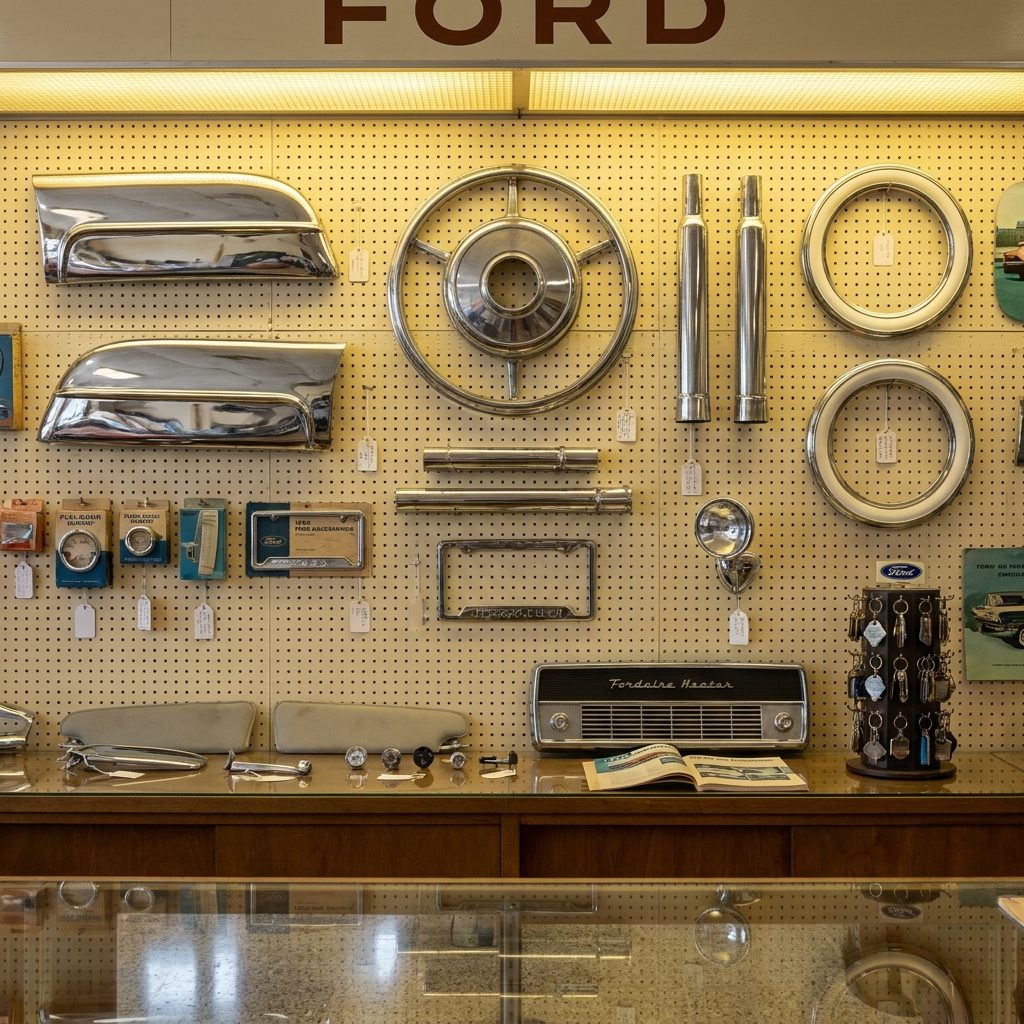
Here’s where the damage got done. You came in for a test drive and ended up transfixed by a pegboard wall of chrome accessories, each one priced individually, which made each one feel perfectly reasonable. Fender skirts. A continental kit for the rear bumper. Exhaust extensions that split the tips into dual pipes. Every piece had a little paper tag dangling from a string, and every piece made whatever was sitting on the showroom floor feel somehow unfinished.
The continental kit — that was the killer. It hung the spare tire off the back bumper in a chrome cradle and stretched a Fairlane’s silhouette into something longer, lower, more serious-looking. Nobody could stare at one on that wall and not picture it bolted to their own car. Dealers moved a staggering number of those kits.
The Ford Times Magazine on the Waiting-Room Table That Made You Want to Drive to Yellowstone
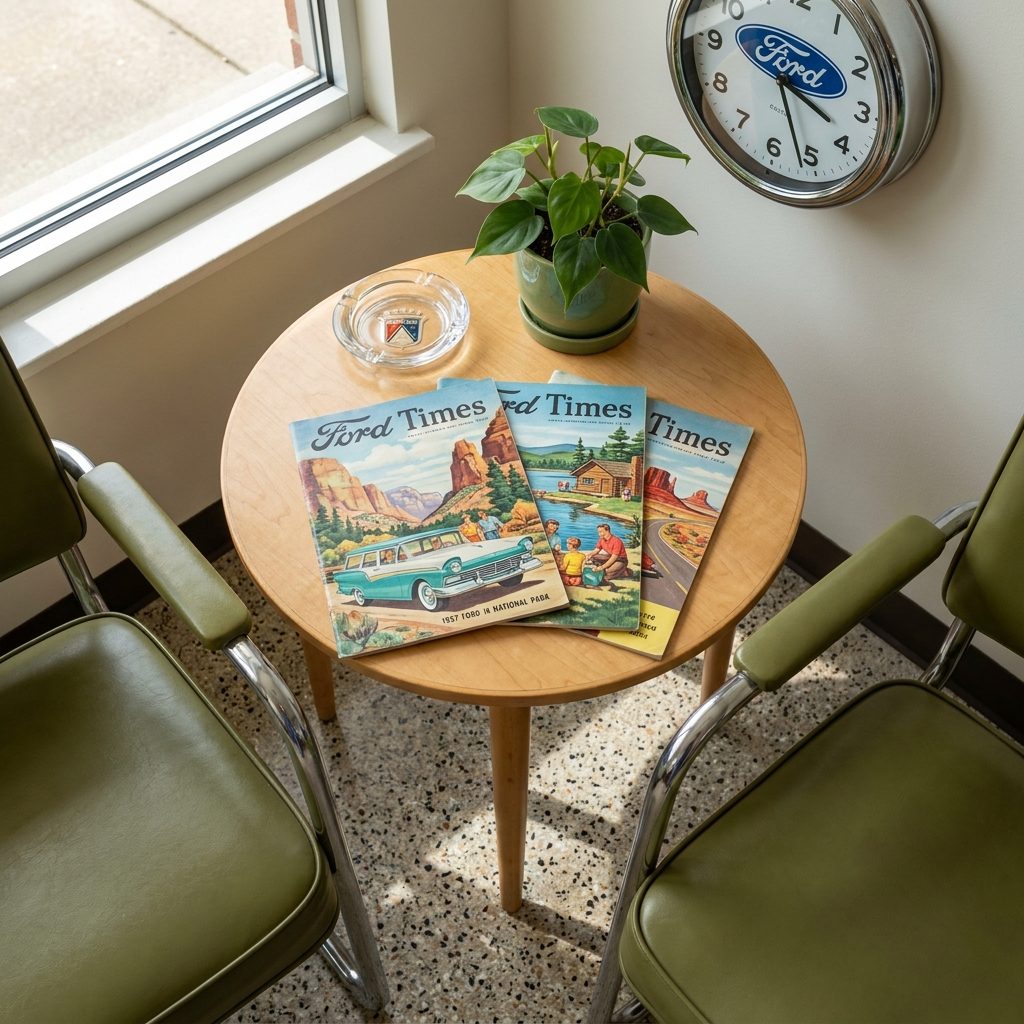
Ford Times was a free monthly the dealer stacked on the waiting-room table, and it barely mentioned cars. Fishing in Montana. Covered bridges in Vermont. The best pie in some town you’d never once thought about. Soft watercolor covers. Stories about road trips that made the new interstate system feel like a personal gift somebody wrapped just for you.
Quiet and brilliant, the whole operation. You sat there killing time during an oil change, flipping through pages that made you desperate to go somewhere — and the only way to get there was the thing gleaming under fluorescent lights ten feet away on the showroom floor. Who could resist that?
The Neon Ford Script on the Roof That Glowed Blue Against the Sky After Dark
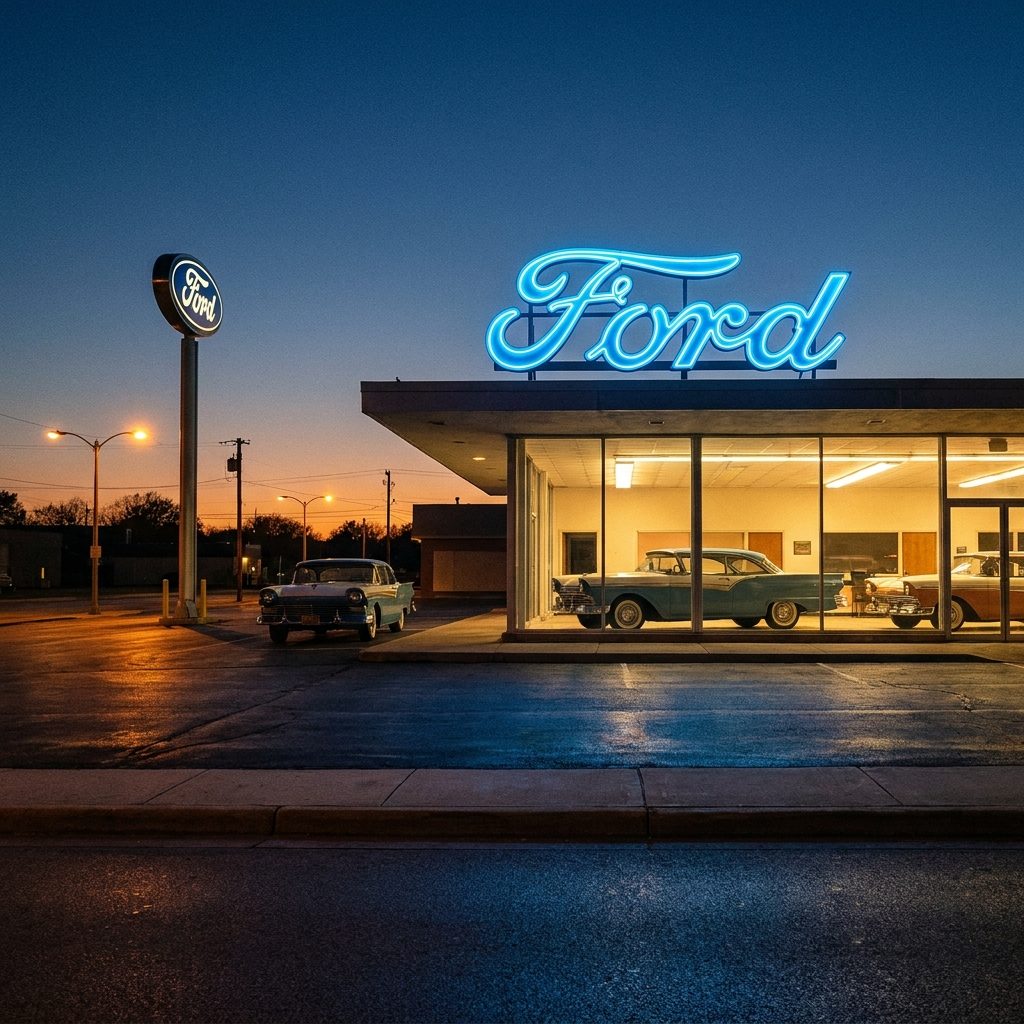
After five o’clock, when the salesmen went home and the lot emptied out, that sign kept at it. Blue neon cursive, three feet tall, humming faintly on the roofline. Visible from the end of Main Street. Visible from the highway on-ramp. It turned the whole building into a landmark that didn’t sleep.
There’s something about neon at dusk — the sky not quite dark yet, the letters floating in that blue-violet corridor between day and night. The showroom windows glowing warm underneath. The cars inside reduced to silhouettes against the lit interior. I don’t know how else to put it: the building looked like an invitation that hadn’t expired.
The Test Drive Route That Always Went Past the High School Right When the Kids Were Getting Out
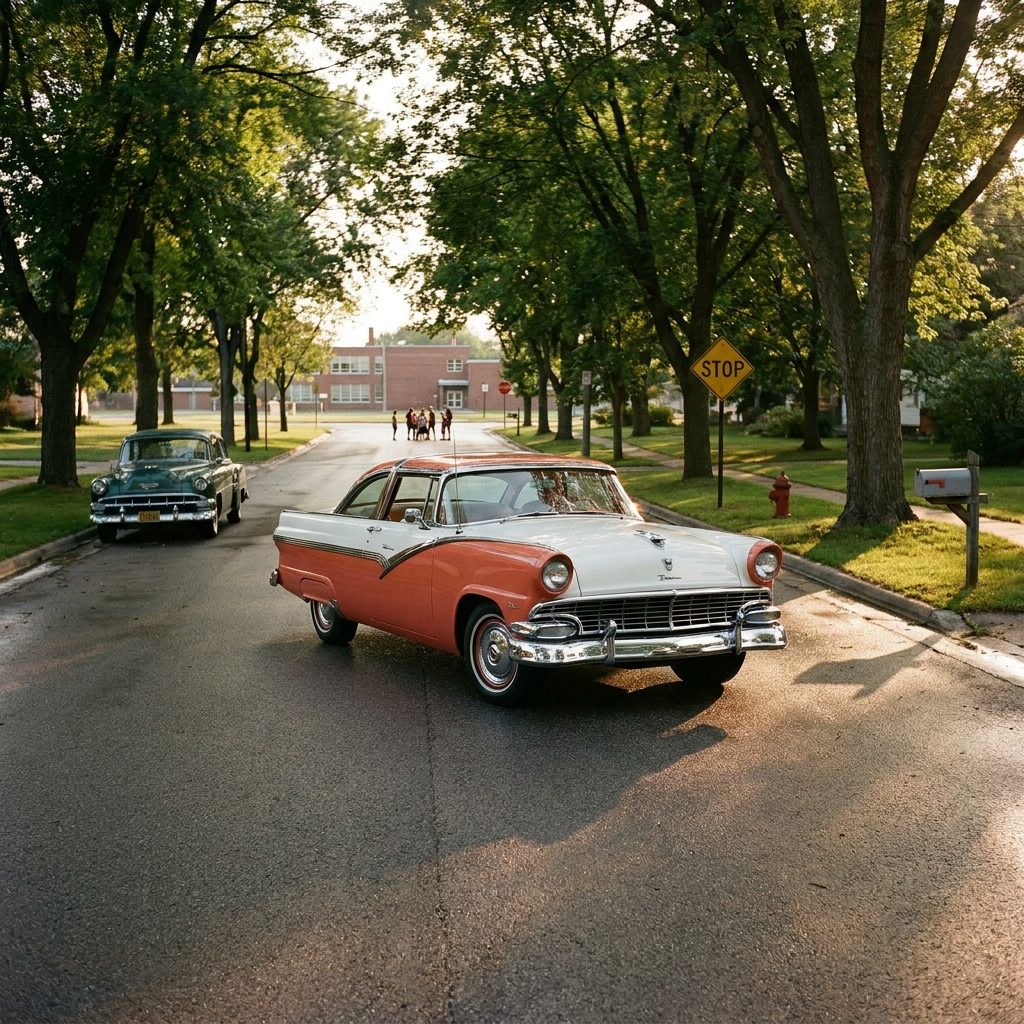
Every dealership had a route. And every route, by sheer coincidence, wound past somewhere people would notice you.
The salesman rode shotgun, let you take the wheel of a Fairlane Victoria you couldn’t quite afford. He’d say turn left here, nice and easy — and suddenly you were rolling past the high school, past the diner, past the barbershop where your neighbor sat in the chair by the window. Everyone saw you in that car. And the salesman understood something ruthless: once your neighbors had seen you behind that wheel, walking back into the showroom and mumbling “I’ll think about it” became almost physically painful.
The Clock on the Showroom Wall That Had the Ford Crest at Twelve O’Clock and Made You Forget How Long You’d Been There
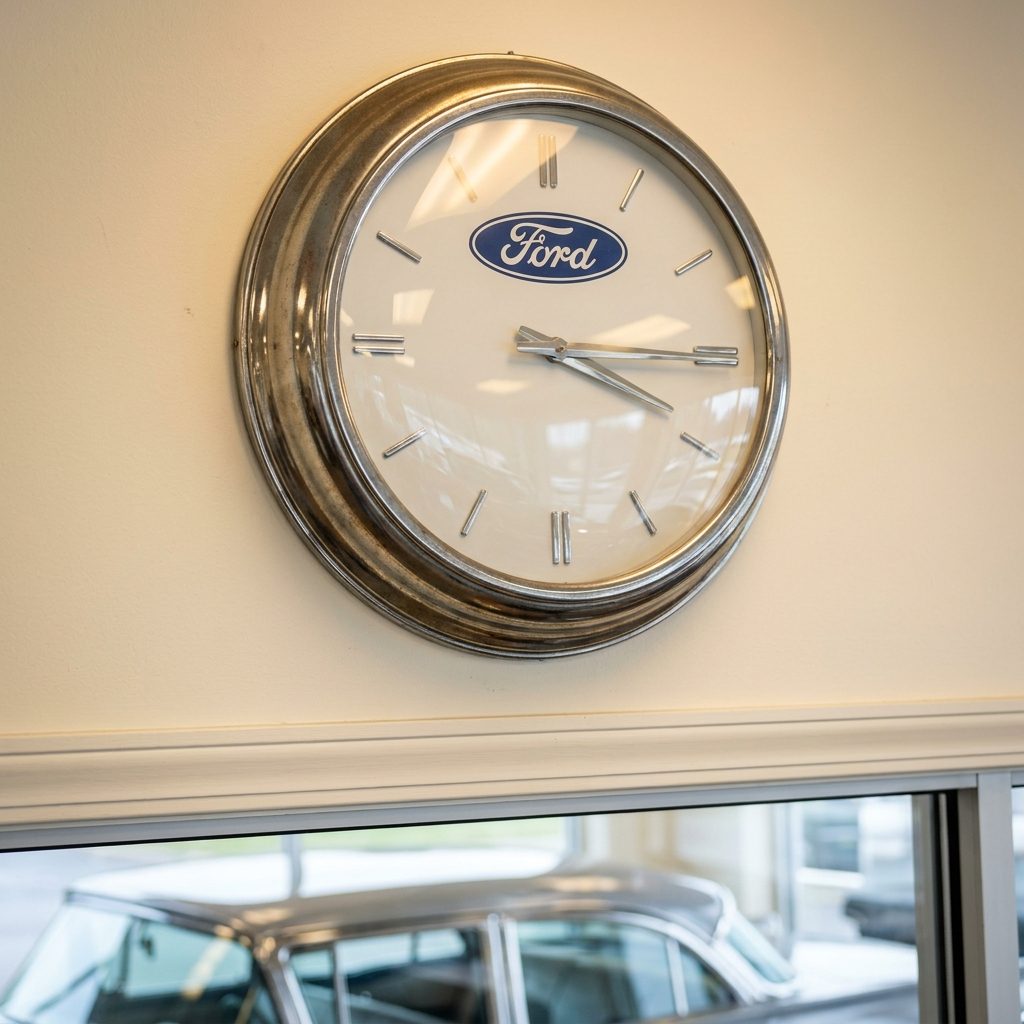
Chrome bezel. White face. Ford crest planted right where the twelve should be. Every showroom had one, mounted high enough that you looked up to check the time, registered the logo, and immediately forgot what hour it was. Probably intentional.
The good showrooms kept you in there long enough to lose track entirely — floor wax smell, weak coffee, a salesman who never once glanced at his watch. Time ran differently inside those plate glass walls, and honestly that clock wasn’t measuring minutes. It was a gauge of how close you were to pulling out a checkbook. A subtle one, sure, but nobody hung a branded clock that high by accident.
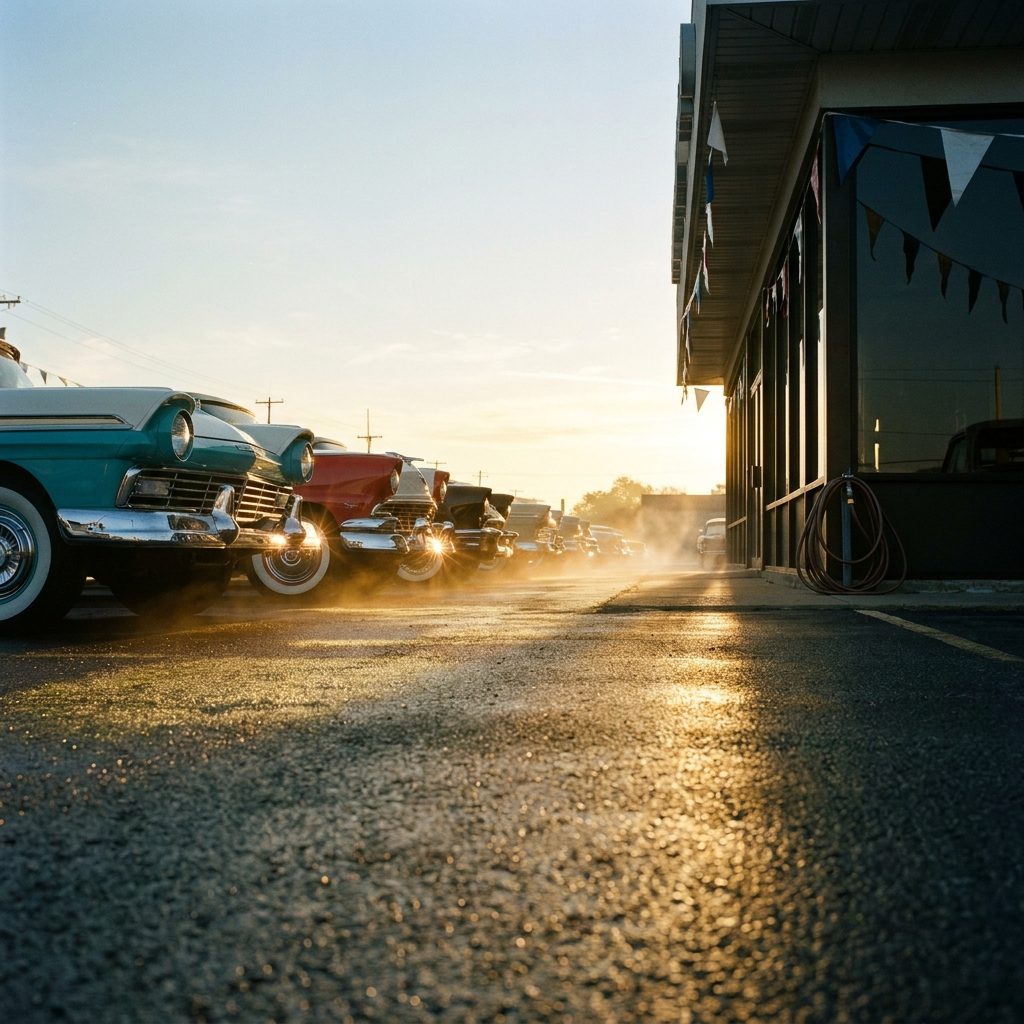
The Fresh Asphalt Smell of the Lot on a July Morning Before the Sun Hit the Chrome
Would you like to save this?
Before the customers. Before the salesmen straightened their ties. Before the coffee urn started its slow, inadequate work. There was this.
Six forty-five on a July morning, the lot still wet from the hose, the asphalt giving off that warm tar smell mixed with chrome polish and the faintest ghost of new-car vinyl drifting out from the showroom whenever somebody propped the door. Cars sat in rows, still cool, their two-tone paint not yet hot to the touch. Every hood ornament held a tiny bead of water. The pennant flags hung limp, dead still. The whole place was holding its breath — waiting for the first family to pull in off the highway and start everything up again.