
Would you like to save this?
Slide onto a vinyl bench seat in 1975 and the smell hits you first—warm plastic, a whisper of leaded gas, and whatever the last driver smoked with the windows rolled up tight. The dash? Often a broad panel of vinyl, molded plastic, or imitation woodgrain, with a few large gauges and a rectangular radio. Nothing beeps. Nothing asks for a password. More than fifty years on, that same square foot of real estate looks like the bridge of a starship. Here’s what changed.
The Steering Wheel Went From Bare to Bristling
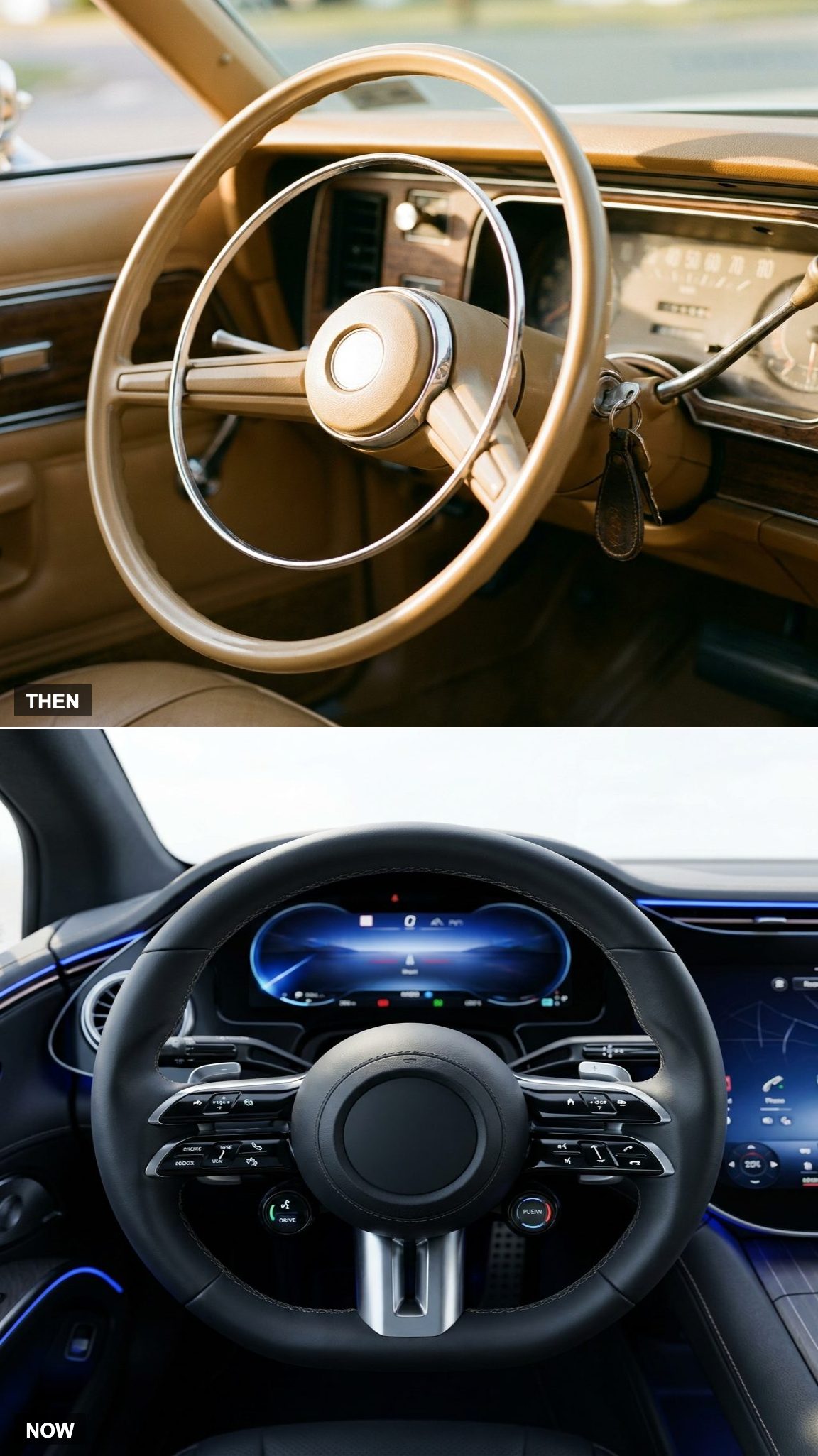
The 1975 wheel was a hoop and a horn—two spokes, a chrome ring, maybe a padded center if you sprung for the deluxe trim. Your hands did the driving, and your right hand handled everything else, reaching across the dash for the radio, the vent controls, or the climate sliders.
Now the wheel runs the show. Cruise, volume, phone, voice, lane assist, drive mode, all thumbable without looking down. Many routine functions can now be handled without moving a hand far from the rim.
Round Gauges Gave Way to a Screen That Shows Everything
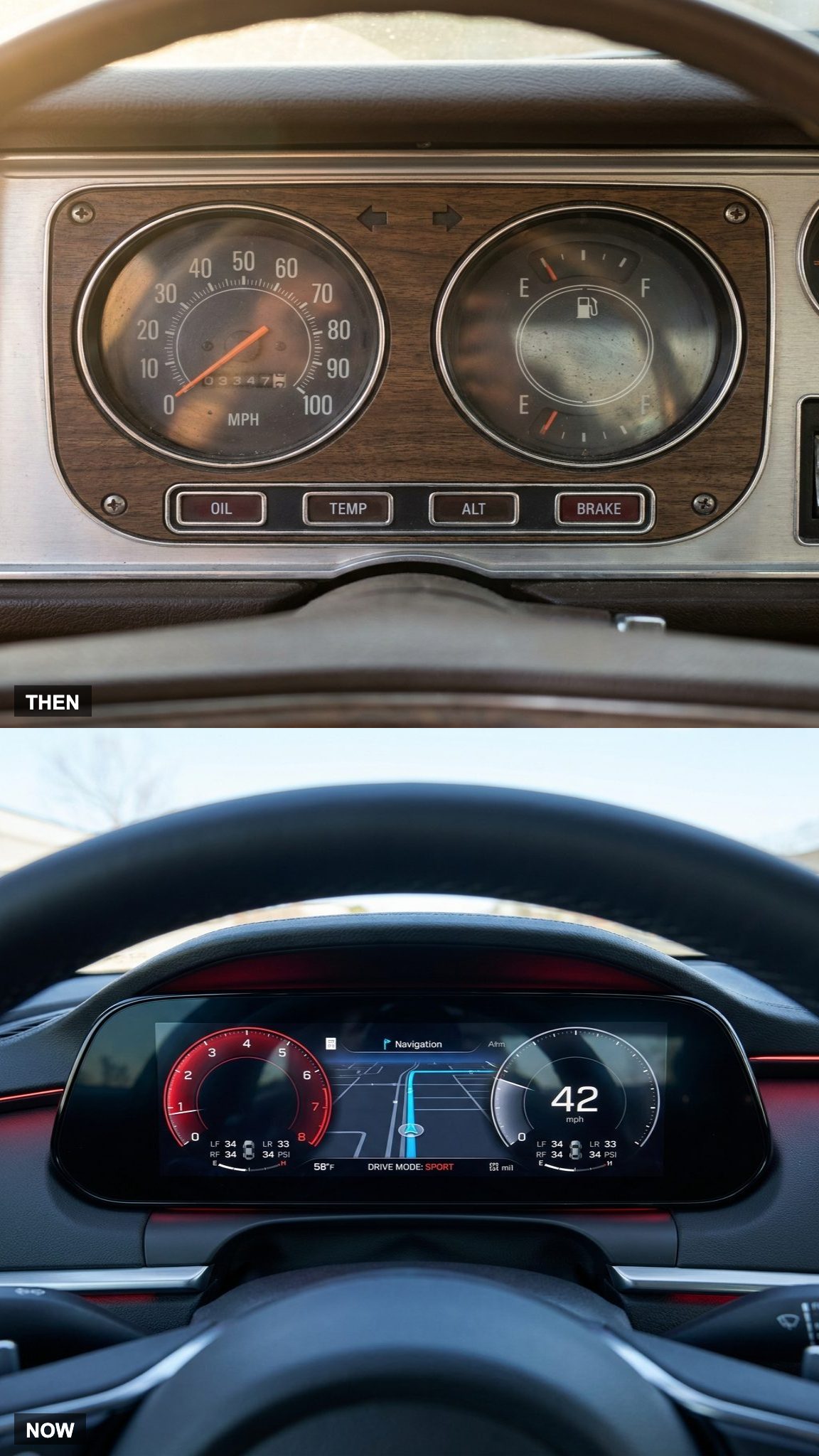
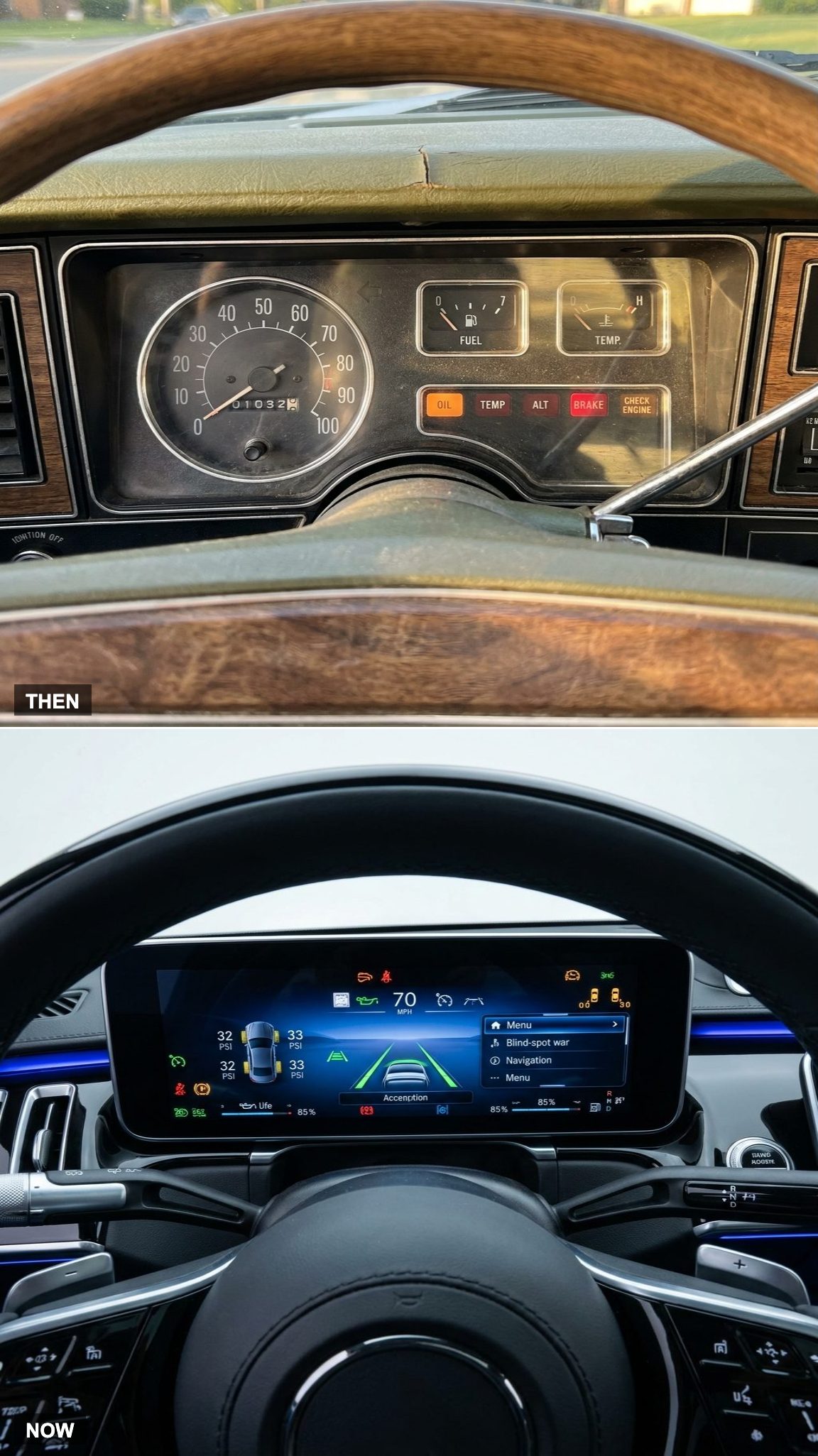
The speedometer and fuel gauge handled most of the visible information, with smaller gauges or warning lights covering temperature, oil pressure, charging, and other basics.
Today’s cluster is a shapeshifter dressed as a screen. Navigation slots between the tach and the speedo, tire pressures update live, and the whole face shifts color when you flip to sport mode. It is beautiful. It is also a lot to look at.
The AM Radio Retired and a Streaming Service Took Its Job
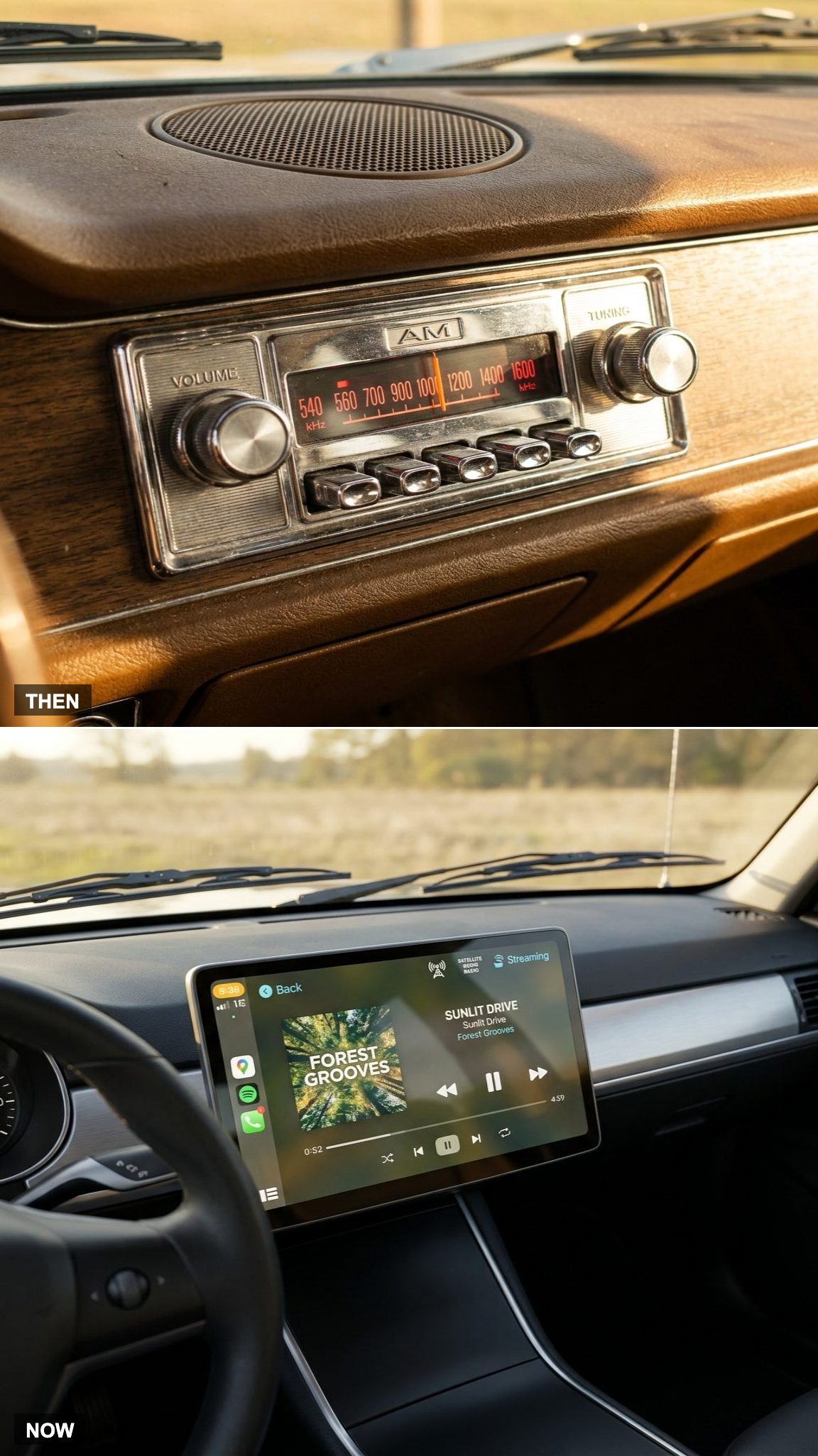
In plenty of basic cars, it was AM only, often with a row of mechanical presets. Drive out of range of your favorite station and you got static and a decision to make: keep chasing the frequency, or give up and sing to yourself for the next forty miles. The tuning knob had a satisfying resistance to it, and you could feel the stations pass under your thumb like ridges on a fence rail.
Now the car pulls in a Brazilian jazz station over cellular data while you’re crossing Nebraska, or a podcast an algorithm picked because it knows your commute better than your spouse does. When coverage holds, the signal can follow you well past any broadcast tower’s reach. Discovery used to mean scanning through static. Now it means never running out of exactly what you already like.
The Little Radio Slot Grew Into a Screen Bigger Than a Laptop
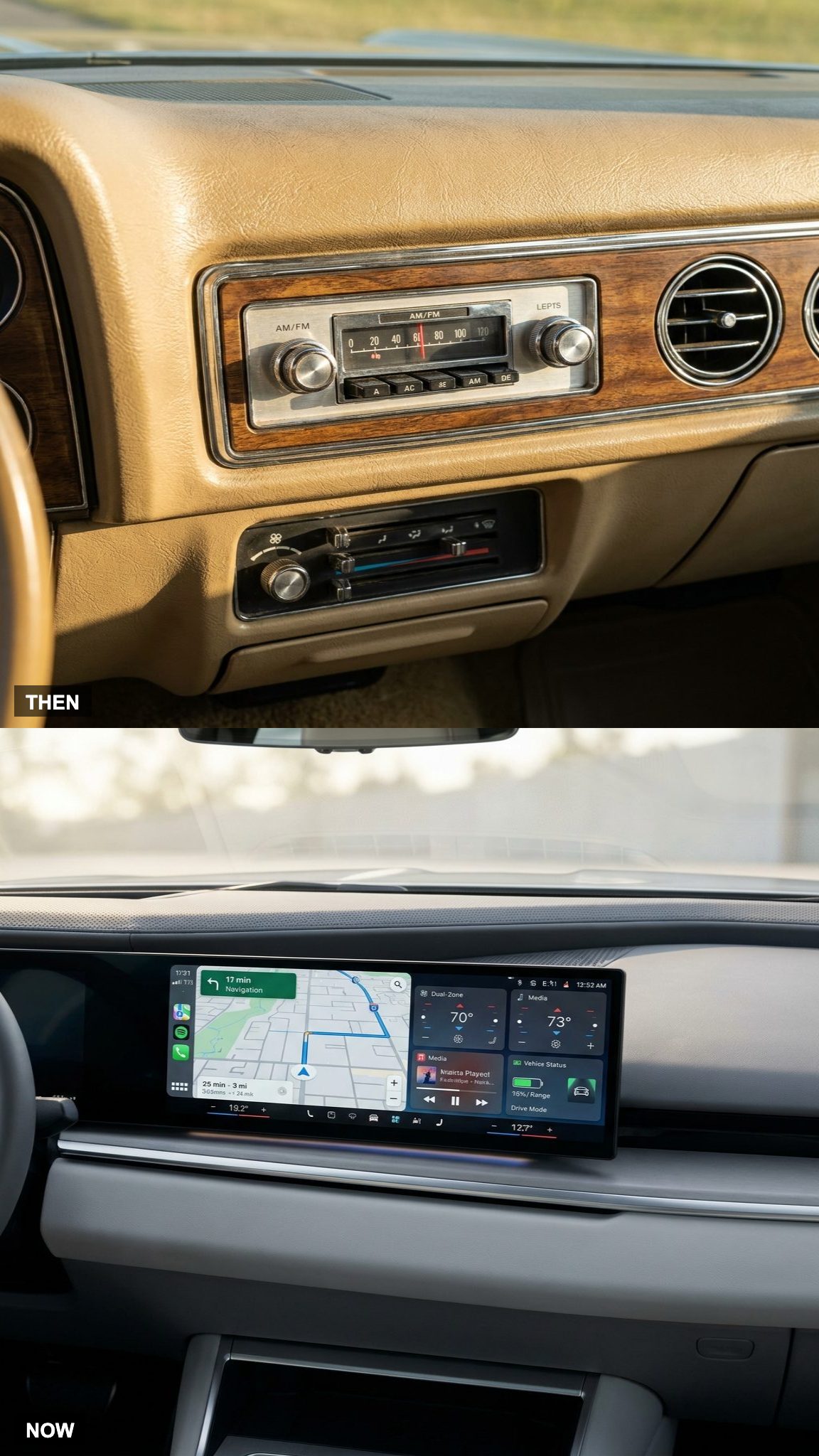
In 1975 the radio was a polite guest on the dashboard—a little rectangle of chrome no wider than a paperback, sitting in a sea of vinyl and woodgrain. The dash was mostly dash: vents, ashtray, glovebox door, acres of flat plastic doing nothing in particular.
Then the screen ate everything. Ten, twelve, sometimes fifteen inches, floating like a tablet somebody mounted where the vents used to be. Heat, defrost, seat heaters, and the owner’s manual all live behind that one pane of glass now. The real estate math flipped entirely: the dashboard used to be architecture with a radio tucked into it, and now it’s one glowing rectangle with a dashboard tucked behind it.
A knob you can find without looking. A menu you cannot.
Sliding Levers for Heat Became Three Zones of Automatic Everything
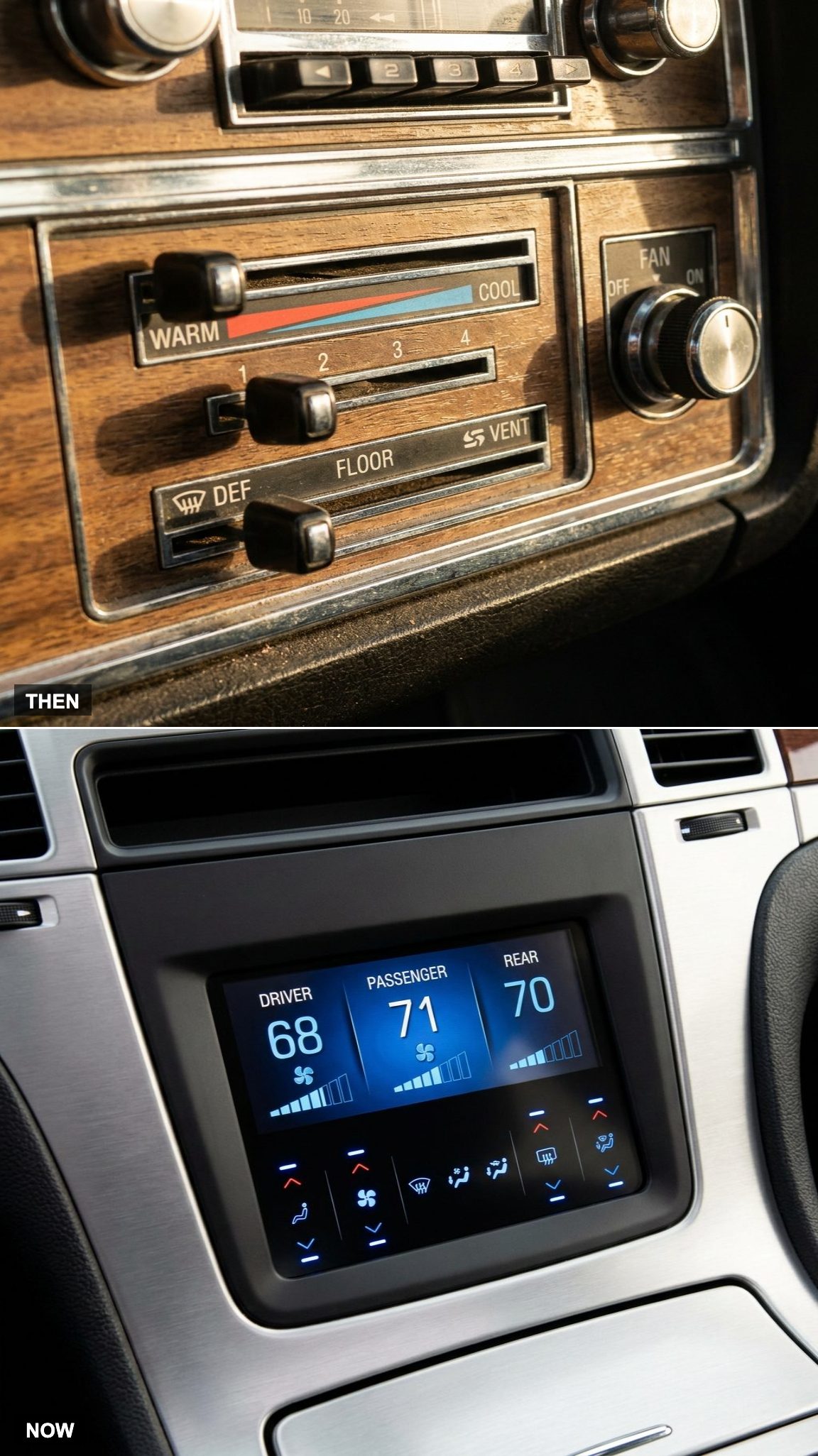
Two sliders and a fan knob. Wanted warmer? You pushed the red one right. Wanted colder? Left. The system didn’t have opinions and it didn’t ask questions.
Now the passenger sets 71, the driver sets 68, the kids in the back get their own zone, and the car remembers your preference and greets you with it in the morning. Genuinely nicer. In some cars, though, even defogging the windshield can mean digging through a menu.
The Crank Handle Bowed Out and the One-Touch Button Took Over
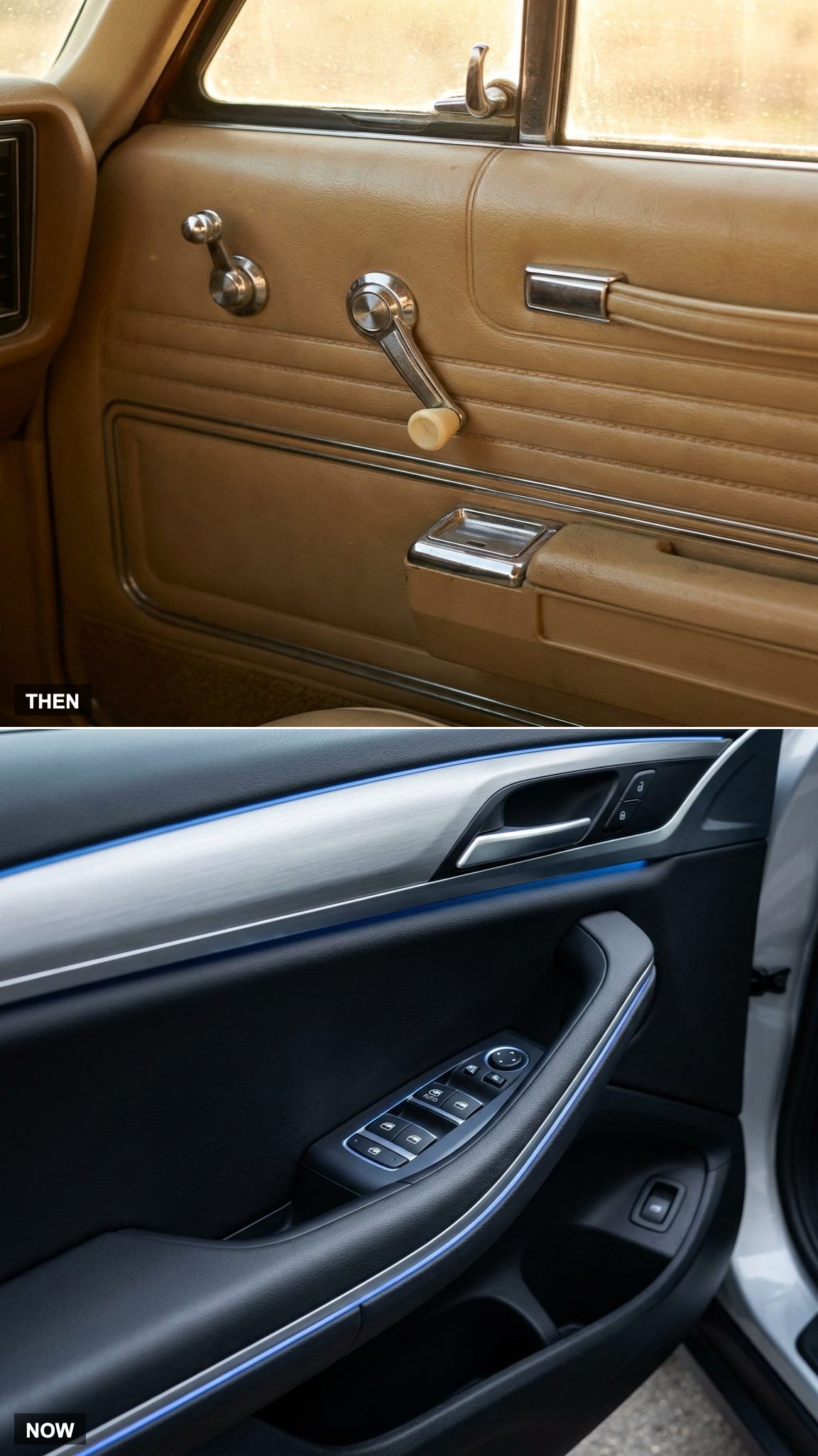
Rolling down the passenger window from the driver’s seat meant reaching across, cranking with your left hand at an angle your shoulder didn’t love, and settling for about halfway. Kids in the back rolled their own or asked politely.
One button now. All four windows. A few can even close them automatically when rain is detected. The crank had character. The button works better.
The Ashtray Retired and a Wireless Charger Moved In
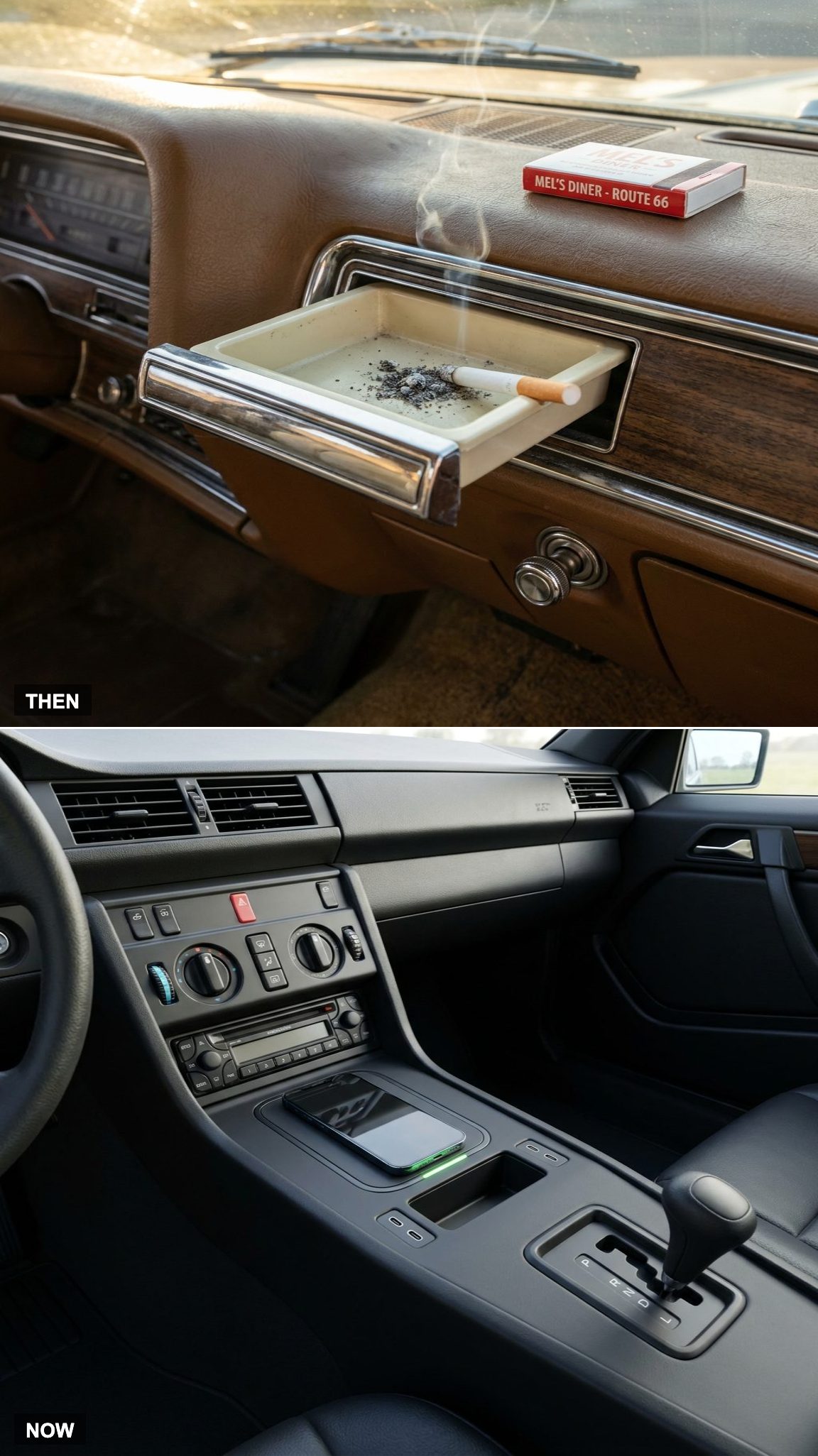
Every car had one. Chrome tray, two cigarette rests, a little pile of ash somebody meant to empty at the next gas station. Even non-smokers used it—for gum wrappers, toll change, the occasional emergency toothpick.
The space once reserved for an ashtray is now more likely to hold a phone tray, USB ports, or a wireless charger. The matchbook collection had to find a new home, but nobody’s mourning the ashtray itself.
The Cigarette Lighter Grew Up and Started Powering Devices
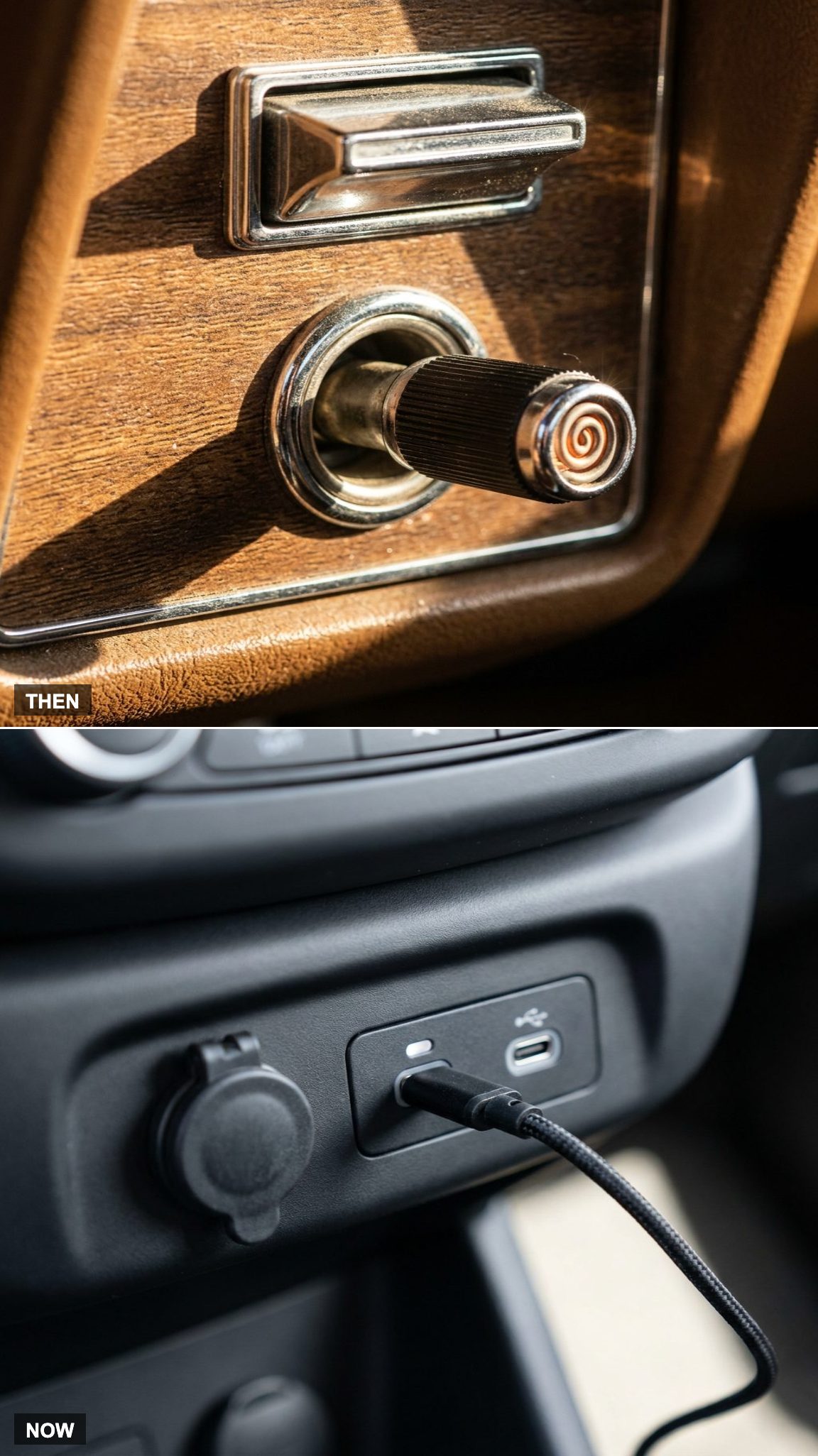
The lighter did one job, and it did it hot enough to melt vinyl if you dropped it. Kids learned early not to touch that coiled orange spiral. And every road trip had a moment where somebody pushed it in and forgot about it until the smell of scorched upholstery announced the arrival.
Same round hole, same 12 volts, different century. Now it charges phones, runs tire inflators, powers coolers, and keeps dashcams alive on long hauls. The lighter name survived because the accessory outlet kept the same familiar round shape.
The Seat Belt Went From Frequently Ignored to Impossible to Forget
Would you like to save this?
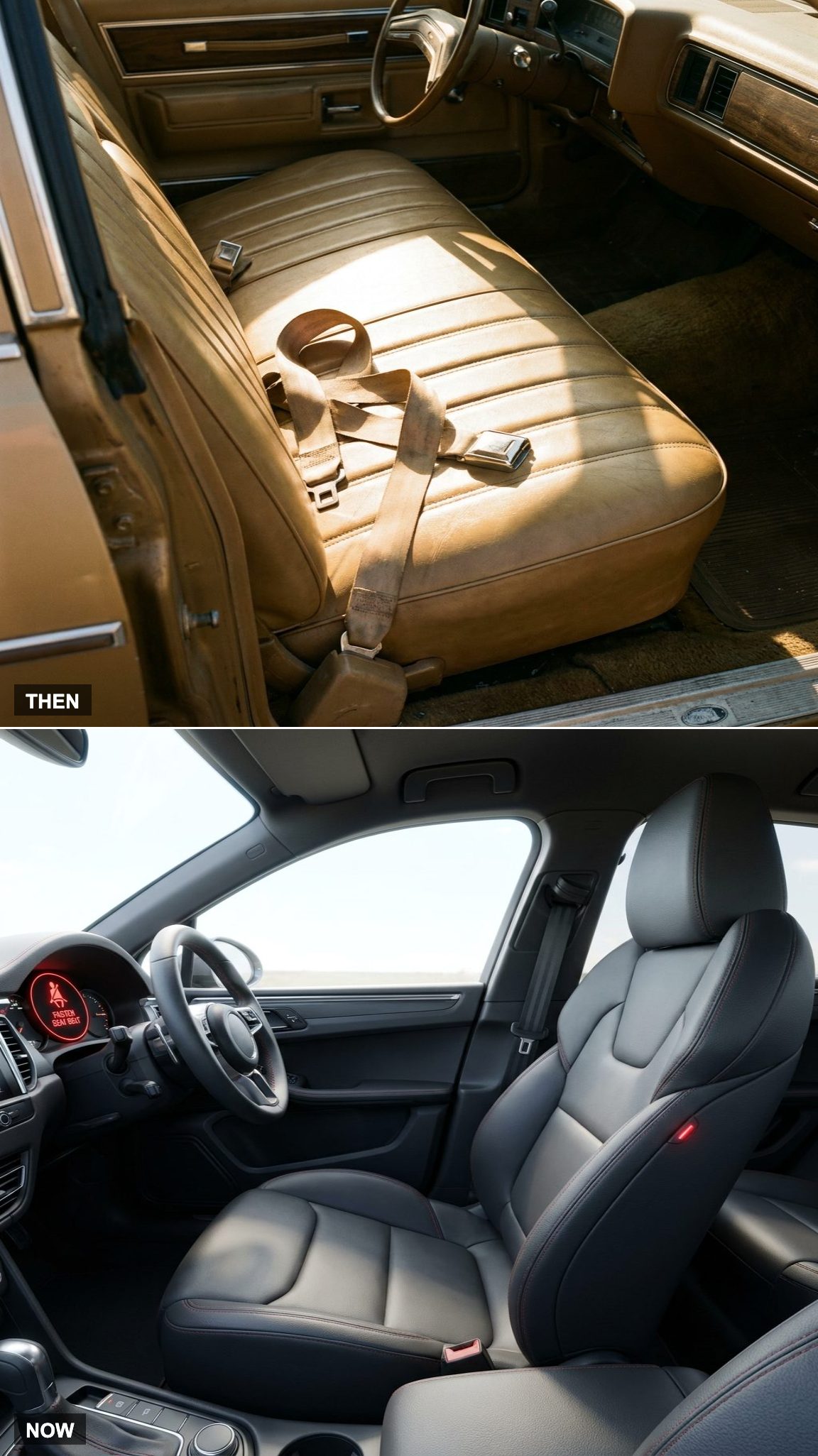
The 1975 belt sat coiled on the seat like a reminder nobody wanted to take. Federal law required them; wearing one was still a personal choice that many drivers declined. The buckle got tucked under the cushion so it wouldn’t dig into your leg on a long drive.
Today the car will chime. Then chime louder. Then flash. Some newer systems can even limit certain functions until you comply. The reminders support a habit that saves lives—anyone who lived through the seventies remembers when the car trusted you to make your own mistakes. Different deal now.
Warning Lights Were Few and Simple vs. Cars That Monitor Their Own Health
In 1975, your car told you almost nothing.
A red light glowed and you had to know whether it meant stop immediately or keep an eye on it until the next service station. Most drivers learned to translate a faint tick or a whiff of coolant faster than they learned the labels on the dash, and that translation was the whole job of owning a car.
Today the car practically writes you a medical report. Tire pressure per corner, oil life percentage, brake pad wear estimates, cabin air quality—it will even warn you that you look tired and suggest coffee. Something gained, sure. Something lost too, mostly the habit of listening to the engine and hearing what it was actually saying.
Side Mirrors You Adjusted With a Prayer vs. Power-Folding, Heated Glass
Roll down the window. Reach for the mirror or work a small interior lever while asking whoever was riding shotgun to say when to stop. That was the adjustment procedure, and rain or a January morning did not excuse you from performing it in full.
Now a single toggle on the door does everything. The mirrors heat themselves clear of frost, fold in when you park in a tight garage, and tilt down when you drop into reverse. The passenger no longer gets to yell back at you about the angle, which was arguably half the fun.
Wide Analog Speedometers Gave Way to Precise Digital Readouts
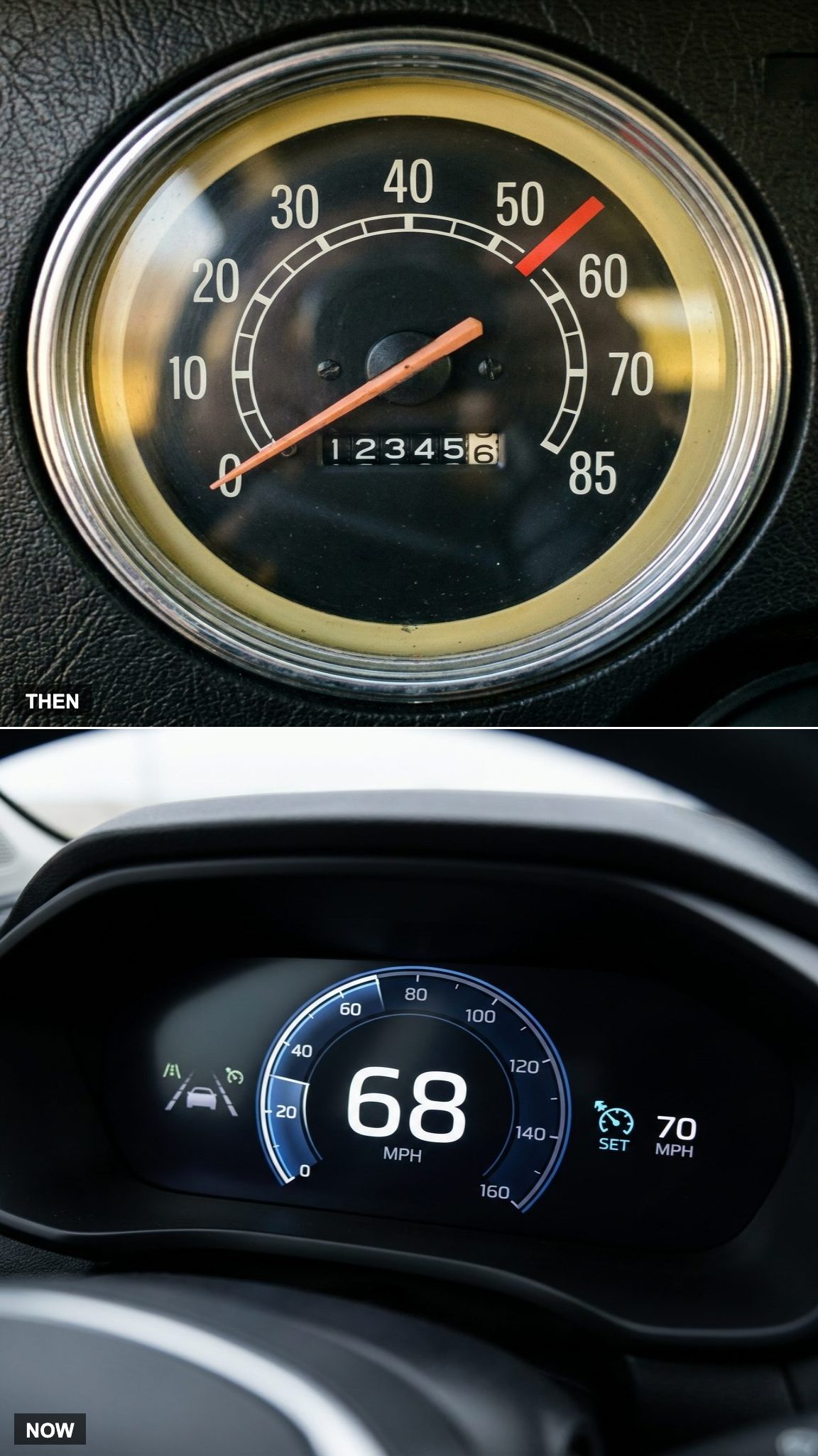
A 1975 speedometer was usually a broad analog dial or horizontal sweep, read by the position of a needle rather than a glowing number. The markings were simple, the response was slightly elastic, and the whole thing felt mechanical because it was.
Modern displays can show an exact digital speed, the cruise-control setting, the posted limit, and a warning when you drift past it. The information is clearer, though the old needle had a way of showing acceleration and speed at the same time without turning either into a lecture.
8-Tracks and Cassette Decks Gave Way to Wireless CarPlay
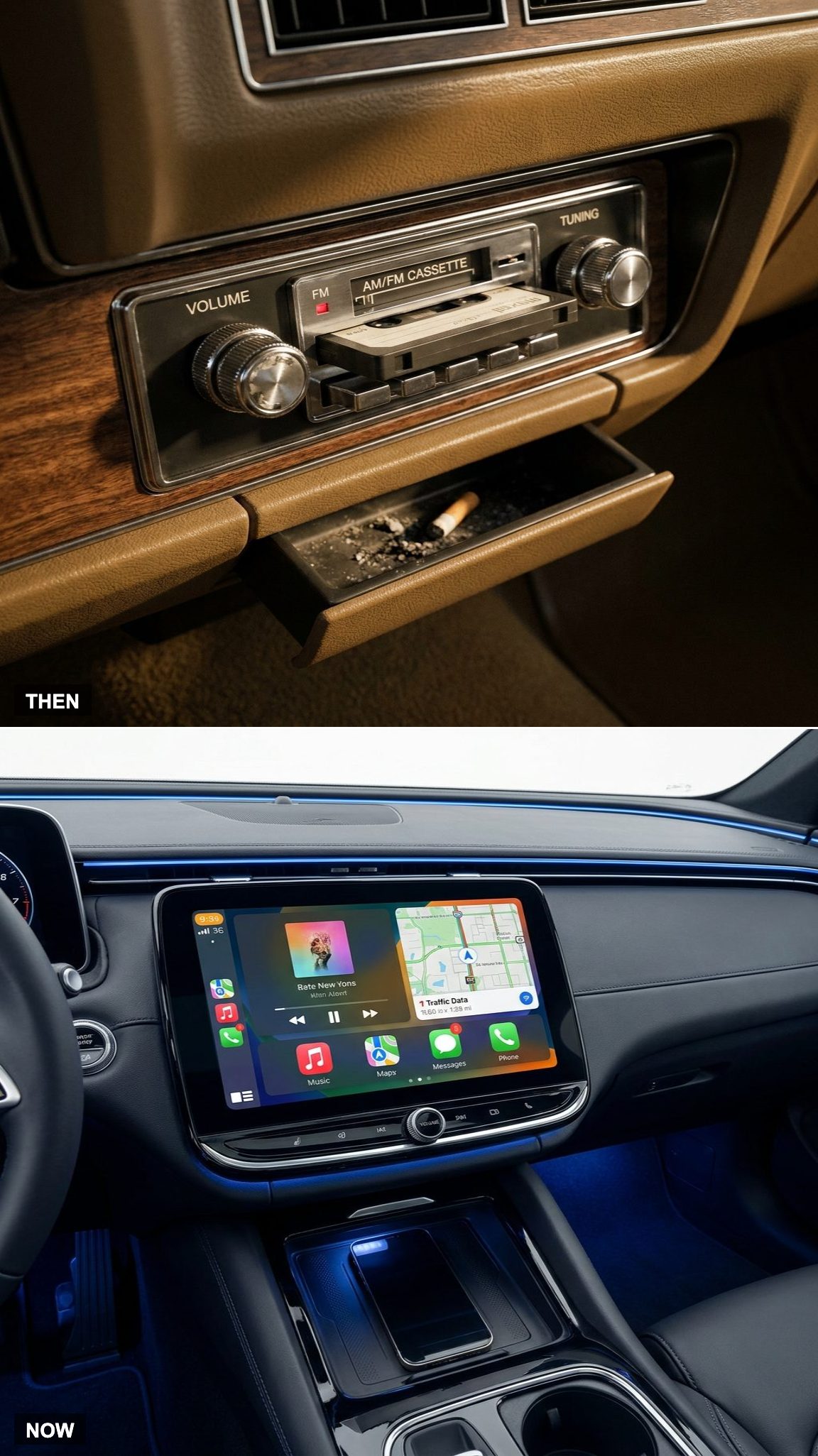
Loading an 8-track or cassette was a whole ritual. Slide in the 8-track and wait for the clunk, or feed in a cassette and hope the deck did not eat it. If you were feeling especially flush, you had a pair of 6x9s on the rear deck and a Pioneer Supertuner your cousin installed using mostly the wrong-color wires and a lot of electrical tape.
Now the phone in your pocket connects to a screen the size of a small television without you touching a single button, and every album ever recorded is one voice command away. Progress—genuinely. But nobody makes a mixtape for anyone anymore, and that was arguably the whole point of the format in the first place.
The Ignition Key Gave Way to a Start Button
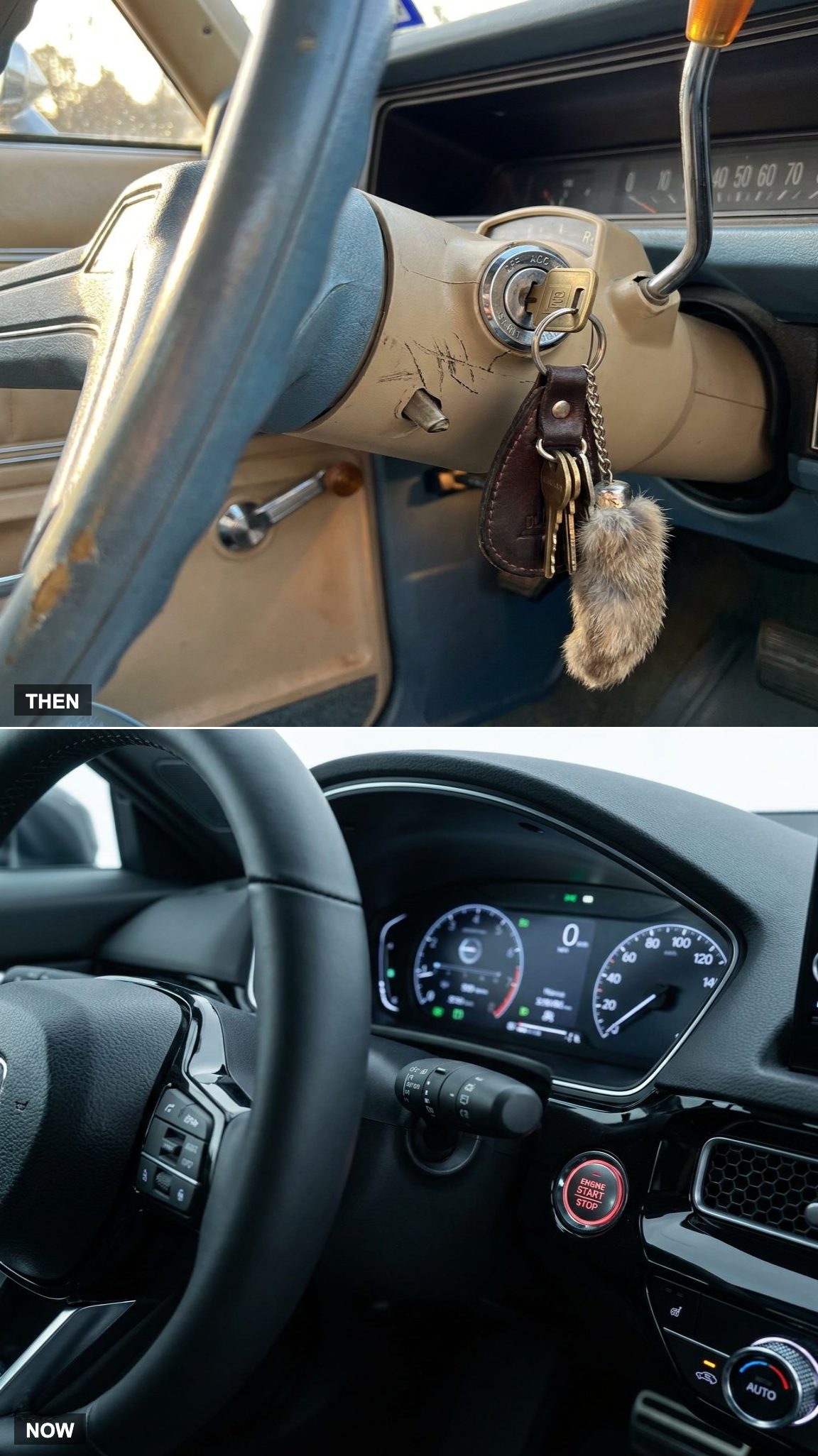
The key had heft to it. Brass, worn smooth along the edges, threaded onto a ring with a house key, a mailbox key, and something you were pretty sure went to a padlock you no longer owned. Slide it in, turn it clockwise, and the starter groaned to life under the hood.
Now the fob stays in your pocket. You press a button. The engine wakes up without any ceremony whatsoever—faster, cleaner, quieter, and less satisfying in a way that is hard to explain until you try describing to a grandkid what it meant to have a favorite keychain.
Backing Up by Memory vs. Cameras Everywhere
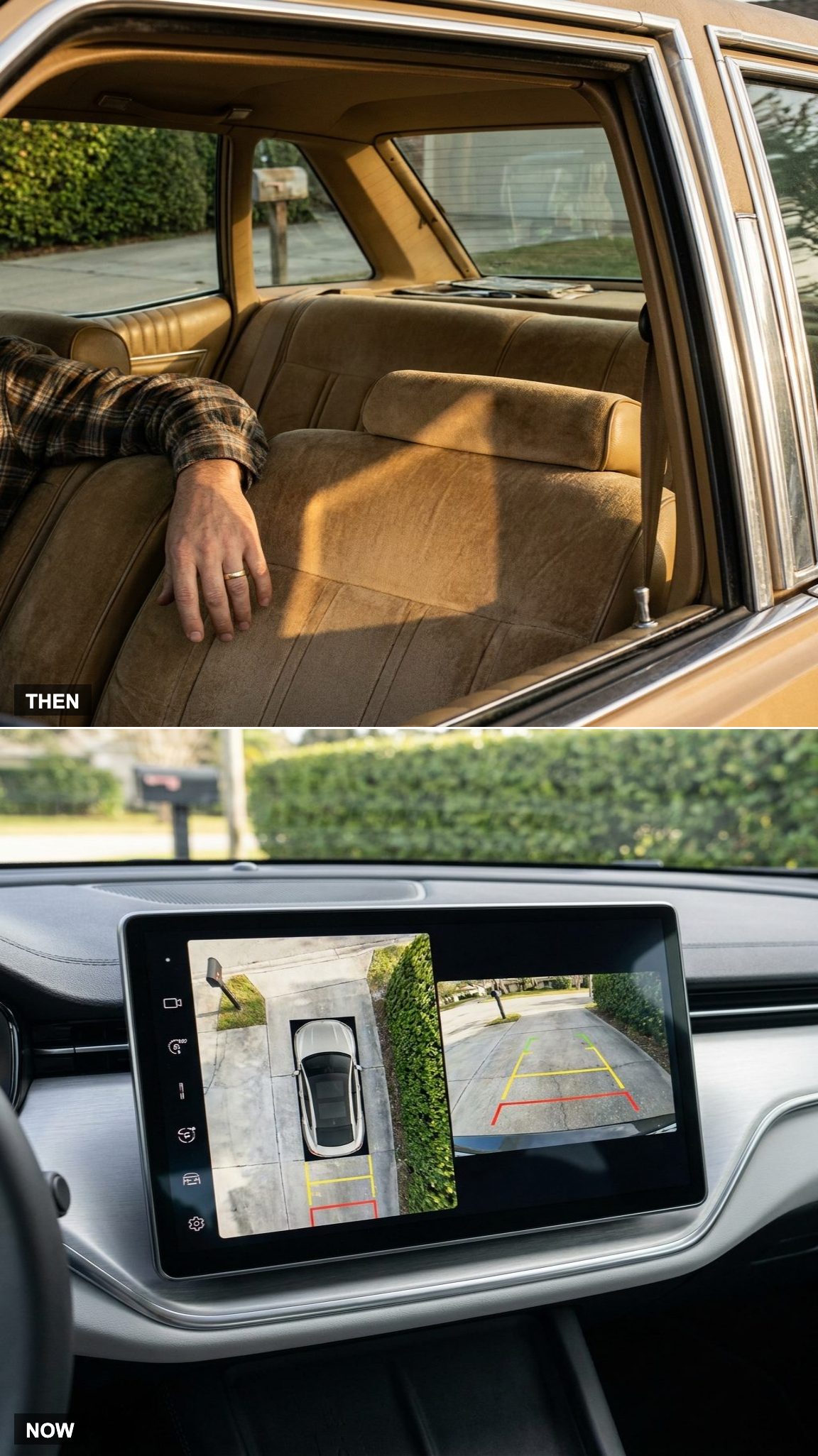
You threw your arm over the seatback, cranked your neck around, and hoped the trash cans were still exactly where you had last seen them. Reverse was a full-body event. Judging the final few feet took practice, especially in a long sedan or wagon with a trunk lid you could not quite see from the driver’s seat.
Modern surround-view cameras hand you a bird’s-eye composite view of your own vehicle. You can watch yourself parallel park from above like you are directing traffic on a construction site. Fewer bumpers scraped, sure. Fewer drivers are forced to develop the spatial sense that an old wagon demanded, and that used to be a skill worth having.
Cruise Control Became Adaptive Speed and Lane Assistance
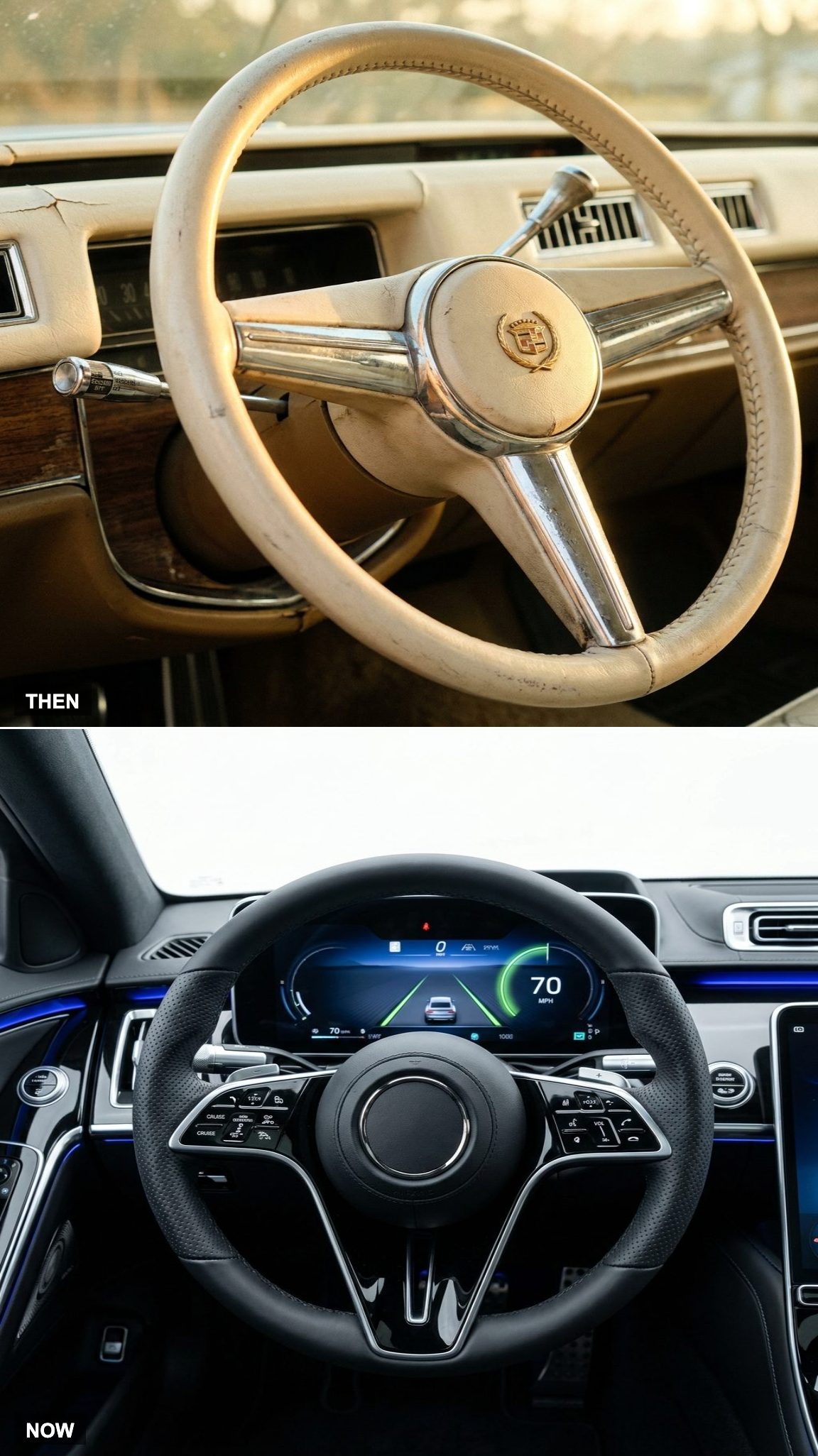
Cruise control on a 1975 Cadillac was a bragging right worth mentioning at the country club. You reached for a small switch on the turn signal stalk, set your speed at 55, and the car held it, more or less, unless a serious hill came along and negotiated a discount. It felt like the future had shown up early.
Now adaptive cruise can detect traffic ahead, match the speed of the pickup two lengths up, and work with lane-centering assistance to help the driver stay within marked lanes. The driver still has to supervise the system and follow the limits set by the manufacturer.
Vinyl, Molded Plastic, and Woodgrain Gave Way to Soft-Touch Everything
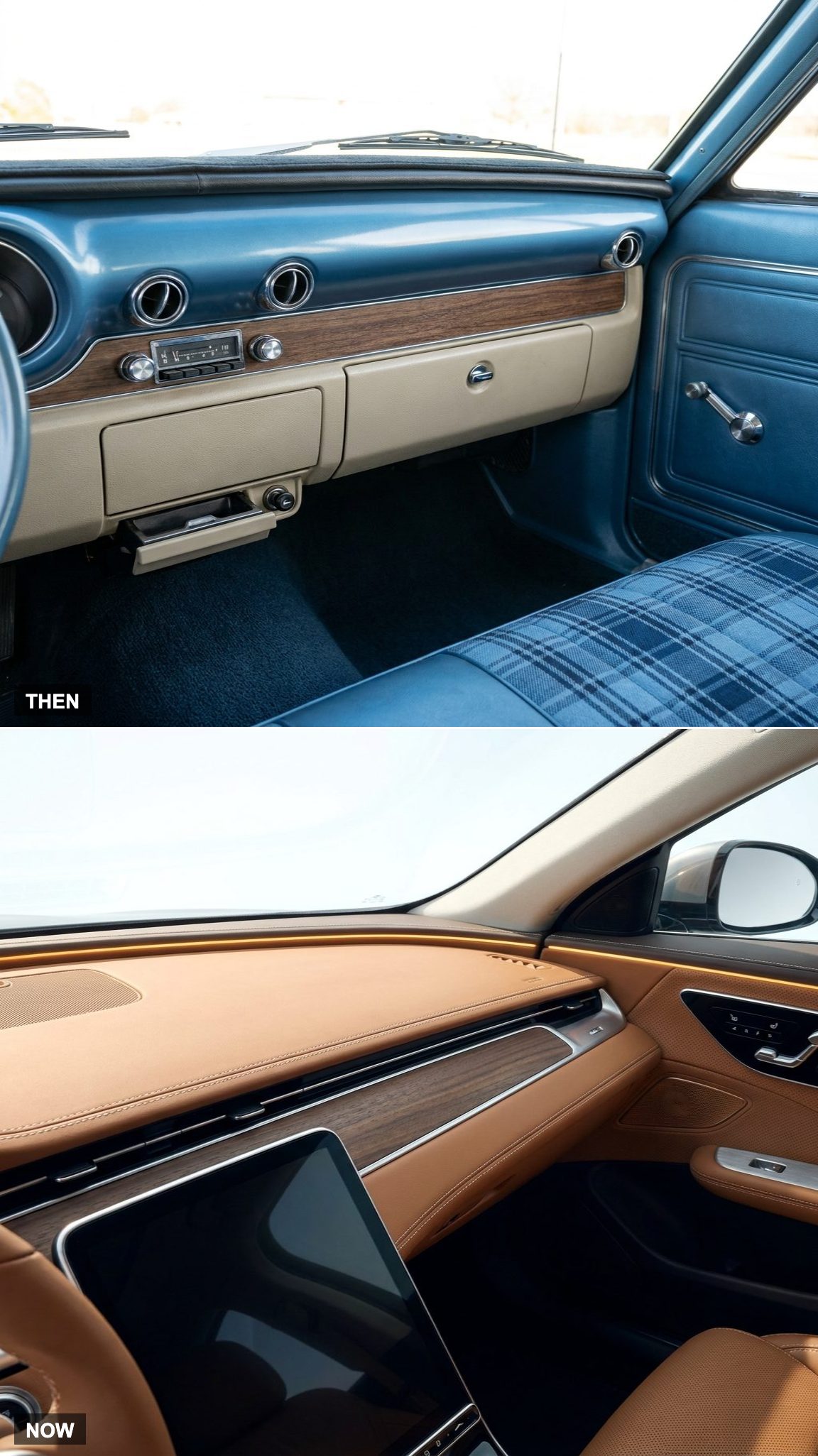
A typical 1975 dashboard mixed molded plastic, vinyl padding, imitation woodgrain, and hard trim pieces. The upper pad could crack into a spiderweb after years in the sun, while darker surfaces became punishingly hot by mid-July.
Today’s dashboards are a different world. Stitched leather, open-pore wood, brushed aluminum, soft-touch everywhere your hand might land. The materials in a modern luxury dash probably cost more than the entire 1975 interior did to assemble, though whether that improvement is worth what a new car now costs is a longer conversation for another afternoon.
Fuel Economy as a Guessing Game vs. Real-Time MPG on Screen
You knew your gas mileage the same way your father did before you.
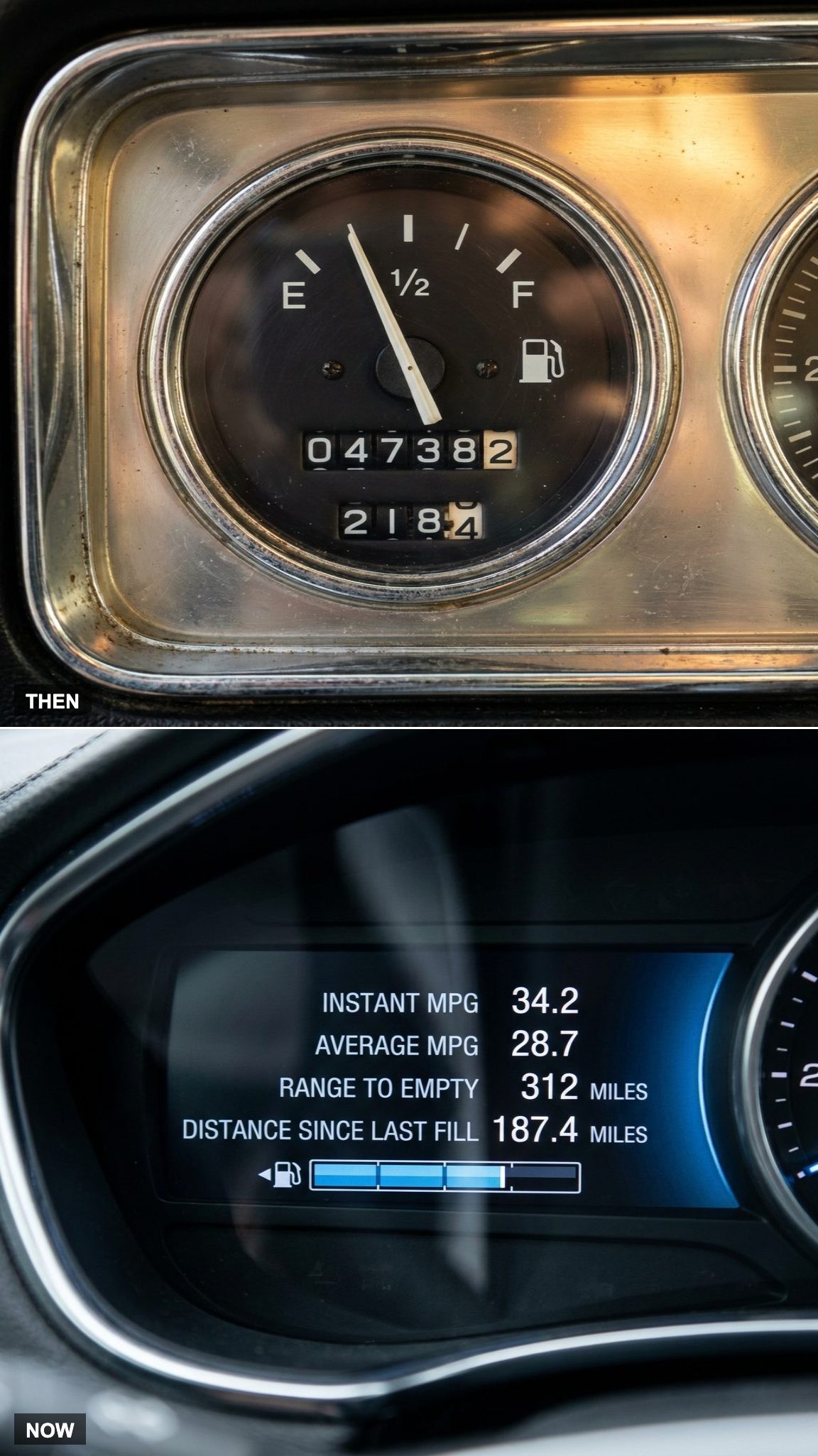
Scribble the miles on a scrap of paper at the pump, divide by the gallons once you got home, and either feel smug about the result or lie about it to your spouse. A wagon with a 400-cubic-inch V8 got what it got, and you did not ask the car impertinent questions about its habits.
Now the car does the arithmetic on its own. Instant miles per gallon, running average, range to empty, distance since the last fill—the trip computer knows more about your driving than you do. Useful, mostly. It also removes the pleasure of ever being pleasantly surprised by your own right foot.
Trust Your Eyes vs. Blind-Spot Monitoring Watching for You
Would you like to save this?
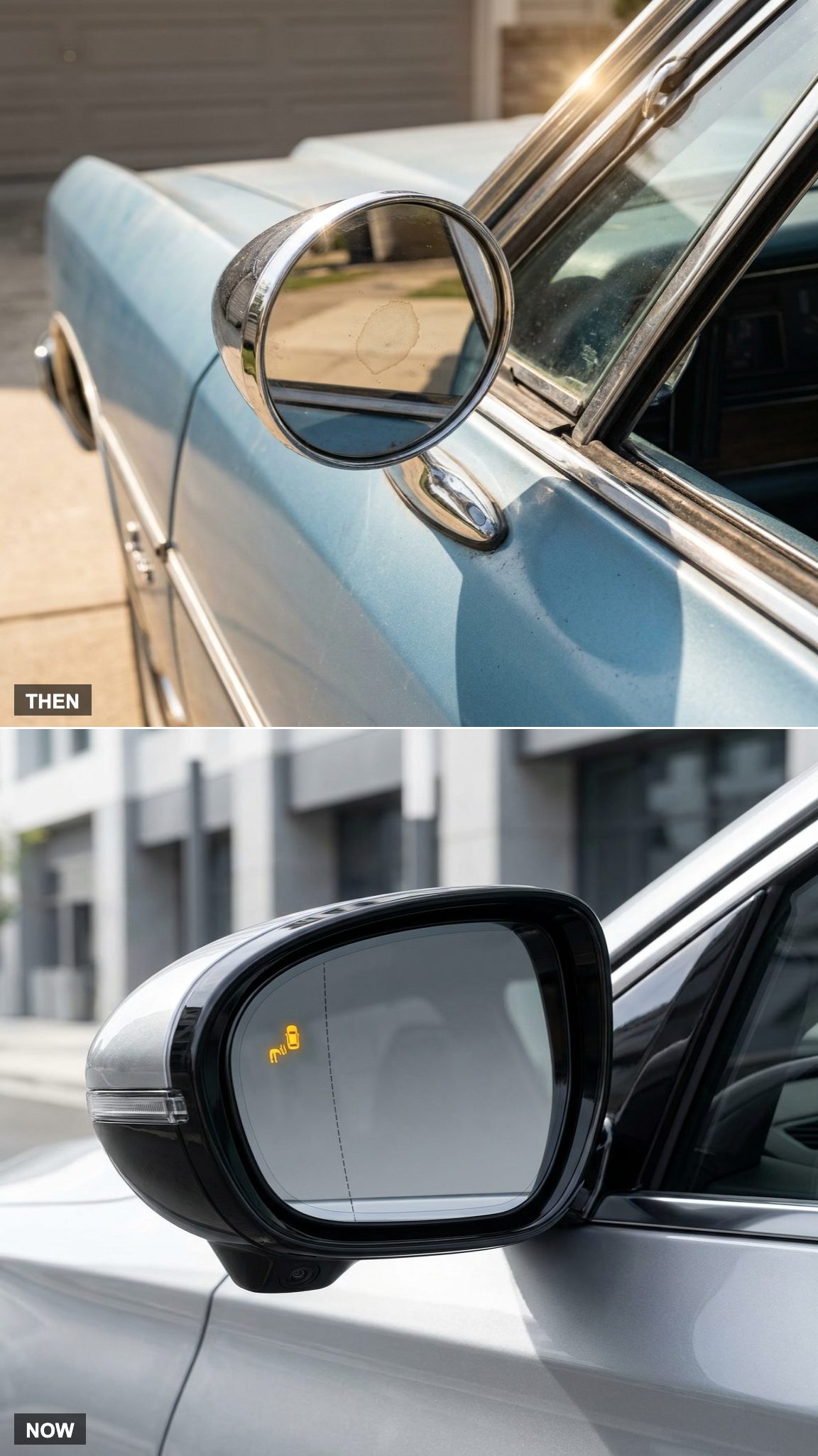
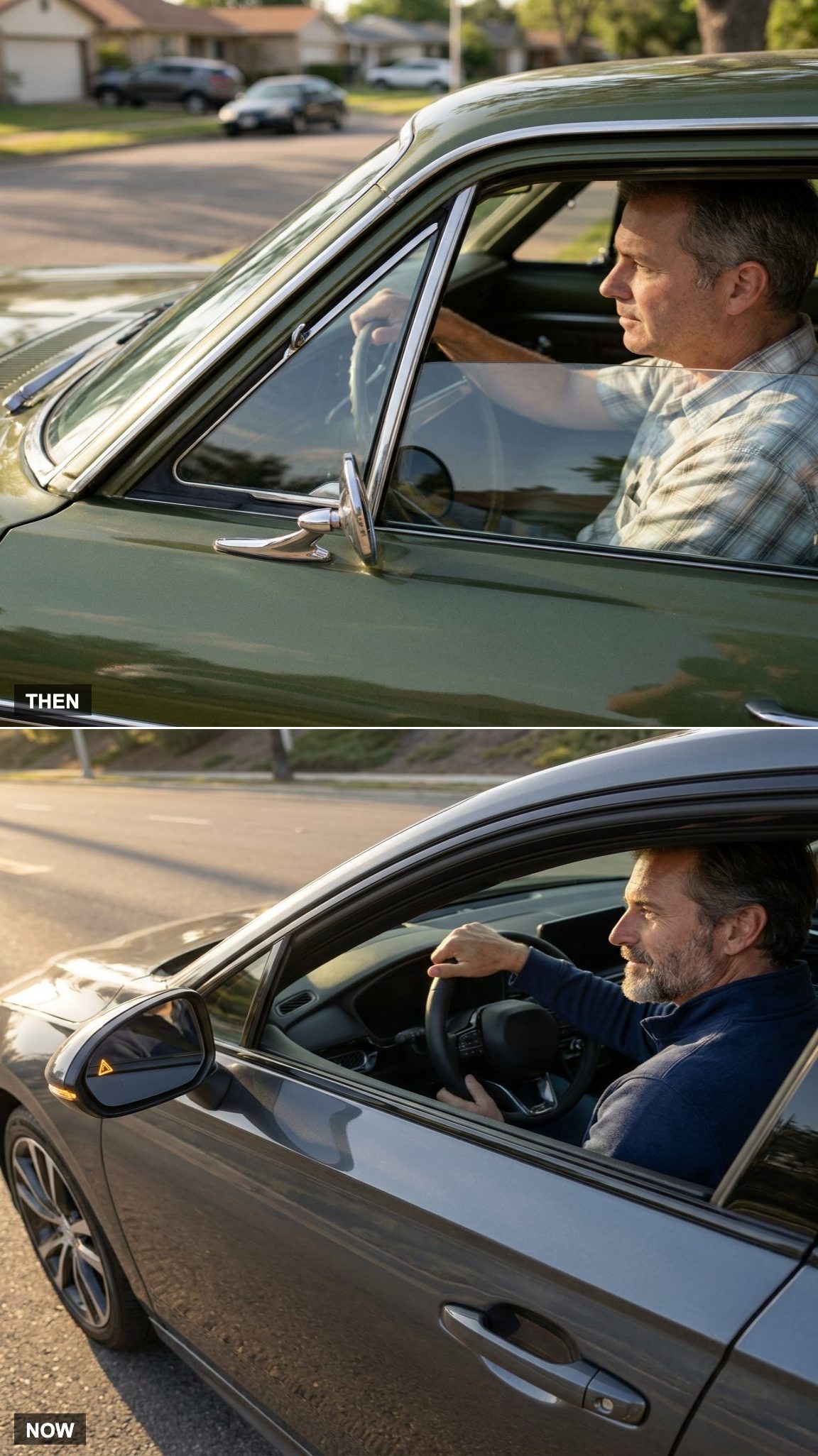
Checking a blind spot in 1975 meant a full head turn, a shoulder check, and a squint at a relatively small door-mounted mirror with a limited field of view. You did it every lane change. If you did not, you learned quickly enough why you should have.
Now a small amber icon lights up on the mirror glass when something is beside you, and some cars will buzz the steering wheel if you signal a lane change toward an occupied lane. The habit of actually looking is fading. The good drivers still do it anyway, because the system is assistance, not a substitute for a shoulder check.
Headlights Used to Wait for Your Hand. Now They Read the Sky.
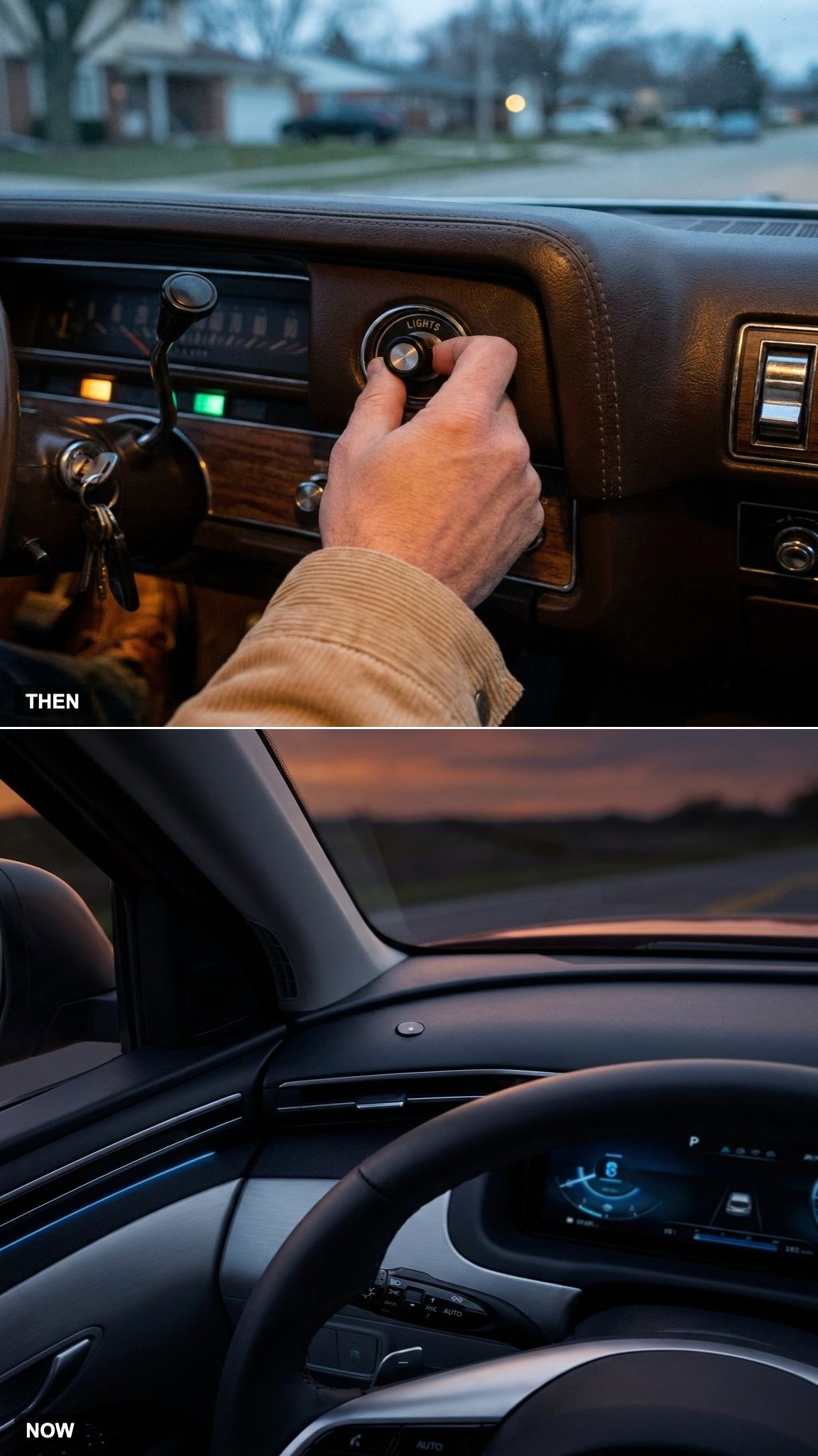
In 1975, turning on your headlights was a decision you made with your hand. You reached for the chrome pull knob and switched the lights on yourself. Forget, and you were the guy walking back to a dead battery in the diner parking lot at 11 p.m.
Today’s cars won’t let you make that mistake. A sensor on the dash reads the outside light and flips the beams on before you notice the sky changed color. Convenient. But there was something honest about a knob that only worked when you told it to.
The Dashboard Clock vs. The Voice That Answers Back
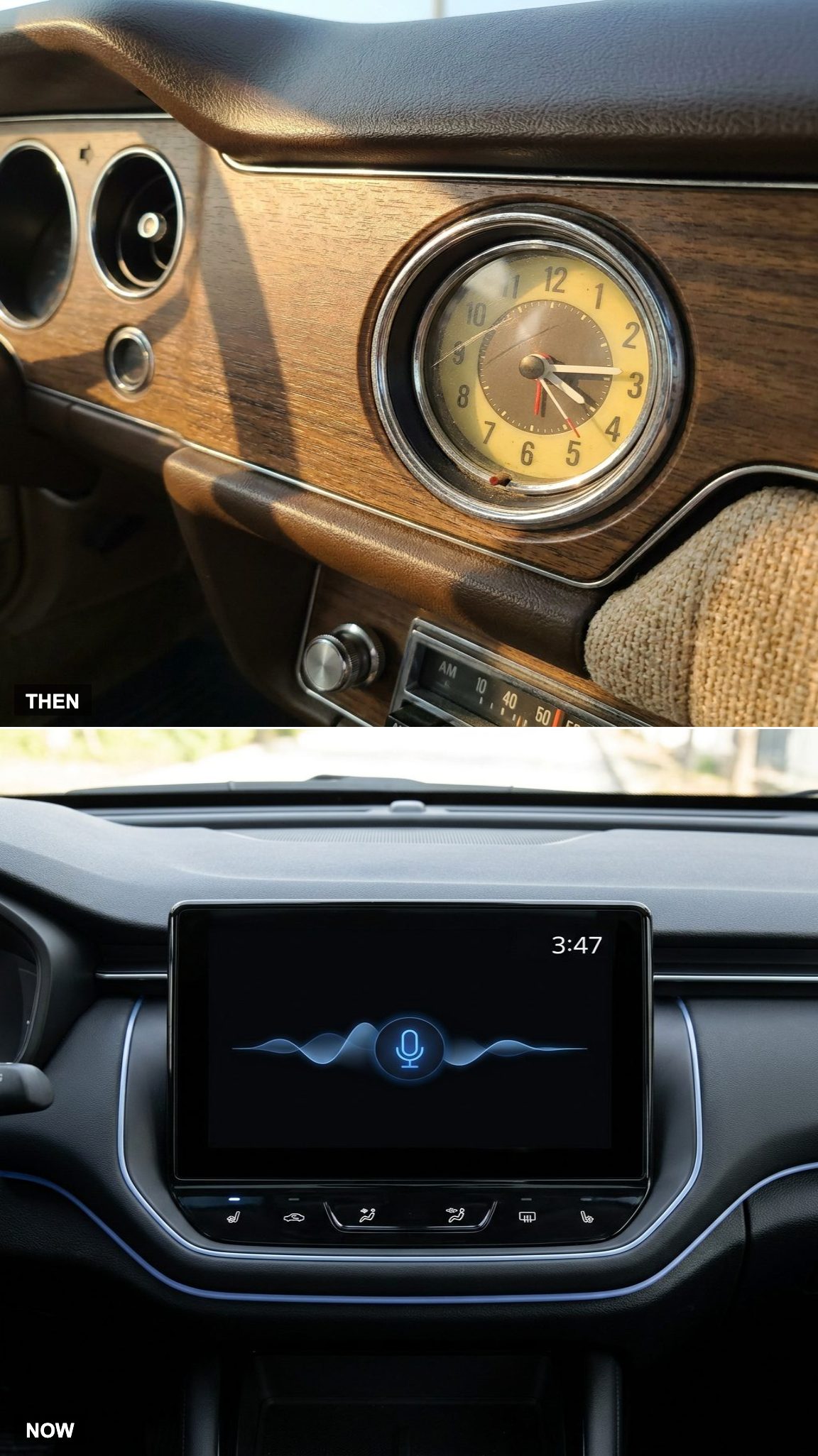
The clock in a 1975 Buick was a status symbol—it meant your car had thought of everything. It also tended to drift and, like many old dashboard clocks, might stop working years before the car did.
Now you press a button on the wheel, ask what the weather’s doing in Denver, and a voice answers in under a second. The clock is still there. It’s just one of forty things the screen does between stoplights.
Mom Navigated by Folding Map. The Phone Navigates by Traffic Data.
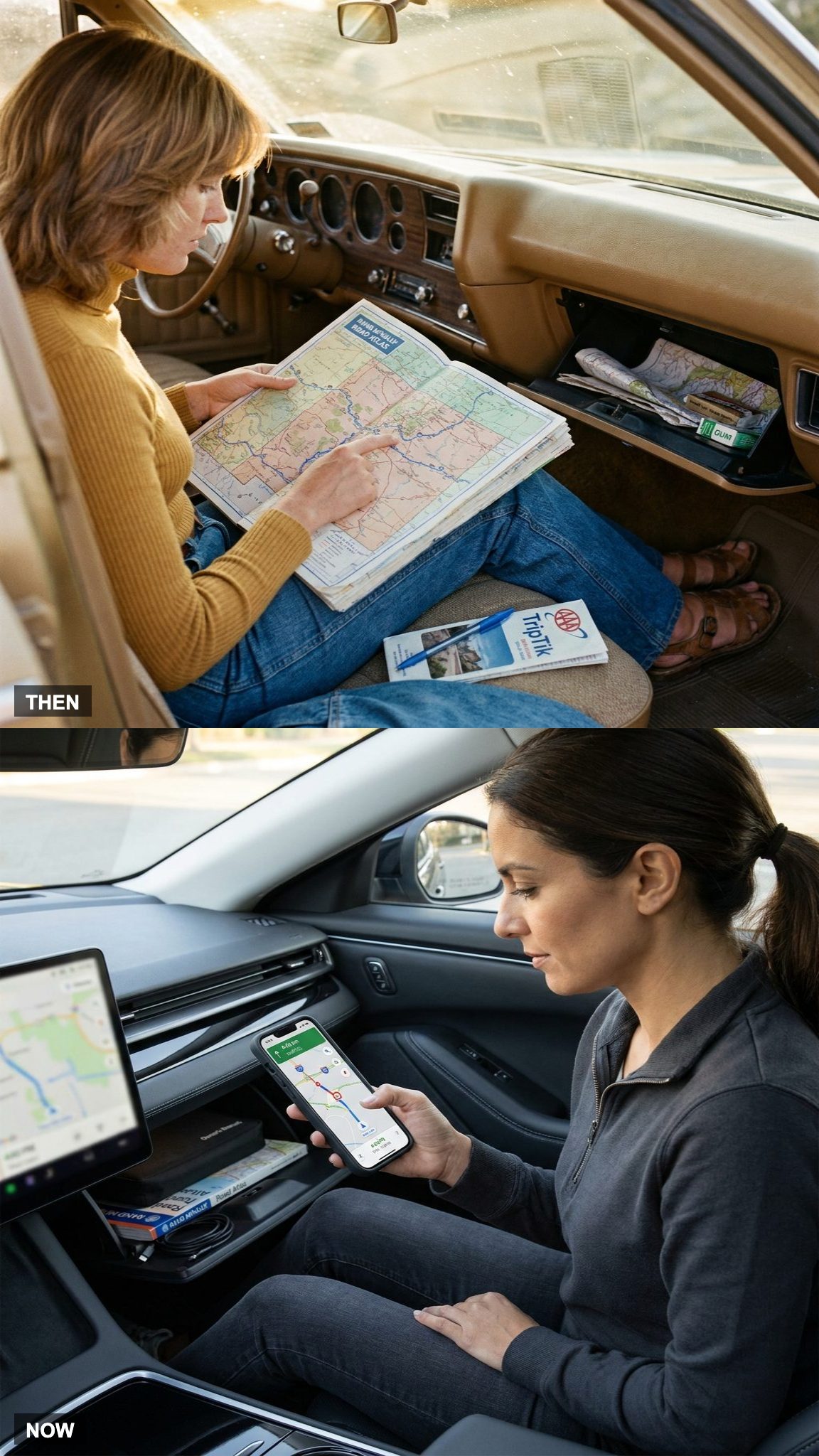
Every family road trip in 1975 had a designated navigator, and it was usually Mom. She unfolded the Rand McNally across her lap, refolded it wrong at every rest stop, and shouted the exit number about four seconds too late.
Today the phone handles it, and it knows there’s a wreck on I-40 before you do. Reroutes you through a town you’ve never heard of and delivers you home twenty minutes earlier than expected. The atlas still lives in a lot of glove boxes, though. Old habits.
Parallel Parking by Feel vs. The Car That Does It for You
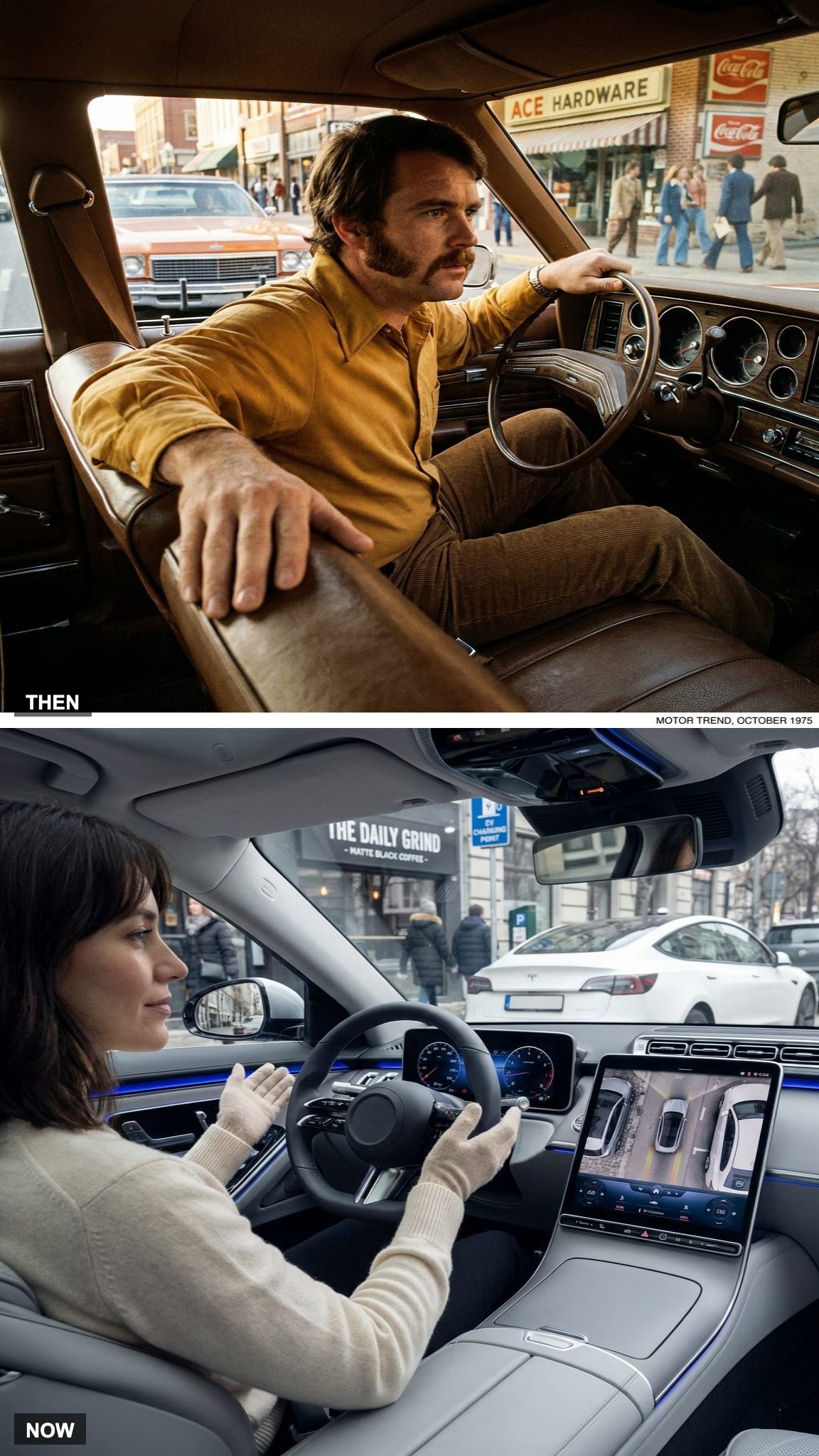
Parallel parking a 1975 land yacht was a full-body sport. You cranked the wheel, watched the fender in your side mirror, prayed the guy behind you had left enough room, and if you tapped a bumper on the way in, nobody cared—that’s what bumpers were for.
Now some cars can steer themselves into a space, while more advanced systems may also control braking and acceleration. The driver still watches the maneuver through cameras and sensors. A marvel. It also means an entire generation is growing up without ever learning to judge a curb through mirrors, steering angle, and experience.
One Compartment Held Everything. Now Every Cord Gets Its Own.
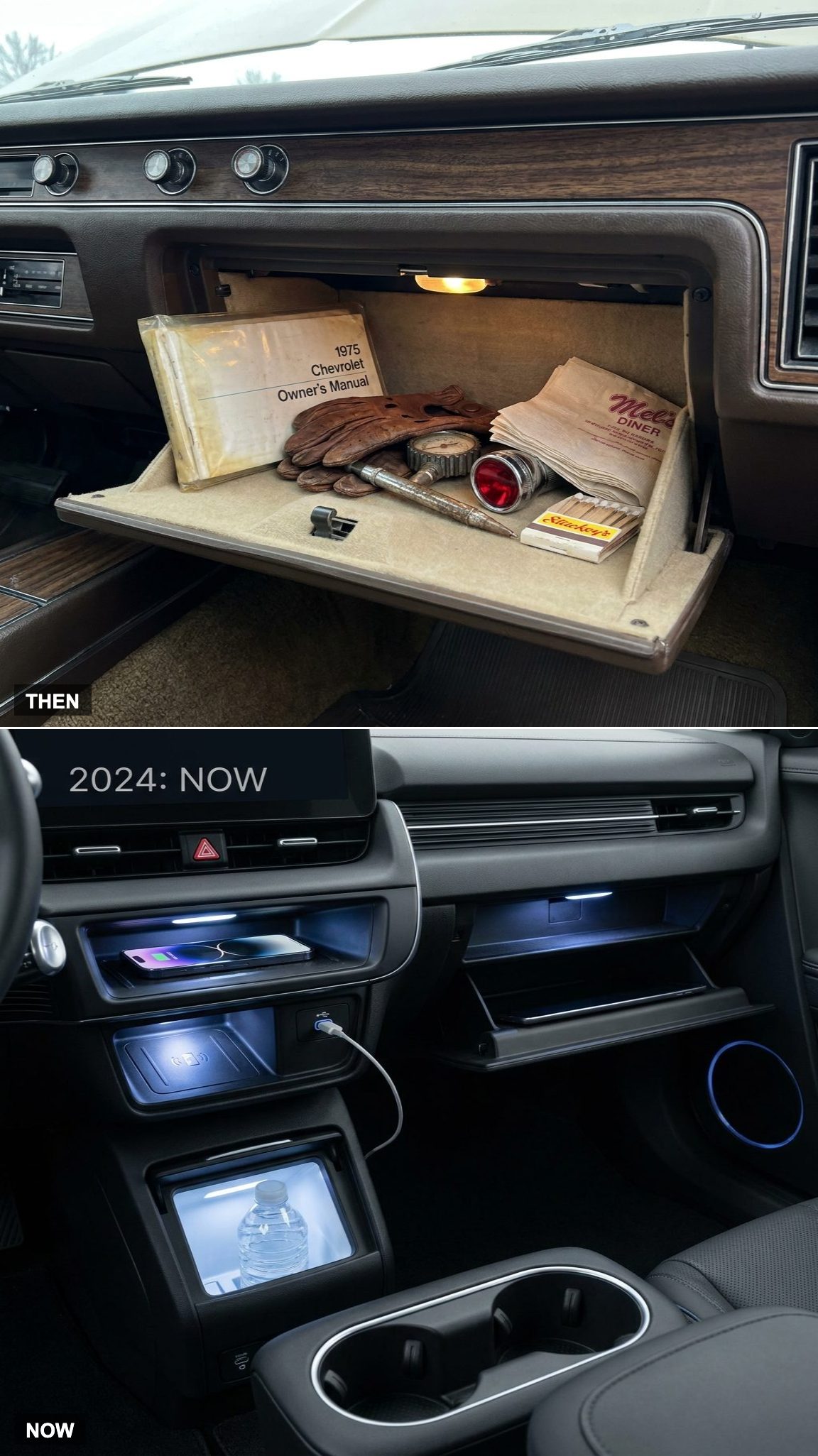
A 1975 glove box held the owner’s manual, a flashlight with dead batteries, and a stack of napkins from every diner between here and Kansas City. That was the whole system.
The modern dashboard has cubbies for cords, deep console bins, cooled compartments for bottled water, and dedicated slots for phones the size of paperbacks. Somehow we still can’t find a pen when we need one.
Diagnosing by Ear vs. The Car That Emails You a Code
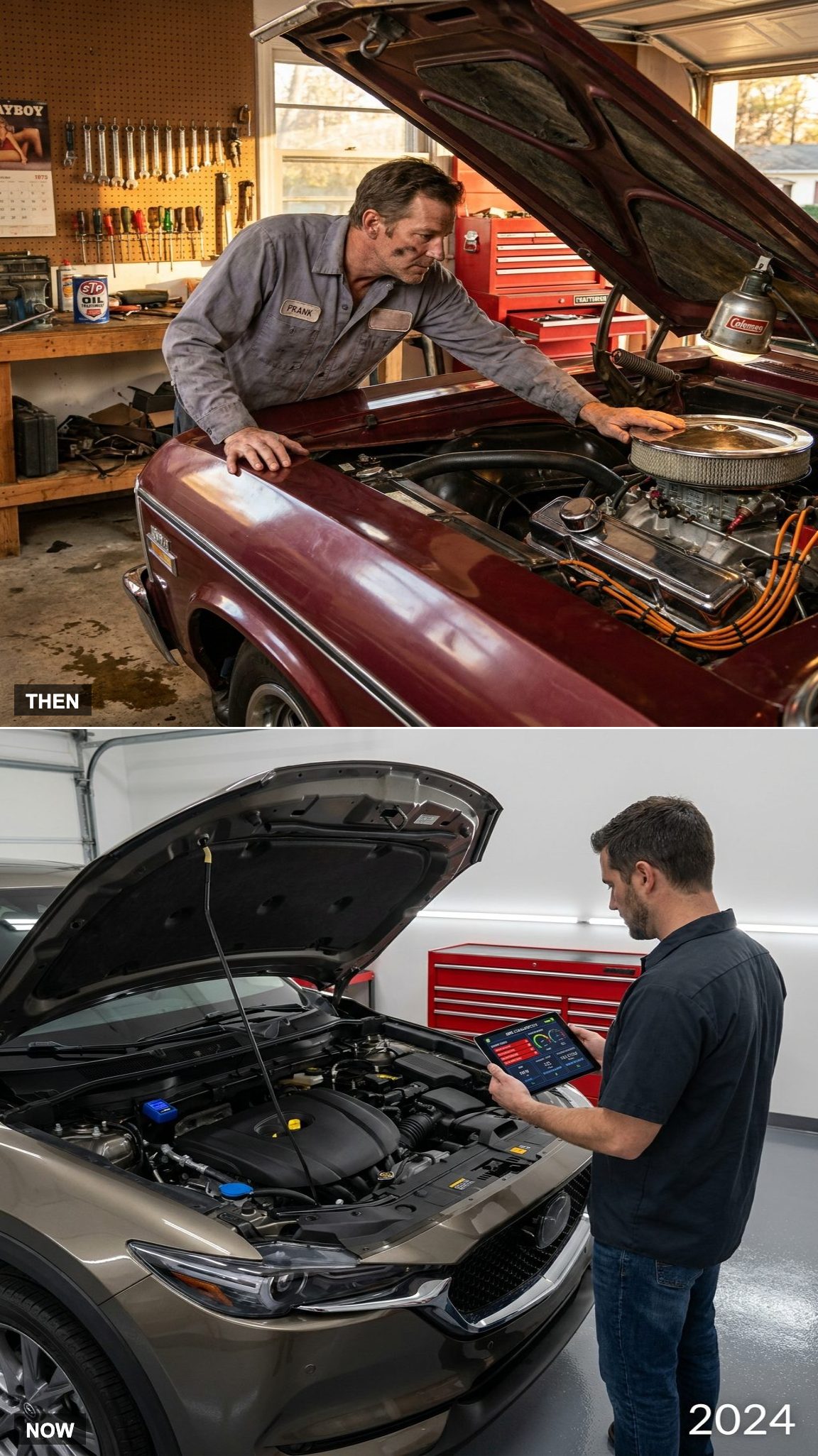
Frank, who kept your family’s cars running for the better part of two decades, could tell you what was wrong with an engine from ten feet away. A ticking lifter, a slipping belt, a carb running lean—he learned it the hard way, over twenty years of leaning into engine bays and getting it wrong before he got it right.
Now the car gives you a starting point. Plug in a cheap scanner and it hands you a code like P0420, which narrows the investigation to catalyst-system efficiency without identifying the failed part by itself. Faster. More accurate. Also less romantic.
The Back Seat Became Its Own Entertainment Zone
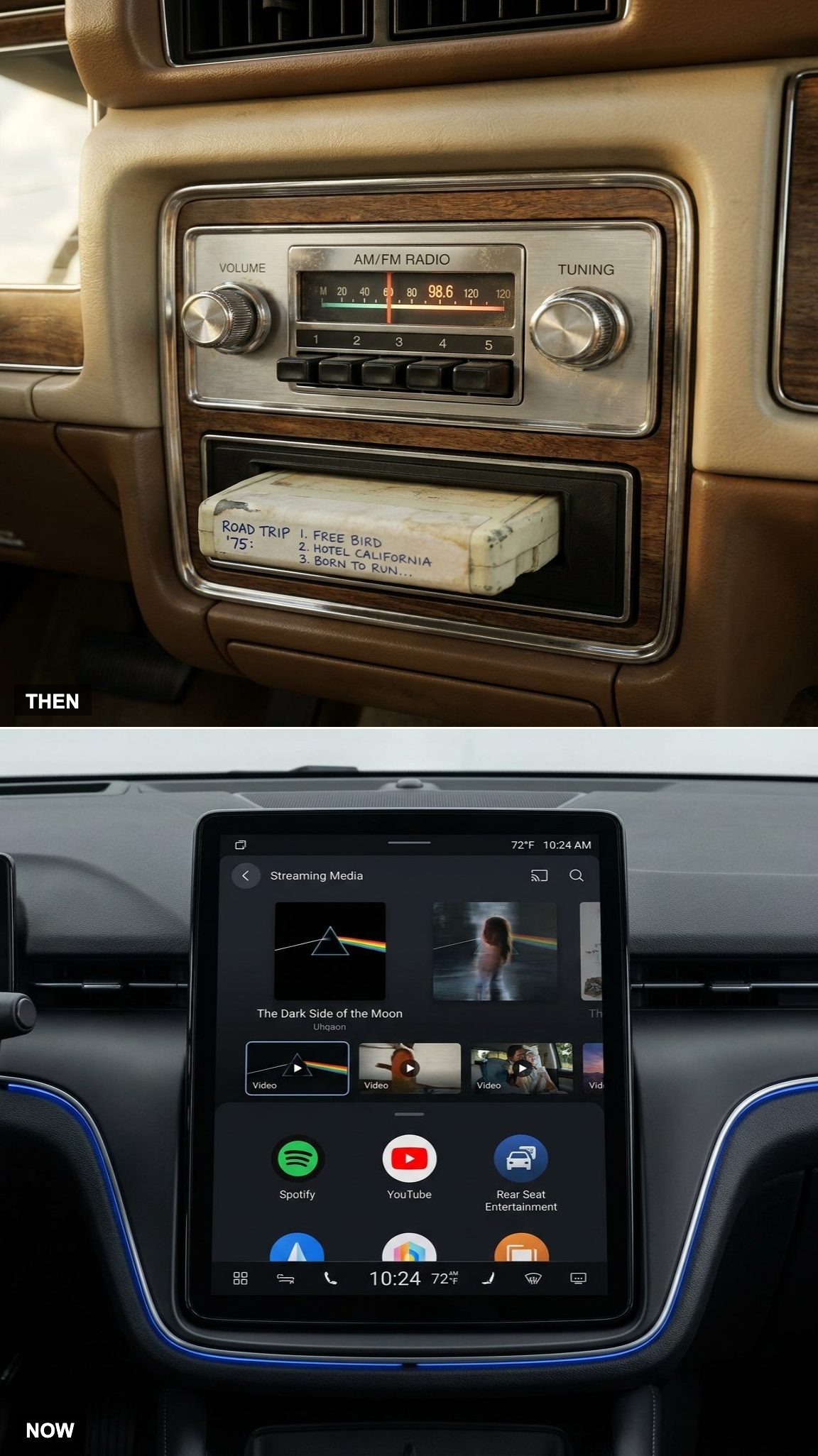
In 1975, everyone in the car shared the same entertainment. One radio, one station, one volume knob, and one argument about whether the driver or the kids got to choose.
Modern family vehicles can stream movies to separate rear screens, route audio through headphones, and let each passenger watch something different. The fighting did not disappear. It simply moved from what was on the radio to who got which screen.
The Bench Seat Had One Setting. The Modern Seat Remembers Yours.
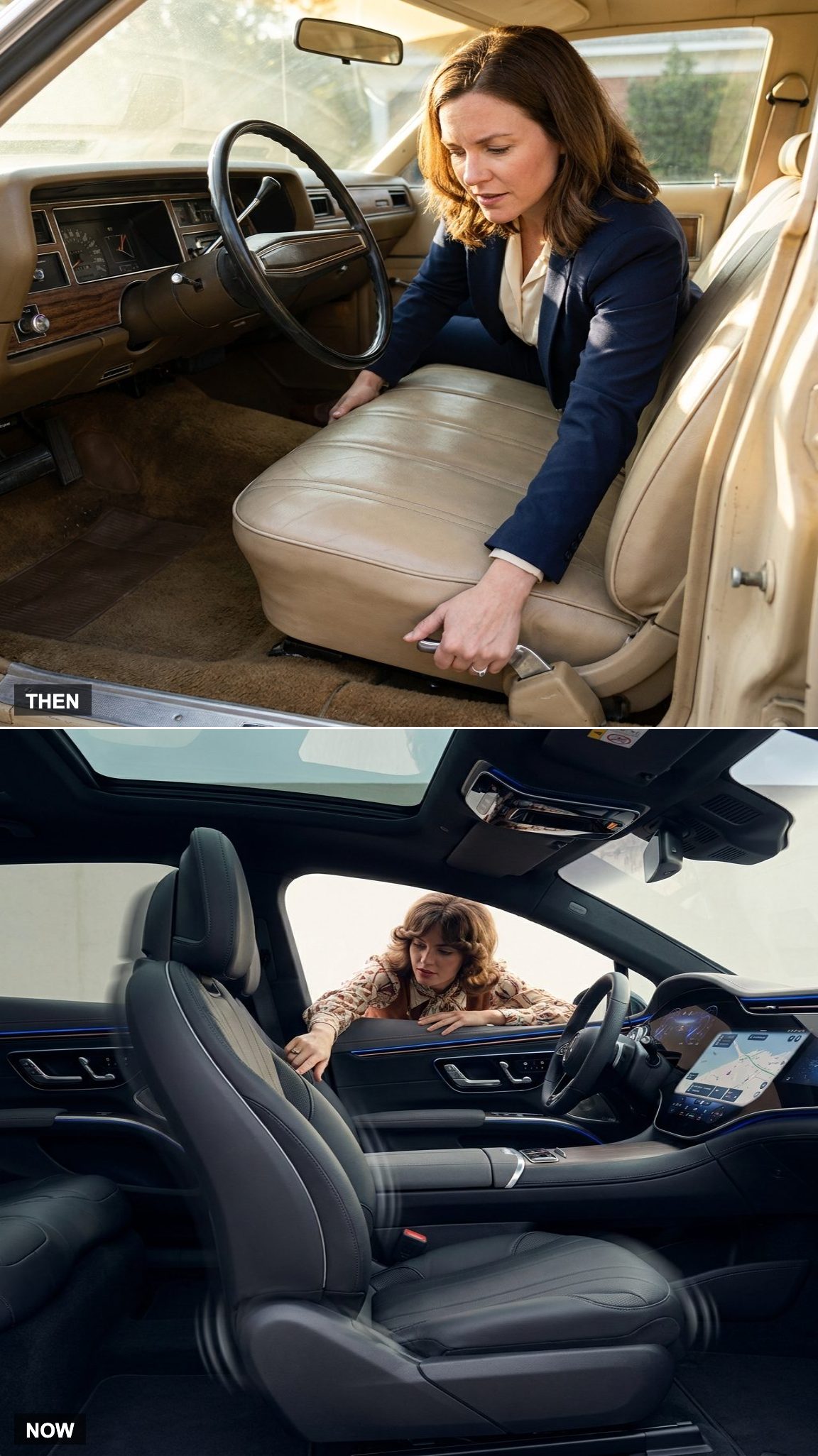
The 1975 bench seat had one setting: wherever the last person left it. If Dad drove home, Mom drove to work with the seat pushed back to the second row and the steering wheel three feet from her chest—she’d yank the lever, throw her weight forward, and hope it caught before her nose hit the horn.
Modern cars remember. Press button 2 and the seat, mirrors, wheel, and radio presets all slide back to your exact preferences. A small thing. But it means nobody has to fight over the driver’s seat before breakfast.
A Dash Built for Driving vs. A Dash Built for Everything Else
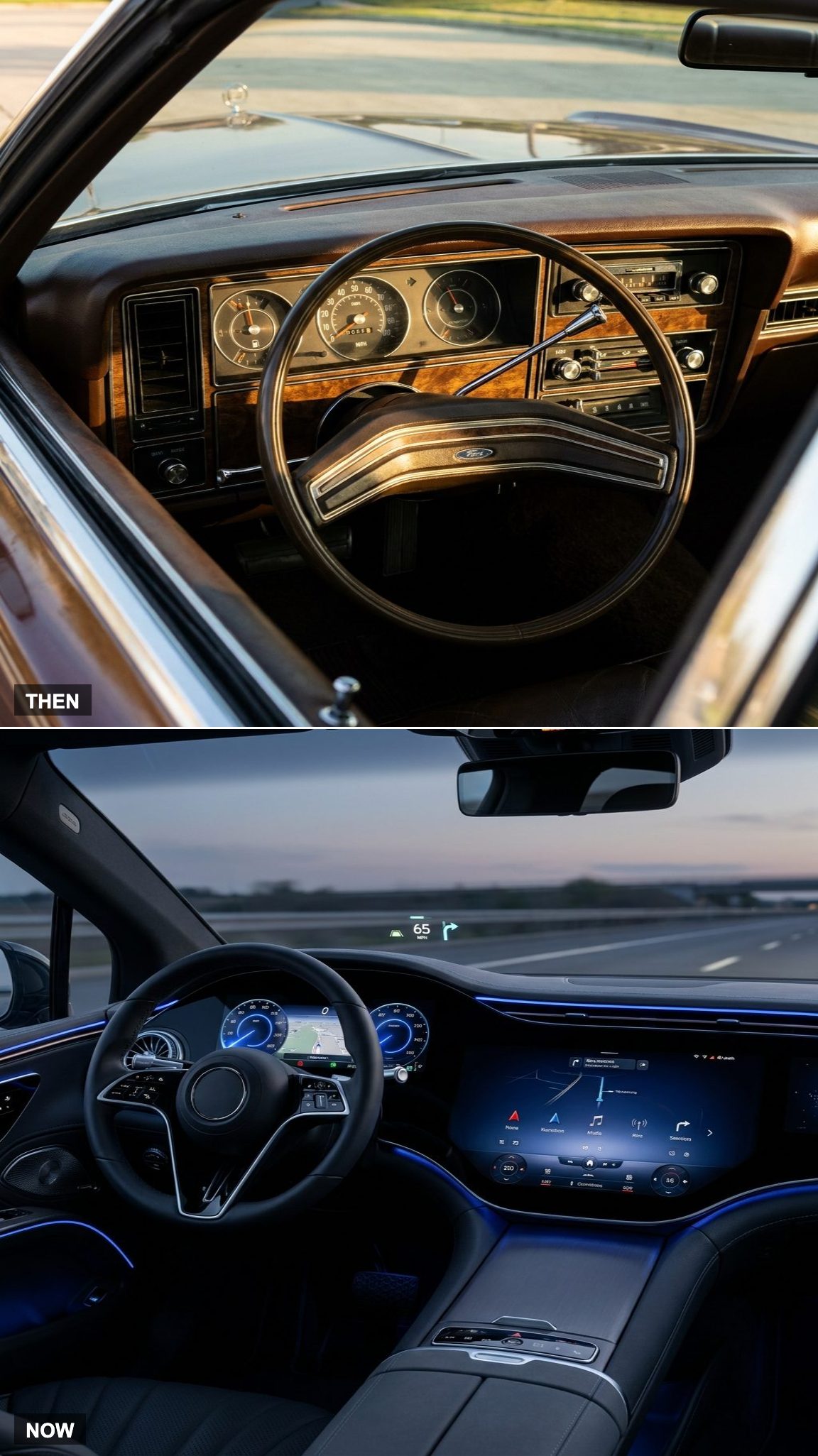
A 1975 dashboard had one job—tell you how fast you were going, how much gas you had, and whether the engine was overheating. Anything else was a bonus. The whole panel could be read with only a quick glance away from the road.
The dashboard in a new car is a command center. Navigation, streaming, climate, phone, camera feeds, driver assistance settings—all of it competing for your attention while you’re supposed to be watching the road. Progress is a word people use for a lot of things.
Cables and Vacuum Hoses Gave Way to a Network of Modules
Would you like to save this?
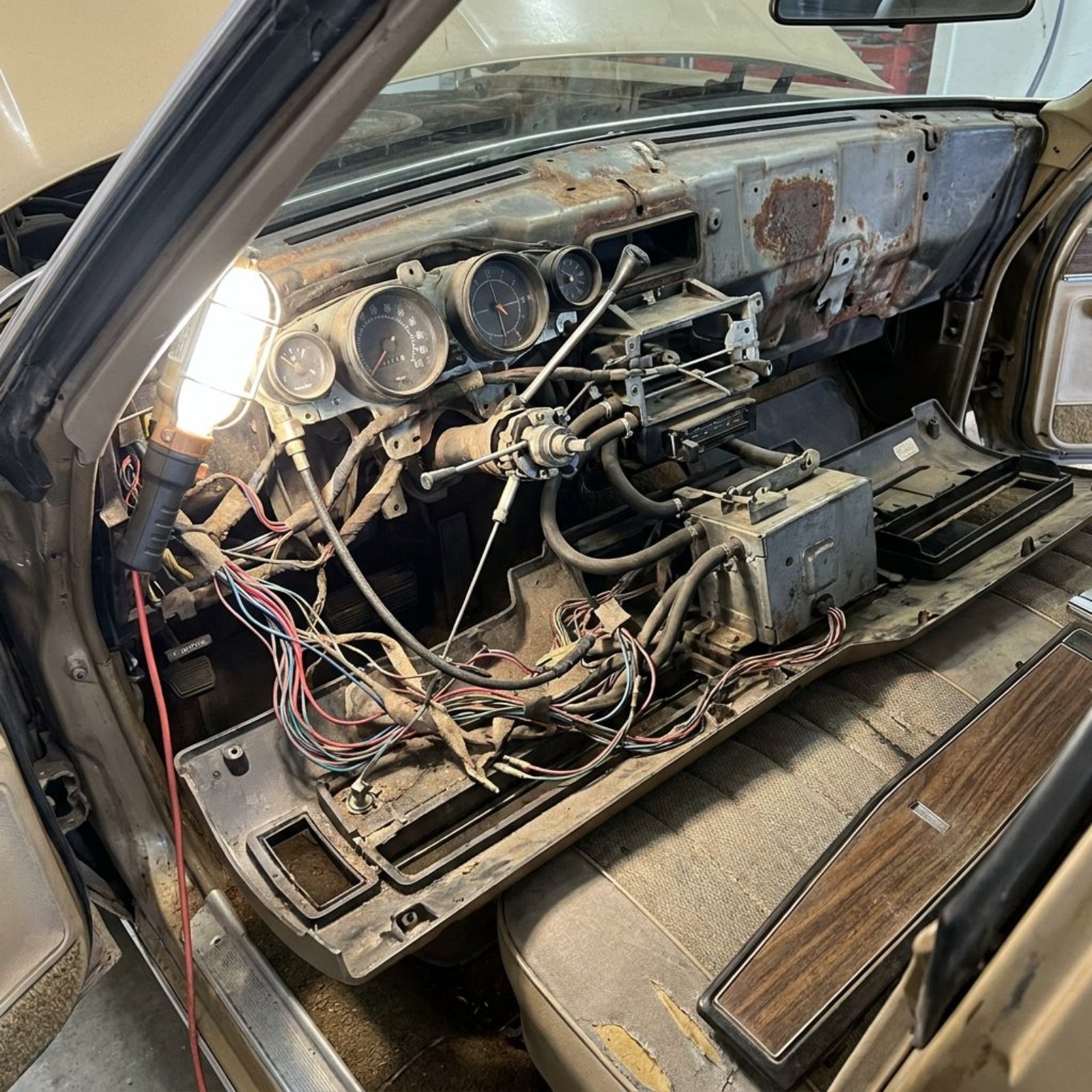
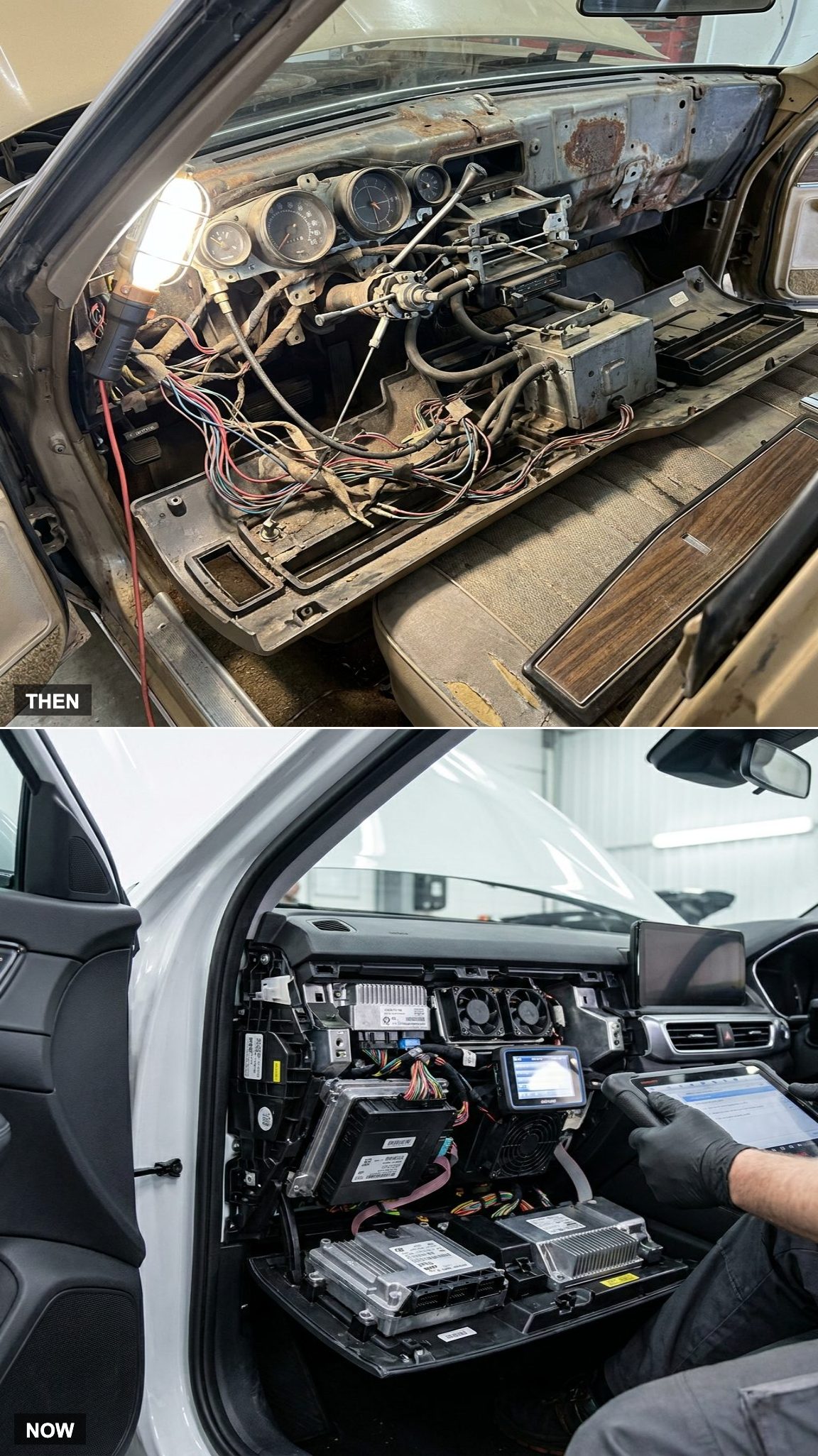
Pull the dash off a 1975 Impala and you found wires, cables, vacuum hoses, and a speedometer connected to the transmission by an actual physical cable that spun in your hand when you rotated it. Many functions could be traced through visible wiring, cables, or vacuum lines, even if the diagnosis was not always simple.
Pull the dash off a modern car and you find modules—little black boxes talking to each other over a network, running software that, in some vehicles, can be updated over the air. A modern car may contain dozens of networked control modules and millions of lines of software. And when it acts up, you don’t chase a wire. You wait for the technician with the laptop.