
Would you like to save this?
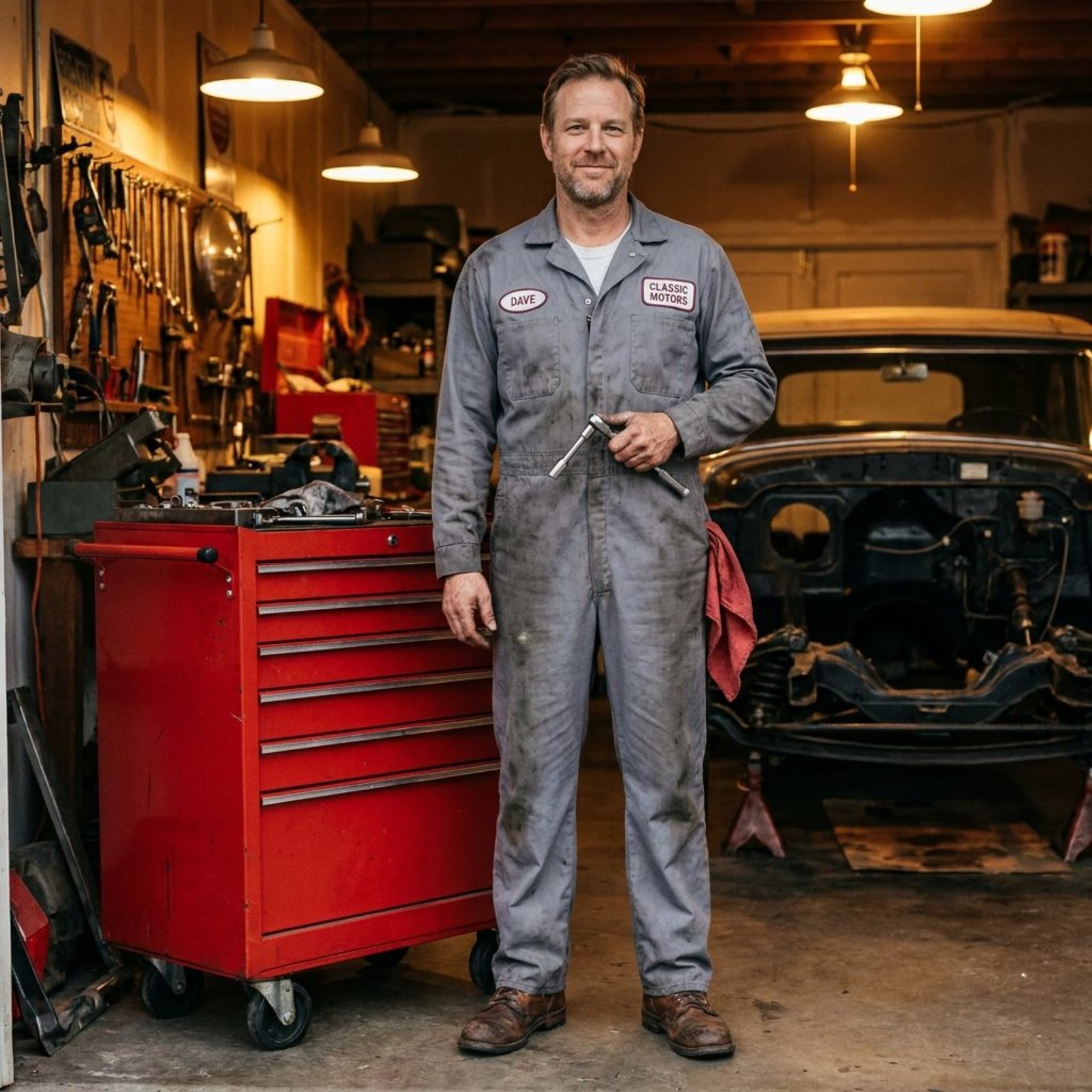
The smell hit you before you were even through the door. Gear oil, cigarette smoke, and hot metal, all baked into a concrete floor stained forty different shades of gray. A radio played somewhere behind the parts counter while a guy in green coveralls with your last name stitched on his chest wiped his hands on a rag that had given up being any real color years ago. That shop still lives in your head. More than five decades later, the work remains, but almost everything around it has changed.
32. Storefront and Garage Doors
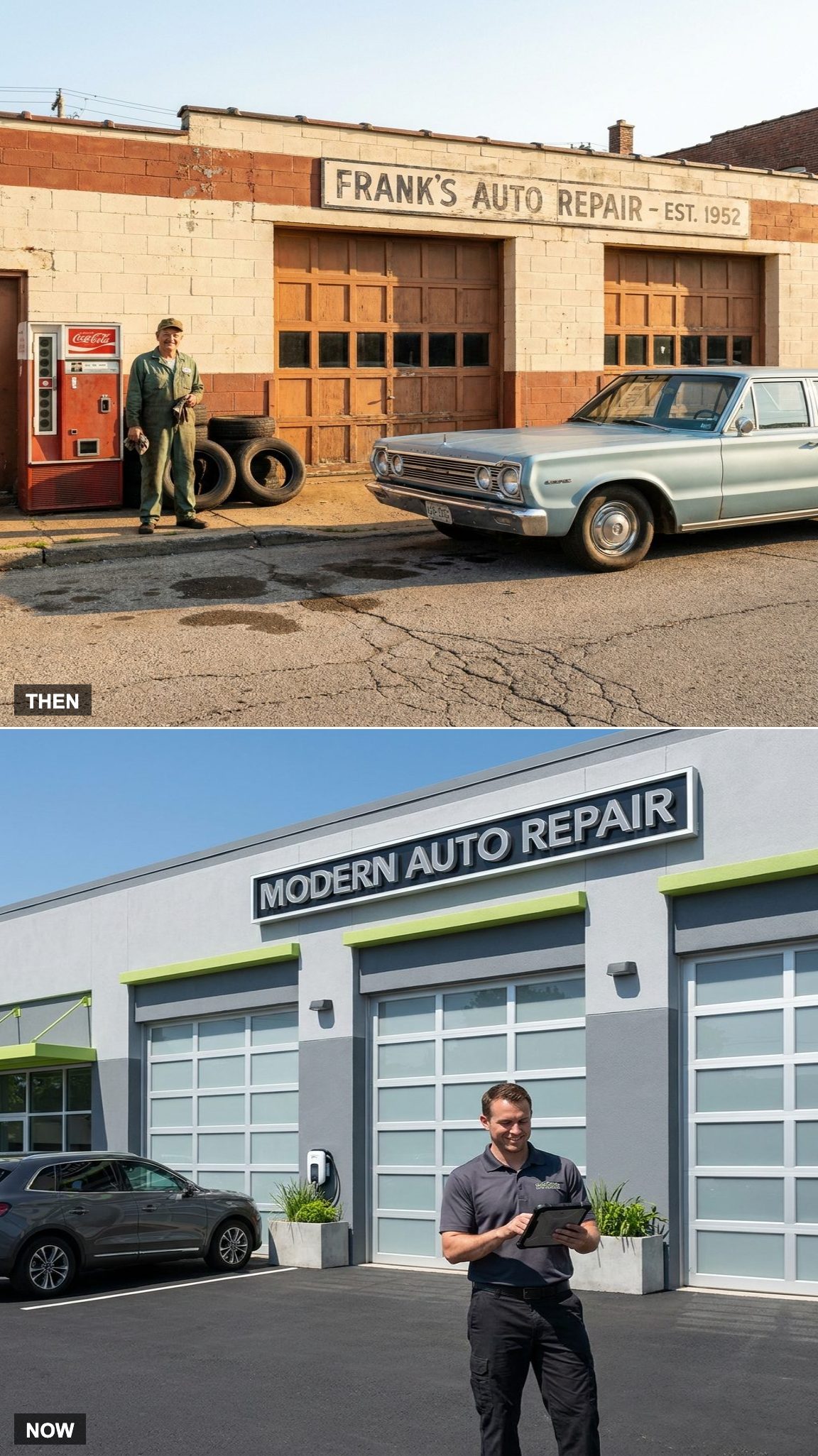
In 1970 the garage door was a wood-frame contraption you hauled up by hand, and you knew every shop on the strip by its hand-painted sign. Cinderblock walls, peeling paint, the whole place looking like it had stood there since Eisenhower. It probably had.
Now the storefront reads more like a polished retail space. Frosted-glass doors lift on insulated tracks, there’s a waiting room with real coffee, and a charging station sits out front. Cleaner, quieter, and honestly, a little colder. You miss the guy who knew your car by the sound of it.
31. Service Bay Layout
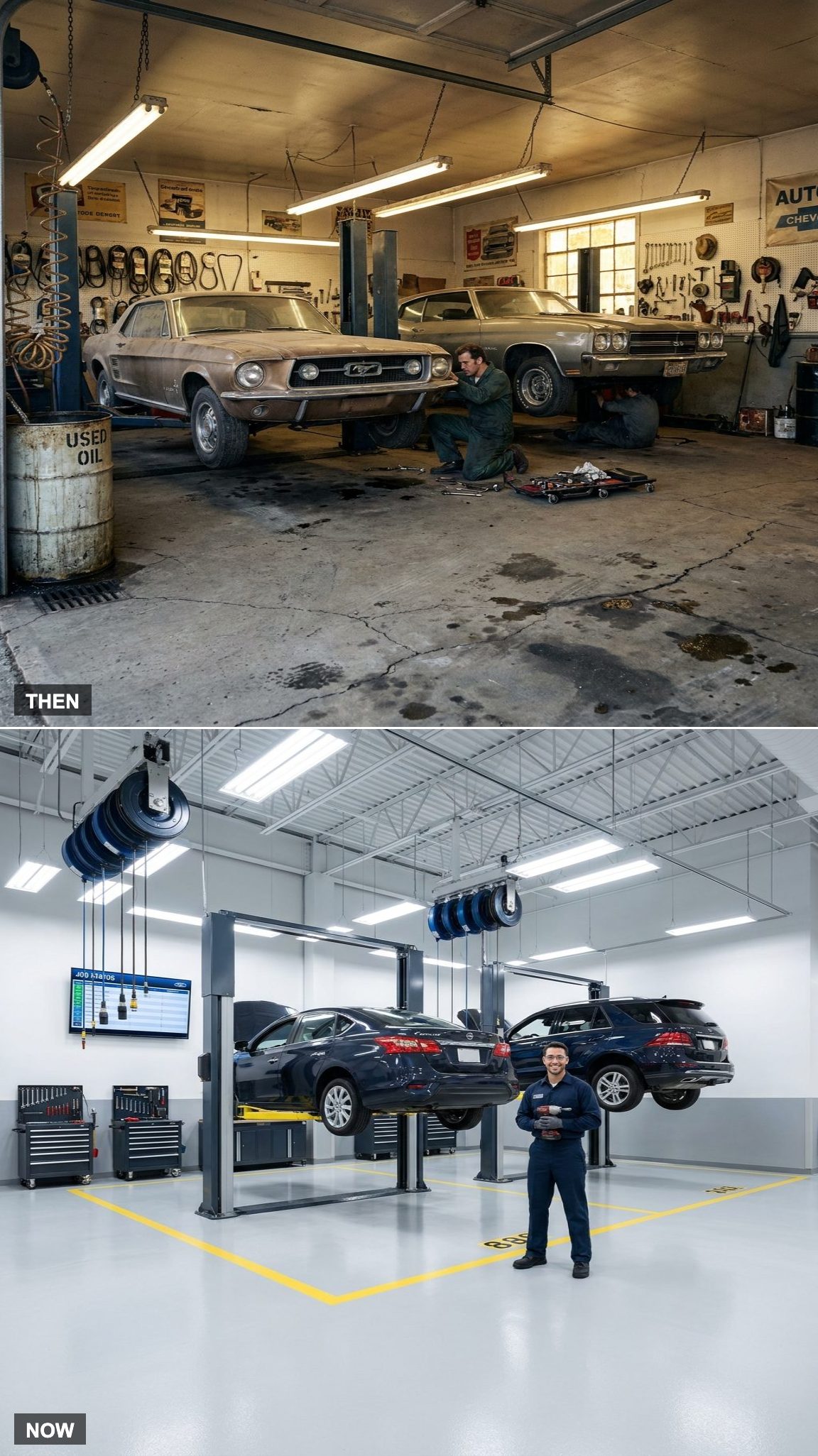
The 1970 bay was organized chaos, heavy on the chaos. Cars sat on ramps or over a greasy pit, tools lived wherever the last job left them, and the floor drain caught whatever ran off. You navigated by memory and the occasional shin bruise.
The modern bay is painted, striped, and fitted with retractable hose reels, while tools return to clearly marked storage. Better place to work. Worse place to tell a story about.
30. Hydraulic Vehicle Lifts
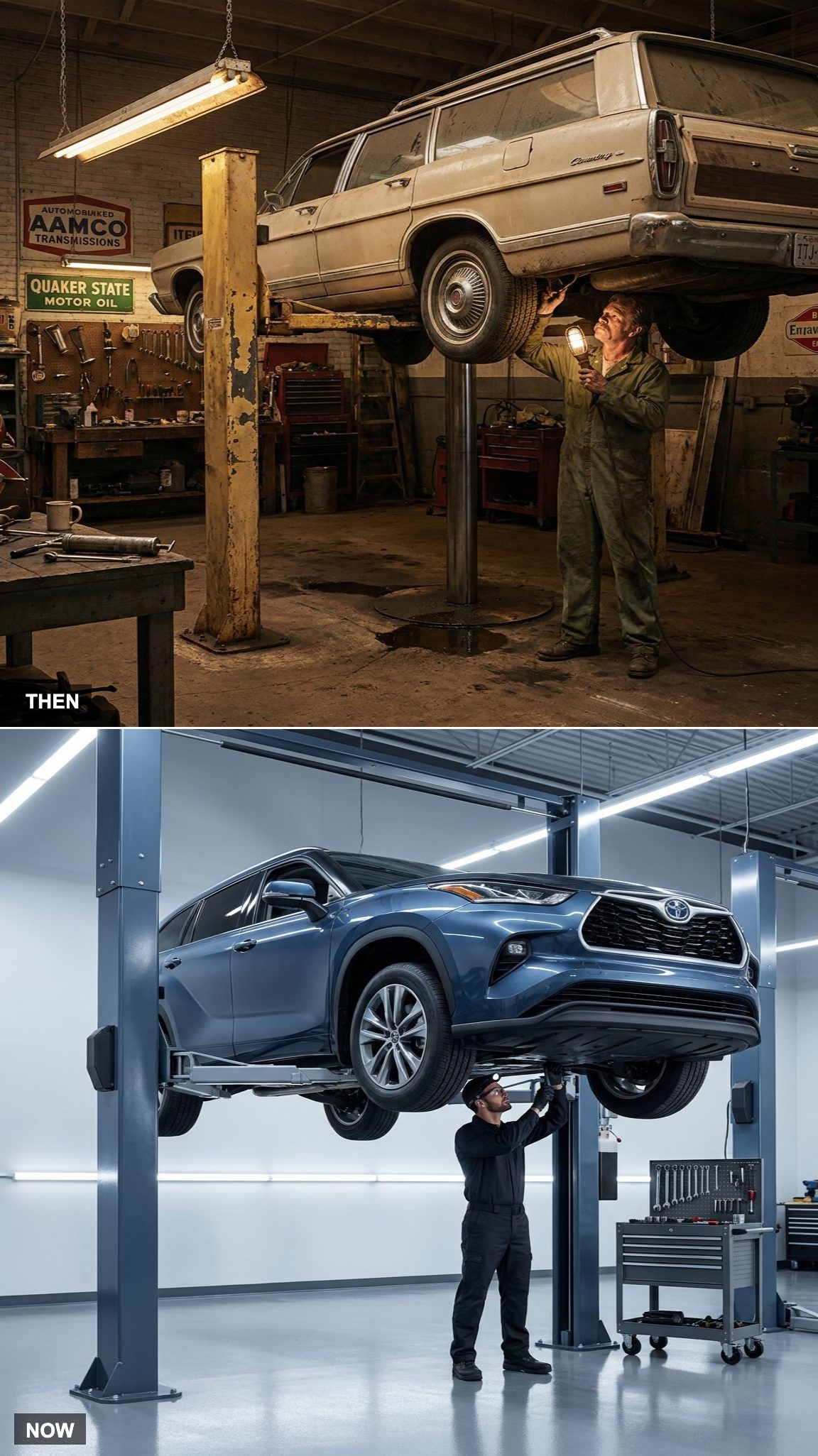
That old single-post lift hoisted the whole car on one greasy center pole, and it always looked like it was thinking about tipping. It never did, usually. Fluid wept from the base while you balanced the car and hoped.
Today’s two-post lift supports the vehicle at four specified pickup points, with mechanical safety locks and all four wheels clear of the floor when the car is positioned correctly. The hardware finally caught up with the confidence, which is a nice thing to say about a machine that holds two tons over your head.
29. Mechanic’s Tool Chests
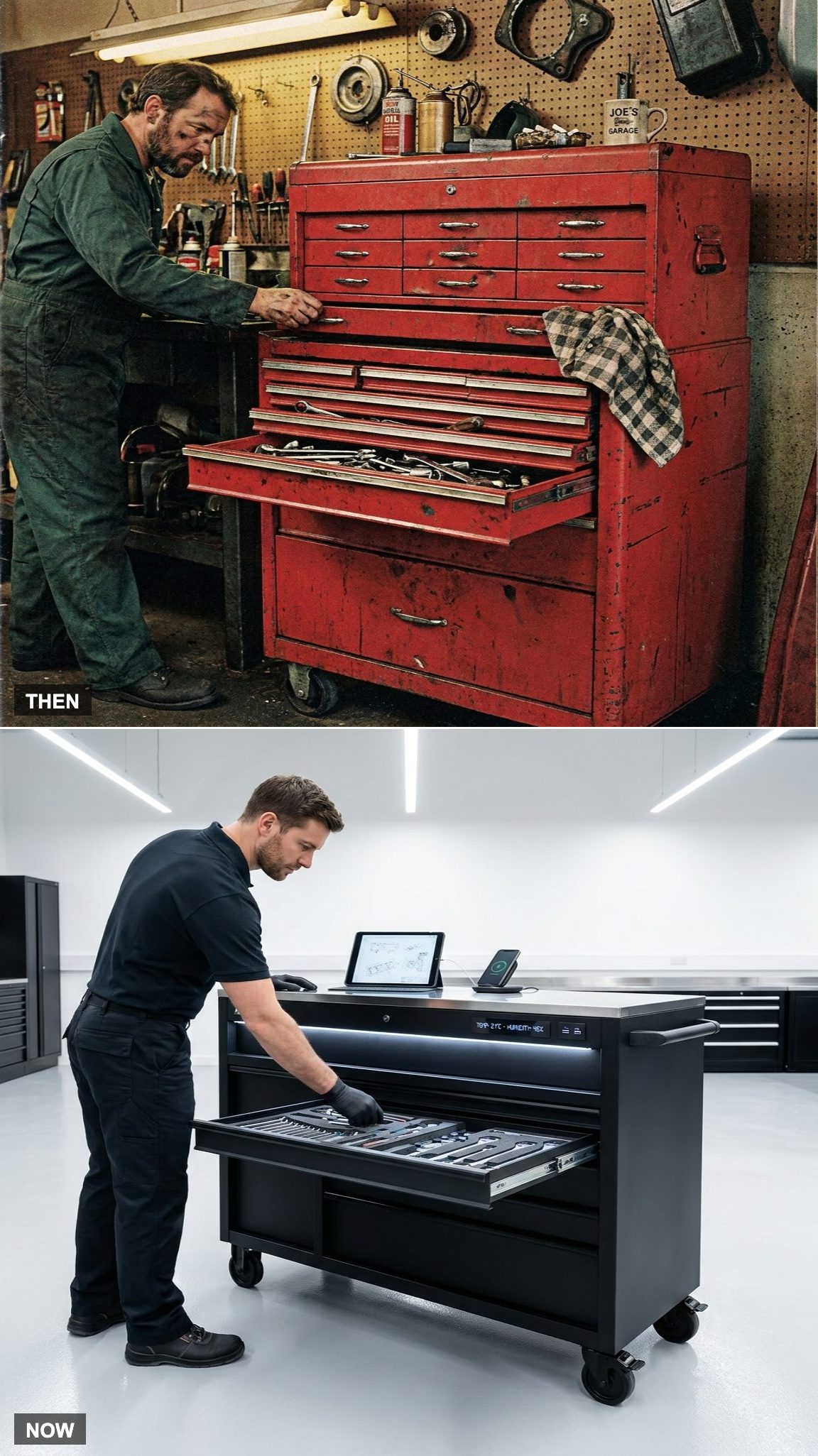
A mechanic’s tool chest in 1970 was a battered red steel box, drawers rattling with loose sockets, the chrome dulled by decades of grease. The dents were a résumé. You could read a man’s whole career in the chips on the paint.
The modern chest? A matte-black monument with soft-close drawers, foam cutouts for every wrench, a stainless top, and USB ports to charge your tools. It’s beautiful. It also costs more than the mechanic’s first car.
28. Workbenches and Repair Stations
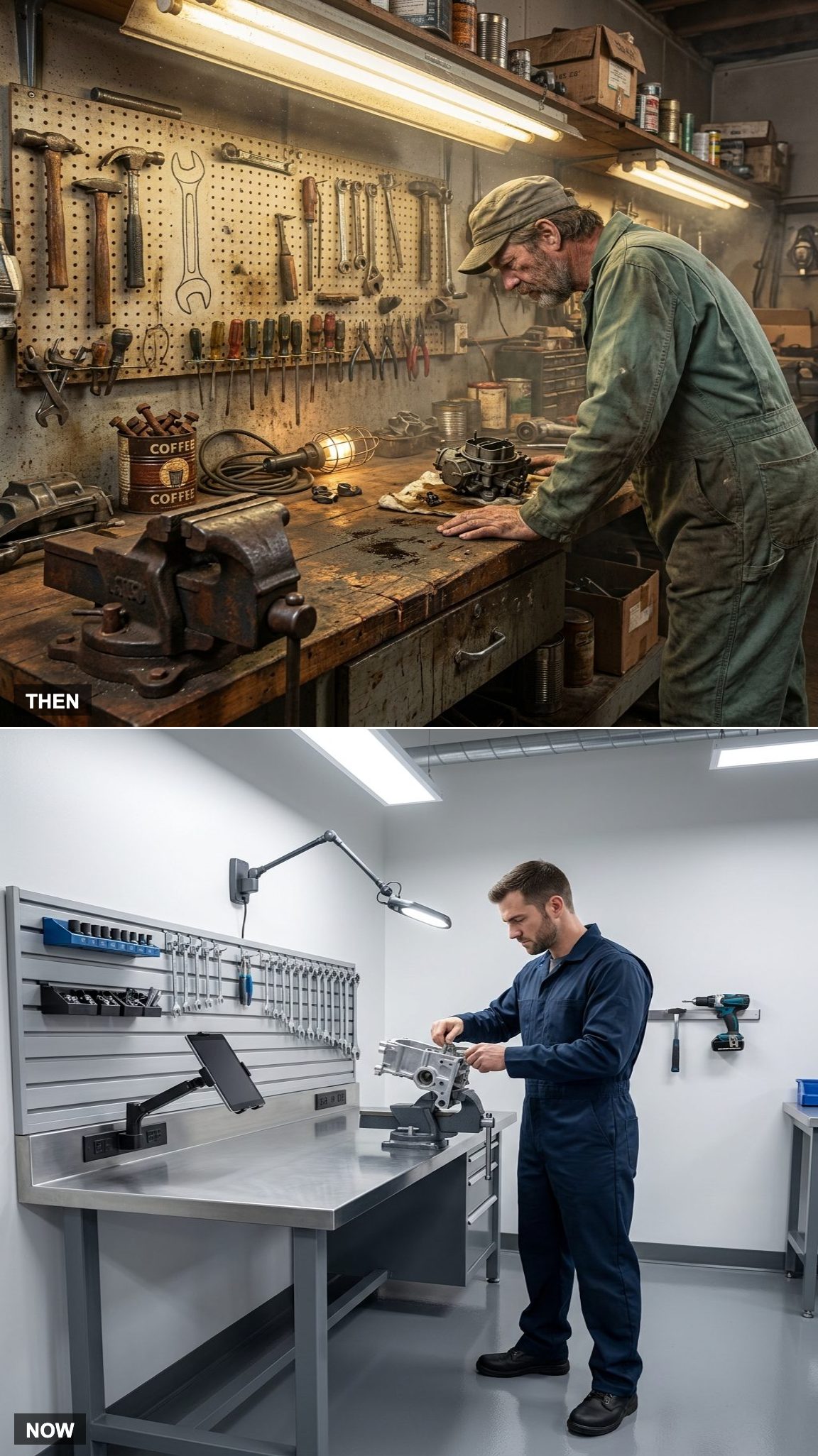
The old bench was a slab of oak-topped abuse, scarred by every job it ever held, anchored by a cast-iron vise you could bend a frame in. Bolts lived in a coffee can. The pegboard behind it had tool outlines drawn in marker so you knew at a glance what had walked off.
Now the station is stainless and slatwall, with outlets built into the top and a tablet propped where the coffee can used to sit. Efficient. Wipeable. It arrives without a single burn mark, and somehow that feels like a small loss.
27. Engine Hoists and Cranes
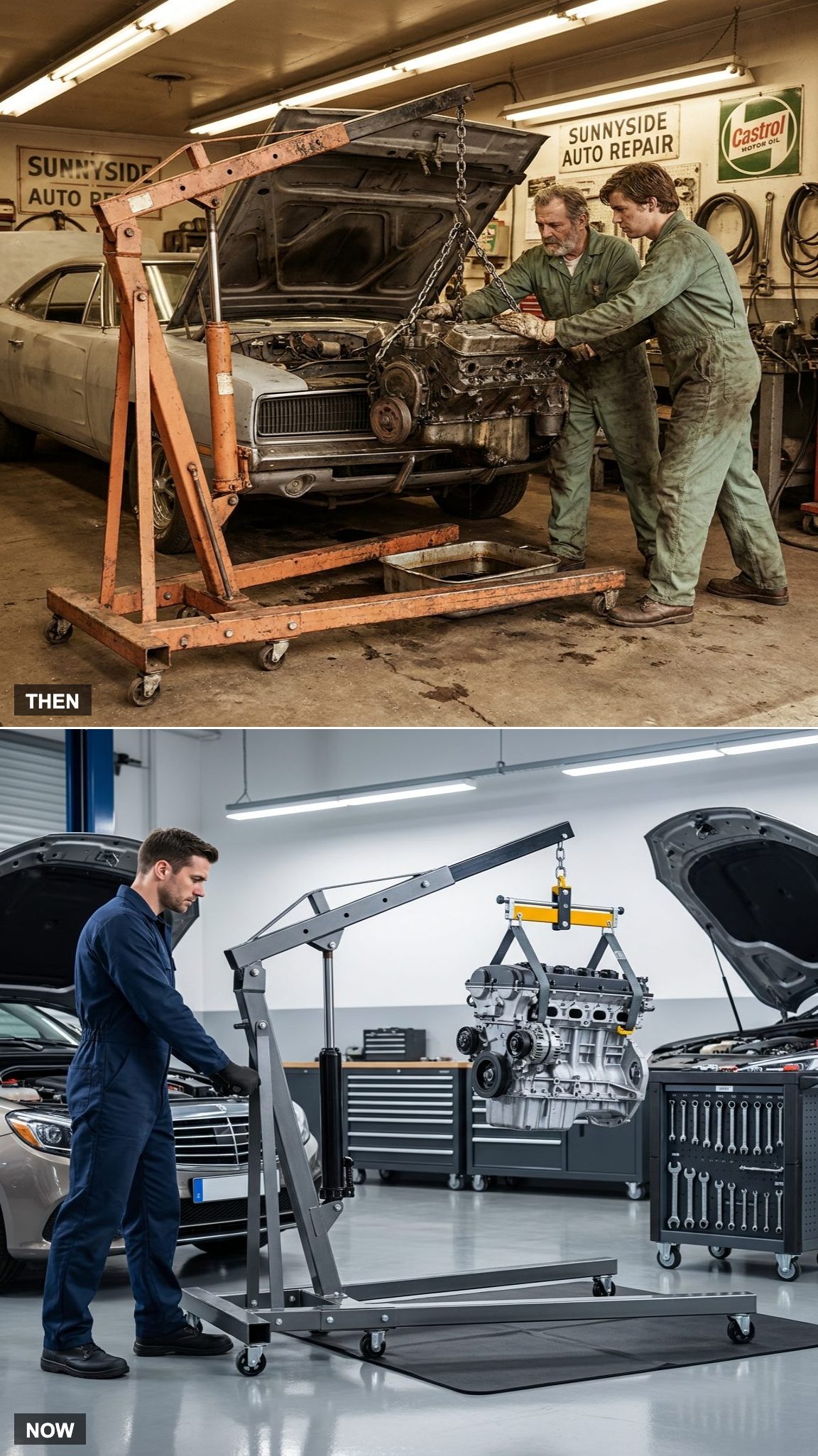
Pulling an engine in 1970 was a two-man ritual with a rusty orange cherry-picker and a chain that swung the block like a wrecking ball. You cranked the handle, held your breath, and guided a dripping V8 out by hand.
The modern crane can fold flat when the job is done, and a load leveler can keep an aluminum-block engine under far better control. Safer, tidier, and a lot less swearing involved.
26. Diagnostic Equipment
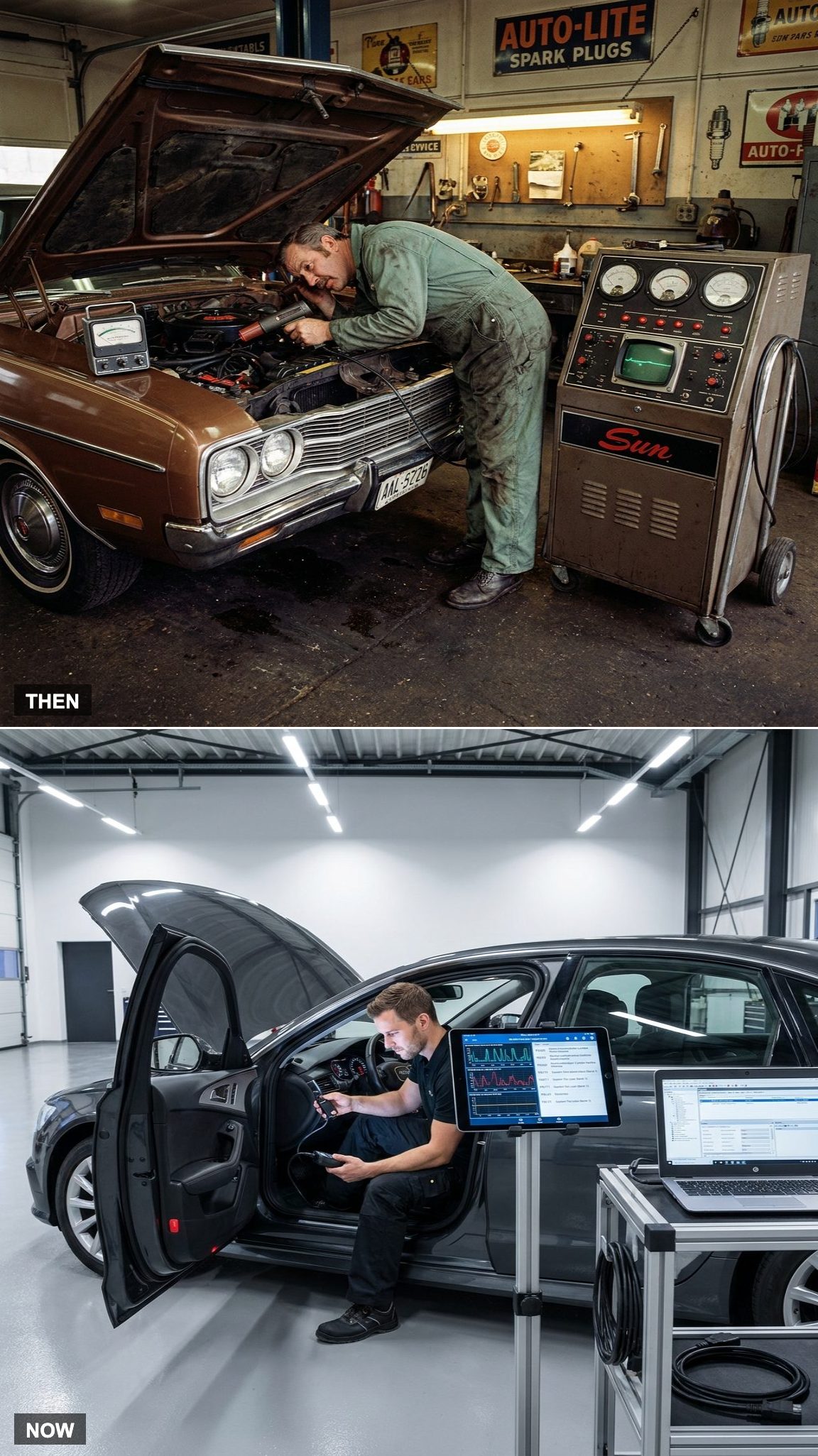
Diagnostics in 1970 meant a good ear and a timing light. The mechanic leaned over your running engine, listened, felt the vibration through the fender, and told you what was wrong. Sometimes he beat any machine that came after him.
Now a technician plugs into the port under the dash and uses fault codes and live data to narrow the search considerably. Remarkably useful. It’s also stolen a bit of the mystery, and the guy who could diagnose a miss by sound alone is a dying breed.
The car used to whisper its problems to a man who knew how to listen. Now it just texts them to a tablet.
25. Tune-Up Machines
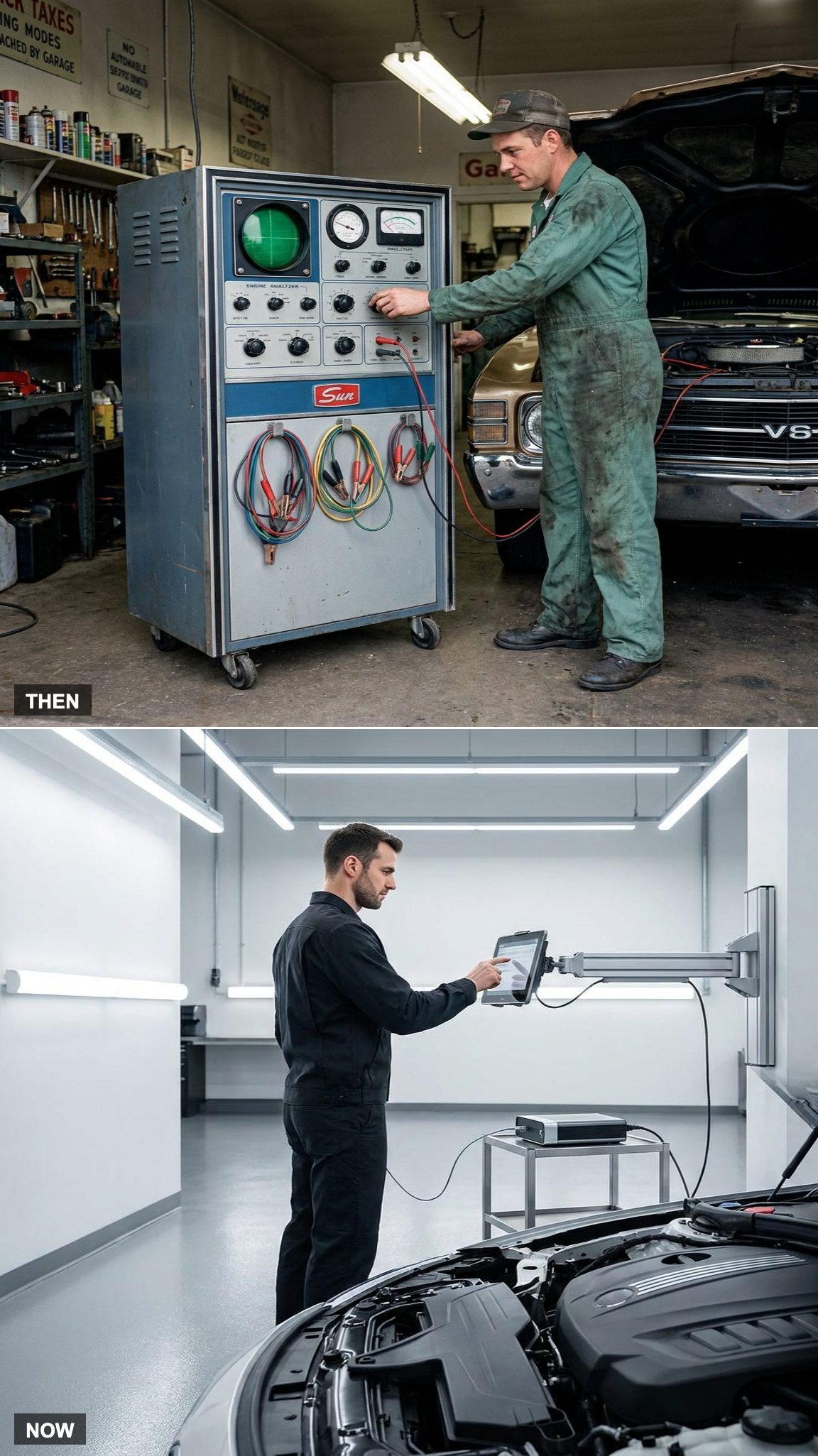
The tune-up machine was the pride of the shop, a rolling console the size of a jukebox with a glowing green oscilloscope and more knobs than a submarine. A tangle of colored leads clamped onto your distributor and plugs, and the mechanic read the waveforms like a heart monitor.
All of that lives inside a tablet now. Points and dwell largely disappeared with electronic ignition, while computerized engine management moved much of the remaining diagnostic work onto a cable and touchscreen. Progress, sure. But that green screen had presence.
24. Wheel Alignment Equipment
Would you like to save this?
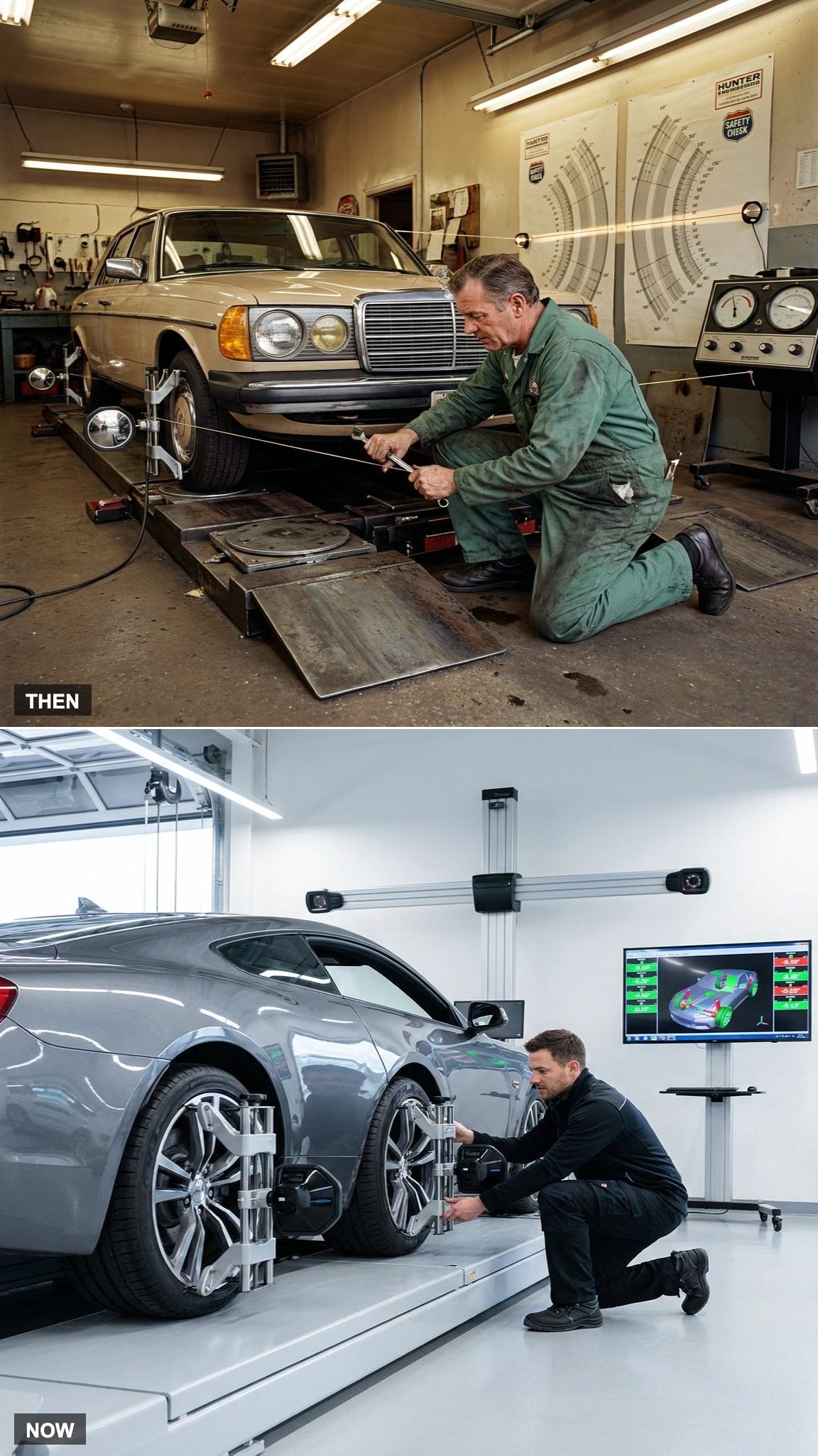
Aligning wheels in 1970 was part carpentry, part optics. Turntables under the front tires, gauges with bubble levels clamped to the wheels, light beams thrown onto printed charts on the wall. The mechanic knelt beside the turntables, adjusting tie rods while watching the gauges and projected marks.
Now cameras read reflective targets on all four wheels and paint a live 3D model of your car’s geometry on a big screen. Green means good, red means turn the wrench. Faster and more precise, no bubble levels required. Still a satisfying job to watch.
23. Tire Changers and Balancers
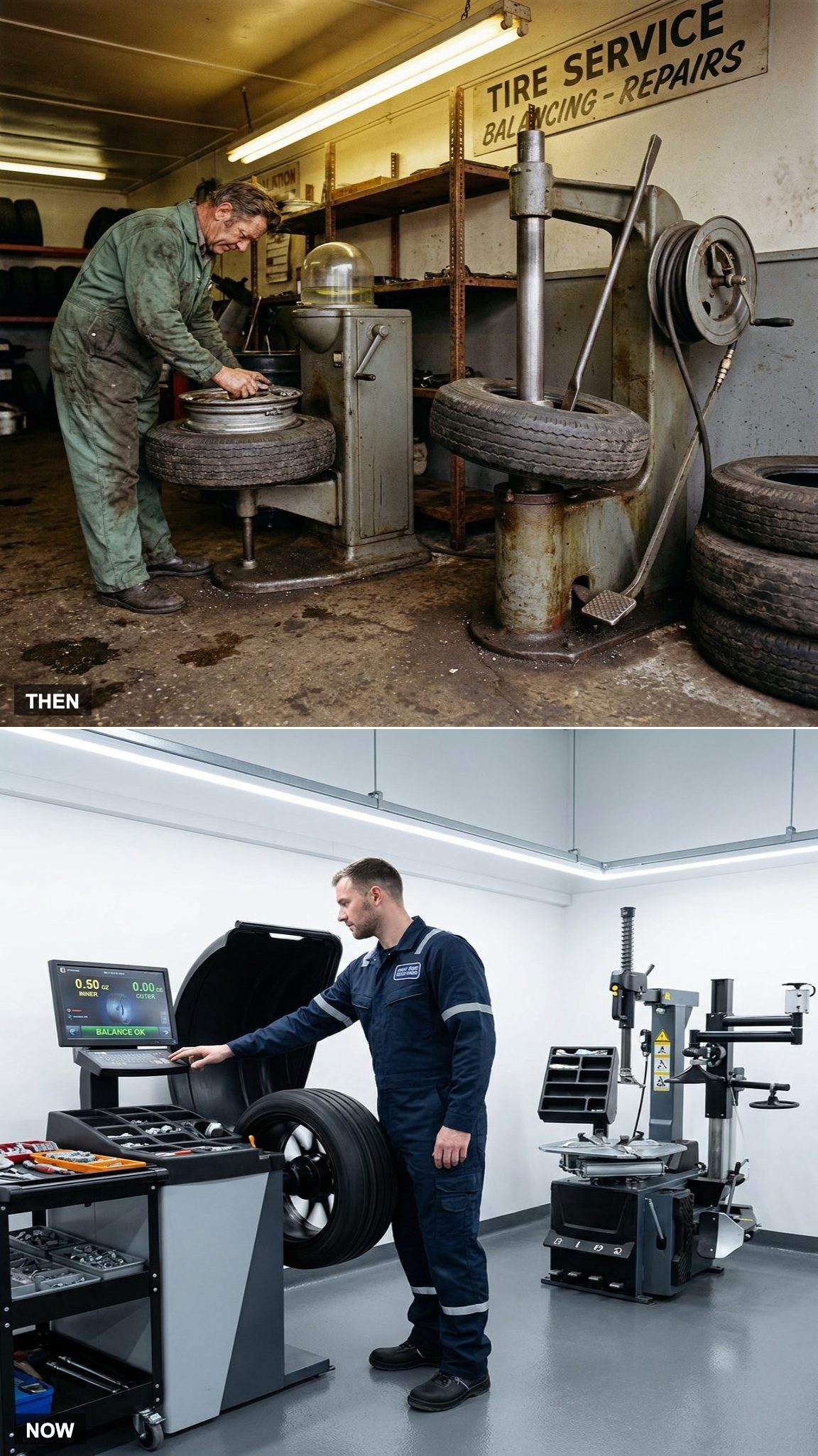
Changing a tire in 1970 was a knuckle-busting arm-wrestle with a long steel pry bar and a foot-stomp bead breaker. Balancing came down to the bubble level: spin the wheel flat, watch the little bubble drift, hammer on lead weights until it centered. Half art, half brute force.
The modern spin balancer whirls the wheel and shows exactly where the weight belongs and how much to add, while pneumatic arms do most of the wrestling. Your knuckles thank the engineers. And somewhere, an old-timer is grumbling that a bubble balancer never needed a wall outlet.
22. Air Compressor Systems: The Iron Beast in the Corner
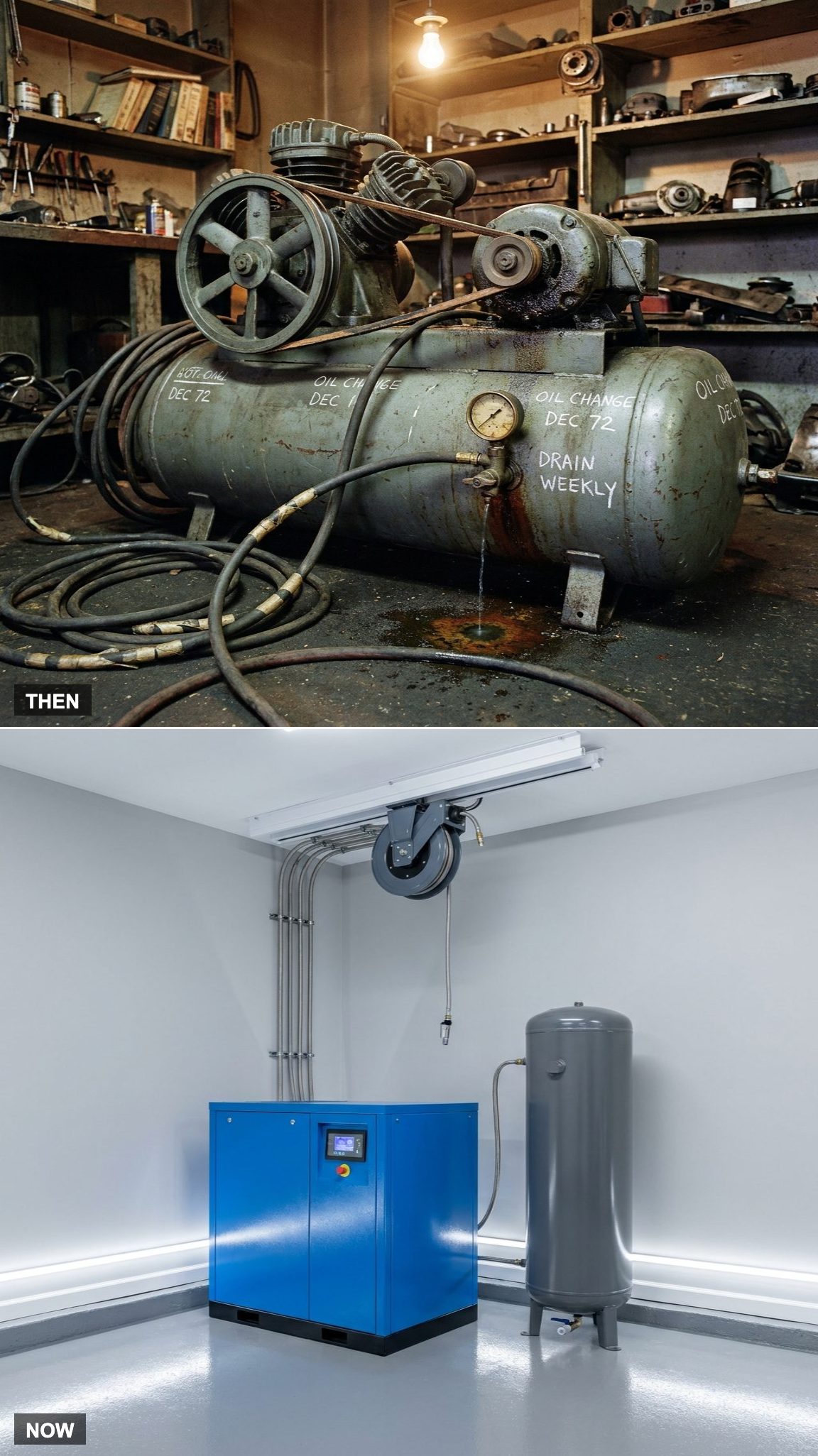
In 1970 the compressor announced itself. That belt-driven cast-iron unit thumped like a heartbeat, kicked on without warning, and hissed air through cracked hoses everybody tripped over. You drained the tank by hand or you didn’t, and the puddle of rusty water underneath told you which mechanics forgot.
A modern system barely whispers—sealed in a cabinet, monitoring its own operation and emptying condensate on a timer. Quieter, cleaner, smarter. Honestly? I miss the thump a little. It meant the shop was awake.
21. Parts Storage: From Greasy Bins to Barcoded Racks
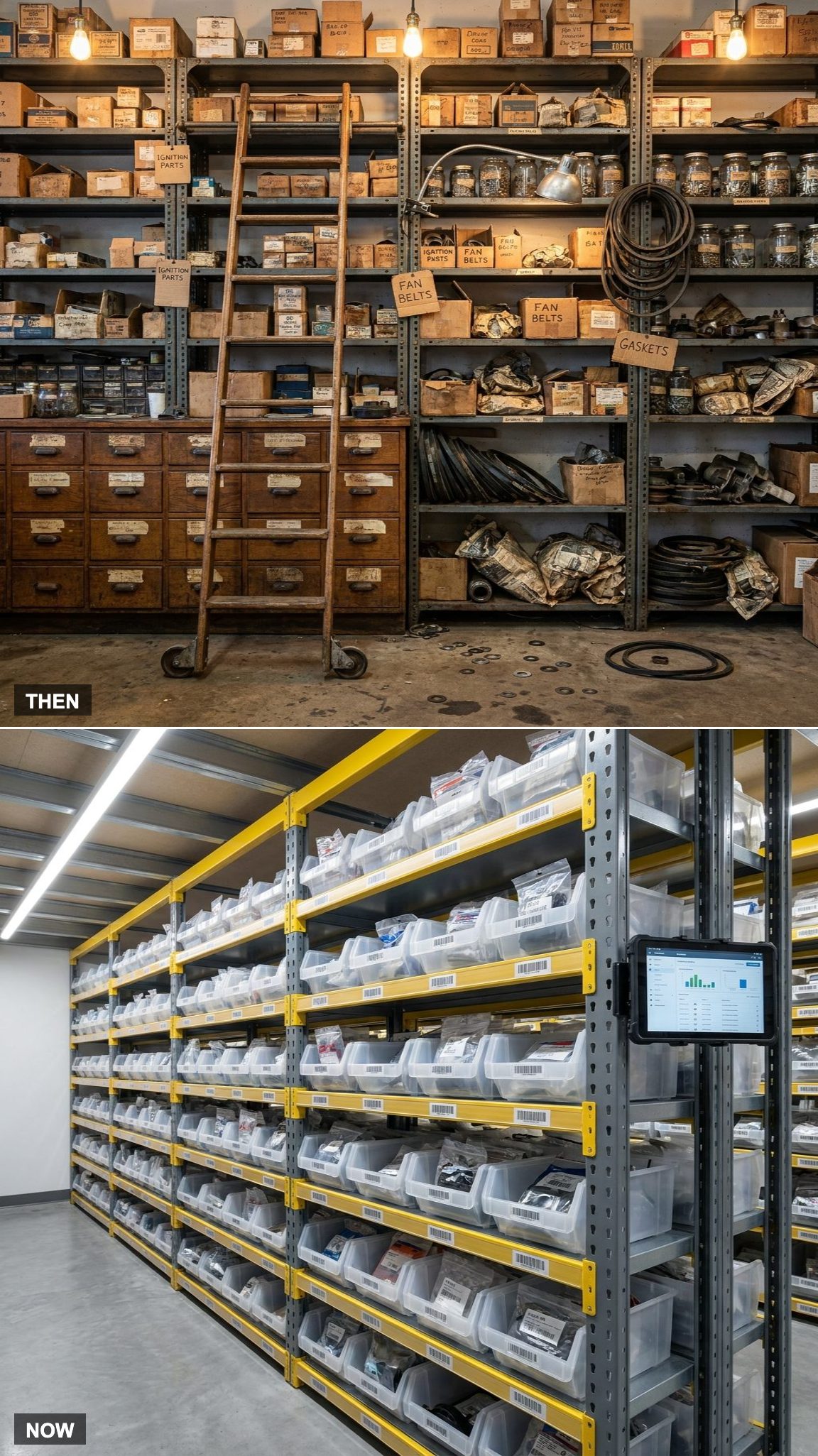
The old parts wall ran on memory and grease pencil. Somebody knew the tie-rod ends lived in the third bin from the left, behind the box of wiper arms nobody had touched since Nixon. Lose that guy and you lost the whole system.
Now a barcode scanner and tablet know where everything is, right down to the shelf. Faster, sure. But there’s no old-timer squinting at a handwritten tag anymore, and something got quieter when that went away.
20. The Oil Change Bay: Drain Pans and Dipsticks
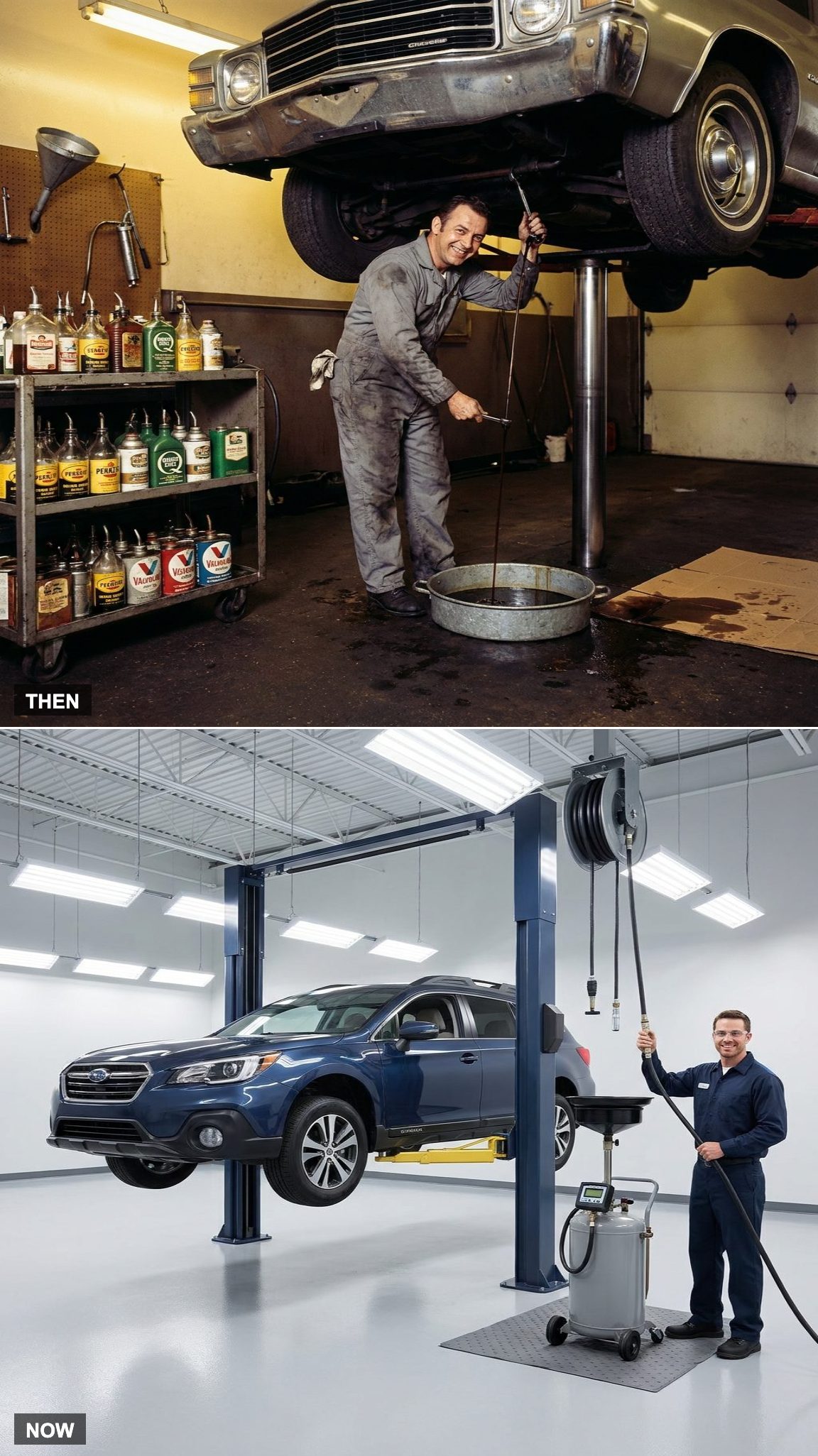
An oil change in 1970 meant a flat galvanized pan, quart cans lined on the shelf, and the certainty that some of that black oil was going on the floor no matter how careful you were. Check the dipstick, wipe it on your leg, check it again.
Today the oil comes off a bulk reel and the drain evacuates into a wheeled tank with a digital readout. Cleaner floors, faster turnaround. The ritual survived. The mess mostly didn’t.
19. Battery Testing: The Load Tester That Sparked
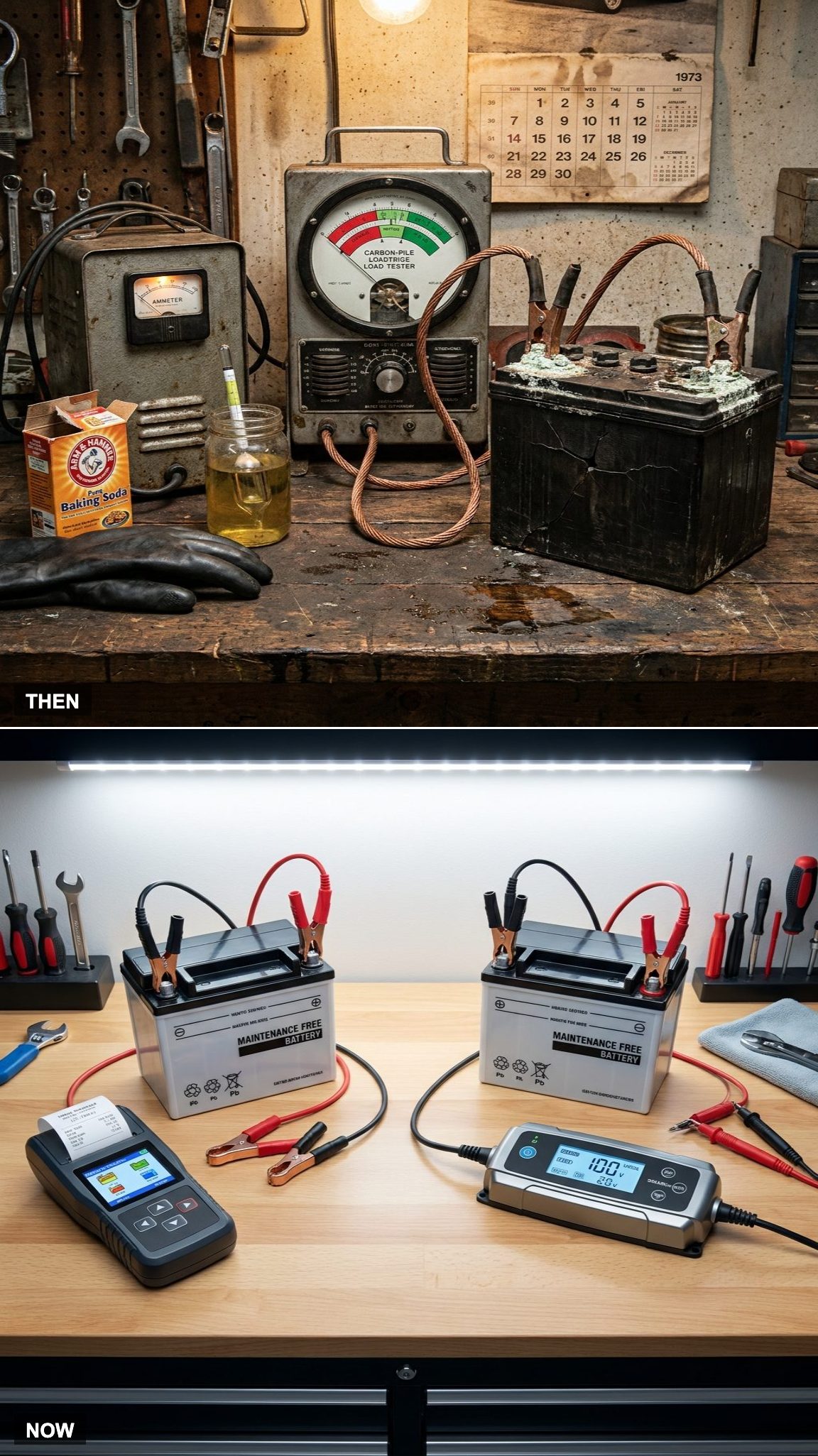
Testing a battery used to be a small act of bravery. You clamped the carbon-pile tester’s cables on, held the load, and watched the needle drop while the whole thing got hot enough to smell. A hydrometer told you cell by cell whether the thing was cooked, and acid on your knuckles was just Tuesday.
Now a mechanic clips on a handheld analyzer, waits a few seconds, and gets a result on-screen or on a printed slip. No smell, no spark, and much less guessing. I’ll admit the digital readout is better. Just not as fun to watch.
18. Welding and Fabrication: Sticks, Sparks, and Soapstone
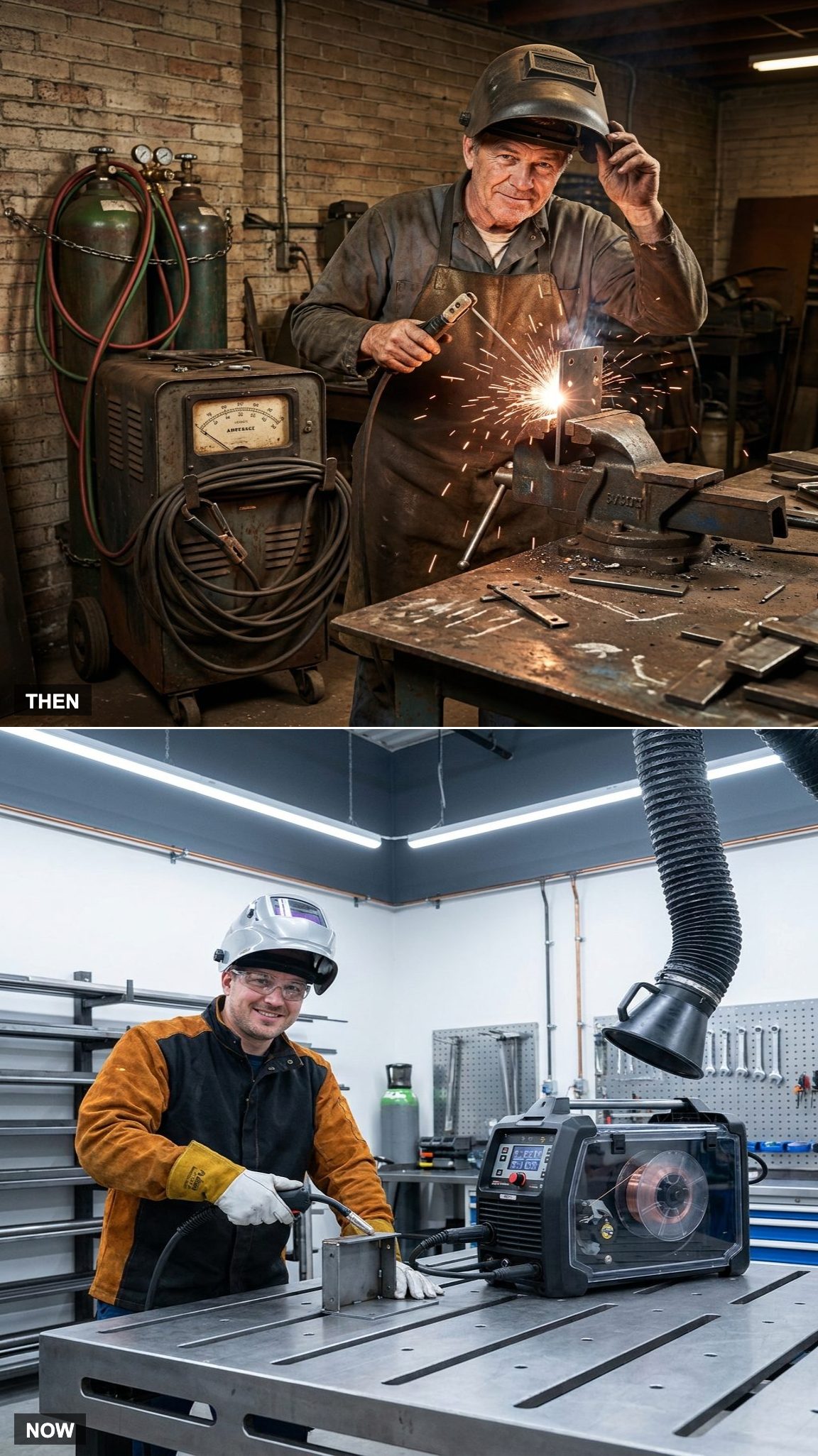
Fabrication in 1970 was arc welders that hummed like power lines, flip-front hoods you nodded down at the last second, and soapstone lines drawn straight by eye. The oxy-acetylene rig chained to the wall handled the cutting and the bending. You learned to read the puddle because nothing told you but your own eyes.
The rig running now is a compact MIG unit with a digital dial, an auto-darkening lens that goes black on its own, and a fume arm drawing welding fumes away before they reach your lungs. Safer, steadier, cleaner welds. Same sparks, though—those never went out of style.
17. Shop Flooring: Oil-Soaked Concrete to Sealed Epoxy
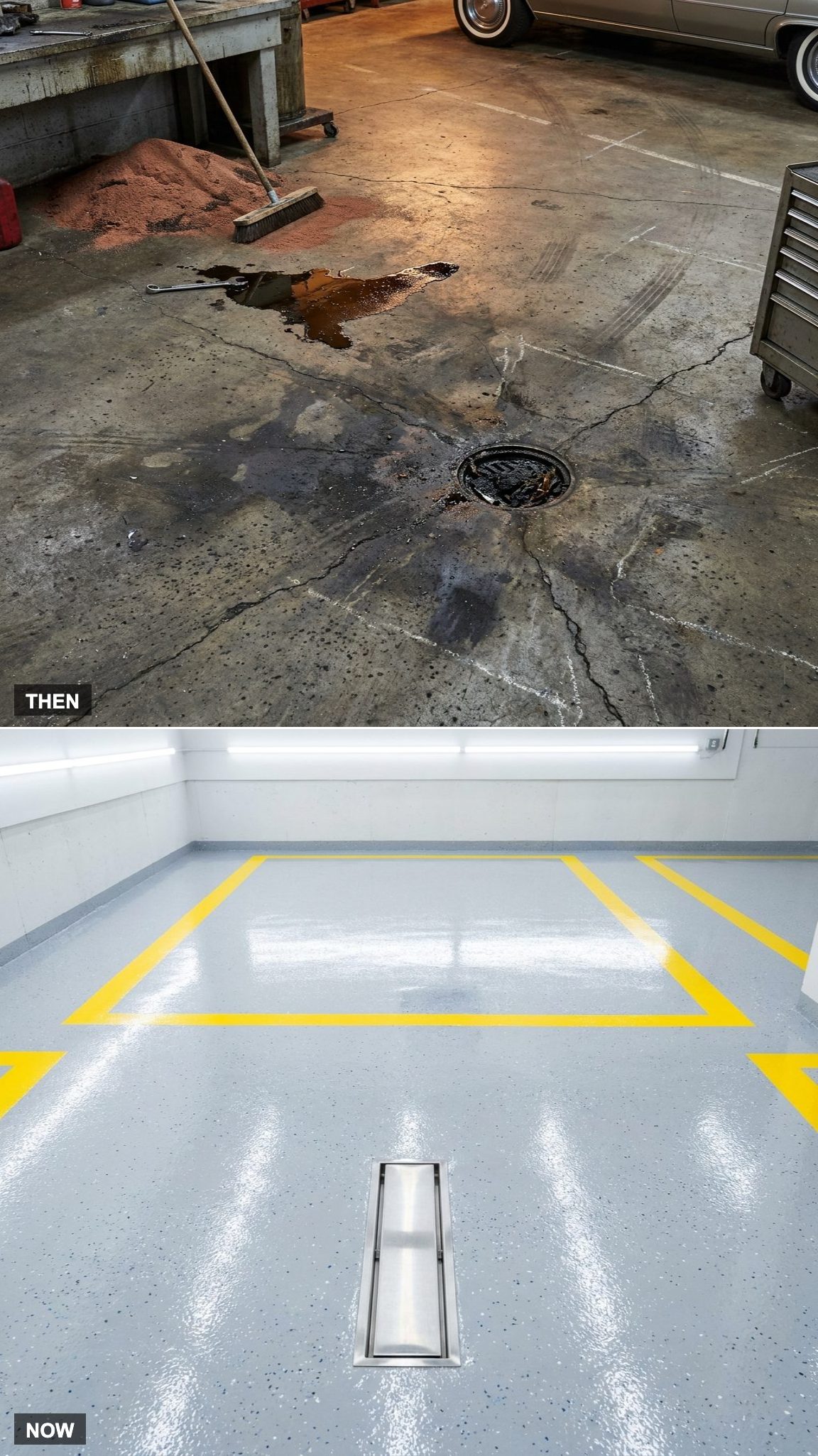
The old shop floor was a map of everything that ever leaked on it. Bare concrete gone black, cracked where the frost heaved it, a red pile of oil-dry sweeping compound in the corner doing what it could. You could smell that floor. Not a compliment.
Now it’s sealed epoxy with a fleck finish, painted safety lines, and a mop that actually works because nothing soaks in anymore. Cleaner, safer, easier on the knees—and it throws the light back up at you, which makes the whole place feel twice as big.
16. Shop Lighting: Bare Bulbs and Drop Cords
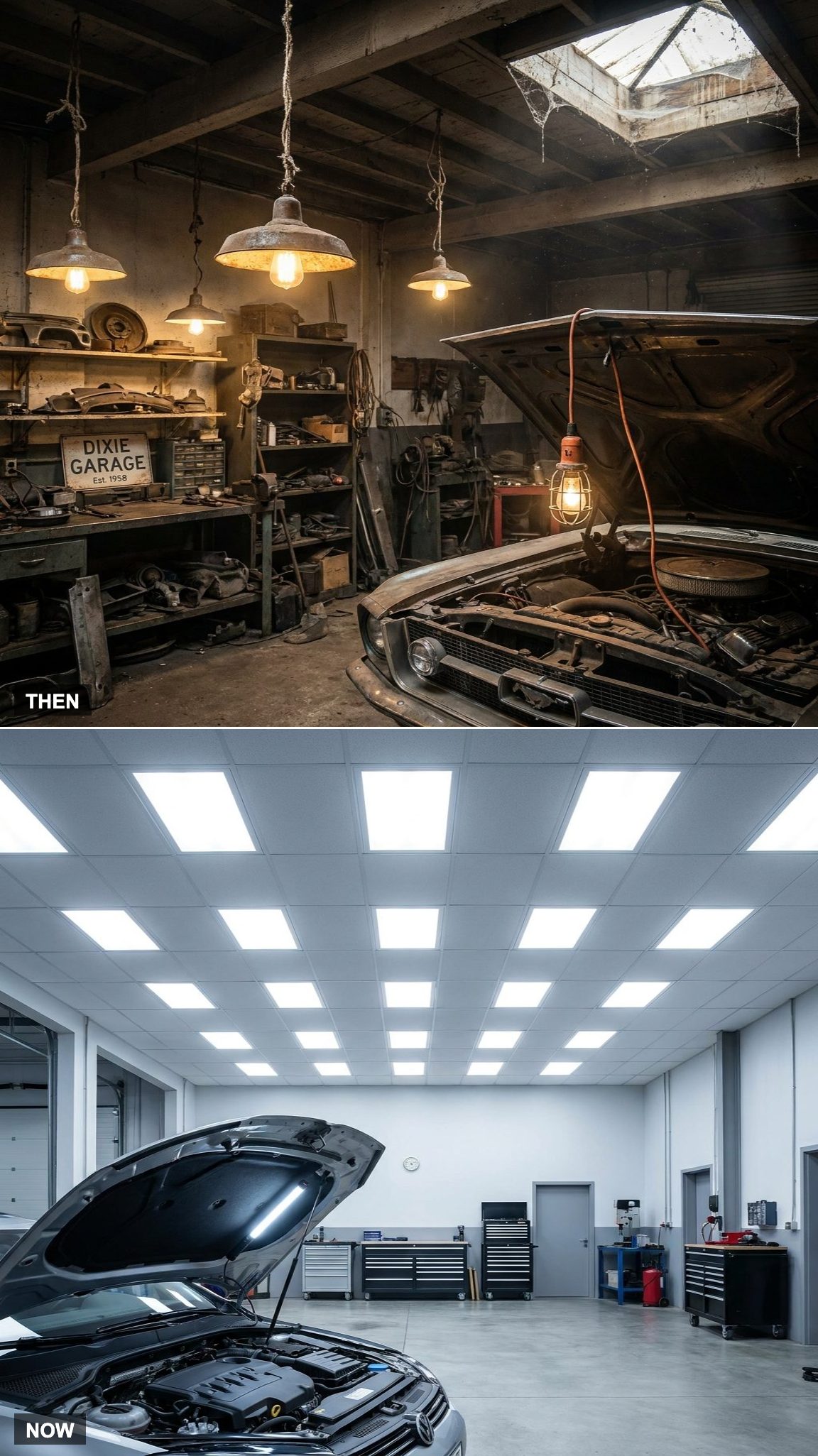
Light in 1970 came in puddles. A handful of bare bulbs in tin reflectors, a caged drop-light on an orange cord that always ran out of reach, and a lot of squinting into shadow with a flashlight in your teeth. Half the shop sat in brown dusk at any given hour.
LED high-bays changed that. More even, cool light from corner to corner, plus a rechargeable work light that hooks anywhere with no cord to snag. You can finally see the color of a wire.
15. Mechanic Uniforms: Gray Coveralls and Rag in the Pocket
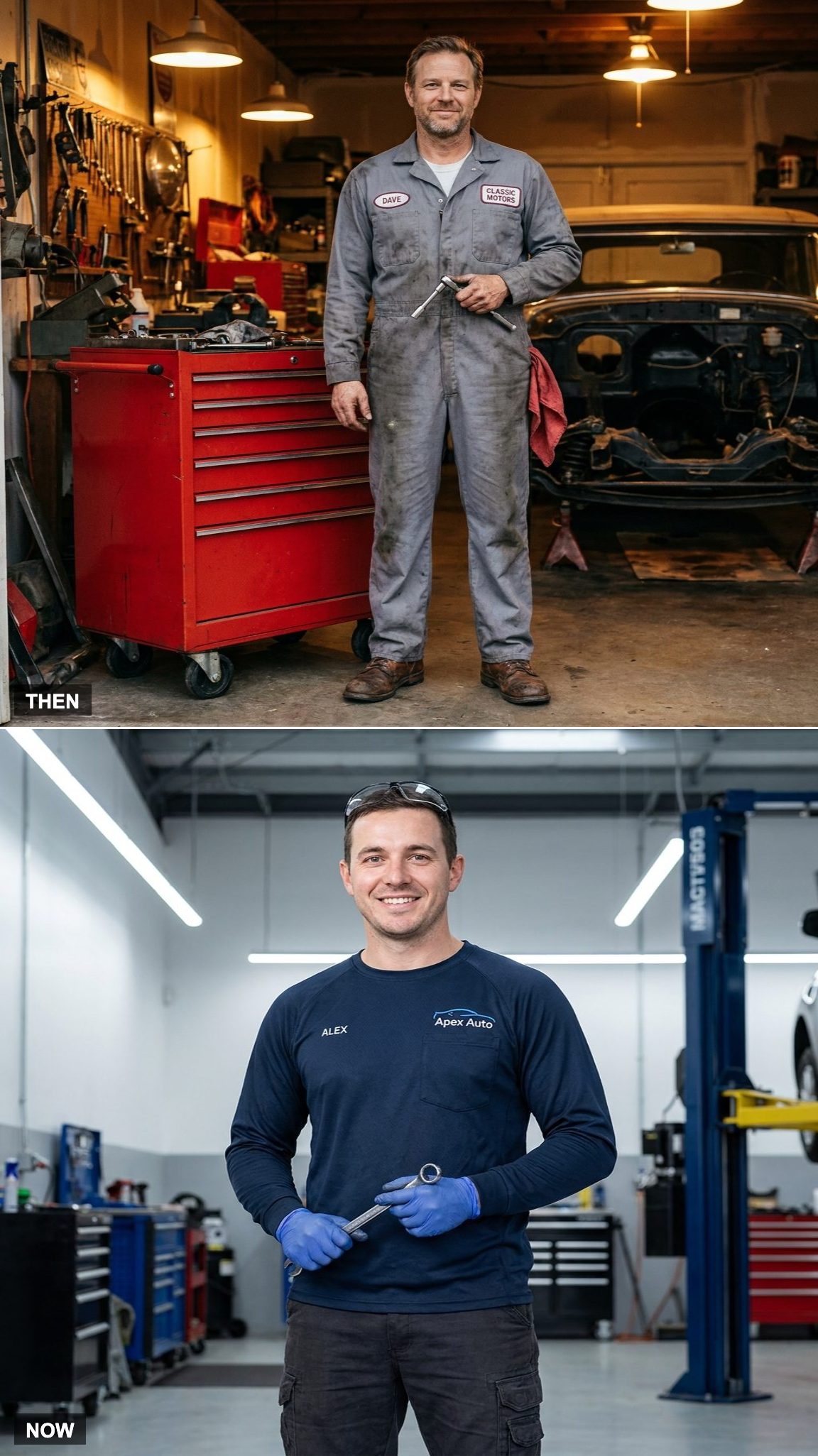
The 1970 mechanic wore gray cotton coveralls with an oval name patch stitched on the chest, snaps down the front, and a red rag in the back pocket that was never quite clean. The grease worked into the knees permanently. That same rig showed up at every station and shop in the country, and that was exactly the point.
Today it’s a navy work shirt in stretch fabric that breathes, cargo pants, slip-resistant shoes, and boxes of disposable nitrile gloves. More comfortable, easier to launder. But nothing said “this person can fix your car” quite like those old coveralls.
14. Safety Gear: Rolled Sleeves to Task-Specific PPE
Would you like to save this?
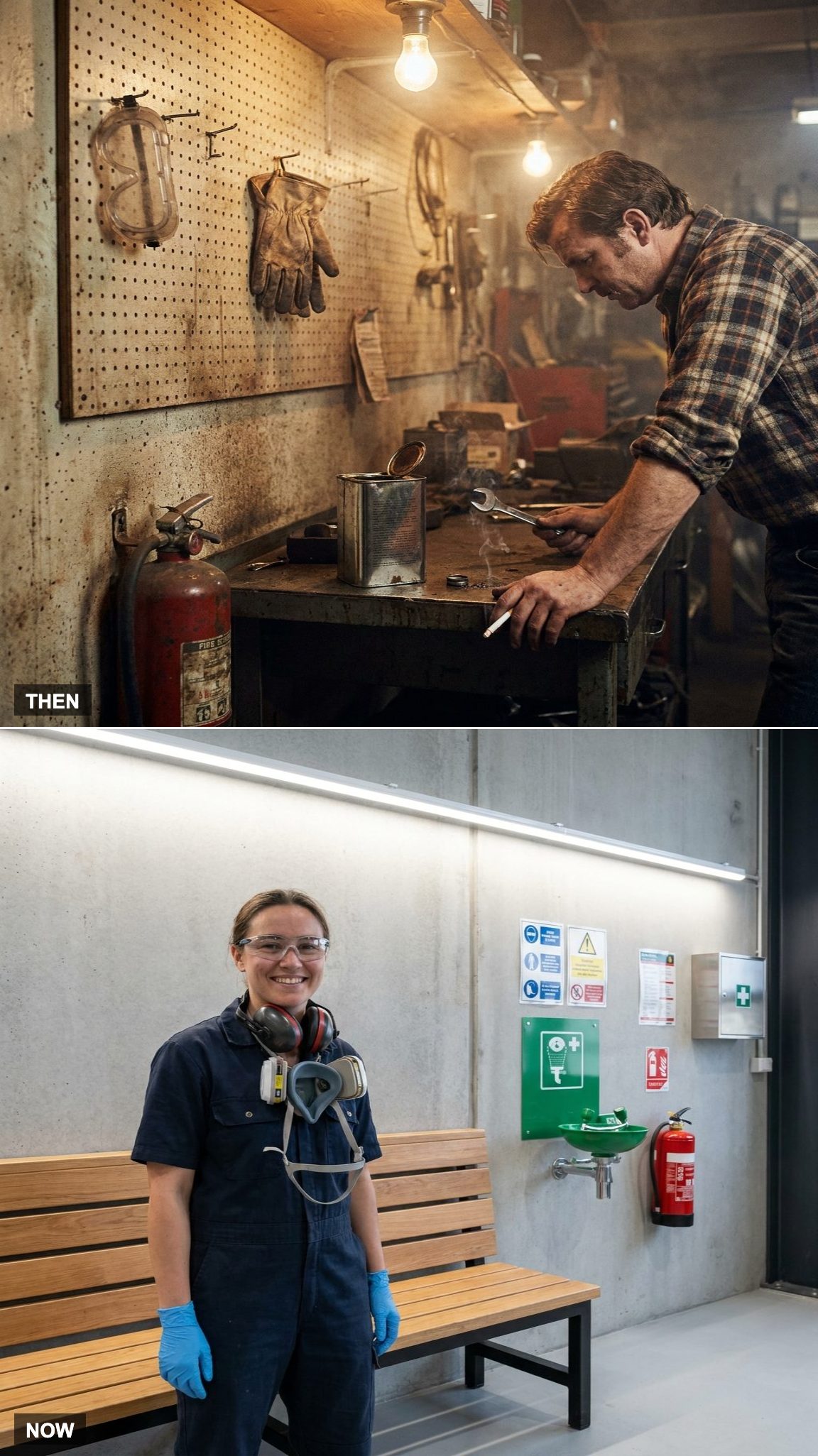
Safety in 1970 was mostly a suggestion. Sleeves rolled up, a cigarette burning on the bench next to the solvent, one dusty pair of goggles hanging on a nail nobody bothered to put on. Something flew at your eye, you were fast or you were unlucky.
Now it’s wraparound glasses, nitrile gloves, ear protection, an eyewash station bolted to the wall, and a respirator for the nasty jobs. Less romantic. A lot more people keeping both eyes and all ten fingers, which turns out to matter more than romance.
13. Repair Information: Printed Manuals vs. Searchable Databases
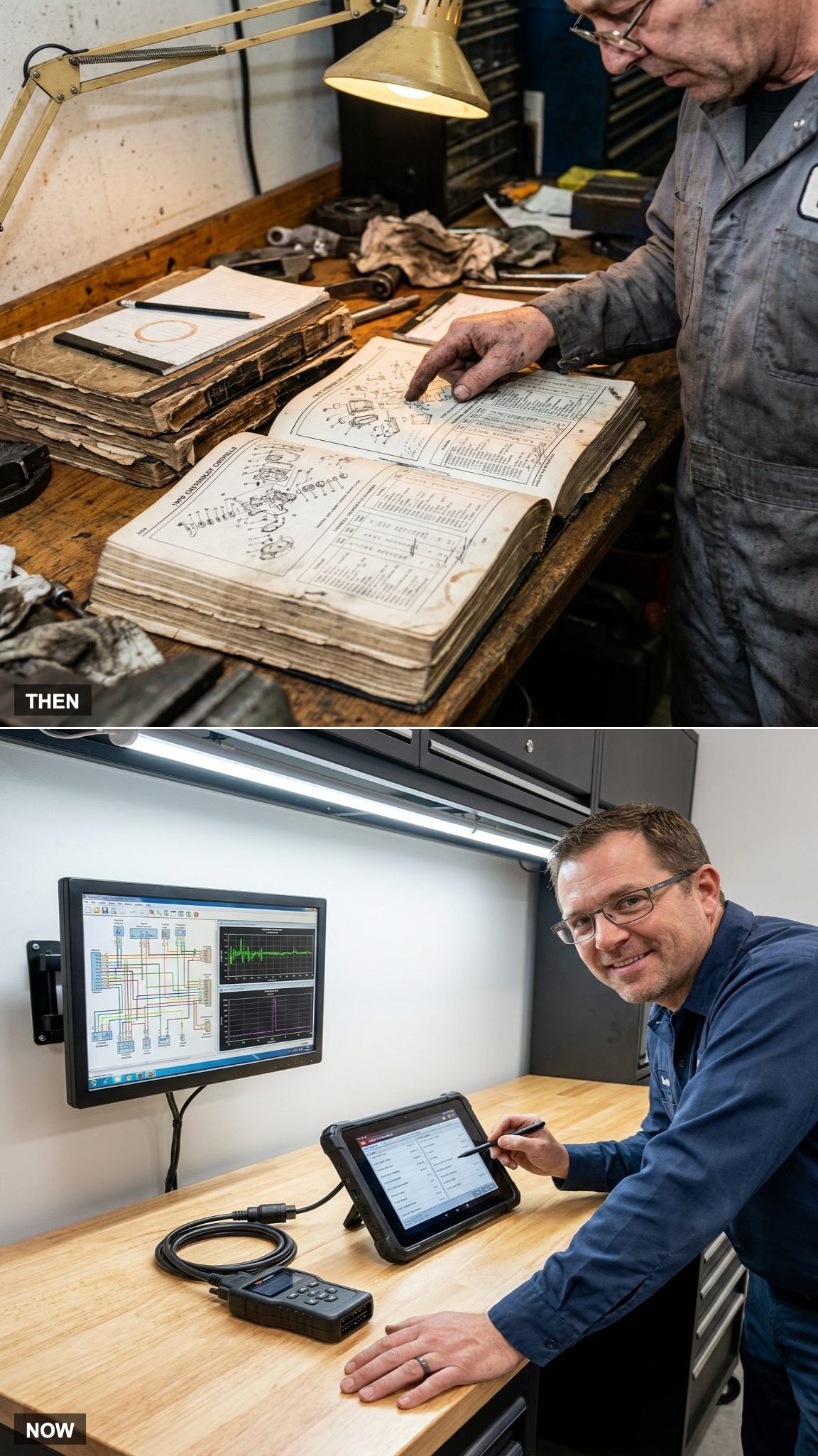
Repair information in 1970 lived in thick factory manuals, wiring books, parts catalogs, and service bulletins. Exploded diagrams were traced with a greasy finger, torque specifications sat in dense tables, and useful corrections accumulated in the margins.
Today technicians search subscription databases for procedures, updated bulletins, wiring diagrams, labor times, and model-specific warnings. The information is easier to retrieve and revise, but it still takes experience to decide which page matters to the problem in front of you.
The old manual preserved the car as it left the factory. The database records everything learned about it afterward.
12. The Service Counter and Reception Desk
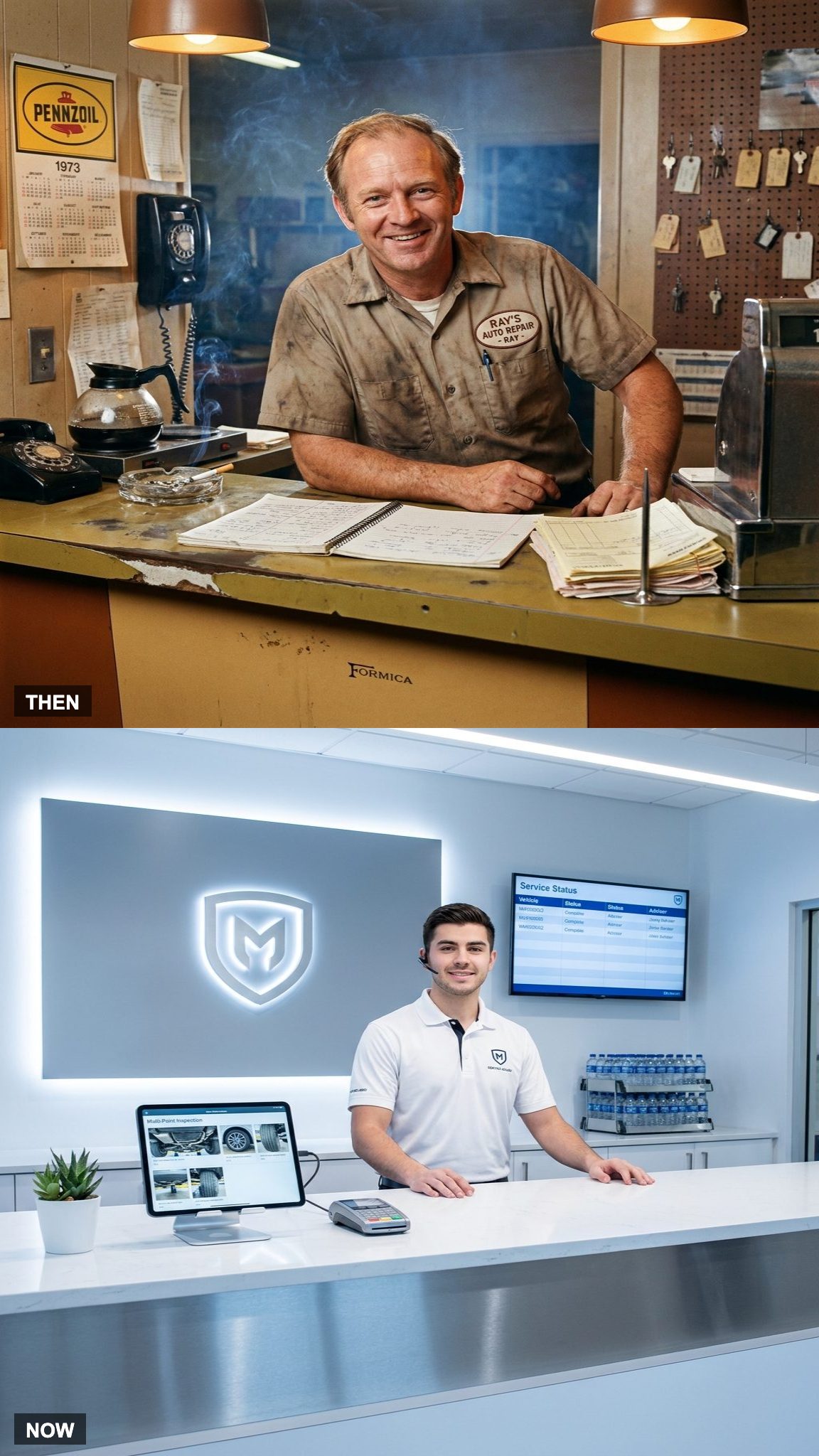
In 1970 the service counter smelled like coffee and cigarettes, and the guy behind it knew your car by its rattle. He wrote your name in a spiral notebook, quoted you off the top of his head, and stabbed your receipt onto a metal spike that had been there since Eisenhower.
Now it’s a quartz desk, a headset, and a tablet that emails you an inspection with photos before you have settled into the waiting room. Faster. Cleaner. A little colder.
11. The Customer Waiting Room
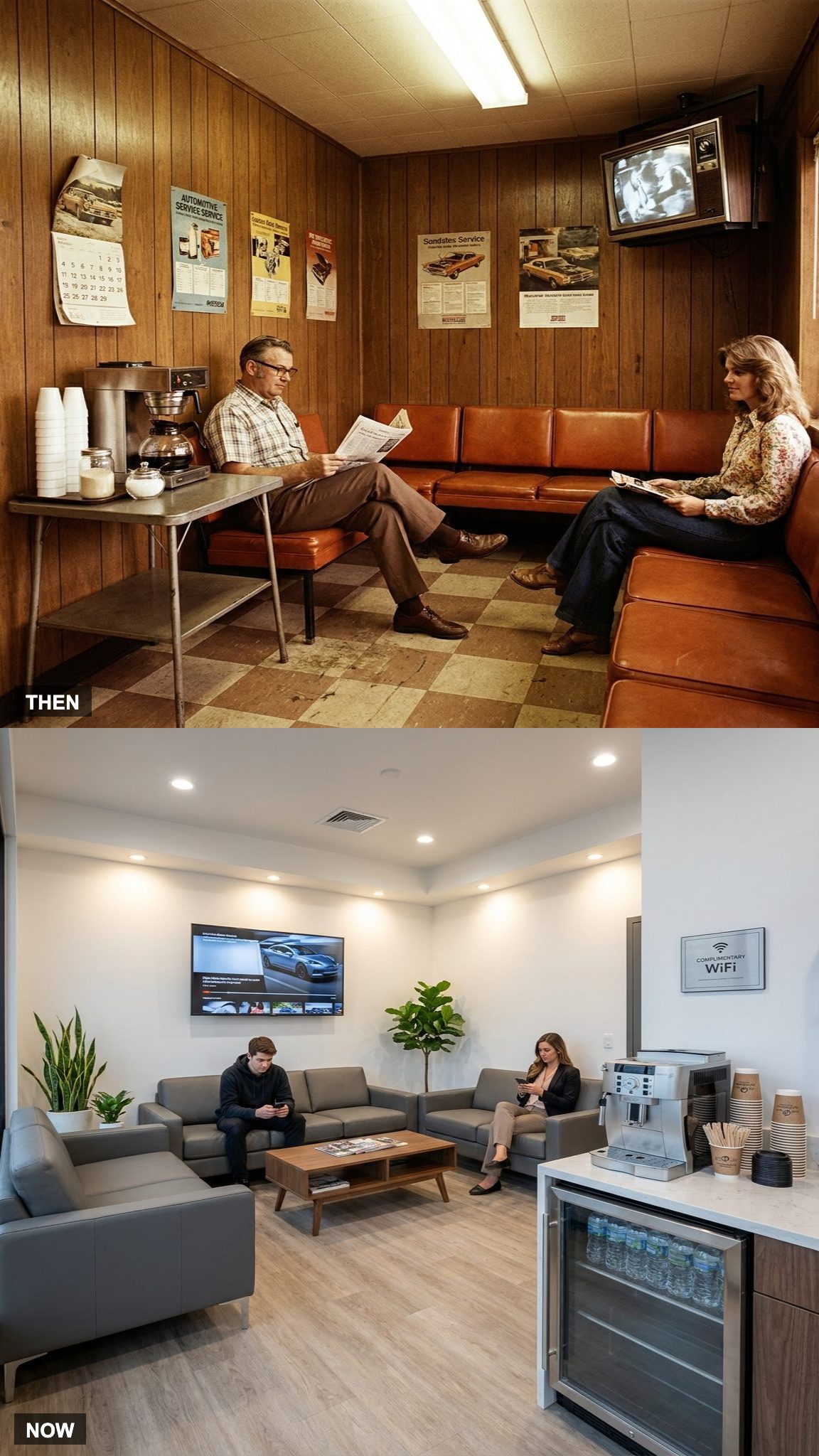
The old waiting room was an endurance test. Burnt-orange vinyl that stuck to the back of your legs in July, a television bolted too high and tuned to whatever came in clearest, and coffee that had been sitting since the shop opened—foam cup, no lid, drink it fast or drink it lukewarm.
Today you get an espresso machine, free Wi-Fi, and a leather-look couch, and you barely notice the two hours. Comfortable, sure. But nobody strikes up a conversation anymore. Everyone’s looking at a phone.
10. The Cash Register vs. the Digital Checkout
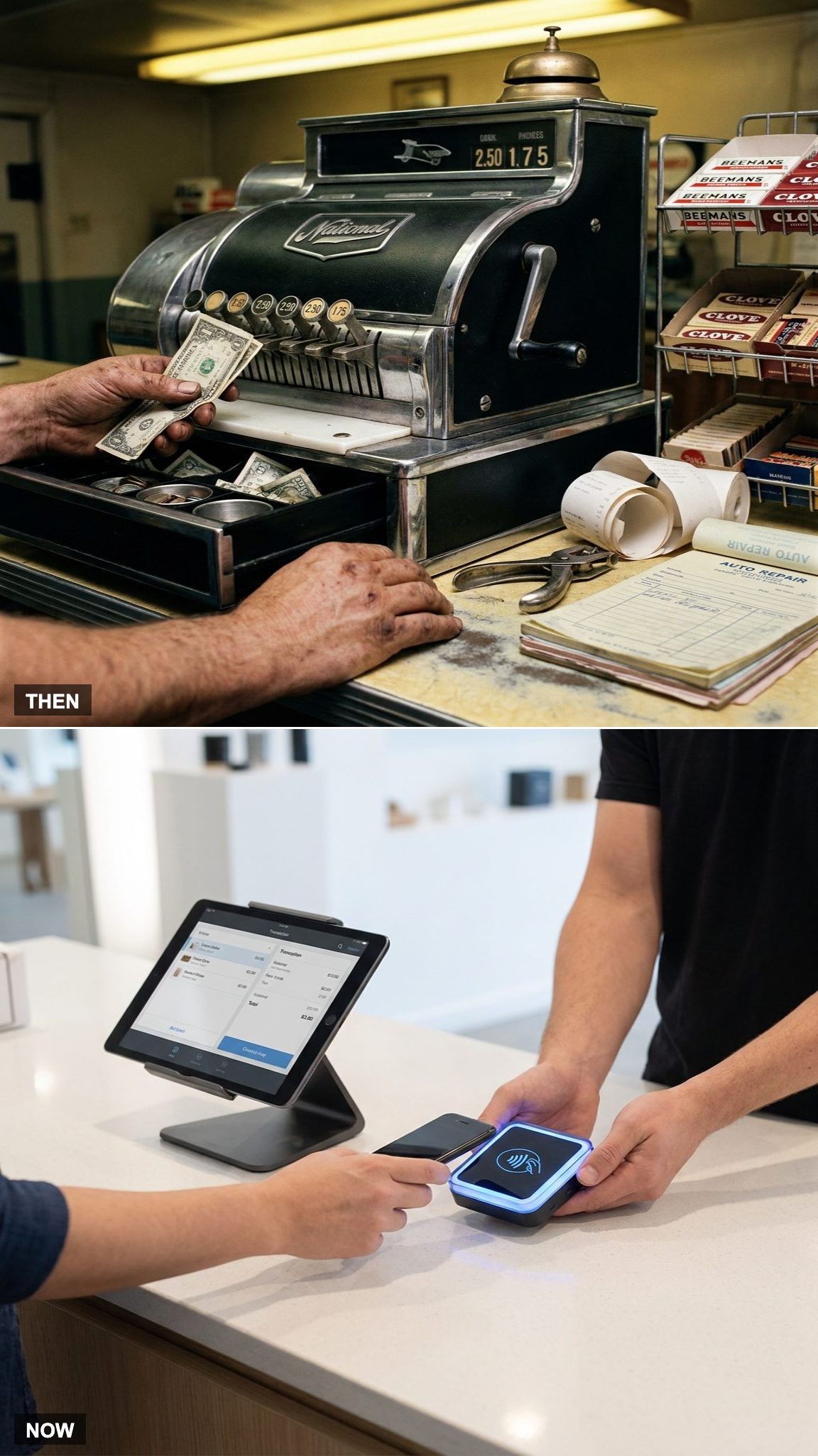
That old National register weighed as much as a small engine block. You pressed the keys, the tabs popped up, the bell rang, and the drawer shot out with a ka-ching you could hear across the shop. Making change was a skill.
Now the whole transaction is a tablet swiveled toward you and a tap of your phone. Silent. Two seconds. The receipt lands in your email before you reach your car.
9. Paper Work Orders vs. Digital Service Records
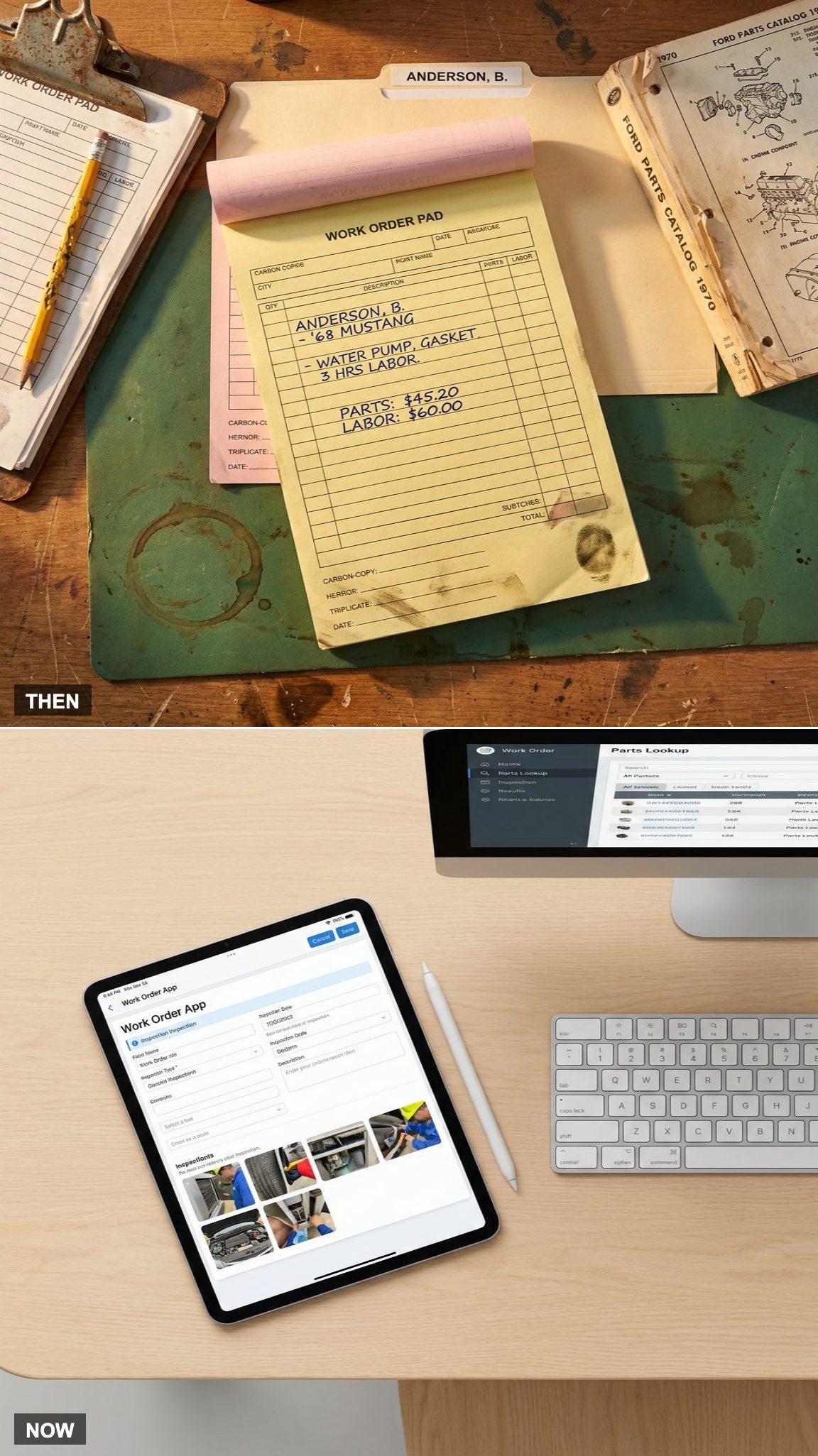
Everything lived on paper—a triplicate pad, one copy for you, one for the shop, one for the file cabinet that eventually swallowed everything. Want your car’s history? Somebody dug through a drawer for twenty minutes and probably didn’t find it.
Now your service history can remain searchable in the shop’s database, and photos of worn brake pads can arrive with the estimate. The record is easier to retrieve, and the pictures give customers something concrete to review before approving the work.
8. Tool Accountability: From Memory to Shadow Boards and Digital Tracking
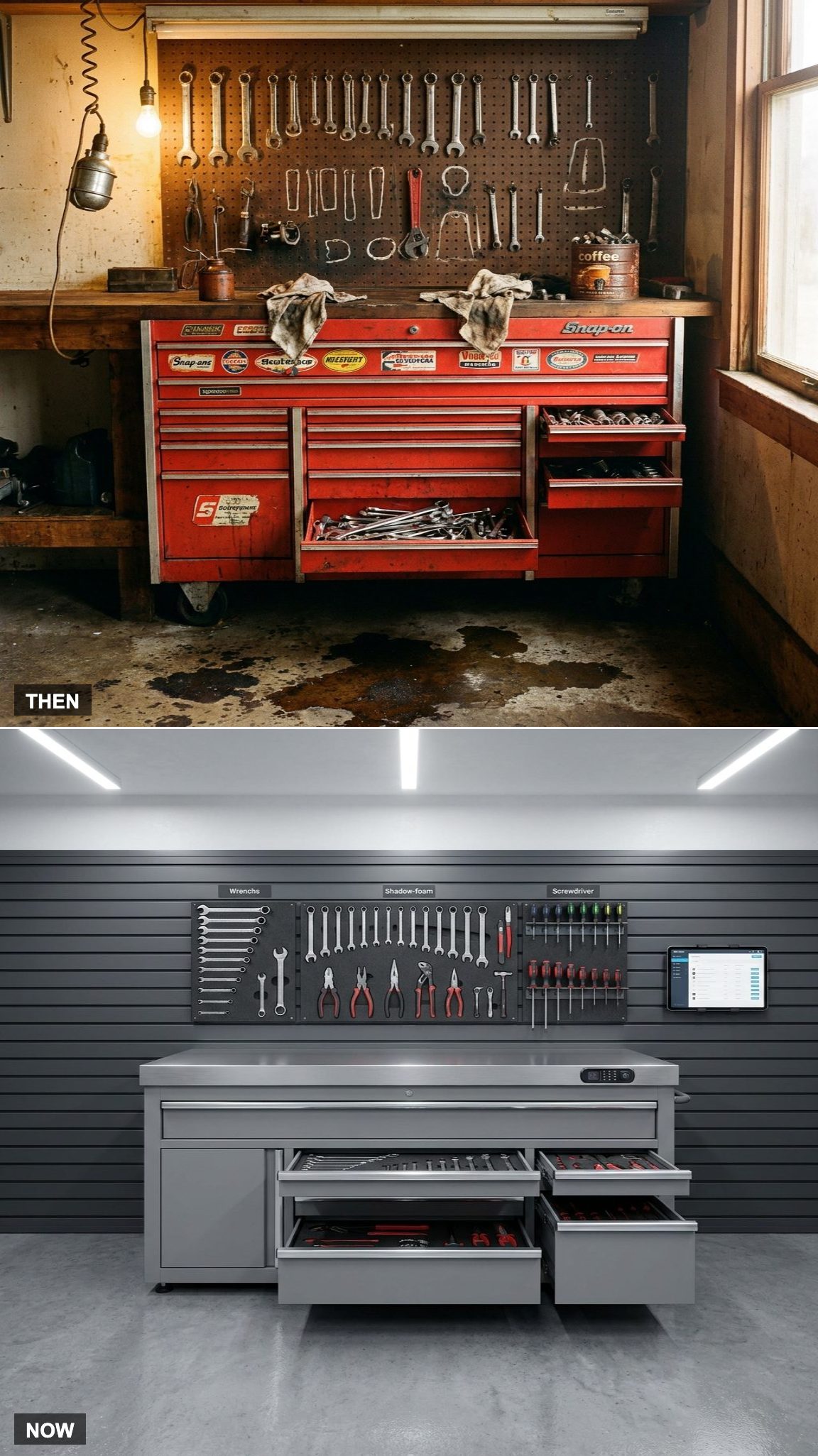
In 1970, tool accountability depended on habit. A painted outline on the pegboard showed what belonged there, while specialty tools might be signed out on a clipboard or simply borrowed by whoever reached them first.
Modern shops use shadow boards, serialized specialty tools, locked shared cabinets, and digital checkout systems. The goal is not cosmetic perfection. It is knowing that every socket, adapter, and extension is back in place before a vehicle leaves the bay.
7. The Waste Oil and Recycling Area
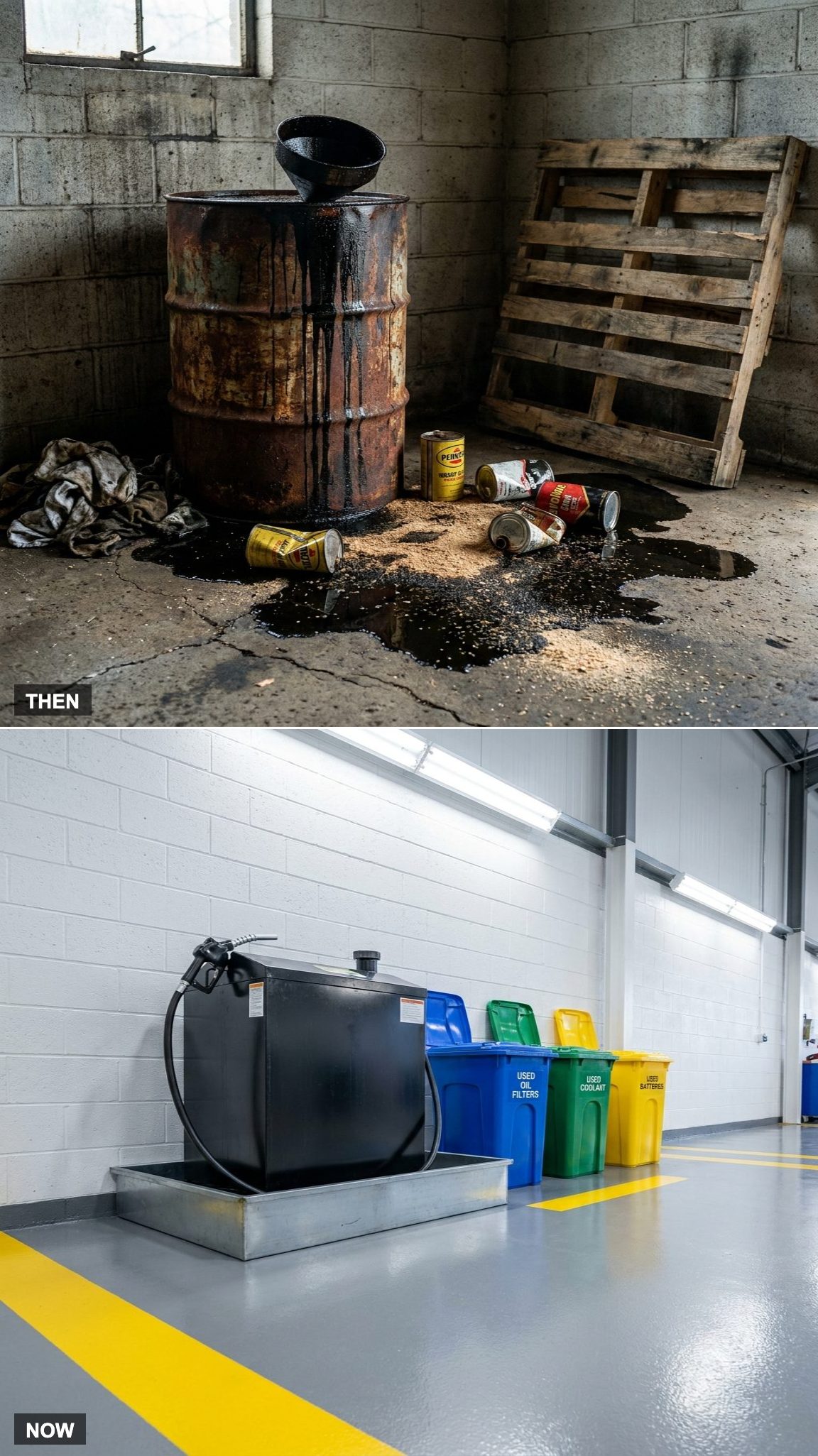
Used oil in 1970 went into a rusty 55-gallon drum out back, and whatever missed the funnel soaked straight into the concrete. Spills were often handled casually—you threw sawdust on the puddle and moved on. Where it all went afterward, well, better not to ask.
Today, used oil is collected in designated tanks, spills must be contained, and filters, coolant, batteries, and other wastes are separated for appropriate handling or recycling. The floor stays cleaner, and far less ends up where it should not.
6. Shop Signage and Branding
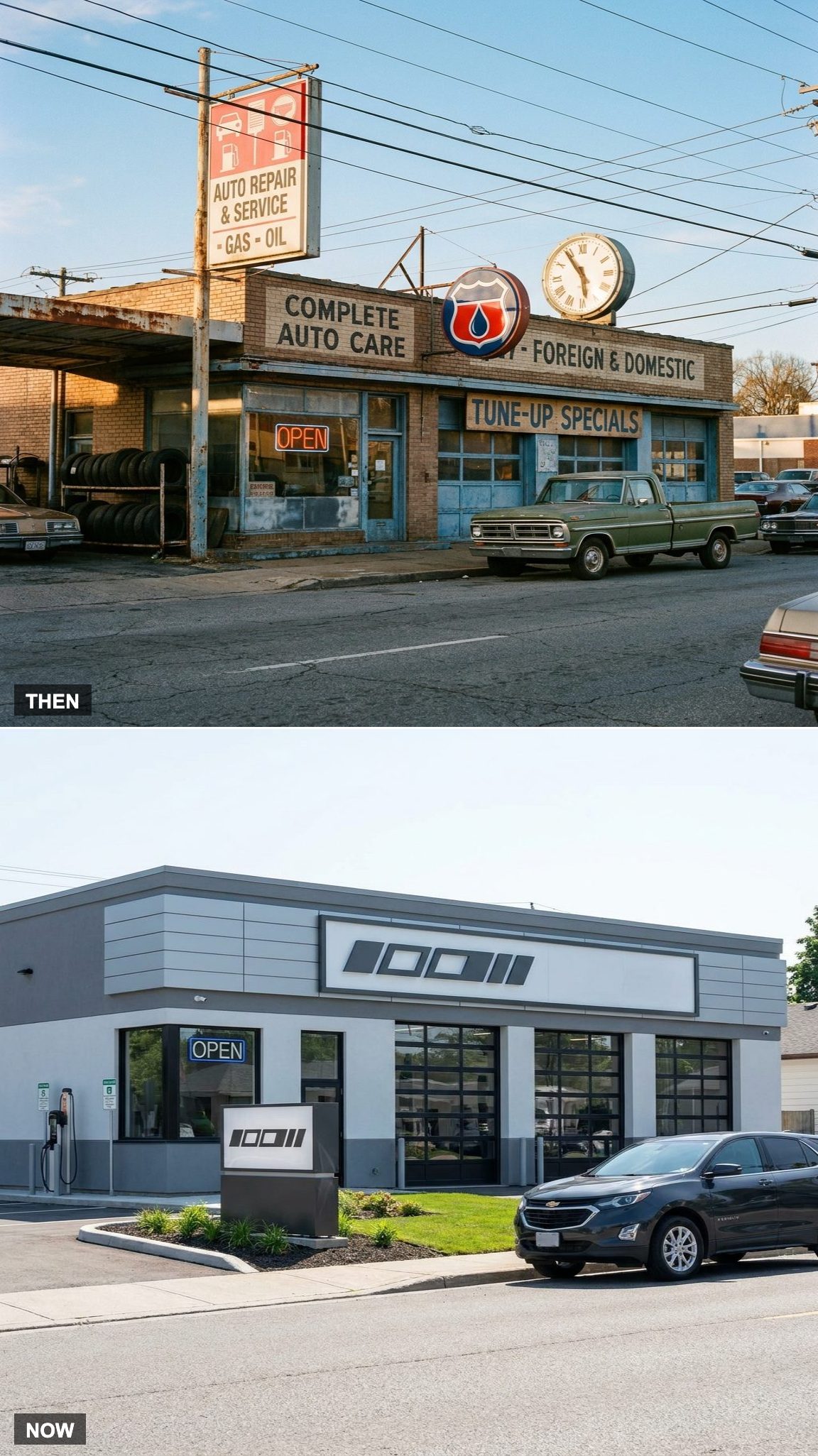
A 1970 shop announced itself with a tall pole sign, a rotating oil-company shield, and hand-painted lettering on the bay doors that hollered TUNE-UP in three-foot letters. The neon OPEN sign buzzed in the office window. It looked like exactly what it was.
Now it’s a backlit monument sign, a clean logo, aluminum cladding, and maybe a little landscaping out front—looks more like a bank branch than a garage. Something got lost when the hand-painting went away.
5. Computerized Parts Ordering
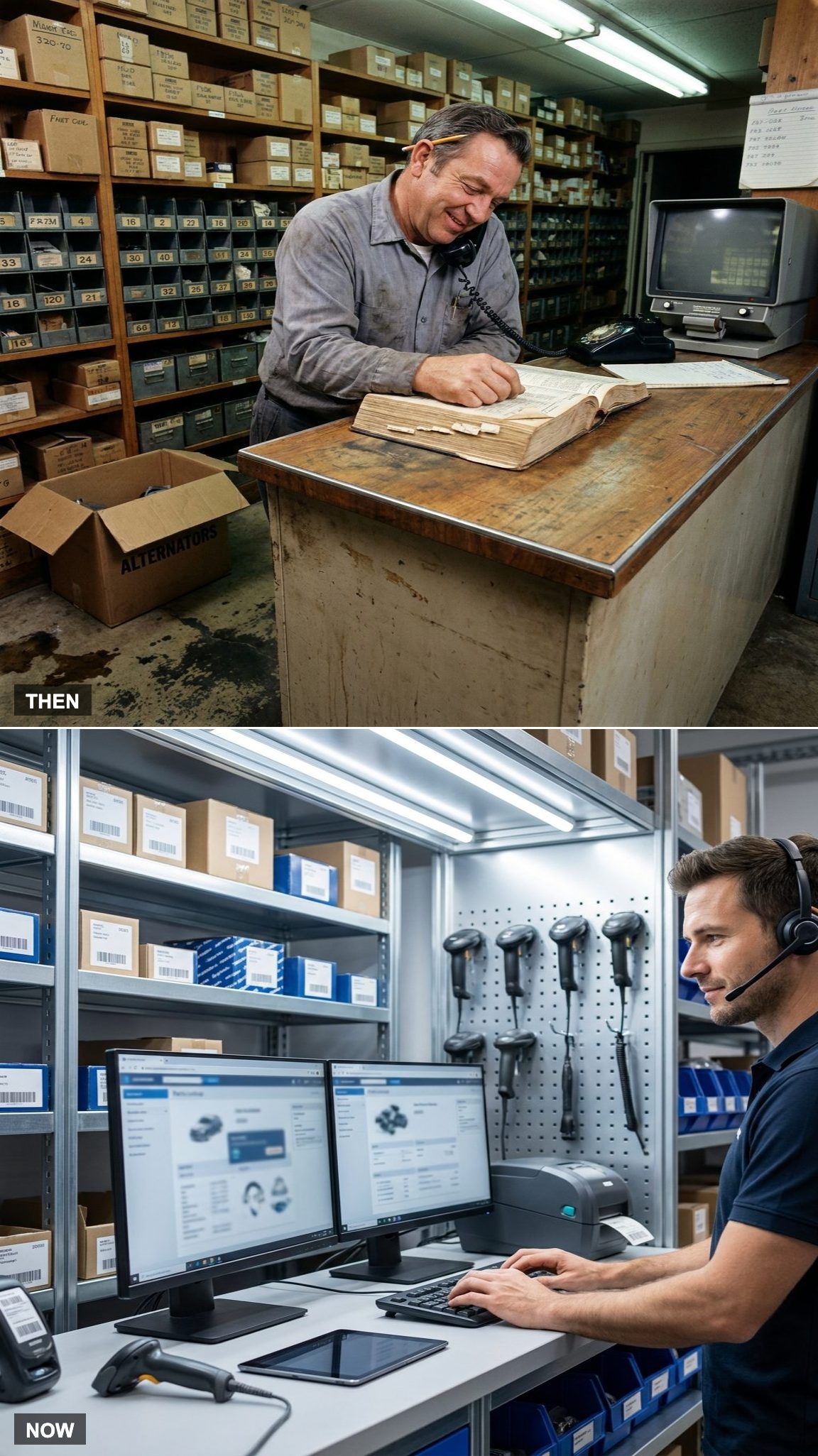
Ordering a part in 1970 meant a counterman, a paper catalog as thick as a phone book, and a lot of page-flipping while he had a rotary phone wedged on his shoulder. If it wasn’t on the shelf behind him, you waited days. Microfiche became a high-tech option in many parts operations, condensing large catalogs onto film sheets.
Now a mechanic types your VIN, the exact part appears with three price tiers and availability at four warehouses, and it shows up that afternoon. Ninety seconds, start to finish.
4. Electric and Hybrid Vehicle Service Bays
Would you like to save this?
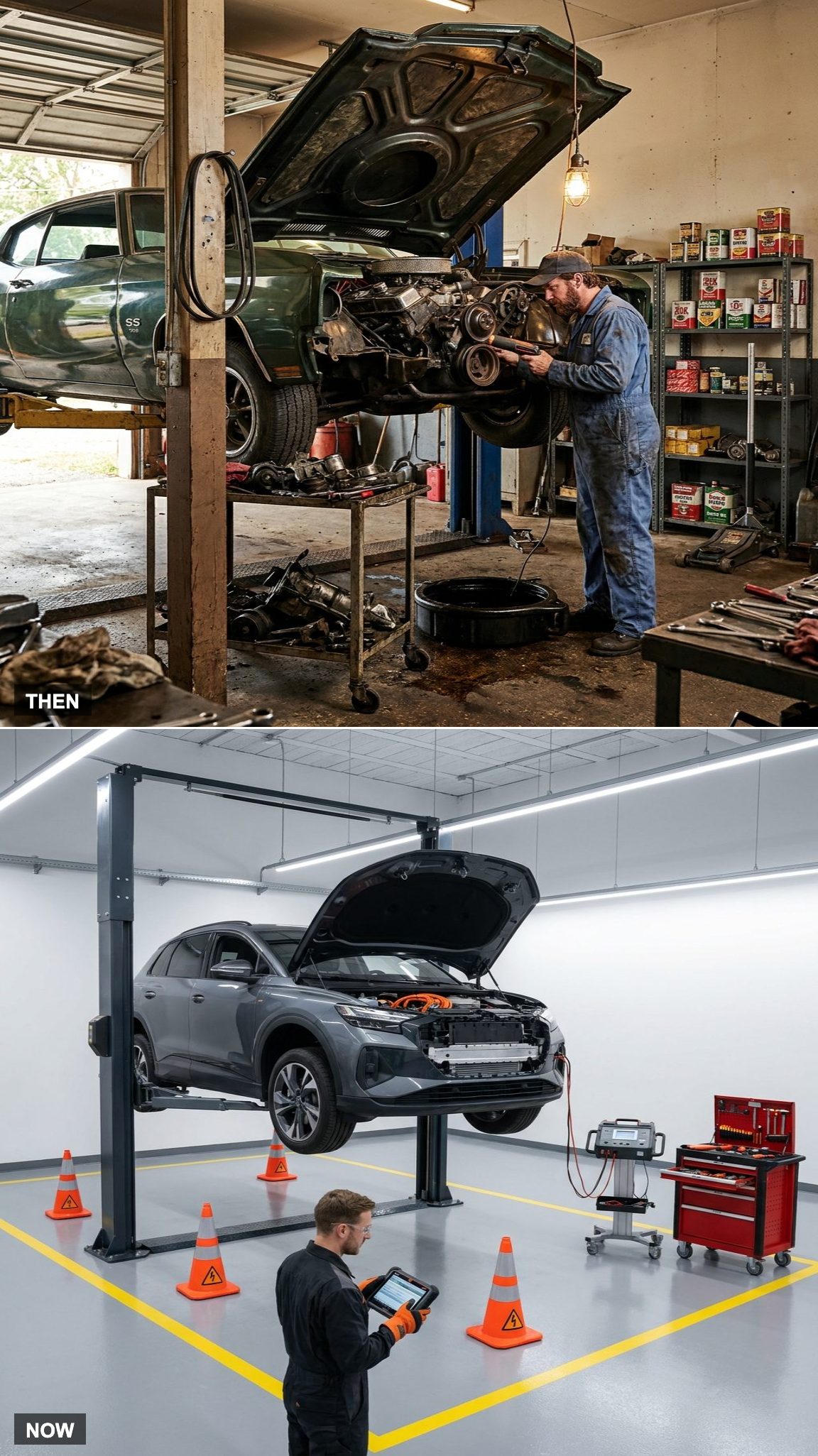
In 1970 the bay held a V8 with the hood up, a droplight, and a mechanic with a timing light and grease to the elbows. Most major systems were mechanical, visible, and familiar to a trained technician.
Now whole bays go to electric and hybrid cars, with orange high-voltage cables, insulated tools and gloves, isolation procedures, and diagnostic equipment designed for battery systems. The tools changed, and the training became more specialized.
The mechanic who once listened for a knock may now test isolation resistance or trace a battery-management fault. Same discipline, different systems.
3. Cleanliness and Shop Organization
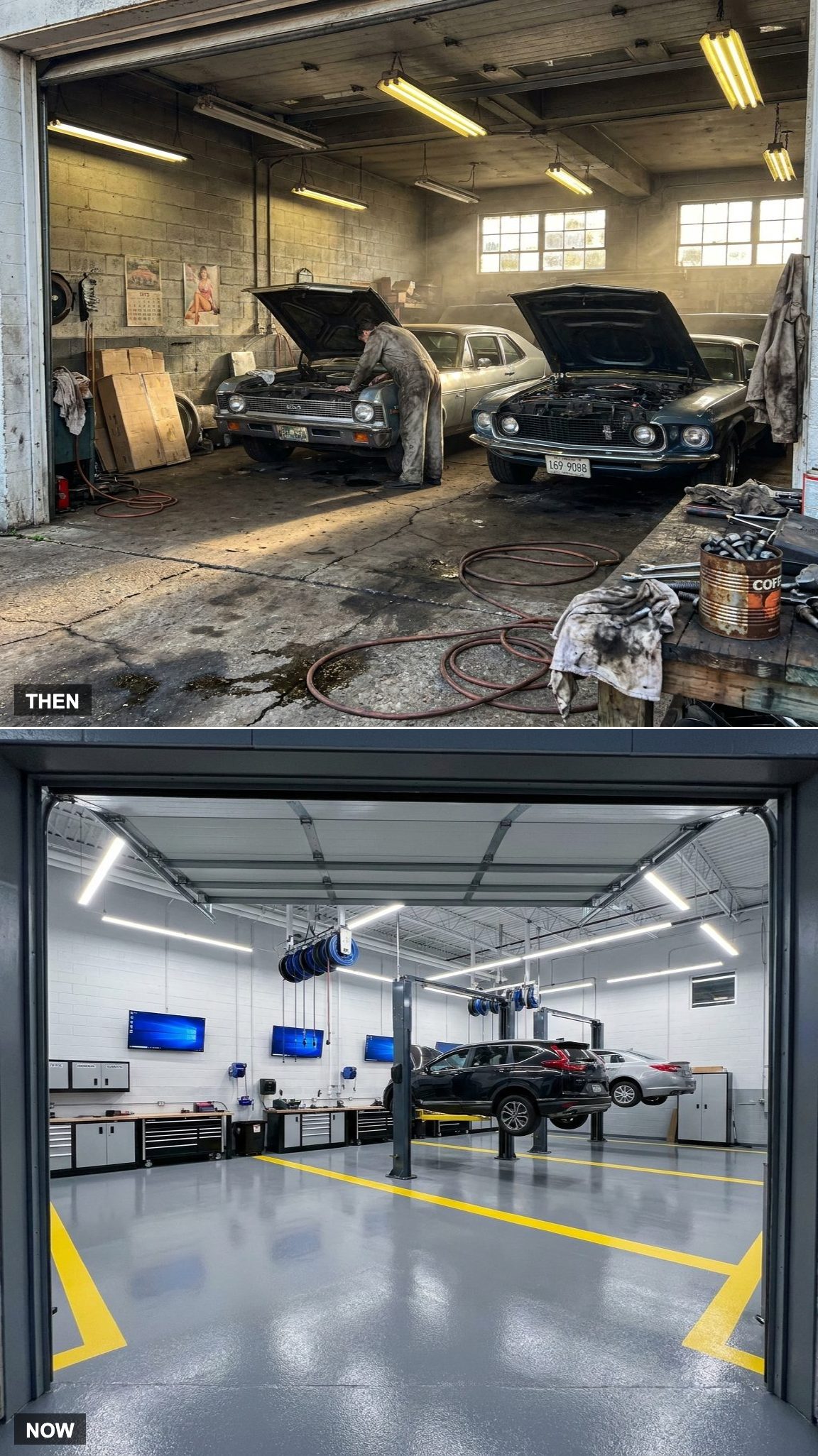
The old shop depended on everyone remembering where things belonged. Shared spaces accumulated parts, hoses crossed walkways, and yesterday’s job often remained visible when today’s car rolled in.
Modern organization is built around flow: marked walkways, defined work zones, labeled storage, scheduled cleanup, and equipment positioned to reduce wasted movement. The result may look less improvised, but it also makes the bay easier to work in and easier to inspect.
2. The Parking Lot and Customer Drop-Off Out Front
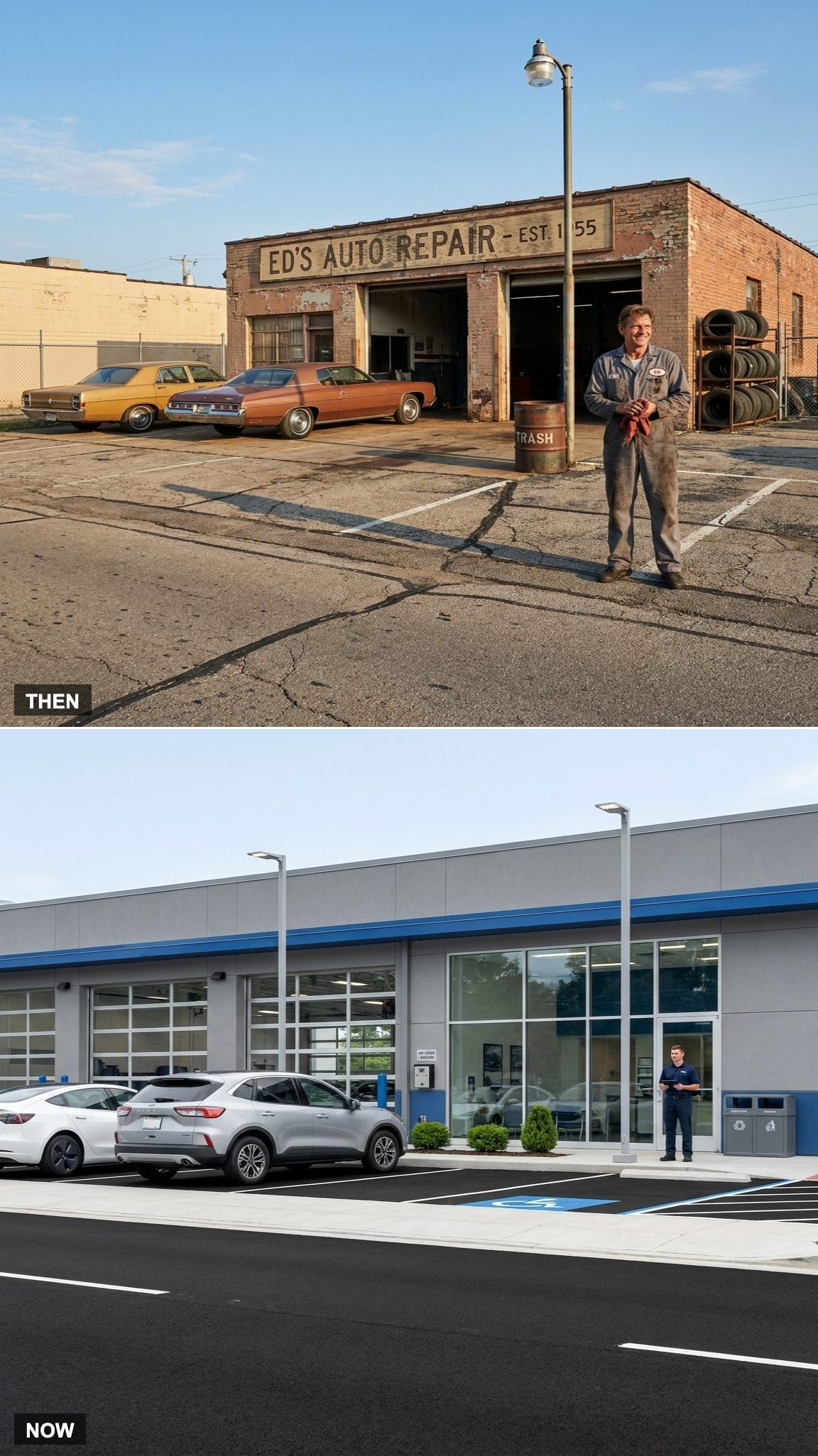
In 1970 the lot told you everything before you cut the engine. Oil ghosts on the concrete, parking lines worn down to suggestions, a dented steel drum standing in for a trash can, and a wall of used tires stacked up like firewood. You’d pull in crooked, wander over to the open bay, and some guy in gray coveralls would look up from under a hood to see what you needed.
Now the front of the shop looks like a carefully planned retail entrance. Sealed black asphalt, crisp white lines, a glass waiting room, and a key-drop box for customers arriving before opening or leaving a car after closing. Tires live inside these days. And the mechanic? He carries a tablet.
1. The Whole Feel of the Place When You Walked In
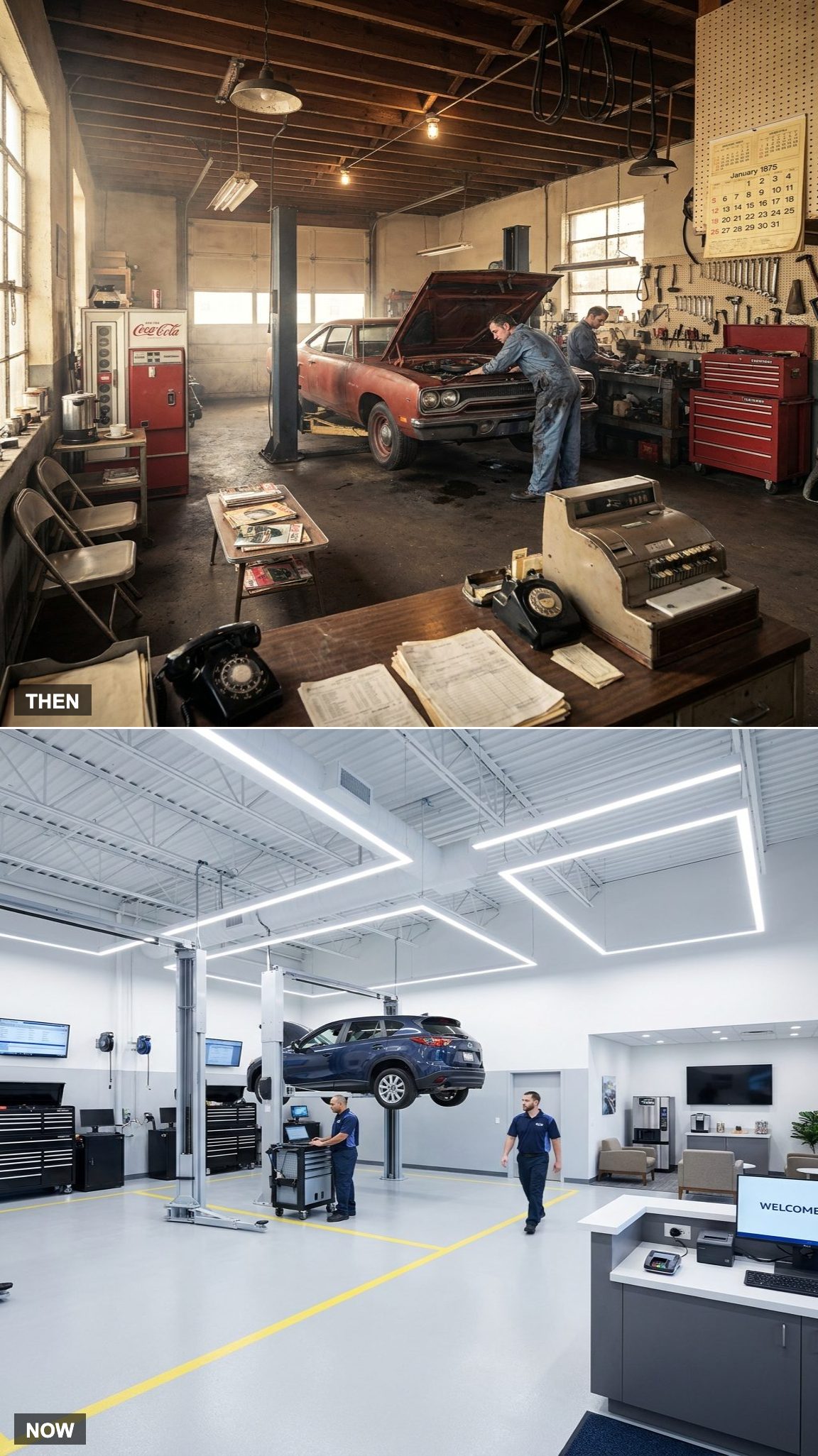
The old shop arrived all at once: motor oil, hot metal, the compressor kicking on, and a rotary phone ringing behind the counter. Nothing was hidden, from the parts hanging on the wall to the stains under the lift.
A modern shop is quieter, brighter, and more controlled. The work is still difficult, but less of the disorder is allowed to become part of the scenery.
You used to read a shop’s history off the walls and floor. The modern version keeps fewer souvenirs.
Both places can fix the car. Only one of them announces its entire history before anyone says hello—and yes, that old air was probably taking years off everyone’s life.