
Would you like to save this?
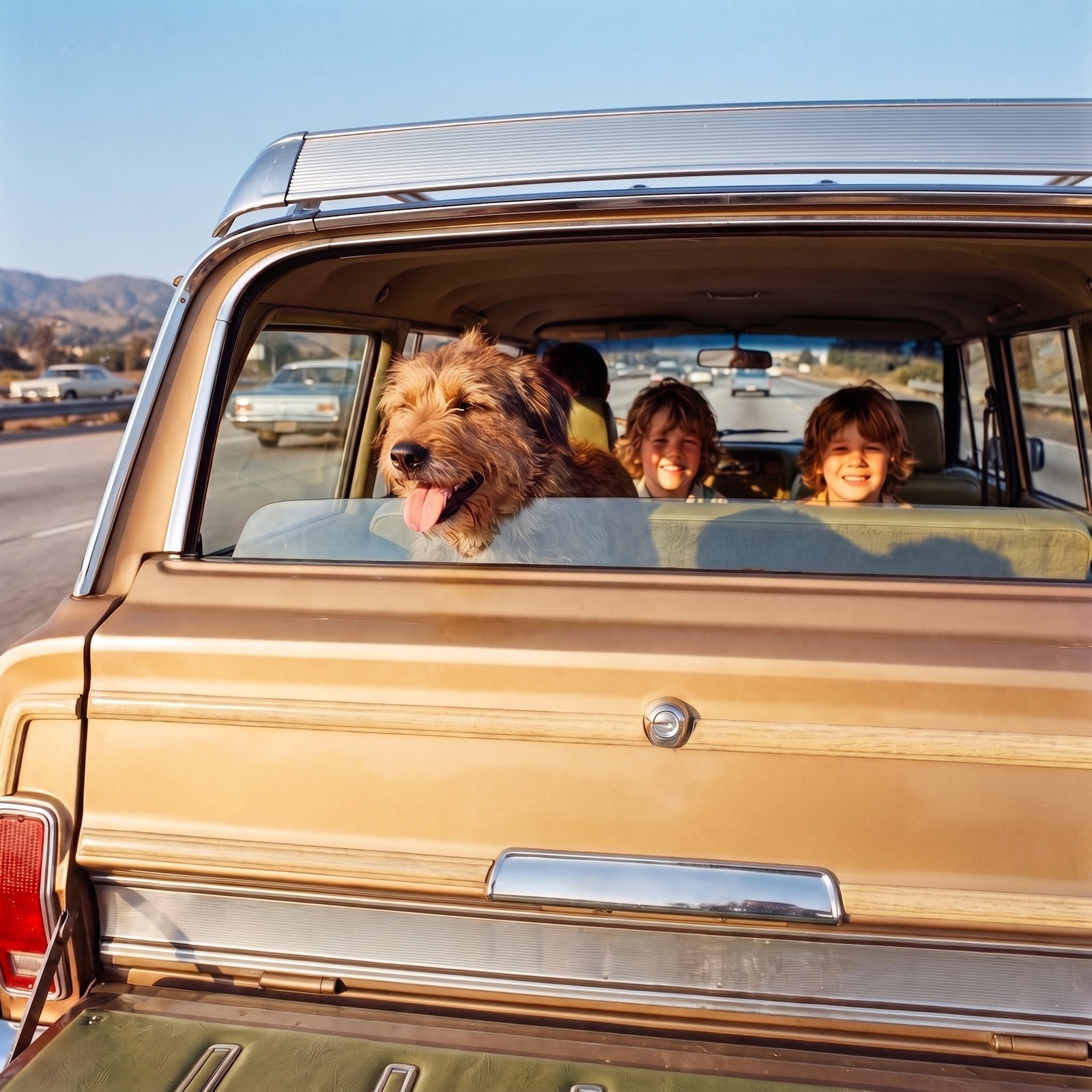
The smell hit you before you even climbed in. Hot vinyl baking in a driveway, a whiff of gasoline, and that cardboard-and-dust scent of a car built to haul six kids and a cooler to the lake. The 1975 station wagon was longer than some boats and proud of it. Fake wood on the doors. Chrome everywhere. A tailgate with tricks nobody had asked for but everybody wanted to demonstrate.
Then the minivan arrived. The SUV followed. Screens replaced knobs, cameras replaced twisted necks, and the low family wagon quietly surrendered the driveway. These 30 before-and-afters show how much changed — including a few things nobody in their right mind would want back.
30. The Endless Roofline and Wagon Profile
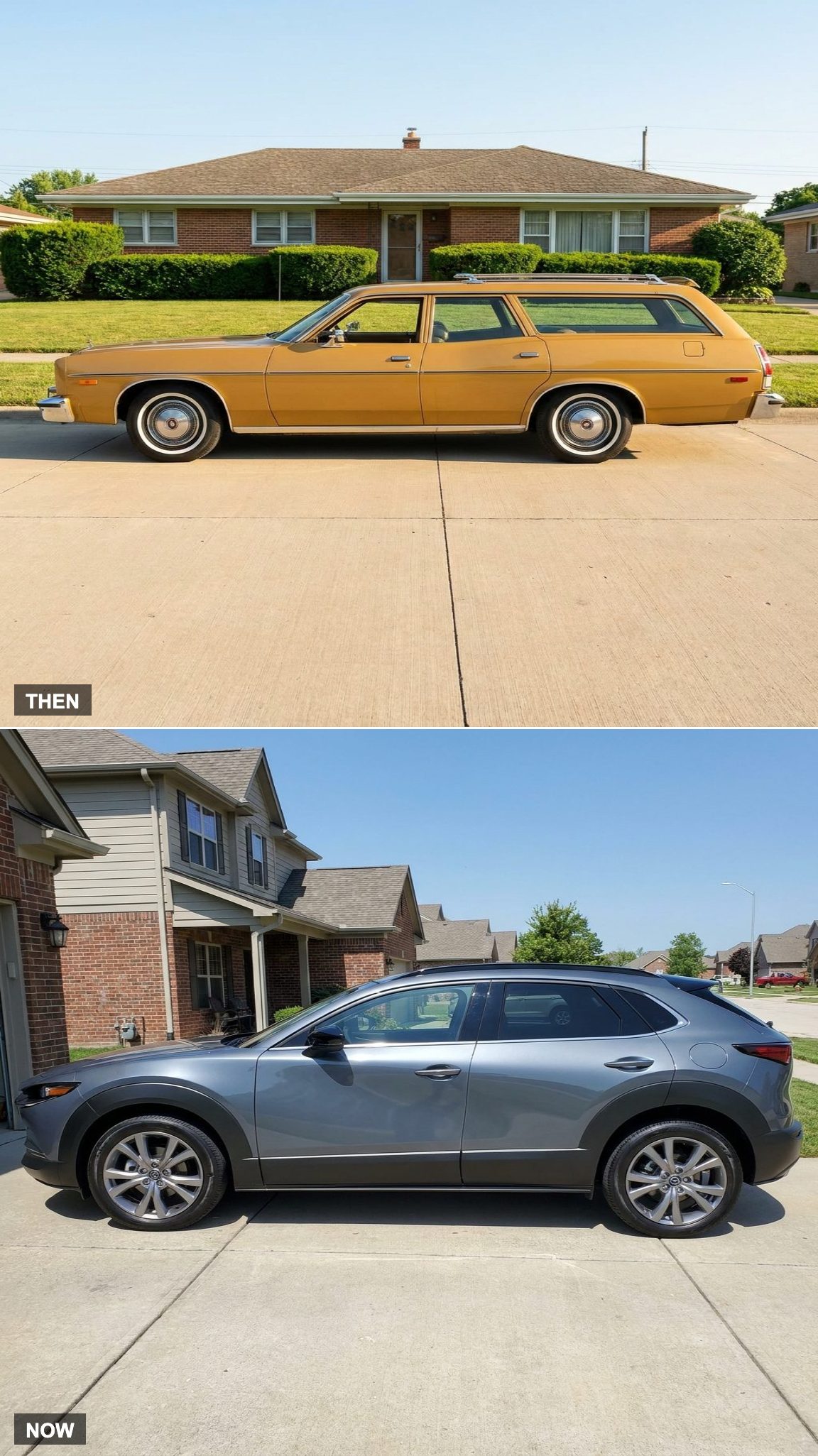
The 1975 wagon didn’t fit in your garage. It fit in your county. Some full-size models stretched past eighteen feet, riding low and flat like chrome coffee tables on wheels. That roof kept running because cargo space and passenger room mattered more than anything a wind tunnel might have suggested.
Today’s nearest equivalent is often a crossover in a cardigan: taller, shorter, smoother through the air, and far easier to maneuver. The old proportions required acreage. The new ones require considerably less courage at the parking garage.
29. Simulated Woodgrain Side Panels
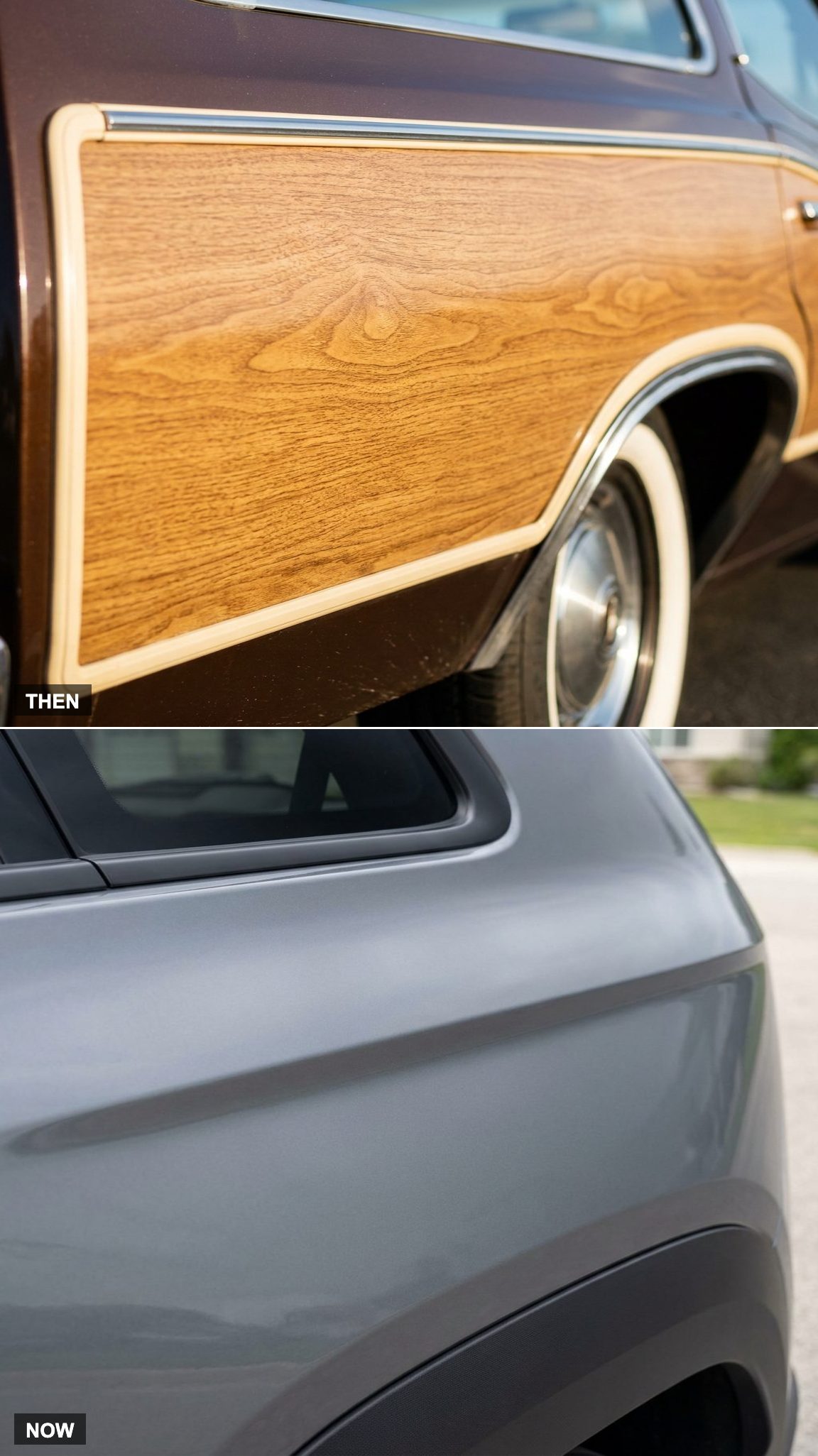
Nobody was fooled. The wood wasn’t wood — it was printed vinyl film applied to steel and surrounded by trim designed to complete the illusion. And somehow it worked.
The woodgrain wagon suggested cabins, lodges, lake trips, and a family with enough luggage to justify seventeen feet of automobile. Age and weather could eventually lift or fade the material, but that hardly diminished the effect. If anything, slightly tired woodgrain became part of the species.
Now the body sides are clean paint, sculpted creases, and black cladding. Nobody has to worry about peeling faux walnut anymore. Whether that’s entirely a victory is open to debate.
28. Chrome Front Grilles and Bumpers
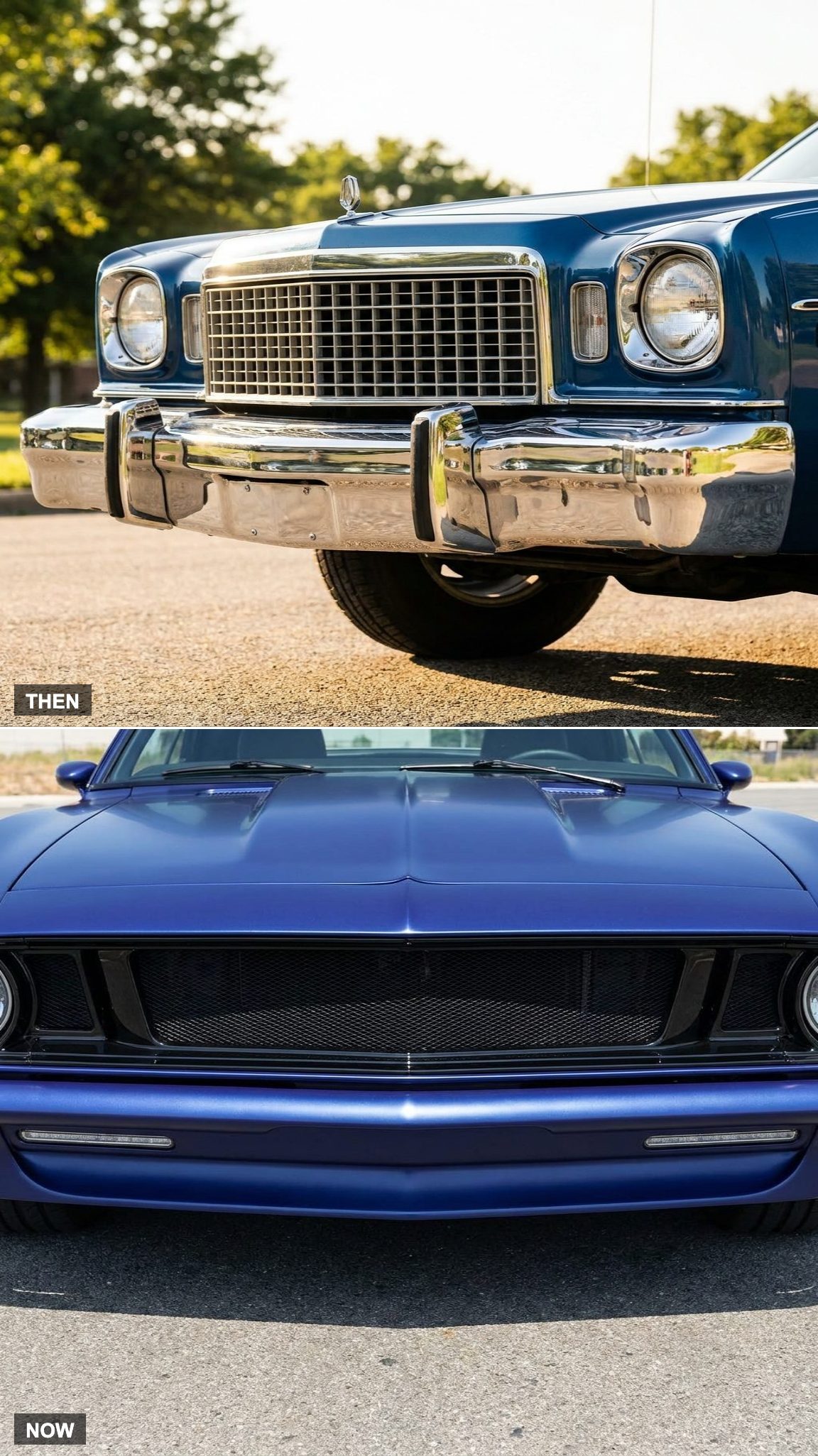
You could see your reflection in a 1975 front bumper. Chrome was decoration and hardware at once, while the grille could spread across the entire nose in a wall of bright bars and framed headlights.
Modern bumper systems hide most of their engineering behind painted plastic fascia, energy-absorbing material, reinforcement structures, sensors, and cameras. They are designed around crash-energy management rather than giving Dad another piece of chrome to polish on Sunday.
27. Quad Round Headlights vs. LED Lighting
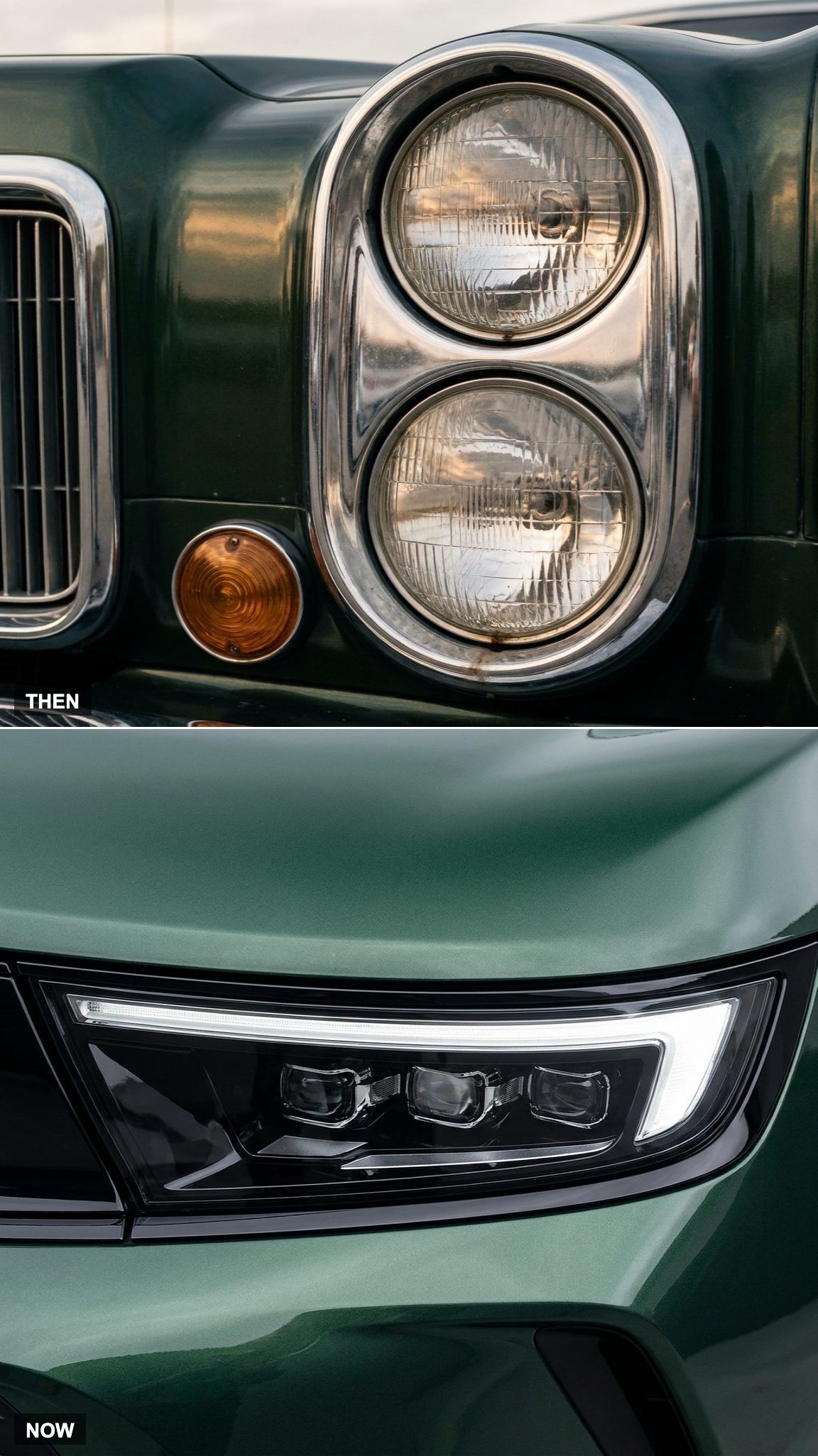
Four round eyes staring down the road. With sealed-beam headlights, a failed lamp could mean a trip to the parts store, a screwdriver in the driveway, and a replacement glass unit that looked much like the one that came out.
Modern LED assemblies throw dramatically better light and give designers freedom that a standardized round lamp never could. The tradeoff arrives when an integrated assembly fails and the repair involves considerably more than buying one sealed beam out of a cardboard box.
26. The Tailgate That Could Open Two Ways
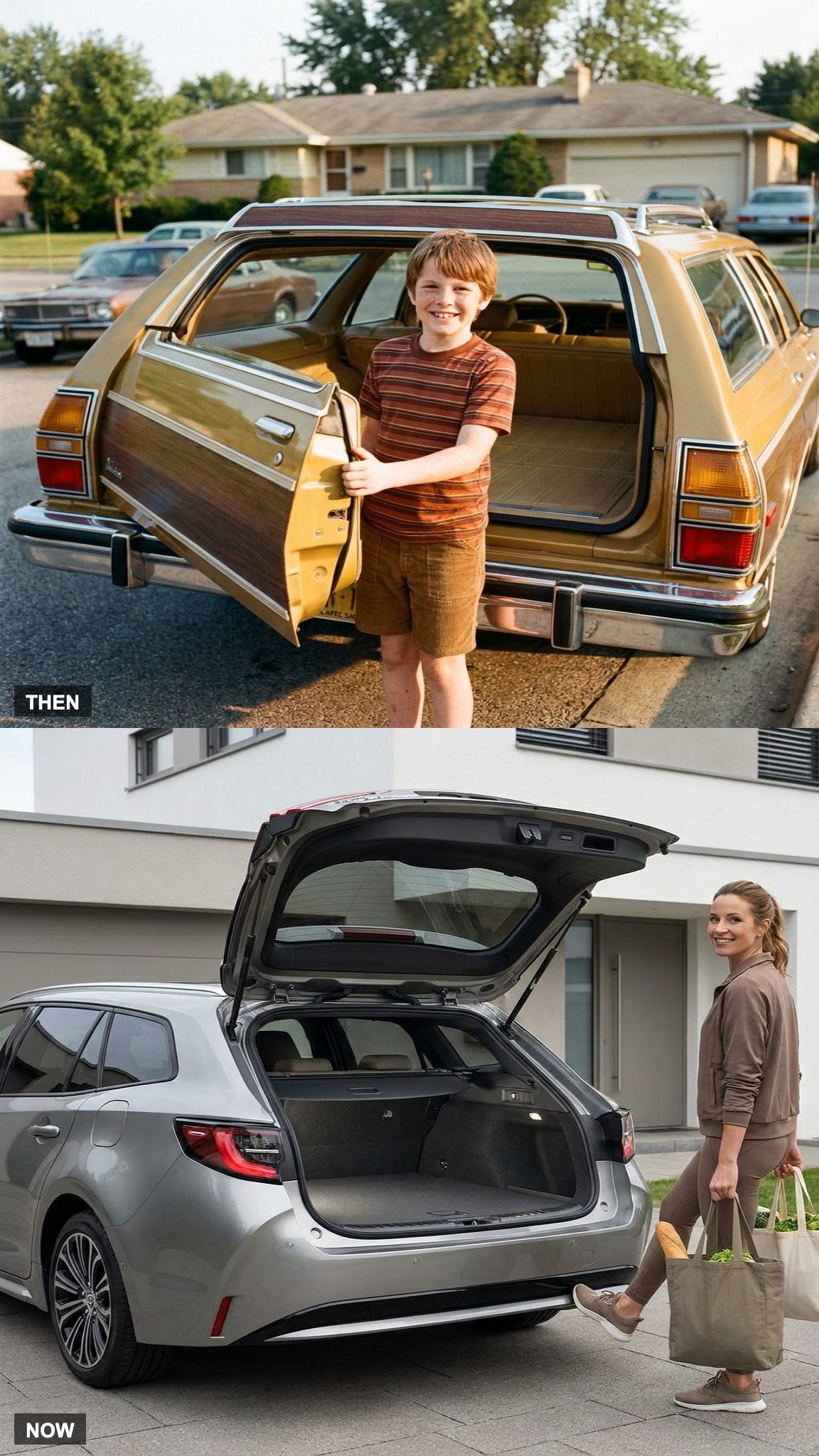
The dual-action wagon tailgate was mechanical theater hiding inside a family car. Depending on the model, a tailgate could fold downward like a pickup gate or swing sideways like a conventional door. Kids didn’t need to understand the hinges. They just needed an adult willing to demonstrate them.
GM also experimented with its separate clamshell design, in which the rear glass and gate disappeared into the body. Detroit had several answers to the same question, and none of them lacked imagination.
Today the standard answer is a power liftgate. Wave a foot under the bumper and it rises on its own — genuinely useful when both hands are full. It also performs roughly the same trick every time.
A 1970s wagon tailgate could turn unloading groceries into a mechanical demonstration for the neighbors.
25. Rear-Facing Third-Row Seats
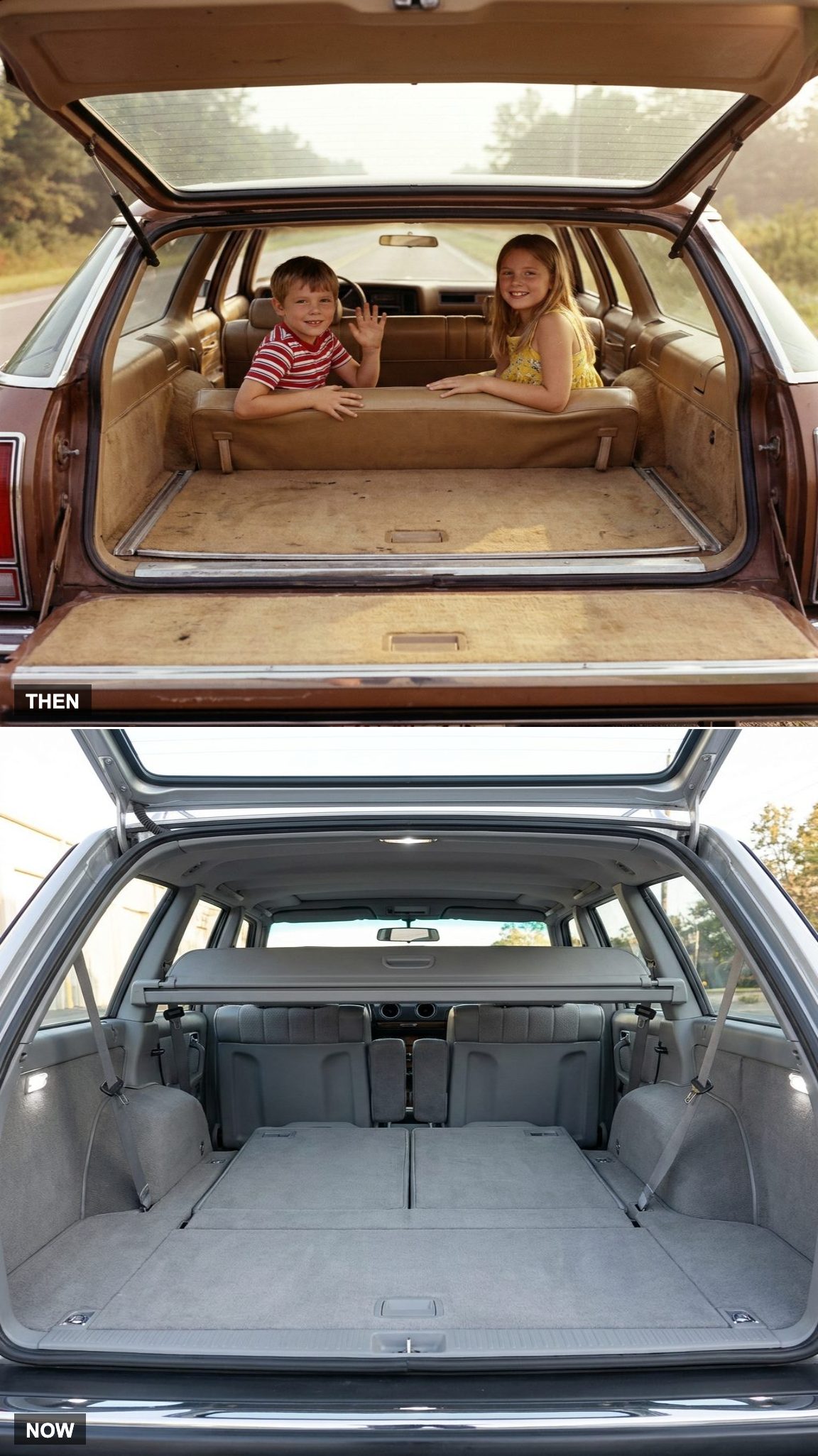
You rode backward, watching where you’d been instead of where you were going, waving at the strangers in the car behind. Restraints in those seats were primitive by modern standards, and some installations relied on simple lap belts.
The rear-facing jump seat was where the kids got sent and where the kids often wanted to be. That giant rear window turned the highway into a movie running in reverse.
Modern family vehicles devote far more engineering to passenger protection, and rear-facing wagon jump seats have essentially disappeared from mainstream American cars. The waving disappeared with them.
24. Bench Seats From Front to Back
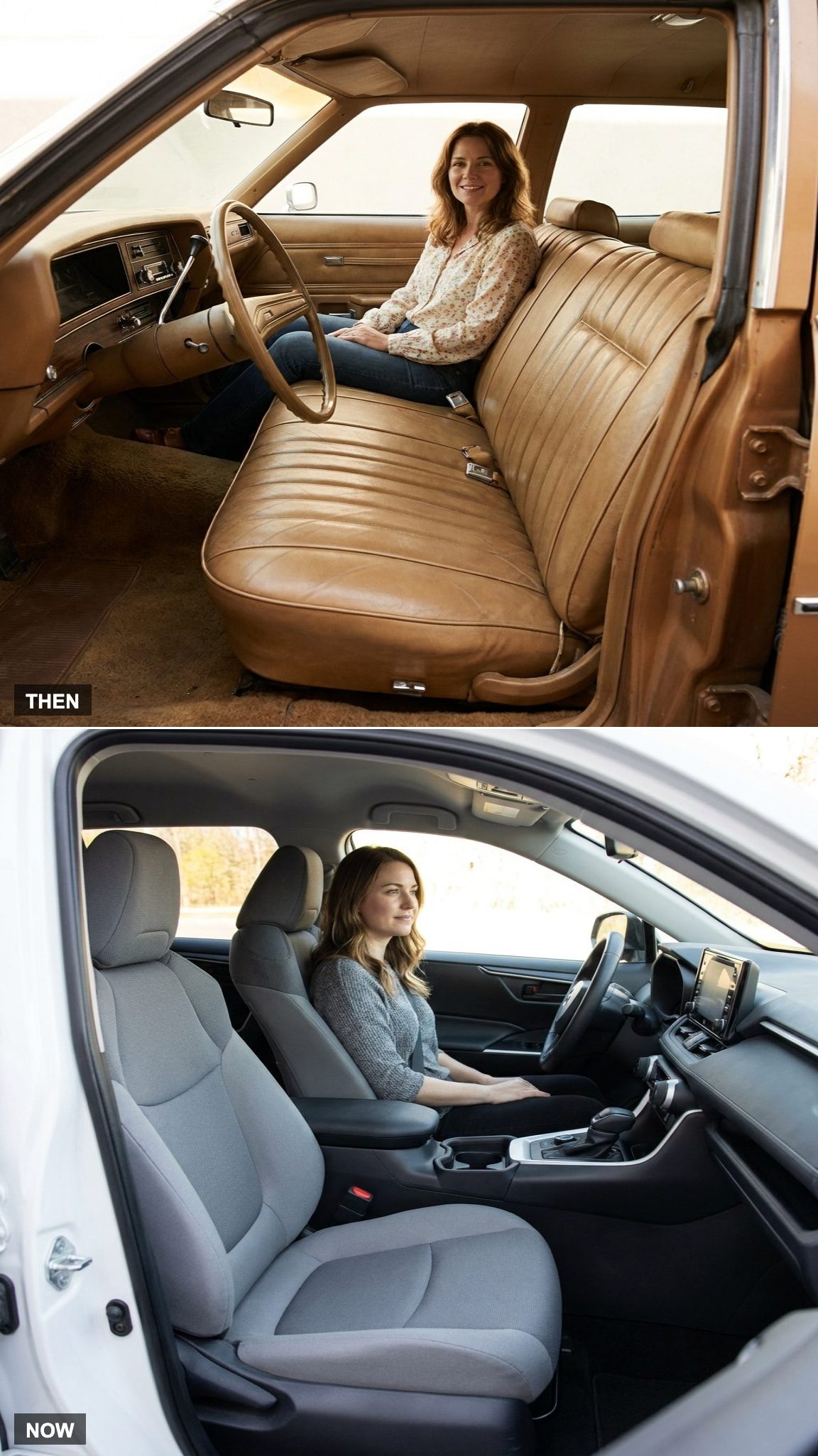
Front bench seat, column shifter. That meant three across up front, and it meant a kid could slide over next to Mom on the way to church or a couple could sit shoulder to shoulder at the drive-in. The bench wasn’t just a seat. It changed the social geometry of the whole cabin.
Now the front is two buckets separated by a broad console full of cupholders, storage, charging pads, controls, and screens. Everybody gets a defined space. Nobody slides anywhere.
23. The Vinyl That Burned Your Legs
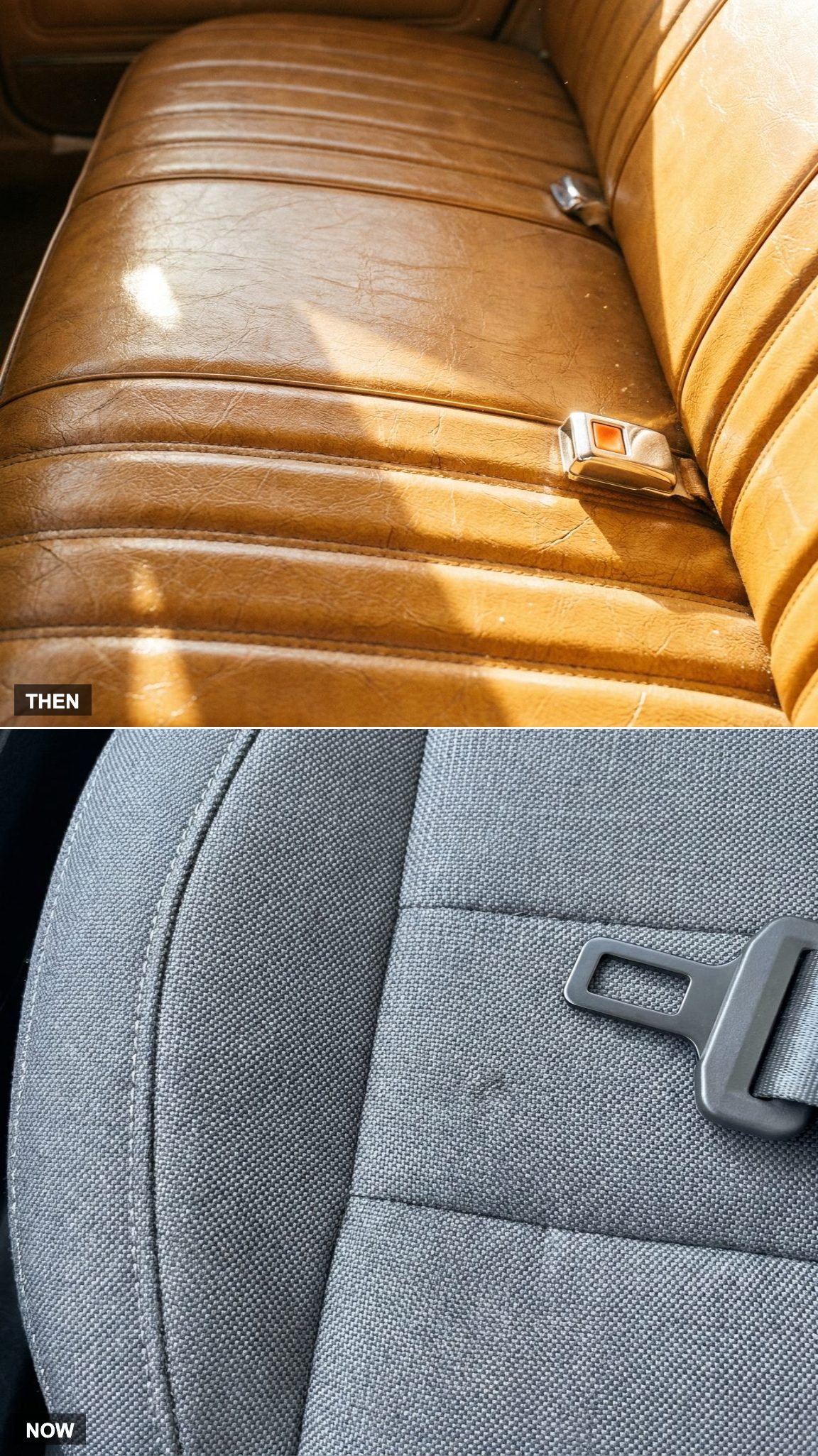
Vinyl in July was a weapon. It sat in the sun all morning, turned into a griddle, and the backs of bare legs paid the price the second somebody climbed aboard in shorts.
But the stuff wiped clean. Spilled milkshake, wet swimsuit, muddy sneakers — all of it could be attacked with a rag. Cloth was cooler and softer; vinyl took family abuse with fewer complaints. Later interiors increasingly mixed cloth, leather, vinyl, and synthetic materials according to price and purpose rather than asking one surface to do everything.
22. The Dashboard: Big Knobs and Controls You Could Feel
Would you like to save this?
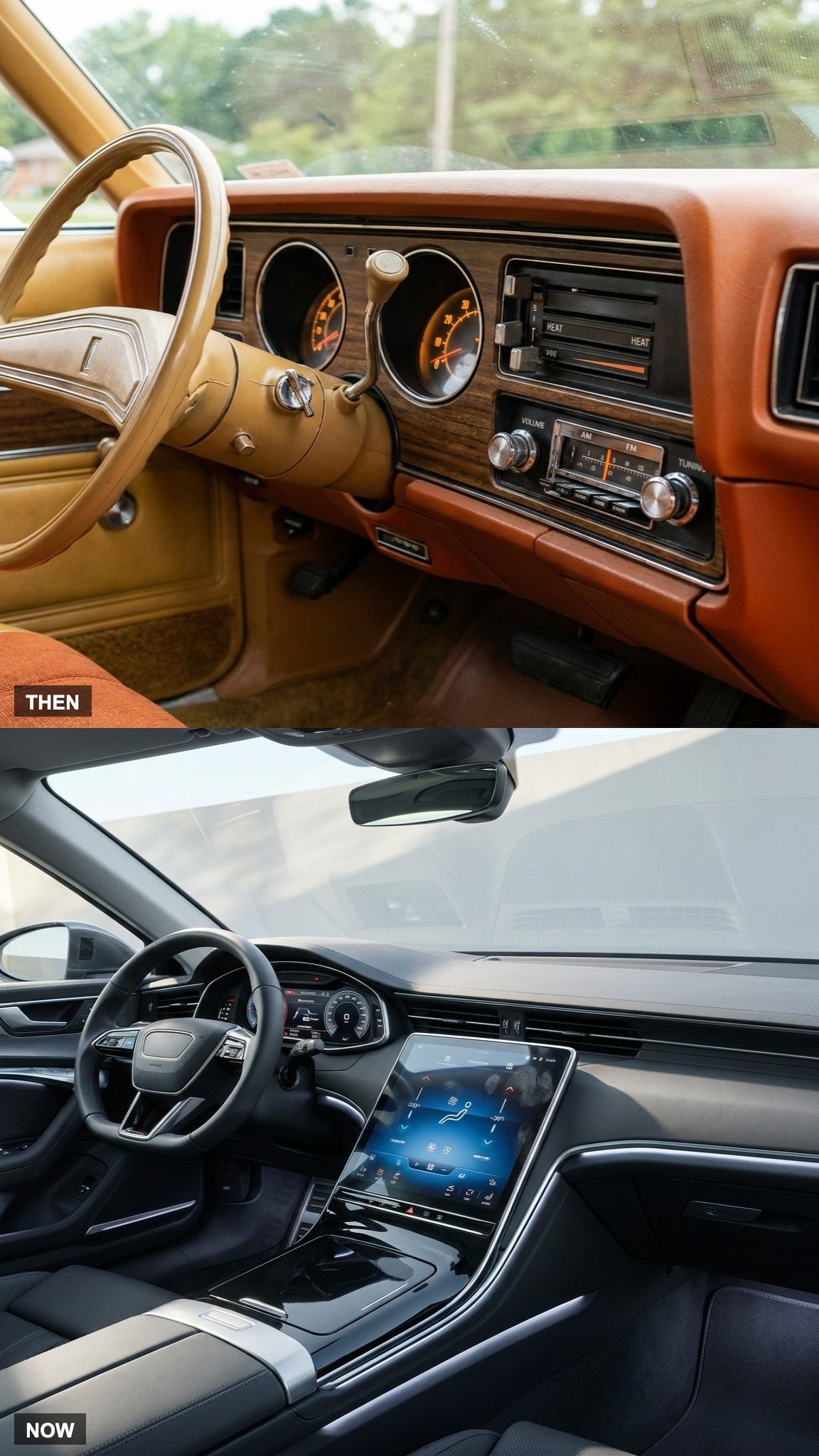
A 1975 dashboard made most controls obvious. Heater levers moved through visible slots, radios had substantial tuning and volume knobs, and widely spaced switches gave your fingers a fair chance of identifying them without much investigation.
Modern dashboards can consolidate navigation, entertainment, climate, phone functions, vehicle settings, and cameras into a single display. That’s enormously capable, but it has also revived an old argument: some jobs are easier when the control has a shape your hand can recognize.
21. Analog Gauges vs. the Digital Cluster
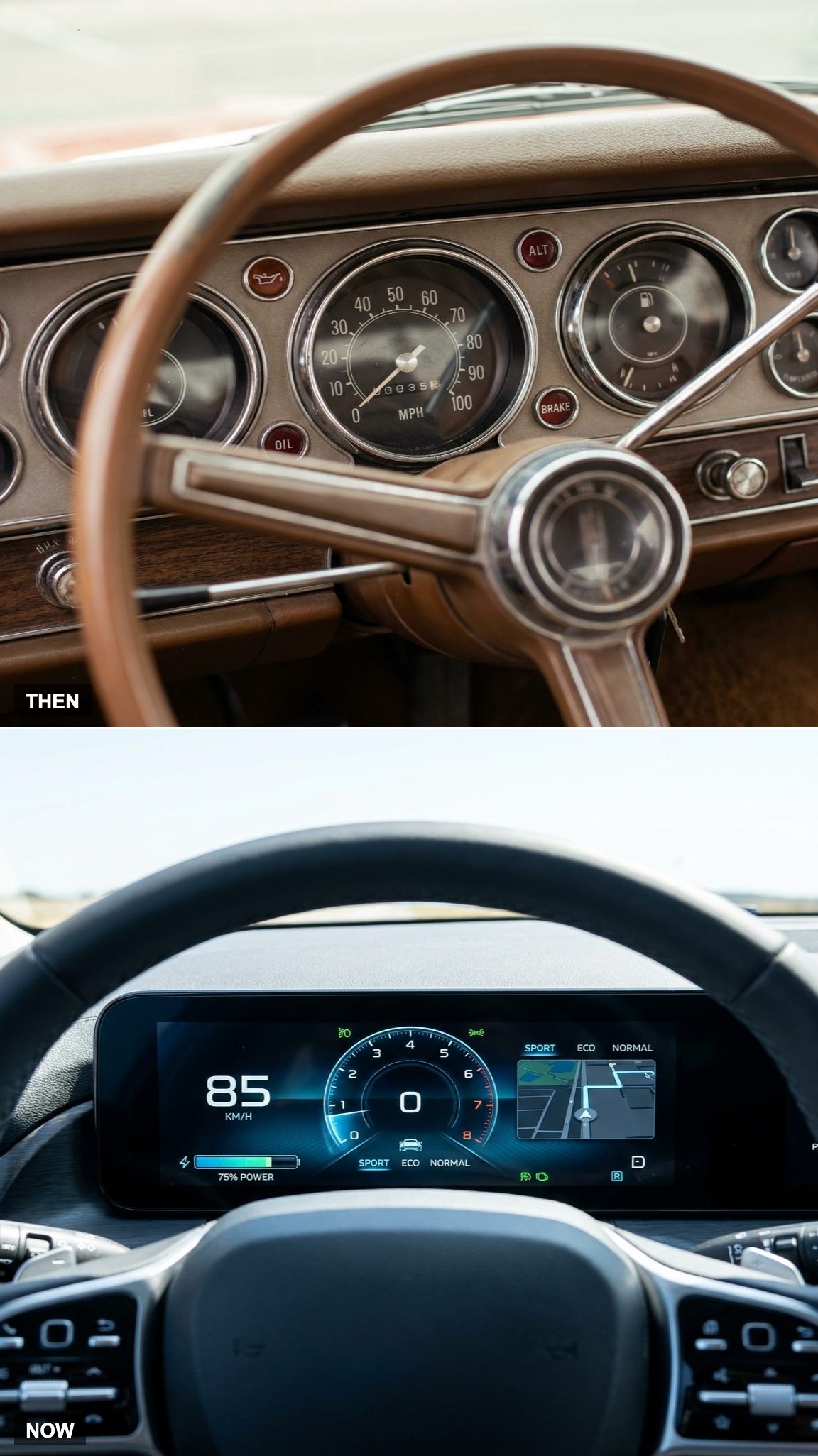
A needle and a number handled most of the conversation. The speedometer swept across a fixed scale, the fuel gauge lived beside it, and warning lamps covered the things the instruments didn’t show continuously.
A modern digital cluster can put navigation, driver-assistance status, efficiency data, media information, warnings, and customizable gauges directly in front of the driver. That’s far more information than an old wagon could provide.
The analog panel’s advantage wasn’t intelligence. It was permanence. The marks were always in the same place.
20. The Steering Wheel: Skinny Rim vs. Button Command Center
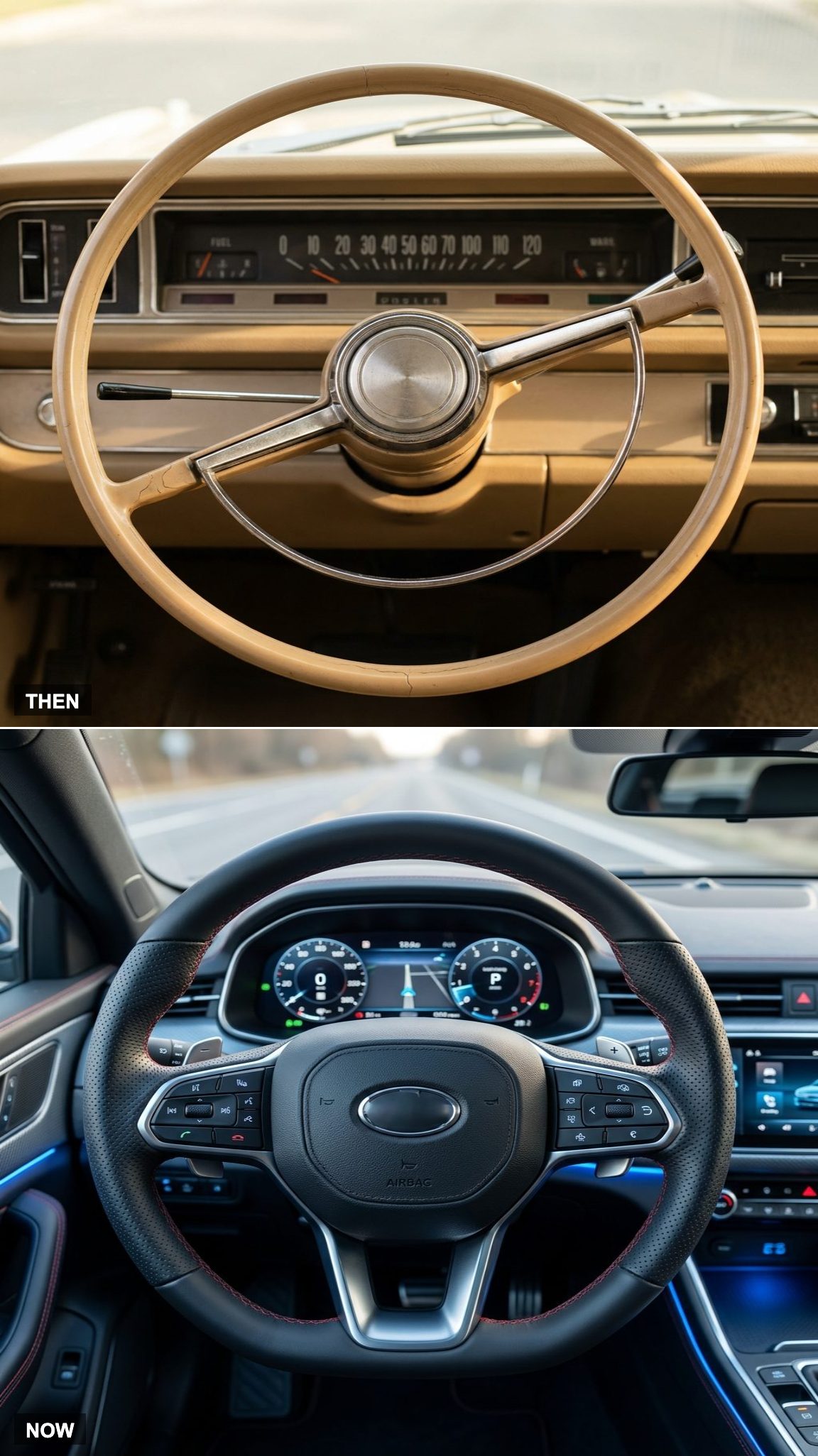
Grip the wheel in a big 1975 wagon and the rim could feel remarkably thin by modern standards. Hard plastic, perhaps a horn ring or horn pad, and very little else competed for space.
Now the steering wheel doubles as a control panel. Audio, cruise control, phone functions, driver-assistance settings, heated rims, paddles, and an airbag all occupy territory that once existed largely for steering and honking.
19. The Sound System: AM Dial and the Sacred 8-Track
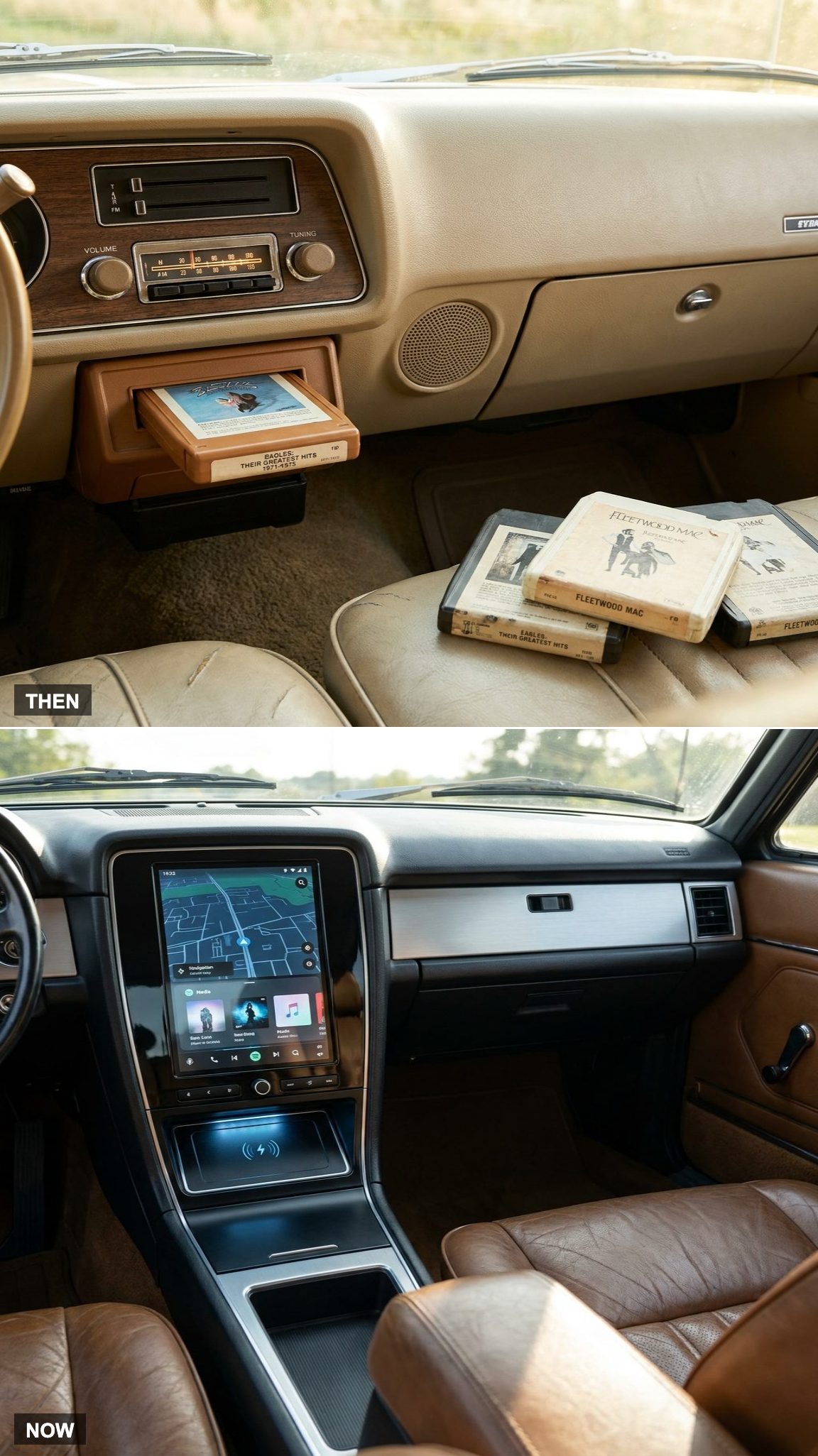
An 8-track player was a prized upgrade because it put your own music in the car instead of leaving the radio station in charge. The cartridge could click to another program in the middle of a song, an interruption so characteristic of the format that it became part of the experience.
Today’s driver has streaming libraries containing more music than a 1975 record store could hold. The format problem has changed too. Instead of an 8-track changing programs at the wrong moment, now Bluetooth decides not to connect.
18. Rolling Down the Window: The Crank vs. the Button
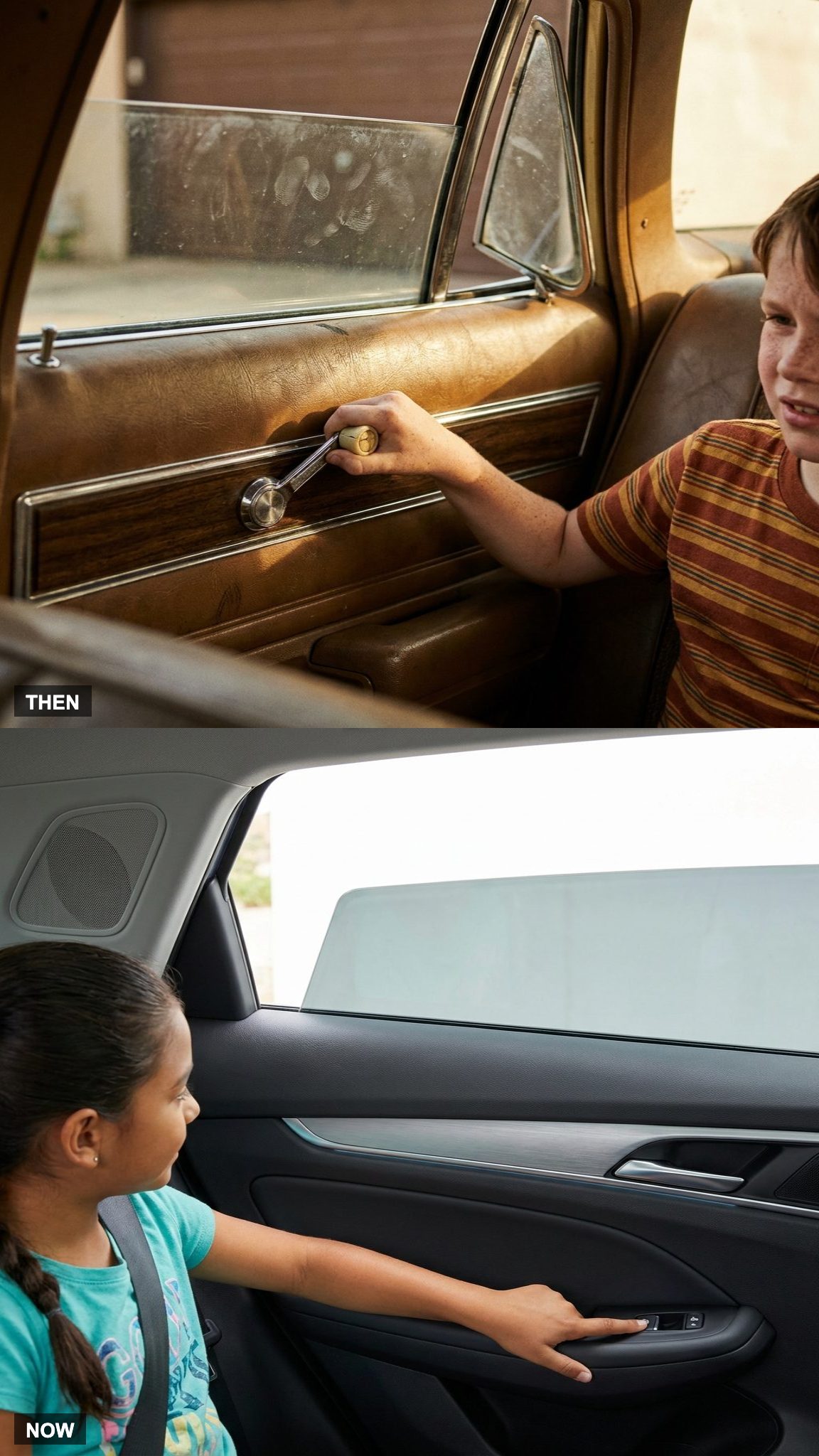
A few turns of the crank got the glass down. More if the regulator had grown stiff with age. Kids in the back worked those handles like they were hauling buckets from a well.
Now it’s one button, often with automatic up and down and anti-pinch protection. The driver can control every window without leaving the seat.
17. Locking Up: The Mushroom Knob vs. the Key Fob
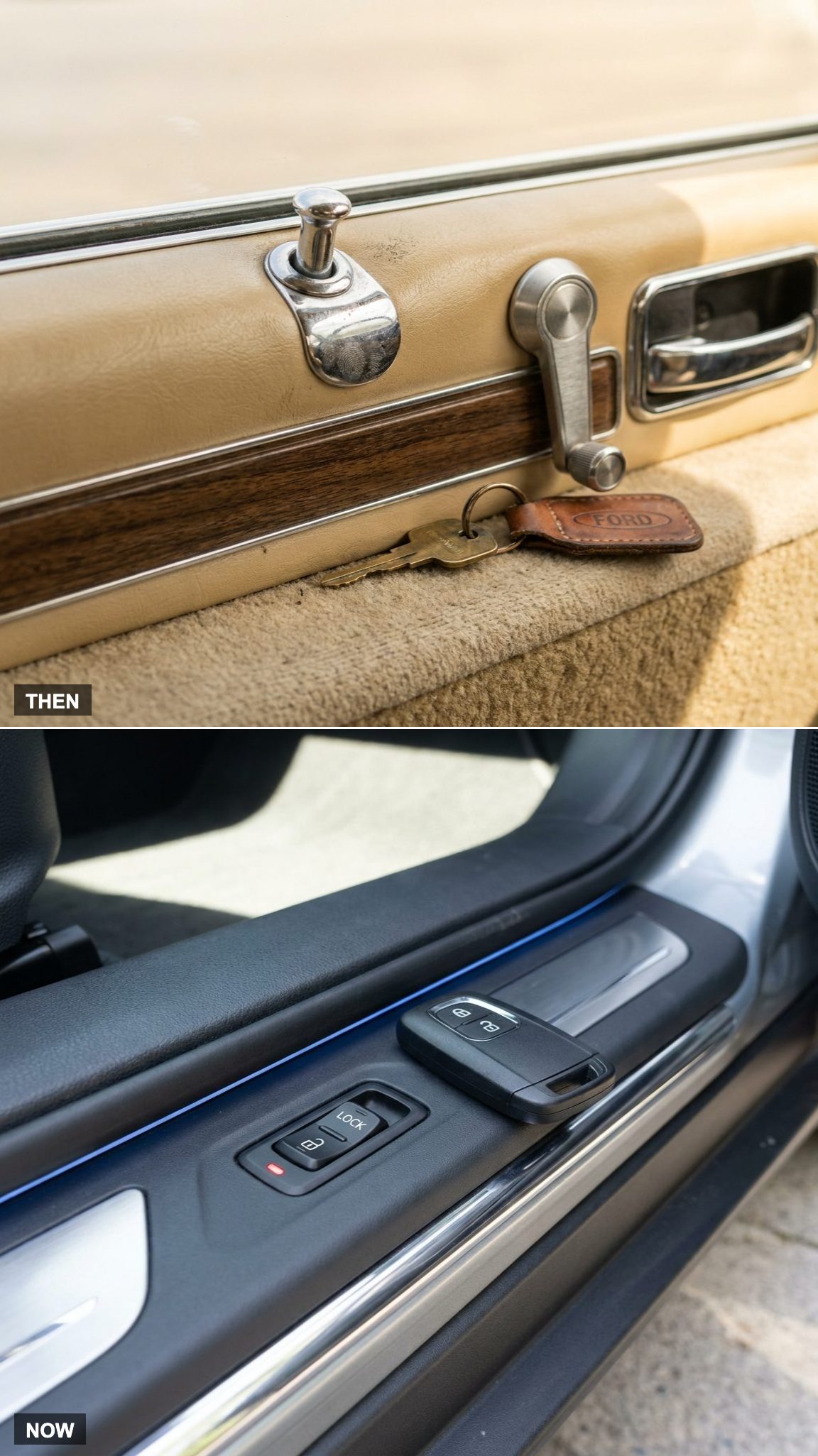
You locked a 1975 wagon by pushing down a little chrome knob with your thumb, then repeated the exercise at the other doors. Lock the keys inside and the family’s afternoon suddenly developed a subplot involving a spare key, roadside help, or somebody with questionable coat-hanger expertise.
Now the car can recognize the fob in your pocket before you touch the handle. Push-button start followed. Phone-based locking and unlocking pushed the physical key another step toward retirement.
The coat-hanger skill can stay in the past.
16. Air Conditioning: A Pricey Option vs. Standard Equipment
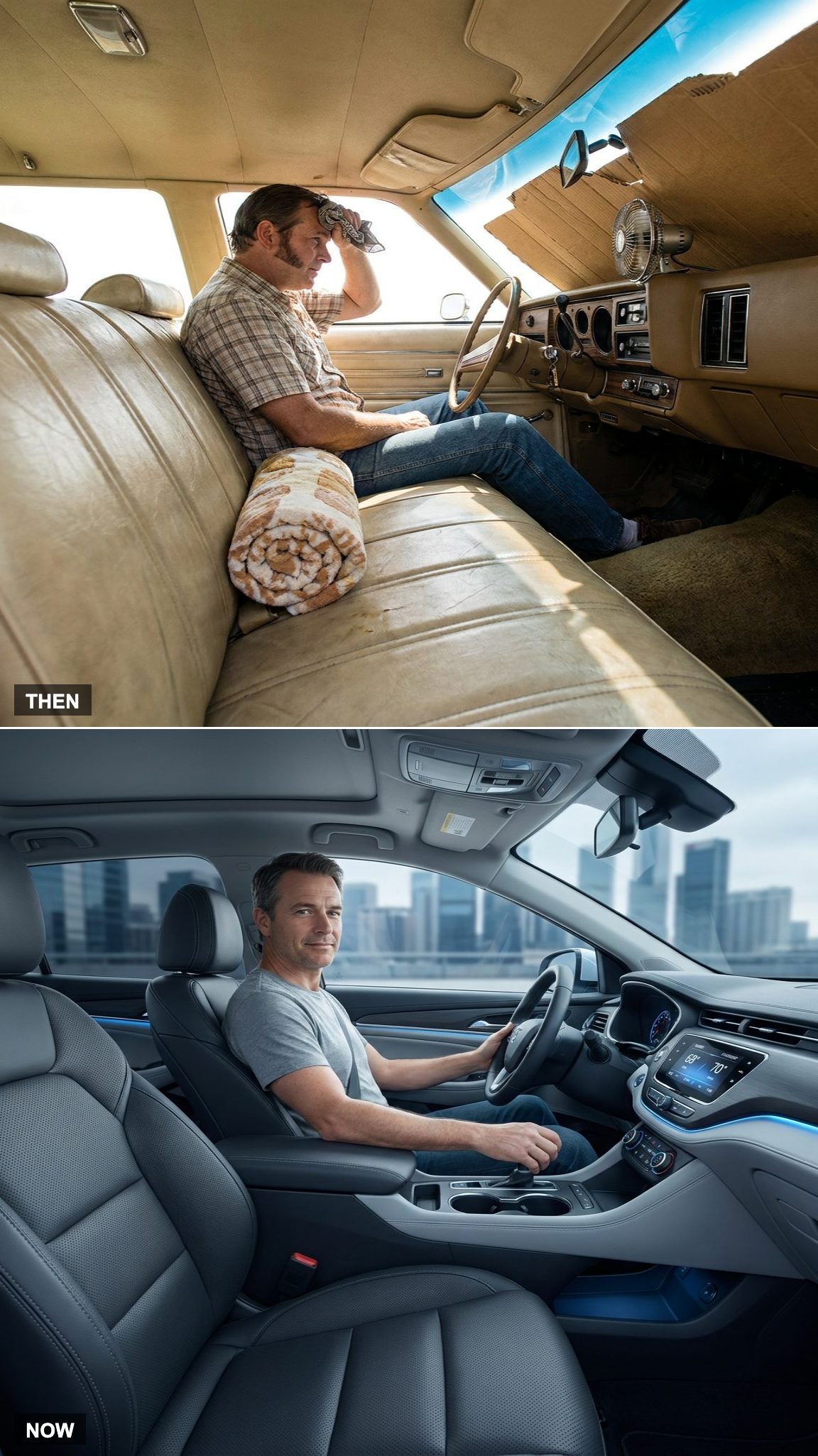
Factory air cost real money in 1975, so plenty of families skipped it. Summer road trips ran on four-sixty air conditioning: four windows down, sixty miles an hour. Vinyl seats did the rest of the punishment.
Today air conditioning is standard on nearly every mainstream new vehicle, and many cabins divide the temperature into multiple zones. Heated and ventilated seats take the argument several steps further.
15. Buckling In: Lap Belts vs. Modern Restraint Systems
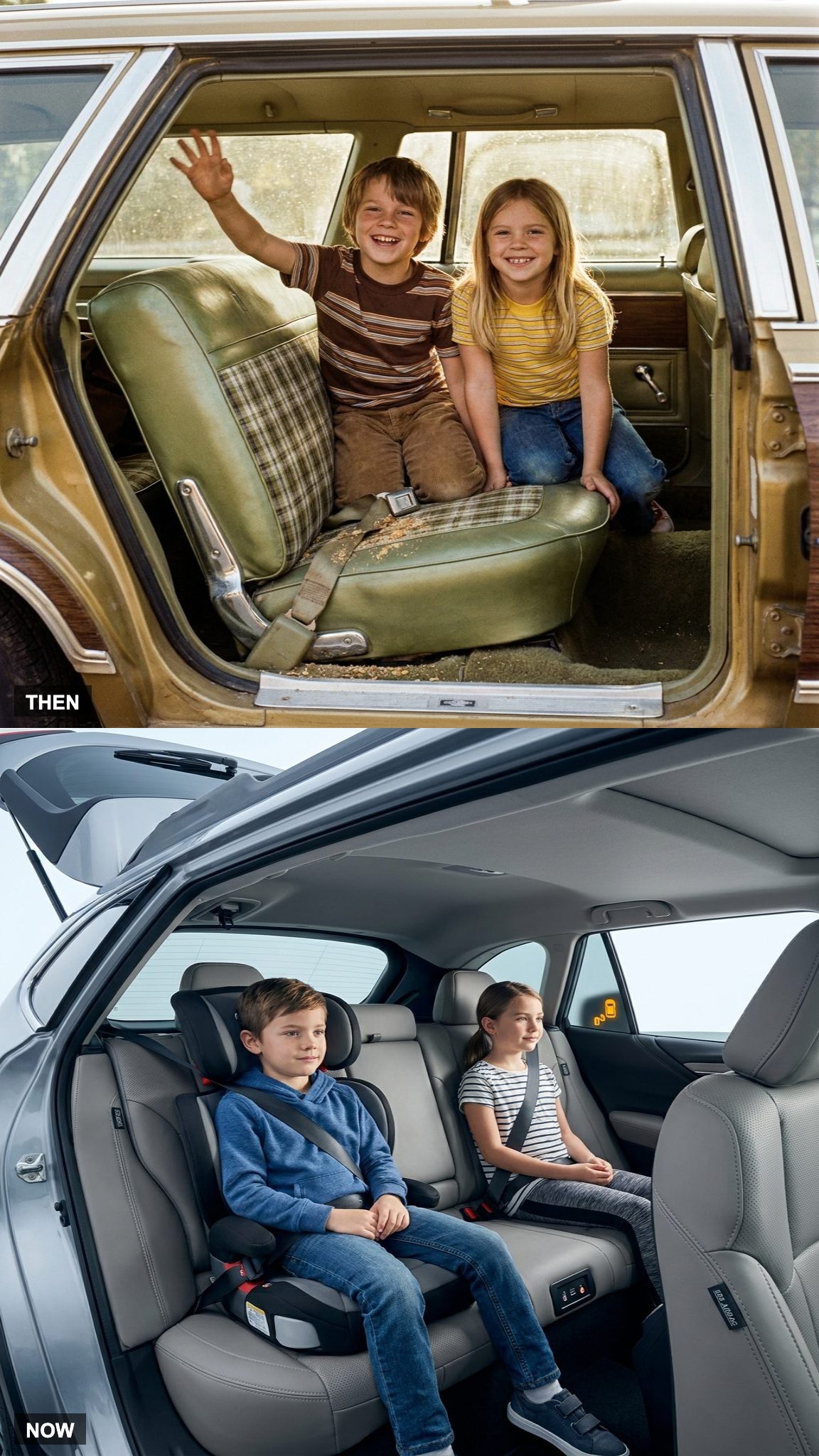
A 1975 family car could combine simple lap belts in some seating positions with three-point restraints in others, and real-world belt use was nowhere near what it is today. A belt tucked between the cushions didn’t help anybody who chose not to pull it out.
Modern restraint systems are a different universe: three-point belts, retractors, pretensioners, load limiters, airbags, child-seat anchors, and structures engineered around keeping occupants inside a protected space during a crash.
The biggest difference isn’t that modern belts are easier to use. It’s that the entire car is now designed around what happens after somebody needs one.
14. The Wayback: Giant Cargo Floor vs. Power-Folding Everything
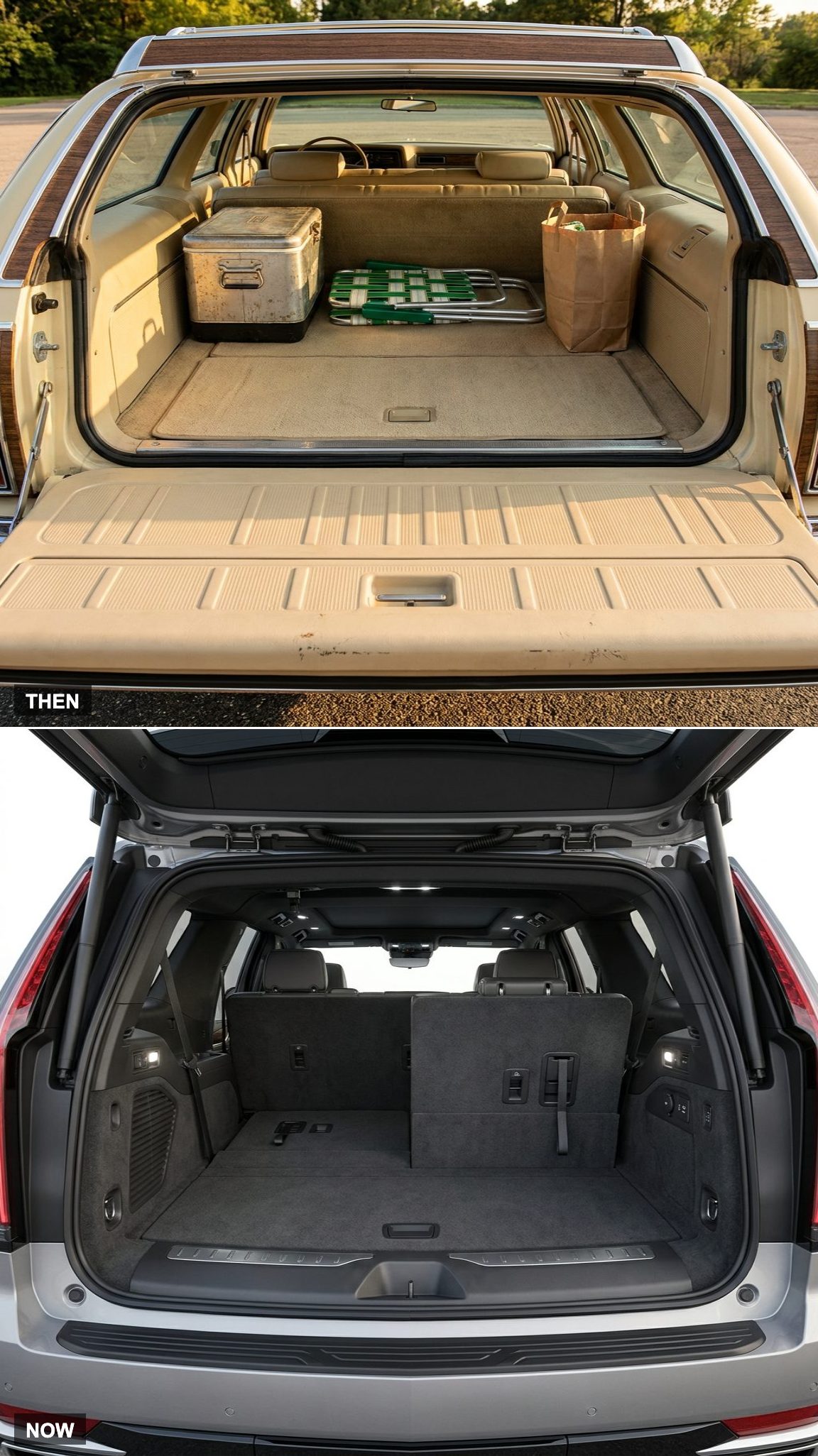
Fold the rear seat in a big 1975 wagon and the car seemed to turn into a room. Long, low cargo floors swallowed camping gear, luggage, dogs, lumber, groceries, and the mysterious assortment of objects a family accumulated over a summer.
Modern cargo areas work harder in other ways. Split-folding seats, underfloor compartments, tie-down points, power seat releases, movable cargo systems, and liftgates make the available space easier to organize even when the vehicle itself is shorter.
The old wagon won with sheer acreage. The new one brings an instruction manual.
13. Loaded for Vacation: The Piled-High Roof Rack
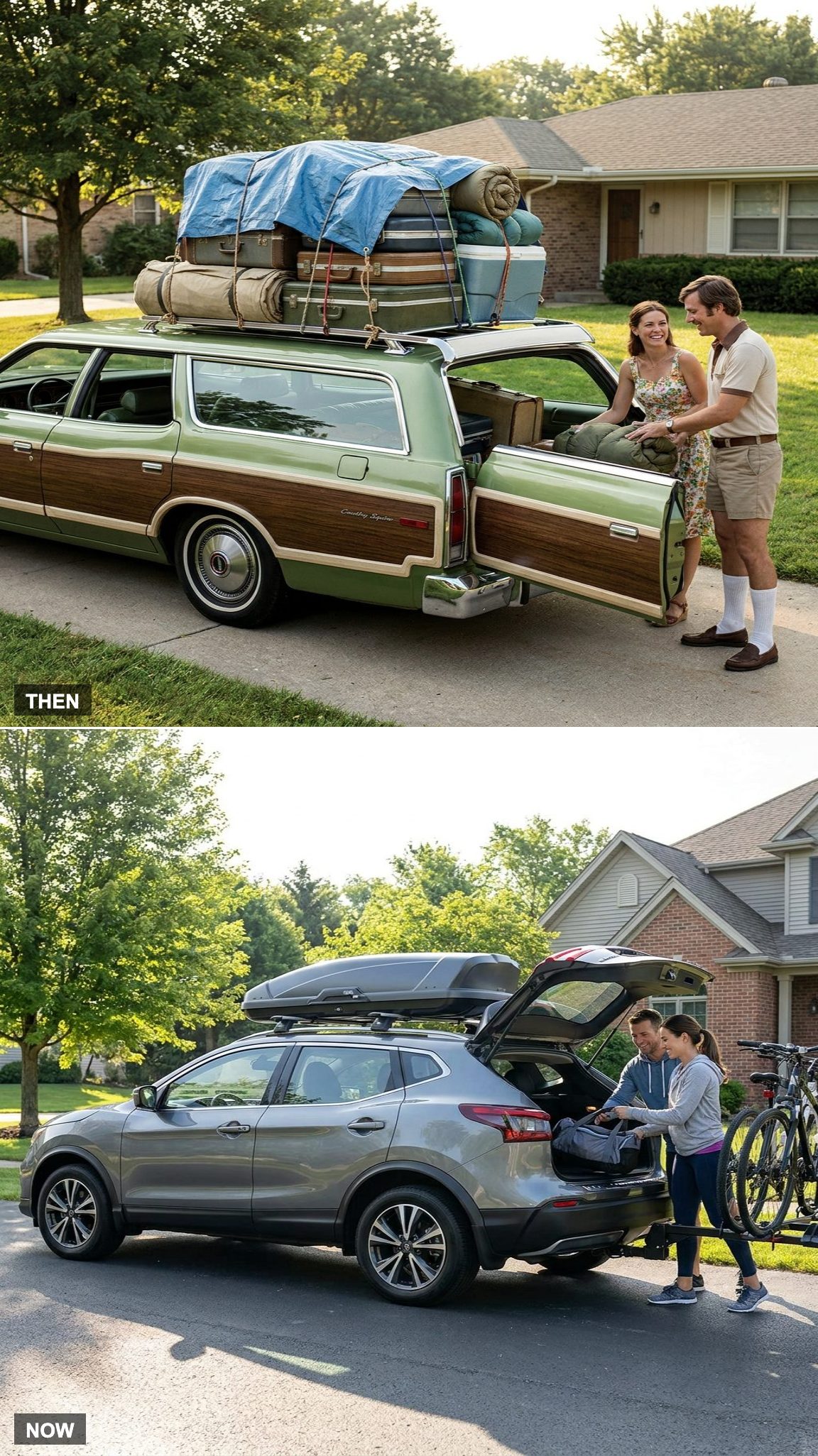
Loading the roof rack was its own summer ritual. Hard suitcases, tent poles, folding chairs, and whatever wouldn’t fit inside went upstairs. Then came rope, straps, a tarp, and the moment when somebody tugged the entire arrangement and declared it wasn’t going anywhere.
Modern cargo boxes lock shut, mount to purpose-built crossbars, and make a serious effort not to behave like sails in a crosswind. They’re cleaner, quieter, and substantially less likely to make the family stare nervously through the rear window after every bump.
12. When Things Went Wrong: Full-Size Spare and a Lug Wrench
Would you like to save this?
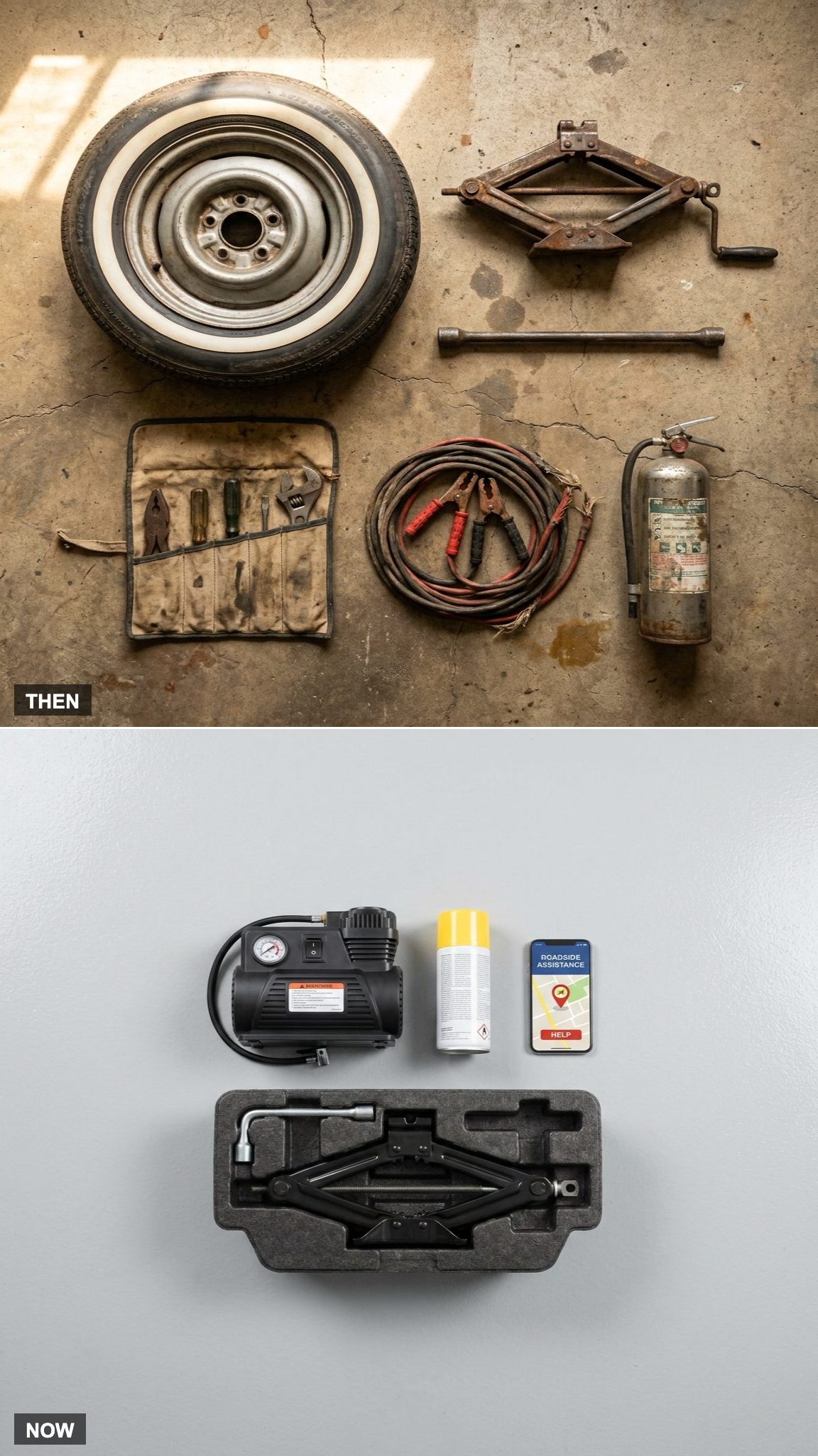
Open the spare compartment on many older wagons and there sat a full-size wheel and tire, often accompanied by the jack and lug wrench needed to change it at the roadside.
Many modern vehicles have moved to temporary spares, tire-inflator kits, run-flat tires, or no spare at all. Weight, packaging, efficiency, and cost all played a part. The result is a strange bit of progress: the car can warn you which tire is losing pressure long before an old wagon could, but it may not carry another tire to replace it.
11. Under the Hood: The Big Lazy V8 vs. Turbos and Hybrids
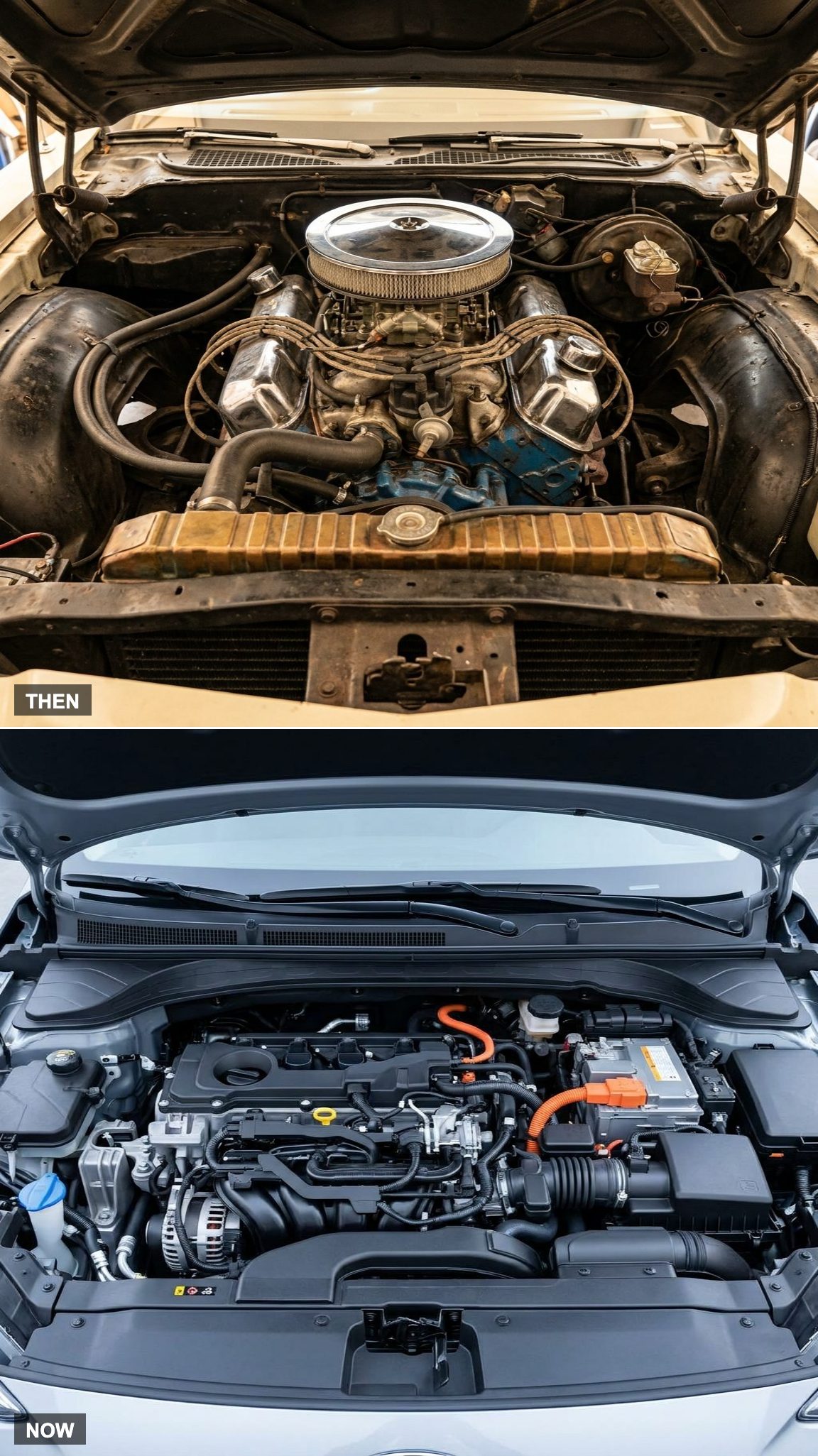
Lift the hood on a big 1975 full-size wagon and a cast-iron V8 was a familiar sight. Large air cleaner up top, hoses and plug wires in plain view, and enough visible mechanical hardware that even a casual owner could identify much of what was happening.
Modern family vehicles can extract remarkable power from turbocharged fours, hybrids, and increasingly electrified drivetrains. Engine bays are tighter, cleaner, quieter, and often hidden beneath covers. High-voltage components bring their own warnings.
The modern system does vastly more with less fuel. It just doesn’t introduce itself as clearly when the hood goes up.
10. Fuel Economy: The 12-MPG Land Yacht vs. the Sipping Modern Wagon
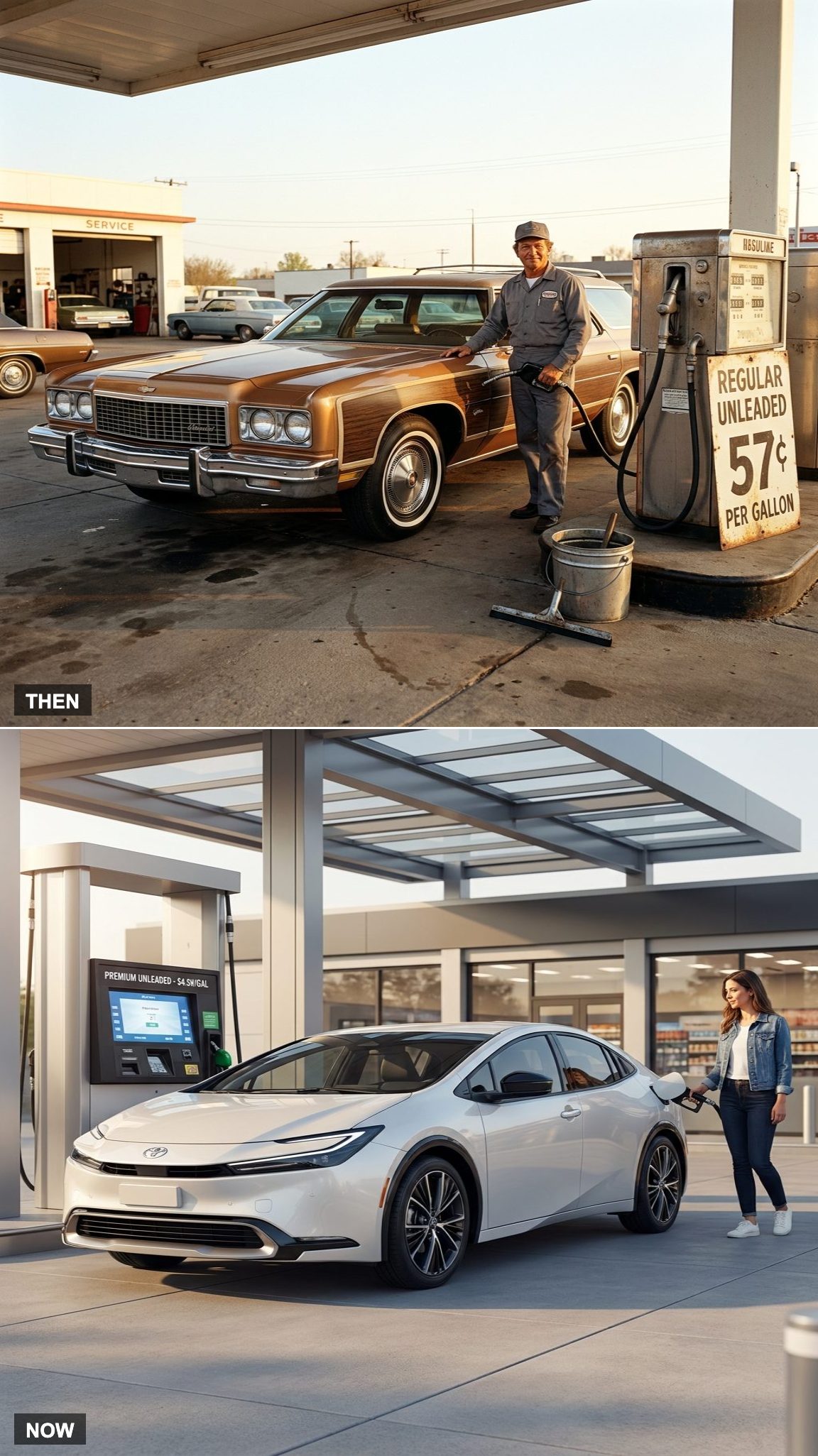
Twelve miles to the gallon was entirely believable territory for a large, V8-powered mid-1970s wagon, and some combinations could do worse. By 1975 that appetite was no longer invisible: the recent oil crisis had put fuel economy firmly into the national conversation.
Modern wagons and wagon-like family vehicles travel dramatically farther on a gallon, while hybrids can push efficiency into territory that would have seemed improbable when carburetors and three-speed automatics were doing the work.
The gas pump didn’t disappear. The amount of road between visits changed considerably.
9. Ride Comfort: The Living-Room Float vs. the Planted Modern Chassis
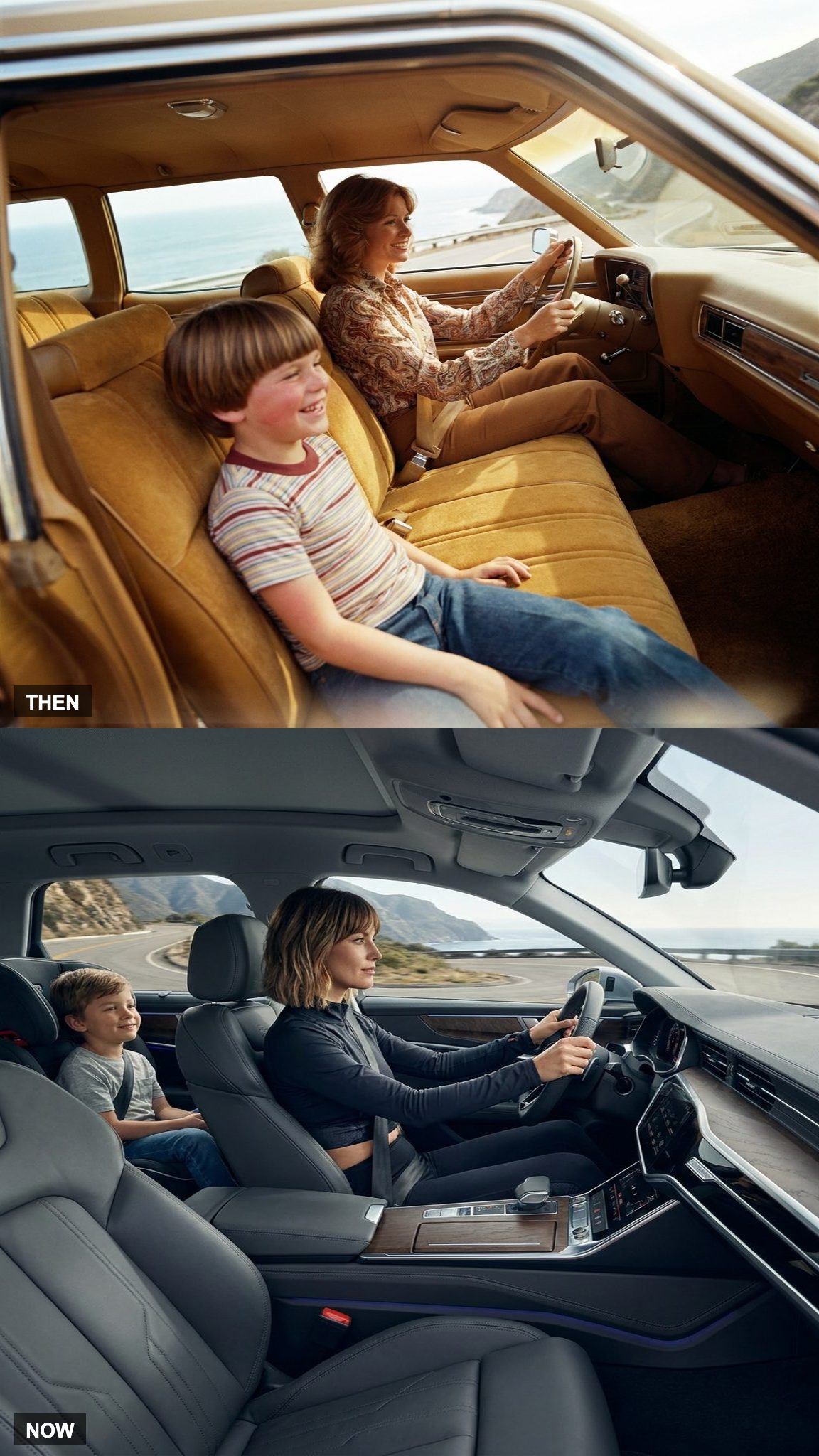
Old full-size wagons could float. Softly sprung suspension turned broken pavement into a long heave rather than a sharp hit, while the body leaned into a bend with the enthusiasm of a rowboat crossing a wake.
Modern wagons stay much flatter. Better damping, stiffer structures, more sophisticated suspension geometry, electronic systems, and supportive seats give the driver far more control over what the body is doing.
The old car isolated you from the road. The new one tries to keep you informed without beating you up.
8. Turning Radius: Three-Point Turns That Became Five-Point Adventures
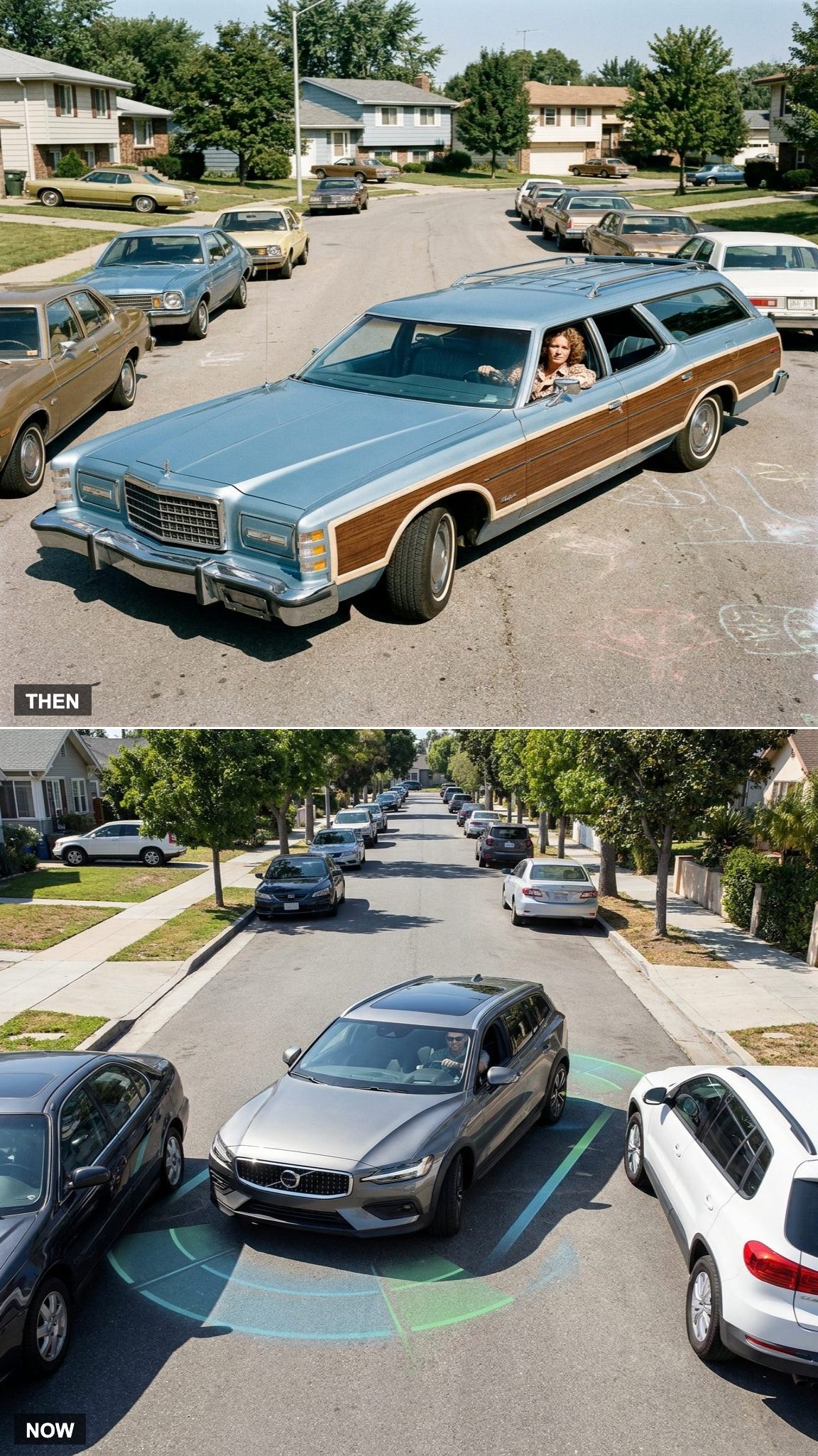
Parallel parking a full-size 1975 wagon meant managing a genuinely enormous footprint. Eighteen feet of body, a long wheelbase, a hood stretching toward another ZIP code, and limited knowledge of exactly where the rear bumper ended could turn a tight space into geometry homework.
Power steering helped, but it couldn’t make the car shorter.
Modern vehicles add parking sensors, rear cameras, 360-degree views, steering assistance, and in some cases automatic parking. Nobody needs to earn a merit badge for putting the family car between two lines anymore.
7. Paint and Styling: Harvest Gold With Woodgrain vs. Fifty Shades of Gray
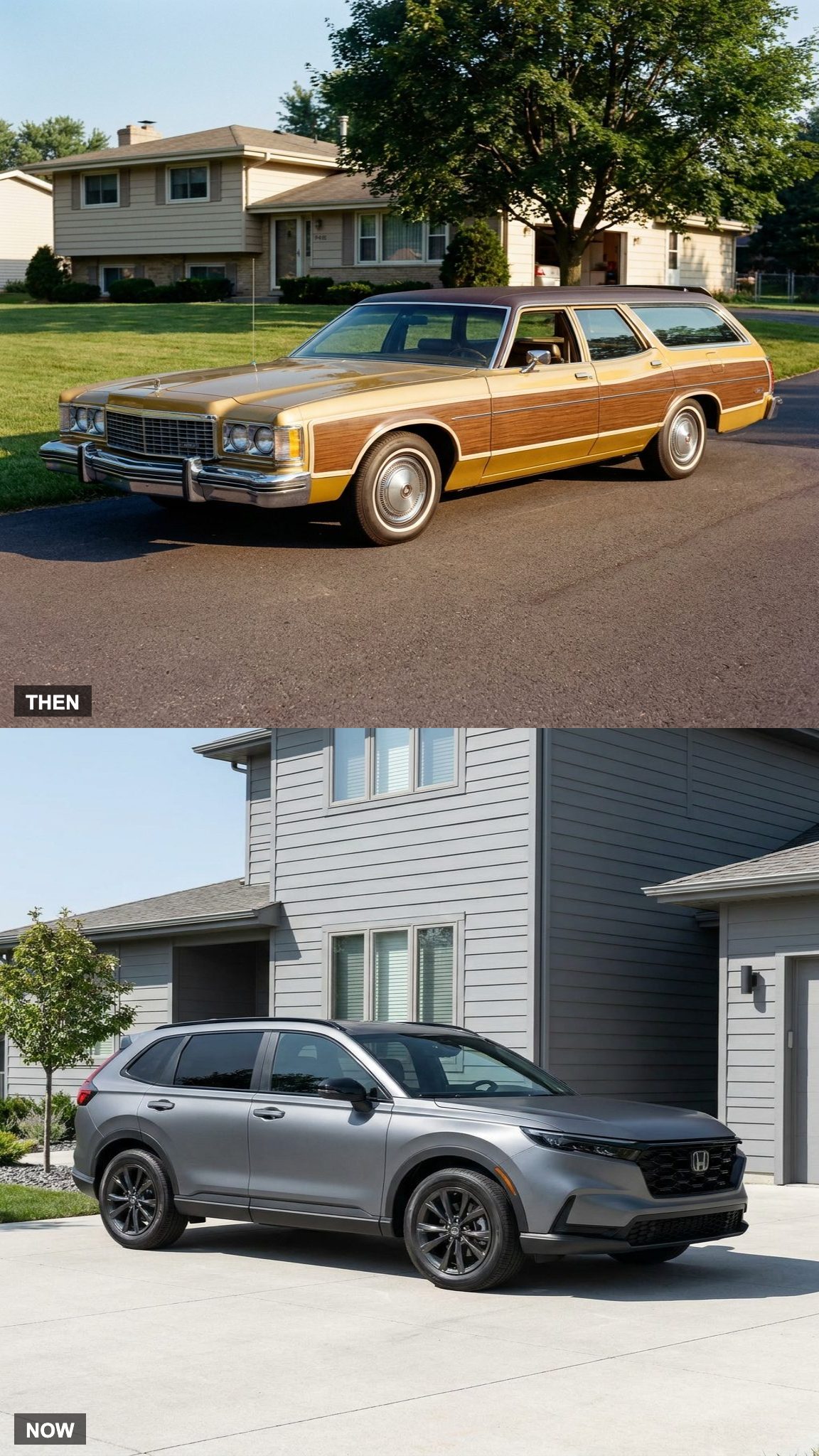
The 1975 palette did not fear a living-room comparison. Harvest gold, avocado green, burnt orange, deep brown, cream, blue — manufacturers offered colors that could turn an enormous wagon into an even larger visual statement. Chrome, vinyl roofs, contrasting interiors, and simulated woodgrain gave designers more places to keep going.
Modern lots lean heavily toward white, black, silver, and multiple interpretations of gray. There are excellent exceptions, but the average family vehicle has become much quieter chromatically.
A 1975 wagon could be identified from halfway down the block. Sometimes the color alone did the job.
6. Wheels: Chrome Wheel Covers vs. Machined Alloy
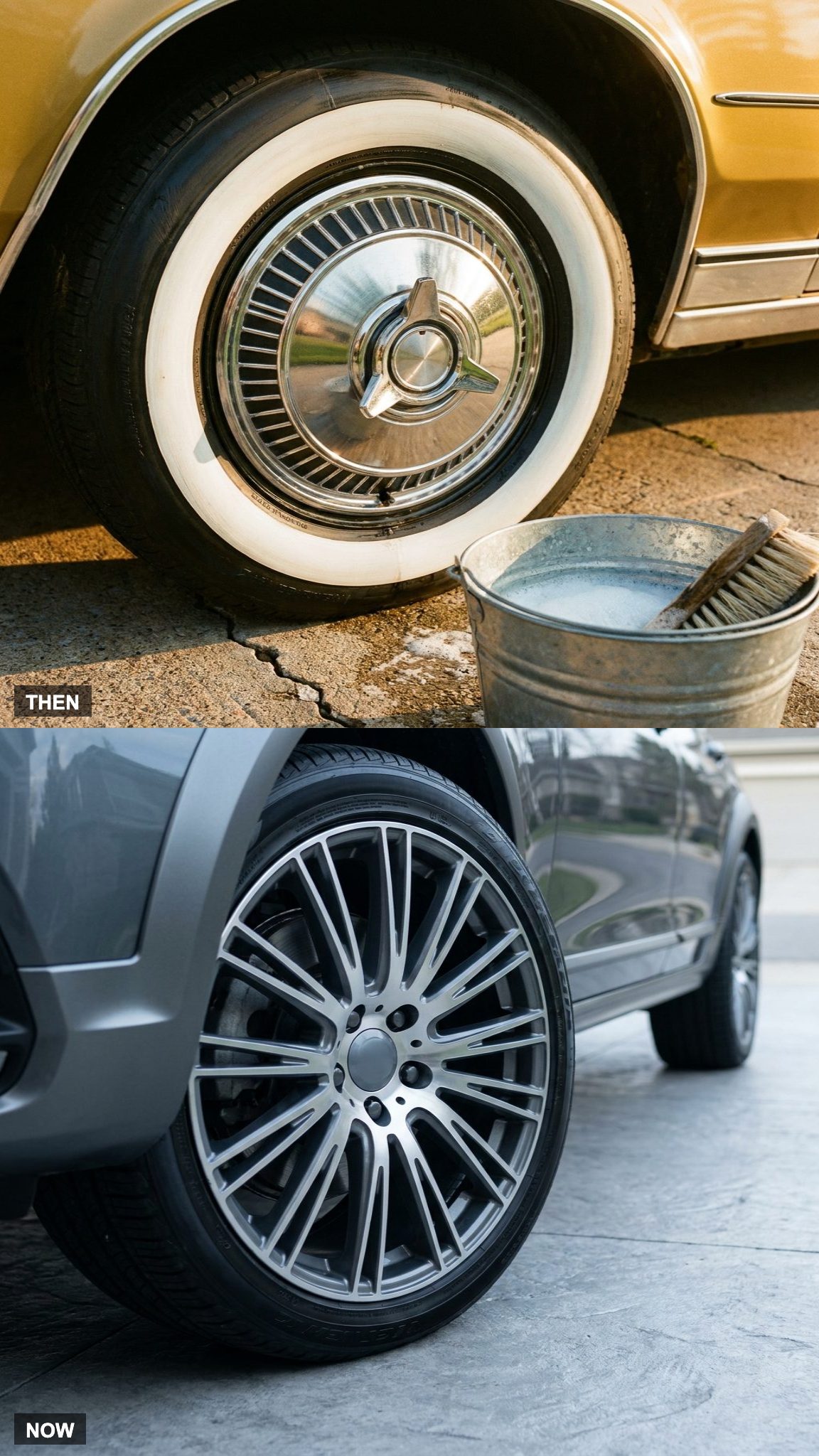
Chrome wheel covers were a culture unto themselves. Full-face designs covered plain steel wheels, whitewalls got scrubbed on wash day, and a badly secured hubcap could occasionally make its own bid for freedom after a pothole.
Now the wheel itself is usually the decoration: cast or forged alloy, machined faces, painted pockets, and lower-profile tires. Nothing needs to snap over the steel wheel because the steel wheel is often gone.
The new setup is lighter and more precise. It is also much less likely to roll independently toward a storm drain.
5. The Family Dog Along for the Ride: Loose in the Wayback vs. Secured for the Trip
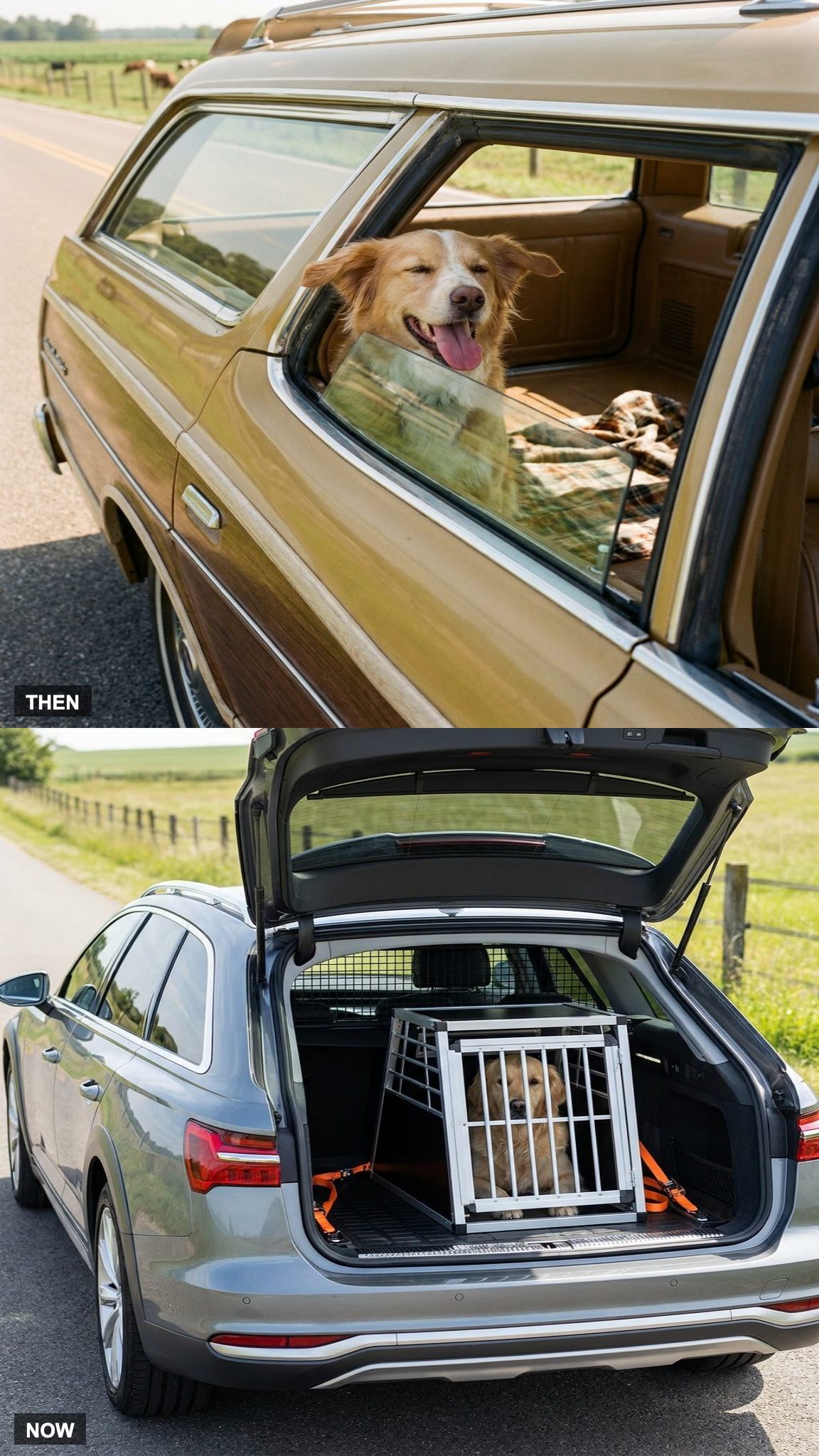
The family dog often treated the wagon as movable real estate. Back seat, cargo floor, window, somebody’s lap — the boundaries were negotiable. A head out the window and two ears in the wind became one of the enduring images of the family road trip.
Today responsible owners have access to secured crates, barriers, and vehicle-restraint systems designed to keep an animal from becoming a projectile in a hard stop. The equipment is less cinematic and considerably more sensible.
The dog still gets the road trip. He just doesn’t necessarily get the entire car.
4. Wagon vs. SUV: How the Whole Category Got Taller
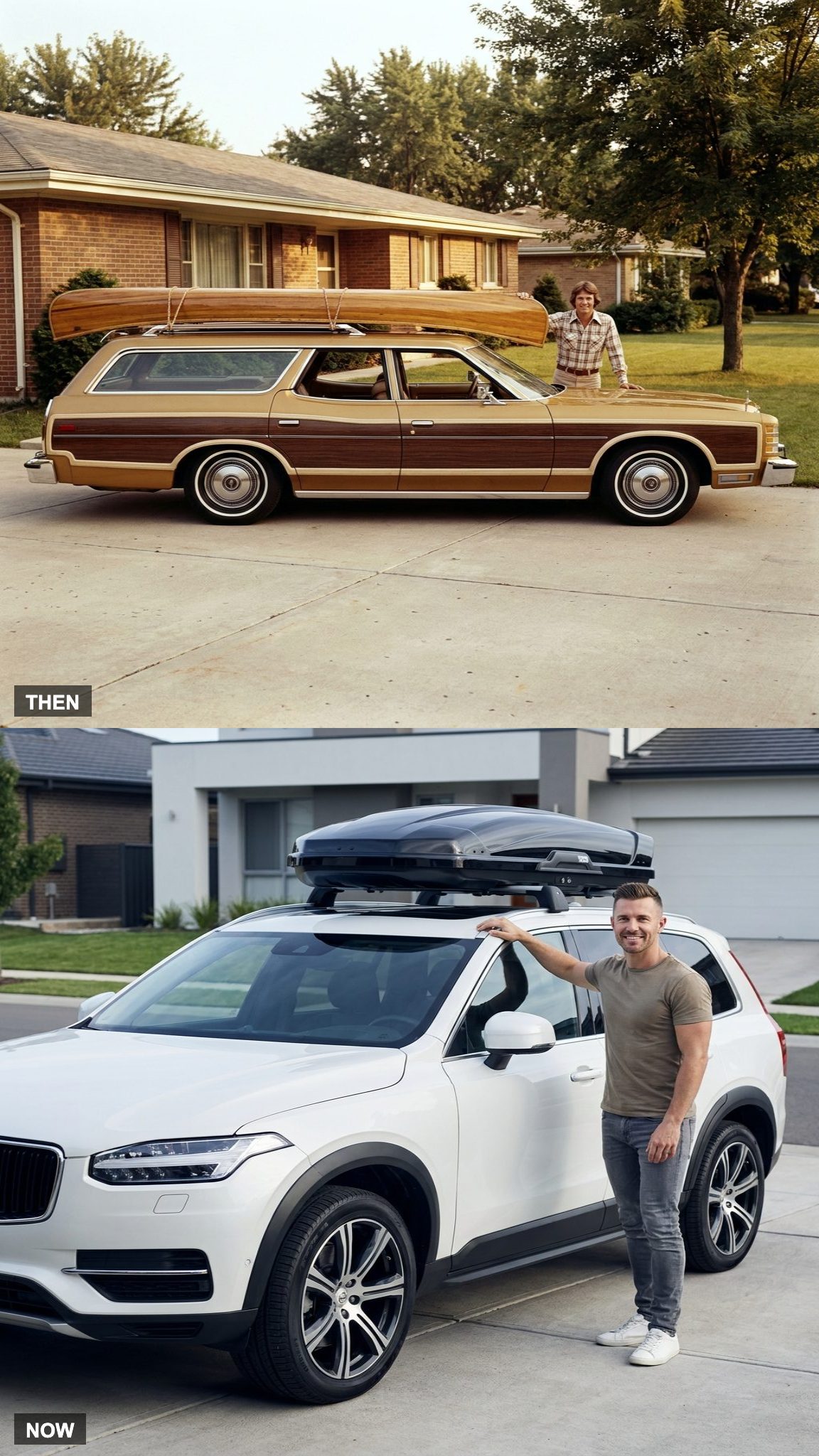
The wagon’s job didn’t disappear. Kids, groceries, luggage, dogs, sports gear, and something oversized strapped to the roof still had to get somewhere. Much of that work eventually moved first to minivans and then to SUVs and crossovers.
You climbed down into many traditional wagons. You climb up into a modern crossover. The mission stayed recognizable while the seating position, body height, ground clearance, and styling moved upward.
That low, long family-car silhouette didn’t fail because families stopped hauling things. Buyers simply found another shape they preferred.
3. The Whole Family Trip: AM Radio and I-Spy vs. Six Screens and Silence
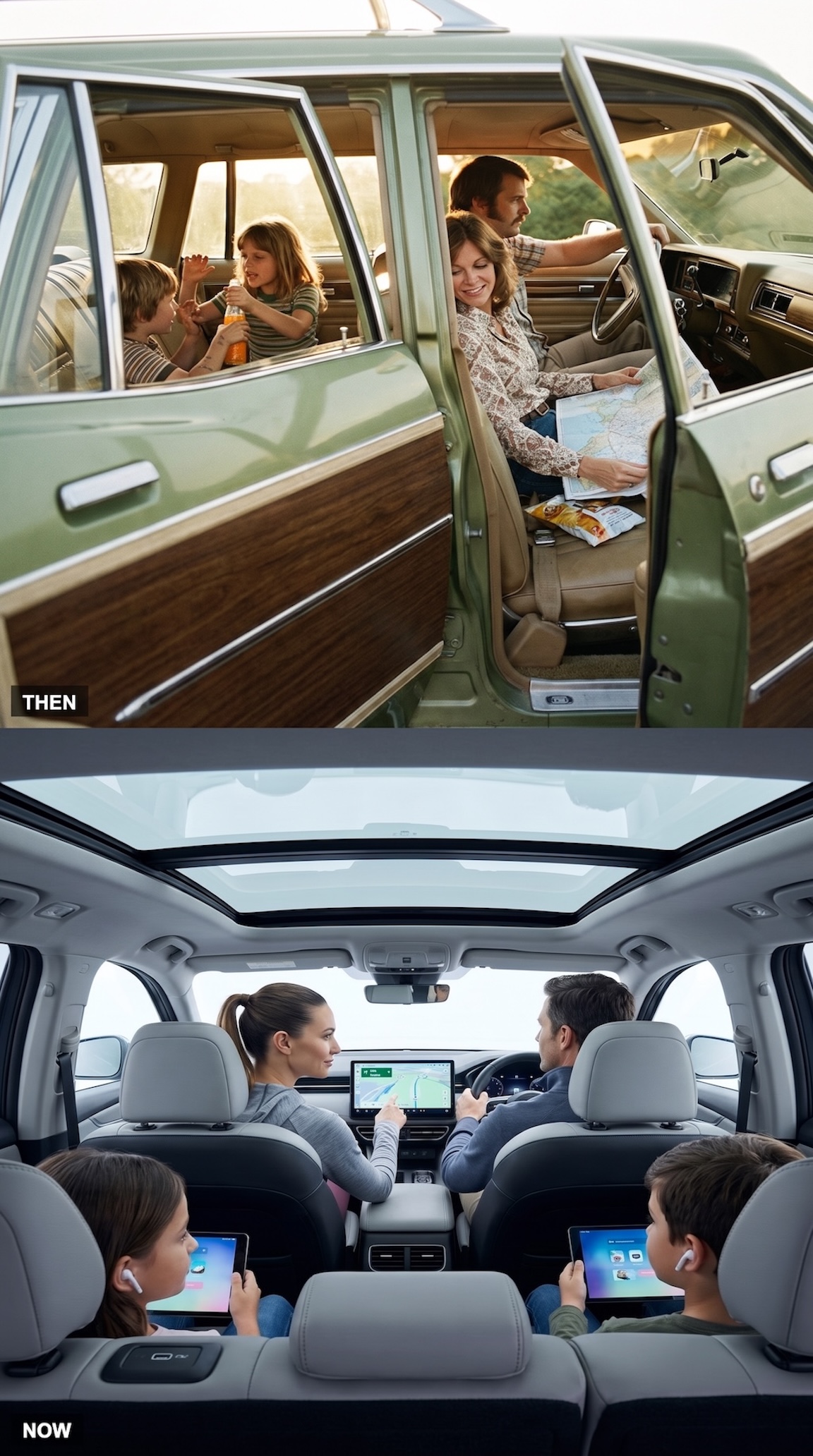
The trip itself supplied the entertainment. A paper map refused to fold back the way it came. Somebody started the license-plate game. Somebody else fought over the last warm soda. The radio weakened between towns, boredom settled over the back seat, and eventually somebody had to talk to somebody else.
Now entertainment can travel individually. Phones, tablets, headphones, streaming music, downloaded movies, games, and navigation can keep six people occupied six different ways for hundreds of miles.
Neither version guarantees family harmony. The older one simply offered fewer escape routes.
The old road trip had one unbeatable entertainment system: everybody was stuck in the same place.
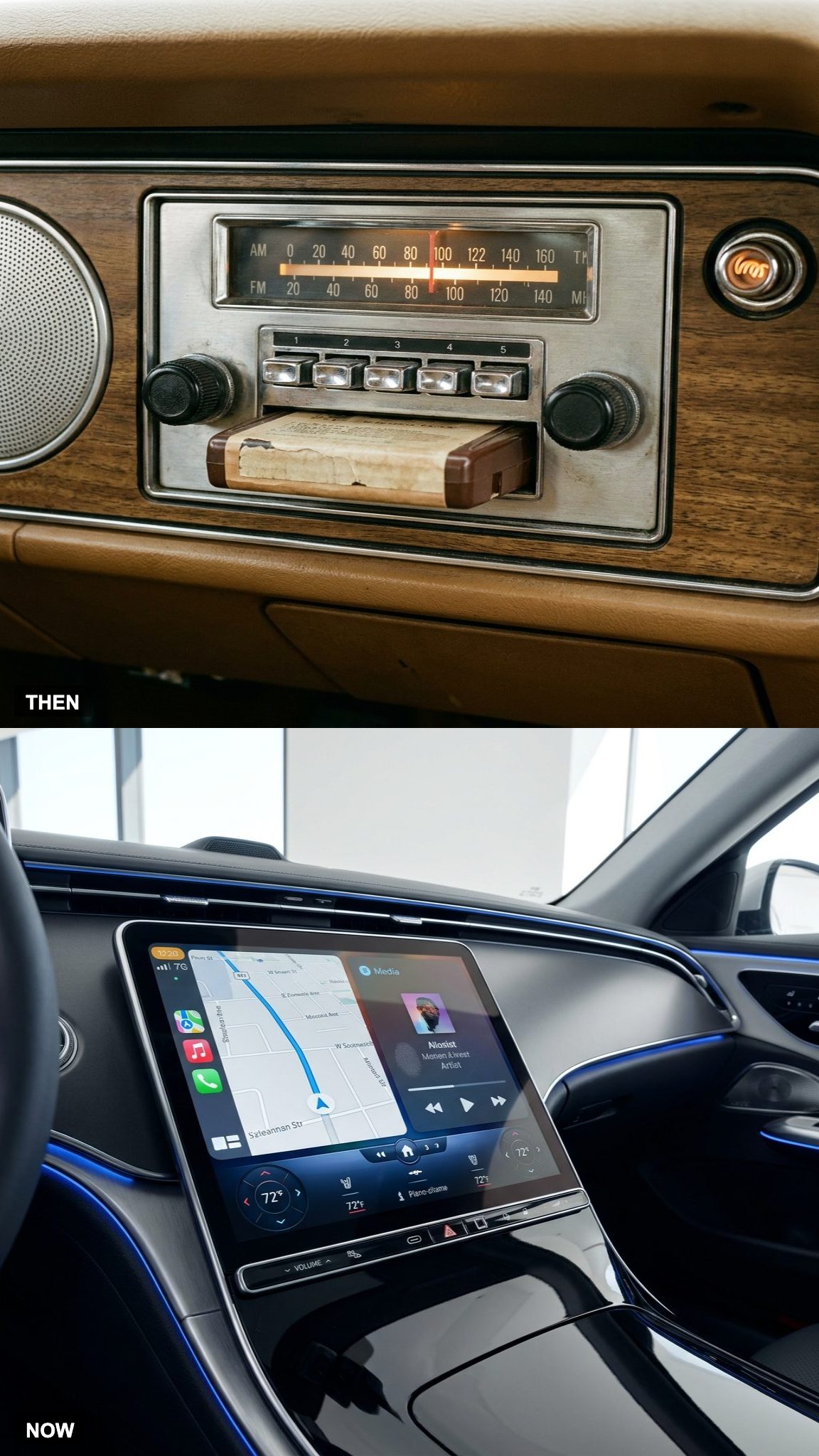
2. Infotainment Screens and Connectivity
Would you like to save this?
In 1975, the dashboard’s connection to the outside world was essentially the radio. Preset buttons found favorite stations, an AM/FM dial showed frequency, and an optional tape player supplied whatever music you had remembered to bring.
The modern center screen manages a completely different category of information: navigation, phone integration, traffic, cameras, vehicle settings, charging or efficiency data, software features, and sometimes climate controls. The car isn’t merely receiving entertainment anymore. It’s exchanging information.
1. Driver Assistance: From Mirrors and Judgment to a Car That Watches Back
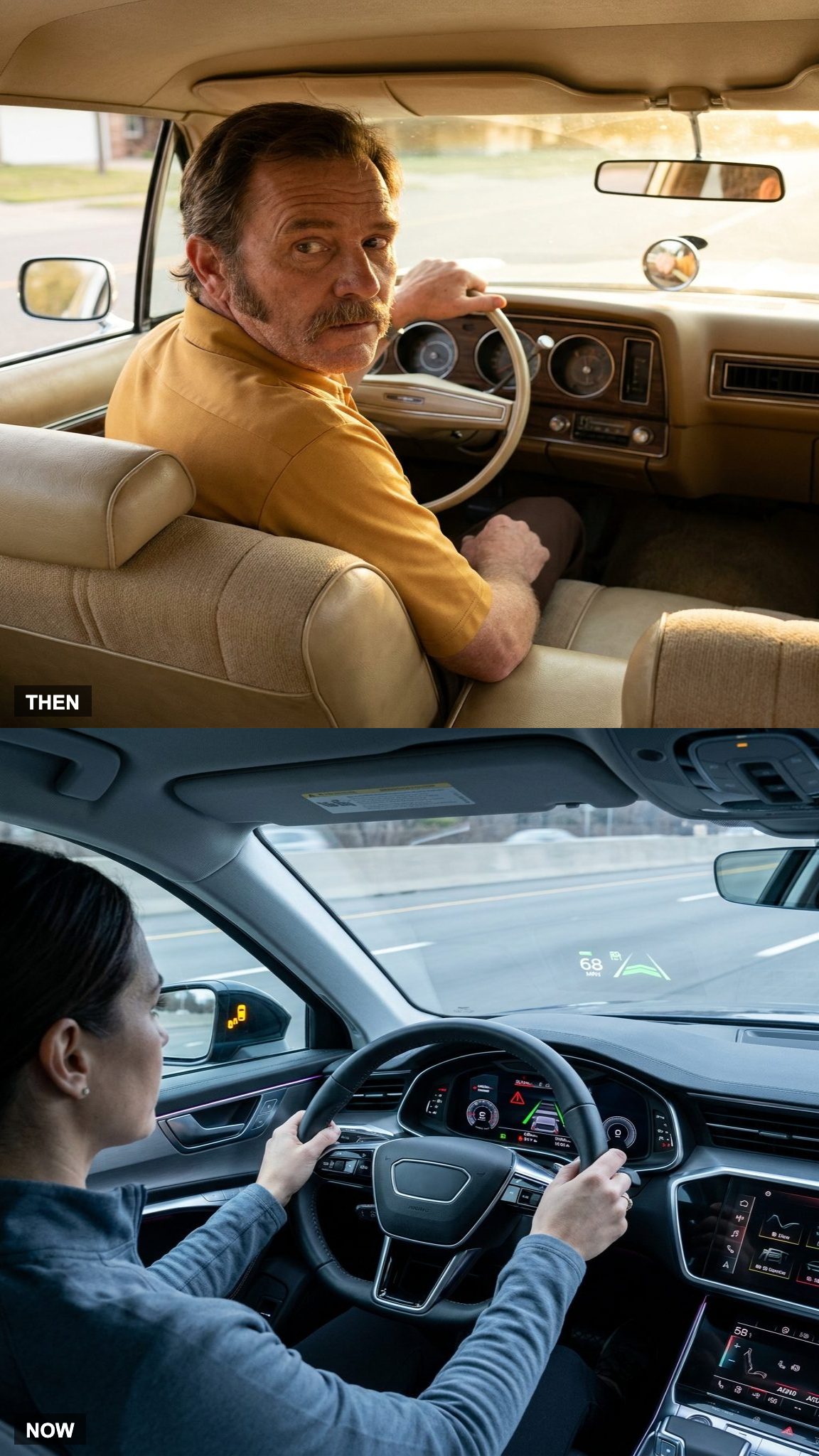
Driver assistance in 1975 began with the driver. Mirrors, a shoulder check, judgment of speed and distance, and enough attention to keep a long wagon centered between the lines handled most of the job.
A modern family vehicle can watch blind spots, warn about cross traffic, maintain a set distance from the car ahead, provide lane-departure warnings or steering assistance, brake automatically in certain emergencies, and project information into the driver’s sightline.
That’s an extraordinary shift. The driver still carries responsibility, but the car now spends a remarkable amount of time checking the driver’s work.
The old wagon gave the driver information. The modern car has started offering opinions.