
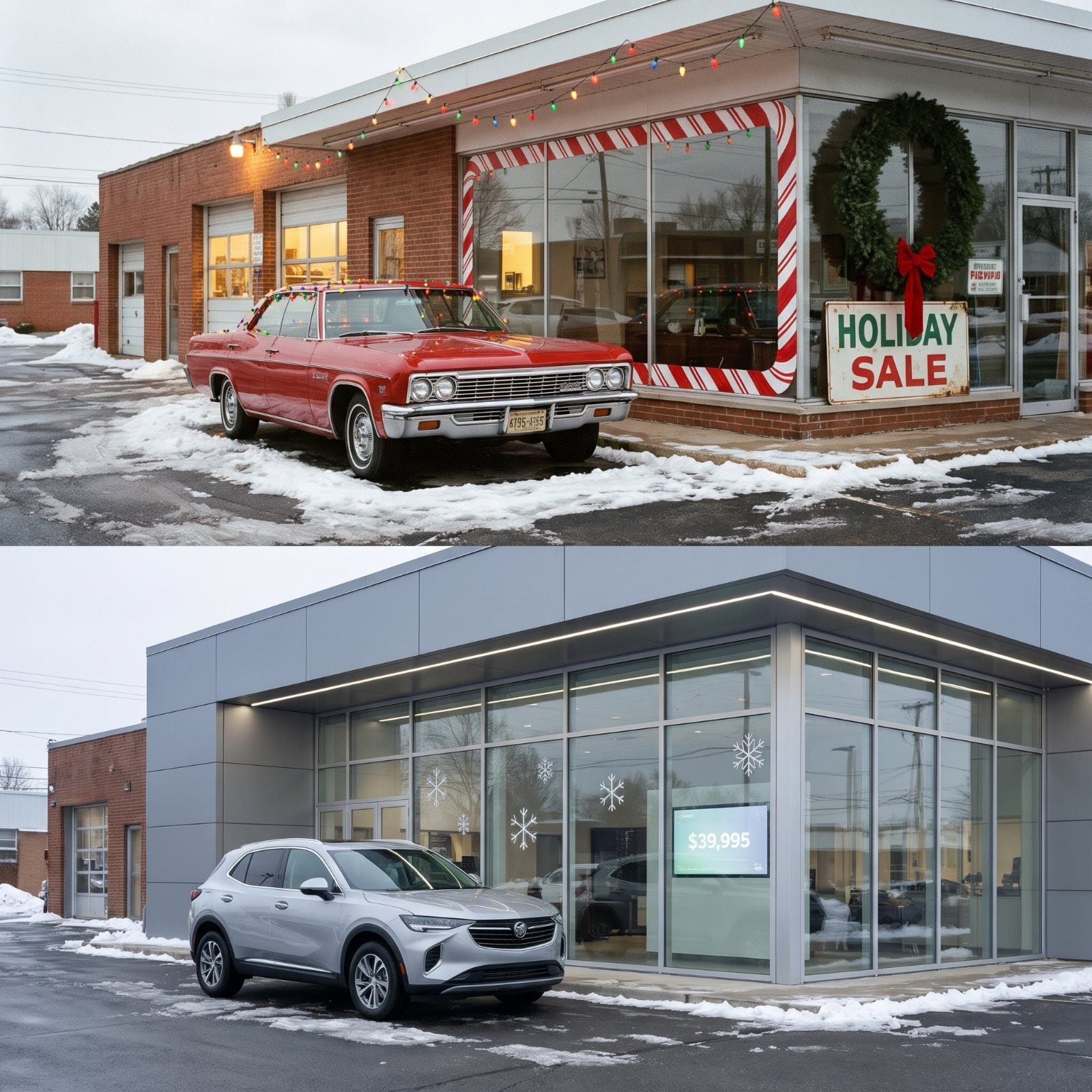
The smell is the first thing you lose. Cold vinyl seats, a radiator warming up, pine needles tangled in the exhaust from somebody’s tree strapped to a wagon roof. December at the local Chevy store in 1966 was a whole production — colored bulbs, hand-painted windows, a salesman in a skinny tie waving you in from the cold. Compare that lot to the glass-and-LED version standing on the same corner today, and the distance between them tells you almost everything about how we buy cars now.
Please note that some of the images in this article were created with the assistance of AI.
28. The Christmas Window Display
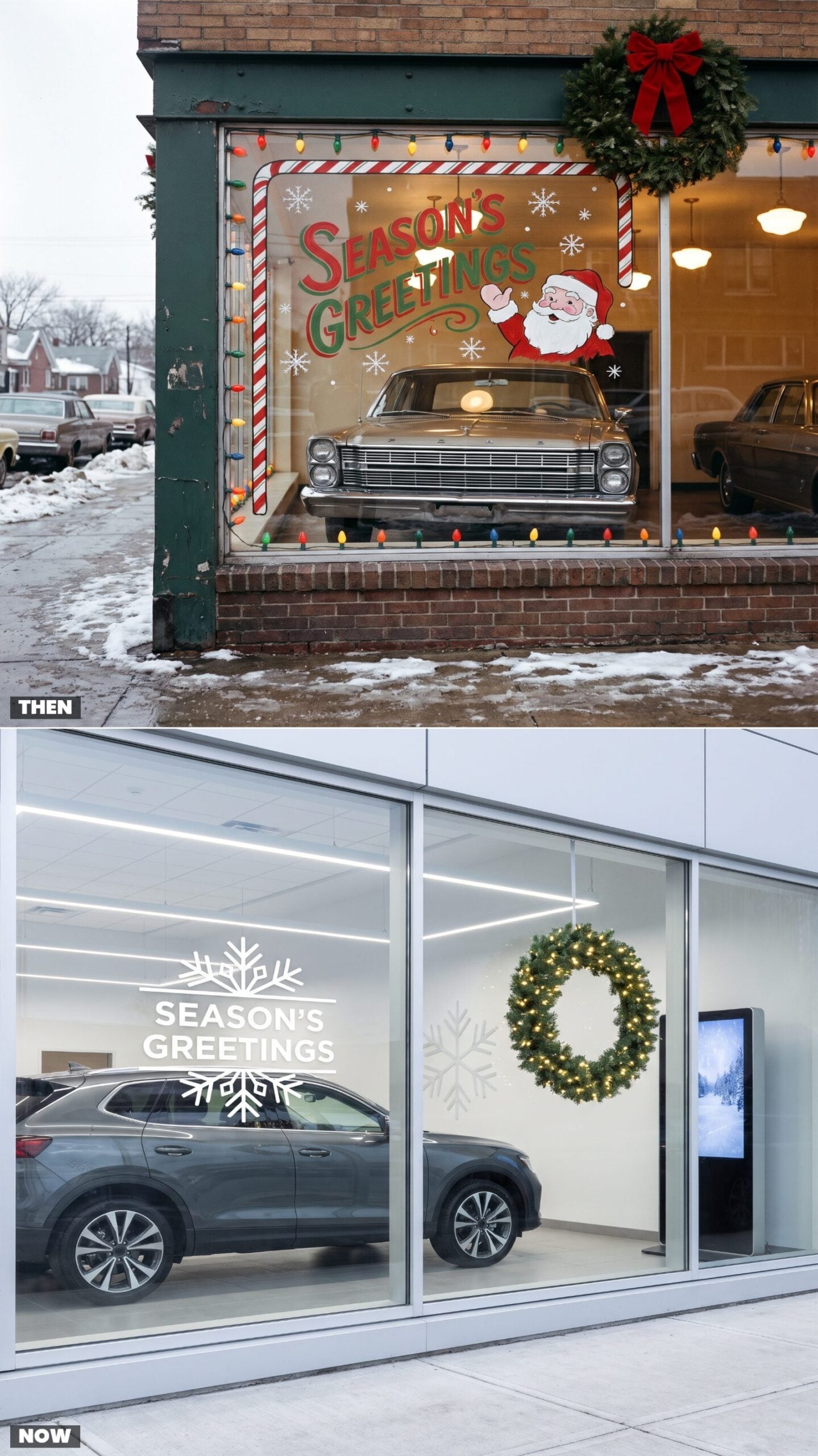
In 1966 the window was somebody’s actual handiwork. A sign painter came out with a bucket of tempera and a long-handled brush, climbed a stepladder, and painted Santa and a candy-cane border straight onto the glass. Every dealership looked a little different because a different human hand made it, and the paint flaked by February and nobody minded.
Today the window gets a vinyl decal applied in a few minutes, pre-cut from a national marketing kit. Clean. Consistent. Identical to the same brand’s store three states over. Something got lost when the brush went away, and I’ll say it plainly: the hand-painted one had more charm in a single flaked snowflake than the whole vinyl sheet has.
27. The Roadside View of the Dealership
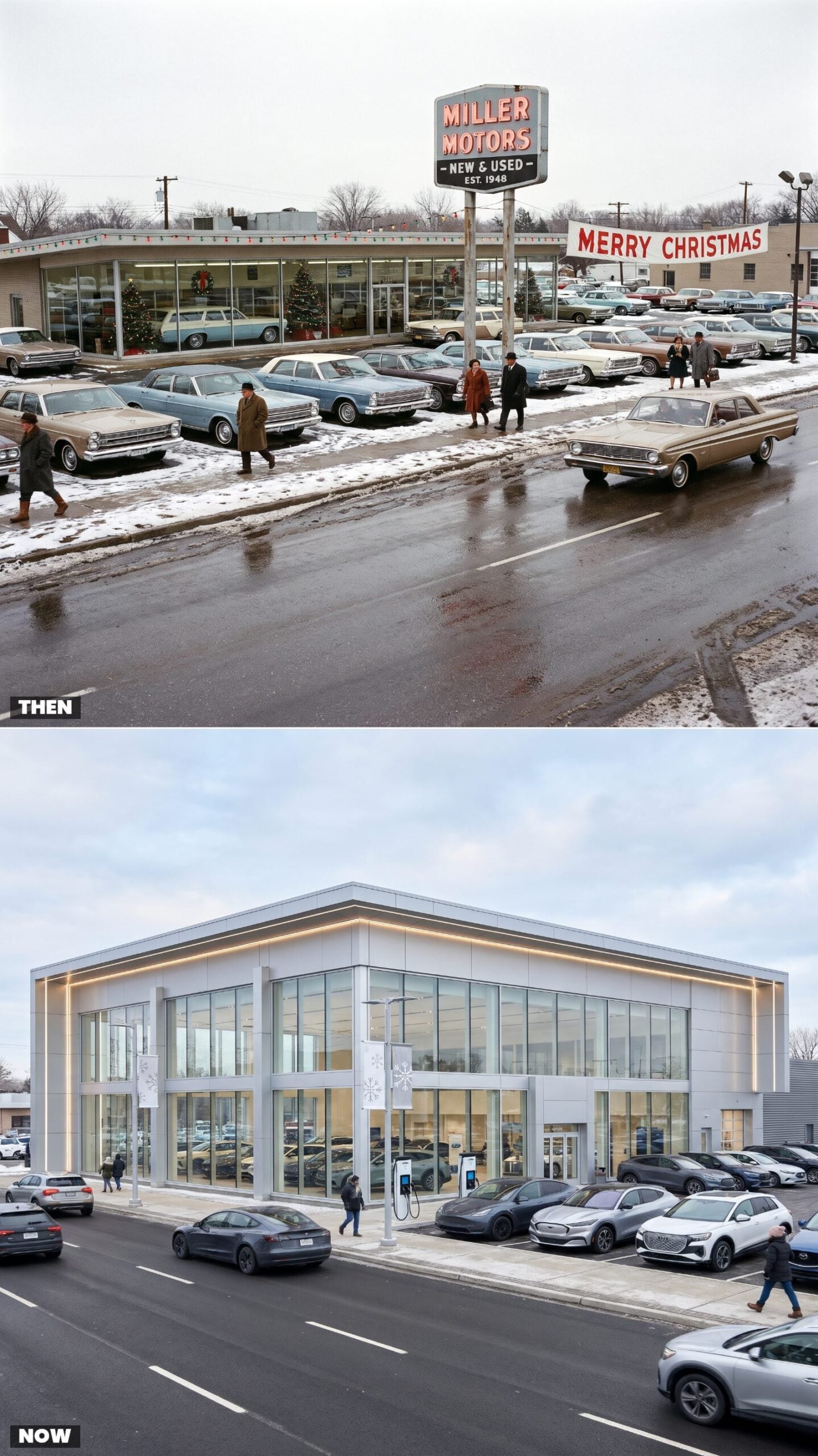
From the road, the 1966 store sat low and friendly — one story, flat roof, a long ribbon of windows you could see straight through to the cars inside. You drove by and the whole operation revealed itself in a glance. It wanted to be looked at.
The modern version towers over you. Two stories of glass, brushed aluminum, an architectural light wash that probably costs more than a whole decade of the old lighting budget. Serious, corporate, handsome in its way. But it keeps its distance, where the old one leaned toward the street like it was glad you came.
What Our Readers Say
- Photos that look like the 1960s got hearts from Jalopy Talk readers 89% of the time, compared with 79% for the other images in the same articles.
- When our readers loved a car photo and tapped a reason, “nostalgic” came out on top at 29%, just ahead of body style at 24%.
From Jalopy Talk reader polls and votes.
26. The Towering Dealer Sign by the Highway
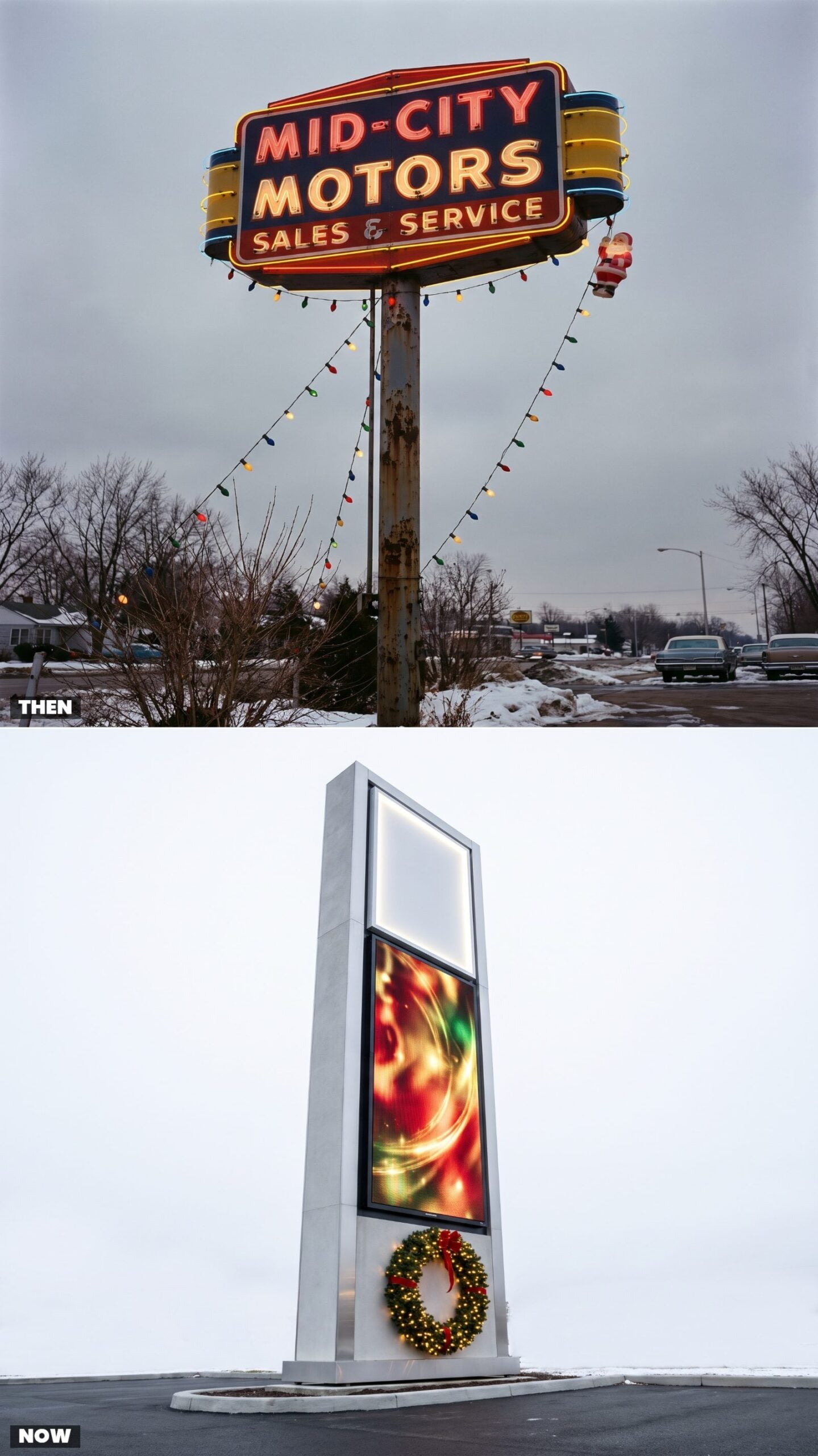
The old pole sign was a landmark. Neon-trimmed, lit with incandescent bulbs that buzzed in the cold, and come Christmas somebody climbed up to drape colored strings down the pole and wire a plastic Santa to a corner. You could spot it from a mile off and know exactly where to turn.
Now it’s a programmable LED screen cycling payment offers. Sharper, brighter, readable at highway speed — it can show a snowflake animation and a lease rate in the same breath. It just can’t be climbed. Nobody’s ever going to feel sentimental about it.
25. The New Cars Lined Up Along the Curb
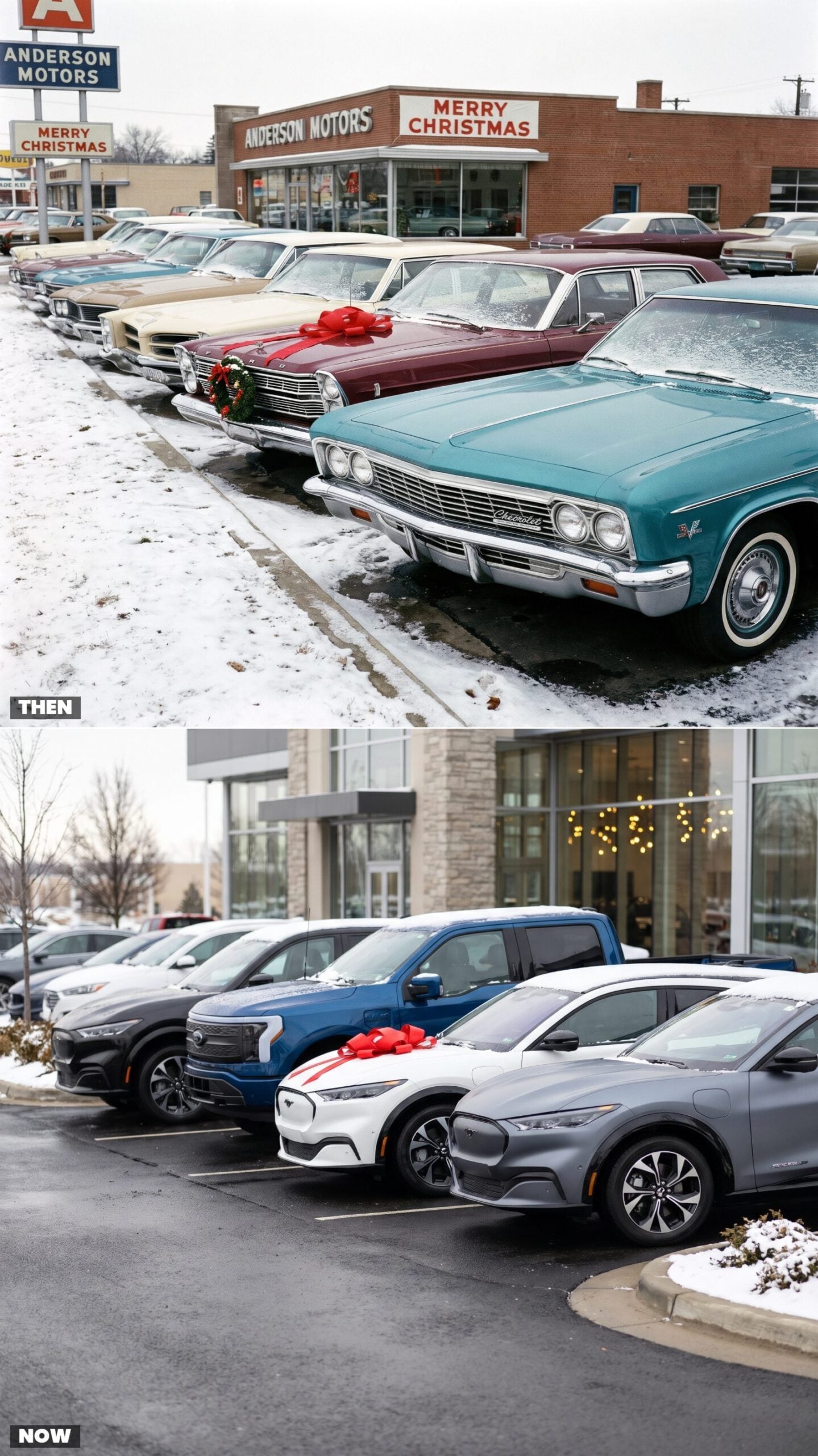
Look at the colors. In 1966 the curb was a candy dish: turquoise, burgundy, cream, two-tones split along a chrome spear. Whitewalls. Bumpers you could see your reflection in. A salesman tied a bow on a hood and the whole thing looked like a gift because it kind of was.
The modern row is grayscale on purpose. Matte gray, white, black, the occasional blue. These are beautiful machines — far safer, far smarter, slippery down to the door handles. But you could stand here an hour and not find a turquoise anything. We traded the color for the coefficient of drag, and I understand why, and I still miss the turquoise.
24. The Outdoor Lighting After Sunset
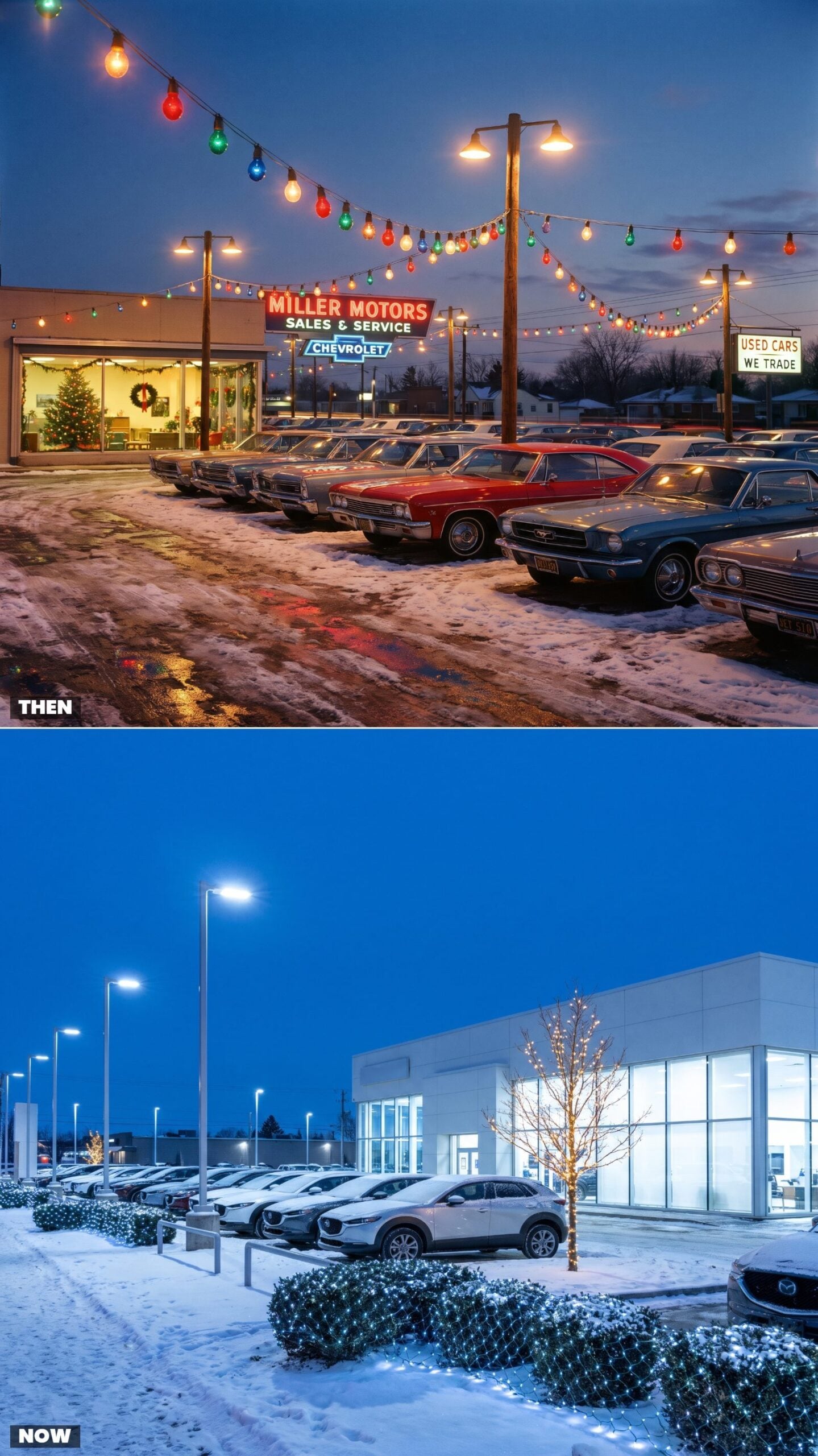
After dark, the 1966 lot was a jewelry box. Big colored bulbs looped roofline to pole, each one throwing a soft halo in the cold air, the snow catching red and green and amber all at once. Those bulbs got hot, and they burned out constantly, so somebody spent half of December up a ladder with a bag of replacements.
The night lot today is cool white and bright as noon. LED net lighting, even wash, zero burnout for years — efficient, and clinical about it. But color temperature matters more than people think. The new lot photographs like a hospital parking garage next to that old box of jewels.
23. The Way Snow Was Cleared From the Lot
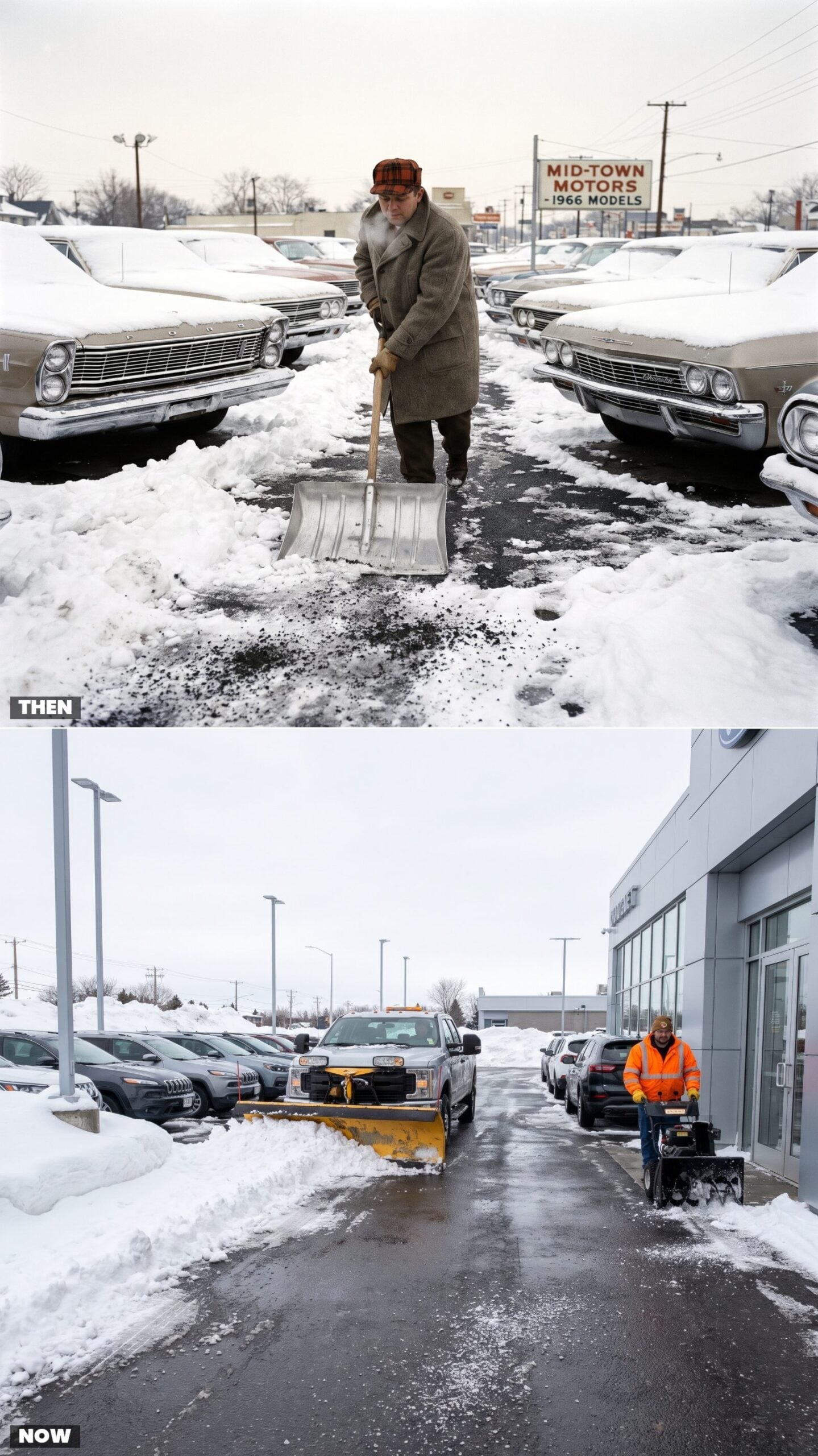
Snow removal in 1966 meant a guy, a shovel, and a thermos. Maybe two guys if it really came down overnight. They cinder-dusted the lot by hand and pushed the drifts into banks at the edges, and by the time the first customer rolled in, their backs already hurt.
Now it’s a plow truck and a contract — hydraulic blade, a walk-behind blower for the tight spots, de-icer spread by machine. Faster, obviously. Nobody misses shoveling a two-acre lot before sunrise, and I’d be lying if I pretended otherwise. But there was a kind of pride in the old way that a plow truck will never feel.
22. The Star Car in the Center of the Showroom
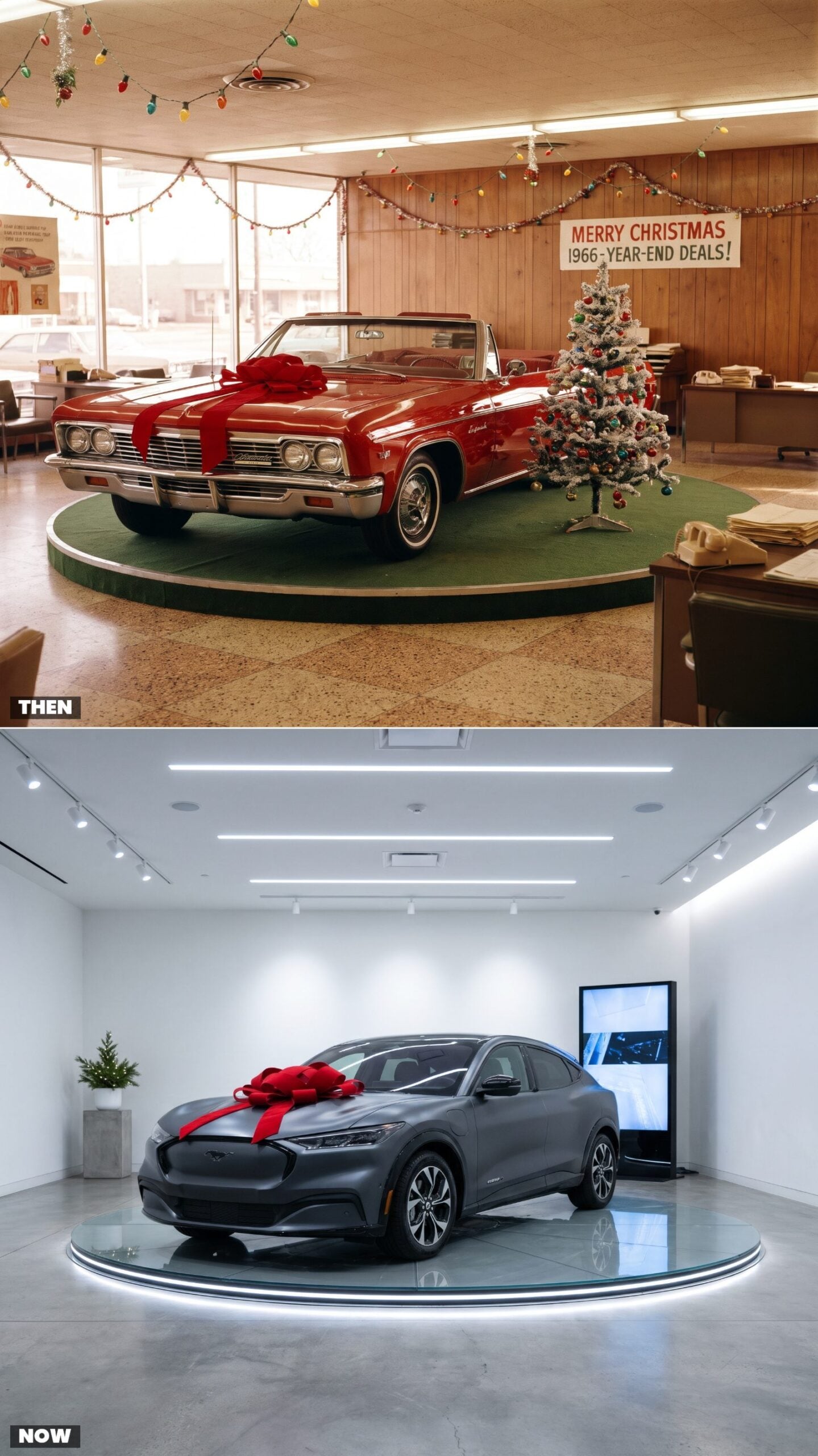
The 1966 showroom had a hero, and everyone knew it. A convertible, usually, parked on a low carpeted turntable right in the center, chrome polished until it threw light on the ceiling, a bow the size of a tablecloth on the hood. It rotated slow so the whole thing showed off from every angle.
The star car still exists — now usually an electric flagship on a glass turntable with a touchscreen explaining its range. Still spinning, still wearing the giant bow, bless the tradition. The difference is the old one made you want to put the top down in January just to feel something. The new one wants to show you an app.
The turntable hero still has fans: convertibles get more hearts from our readers than the other images in the same articles, 80% versus 72%.
21. The Dealership Christmas Tree
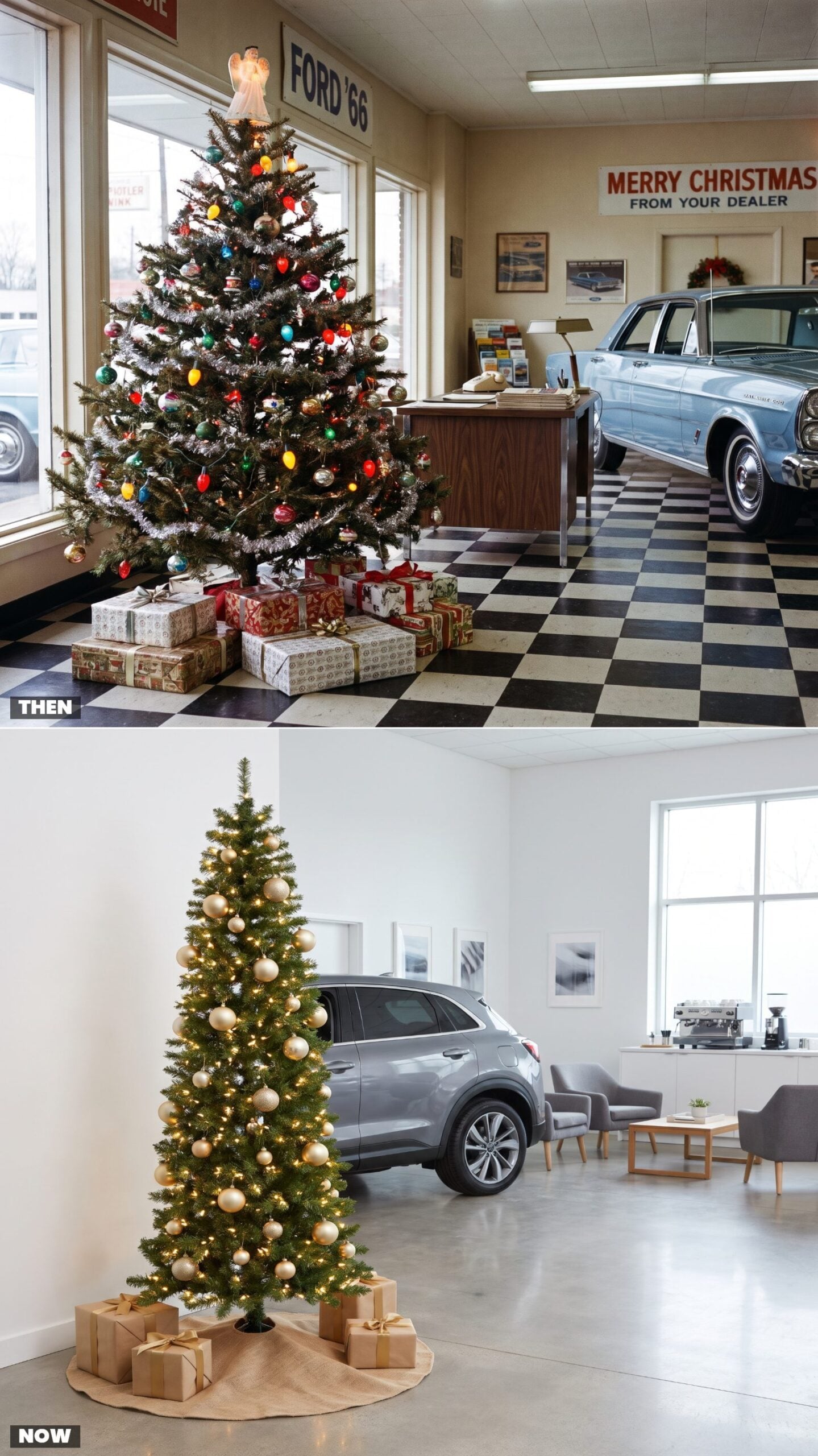
The tree in the corner of a 1966 showroom was gloriously mismatched. Maybe a real fir dropping needles on the tile, maybe one of those aluminum pom-pom trees lit by a rotating color wheel that turned it red, then blue, then gold. Glass balls, fistfuls of tinsel, a crooked star, somebody’s actual gift boxes piled underneath.
Today it’s a pre-lit artificial tree with a coordinated ornament scheme, warm-white only, no tinsel because tinsel is a vacuum’s sworn enemy. Tasteful. Tidy. Completely forgettable next to a silver aluminum tree spinning through a color wheel, which happens to be one of the great lost sights of the American Christmas.
20. The Decorations Hanging From the Ceiling
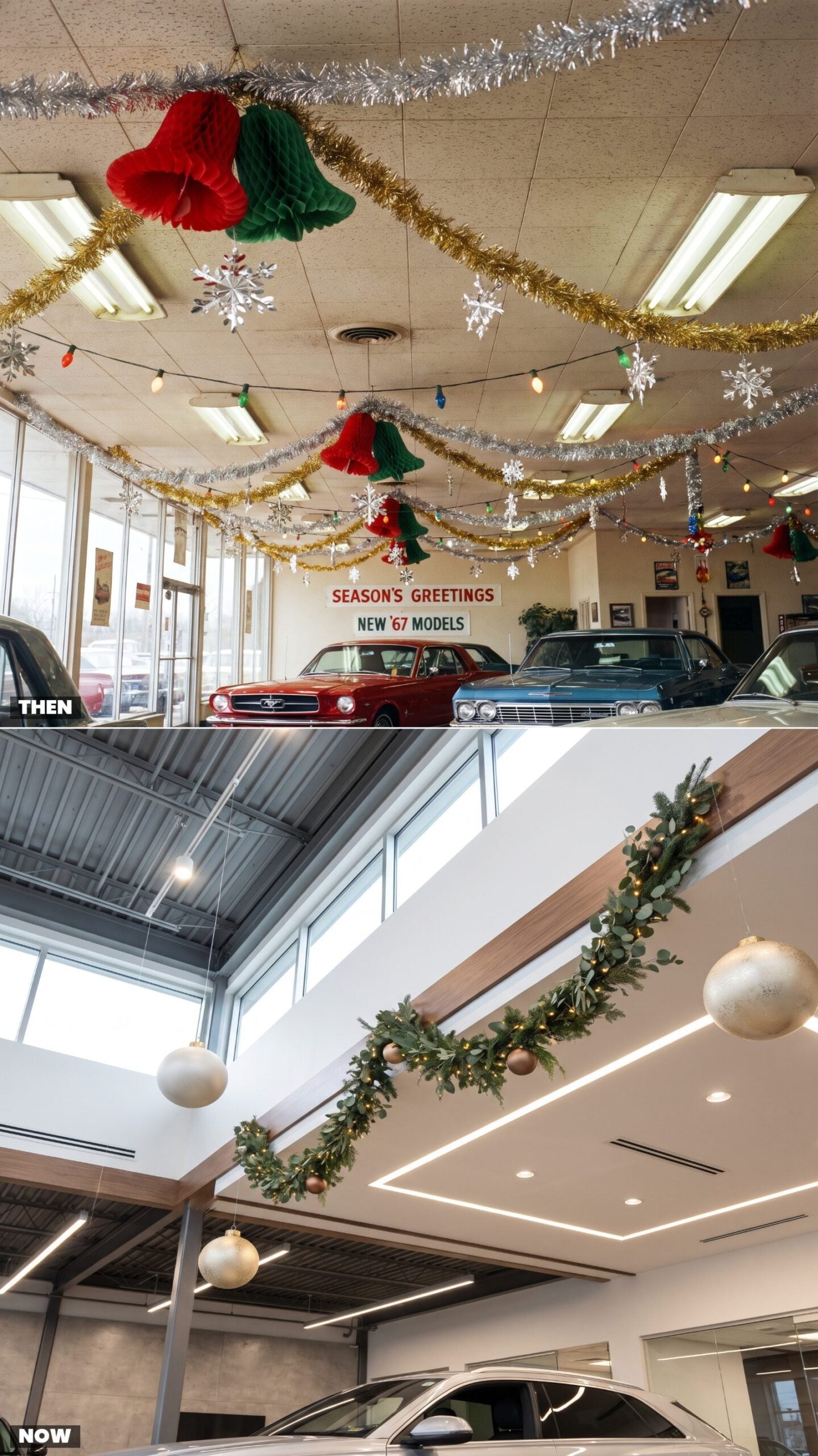
Look up in 1966 and the ceiling was doing as much work as the floor. Tinsel garland crisscrossing wall to wall, honeycomb paper bells that unfolded into fat accordion spheres, foil snowflakes twisting on fishing line, colored bulbs draped over the fluorescent fixtures. More was more. Nobody ever stood under that ceiling and thought it looked restrained.
The modern ceiling practices discipline. A few oversized matte ornament balls on clear line, maybe one garland swag, and a lot of deliberate empty space. Designers call it clean. I call it a honeycomb bell shortage. Both are true.
19. The Hand-Lettered Holiday Price Signs
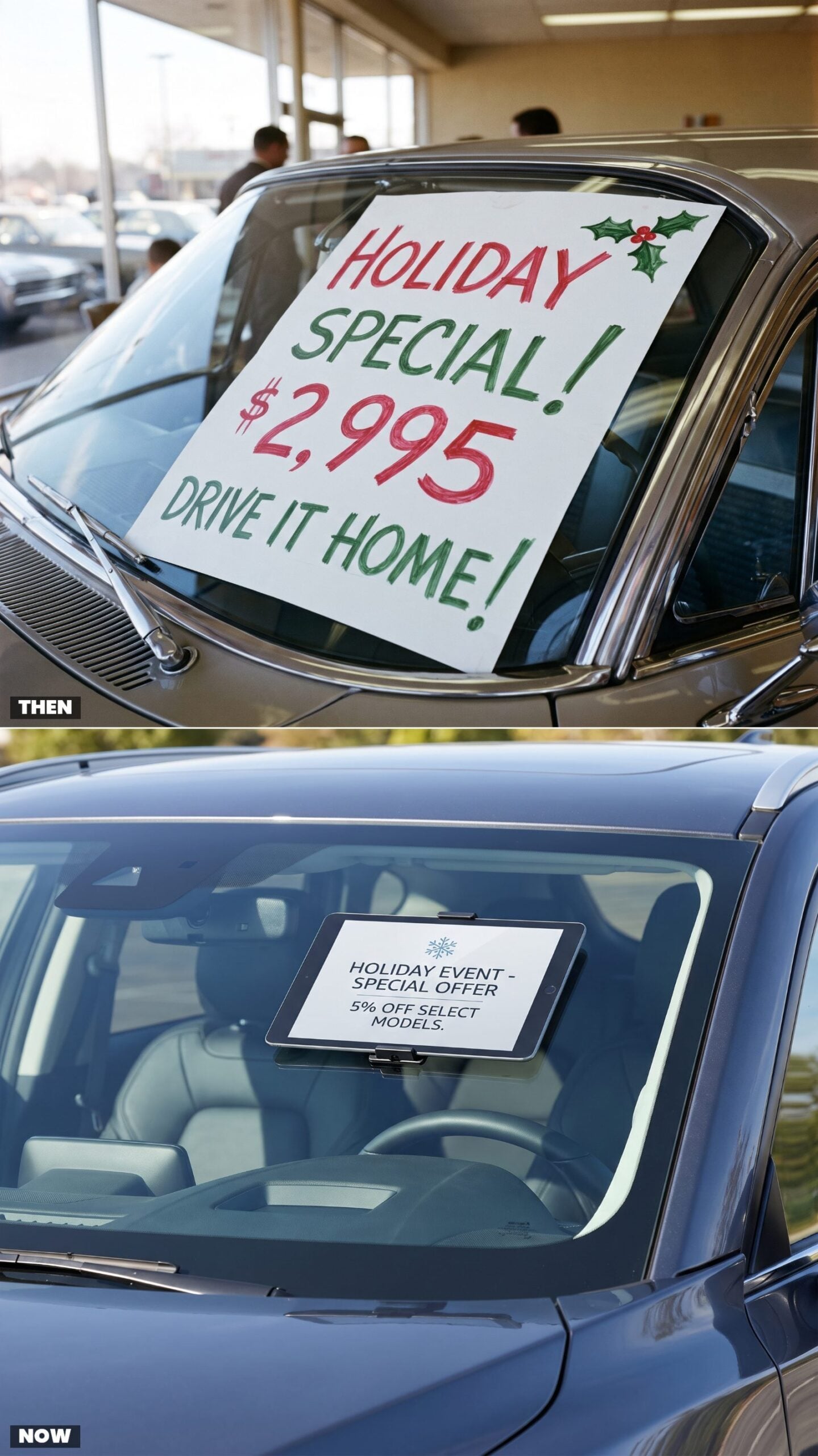
Every price in 1966 was somebody’s handwriting. A big white poster card, grease pencil in red and green, maybe a holly sprig painted in the corner by whoever had the steadiest hand in the sales office. The numbers leaned a little. The 7s had personality. You could tell a Tuesday card from a Friday card.
Today the price is a printed windshield cling or a mounted tablet — typeset, aligned, a snowflake graphic pulled from the same file as every other store. Perfectly legible and perfectly anonymous. The hand-lettered card told you a person worked here. The printed one tells you a template does. Everything on this whole list comes down to that one windshield.
18. The Dealership Santa’s Visit
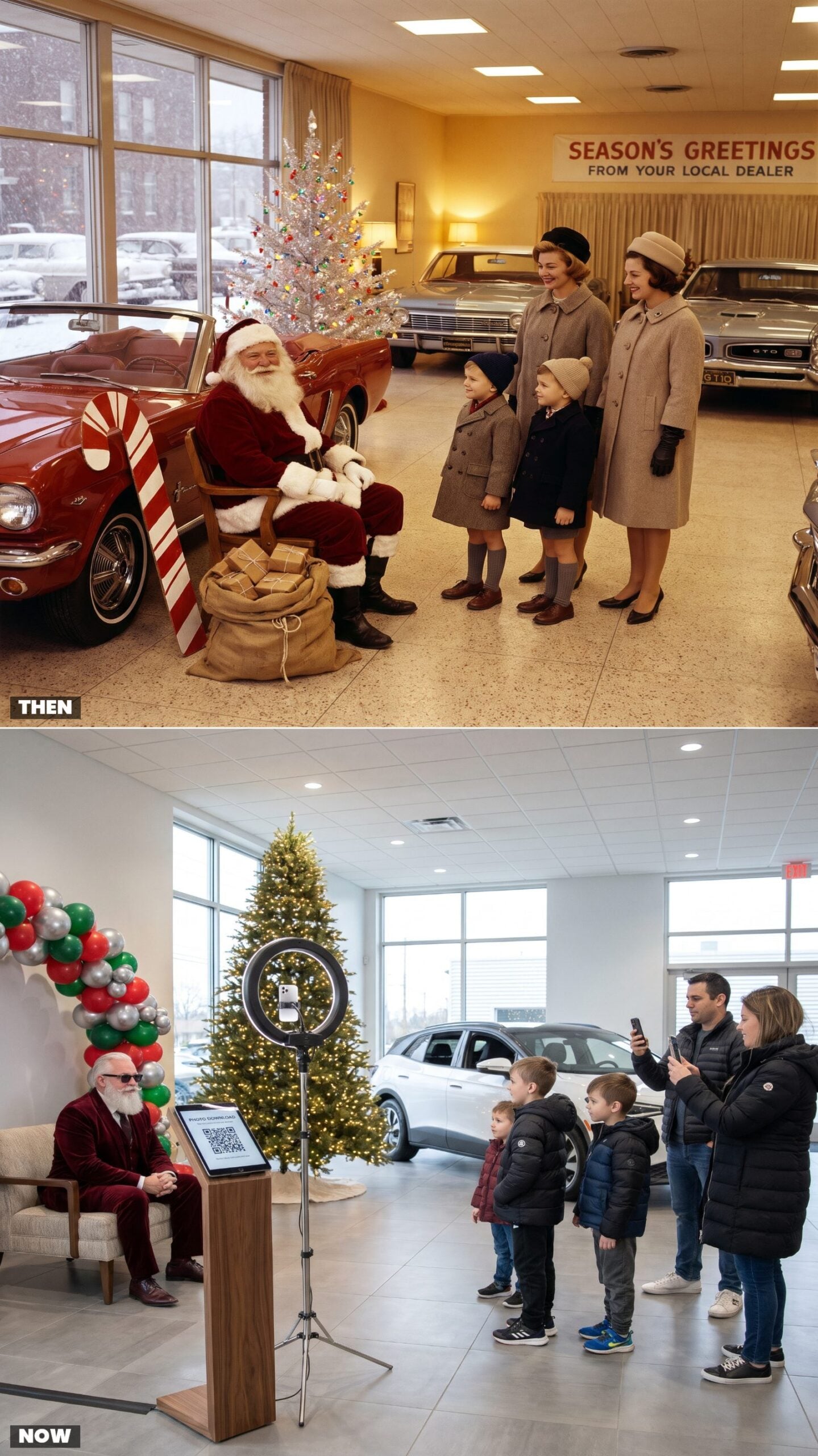
The dealership Santa pulled real crowds in ’66. Dad pretended he was shopping trucks while you got hoisted onto a red velvet knee, and you walked out clutching a candy cane and a cheap tin toy that rusted by February. Nobody photographed it. You just remembered it.
Now Santa comes with a ring light, a branded backdrop, and a QR code so the photo lands on your phone before you reach the parking lot. The candy cane is still free. The toy is gone.
17. The Salesman’s Desk
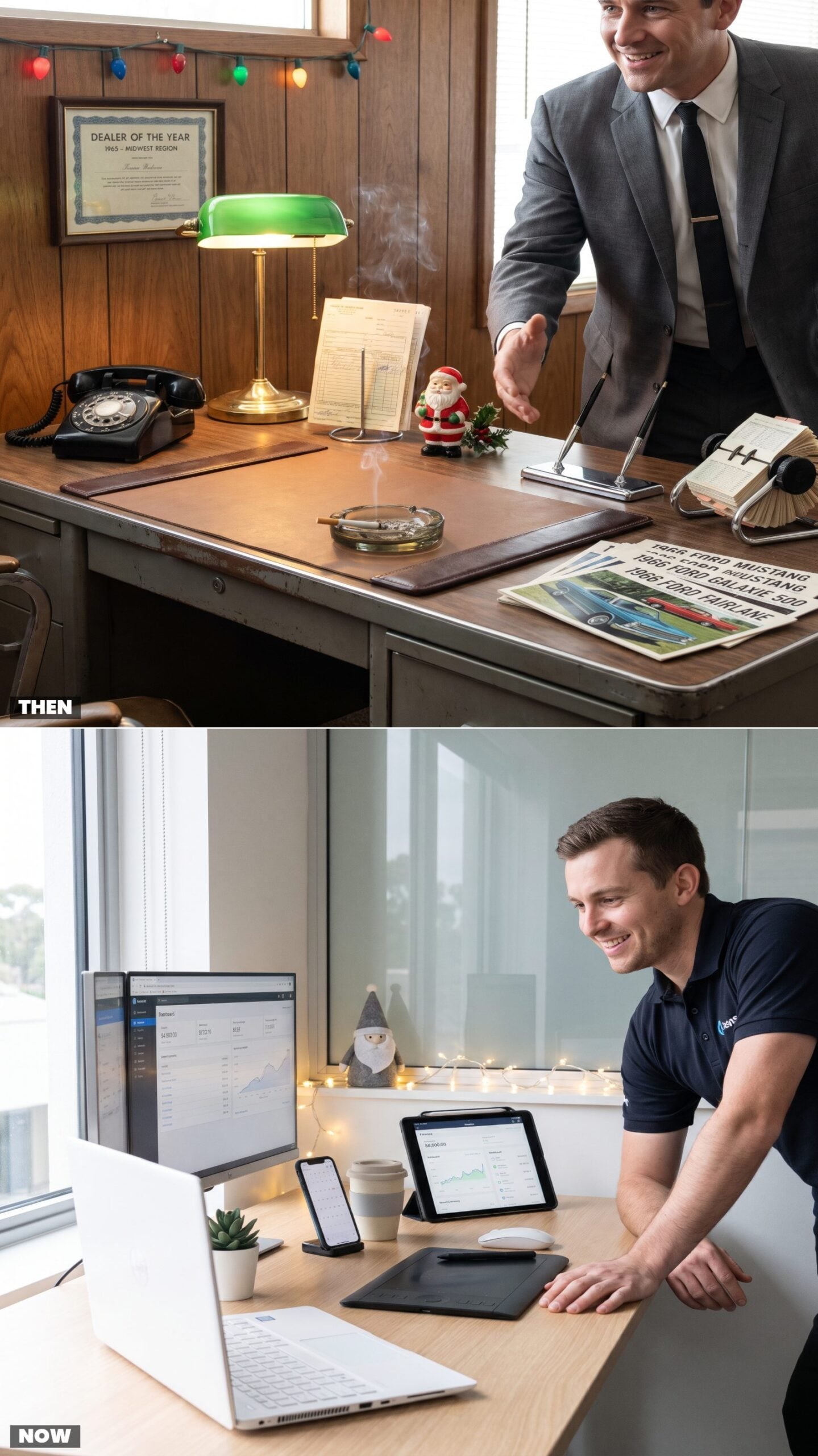
A 1966 salesman’s desk was a working object, and it showed. Rotary phone, a glass ashtray with a lit cigarette parked on the edge, carbon-copy forms stacked three deep, and a rolodex thick enough to stop a door. The numbers got worked out in pencil, right there, while your coffee went cold.
The desk today? A laptop, two monitors, a phone on a little stand. The paper’s gone. The ashtray’s long gone. The deal still happens at this spot, it just happens on a screen you both lean toward.
16. The Racks of New-Car Brochures
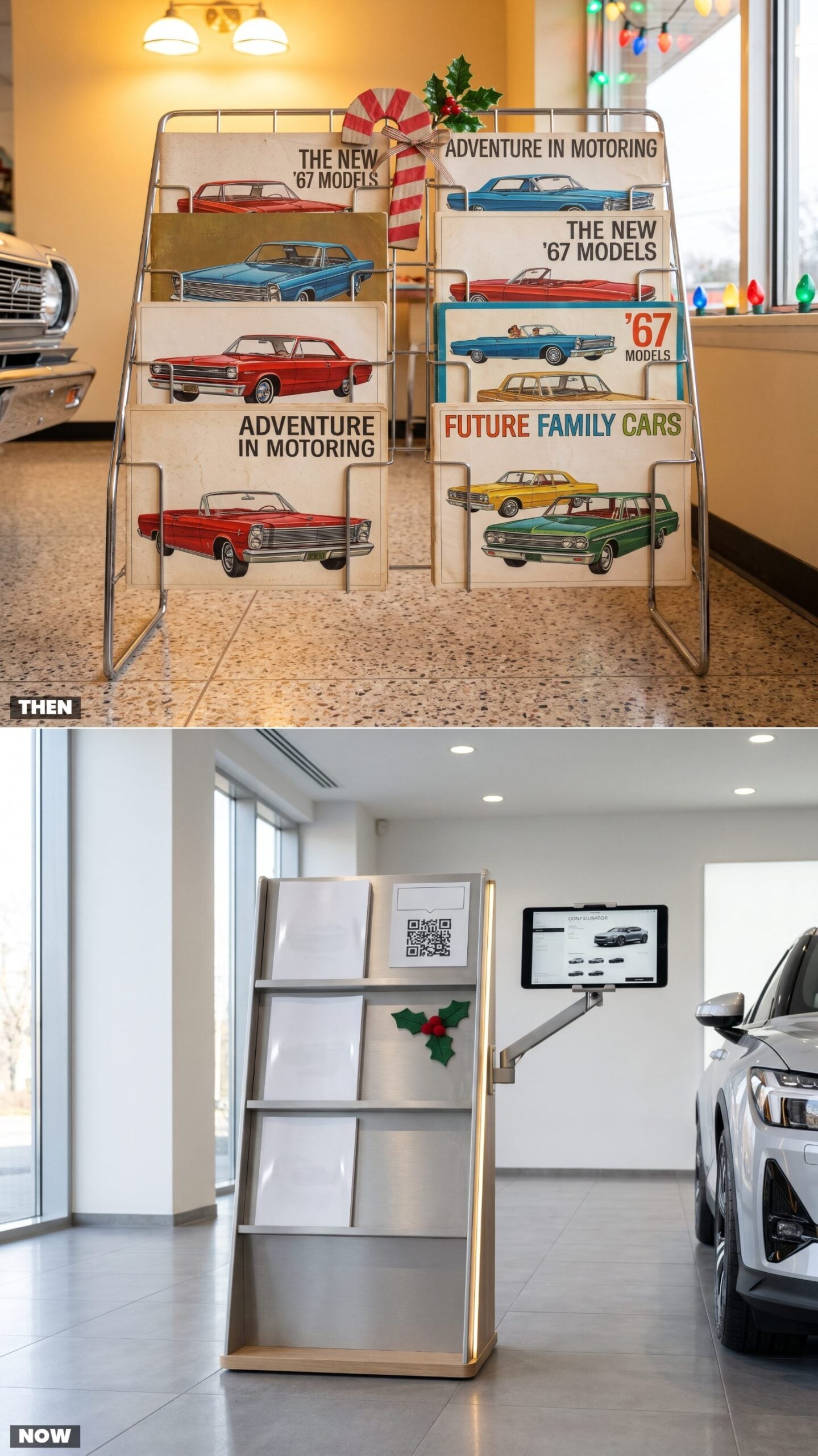
For a ten-year-old, the brochure rack in 1966 was a treasure chest. Thick glossy fold-outs with hand-painted illustrations of cars in colors that didn’t quite exist, every option laid out on heavy paper you could smell. You stuffed three in your coat and studied them under the covers for weeks.
Now the rack sits mostly empty, and that’s deliberate. A couple of spec sheets, a QR code, a tablet running the configurator. Everything you’d have carried home lives on your phone and gets deleted by New Year’s.
15. The Window Sticker on a New Car
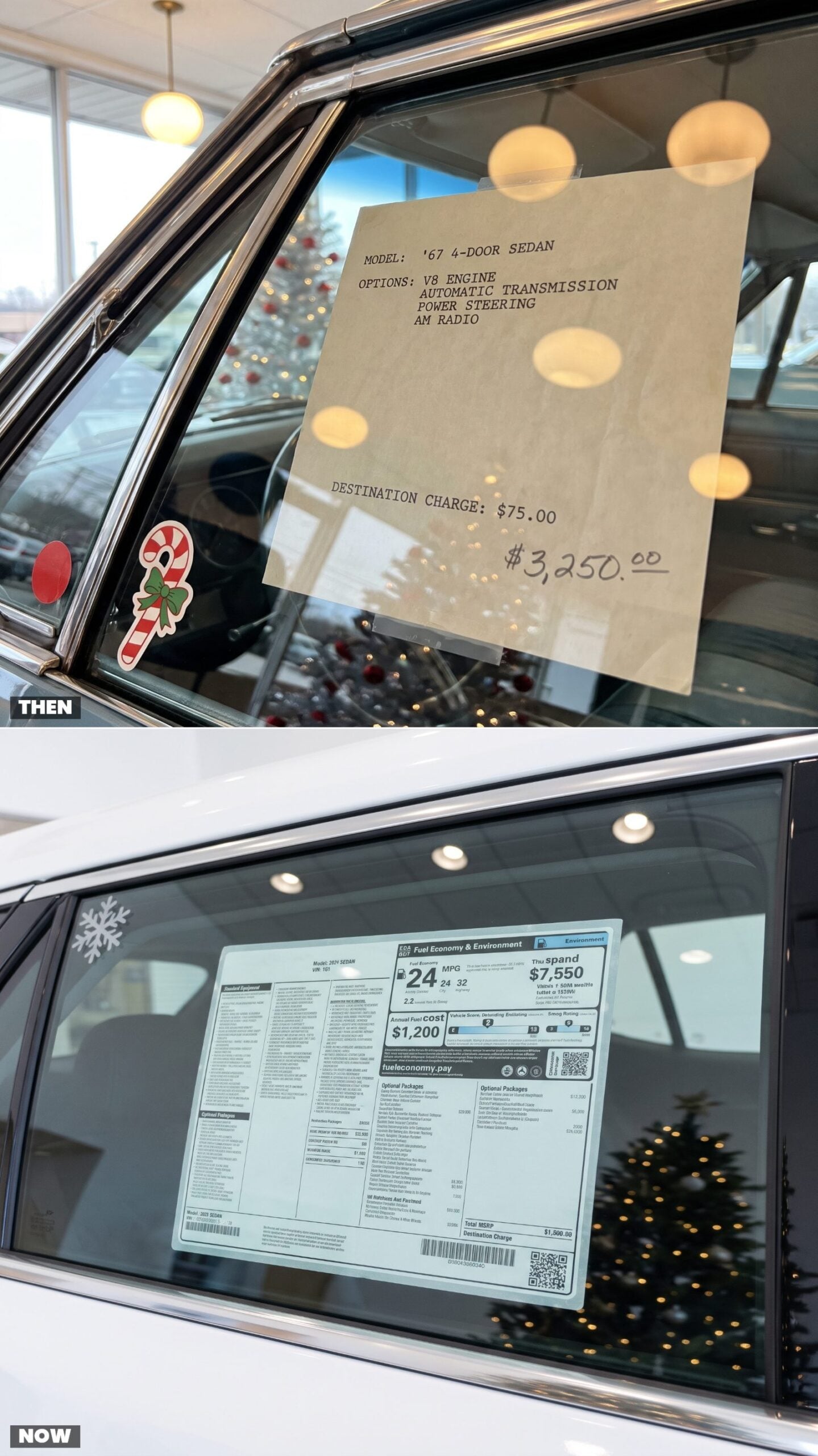
The Monroney sticker showed up on every new car’s window starting in 1958, and by ’66 it was the one honest document in the building. Typewriter black on cream paper, a grease-pencil price in the corner, options you could actually read. You stood there doing the math in your head.
The sticker’s still required by law. It’s laser-printed now, with a bar code, a QR code, and a fuel-economy block, and the real arithmetic has moved to the finance office. Same little rectangle of paper. A lot more fine print.
14. The Family-Wagon Display
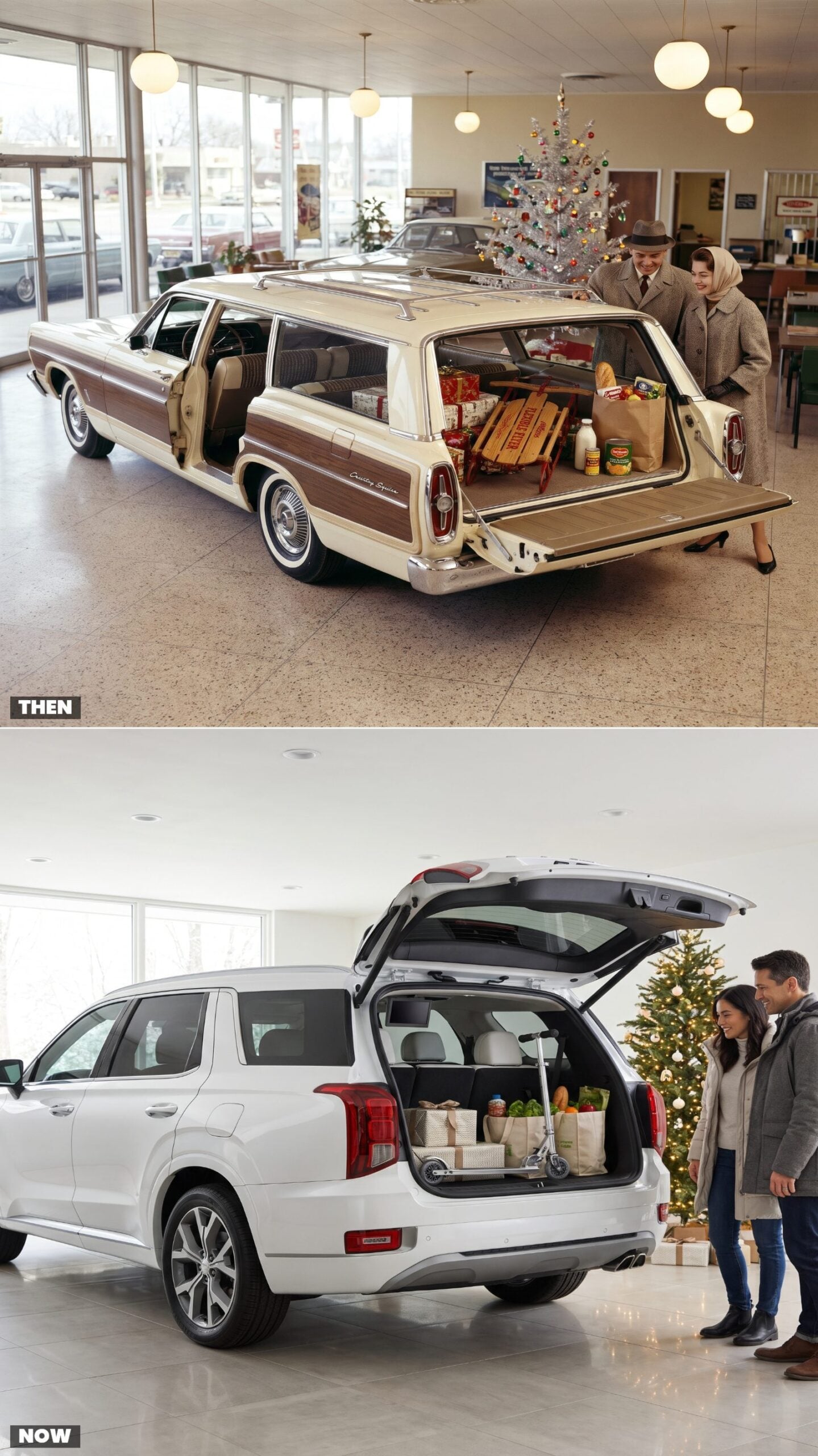
The family hauler of 1966 was a full-size wagon, long as a canoe, with fake woodgrain down the flanks and a rear-facing third seat where the kids rode backward watching the road unspool behind them. Tailgate down, staged with wrapped gifts and a sled, it sold the whole of Christmas morning in one glance.
Then the wagon became the minivan, and the minivan became the three-row SUV. Captain’s chairs, a screen for every row, a power tailgate that opens with a kick of your foot. Same job, same gifts in the back. The rear-facing seat, and the view that came with it, didn’t make the trip.
Our readers still have a soft spot for these long haulers, with full-size land yachts getting hearts 84% of the time versus 79% for other images in the same articles.
13. The Performance-Car Display
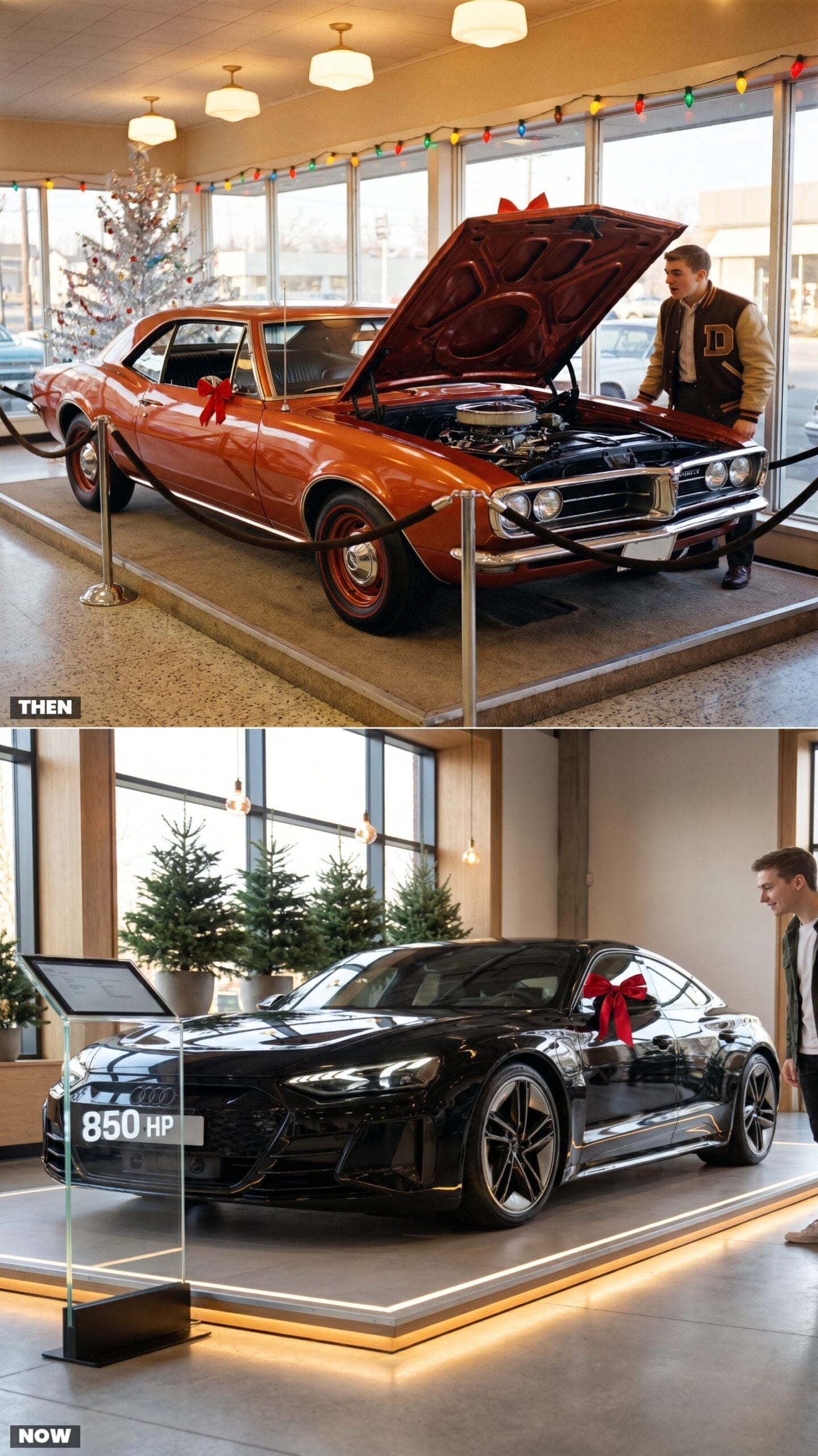
The performance corner in 1966 was pure theater. Hood up, a big chrome-dressed V8 on display like a trophy, redline tires, dual exhaust, and a color that announced itself from across the parking lot. You leaned over the velvet rope just to smell the new rubber.
The fast car today sits with the hood shut, because there’s nothing to show up front anyway. The spectacle moved to a screen listing horsepower and zero-to-sixty, and the soundtrack is a hum. It’s quicker than anything from ’67. It just won’t wake the neighbors.
12. The Used-Car Corner of the Lot
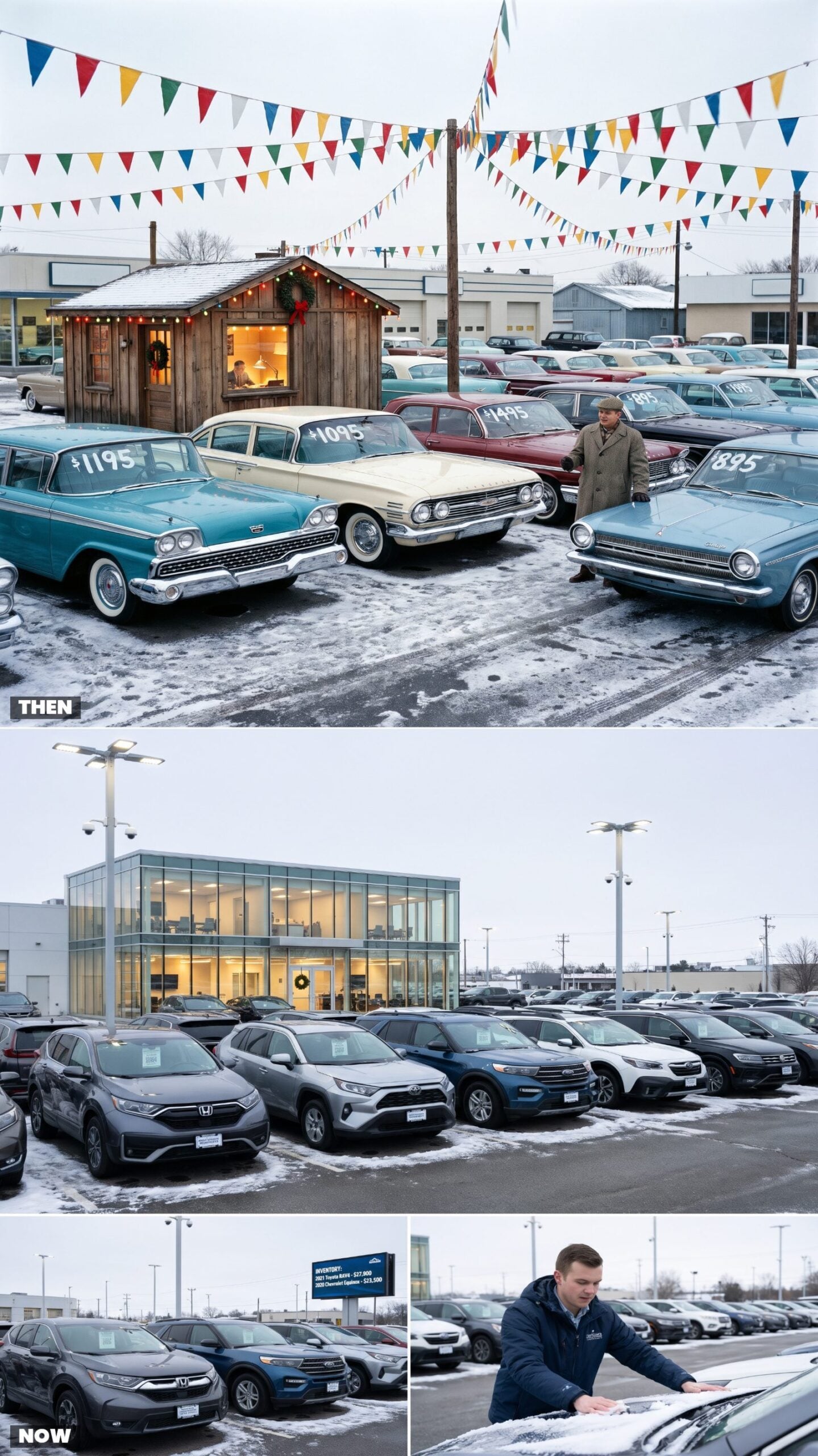
The used-car corner in 1966 lived outdoors, weather be damned. Rows of trade-ins under crisscrossed plastic pennant flags snapping in the cold, prices written straight on the windshield in white shoe polish, and a little heated shack with a wreath on the door where deals got done.
The pennant flags? Mostly gone. Prices live on window cards with QR codes, or a digital board by the entrance, and the whole lot’s been photographed for the website before you ever pull in. You can read the vehicle history before you read the windshield.
11. The Board Holding Every Car Key
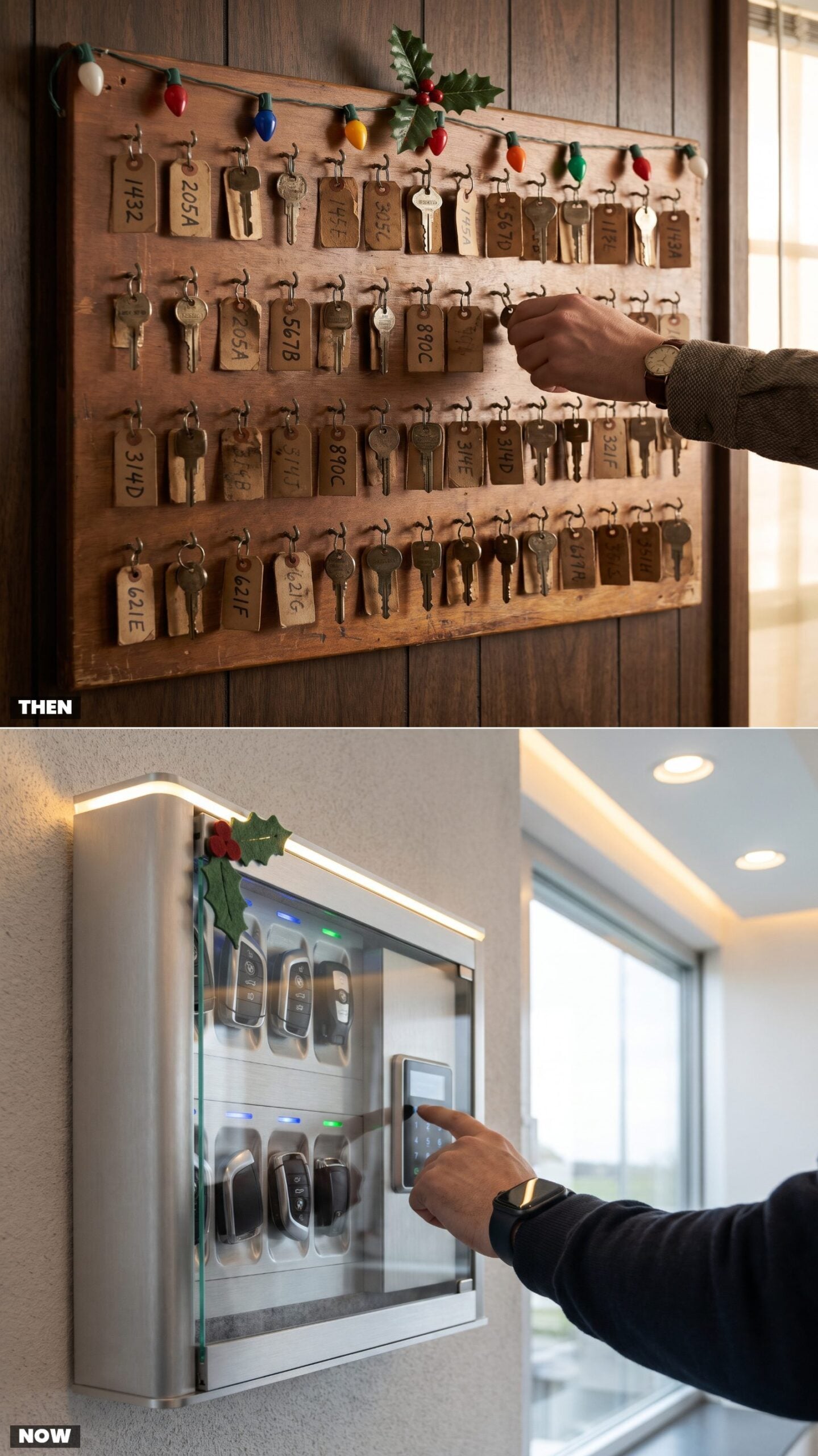
Every key in the building hung on one board in 1966. Rows of little brass keys on cardboard tags, stock numbers scrawled in pen, the whole thing jingling when the heat kicked on. The sales manager guarded it like a church bell, and a lost key meant a very bad afternoon of walking the lot trying every door.
That board is now a locked electronic cabinet with a touchscreen and lit slots. Fobs get logged out by code, nothing jingles, and the system always knows who has what. Safer, quieter, and completely without romance.
10. The Dealership Telephone System
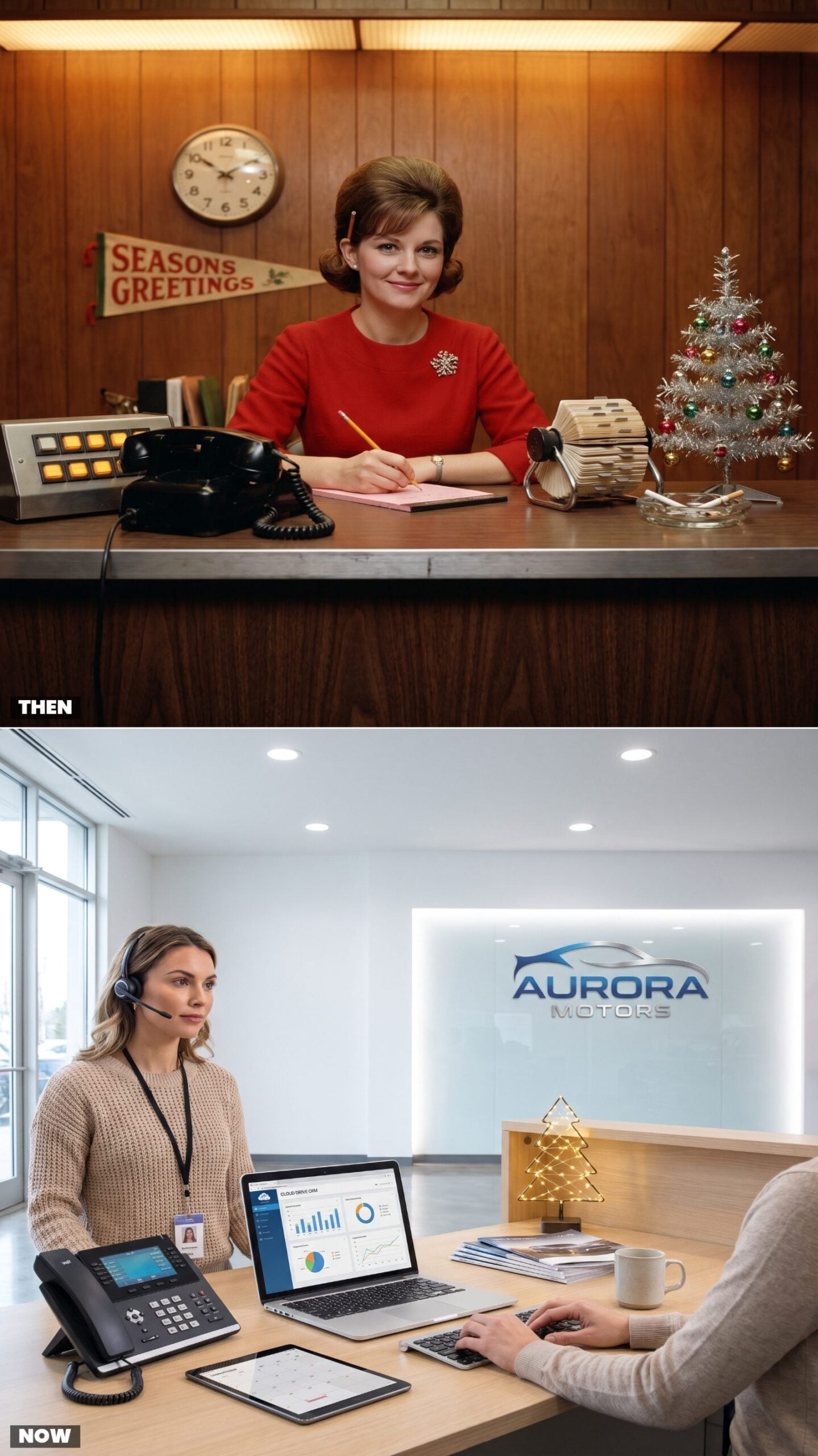
In 1966, calling the dealership meant a human picked up by the second ring. A black rotary phone, a switchboard with four blinking lines, and a receptionist writing your message on a pink carbon pad she tore off and spiked onto a metal holder. If the salesman stepped out for lunch? You called back. That was the whole system, and nobody thought it was slow.
Now the first voice you hear is usually a recording, then a menu, then a chatbot that already knows your name and the last SUV you clicked. The phone itself is a flat screen running software. Nobody tears off a message slip anymore — it logs itself.
9. The Sales Contract and Paperwork Tools
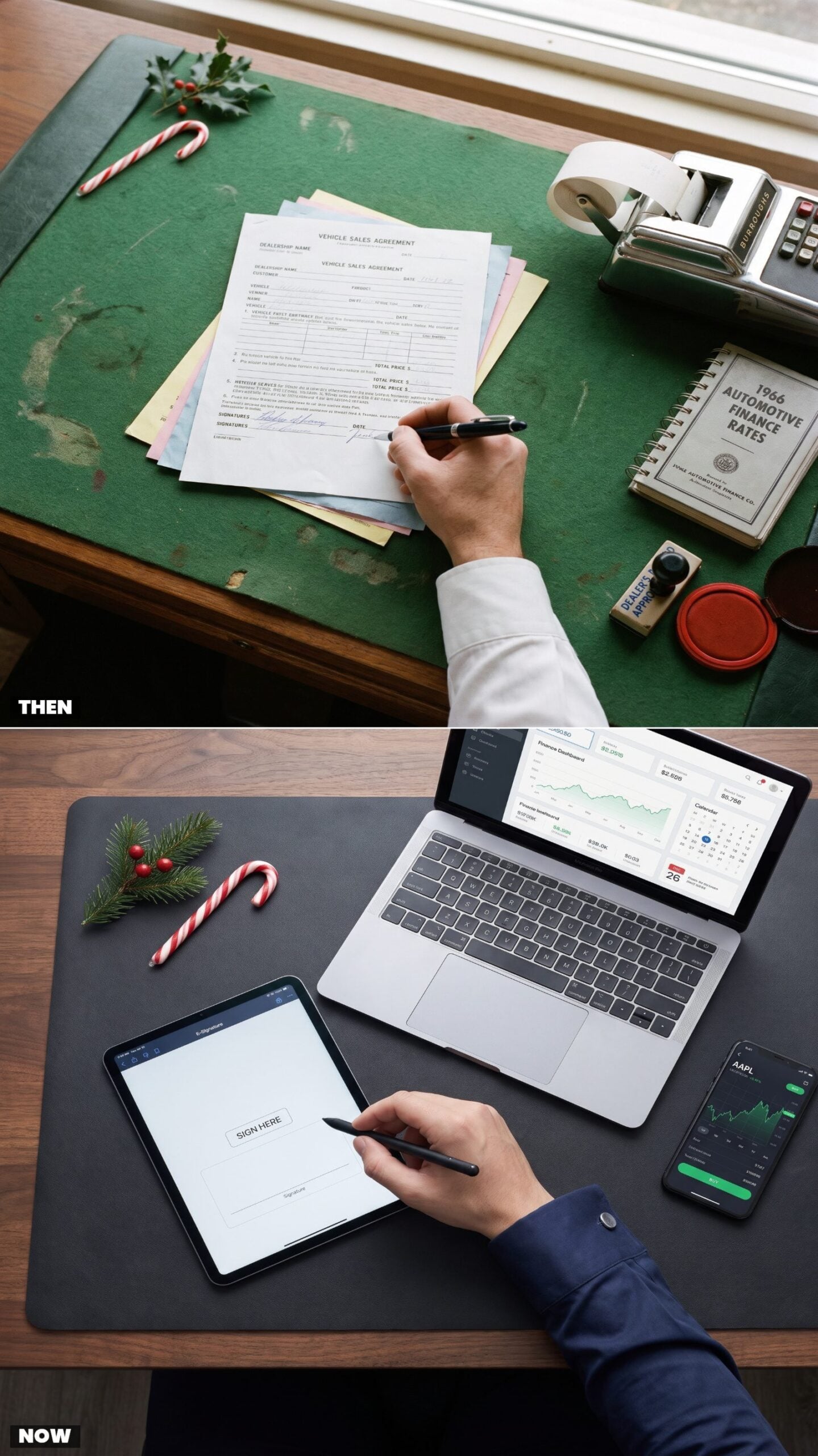
Buying a car in 1966 came with a smell: carbon paper. You pressed hard with a cheap ballpoint so the signature bled through three colored sheets while the salesman ran your numbers on a chrome adding machine that chattered out a paper tape. A rubber stamp and a red ink pad made it official. You drove home with a yellow copy folded in the glovebox.
These days the whole thing lives on a tablet. You tap a stylus on a signature line, and the deal, the finance terms, the warranty paperwork all land in your email before you leave the lot. No carbon. No tape. No ink on your fingers to prove you were ever there.
8. The Newspaper-Ad Display Near the Entrance
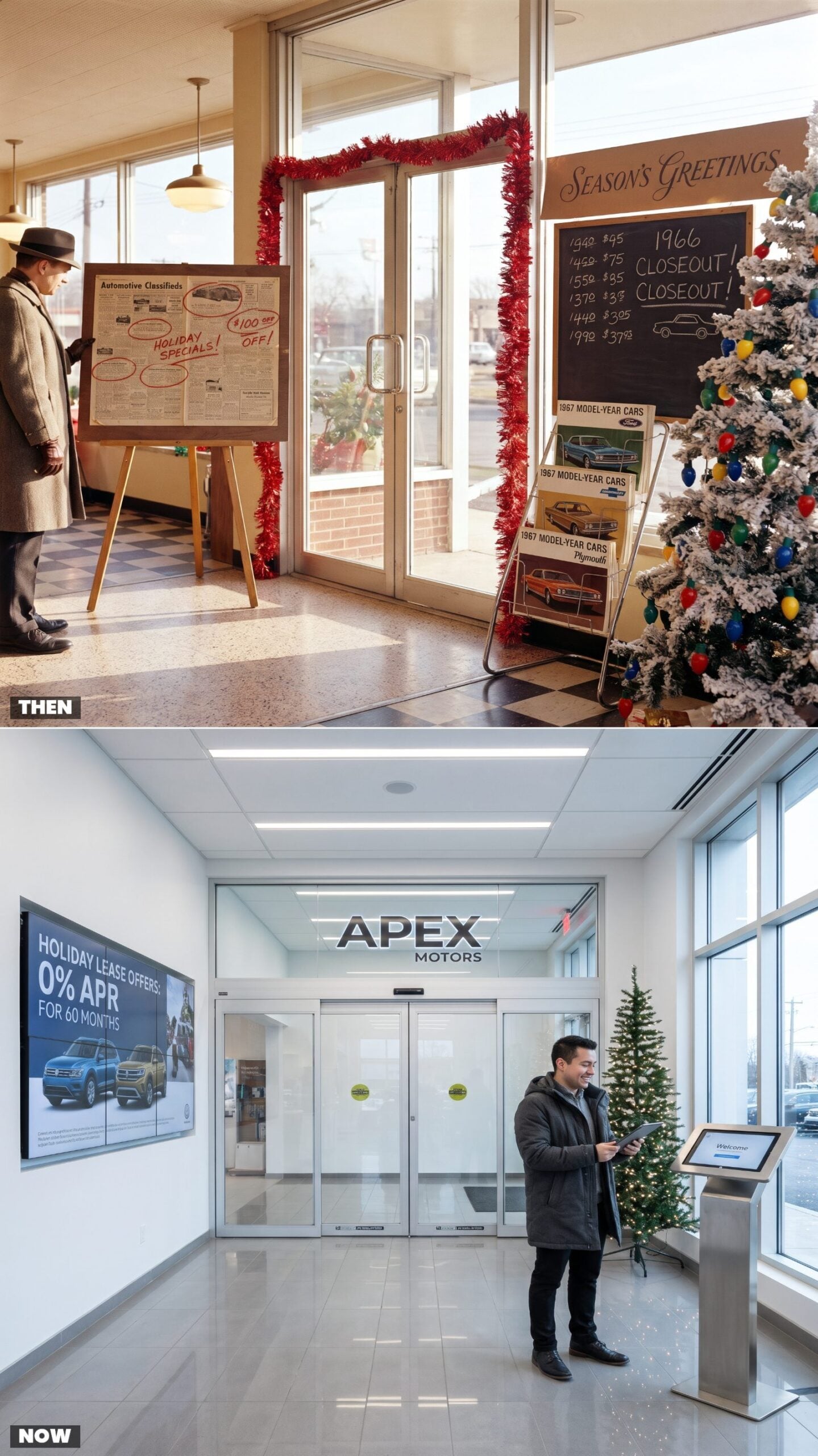
The front of a 1966 dealership greeted you with newsprint. An easel held the week’s automotive classifieds from the local paper, the holiday specials circled in grease pencil, and a chalkboard spelled out prices a porter wiped and rewrote every morning. You grabbed a glossy brochure for the new models and read it in the car.
Walk in now and a wall-sized screen loops lease offers in a slow fade, brighter than the tree next to it. The brochure rack is a tablet. Nothing gets circled anymore. The specials update themselves overnight from a server somewhere you’ll never see.
7. The Trade-In Appraisal Process
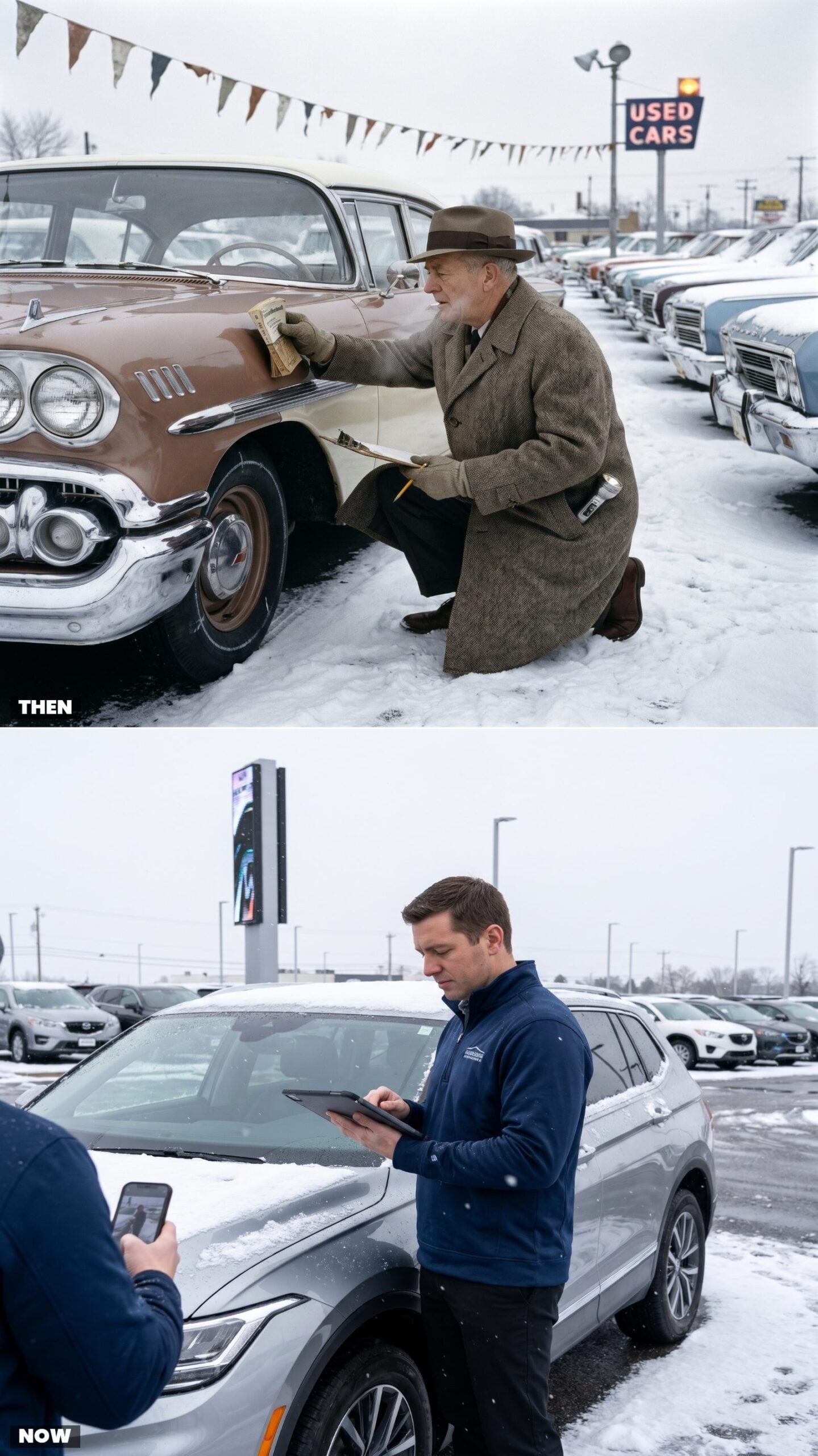
Trading in your car in 1966 meant a man in an overcoat walking slow circles around it in the cold, writing on a clipboard. He’d kick a tire, pop the hood, chalk a mark on the sidewall, and flip through a dog-eared pocket value book while his breath fogged the air. The number he gave you came out of his head and that book, and you negotiated from there.
Today someone scans the VIN with a tablet, snaps a few photos, and the software pulls live auction data and regional demand before they’ve finished the walk-around. The number arrives on a screen. Faster, colder, and a lot harder to argue with.
6. The Start of a Customer Test Drive
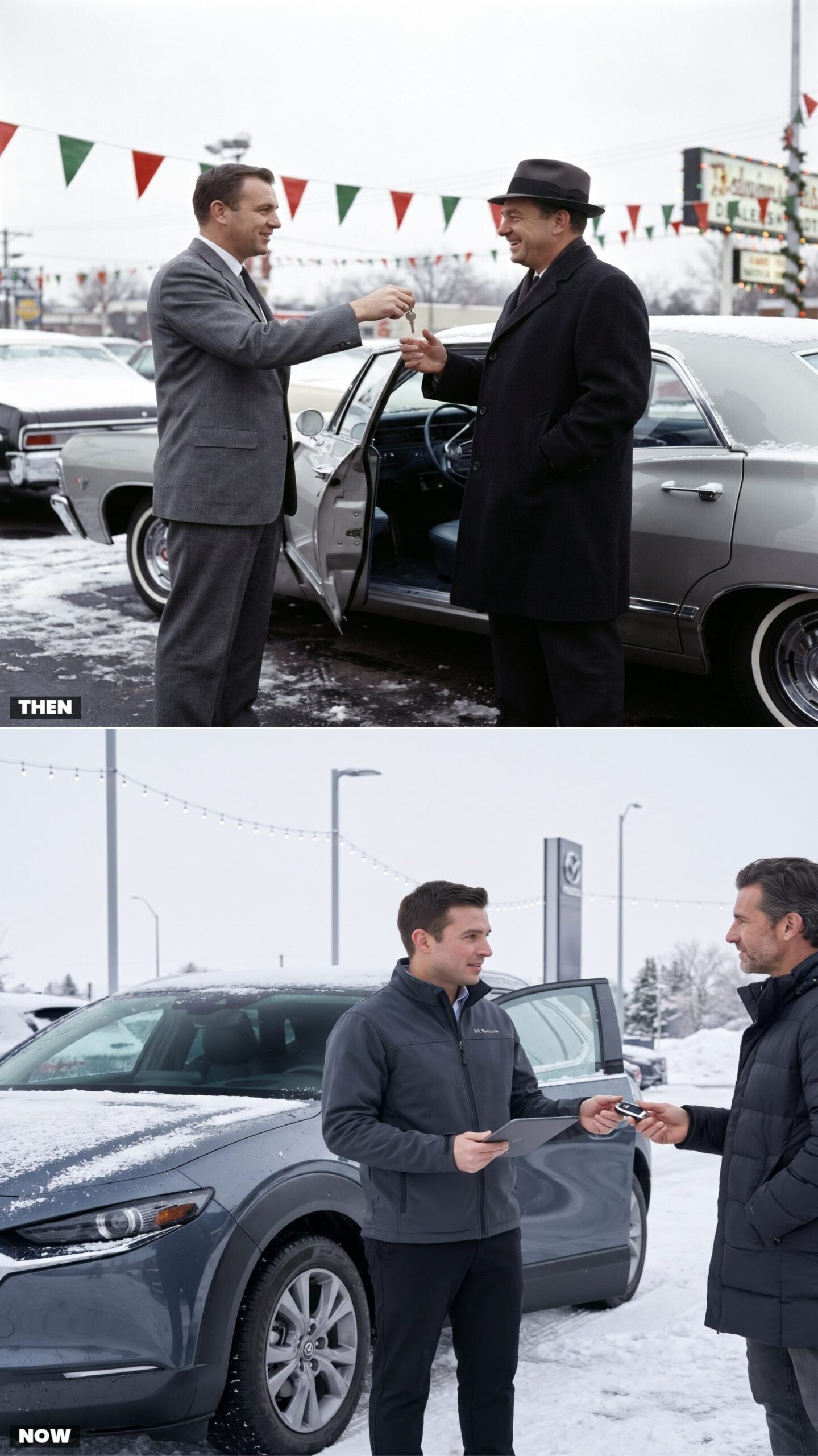
A test drive in 1966 started with a handshake and a key. The salesman dropped a single metal ignition key in your palm, maybe rode along in the passenger seat and maybe didn’t, and off you went around the block. No ID copied, no form signed. Trust was the paperwork.
Now it begins with a license scan on a tablet, a photo of your insurance, and a fob with a button instead of a cut key. Some dealers track the whole route by GPS. The block got longer and the leash got shorter.
5. The New-Car Delivery Bay
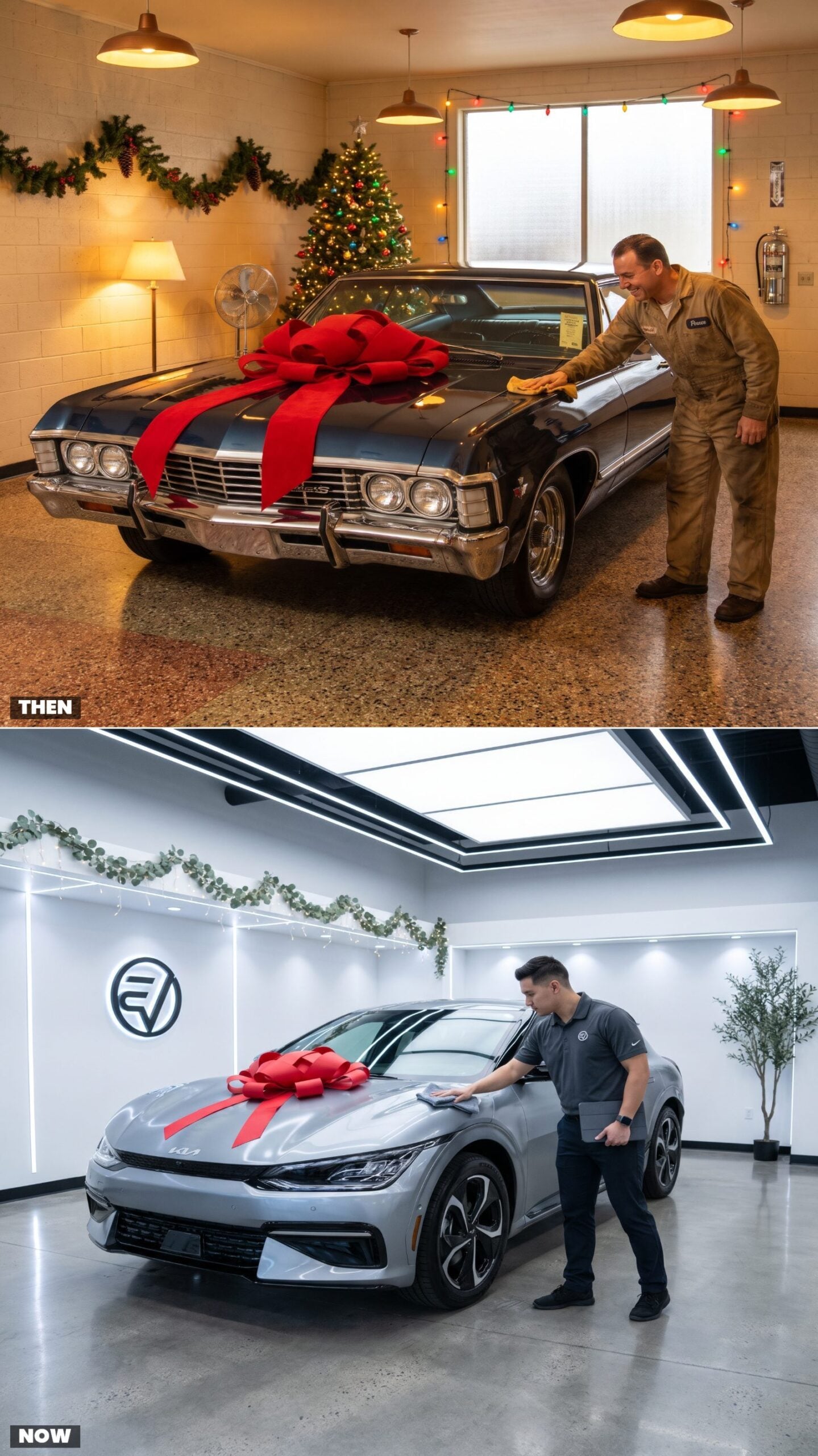
The delivery bay was the payoff. A porter wiped the new car down one last time with a chamois, a red fabric bow sat on the hood, and the colored bulbs on the corner tree threw little dots of light across the fresh paint. The salesman walked you around it, showed you the choke, the heater, the AM radio dial, and handed it over.
The modern version keeps the bow. But the walkthrough is now a tablet tour of touchscreens, driver profiles, and app pairing, and the “delivery specialist” syncs your phone before you pull out. Same ribbon on the hood. Twenty extra minutes learning where the buttons went.
4. The Dealership Employee Christmas Party
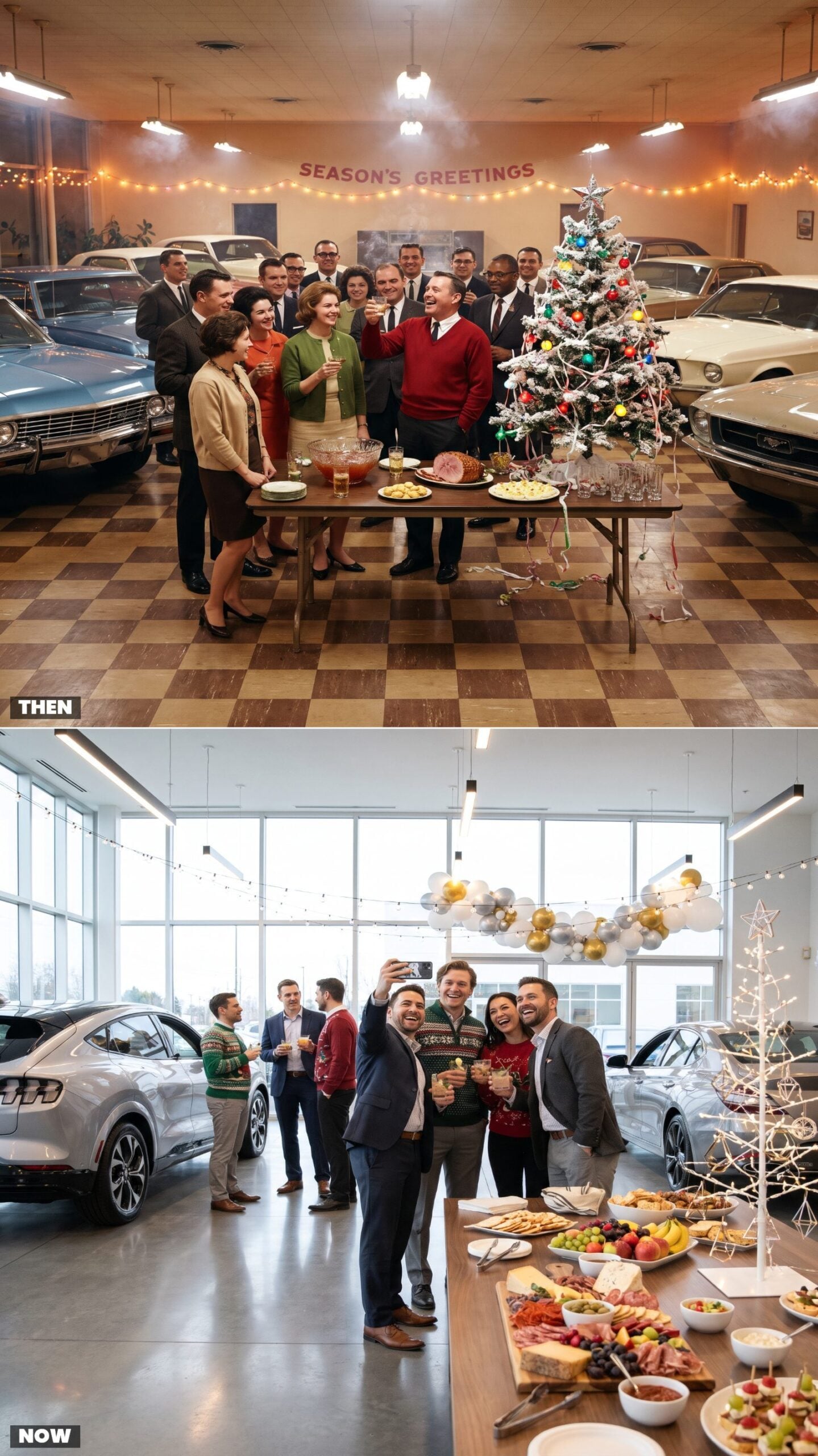
After the doors locked on a December night in 1966, the showroom turned into the ballroom. They pushed the new cars to the walls, set up a folding table with a punch bowl and a glazed ham, poured highballs, and let a little cigarette haze settle over the tinsel. Somebody always made a toast too long. Somebody always danced by the tree.
The party survived, mostly. Now it’s craft cocktails and a charcuterie board, a group selfie instead of a long-winded toast, and sparkling water for whoever’s driving. The cars still get pushed to the walls. But the haze is gone, and so are the ashtrays.
3. The Repair Bays Behind the Showroom
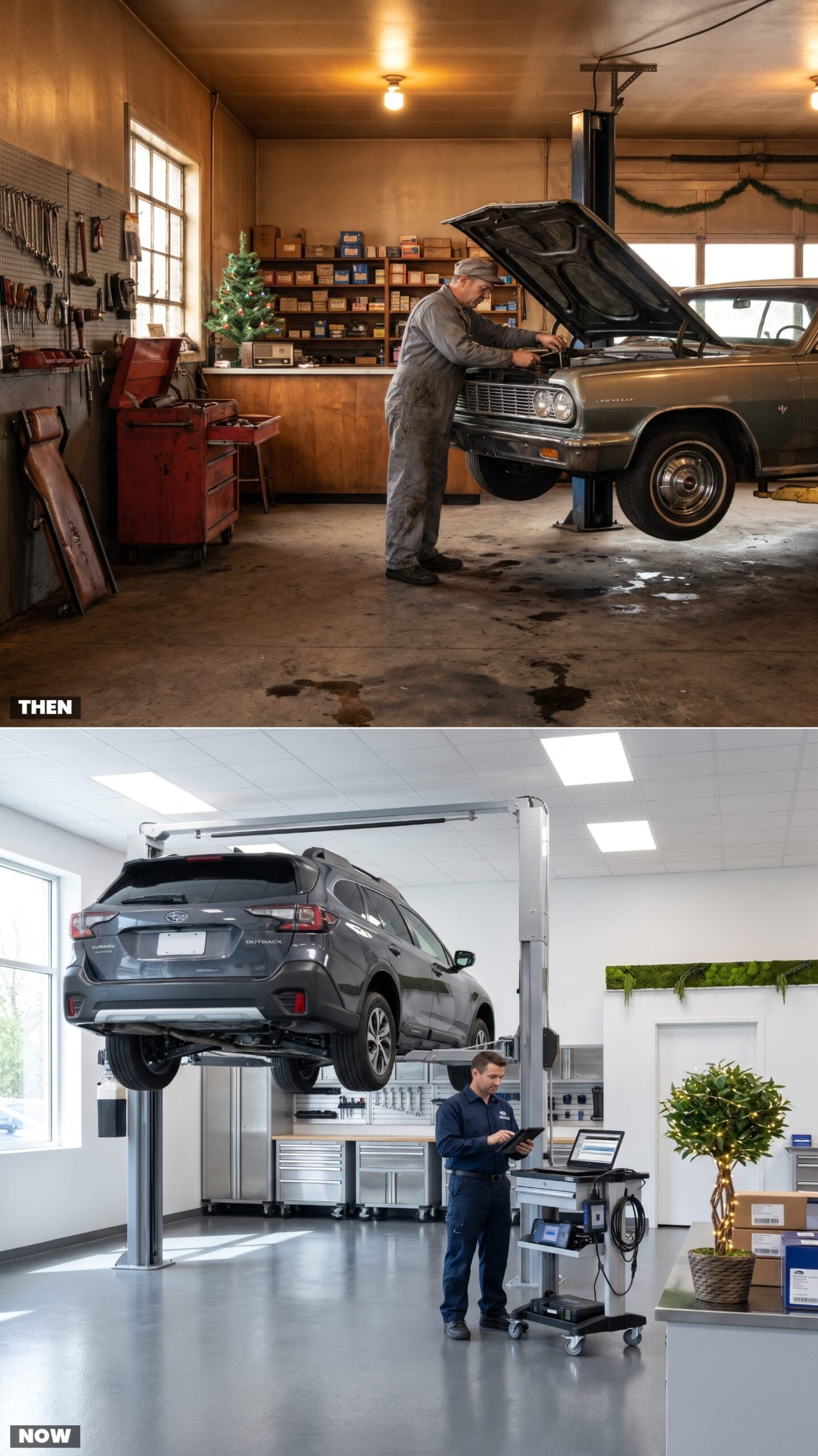
Behind the shiny showroom in 1966, the service bays smelled like gear oil and cold concrete. A mechanic in grease-stiff coveralls stood under a car on a single-post lift, pegboard walls bristling with wrenches he knew by feel, a creeper by his boot, and a sad little tree with four bulbs on the parts counter for the holidays.
Walk back there now and the floor is epoxy-coated and swept, the lifts are twin-post, the tool cabinets are sealed stainless, and a tablet rides on a rolling cart next to the car. Cleaner, brighter, quieter. The smell’s mostly gone — and so is the pegboard that told you exactly who worked that bay.
2. The Equipment Used to Diagnose a Car
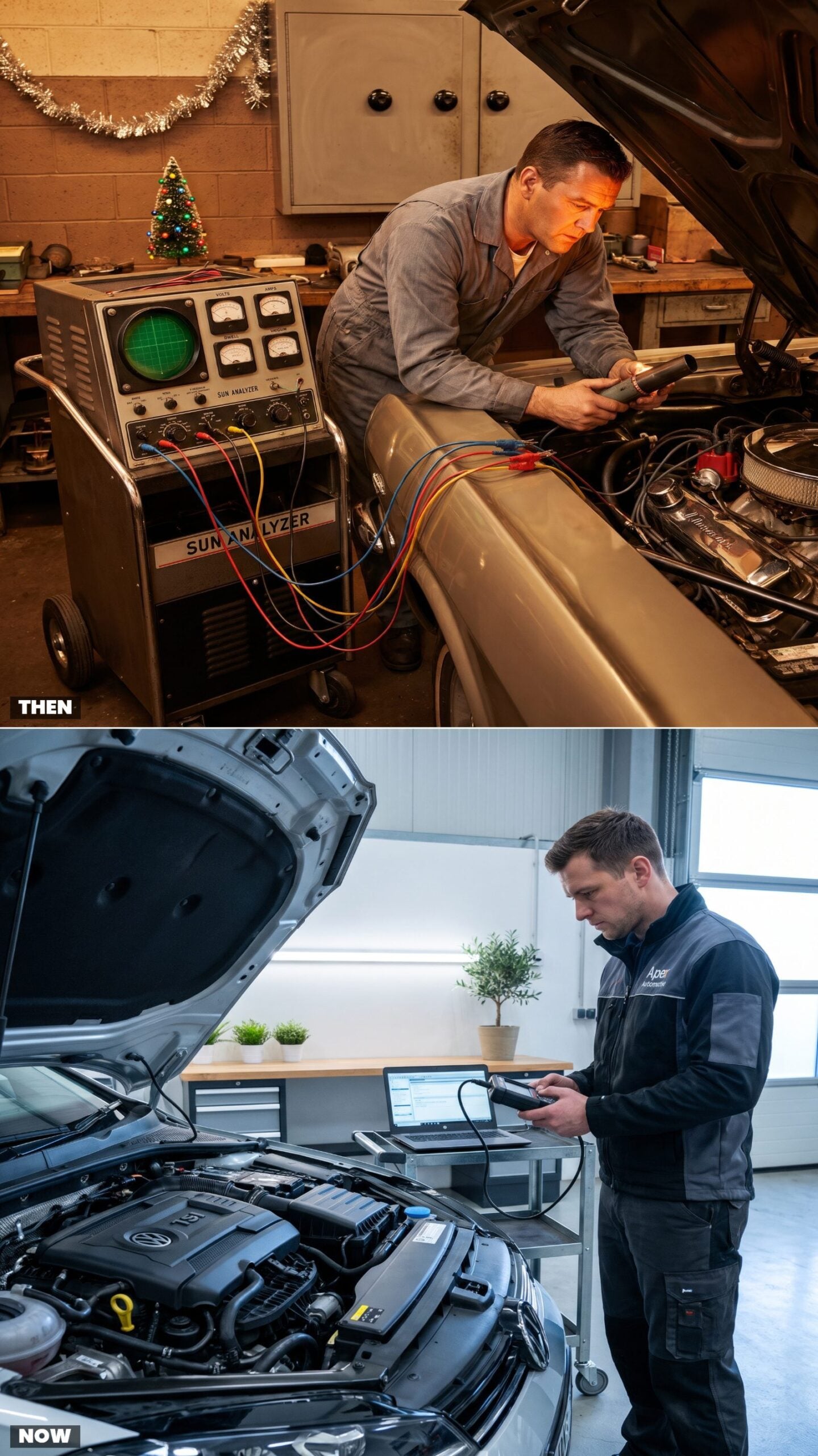
Diagnosing a 1966 car was part science, part feel. A mechanic rolled over an engine analyzer the size of a jukebox, clipped a dozen color-coded leads onto the distributor and plugs, squinted at a round green oscilloscope, and listened. A timing light, a vacuum gauge, and twenty years of ear training did the rest. The machine helped. The man decided.
Now he plugs a scan tool into a port under the dash and the car confesses in codes. The laptop tells him the cylinder, the sensor, sometimes the exact part number. The jukebox is gone, and so, mostly, is the listening.
1. The Electric-Vehicle Charging Stalls
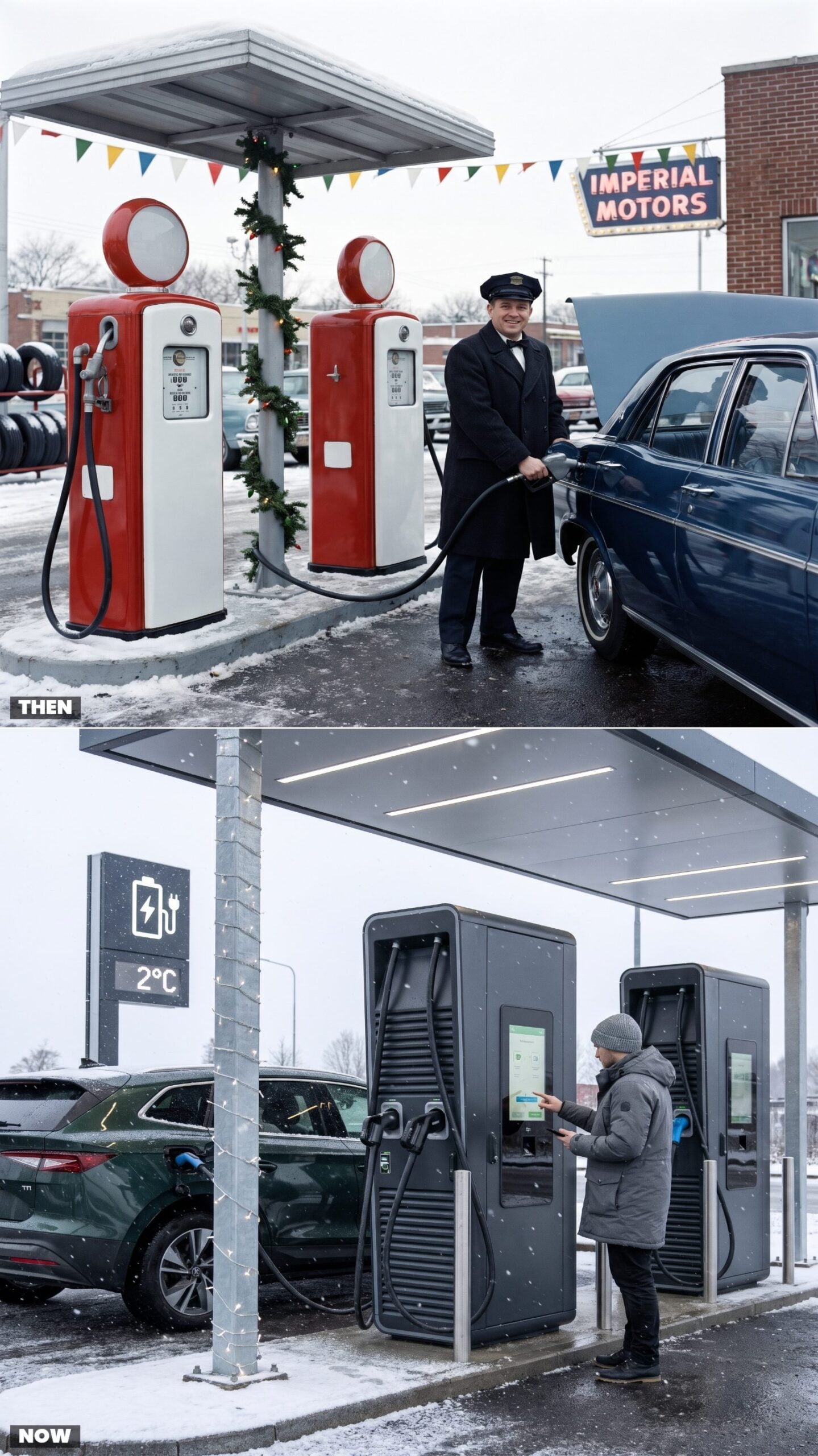
In 1966 the closest thing a dealership had to a charging station was the fuel island. An attendant in a bow tie worked the pump with the spinning-number dial, filled your tank, checked your oil, cleaned your windshield, and wished you a merry Christmas, all without you leaving the seat. Full service meant exactly that.
Now a row of tall charging stalls hums at the edge of the lot, thick cooled cables resting in their holsters, a touchscreen where the attendant used to stand. You tap your phone, plug in, and wait twenty minutes with a coffee. Nobody checks your oil. There isn’t any to check.
The attendant in the bow tie became a touchscreen, and the thing that took longest wasn’t the fill-up. It was learning to wait.