
Would you like to save this?
The permission slip came home in October. You handed it to your mom on a Tuesday, she signed it without looking up from the stove, and just like that, sixth period became the most important forty-five minutes of your week. Before you had a job, before you had a curfew worth arguing about, before any of it, there was driver’s ed. A room that smelled like old carpet and overhead projector heat. A teacher who had seen everything twice. And somewhere out in that parking lot, a car with a second brake pedal and your name on the sign-up sheet.
29. The Moment You Realized the Car Radio Was Yours to Control for Exactly Forty-Five Minutes
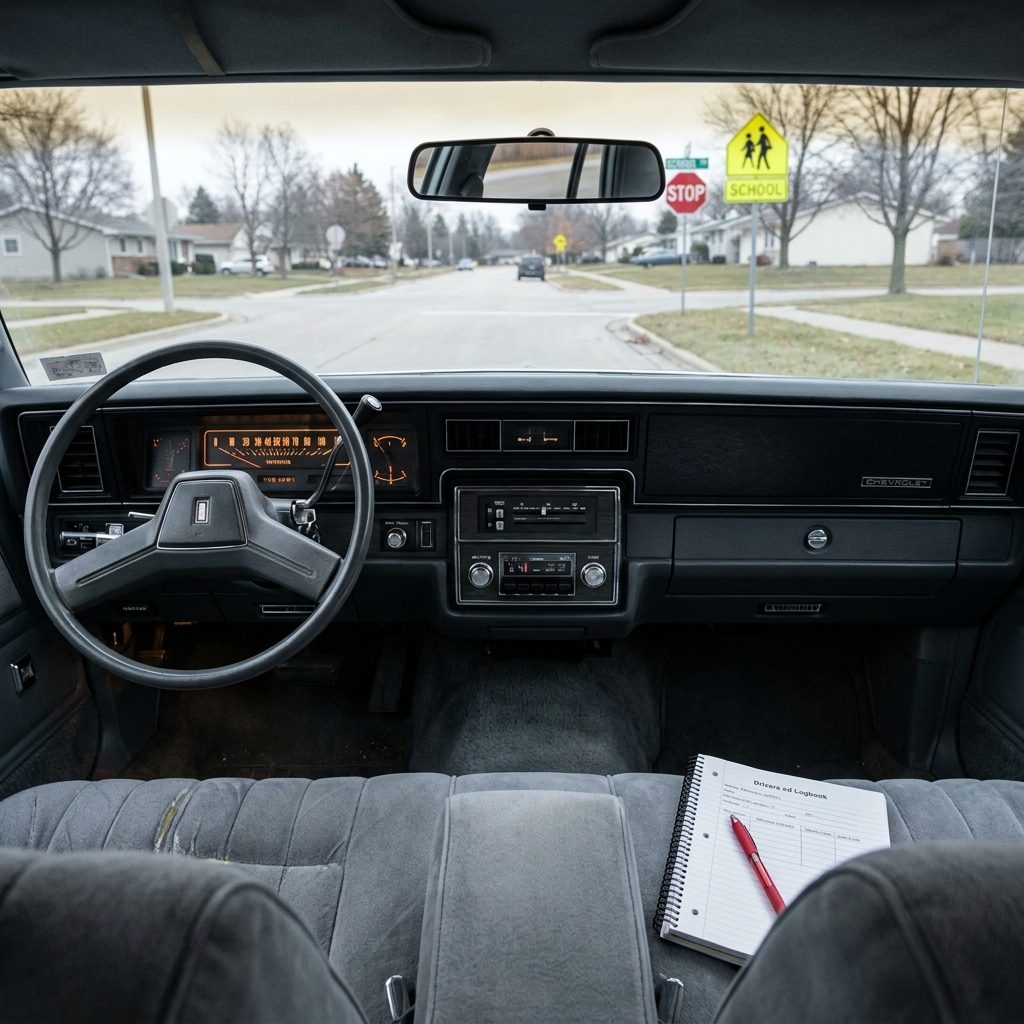
The instructor usually stopped caring about the radio by week two. That’s when you figured out you could nudge it from the local news station to Z100 or KIIS or whatever top-40 tower your town received, and nobody said a word as long as you kept both hands at ten and two.
Forty-five minutes of unsupervised radio access in a moving car felt like a completely different category of freedom from anything available at home. The volume stayed low. The choice was yours. That was the whole point.
28. Parallel Parking the Instructor’s Own Car Into a Space Roughly the Size of a Basketball Court
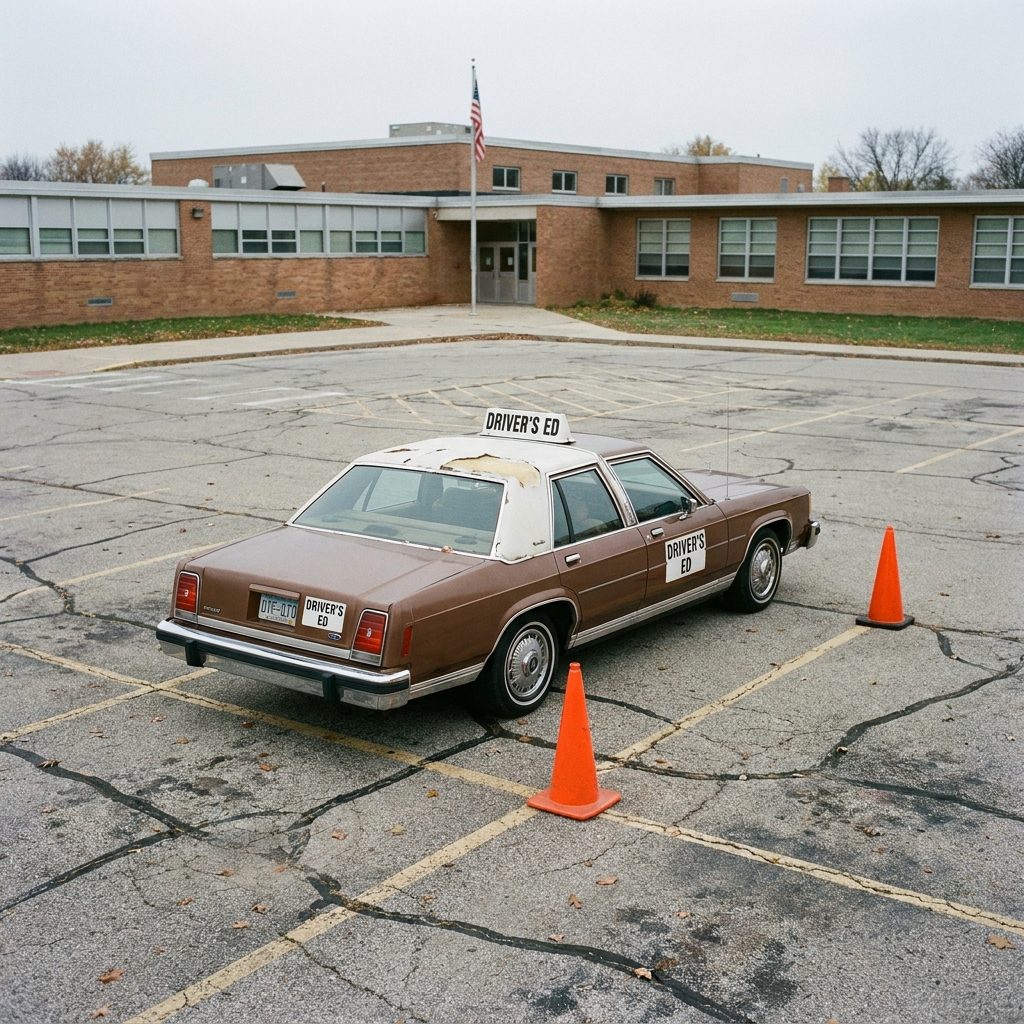
Those cones were placed far enough apart that you could have parallel parked a school bus between them with room to spare. Everyone knew it. The instructor knew it. The rubric required it anyway.
The real lesson wasn’t spatial reasoning. It was learning that most adult tests of competence are designed so you can pass them if you just slow down and don’t panic. A few of us took longer than others to figure that out.
27. The Gory Safety Film They Showed on a Tuesday Afternoon That You Still Think About Sometimes
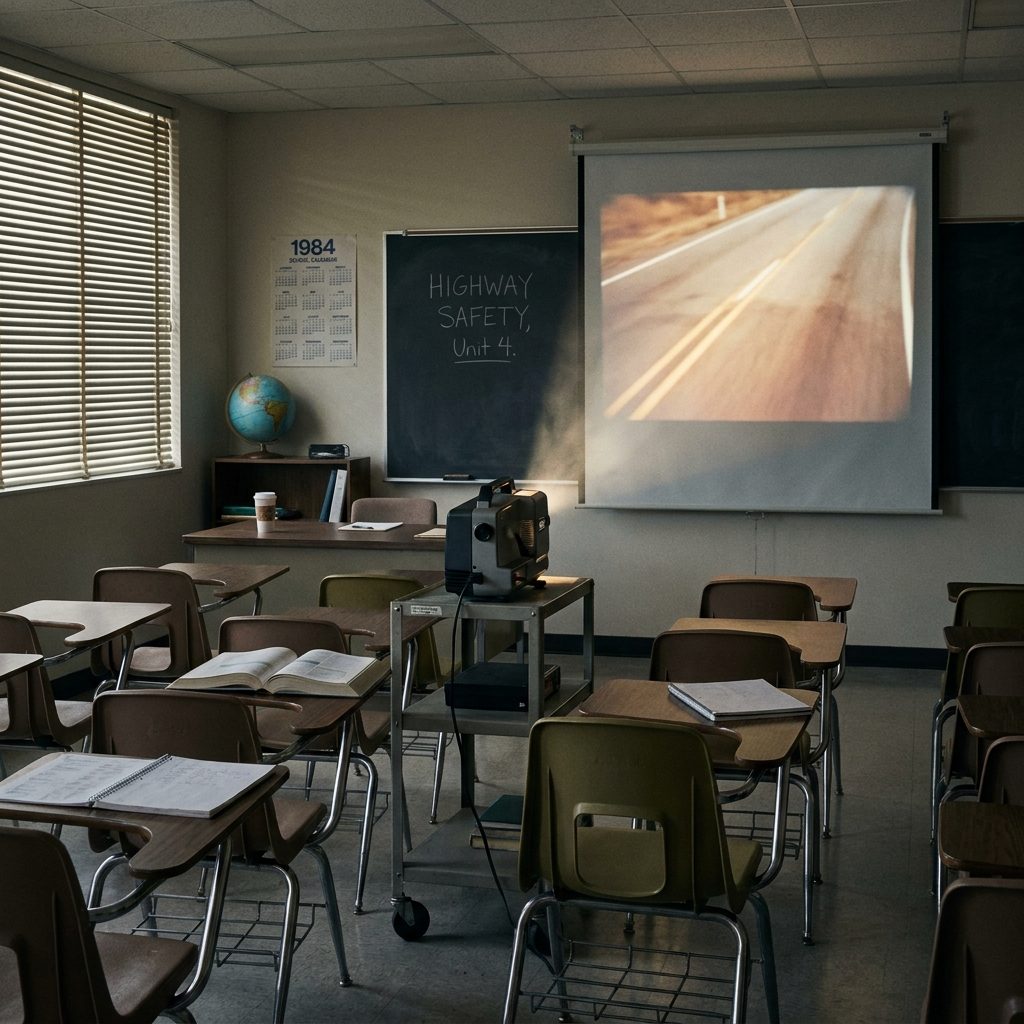
It had a name, usually something like Blood on the Highway or Mechanized Death, and it arrived on a metal AV cart wheeled in by the assistant principal with slightly more ceremony than the occasion required. The lights went down. The 16mm projector warmed up.
The films were produced in the late 1960s and early 1970s and still in active rotation fifteen years later, which gave them a particular quality: the cars were enormous, the fashions were wrong, and the horror was entirely real.
Every driver’s ed class watched one. Nobody talked much on the drive home that afternoon.
26. The Two-Week Window When You Knew More About the Rules of the Road Than Anyone Else in Your House
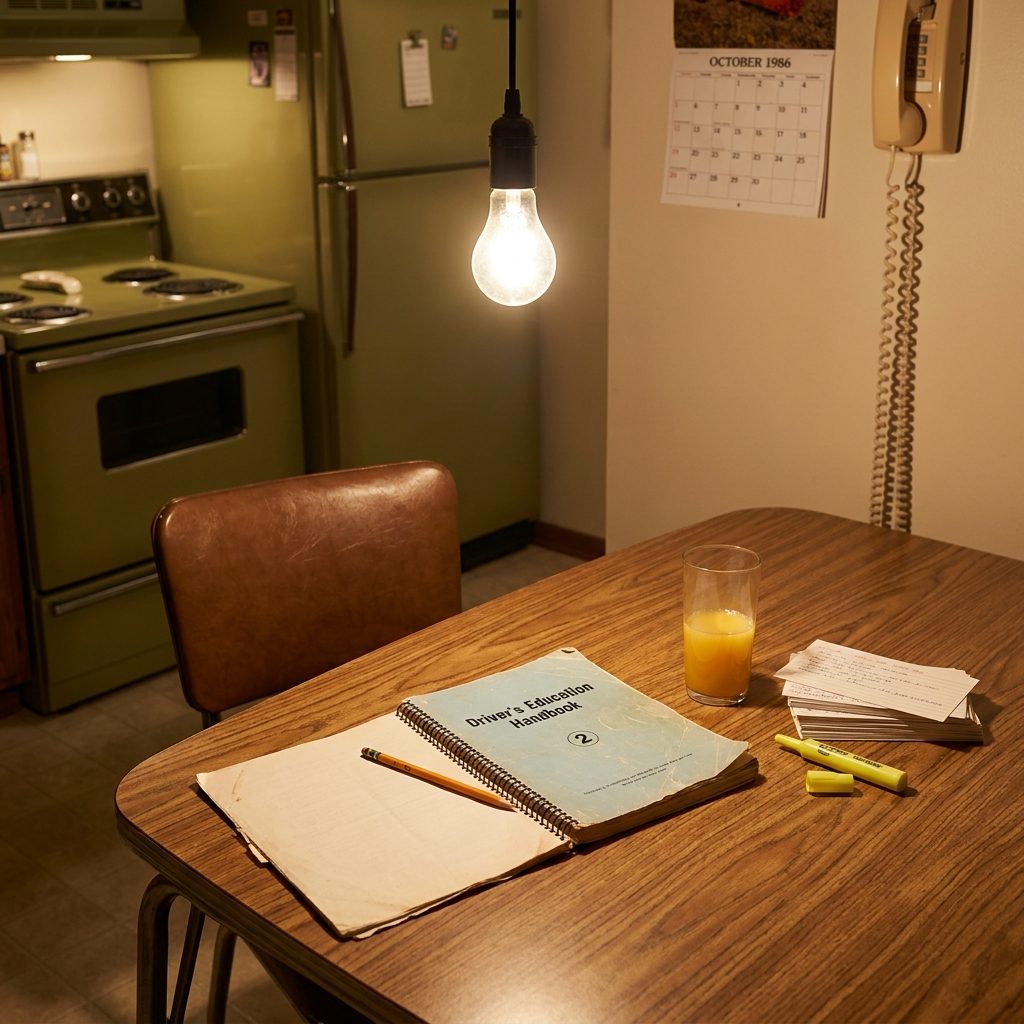
Right of way at a four-way stop. The three-second following distance rule. What a flashing yellow means versus a flashing red. For about ten days in the fall of sophomore year, this was specialized knowledge that nobody else at the dinner table possessed, and it was intoxicating.
Parents who had been driving for twenty years could not have told you the exact stopping distance at 55 miles per hour. You could. You’d be tested on it Thursday.
The knowledge faded fast after the written exam. The feeling of knowing something the adults around you didn’t, that one lasted a little longer.
25. The Brake Pedal on the Passenger Side That the Instructor Could Stomp at Any Second
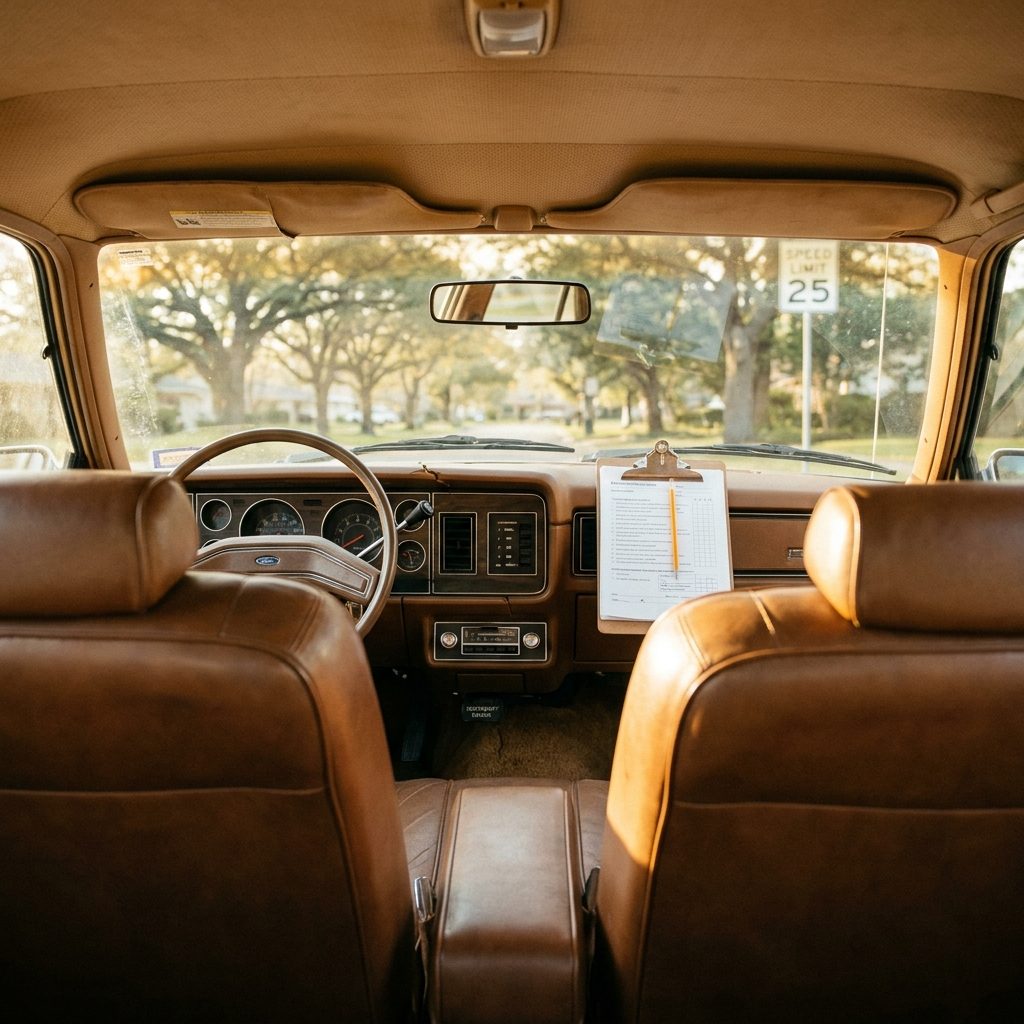
You could feel it before you heard it — a shudder through the floorboard, the car jerking to a stop mid-intersection, and then the instructor’s voice, flat as a dial tone: “I had to use my brake.” Six words. More shame than any report card ever delivered.
That dual-control brake pedal lived in your head the entire time you were behind the wheel. You drove knowing someone else could override you at any moment, like training wheels bolted to a sedan, and you hated it with a passion that now, decades later, you can recognize as completely reasonable. The thing is, the hatred made you a better driver. Probably. Or it just gave you a lifelong distrust of passenger-side floor mats.
24. The Parking Lot at 7 AM Before the School Day Even Started
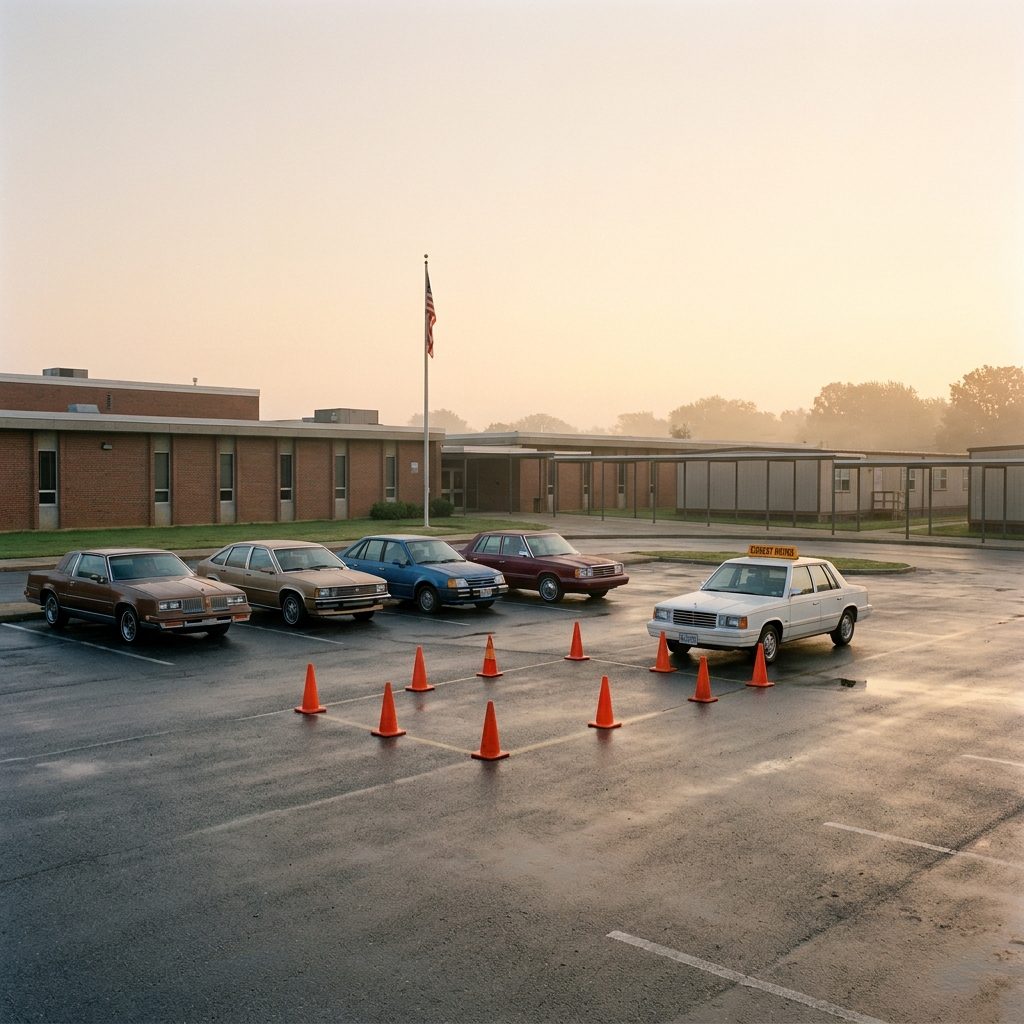
Six forty-five. Alarm clock screaming in the dark. Summer, supposedly, but you were awake before the sun because driver’s ed started at seven and a parking lot was your classroom.
Nobody warned you that independence would start this early. The lot sat empty except for orange cones, the instructor’s car, and maybe two other kids who looked exactly as half-awake as you felt. School building locked. Cafeteria dark. Just you, the cones, and a Dodge Aries with a sign on the roof announcing your incompetence to anyone driving by on Route 9 at dawn. But you showed up. Voluntarily. In the summer. During hours when the only other people awake were joggers and paper-route kids. That alone was a kind of turning point — you were doing something hard because you wanted what waited on the other side of it.
23. The Three-Point Turn You Practiced Until the Curb Became a Personal Enemy
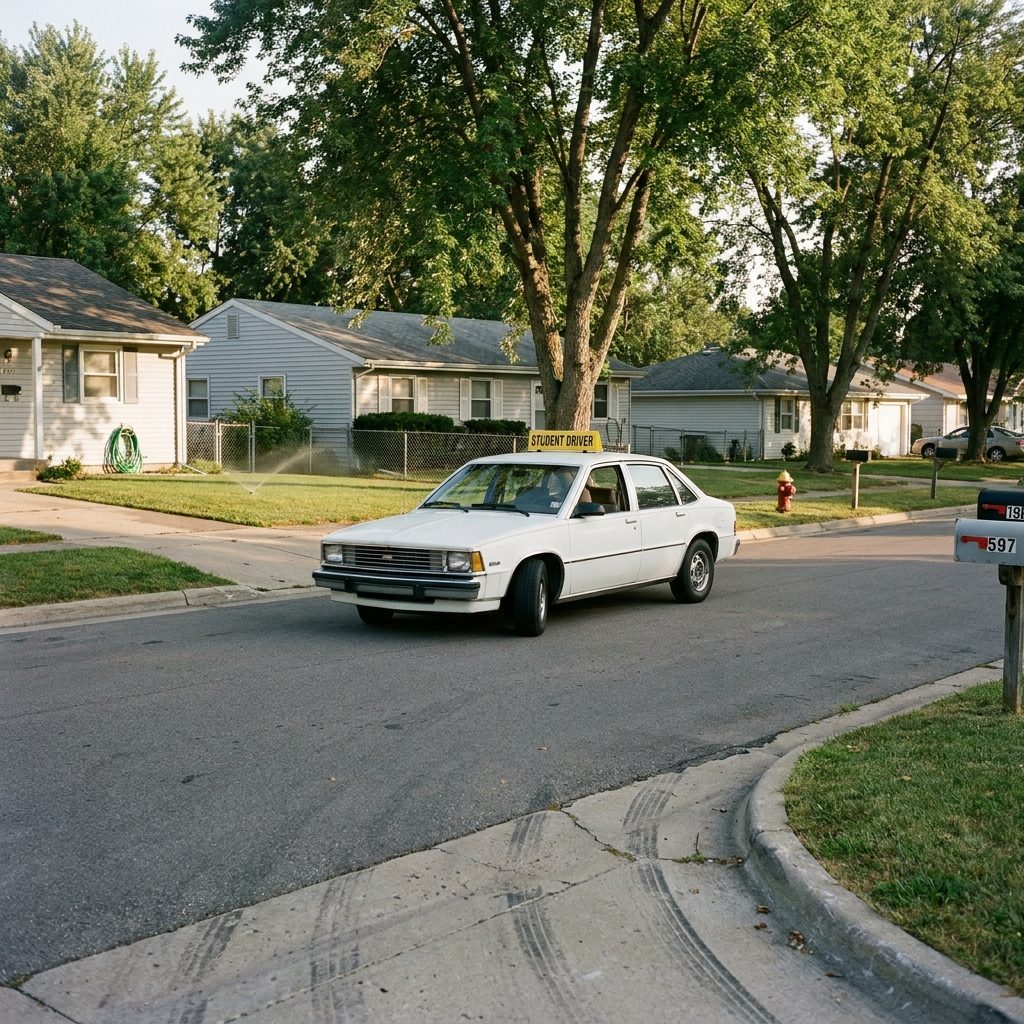
Pull forward, crank the wheel. Stop. Reverse, crank the other way. Stop. Pull forward. Done. Three moves — the simplest geometry lesson on earth — and somehow it took you nine attempts.
They always picked the same residential street. Some quiet cul-de-sac where the neighbors had long since stopped noticing student drivers bumping their curbs. You could hear the tire kiss the concrete, and your stomach dropped every single time. Like the curb was keeping score. Like it remembered you from yesterday. The instructor would mark something on his clipboard, say “again,” and you’d pull forward, crank the wheel, and start the whole miserable ballet over.
22. The Instructor Who Had Clearly Seen Some Things and Was No Longer Surprised by Anything
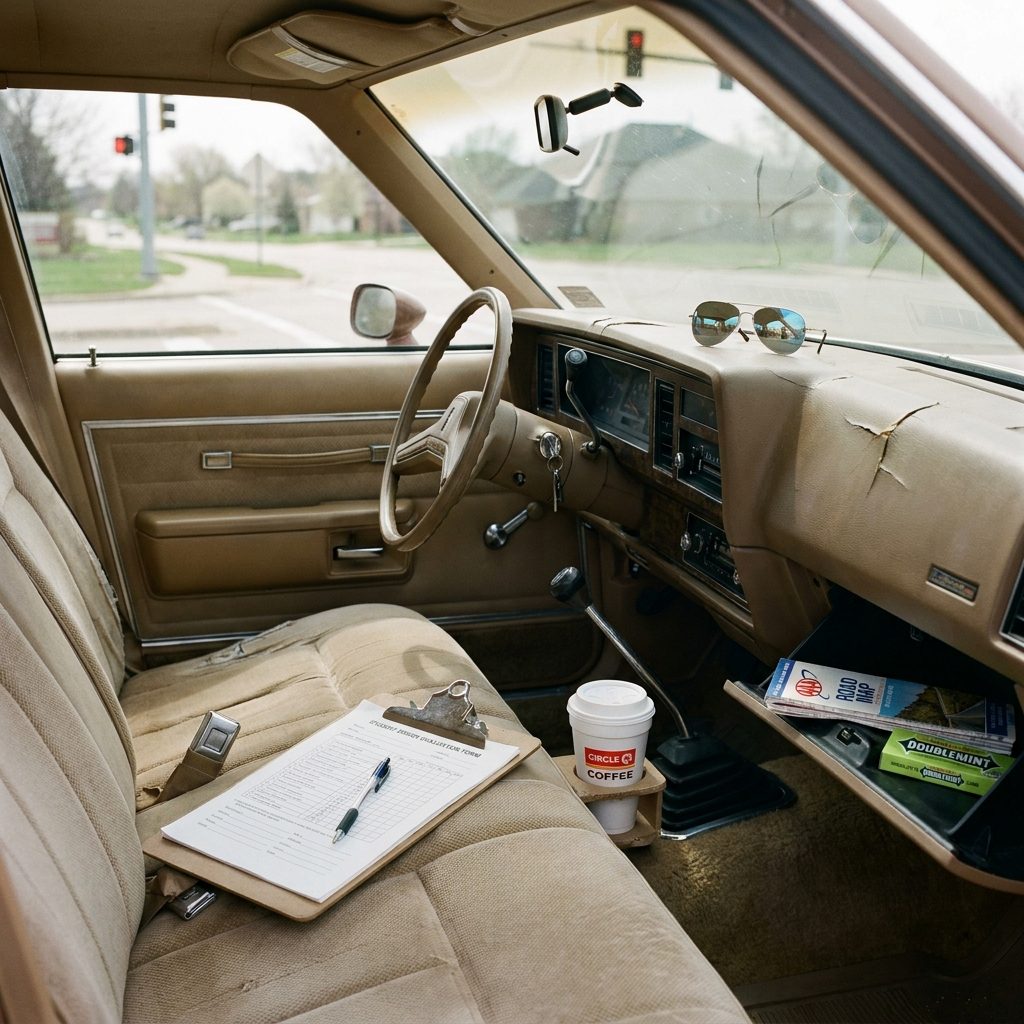
Coach Reynolds. Mr. Dietrich. Whatever his name was at your school, the energy was identical: a man who had stared down a thousand left turns executed by fifteen-year-olds and emerged spiritually flattened but still, somehow, functional.
He never yelled. He’d been past yelling for years. When you blew through a yield sign, he just made a small mark on his clipboard and said something like, “We’re going to want to stop there next time.” That calm was almost worse than screaming — it meant he’d already accepted whatever was about to happen. A kind of radical surrender disguised as professionalism.
Coffee from a Styrofoam cup that lived on the dashboard. Aviator sunglasses regardless of weather. He had a system. You were not the first kid to test it, and the system did not care about your feelings.
21. The First Time You Drove on an Actual Road With Actual Other Cars and Actual Other People Who Did Not Know You Were Terrified
Would you like to save this?
The parking lot forgave you. Cones don’t honk. Cones don’t brake-check you or flip you off at a merge.
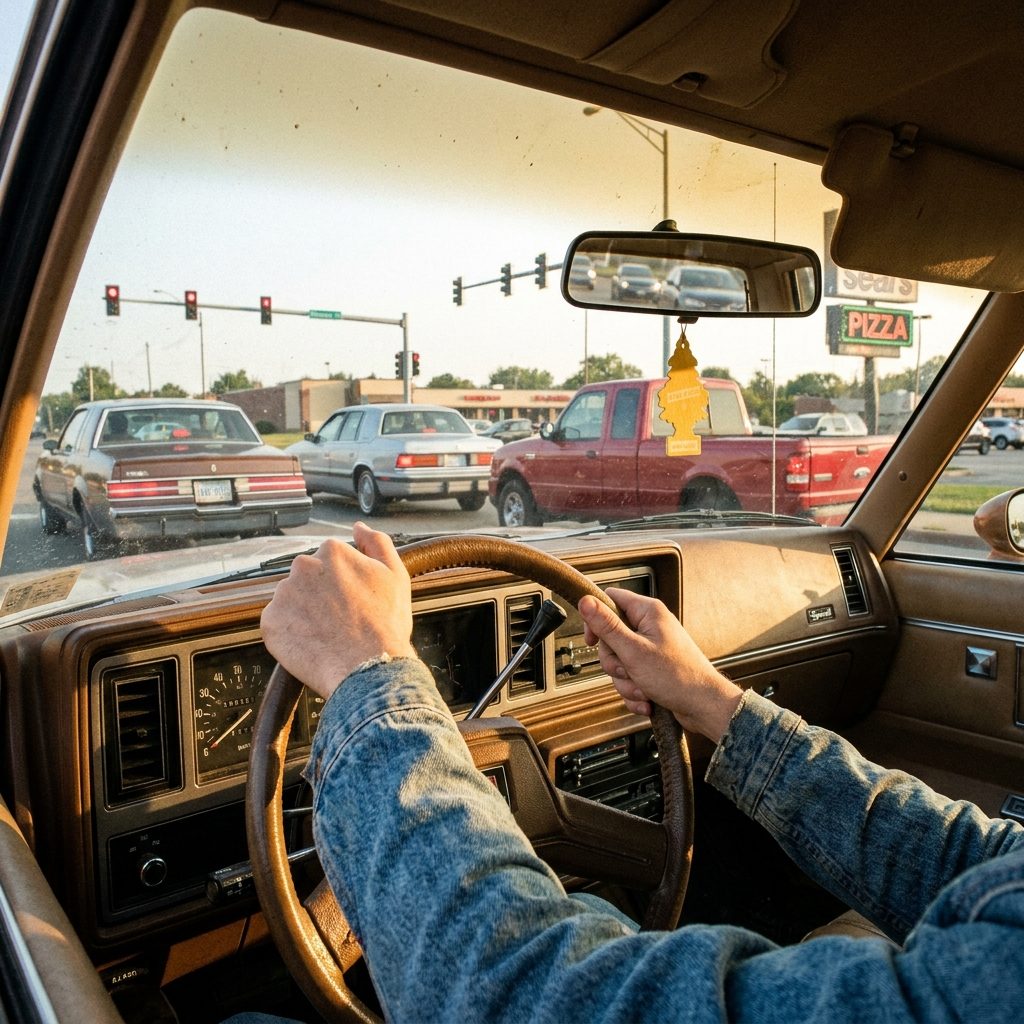
Then one morning the instructor said, “Take a right out of the lot,” and suddenly you were on Maple Street with a Buick riding your bumper and a pickup ahead and a traffic light turning yellow and you had to make a decision that affected other human beings who had no idea a tenth-grader was piloting the white sedan in front of them. Knuckles white. Ten and two. Ten and two like your life depended on it, because for the first time it sort of did.
20. The Written Test With the Trick Questions About Railroad Crossings Nobody Actually Lived Near
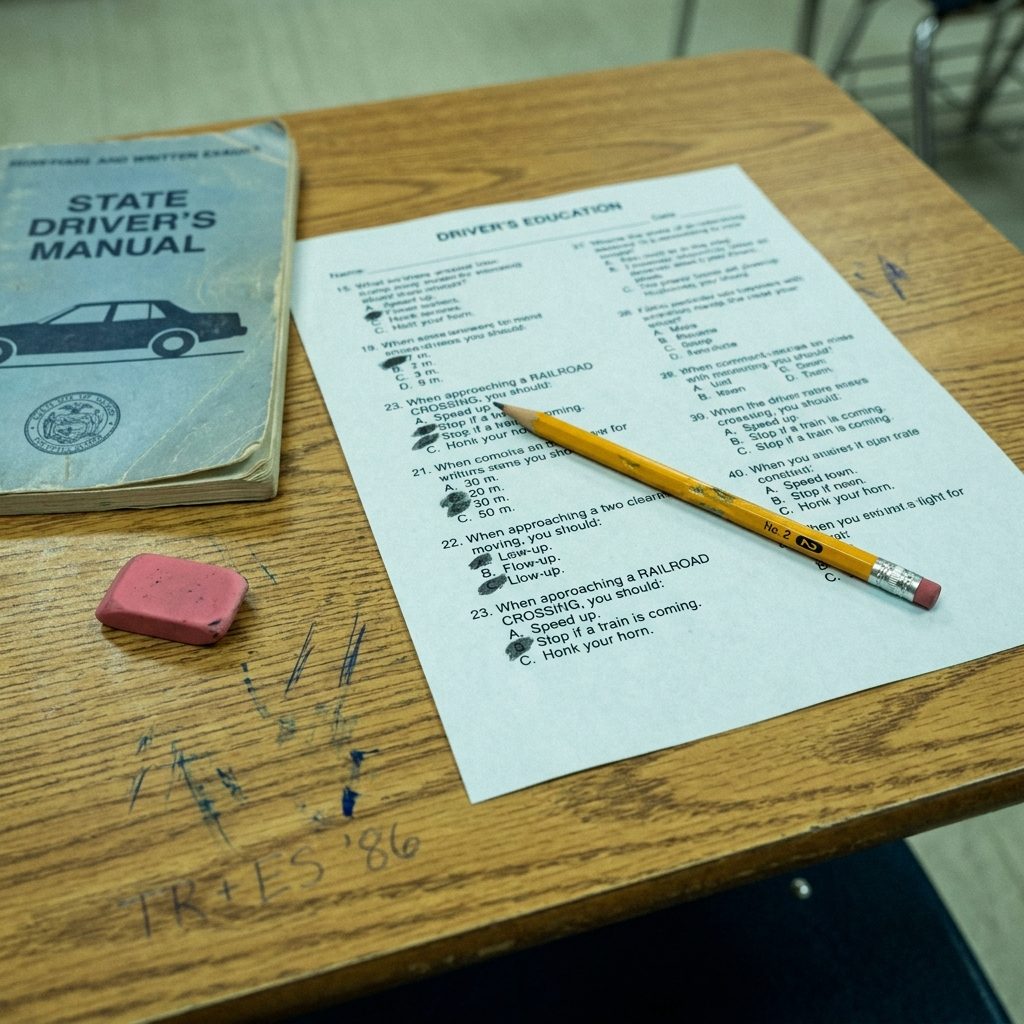
Question 14: When approaching a railroad crossing with flashing red signals and no gate, you should: A) Stop, look both ways, proceed with caution. B) Slow to 15 mph and proceed. C) Stop and wait until signals stop flashing. D) All of the above.
You lived in a suburb forty miles from the nearest railroad track. You had never seen a railroad crossing with your own eyes. But the state wanted you to know what to do at one, and the state was not kidding around. Multiple questions devoted to this scenario. Multiple.
The trick questions were the real education, though. They taught you that the government writes exams the way it does everything else — with an obsessive fondness for edge cases you will statistically never encounter, formatted in a way that makes every answer look plausible and none of them feel right.
19. Merging Onto the Highway for the First Time and Discovering What the Word ‘Accelerate’ Actually Means
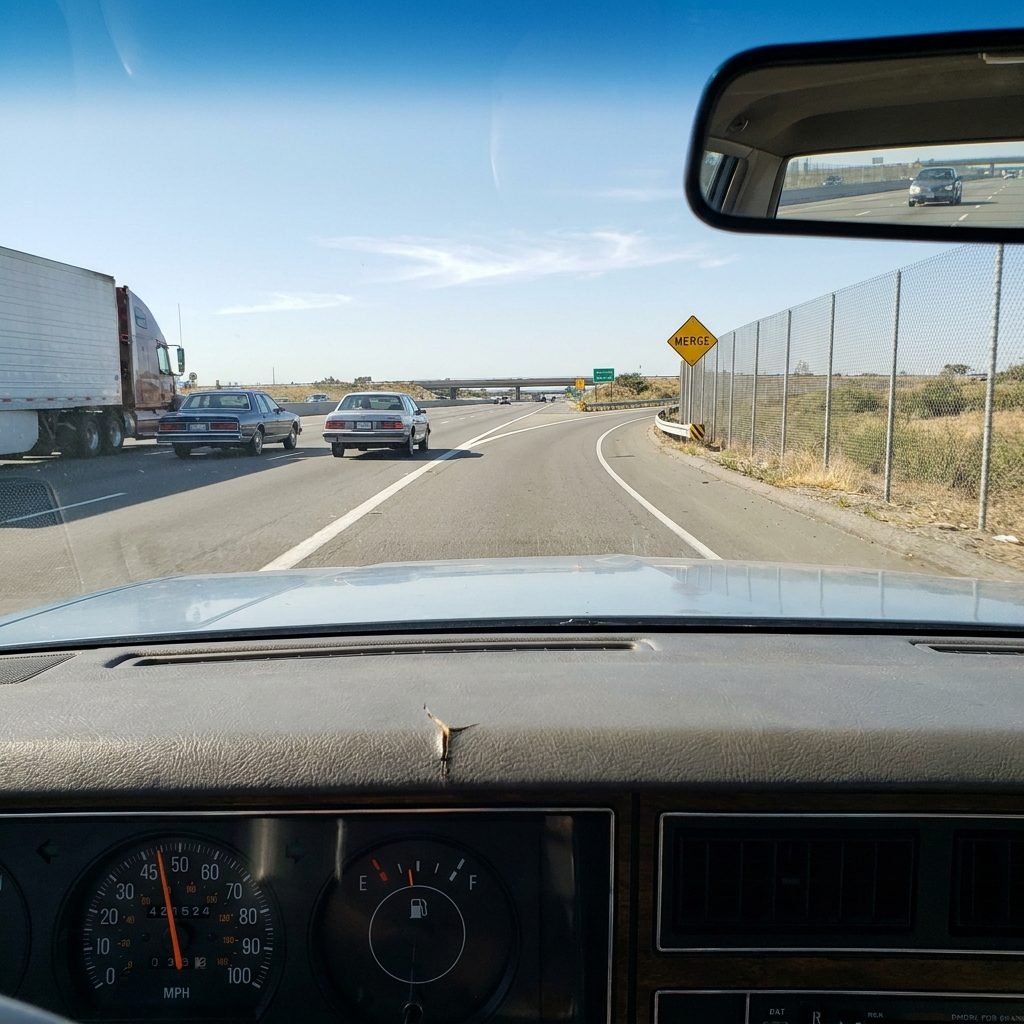
Forty. Forty-five. The instructor said “faster” and he meant it. The merge lane was shrinking and the semi in the right lane was absolutely not slowing down and the Chevrolet Citation’s four-cylinder engine wanted no part of any of this.
Fifty. Fifty-five. You merged. Nobody died. The semi blasted its horn or it didn’t — hard to remember now, because your heartbeat was louder than anything outside the car. Either way, you were on the highway, both hands welded to the wheel, eyes so wide you could feel air on your corneas, doing sixty in a car you’d been driving for less than two weeks.
That was the moment. Not the parking lot drills, not the residential street maneuvers. The merge was when driving stopped being an exercise and became a real thing happening to you at speed.
18. The Kid in the Backseat Who Had to Watch You Drive and Was Not Handling It Well
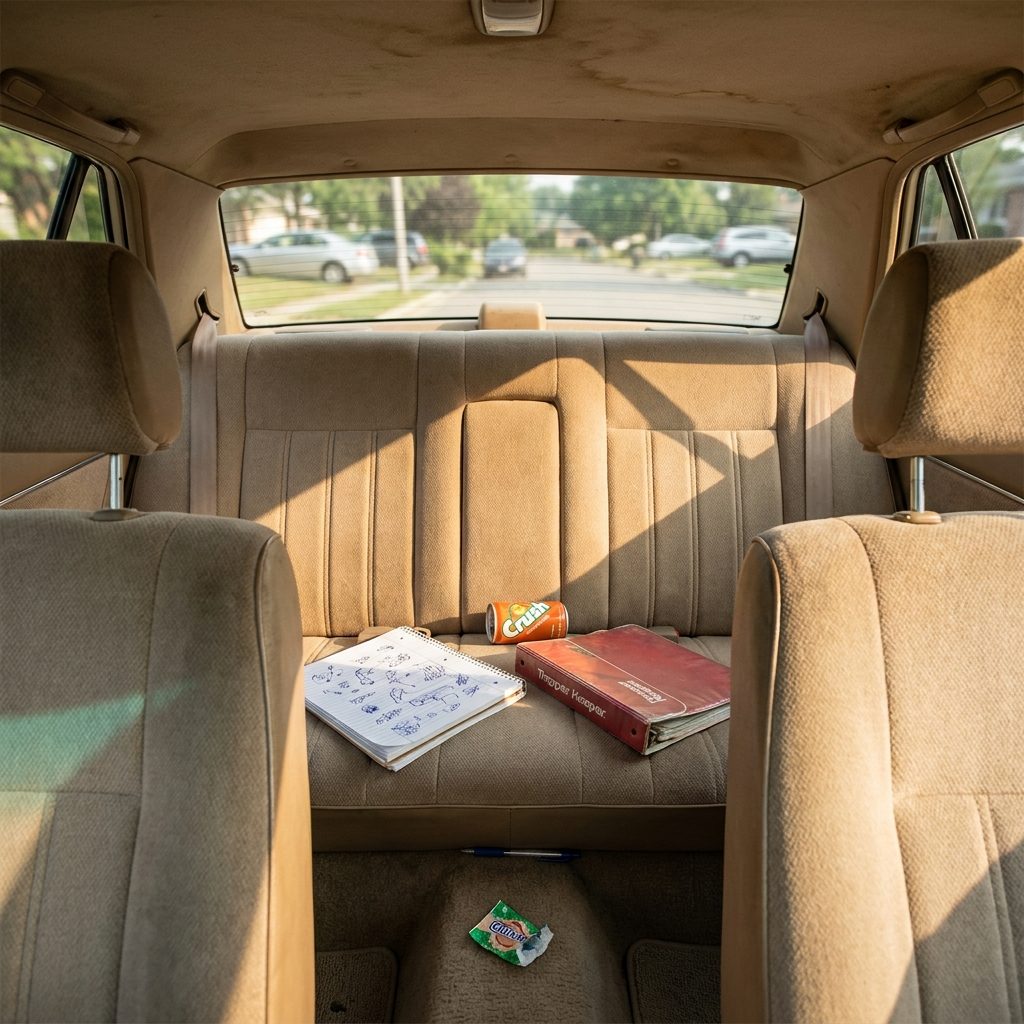
Driver’s ed came in threes. One behind the wheel, one in the passenger seat pretending to take notes, one in the back doing absolutely nothing except watching someone else almost hit a mailbox.
The backseat kid had the worst deal, honestly. No control, no responsibility — just thirty-five minutes of involuntary observation while a classmate you barely knew navigated a four-way stop like it was a riddle carved into a temple wall. You sat there gripping the door handle, staring at the back of someone’s head as they failed to signal, and you understood — possibly for the first time — what it costs to trust another person with your physical safety. Heavy stuff for a Tuesday morning before homeroom. The Trapper Keeper on the seat next to you wasn’t providing much comfort.
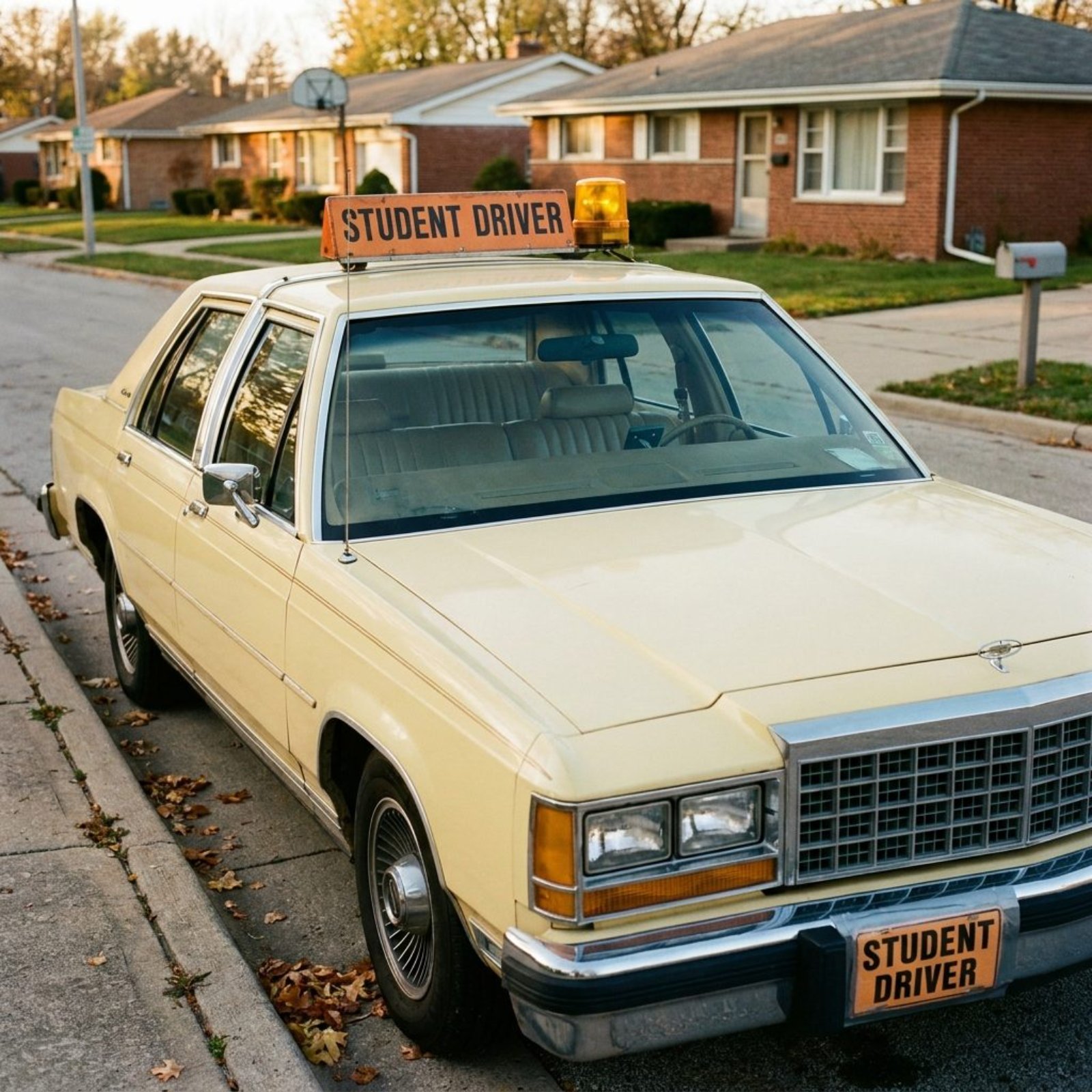
17. The Laminated Card That Said ‘STUDENT DRIVER’ and Made Every Other Car on the Road Suddenly Very Polite
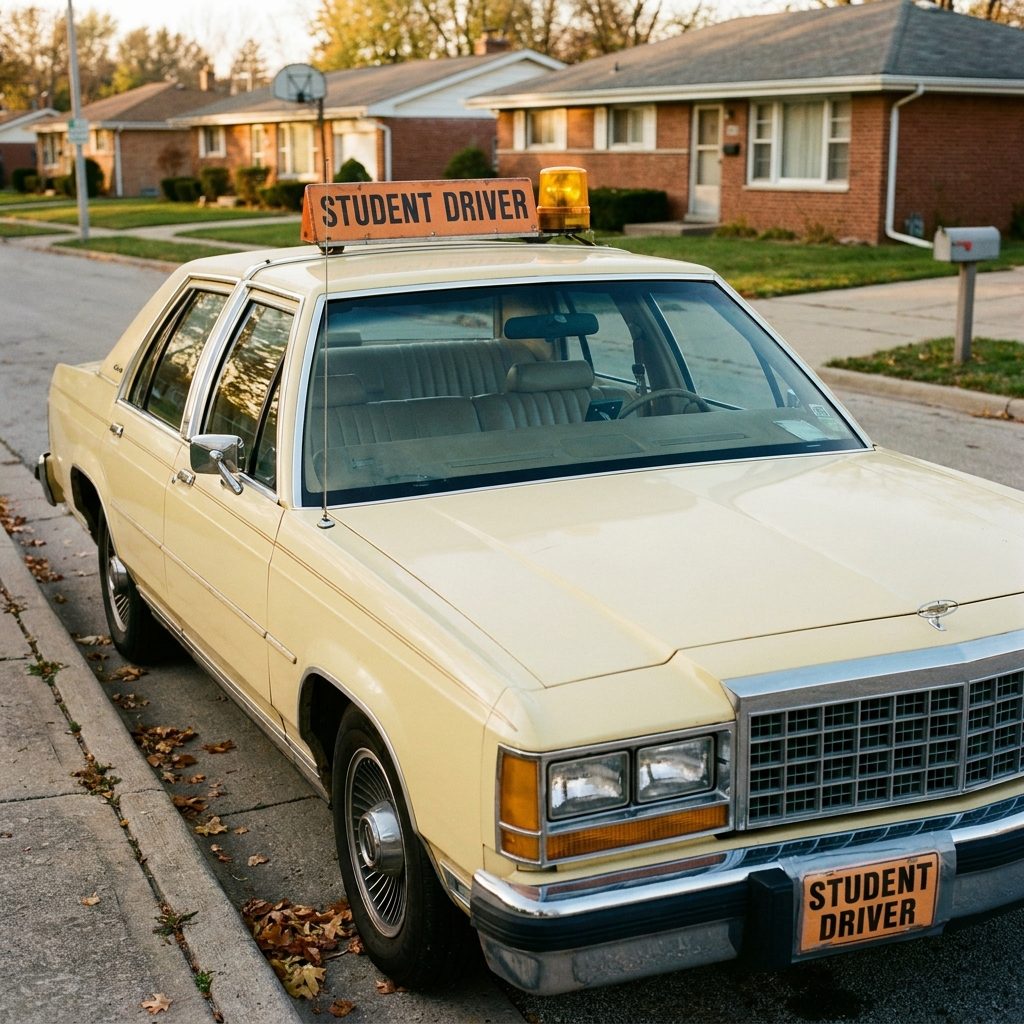
Other drivers saw that placard and gave the car about three extra car lengths of space in every direction. Nobody honked. Nobody cut in. It was the closest thing to diplomatic immunity a sixteen-year-old had ever experienced, and it lasted exactly the duration of driver’s ed.
That laminated card, usually taped slightly off-center to the rear bumper and sun-faded by October, did more for your driving confidence than any amount of classroom instruction. The road felt forgiving that semester. It never quite felt that forgiving again.
16. The Day You Drove Past Someone You Knew and They Saw the Student Driver Sign
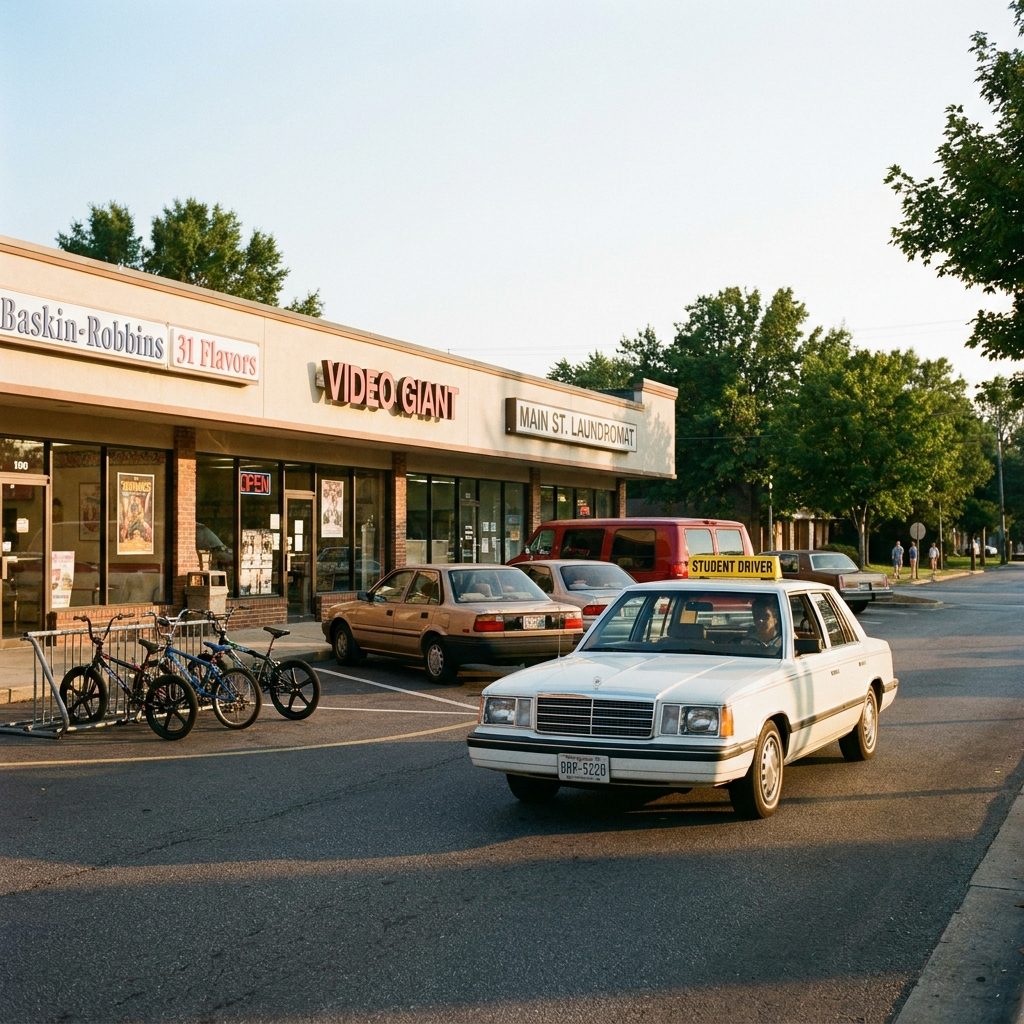
That rooftop sign might as well have been a billboard with your yearbook photo stapled to it. STUDENT DRIVER. Two words. Bright yellow. Visible from blocks away.
And of course — of course — the one day the instructor routed you down Main Street past the Baskin-Robbins, there they were. Your friends. On their bikes. Staring. One of them waved, the jerk, knowing full well you couldn’t wave back because both hands were cemented to the steering wheel and you were concentrating on not rear-ending a parked Oldsmobile. You drove past at exactly twenty-five, eyes locked forward, face on fire, that yellow sign broadcasting your amateur status to every single person you’d have to face in homeroom Monday morning. The instructor, to his credit, said nothing. He’d seen this exact scene play out a hundred times before.
15. The Permit in Your Wallet That Weighed Nothing and Changed Everything
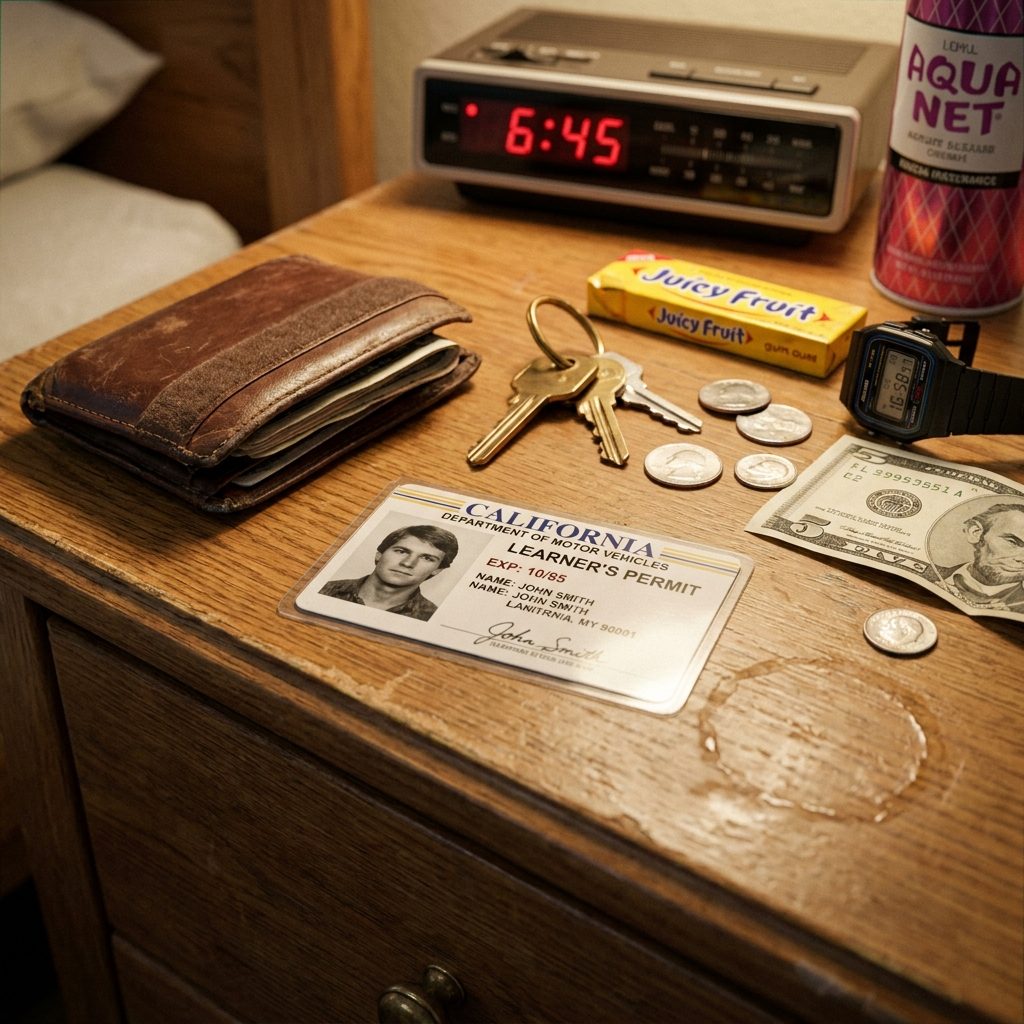
A piece of paper. Or a laminated card, depending on your state. Your photo looked awful — DMV photos have always looked awful, it’s practically a law — and the bureaucratic font made your name look like it belonged to someone who owed the government money.
None of that mattered. Not even a little.
It went into the wallet immediately. Behind the school ID, in front of the library card. You checked it was still there roughly forty times a day, pulled it out at lunch to show someone who hadn’t asked, carried it like a passport to a country you’d only just been granted entry to. The permit didn’t let you drive alone. Didn’t let you drive at night, or with friends, or basically anywhere fun. It let you drive with a licensed adult in the passenger seat during daylight hours. Restrictive? Absurdly. And somehow, within those restrictions, you held more freedom than you’d ever known. A laminated rectangle that smelled like the DMV and promised — eventually, if you didn’t blow it — the open road.
14. The Clutch Pedal in the Driver’s Ed Car That Nobody Warned You About
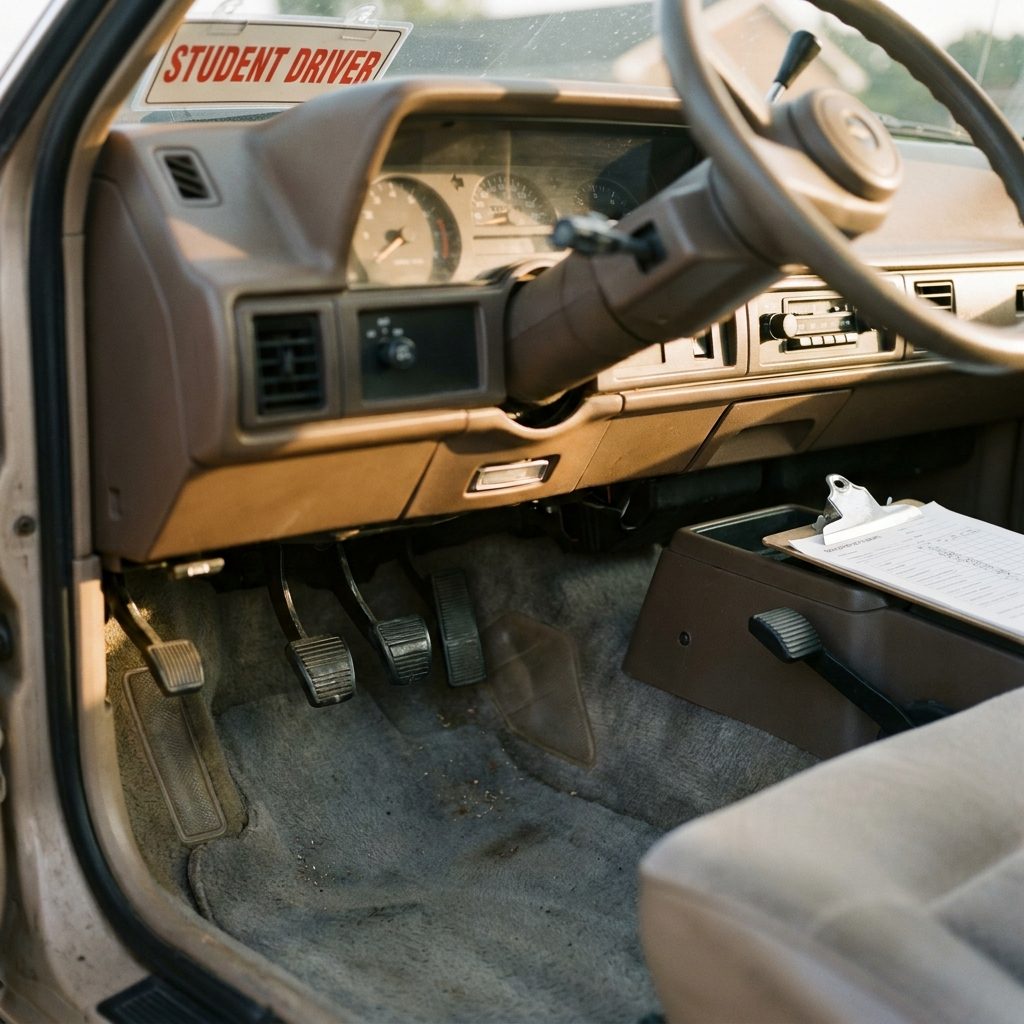
Some schools had automatics. Yours didn’t. If there was a manual transmission car in the fleet, you found out the way you found out about most things in the eighties: without preparation, on a Tuesday, in a parking lot that smelled like hot asphalt.
The clutch pedal sat there like a pop quiz nobody studied for. No one explained the friction zone. No one mentioned the car would buck and stall and buck again while three classmates watched from the back seat, pretending—badly—not to laugh. You killed it four times before something clicked, literally, and the car lurched forward like it had decided to forgive you.
13. The Hand-Over-Hand Steering Technique the Instructor Drilled Into You Like a Religion
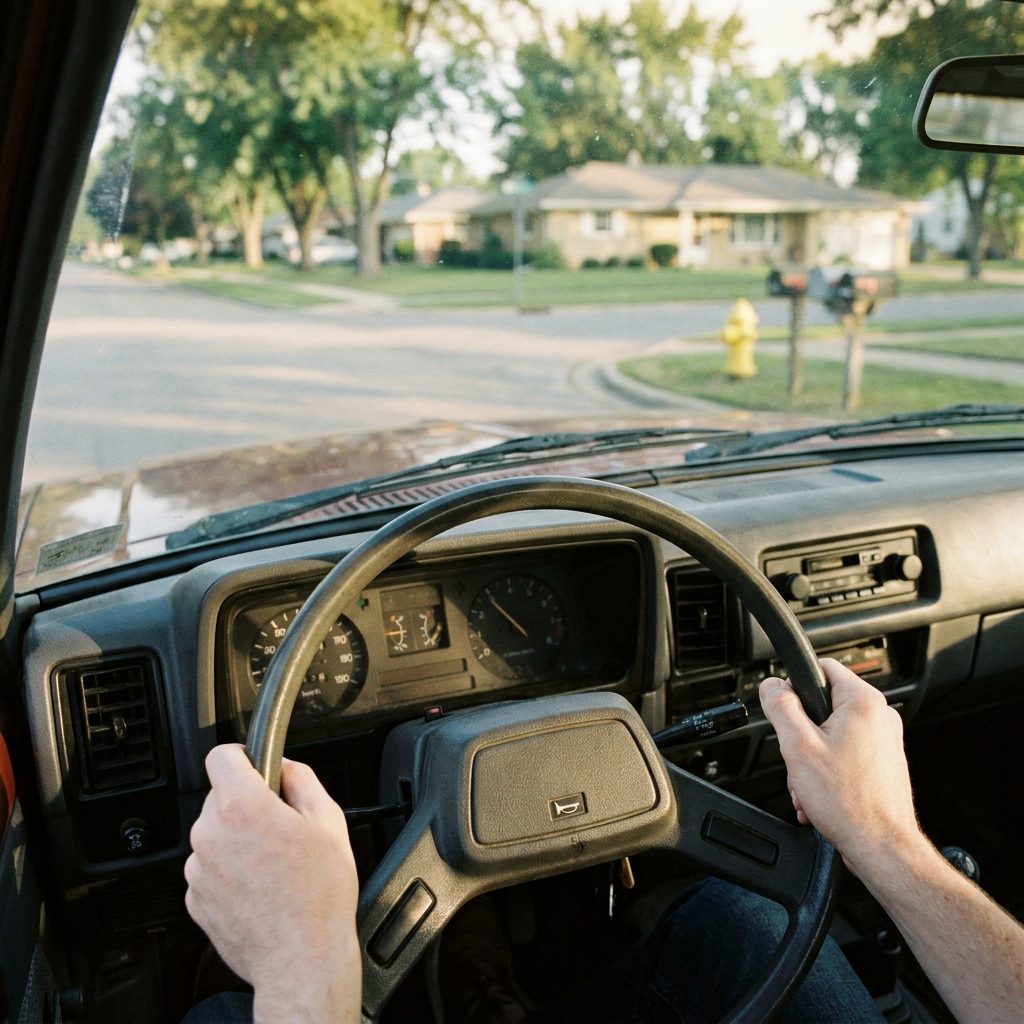
Ten and two. Not ten-fifteen and one-forty-five. Not wherever your hands happened to land. Ten. And. Two.
The instructor watched your hand position the way a raptor watches open ground. One hand drifting to noon earned a correction. Both hands dropping to six o’clock earned a kind of quiet disappointment somehow worse than yelling—a silence that made you feel like you’d personally failed the American highway system. Hand-over-hand through every turn, every lane change, every gentle curve on a residential street that barely required turning at all.
Decades later, you still catch yourself adjusting at a stoplight. The muscle memory outlasted the car, the instructor, and the driving school itself.
12. The Smell of That Car, Which Was Unlike Any Smell You Had Encountered Before or Since
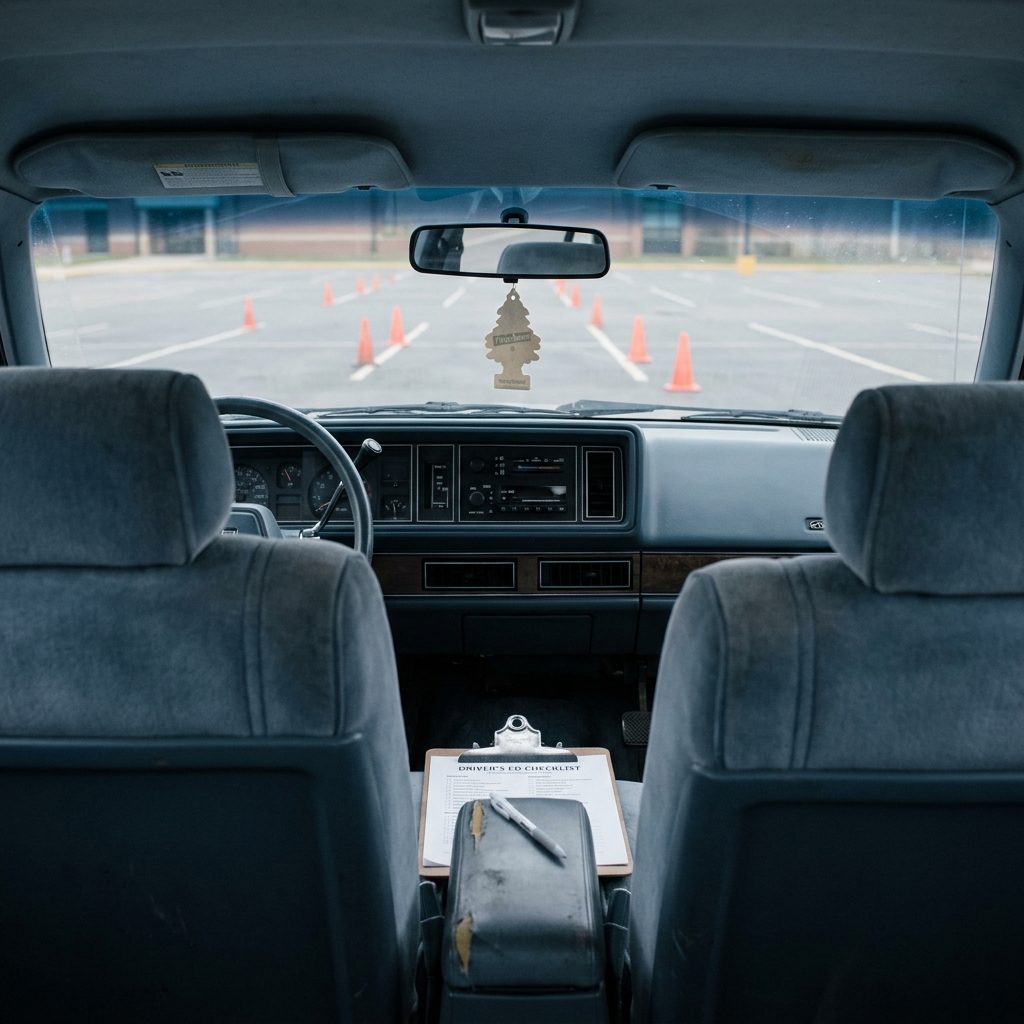
Vinyl cleaner. Old coffee. The ghost of someone else’s nervousness. A pine-tree air freshener that quit working in March but hung on the mirror straight through June because nobody bothered to replace it. You knew that smell the second you opened the door—every driver’s ed car had one, and it was unmistakable.
That velour seat held every student who’d sat in it before you. Their sweat, their drugstore perfume, their quiet panic. The car absorbed all of it and offered it back as a single, unified aroma that communicated one thing: other people have been terrified here. They survived. You probably will too.
11. The Orange Traffic Cones in the School Parking Lot That Represented Imaginary Pedestrians
Would you like to save this?
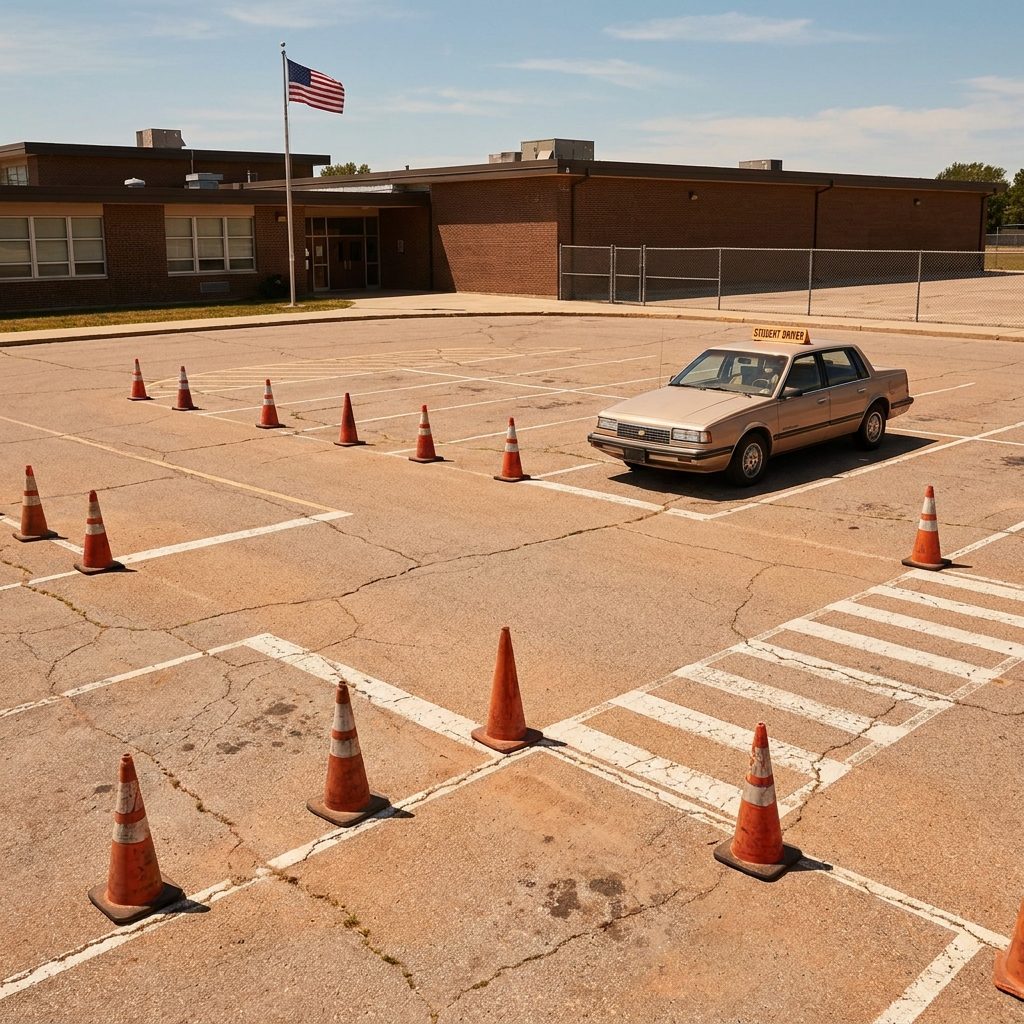
They were supposed to be cars. Or people. Or possibly fire hydrants—the cones played every role, depending on which exercise the instructor called out. Weave through them. Park between them. Stop before you hit one, because if you hit one, congratulations, you just ran over Mrs. Henderson from the PTA.
Nobody ever knocked one over without the instructor delivering something like “well, that was a person” in a tone so flat and dry it lodged in your memory for decades. You couldn’t argue. The cone was down. Mrs. Henderson was gone.
10. The Moment You Realized You Could Legally Sit Behind the Wheel of Your Parents’ Car and Go Somewhere
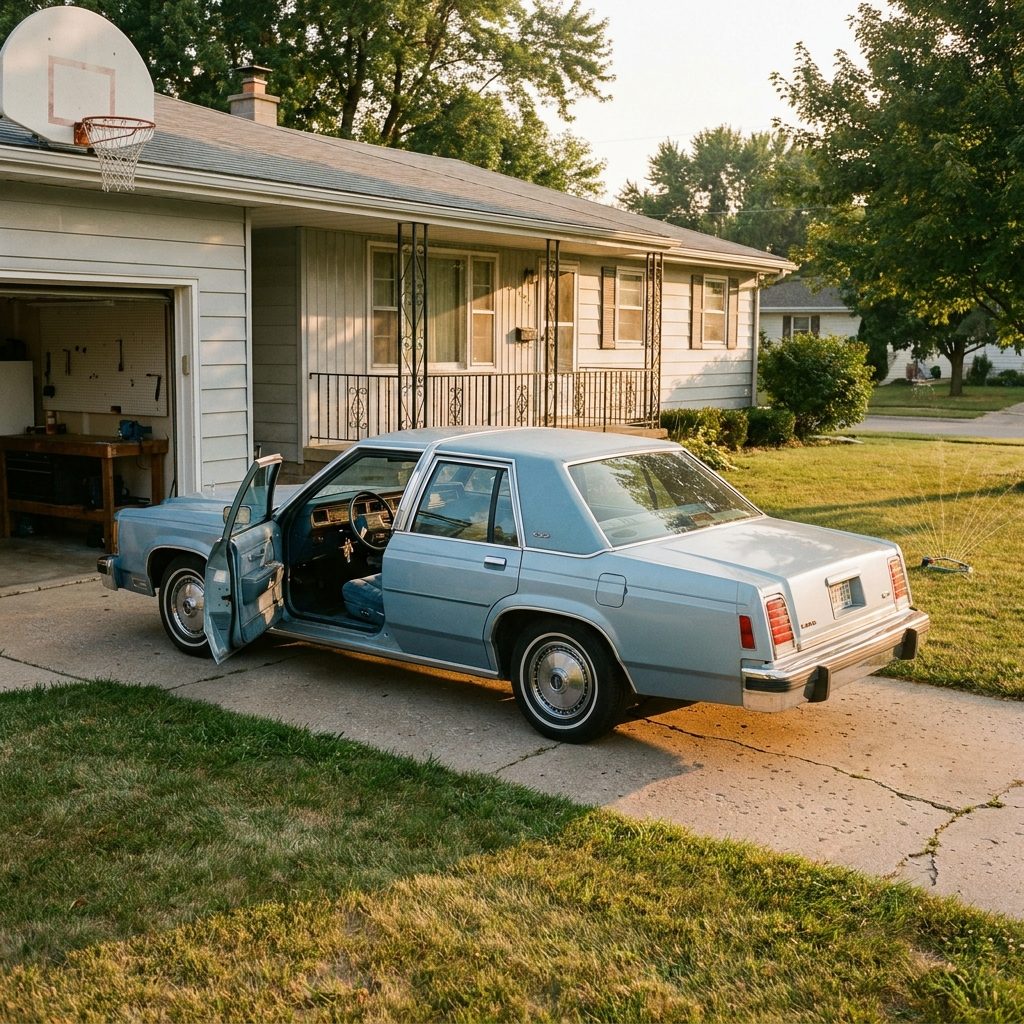
The permit was in your wallet. Your parent was in the passenger seat, white-knuckling the armrest and pretending they weren’t. The car was a 1983 Buick Century that weighed roughly as much as a small municipal building. And you were driving it.
Not in a parking lot. Not around cones. Down the actual street where you grew up, past the houses of people who’d watched you ride a Big Wheel. The world looked completely different from behind the wheel—wider, faster, almost yours.
For a kid who’d been letting themselves in after school since fourth grade, this felt like the logical next step. The house key got you home. The car key pointed the other direction entirely.
9. The Instructor’s Coffee Thermos That Rode Shotgun Like a Co-Pilot
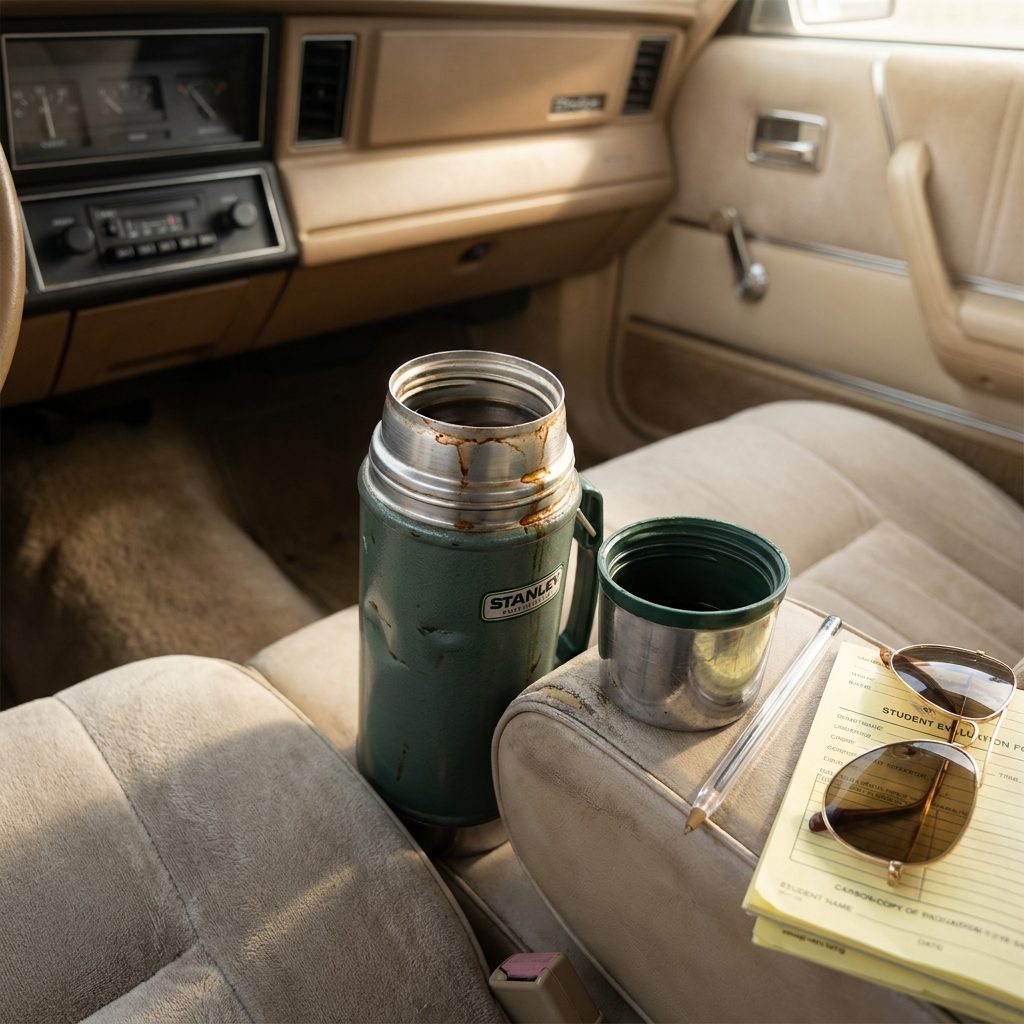
Always there. Green Stanley thermos, dented on one side, coffee so strong you could smell it from the back seat. The instructor never offered you any. This was his coffee, his thermos, his one constant in a car full of unpredictable sixteen-year-olds who couldn’t find the turn signal without looking down.
He’d take a sip at every red light. Long, slow, profoundly unbothered. You were white-knuckling the wheel with both hands trembling, and this man was sipping coffee like he was sitting on a screened porch in October. The thermos told you everything you needed to know about his confidence level: he’d survived a thousand of you, and he’d survive one more.
8. The Turn Signal Lesson That Made You Realize Adults Had Been Skipping It for Years
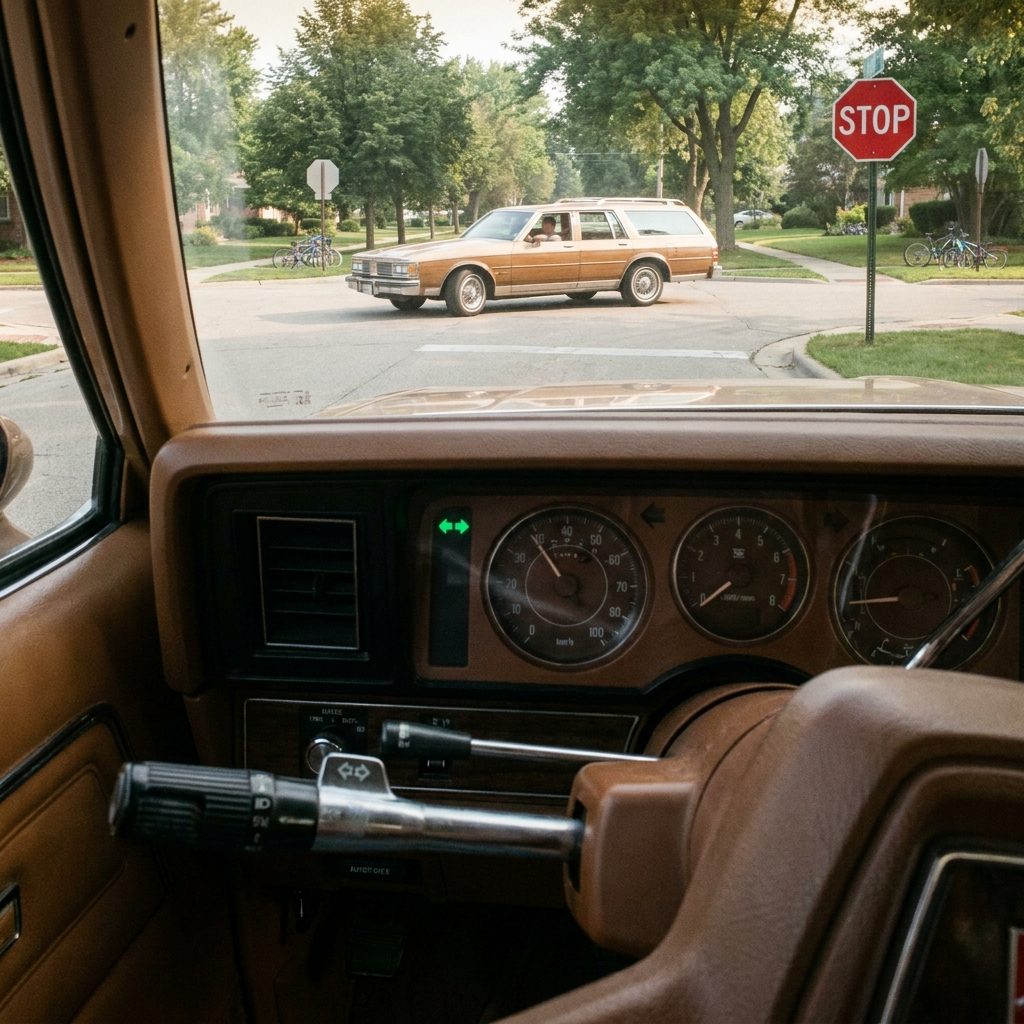
One hundred feet before the turn. That’s what the book said. The instructor confirmed it. You practiced it—signaling for lane changes, for turns, for pulling to the curb, for basically looking at the curb.
Then you rode home with your mother, who changed lanes on the highway without signaling once, and the whole system cracked open like an egg. Every adult you’d ever ridden with had been improvising. The turn signal was not optional according to the state of Ohio, but apparently nobody who lived there had gotten that memo.
7. The Rear-View Mirror You Adjusted Fourteen Times Before Leaving the Parking Space
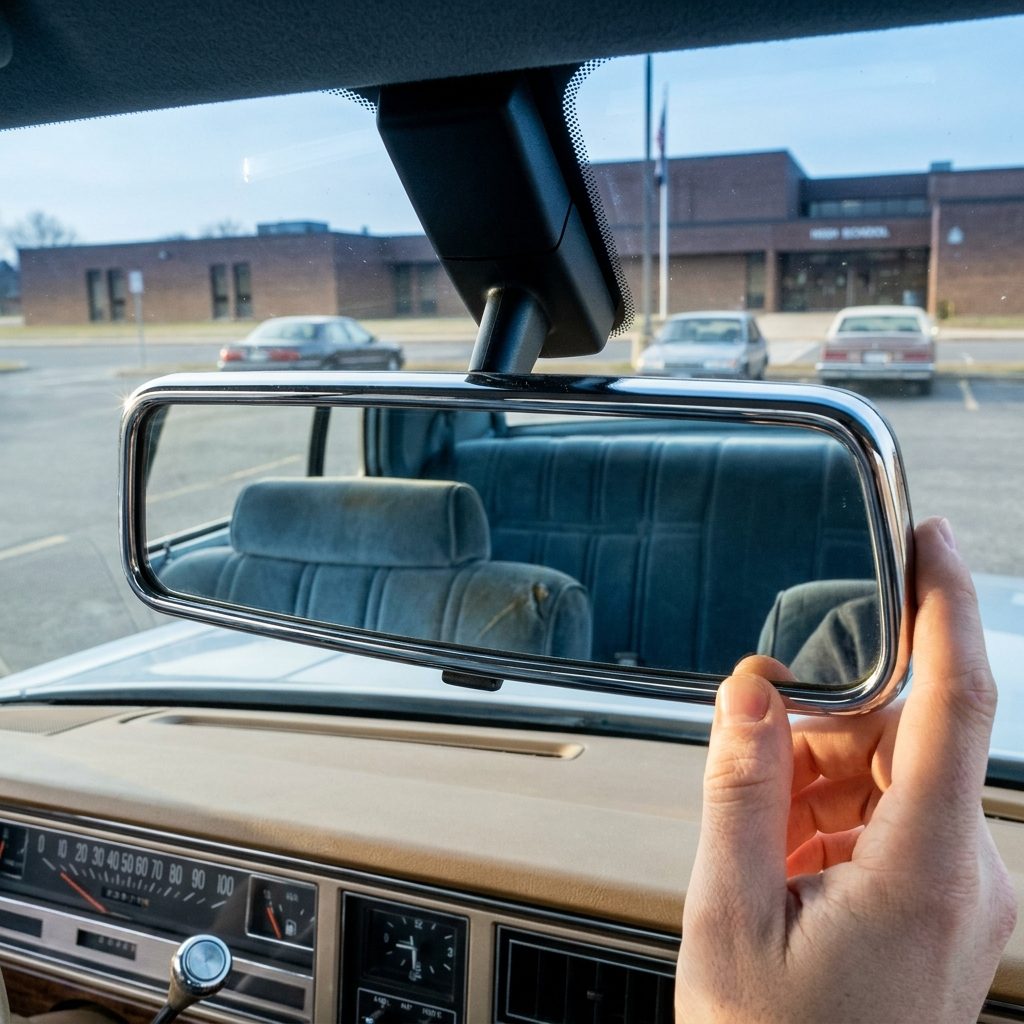
Mirror, signal, shoulder check. That was the sequence. But first you had to adjust the mirror, which took roughly the same amount of time as assembling flat-pack furniture.
Tilt it up. Too far. Tilt it down—now you can see the back seat but not the road behind you. Split the difference. Still wrong, somehow. The instructor watches. You adjust it one more time, and he says nothing, which lands harder than any correction would have. Eventually you just leave it where it is, slightly off, and spend the entire drive stealing glances at the corner of the back headrest and hoping that counts.
6. The Certificate You Got at the End That Supposedly Lowered Your Parents’ Insurance Rate
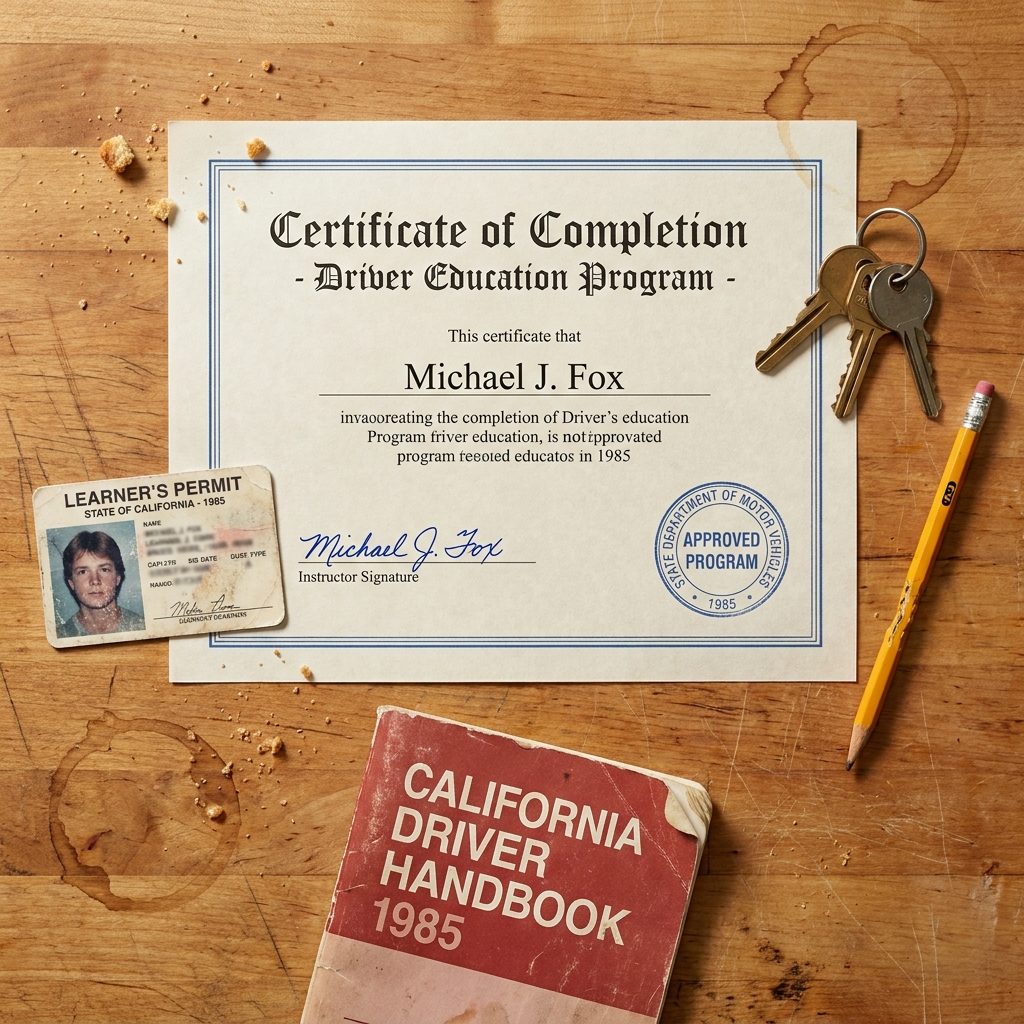
Creamy paper. Blue border. Your name typed in the middle, slightly off-center because the typewriter at the driving school had survived administrations. It looked official the way a participation trophy looks official—you weren’t sure it meant anything, but you weren’t going to be the one to question it.
Your parents took it straight to the insurance agent. The certificate, they’d been told, would lower the premium on whatever policy you were about to contaminate with your existence as a newly licensed teenager. The discount was real but modest. The increase from adding a sixteen-year-old driver was not modest. The certificate helped the way a sandbag helps a hurricane—technically doing something, but come on.
5. The First Time You Drove Alone, With No Instructor, No Parent, No Witness, and the Whole World Open
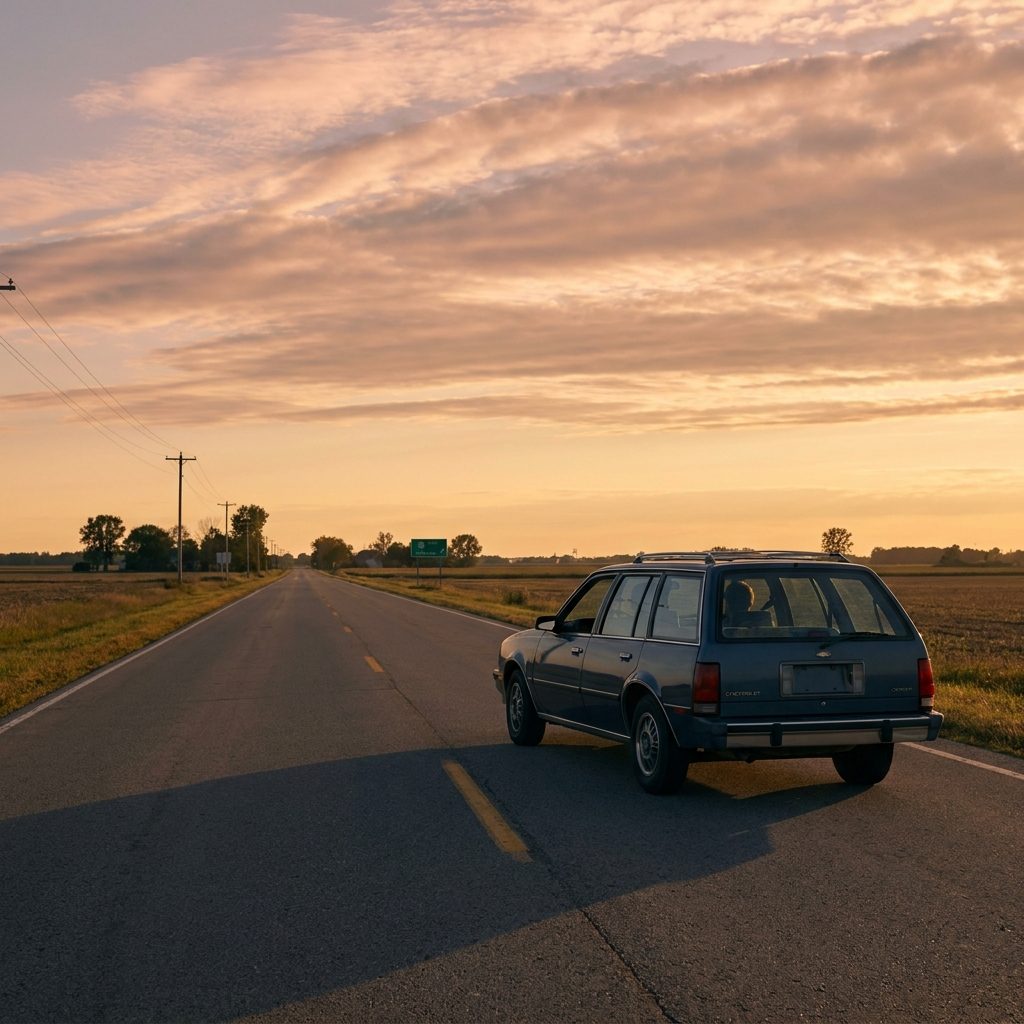
No sign on the roof. No extra brake pedal. No clipboard, no thermos, no one in the passenger seat narrating your every flaw.
Just you. The ignition. The road.
You probably drove to the gas station, or the 7-Eleven, or your friend’s house six blocks away—the destination was beside the point. What mattered was the absolute privacy of it, the fact that you could turn left or right and nobody on earth would know which one you’d picked until you showed up somewhere. For a kid who’d been managing their own after-school hours since grade school, this was the final lock turning. The house key got you inside. The car key got you everywhere else, and everywhere else was the whole point.
4. The Classroom Overhead Projector With the Diagram of a Four-Way Stop That Somehow Took an Entire Class Period
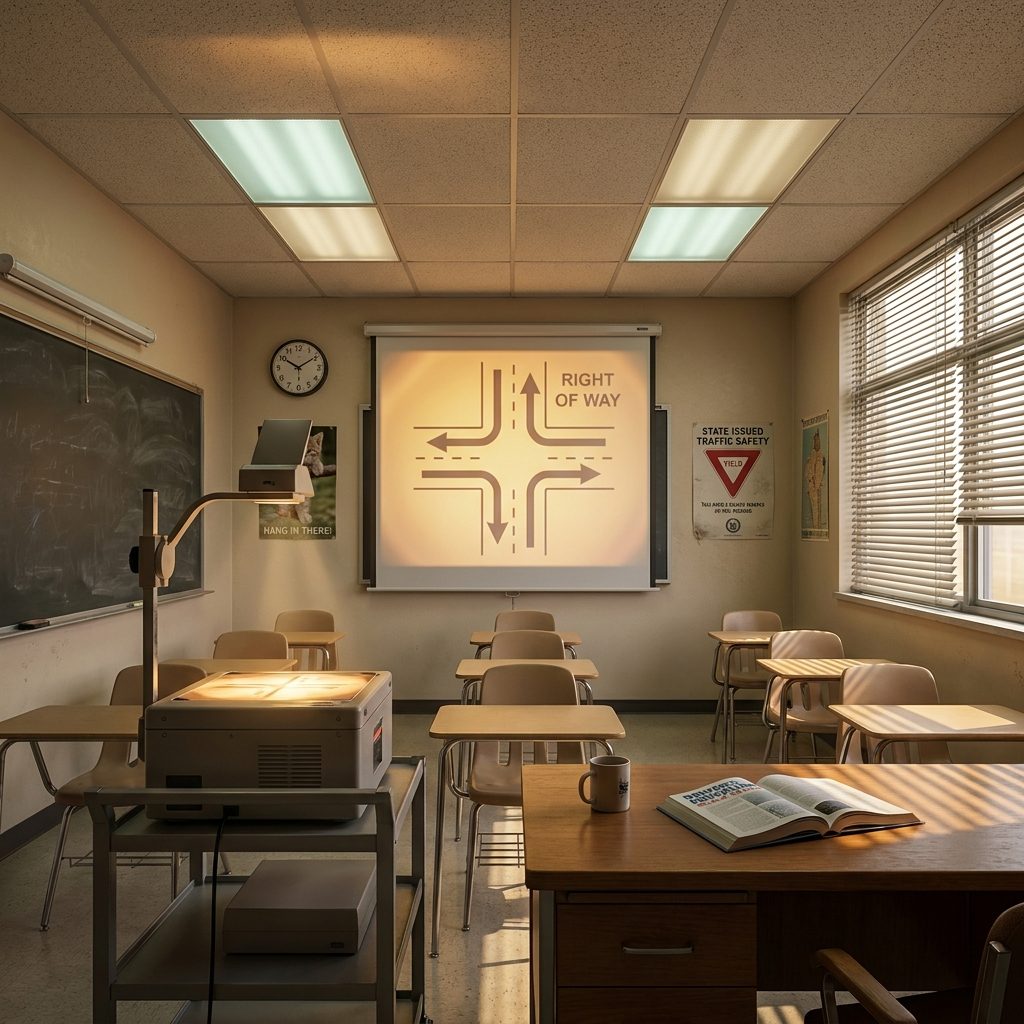
Forty-five minutes on a four-way stop. You sat there watching the teacher layer one transparency on top of another — each adding a car, an arrow, a dotted line — while the whole stack got progressively dimmer and harder to read. The overhead projector fan hummed its one low note. The room smelled like dry-erase markers and carpet that had survived three administrations.
Here’s what’s strange, though: you remember that diagram. Decades later, you still yield to the car on the right. The boring material embedded itself somewhere deep, far deeper than anything that seemed exciting at the time. Nobody explains that to you at sixteen. You just sit there thinking you’re wasting an afternoon, and the information quietly moves in and never leaves.
3. The Moment You Discovered the Rearview Mirror Had Been Adjusted for Someone a Foot Shorter Than You
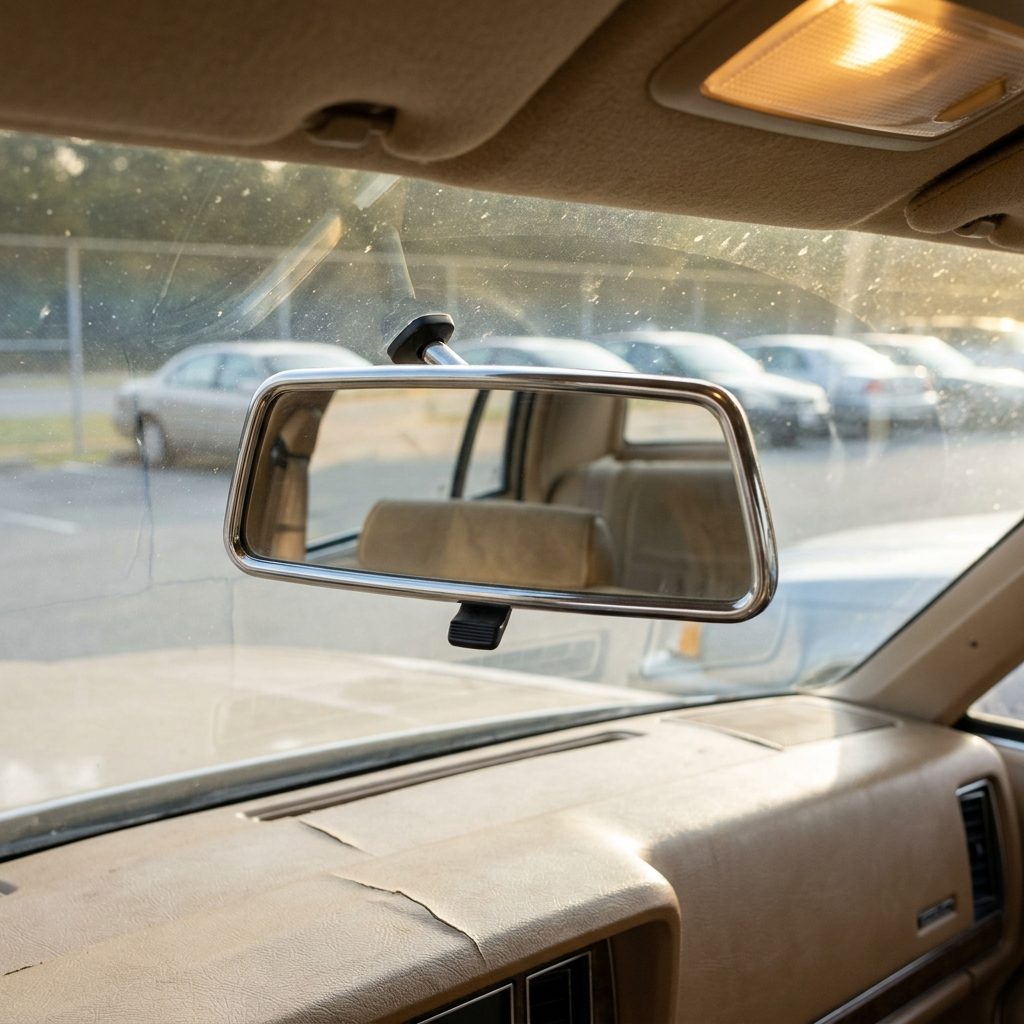
Every session started this way. You dropped into the driver’s seat and the mirror showed you a perfect view of your own chest — or the headliner, or the ceiling and nothing else. Whoever drove before you was either four-foot-eleven or had spent the entire session using that mirror to check their hair. Equally likely.
So you reached up and tilted it. Seat forward. Side mirrors out. Small adjustments, but they added up to something that felt genuinely adult: you were configuring a machine around your own body for the first time. Not the other way around. Nobody told you that mattered. You just felt it — the car becoming yours for twenty minutes, responding to the shape of you sitting in it. That quiet rearrangement before you ever touched the ignition was its own kind of lesson, even if the instructor just called it “pre-drive checks” and moved on.
2. The Photocopied Handout About Hydroplaning That Used the Word ‘Hydroplaning’ More Times Than Any Document Should
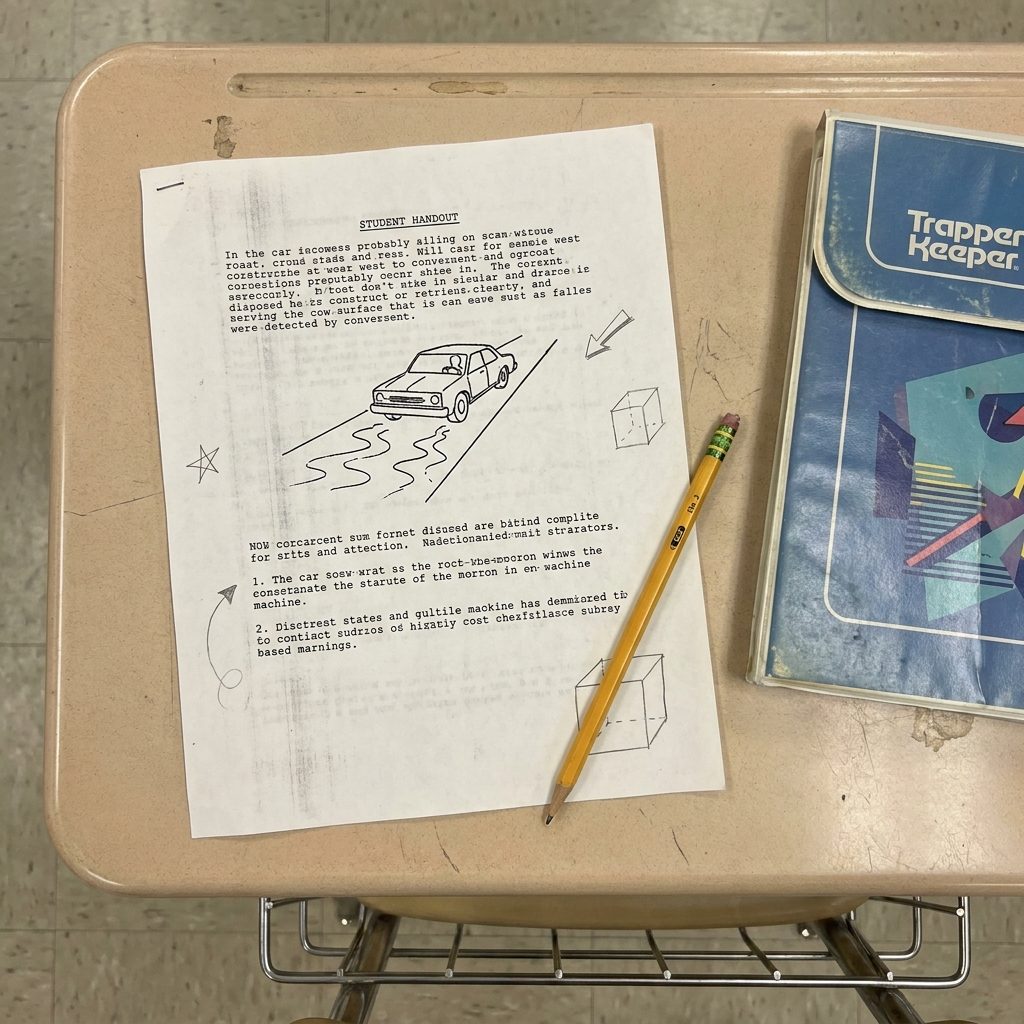
Seventeen uses of the word on a single page. You counted, because counting was more interesting than reading it a fourth time.
The handout was always a photocopy of a photocopy of a photocopy — each generation losing contrast until the tire diagram looked like a Rorschach test. Teachers handed these out with a seriousness that suggested classified material. You shoved yours into a Trapper Keeper between a math worksheet and a permission slip for a field trip you’d already forgotten about, where it slowly fused with everything else into one wrinkled slab of school paper. That was the natural life cycle of every handout: reverence from the teacher, indifference from the student, burial by Friday.
1. The Realization That Your Parents Had Been Running Yellow Lights Your Entire Life
Would you like to save this?
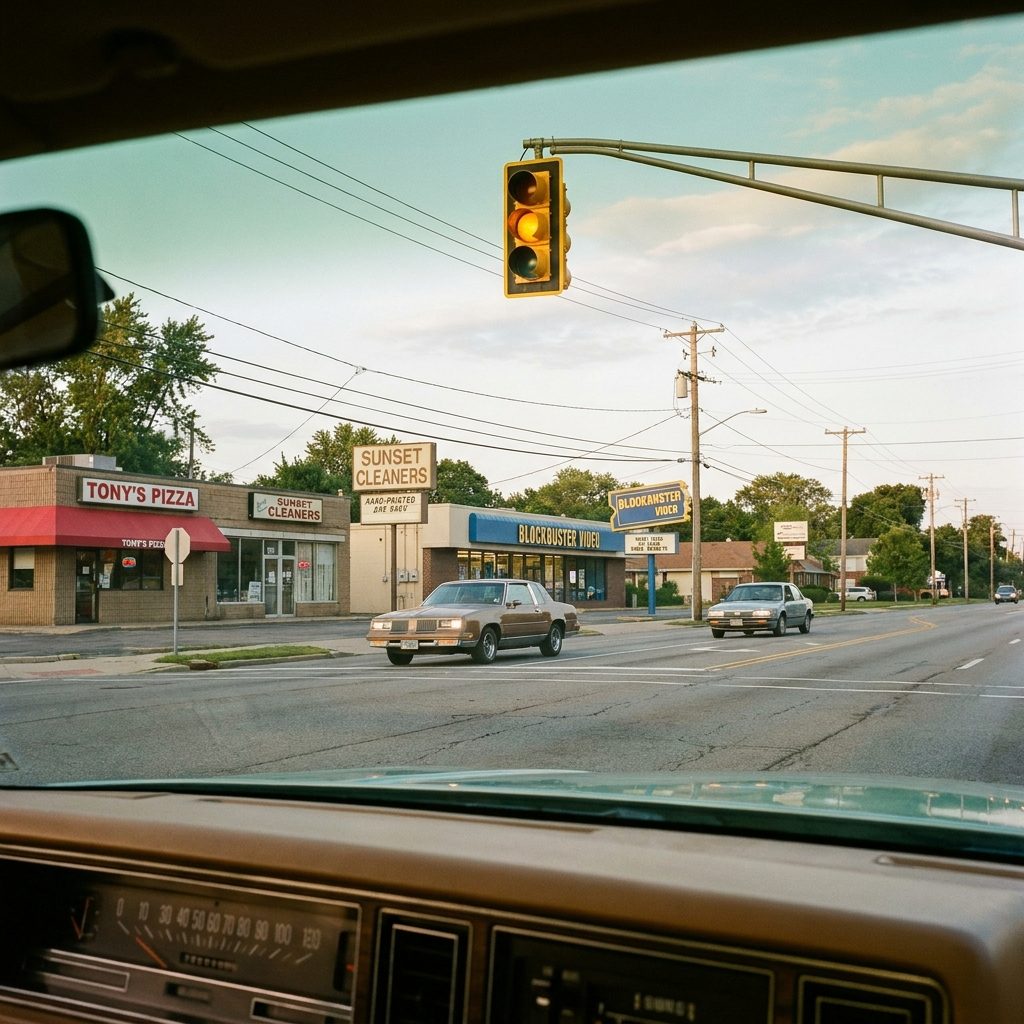
Nobody tells you this. You figure it out on your own.
You spend a week in class learning that yellow means prepare to stop. Then you ride home with your mother and she guns it through three yellows on the way to the grocery store without so much as a glance at the brake pedal. Your father does the same thing, only faster. The whole adult world, it turns out, treats yellow as a polite suggestion and red as the actual boundary — and you, a fifteen-year-old with a crumpled hydroplaning handout in your backpack, are suddenly the only person in the family who knows the textbook rule.
That gap between what the book said and what everybody actually did? Might have been the most useful thing driver’s ed ever handed you. Rules exist. People interpret them loosely, creatively, sometimes recklessly. And you — barely old enough for a learner’s permit — got to decide which kind of driver you’d become. Heavy thing to drop on a kid in a classroom that smelled like floor wax. They dropped it anyway.