
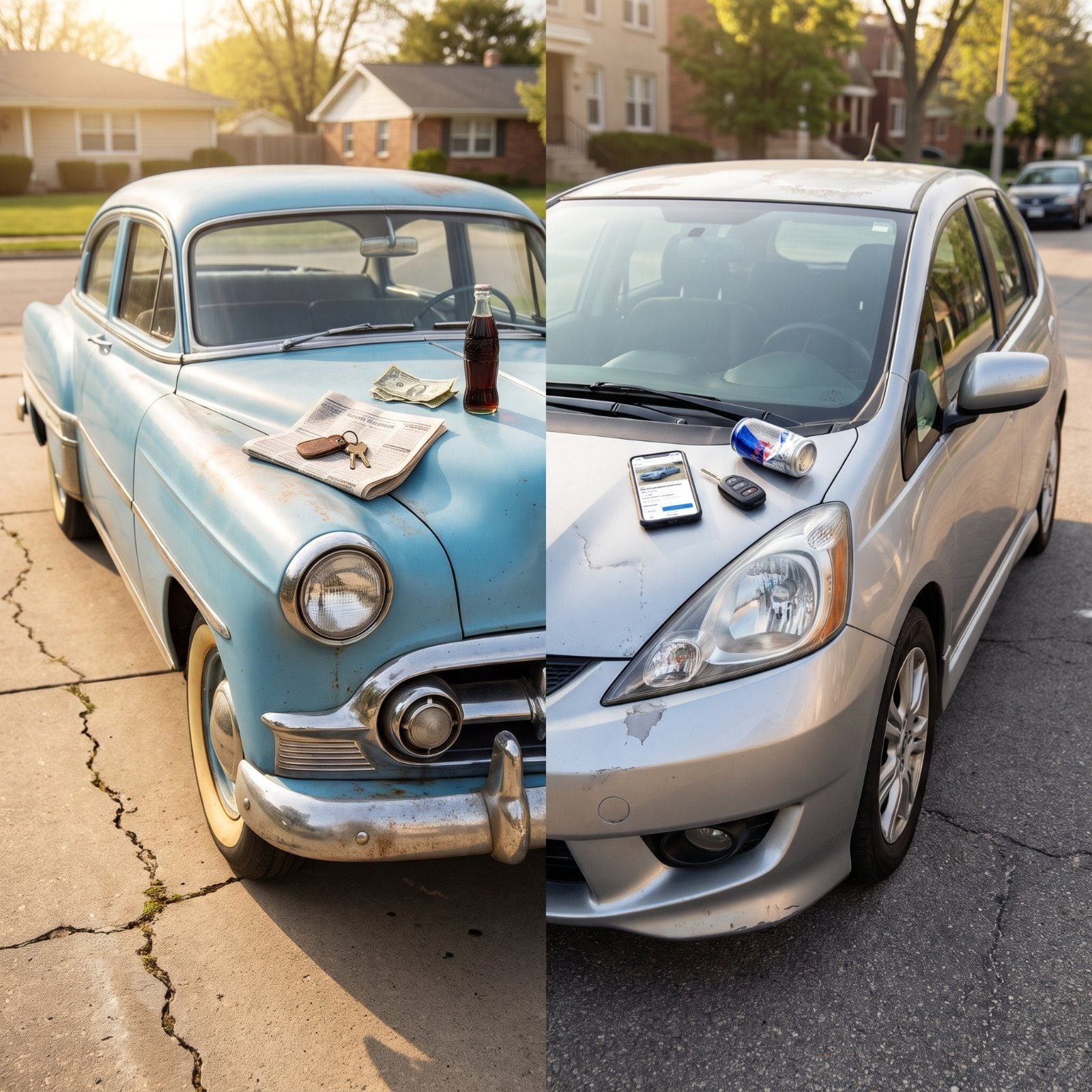
Sixty dollars down and a handshake. That was how a lot of kids got their first set of wheels in 1962, usually a tired Chevy with a bench seat that smelled like warm vinyl and gasoline. Today’s teenager scrolls past hundreds of listings on a cracked phone screen before ever hearing an engine turn. We lined up the two side by side, the beater of then against the hand-me-down of now, and the differences run deeper than horsepower.
Please note that some of the images in this article were created with the assistance of AI.
39. The Used-Car-Lot Bargain vs. the Online Marketplace Find
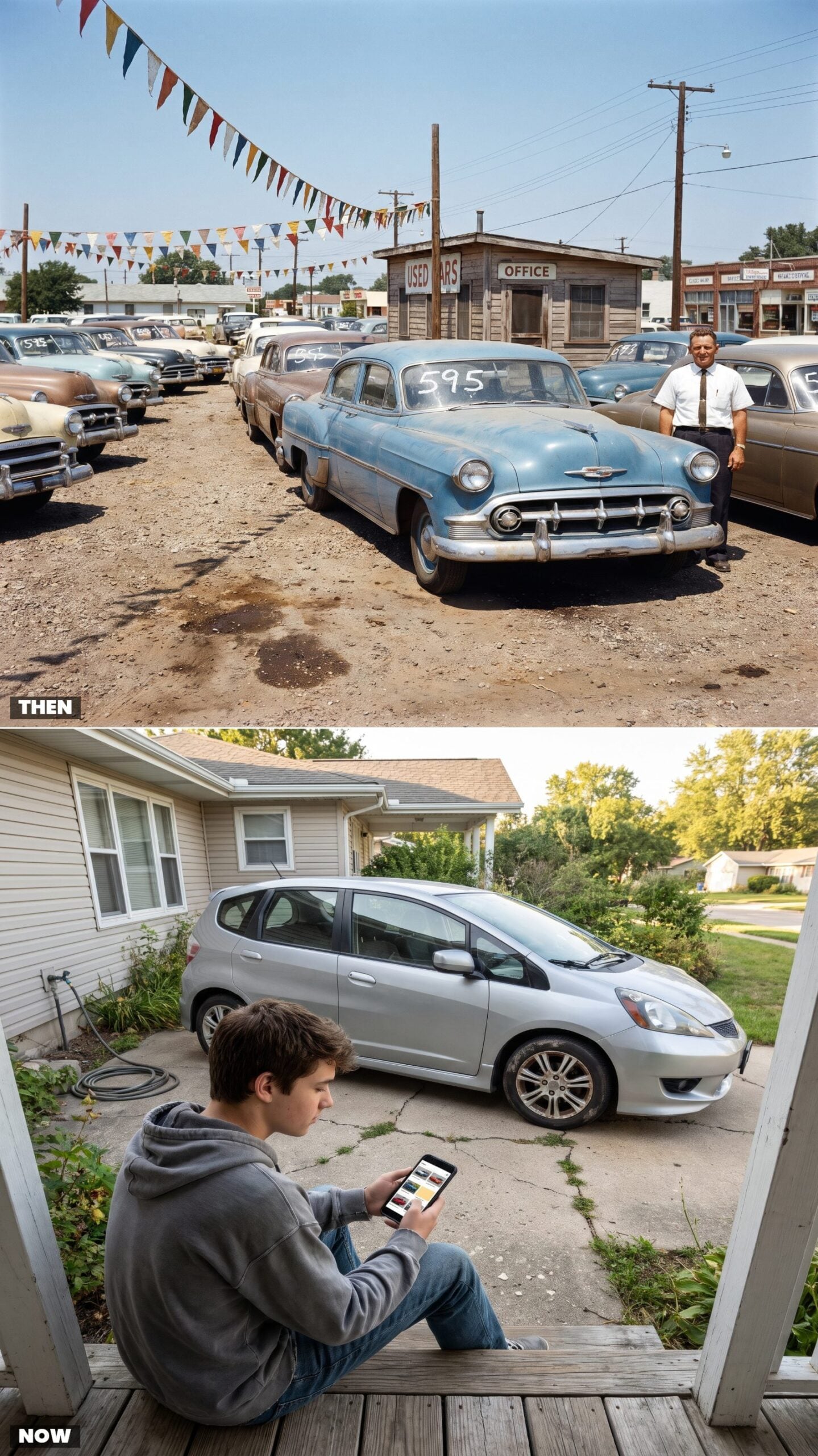
In 1962, the bargain was a physical place. You walked a gravel lot while pennant flags snapped overhead and a salesman who knew your dad quoted a number scrawled in white soap across the windshield. You kicked the tires because kicking the tires was all you had.
Now the lot is a glowing rectangle in your hand. A teenager filters by price, mileage, and radius before a single engine turns over, haggles over text, and ends up dealing with a stranger forty minutes away who may or may not answer.
What Our Readers Say
- Jalopy Talk readers gave photos that look like the 1960s hearts 87% of the time, compared with 80% for the other images in the same articles.
- When our readers hearted a car photo and tapped a reason, “nostalgic” came out on top at 26%, just ahead of body style and “would drive.”
From Jalopy Talk reader polls and votes.
38. A Hand-Me-Down Sedan vs. a Hand-Me-Down Crossover
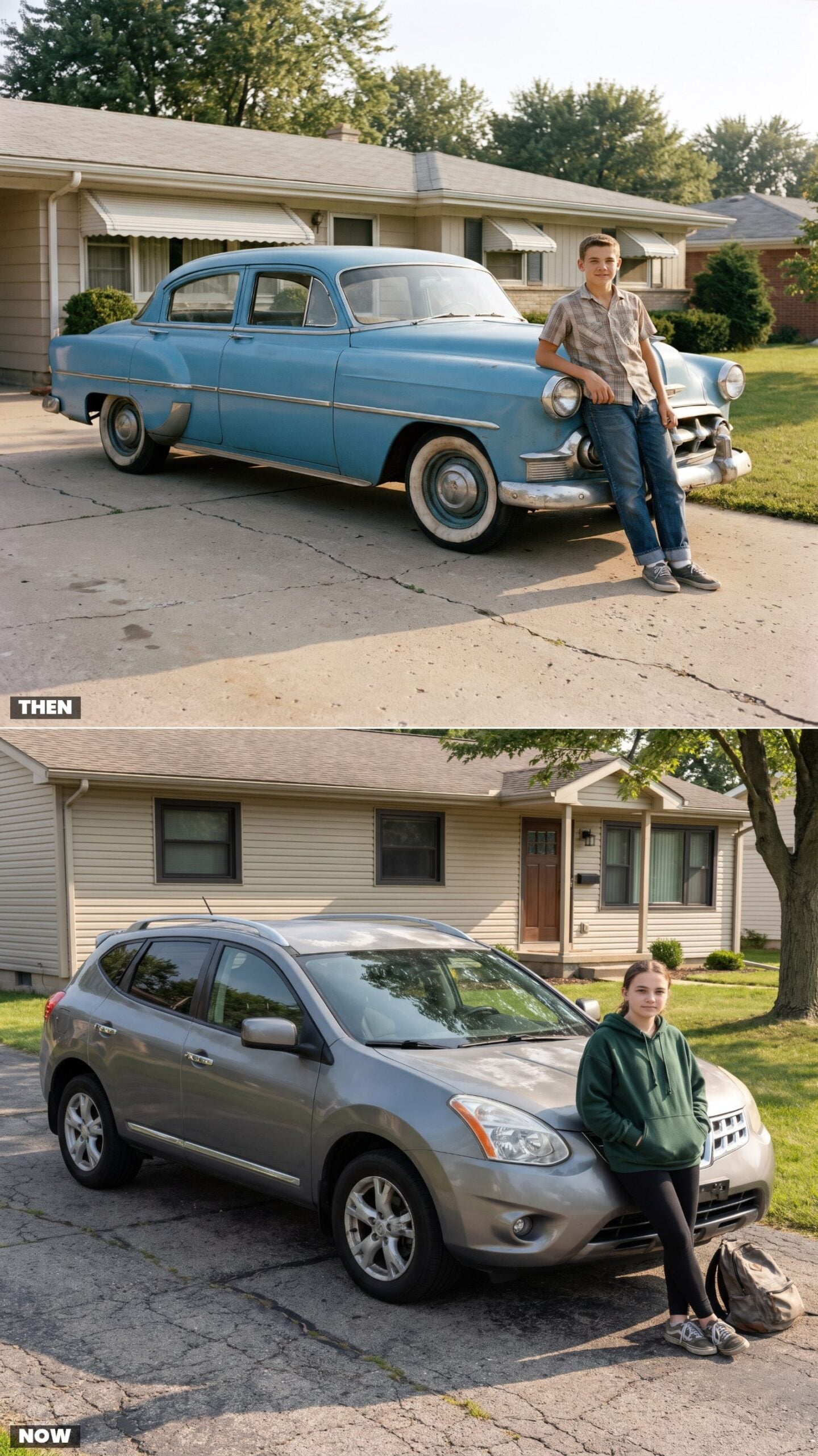
The family cast-off used to be a sedan. Dad got the new wagon and the kid got the old four-door, a tank of a thing with a bench seat wide enough for the whole baseball team. Heavy, upright, easy to see out of in every direction.
Now the hand-me-down is a crossover. It sits higher off the ground, trades the trunk for a hatch, and folds its back seat flat for dorm boxes. Somehow the silhouette shrank and ballooned at once, lower on glass, taller on the body.
37. Faded Enamel Paint vs. Sun-Damaged Clear Coat
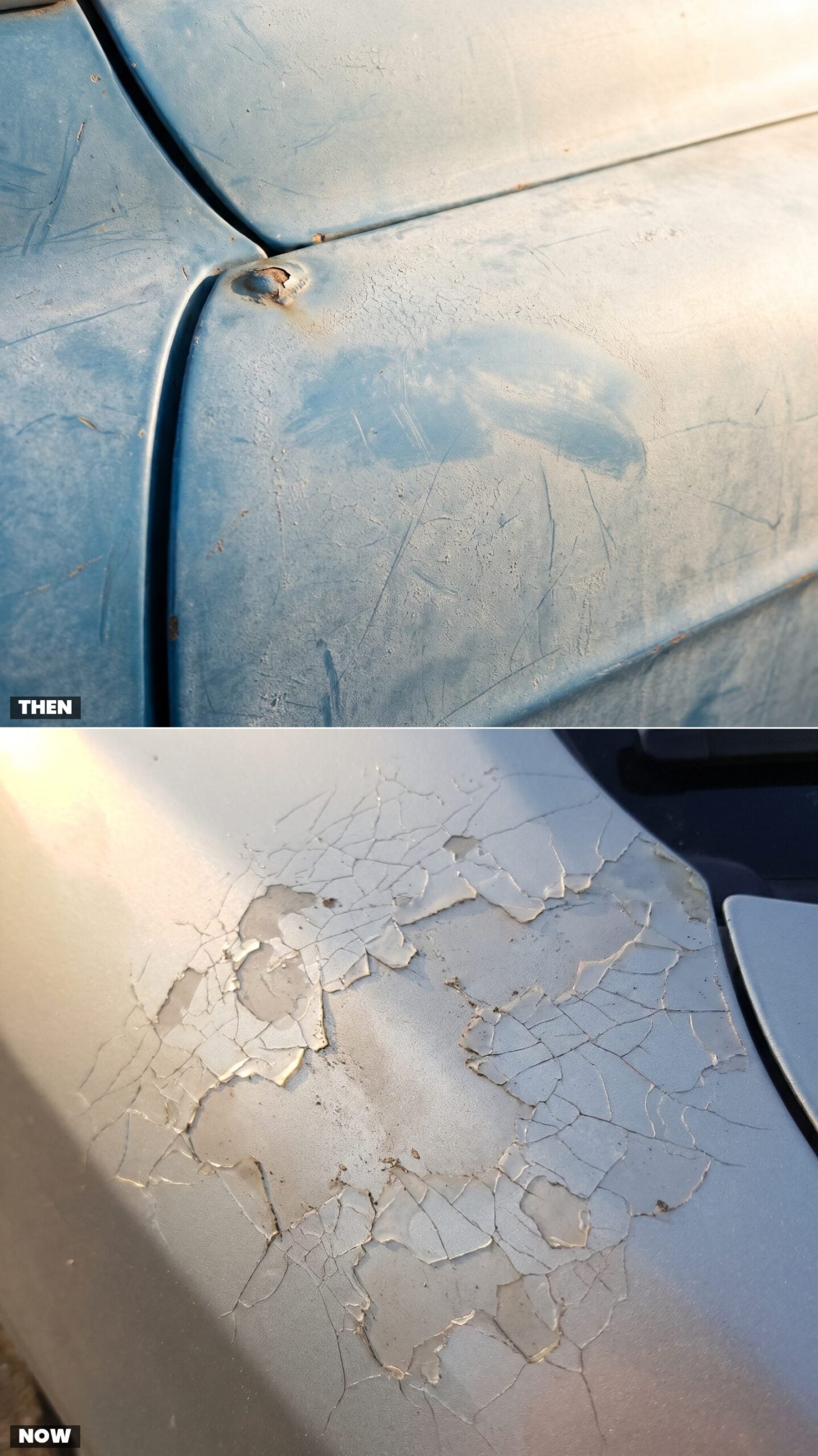
Old enamel paint died slowly and gracefully. One thick coat of color, no clear layer on top, so when the sun got at it the finish just went chalky. A rag and some elbow grease on a Saturday would rub it back to a shine.
Modern clear coat fails differently, and uglier. The color stays fine underneath while the glossy top layer peels away in cloudy patches, like a sunburn that won’t stop shedding. No amount of rubbing brings it back. Call it the price you pay later for that mirror shine the day it rolled off the lot.
Explaining why sun-baked modern paint can’t just be buffed back, a professional auto detailer warns that “If the clear coat is lifting at the edges or coming off in flakes and you can see bare color coat underneath, the clear has separated from the base coat, and no amount of polishing puts it back”
36. Chrome Bumpers vs. Body-Color Plastic Bumpers
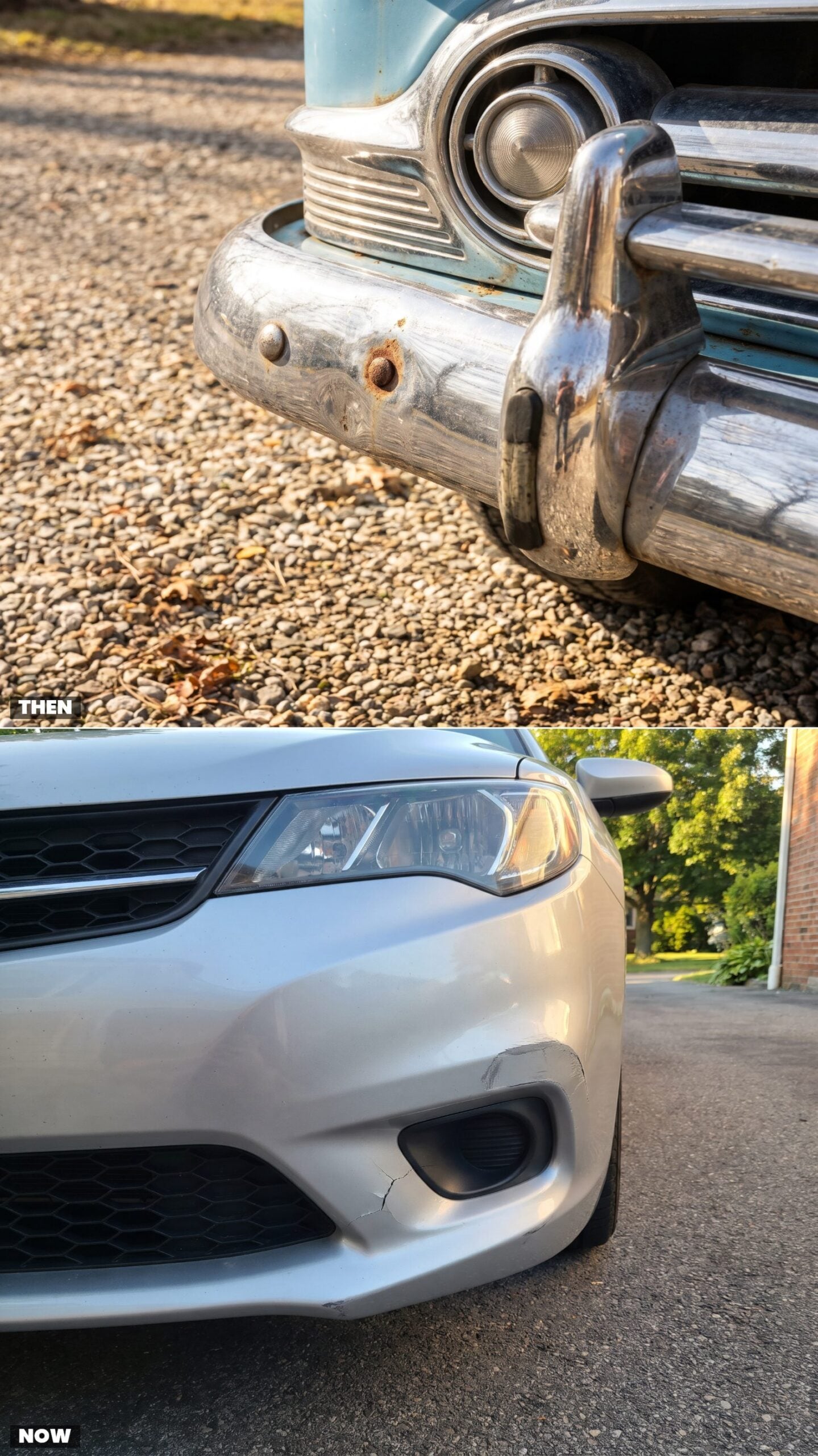
A chrome bumper was something you could lean on. Thick steel bolted to the frame, heavy enough to shrug off a parking-lot tap and shiny enough to check your hair in. A fender-bender in 1962 meant a dent, and often a dent you could hammer back out yourself in the driveway.
The modern bumper hides in plain sight. Painted to match the body, it’s a plastic cover over foam and crush structure, built to absorb a hit by sacrificing itself. Scrape a curb and you reveal gray plastic, not steel. Tidy right up until the day it isn’t.
35. A Towering Hood Ornament vs. a Flush-Mounted Badge
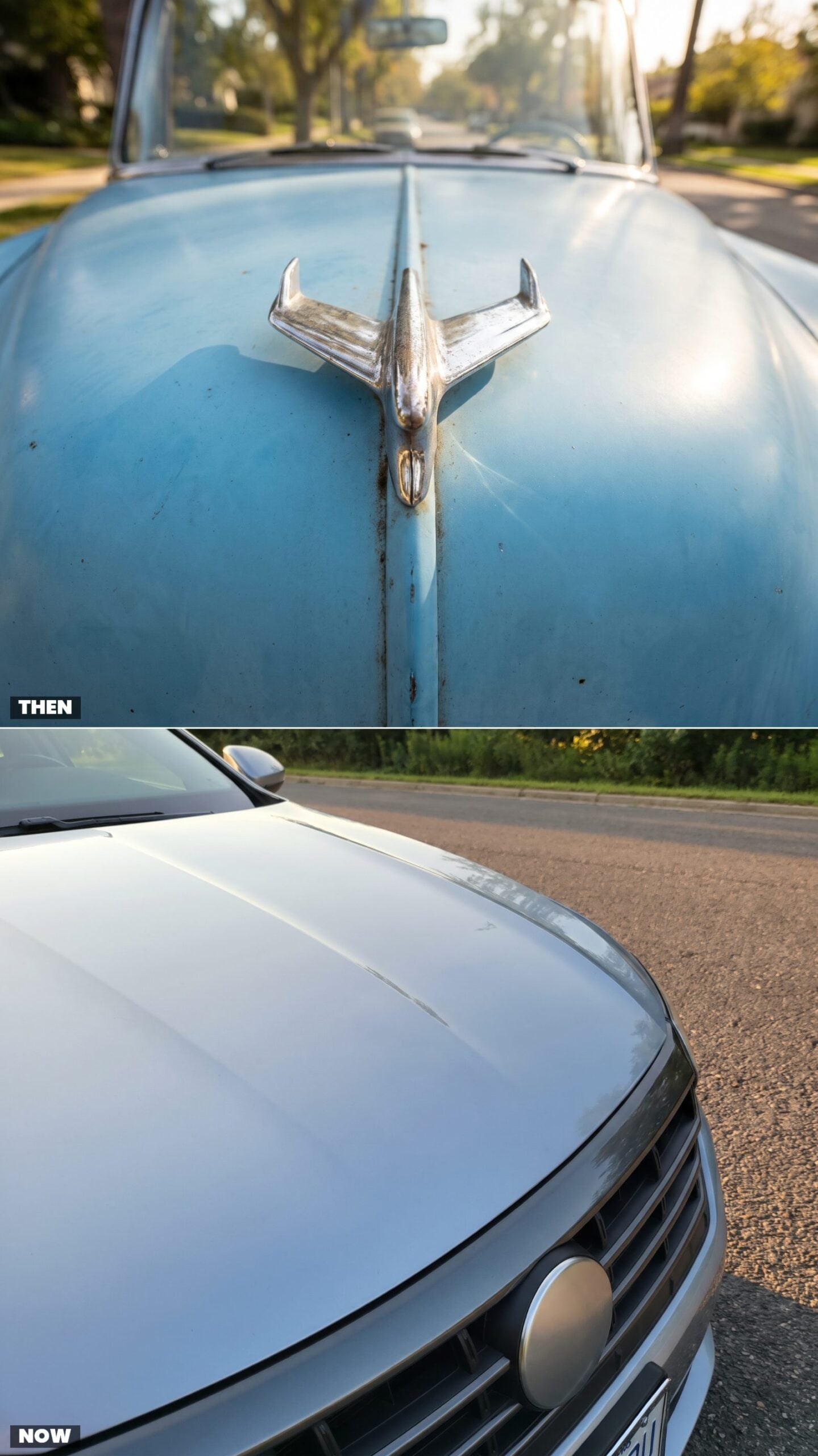
Cars once wore crowns. The hood ornament rode out front like a figurehead on a ship, a chromed wing or rocket that told you the make from half a block away and gave the hood a point to aim down the road.
Today the badge lies flat, pressed into the grille, smooth enough that nothing snags the wind or a pedestrian. Aerodynamics and safety rules sanded the sculpture right off the nose. Efficient, sure. A little less to look forward to over the hood.
34. Round Sealed-Beam Headlights vs. Sculpted LED Headlamps
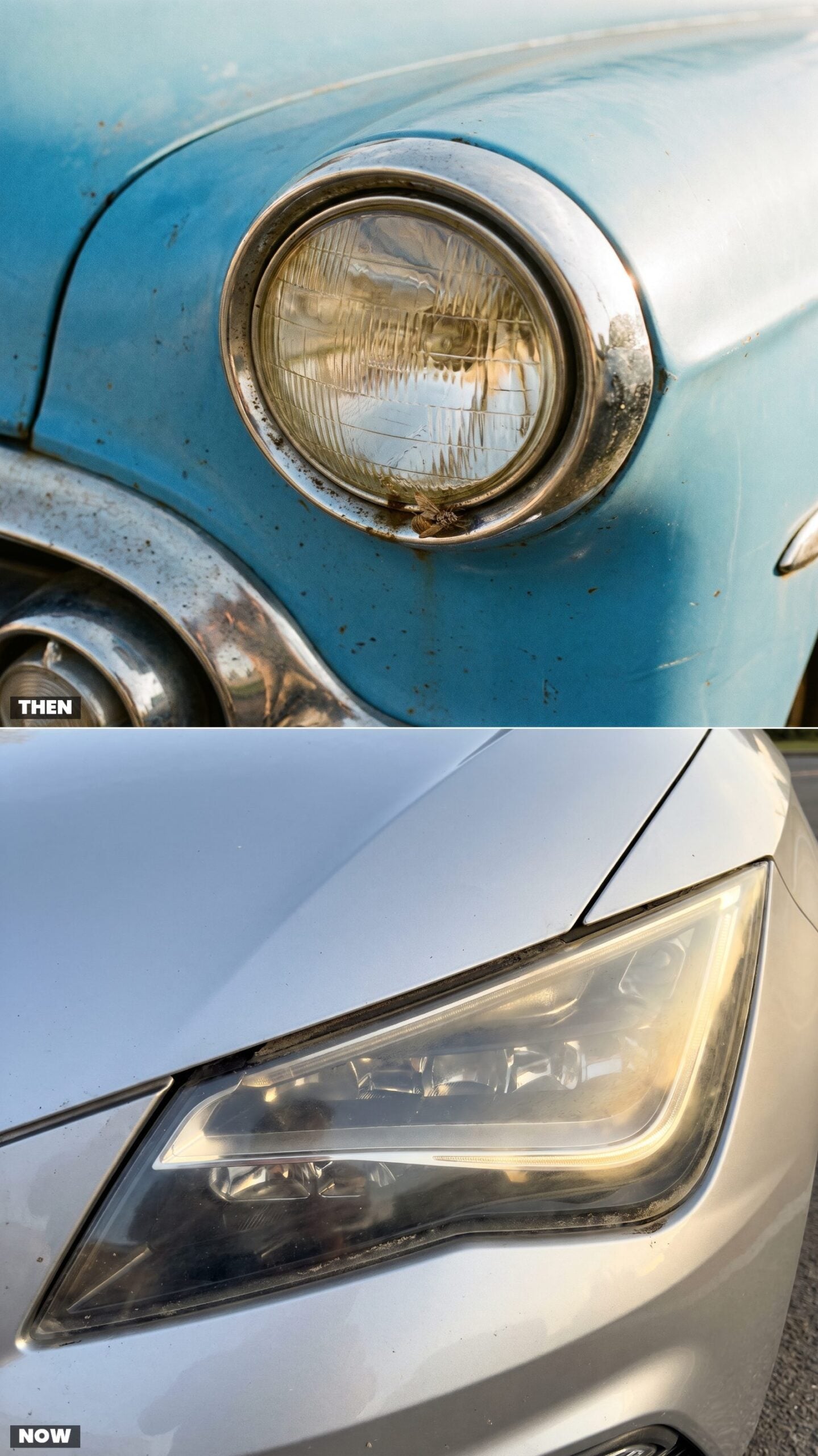
Headlights used to be round and dumb, in the best way. A sealed-beam unit was a standardized glass puck you could buy at any parts counter, swap in five minutes with a screwdriver, and drive home with both eyes working again.
The modern headlamp follows the fender line, packed with projectors and LED strips behind a plastic lens that slowly fogs in the sun. When it fails you don’t buy a bulb. You price an entire unit, and the number makes you sit down.
33. A Chrome-Bar Grille vs. a Black Honeycomb Grille
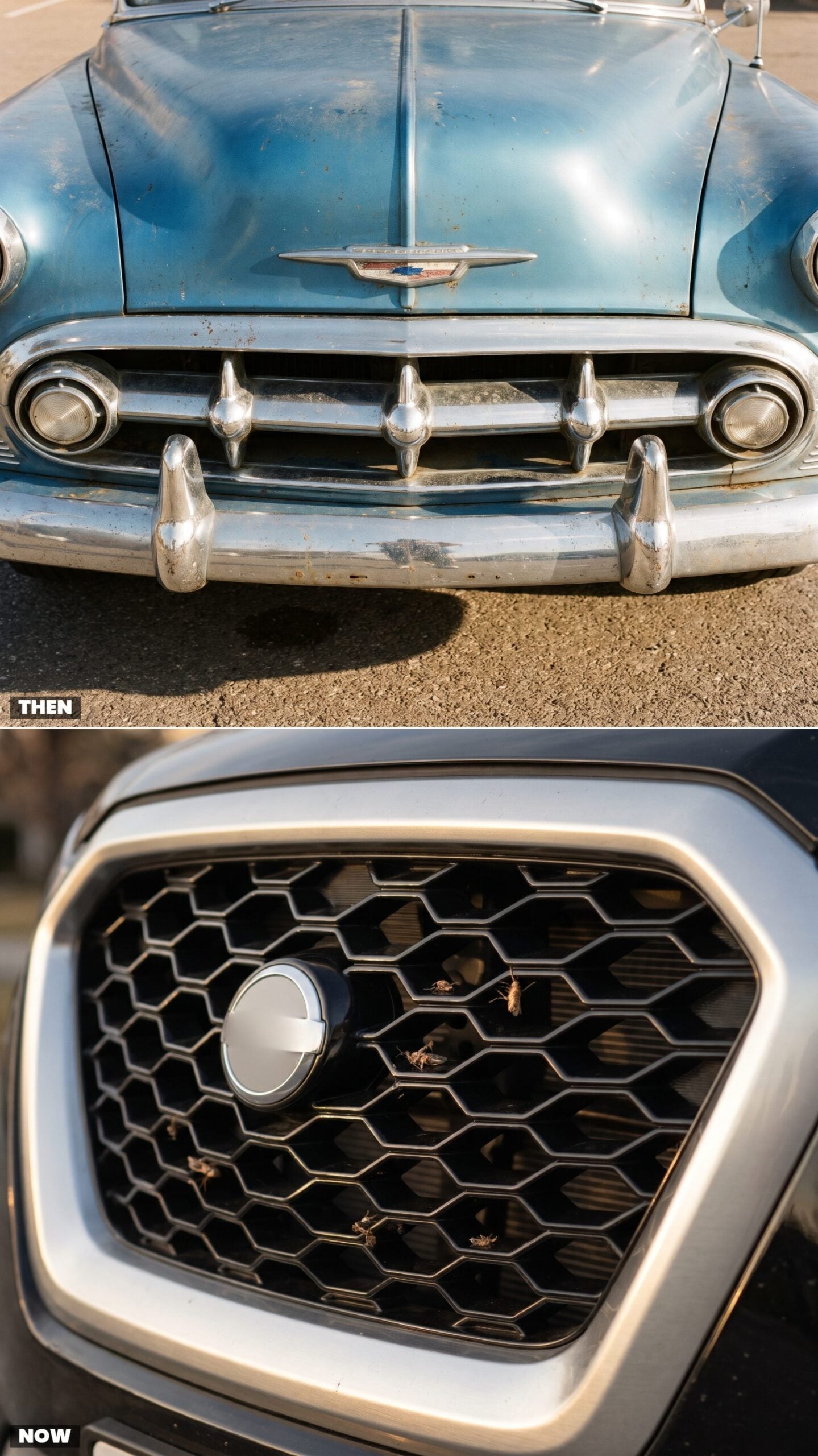
The grille was once the car’s smile, all chrome teeth and horizontal bars, so bright it threw the sunlight right back at you. Plating it cost real money, and it told everyone the car was trying to look like something.
Now the grille is a black plastic honeycomb, matte or gloss, meant to disappear into the front end while funneling air to the radiator. Cheaper, lighter, mean in a quieter way. Catching bugs is its one unchanged job.
In our readers’ votes, cars wearing lots of chrome got hearts 81% of the time, versus 74% for the other images in the same articles.
32. Bullet-Shaped Taillights vs. Full-Width LED Taillights
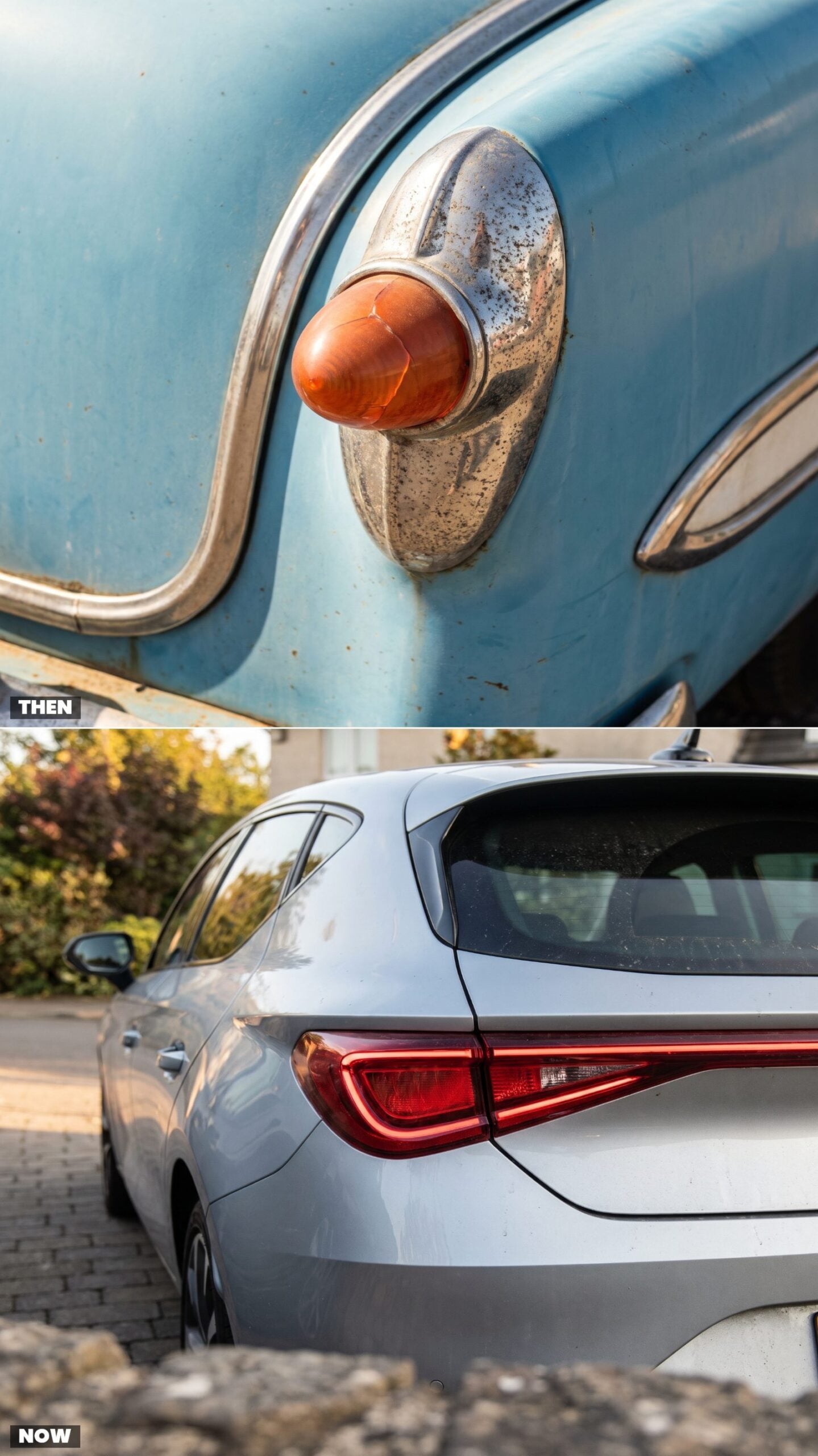
Back in ’62 the taillights were little red buttons, bullet-shaped lenses tucked into the fenders, just big enough to say stop and turn. Half the time one was cracked and nobody fixed it until the ticket came.
The modern tail is a light show. A wide red bar lights up in a wave, LEDs instead of a single bulb, often running clean across the rear end. More visible, pricier, and when one segment dies you replace the whole illuminated slab.
31. Steel Wheels With Hubcaps vs. Alloy Wheels With Curb Rash
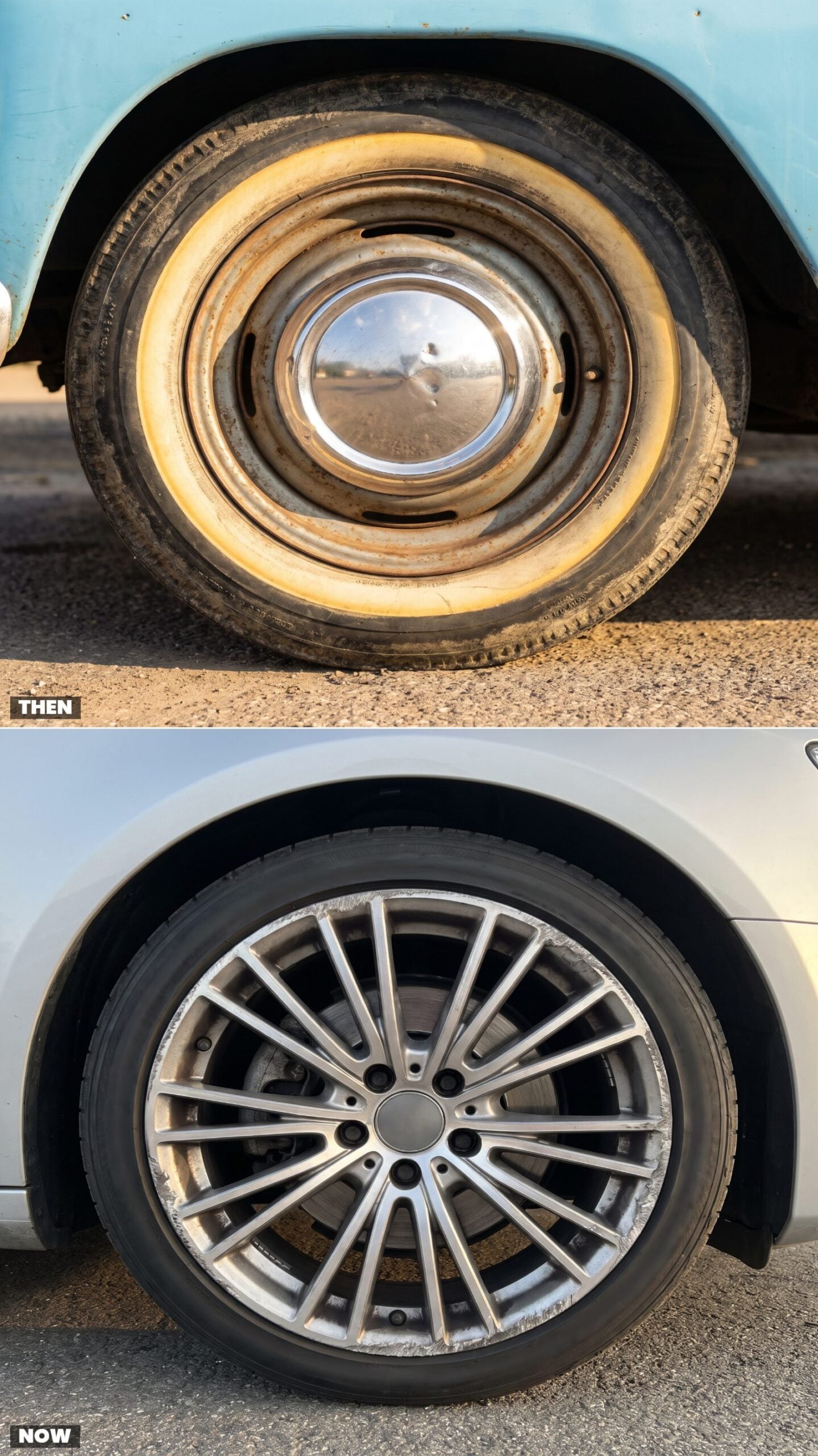
The old wheel was a painted steel disc with a chrome hubcap snapped over it. Hit a curb and worst case the cap popped off and rolled down the street while you chased it. The steel underneath didn’t care.
Today’s teenager rolls on alloys, prettier and lighter, with one guaranteed scar: curb rash. That silvery gouge along the rim edge where somebody parallel-parked with optimism. Call it a rite of passage now, the first dent in the first car’s pride.
In a shop walkthrough of restoring curb-rashed alloys, a wheel repair technician shows that a hard curb hit can do more than chew up the rim’s edge and can buckle the wheel too.
30. A Full-Size Spare vs. a Tire-Inflator Kit
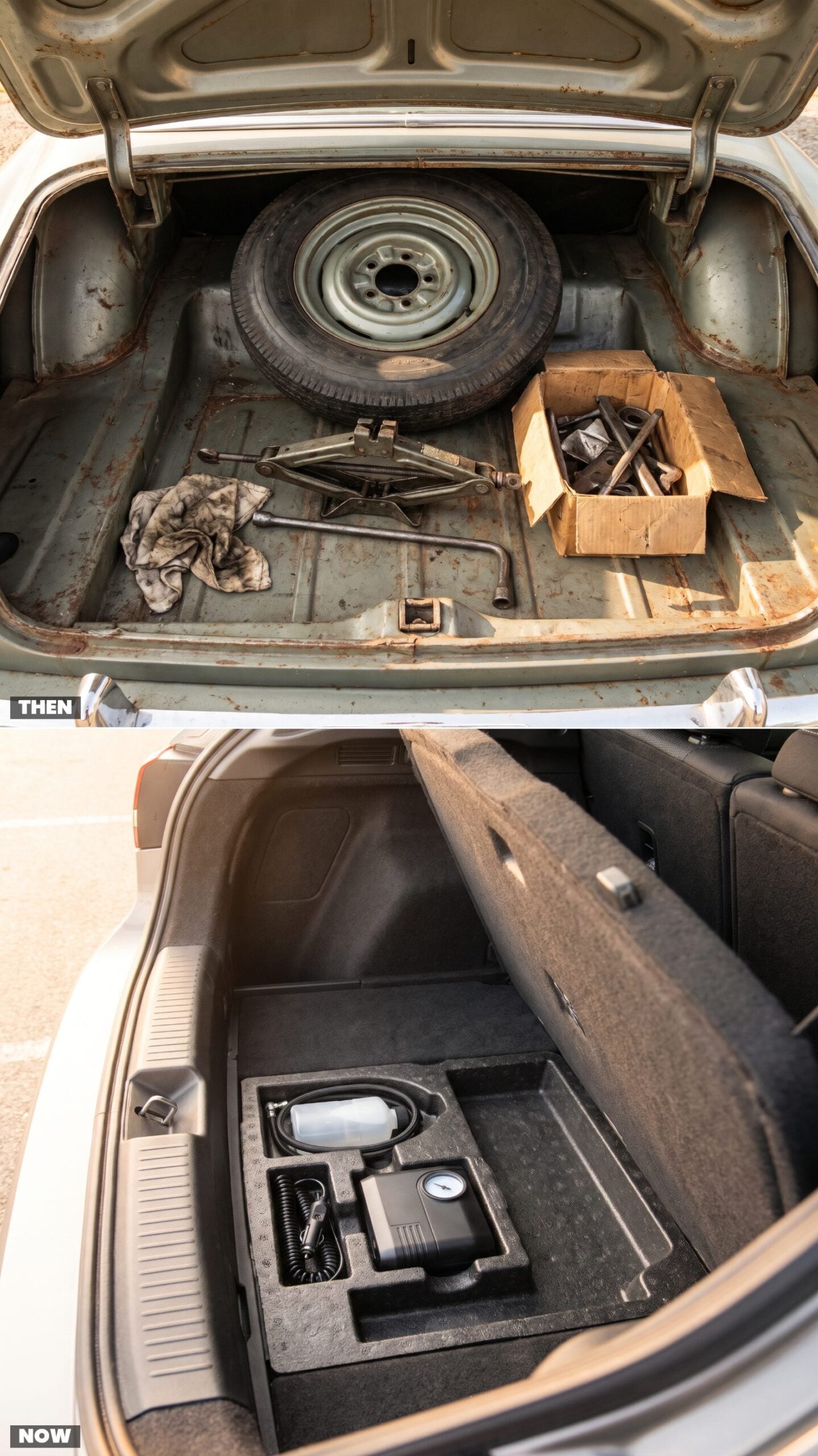
Pop the trunk in 1962 and there it was: a full-size spare, same as the four on the ground, with a jack and a lug wrench. A flat on a dark highway meant twenty minutes of knuckle-busting work and then you were gone, running on a real tire.
Lift the trunk floor today and you might find a foam tray with a little air compressor and a bottle of goo. No spare at all. A blowout means a can of sealant and a prayer, or a phone call and a long wait on the shoulder. Lighter car, better mileage, and a whole lot more trust in the cell signal.
29. A Flat Bench Seat vs. Seats That Hug You in Turns
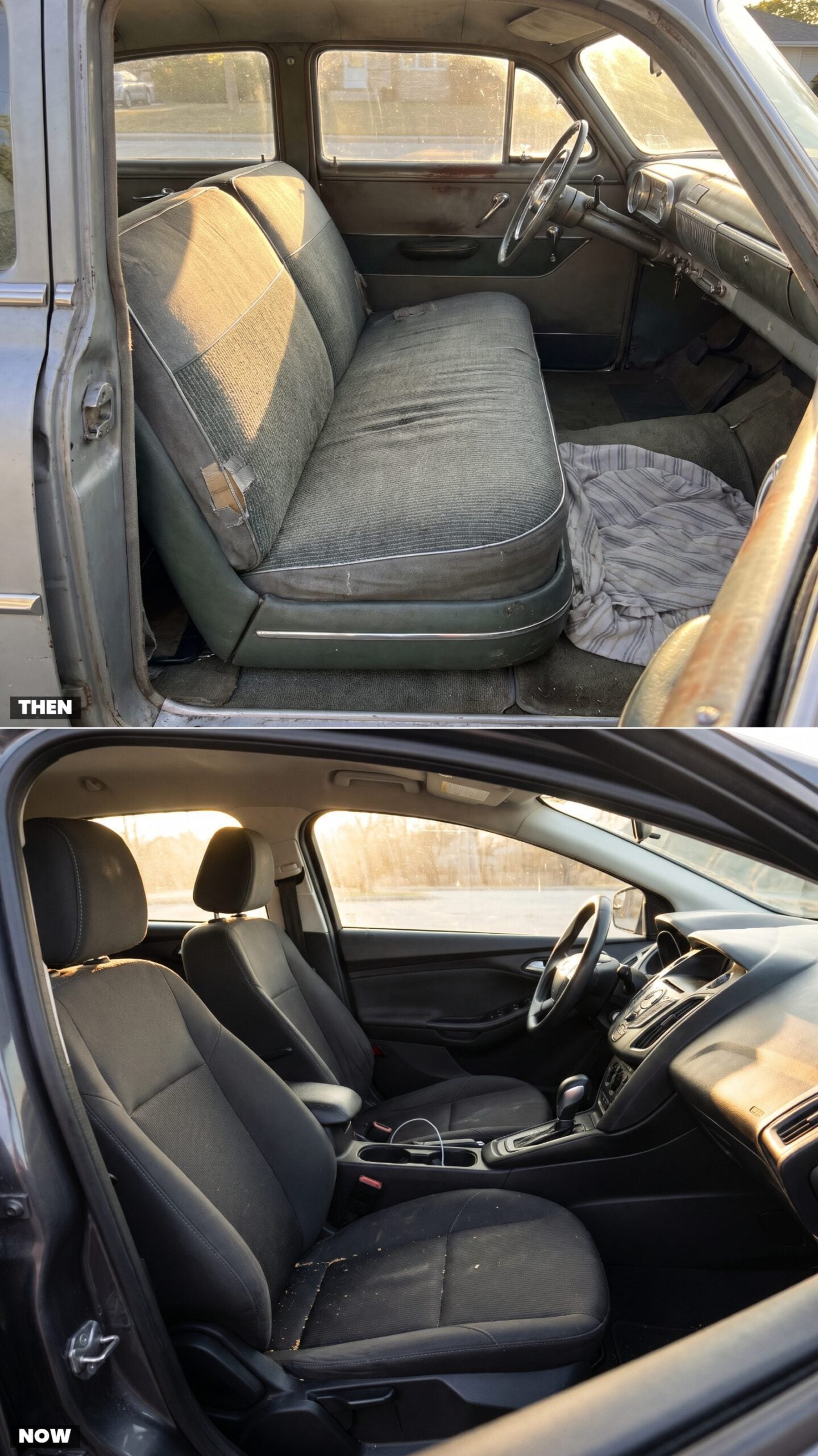
You could fit three friends up front in 1962 and nobody blinked. The bench seat was a couch on wheels, flat as a church pew, upholstered in cloth that trapped the heat and held the smell of everyone who ever rode in it. Cornering meant sliding sideways into whoever sat beside you.
The teenage car today splits the front into two bucket seats with bolsters that grip your ribs through a turn. A console walls off the middle. Safer and snugger — and nobody’s scooting close anymore.
28. Three on the Tree vs. a Button That Picks Your Gear
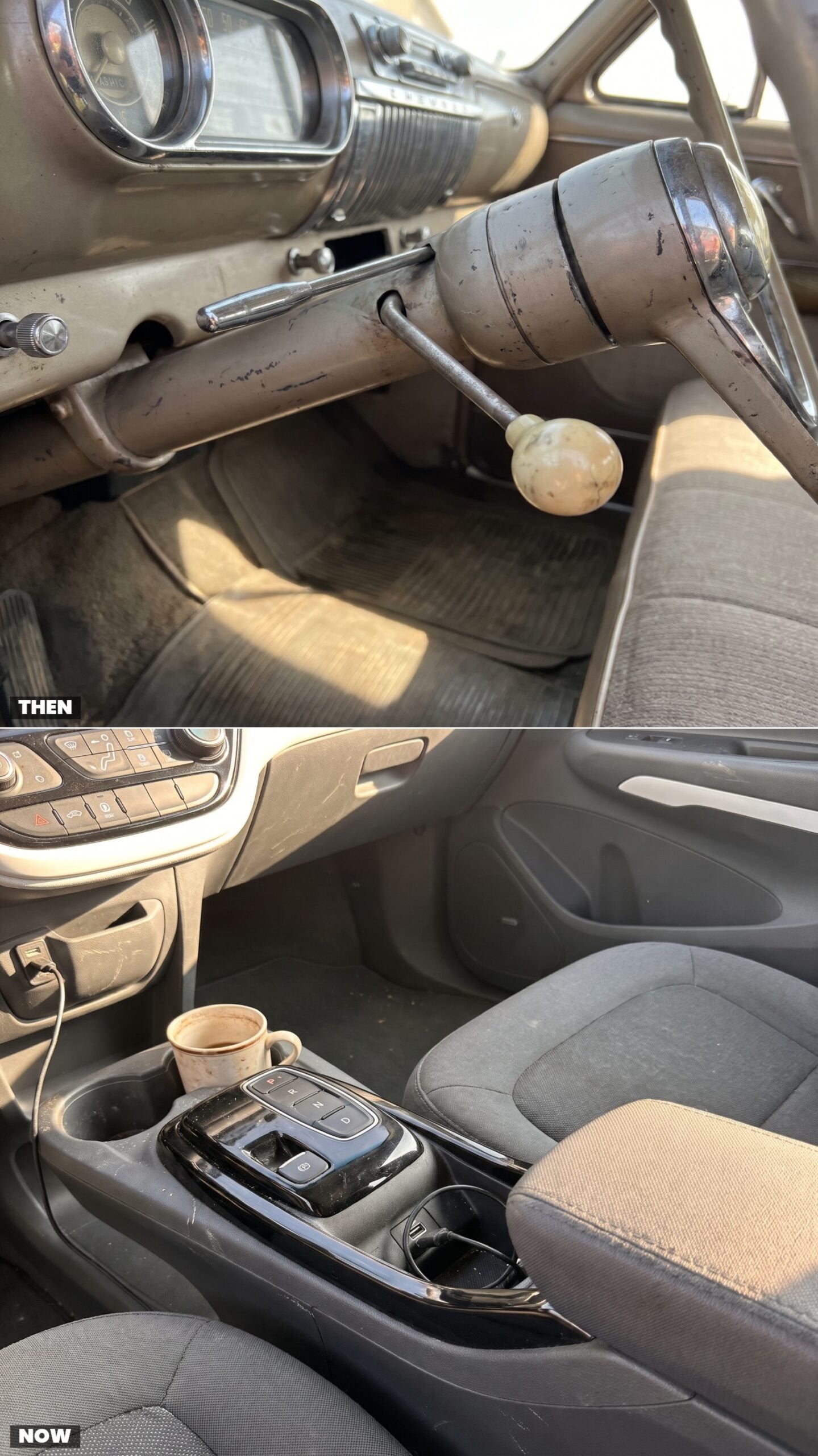
Three on the tree. The shifter lived on the steering column, a skinny lever you worked with your right hand while reading the clutch with your left foot, and teenagers stalled it at every stop sign until the pattern lived in their wrist.
Now the gear selector sits on the console, and half the time it isn’t even a lever. A row of buttons, maybe a little joystick, sending a signal off to a computer. P, R, N, D. No cable, no linkage, nothing to feel. Push the letter you want.
27. A Clutch You Had to Master vs. a Gearbox With No Gears to Feel
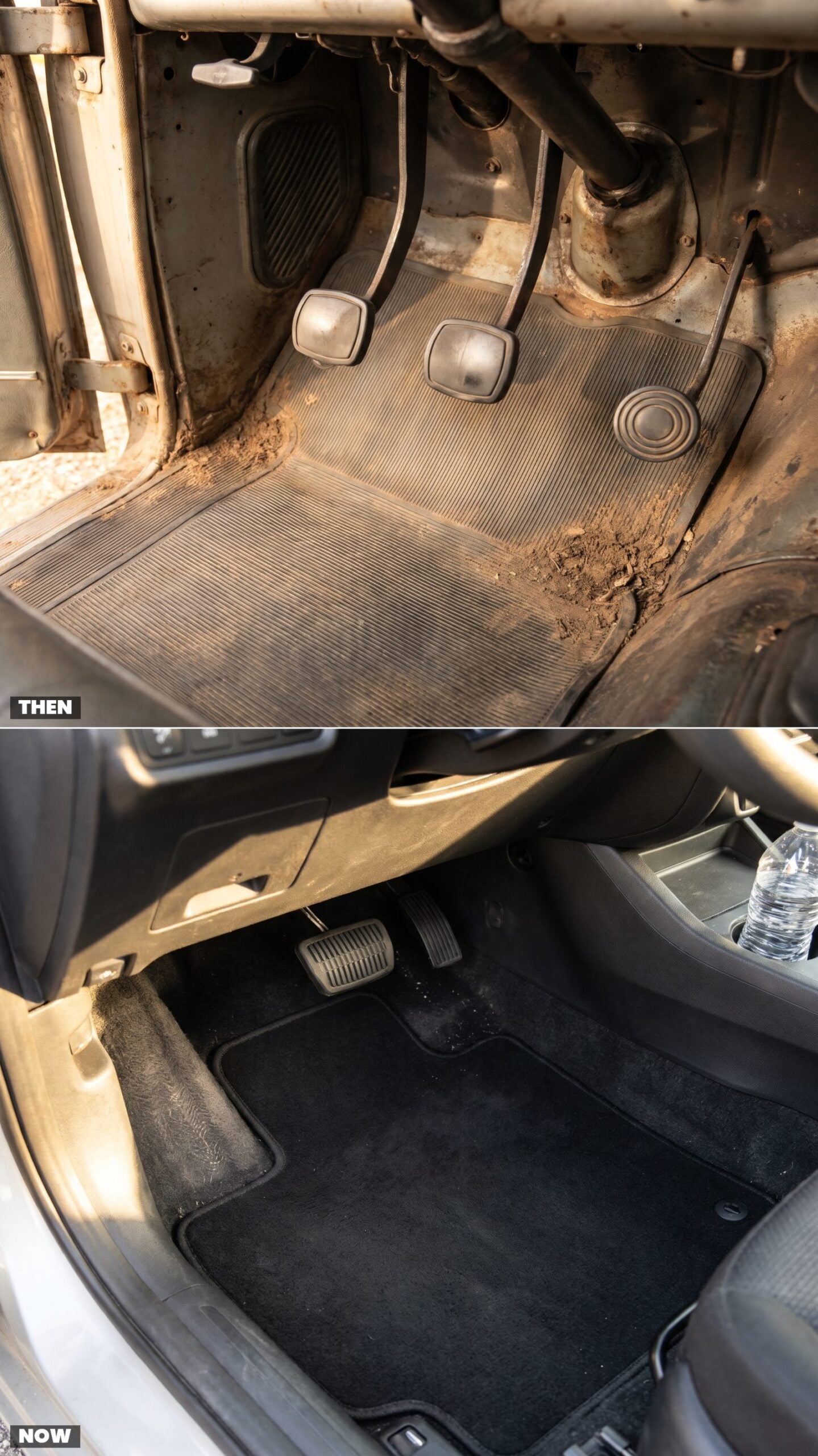
Three pedals meant you actually had to learn to drive. Clutch in, lift off slow, feed the gas, catch the bite point or lurch and stall in front of everyone. A kid who could launch a ’53 Chevy up a hill without rolling back had earned something.
The entry-level car today has two pedals and a CVT that doesn’t shift so much as slide through an endless spread of ratios. No clutch. No gears to count. Smooth, efficient, and a touch soulless. A whole generation will never know the small panic of a hill start.
26. A Painted Steel Dash vs. a Dash Molded From Soft Plastic
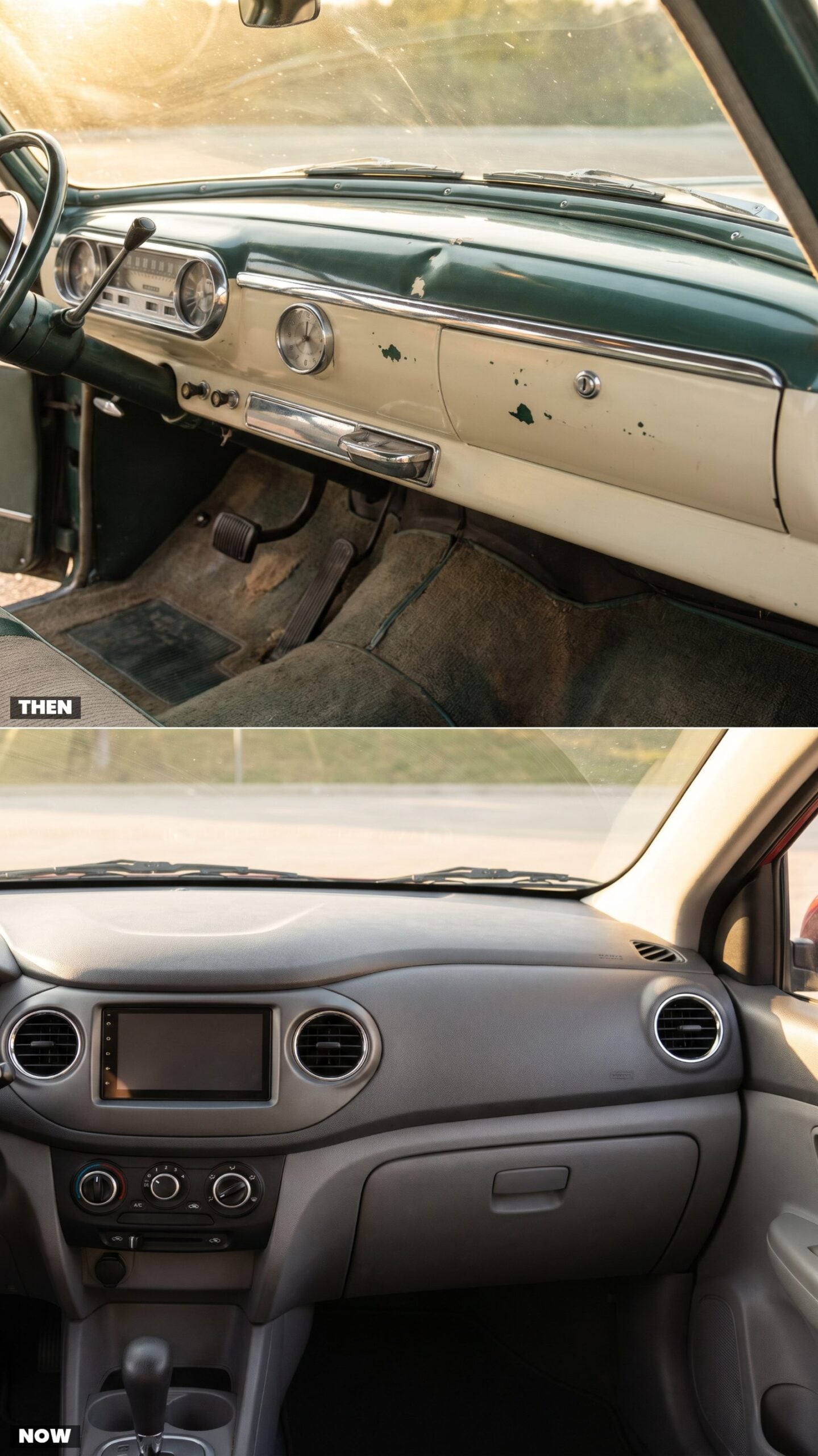
The dash in 1962 was a wall of painted steel, hard as a cast-iron skillet and about as forgiving. Chrome strips, a metal ashtray, a little clock that quit working somewhere around the Johnson administration. Nice to look at. Terrible to meet with your forehead.
Today the whole dash is molded soft-touch plastic with a padded top that gives when you press it. Grained, dark, quiet. Boring next to that old chrome, sure — but it was drawn up by people who had seen exactly what a steel dashboard does to a skull.
25. One Long Speedometer vs. a Screen That Rearranges Itself
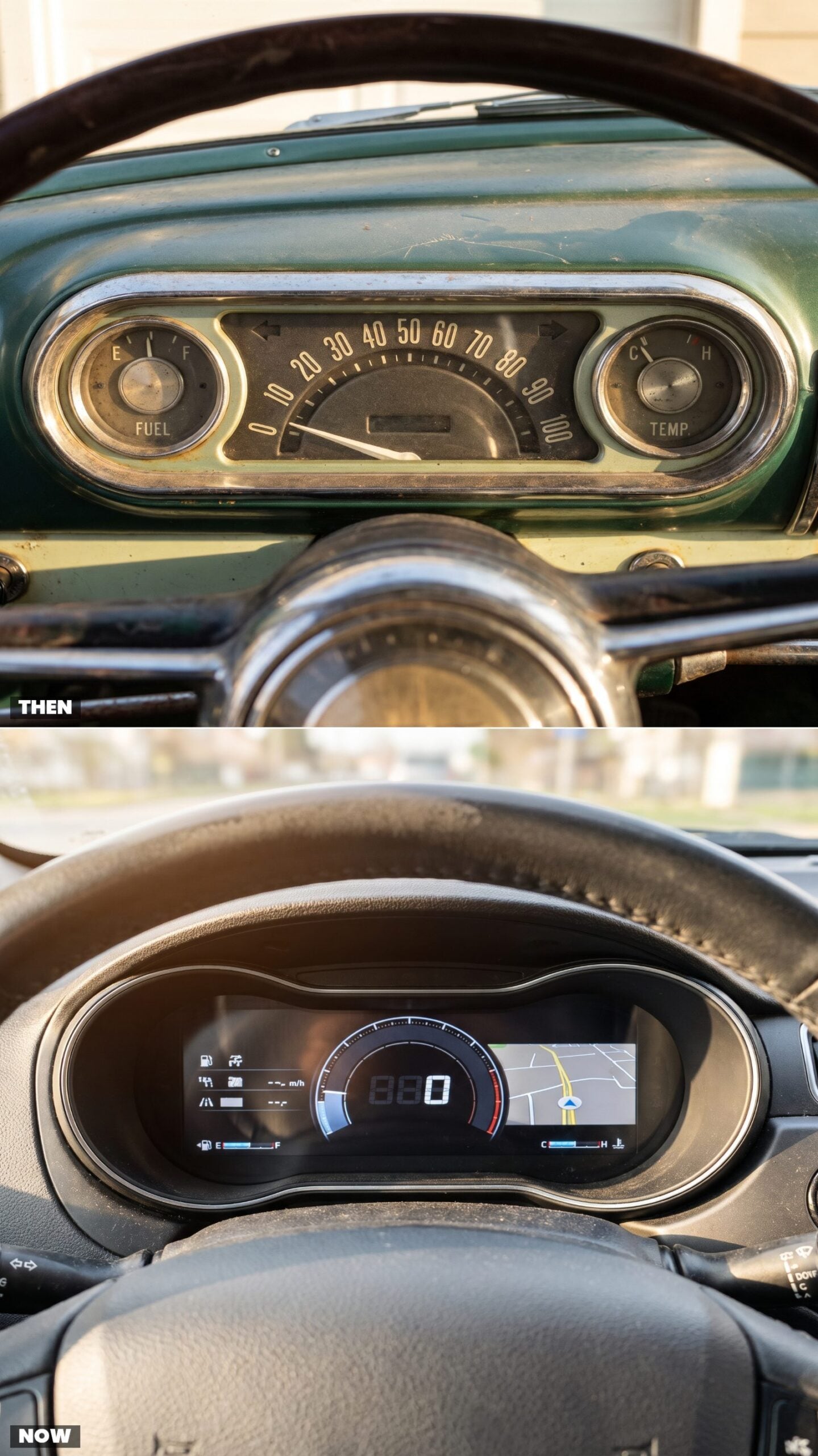
One gauge told you what you needed. The 1962 speedometer was a long horizontal ribbon with a needle that swept across as you sped up, flanked by a fuel gauge and a temp gauge, and that was the whole conversation.
The teenager’s cluster now is a screen that reshapes itself on command. Digital numbers. A map tucked into the corner, fuel economy, a tire-pressure warning, your phone’s next turn. More to read in one glance than the old car gave you in its entire life.
24. A Key You Turned vs. a Button You Press
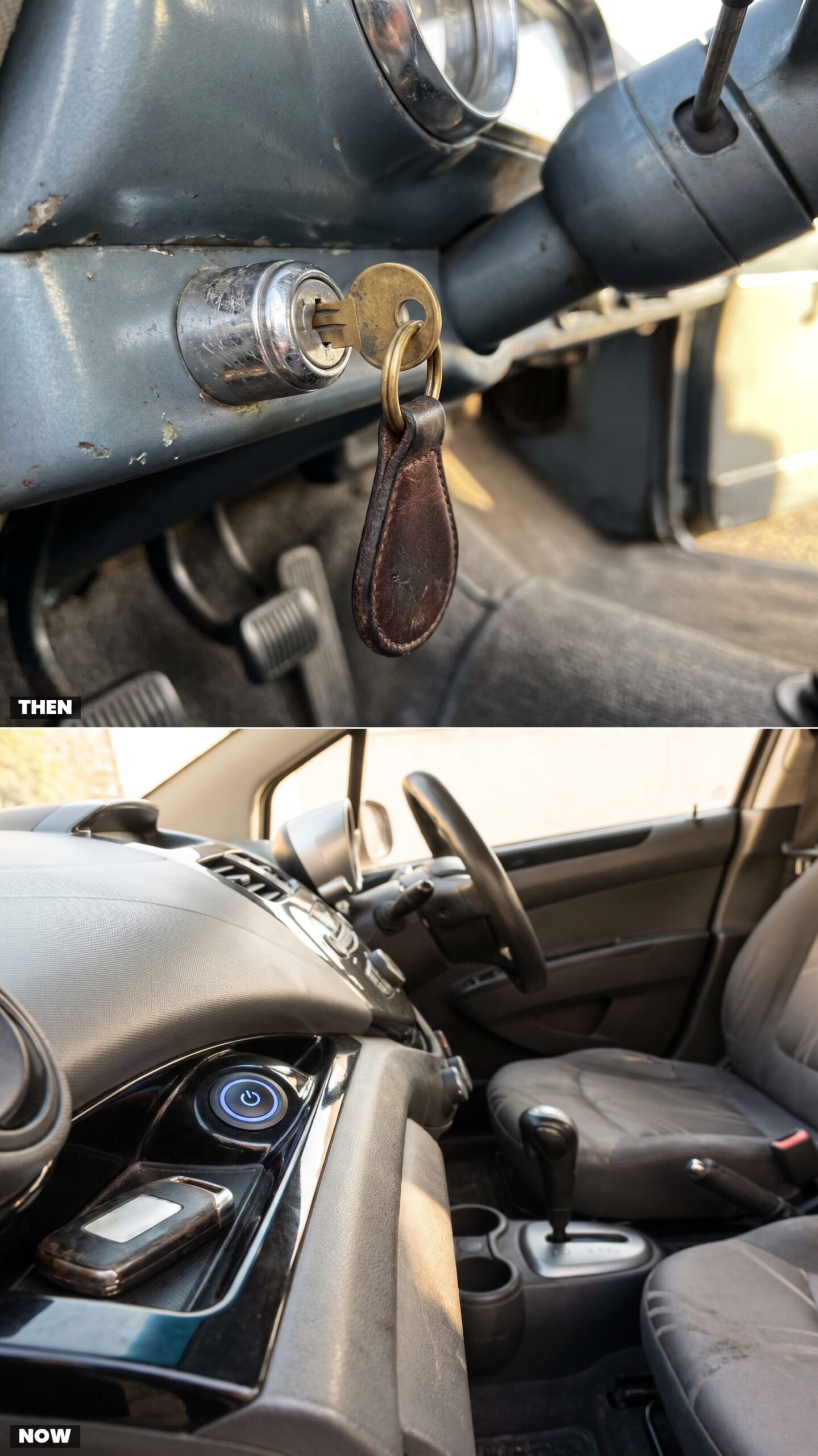
You slid a brass key into the dash, gave it a twist, and the starter groaned the engine to life. Lose the key and you were stuck. Jiggle it just right on a cold morning and it caught. Simple, physical, honest.
The first car today often has a button instead. The fob stays in your pocket, the car reads it, you push a round button and it fires. No fumbling at the door in the dark, nothing to wear out in the cylinder — and, if we’re being honest, nothing to feel either.
23. Door Locks You Thumbed Down vs. One Button That Locks Them All
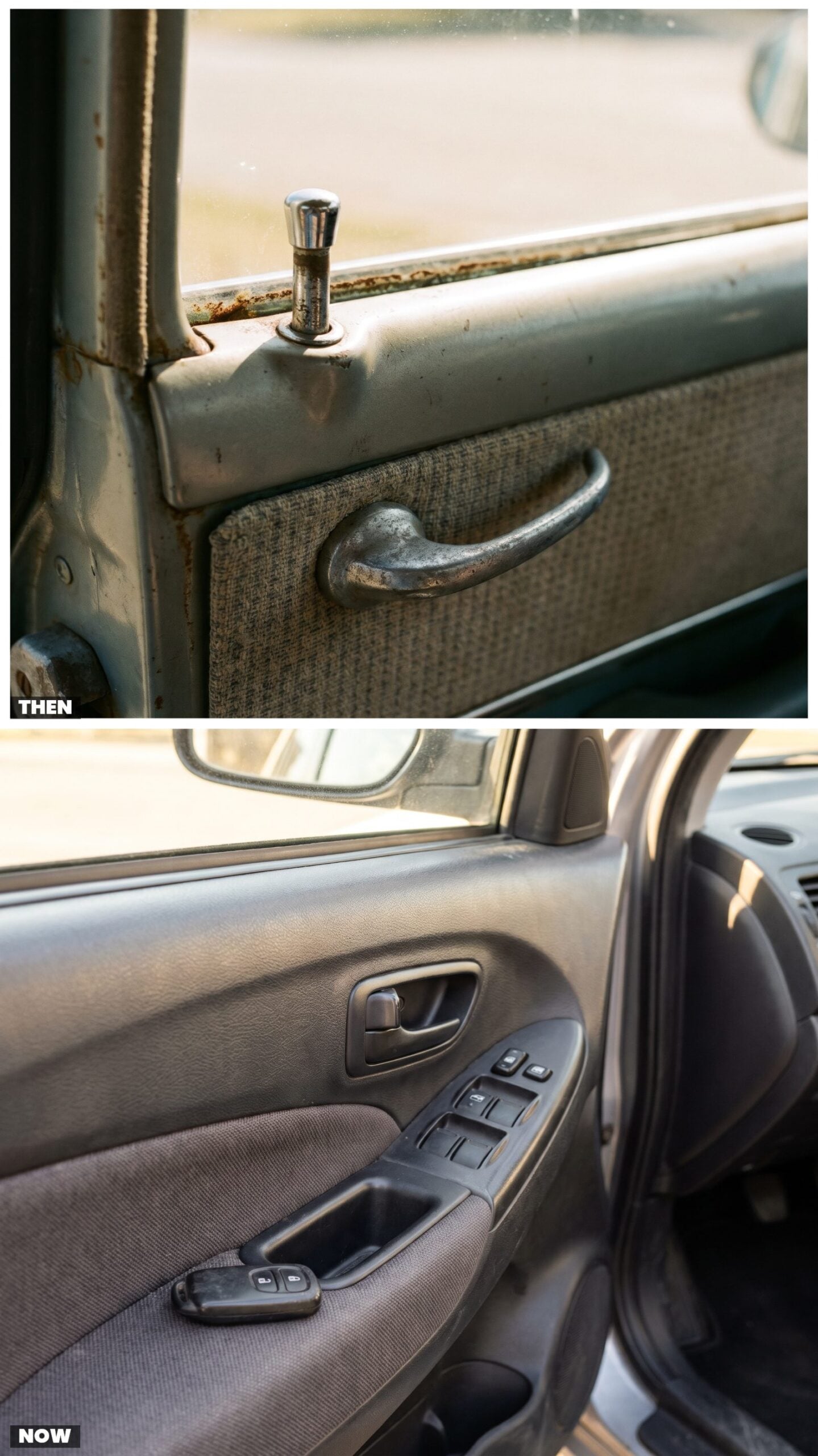
Locking up meant pressing down four little knobs by hand, one door at a time, then circling back to check you hadn’t left one standing proud. Forget the far rear door and you found out when it was already too late.
Now a kid taps one button on the fob from clear across the parking lot and every door thunks shut at once, hazards blinking to confirm. That whole ritual — walking the car, pressing each knob — has quietly disappeared. Convenient, sure. Also one less thing anyone has to actually think about.
22. A Window Crank You Worked by Arm vs. Glass That Drops at a Touch
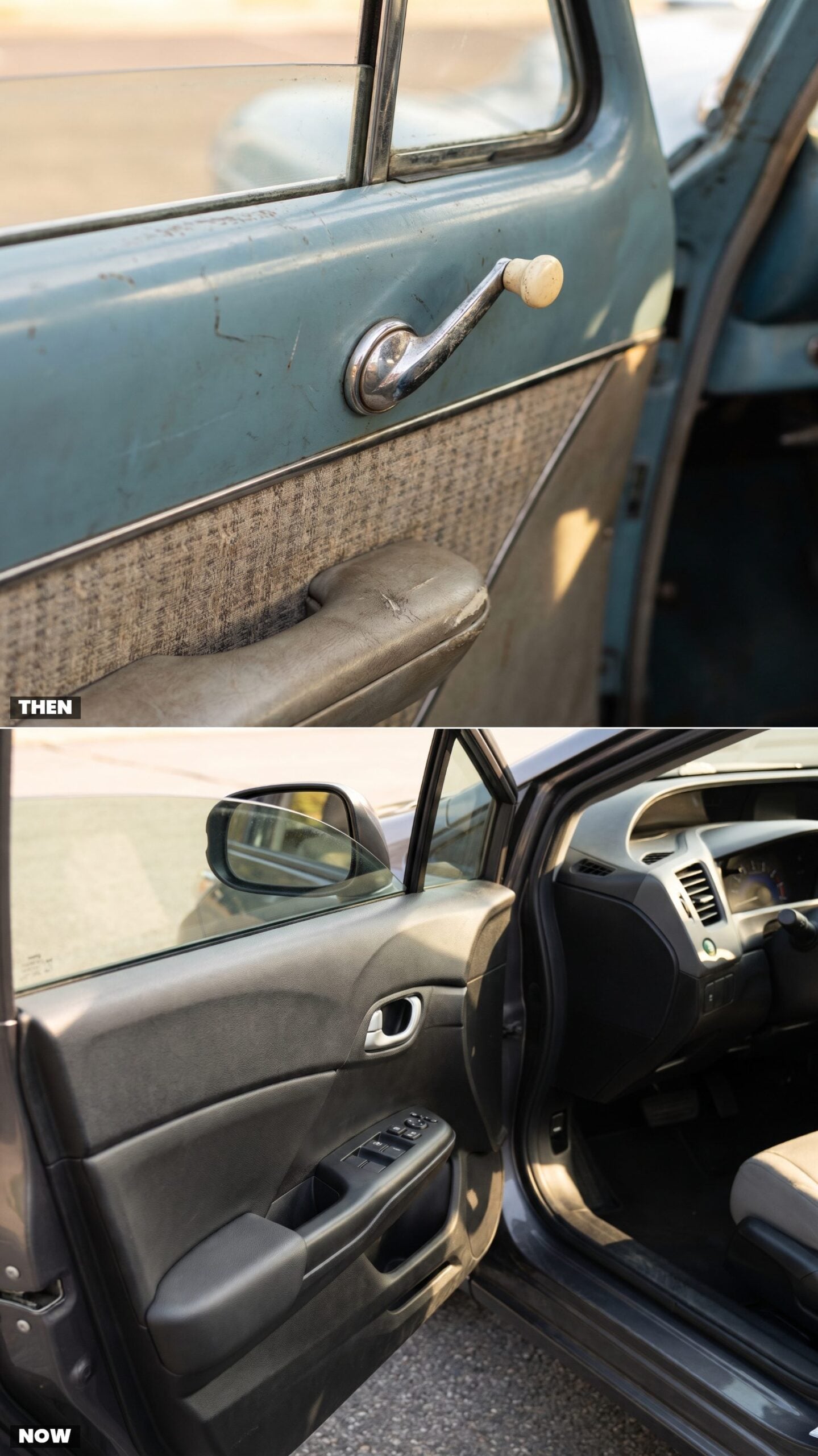
You rolled it down. Literally. The crank took a few full turns and a shoulder that worked, and on a hot day you’d spin all four before anyone could ask. Reaching across to crank the passenger window was its own small workout.
Press and release. The driver’s window drops all the way on its own, one touch, no arm involved — a little motor doing what your shoulder used to. Faster at a drive-through, quieter, and a kid today will never understand why we called it rolling down the window.
21. Vent Windows vs. Automatic Climate Control
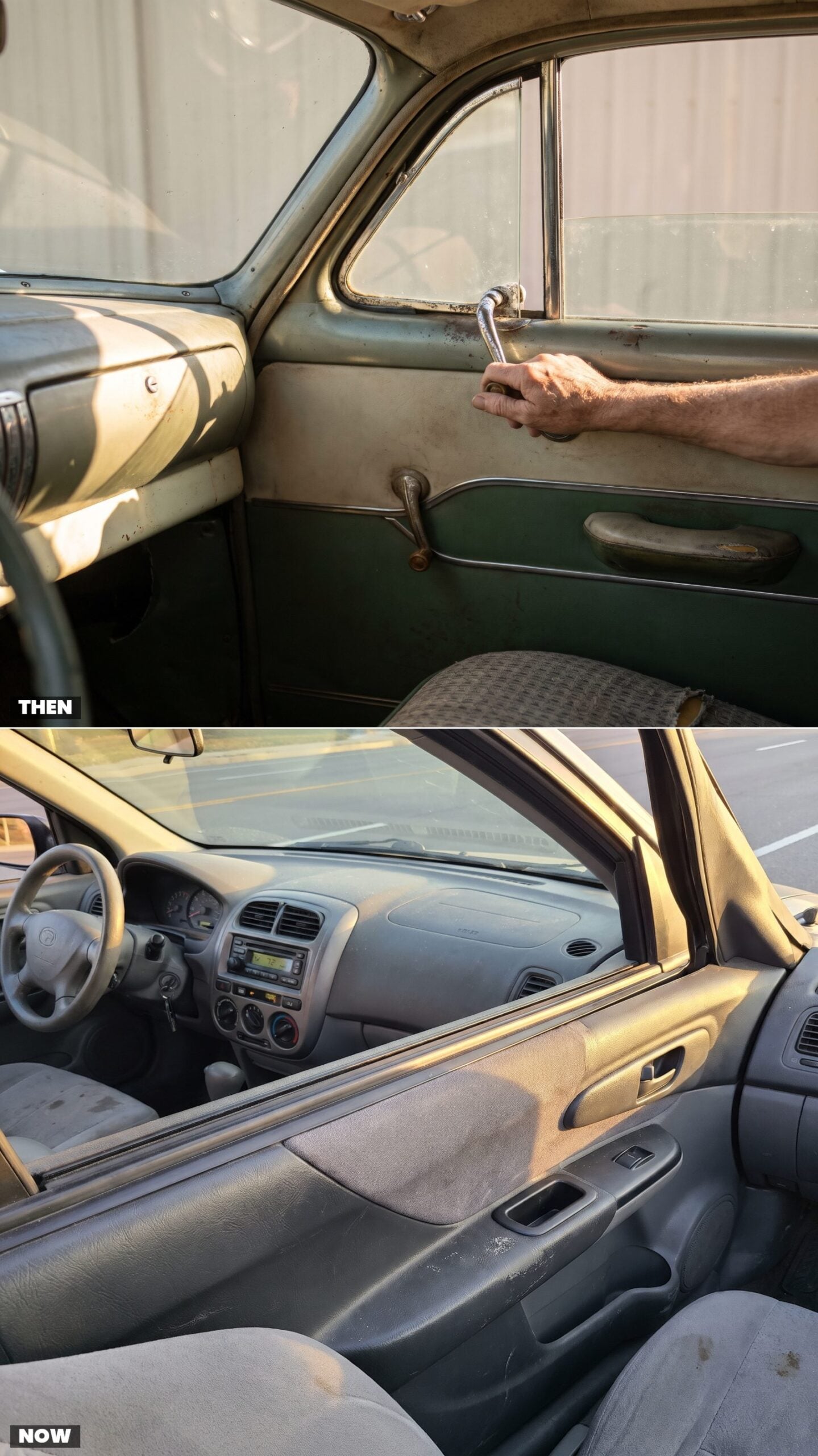
The wing window was the cleverest little gadget nobody appreciated until it vanished. Crank it out and it scooped highway air straight onto your face without the buffeting you got from a rolled-down main window. Hot day? You learned to angle it just right. No fan speeds, no recirculate button, no digital readout — just you, a little chrome lever, and the laws of physics.
Now a teenager sets a number on a screen and the car holds it. The vent window is gone entirely, written off as a leak and a source of wind noise. Comfort got easier and a whole lot less personal.
20. An AM Radio With Push-Button Presets vs. Touchscreen Streaming
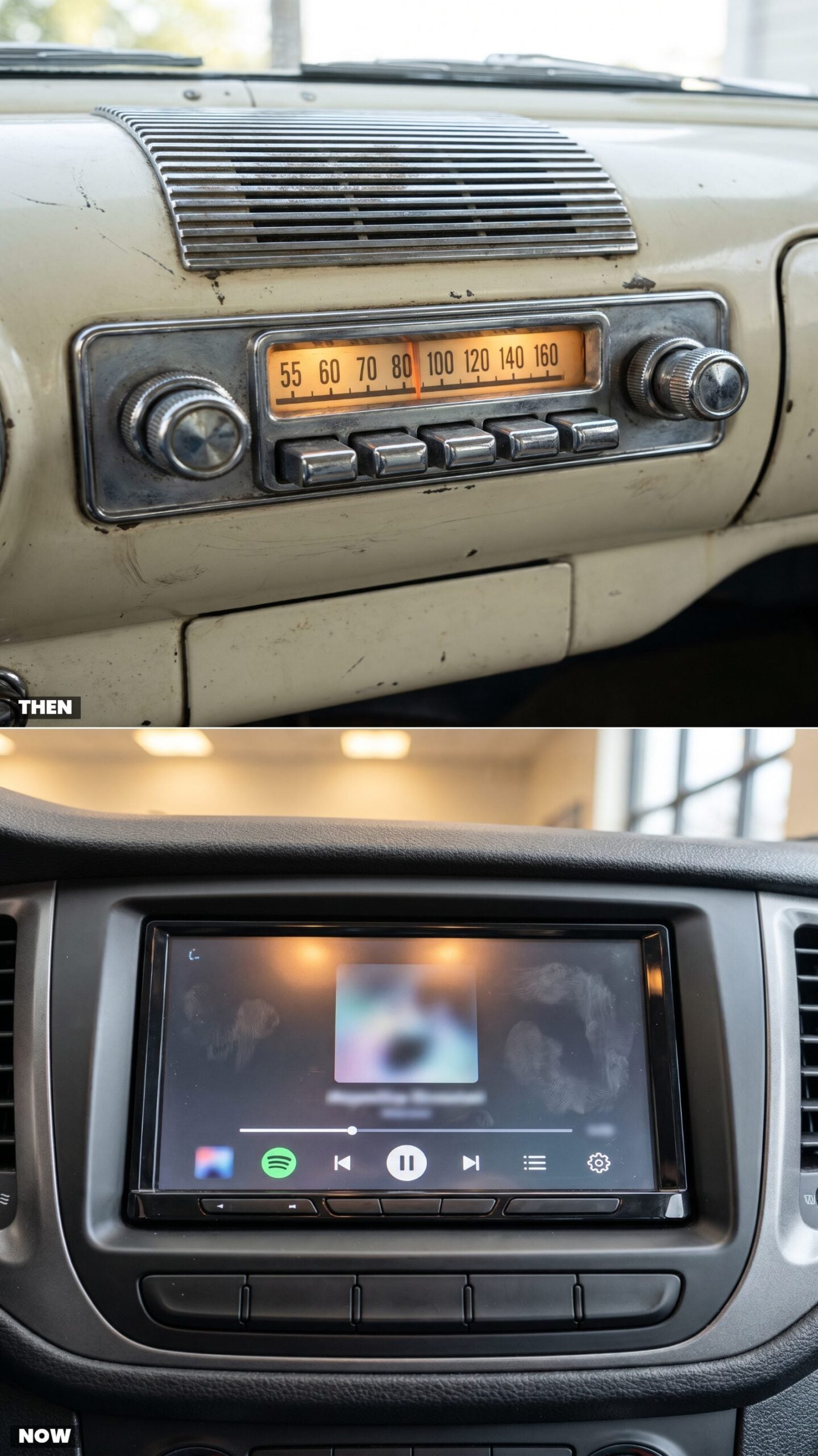
Five chrome buttons. That was your entire music library. You pressed each one hard enough to feel the mechanism thunk, and it snapped the needle to the station you’d pre-set. AM only, with static whenever you drove under a bridge. If your favorite song came on you turned it up and prayed the next three were good too, because there was no skipping.
A teenager today holds every song ever recorded in a glass rectangle, on demand, with the album art glowing back at them. More choice than any human needs, really.
19. A Paper Road Map vs. Turn-by-Turn Navigation
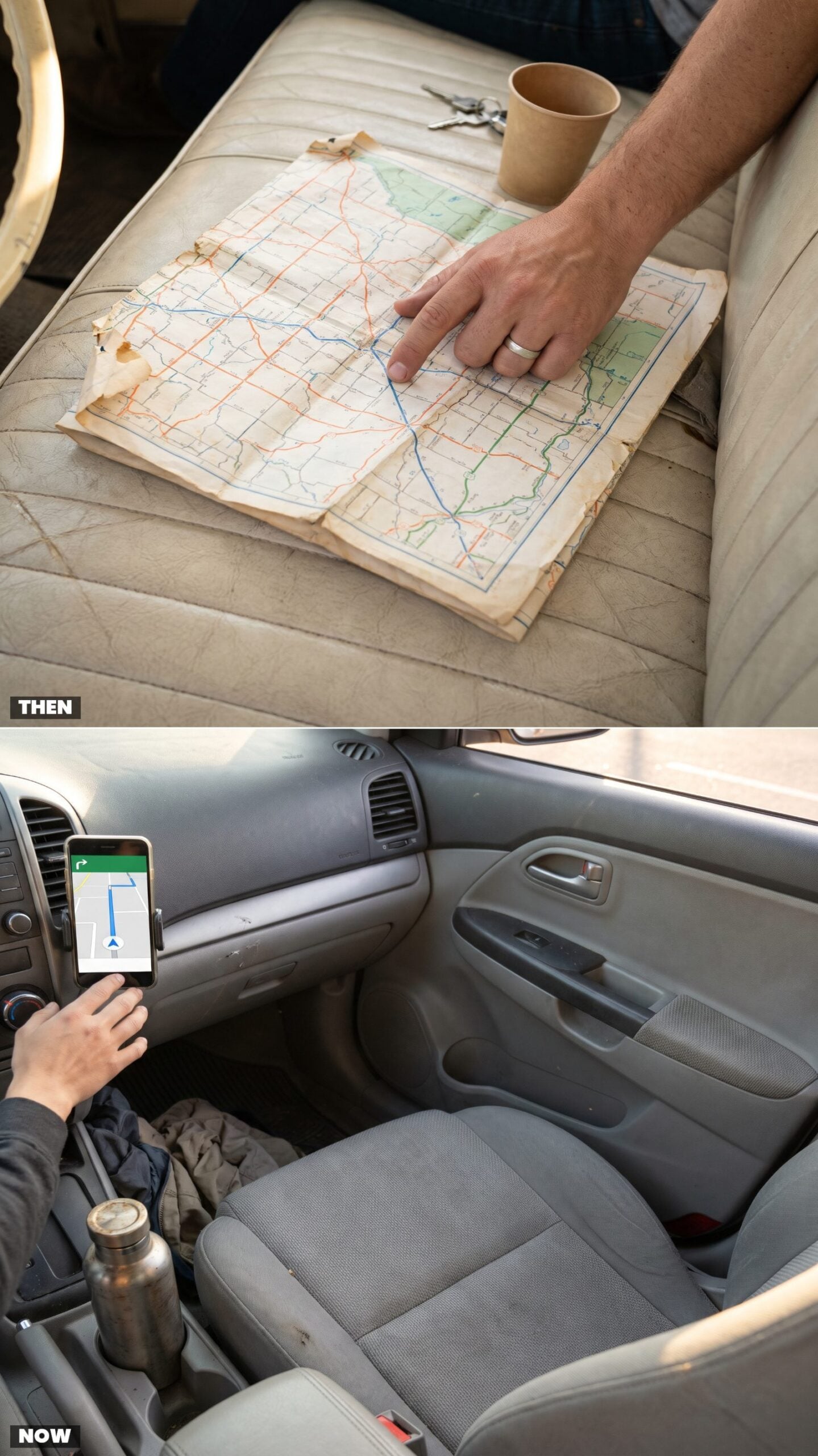
Folding the map back up was its own skill, and most people never mastered it. You’d grab one free at the Texaco station, spread it across the seat, and trace your route with a finger before you ever turned the key. Get lost? You pulled over, squinted at the grid, and asked a stranger at the next gas station.
A teen now just says where they’re going and a calm voice handles the rest, rerouting around traffic in real time. Nobody gets lost anymore. Something’s been lost anyway, if you ask me.
18. No Cupholders vs. Cupholders in Every Reachable Corner
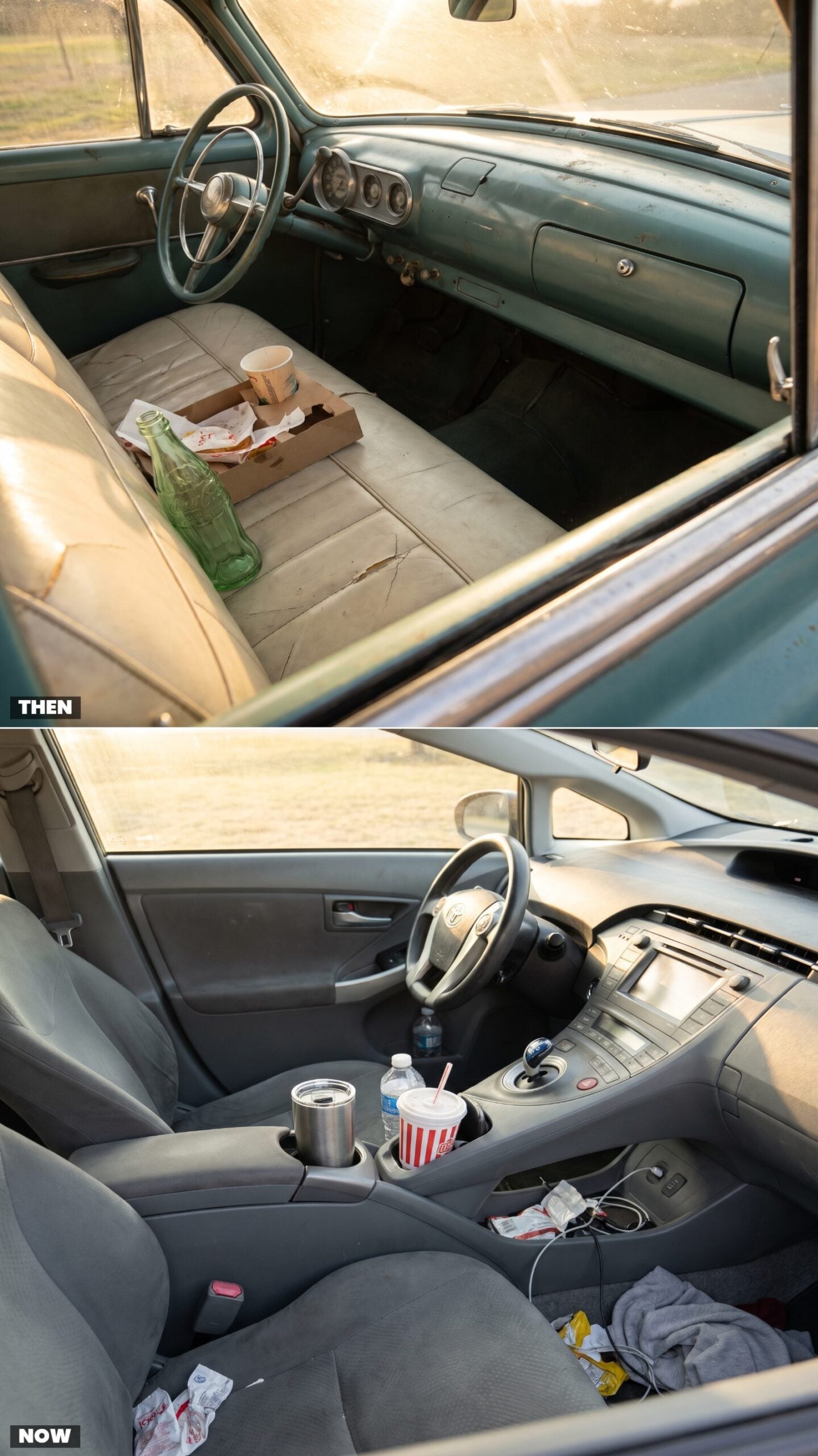
There were no cupholders. None. You wedged your bottle between your thighs, balanced the drive-in tray on the bench seat, and took the turns slow so your root beer didn’t end up in your lap. Everyone just lived like this.
Modern cars overcorrected hard. Go ahead and count the cupholders in a cheap used compact — you’ll hit eight before you’ve even checked the doors. A teenager can carry a drink for every passenger and still have spots left over.
The cupholder is the single most-requested feature in American car buying history, and it didn’t become standard until the 1980s.
17. A Roomy Metal Trunk vs. a Carpeted Hatch With Underfloor Storage
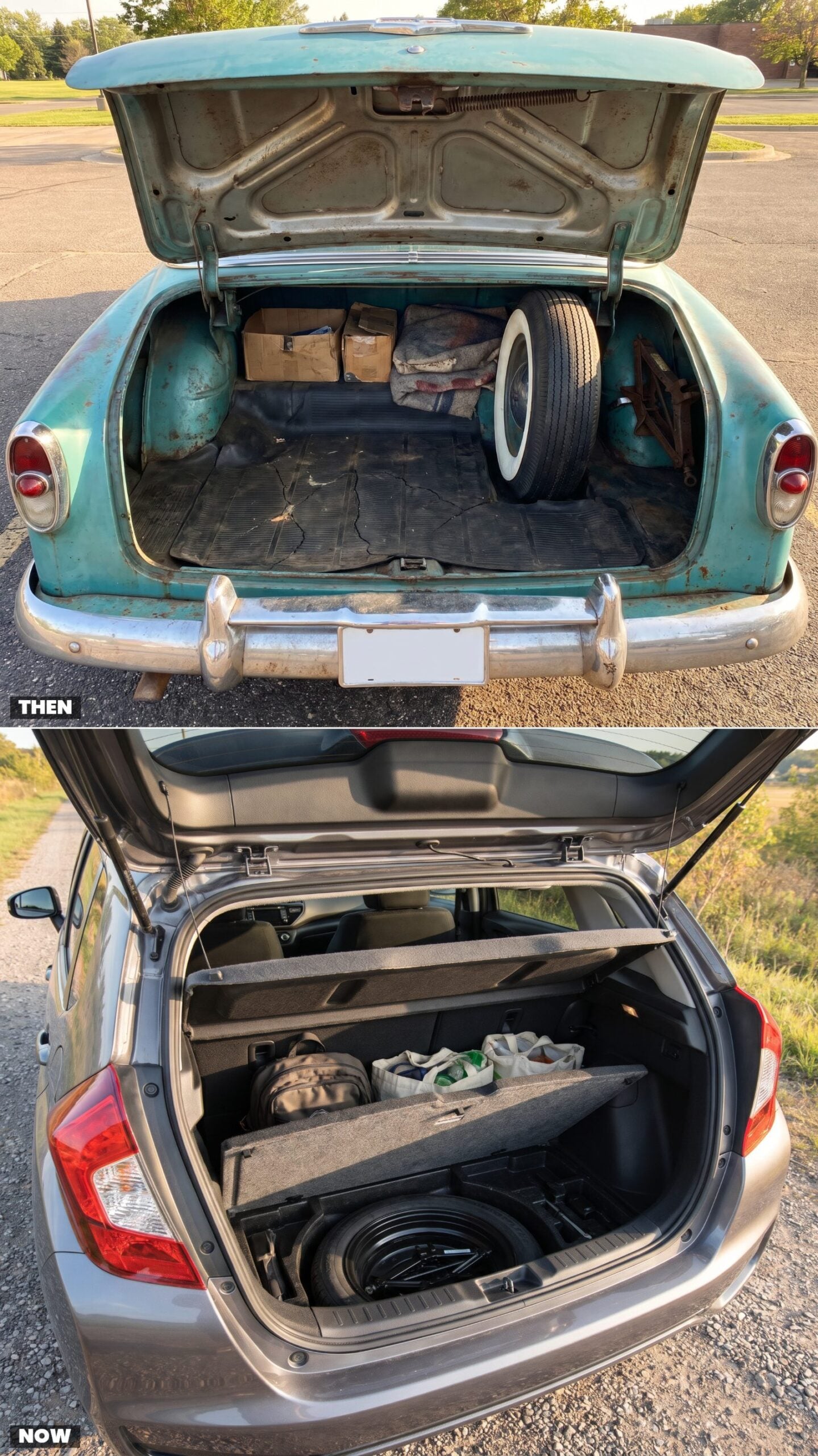
A 1962 trunk was a steel cave. You could fit a week of groceries, a full-size spare standing upright, and still have room to hide a friend sneaking into the drive-in. Bare metal, a rubber mat, maybe some surface rust in the corners. It didn’t look nice. It held everything.
Today’s used compact trades the sedan’s box for a hatch. Fold the rear seats and you’ve got a flat load floor, and lift the carpeted panel to find a hidden well for the spare and your jumper cables. Smaller footprint, smarter about using it.
For what it’s worth, hatchbacks got fewer hearts from Jalopy Talk readers than the other images in the same articles, 43% versus 65%.
16. A Bumper-Mounted Gas Cap vs. a Locking Fuel Door
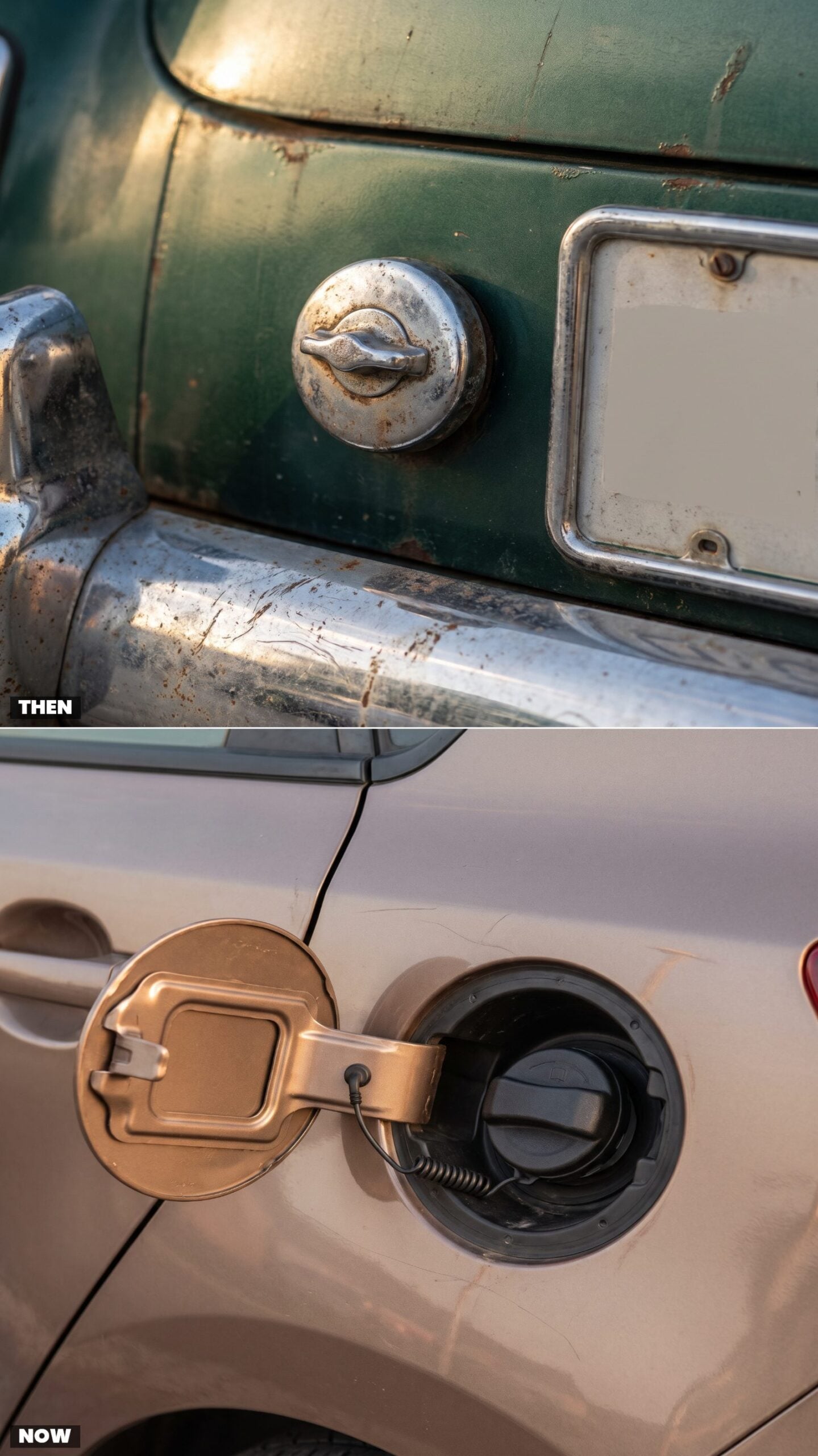
The gas cap just sat out in the open, chrome and bare, sometimes tucked behind a flip-down license plate. Anyone could unscrew it. Theft wasn’t much of a worry when gas cost a quarter a gallon and the whole neighborhood knew your car.
Now the filler hides behind a painted door that pops from a button inside, often with a locking or tethered cap so you can’t drive off and leave it sitting on the roof. Tidier, sure. Also one more thing a teenager will forget is empty until the warning light pings.
15. A Choke-Fed Straight-Six vs. an Instant-Start Computer-Controlled Four-Cylinder
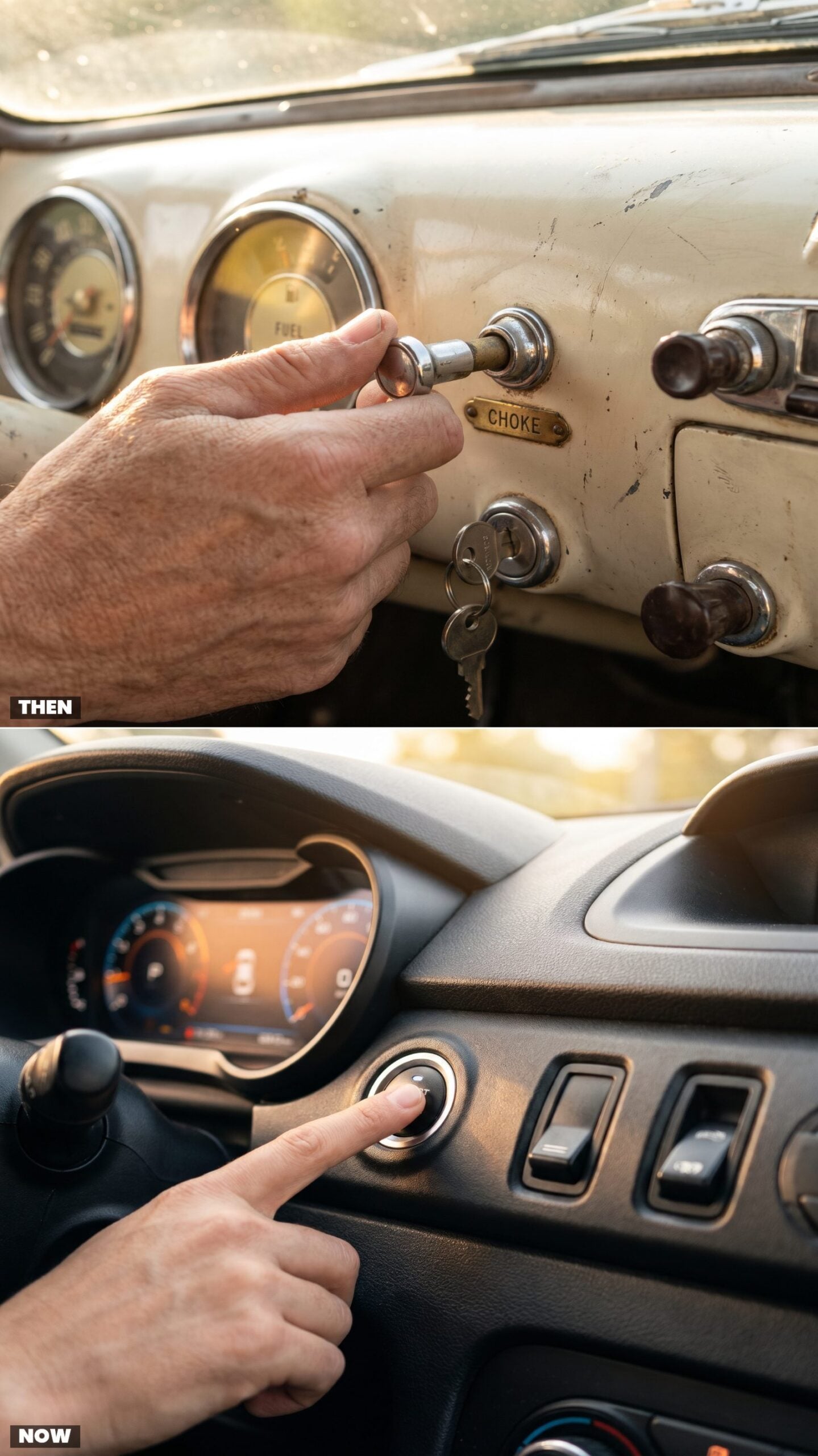
Cold morning, and the ritual began. Pull the choke knob out, pump the gas pedal a couple of times, turn the key, and coax the straight-six to life while it coughed and stumbled. Push the choke back in too soon and it stalled. You learned your own car’s temper by feel, in the dark, on a December driveway.
Now a teenager presses a button and the computer handles cold-start fueling before they’ve even buckled up. It just works, every single time. I’ll admit the choke built a kind of relationship you don’t get from a car that never needs coaxing.
14. An Open, Accessible Engine Bay vs. an Engine Hidden Under Plastic
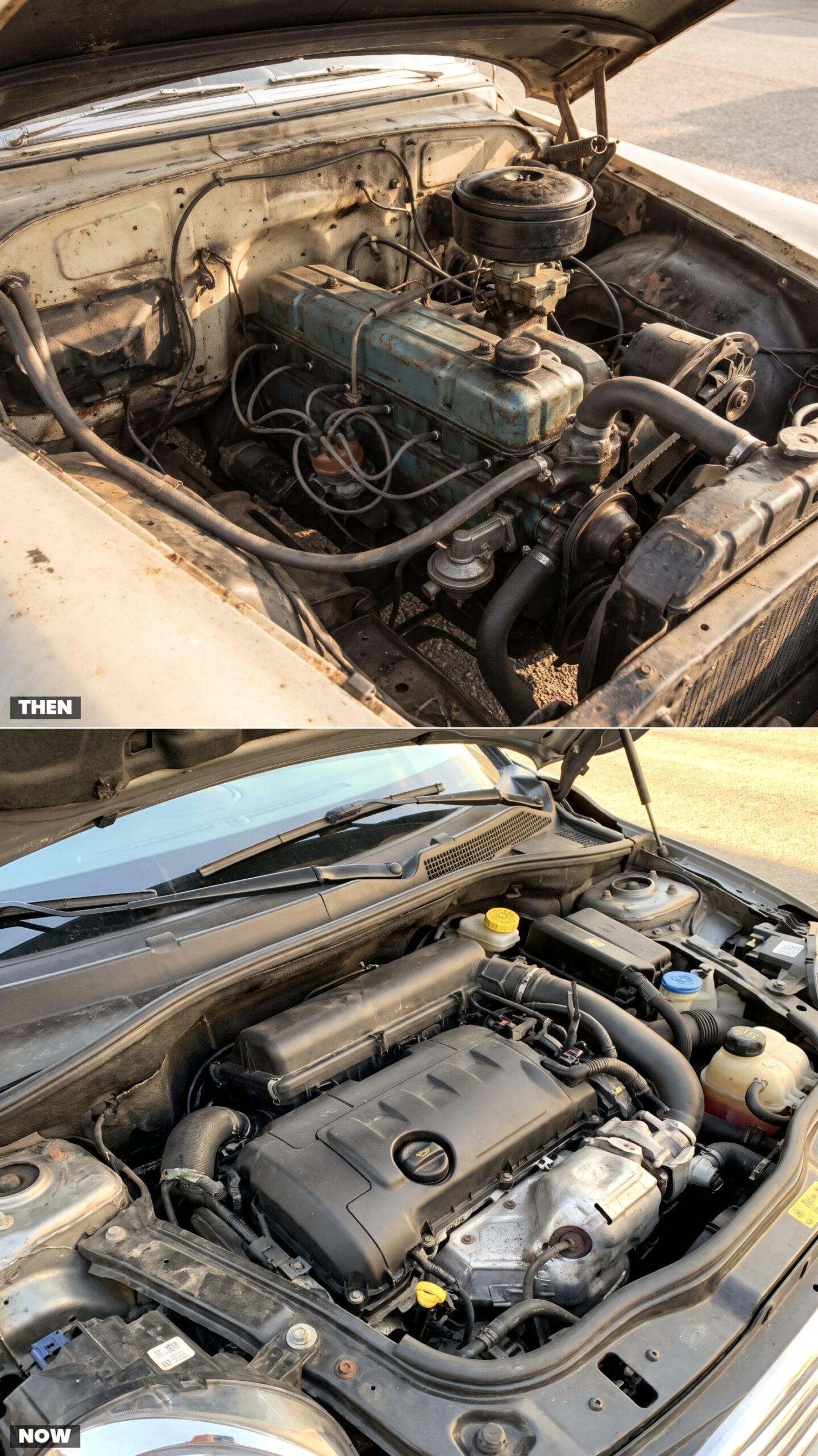
Pop the hood on a 1962 six and you could practically climb in. Acres of space around the block, the spark plugs and distributor and carburetor all right there, every one of them reachable with a basic wrench. A teenager learned the engine because the engine let them.
Lift a modern hood and a slab of black plastic covers everything, with components jammed shoulder to shoulder underneath. Most teens never touch it. Hard to learn a machine that’s been hidden from you on purpose.
13. A Generator and Simple Wiring vs. an Alternator and Multiple Control Modules
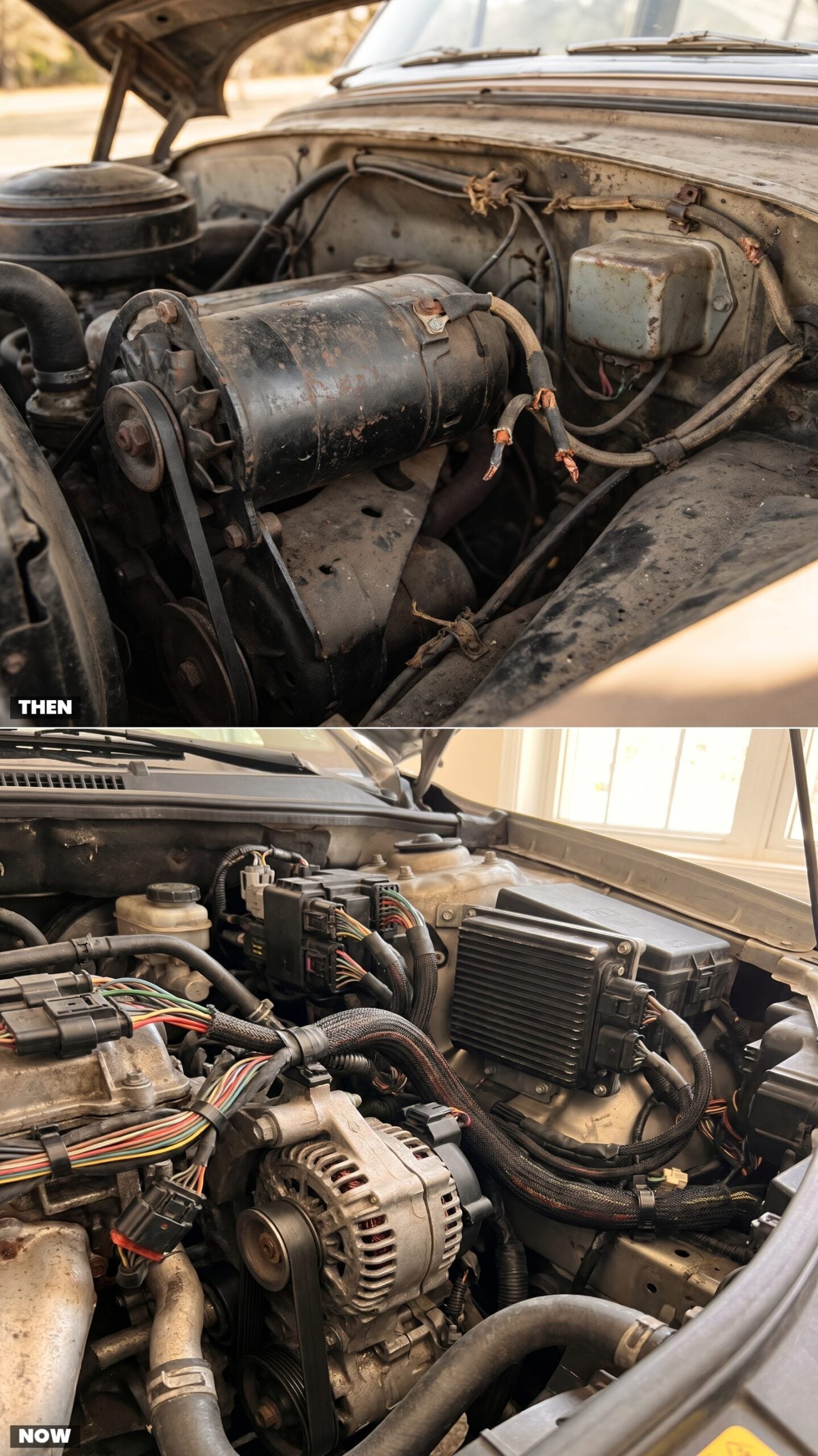
The 1962 electrical system was something a shop-class kid could grasp in an afternoon. A generator kept the battery charged, a voltage regulator box managed it, and the wiring ran in a handful of cloth-wrapped bundles you could trace by eye. Something quit, you found it.
A modern compact runs an alternator feeding a web of control modules that chatter at each other over a data network. Dozens of sensors, hundreds of wires, computers managing computers. When a warning light comes on now, a teenager plugs in a code reader instead of popping the hood. Smarter cars. Fewer people who understand them.
12. A Driveway Tune-Up vs. a Diagnostic-Code Scan
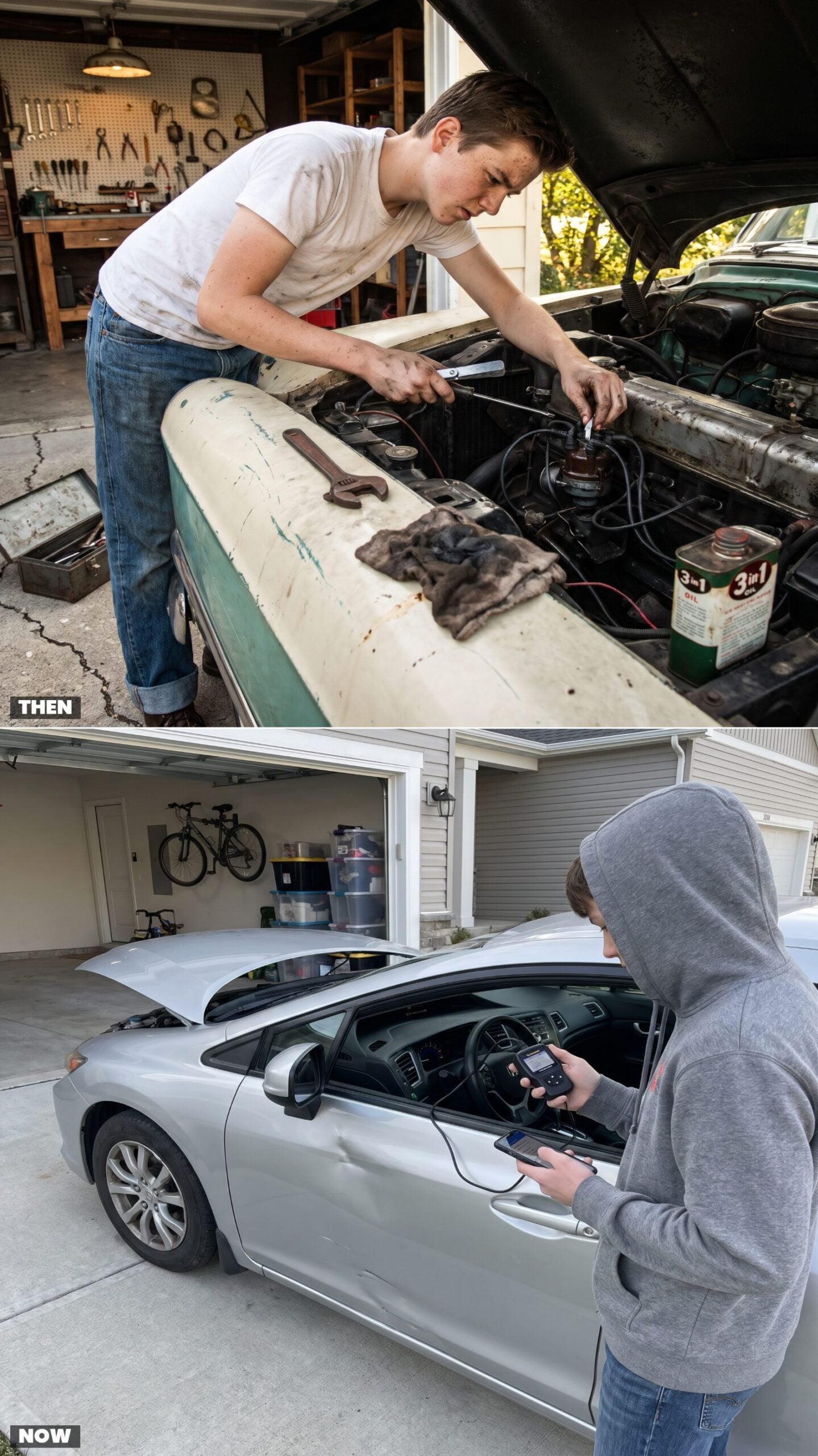
In 1962, a tune-up meant knuckles. You pulled the plugs and gapped them with a feeler gauge, set the points, and maybe adjusted the carb by ear until the idle smoothed out. A teenager could keep a vintage Chevrolet running on allowance money and a borrowed Saturday.
Now the car tells on itself. A check-engine light blinks, you plug a handheld OBD-II scanner into a port under the dash, and up pops a code. P0301. Cylinder one misfire. No gauge, no ear, no grease — just a number and a Google search.
11. A Floor-Mounted High-Beam Switch vs. Automatic High Beams
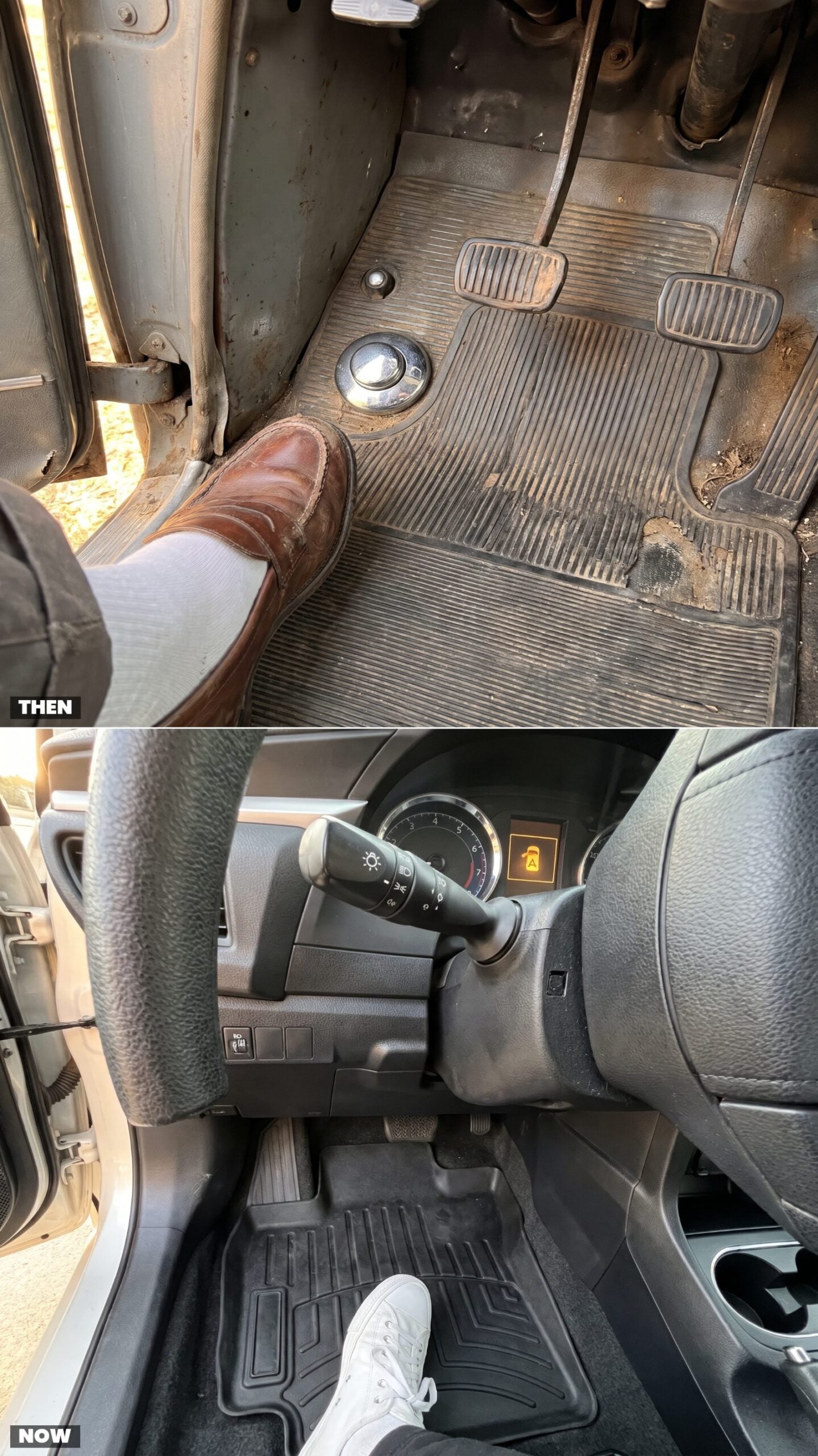
You dipped the brights with your left foot. A chrome button on the floorboard, stomped like a one-note organ pedal, and the road ahead dropped from floodlit to polite. Half the fun of a dark back road was the rhythm of it — stomp down for the oncoming car, stomp back up when the taillights passed.
Today the car reads the night for you. A camera watches for headlights and streetlamps and swaps the beams on its own, no foot required. The kid behind the wheel of a modern commuter may never know the switch existed, let alone that it lived down on the floor.
10. Single-Speed Vacuum Wipers vs. Rain-Sensing Wipers
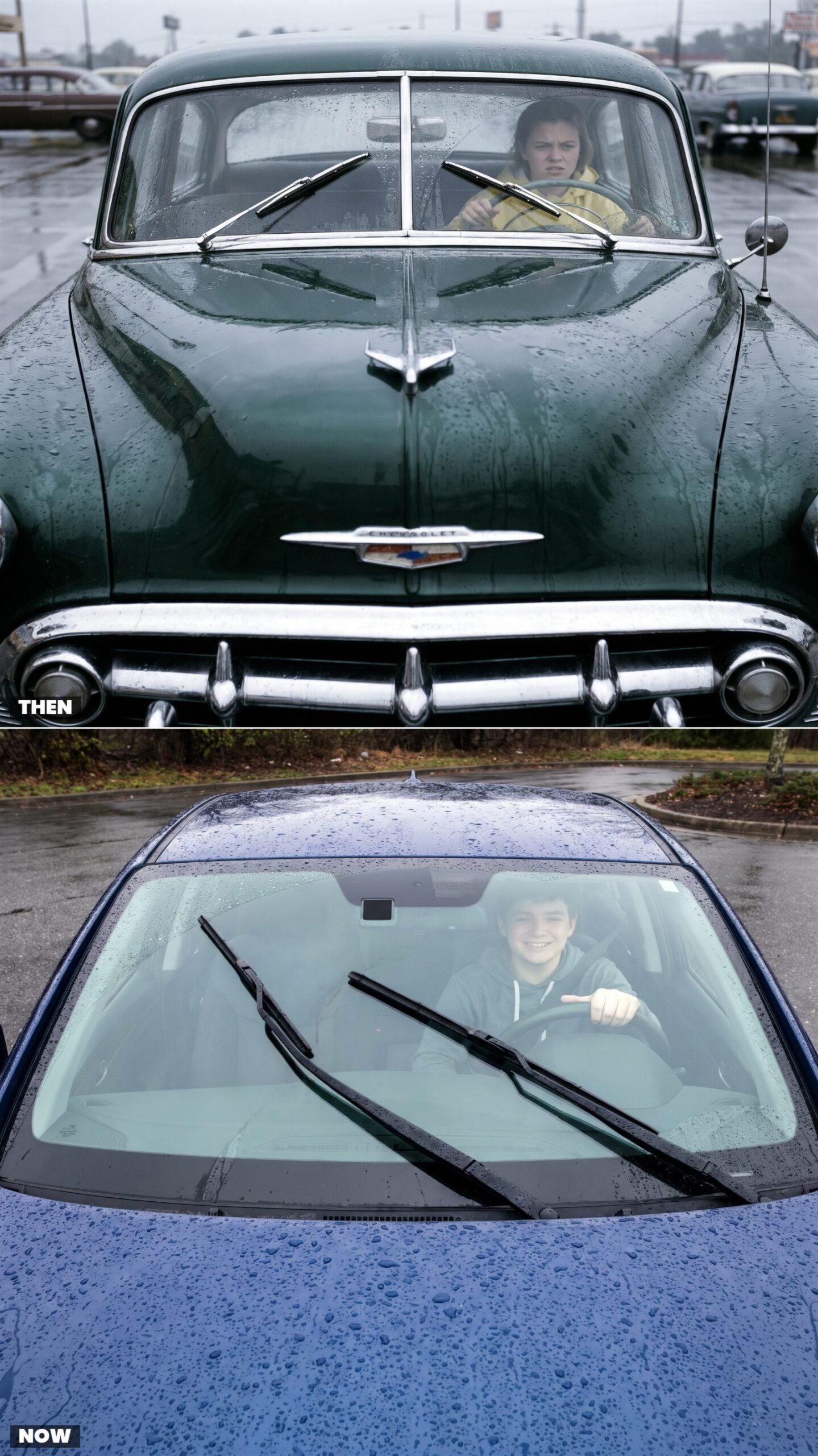
Vacuum wipers had a cruel sense of timing. They ran off engine vacuum, so the harder you pressed the gas, the slower they swept. Merge onto the highway in a downpour and the blades would nearly stop dead, leaving you squinting through a sheet of water at the worst possible second.
Now a tiny sensor by the mirror reads the rain and sets the speed for you. Light drizzle, slow sweep. Cloudburst, fast sweep. The driver does nothing at all. A small thing, sure — but it quietly erased one of the genuinely scary parts of driving an old car.
Remembering a rainy night towing a trailer up a long interstate grade in his vacuum-wiper ’59 Ford as a teenager, a longtime car owner writes that “climbing that hill, with that trailer, the wipers stopped completely and I had to open the window, hang my head out in the wind and the rain just to see.”
9. No Rear Defroster vs. Heated Rear Glass
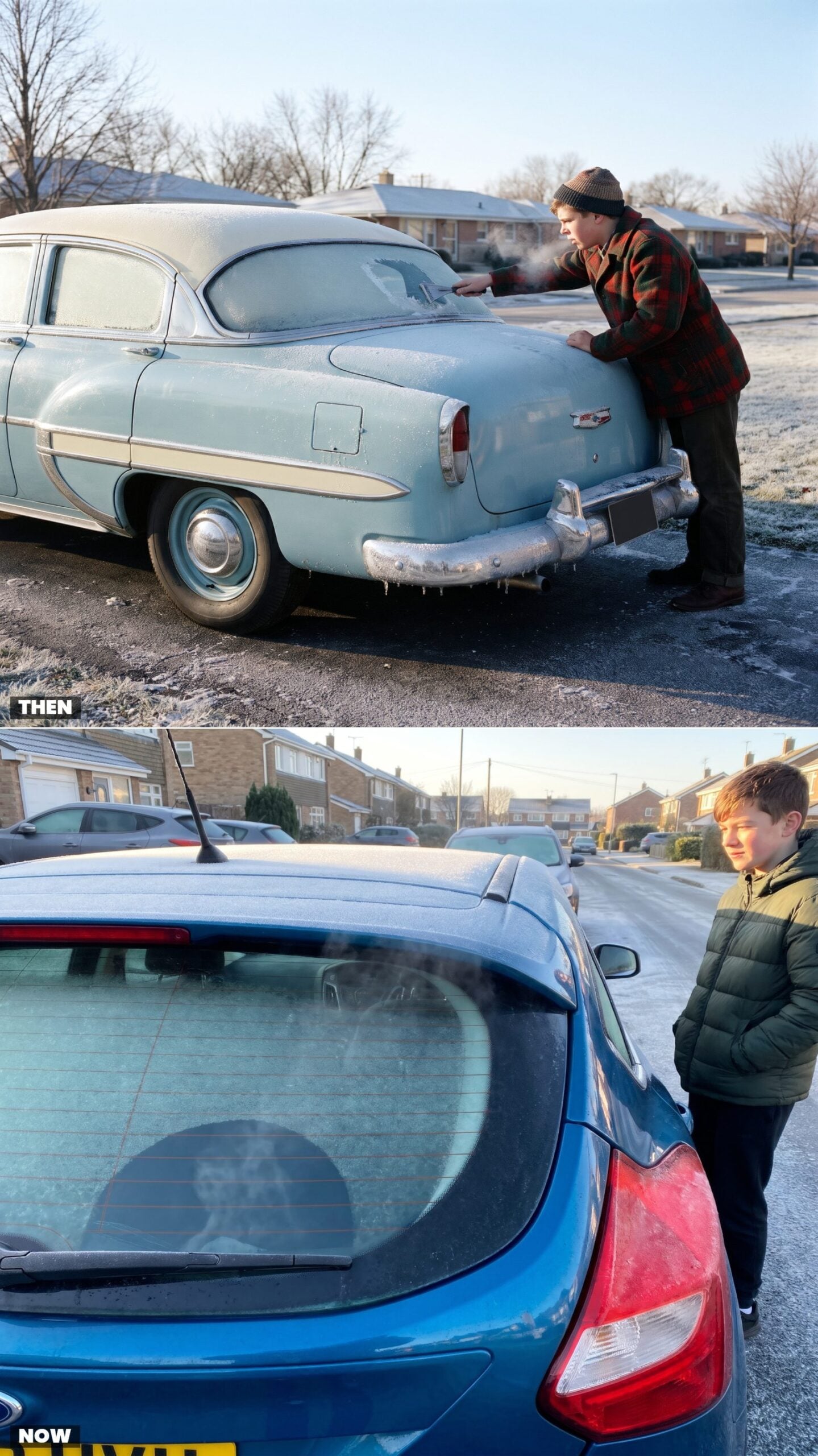
A rear defroster in 1962, on a teenager’s hand-me-down Chevy? Not a chance. You scraped the back glass by hand, or you drove with a porthole of visibility and prayed. Some folks kept a flat spatula in the glovebox just for the job. Cold mornings started with a workout.
The modern first car has thin heating wires baked right into the rear glass. Press a button, wait two minutes, and the frost retreats in neat horizontal stripes while you sit inside with the heater running. The kid scraping ice at dawn is fast becoming a memory nobody’s nostalgic for.
8. A Solid Bench With No Headrests vs. Adjustable Head Restraints
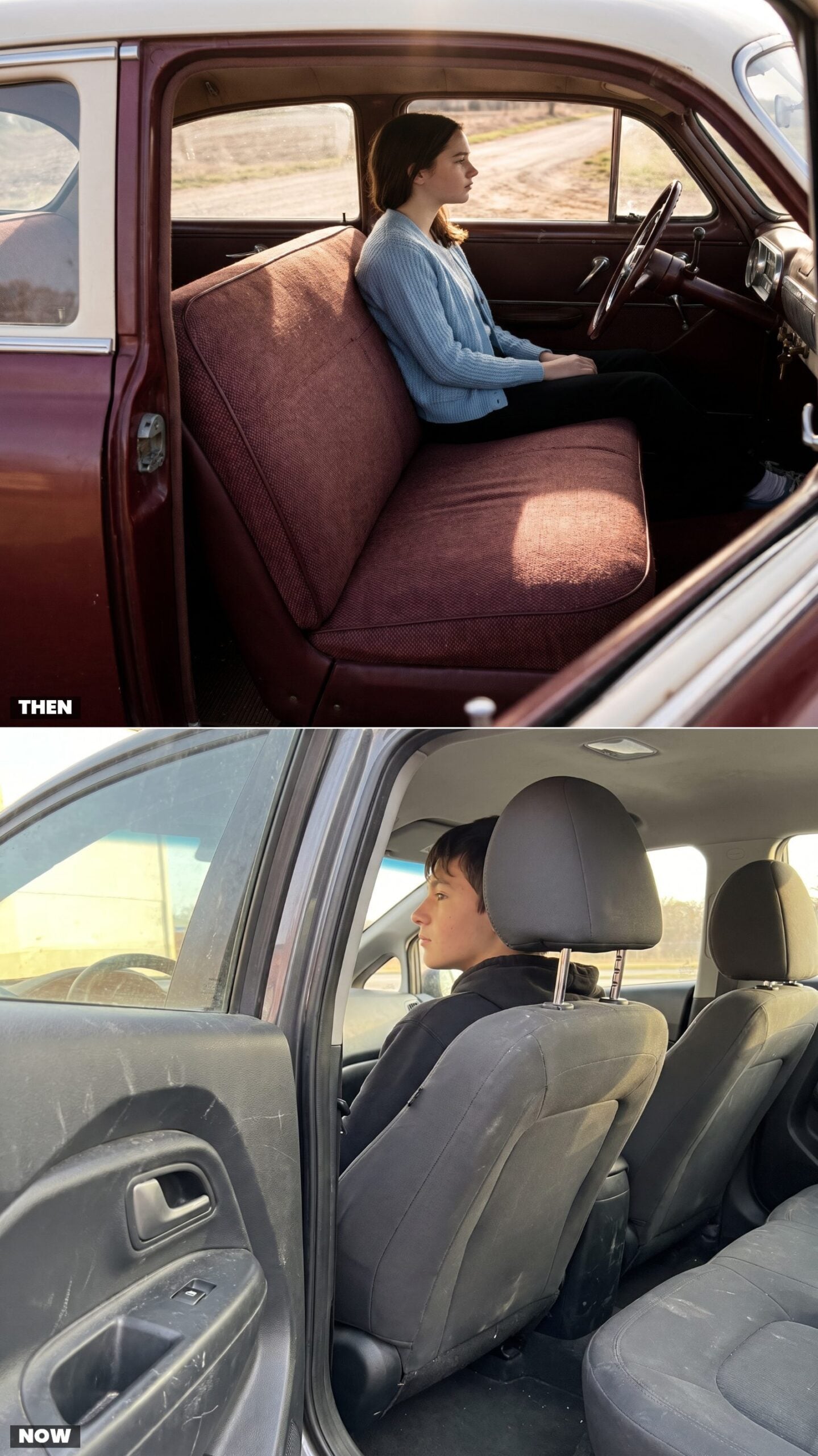
That flat bench seat was glorious for three friends up front and terrible for your neck. The seatback stopped at your shoulder blades with nothing above it, so in a rear-end collision your head snapped back over open air. Whiplash wasn’t a lawsuit term yet. It was just the sore neck you had for a week.
Now every first car has an adjustable head restraint sitting an inch behind your skull, tuned to stop that snap. Teenagers shove them all the way down for looks, which defeats the point — and that’s a small hill I’m willing to argue on.
7. Drum Brakes vs. Anti-Lock Disc Brakes
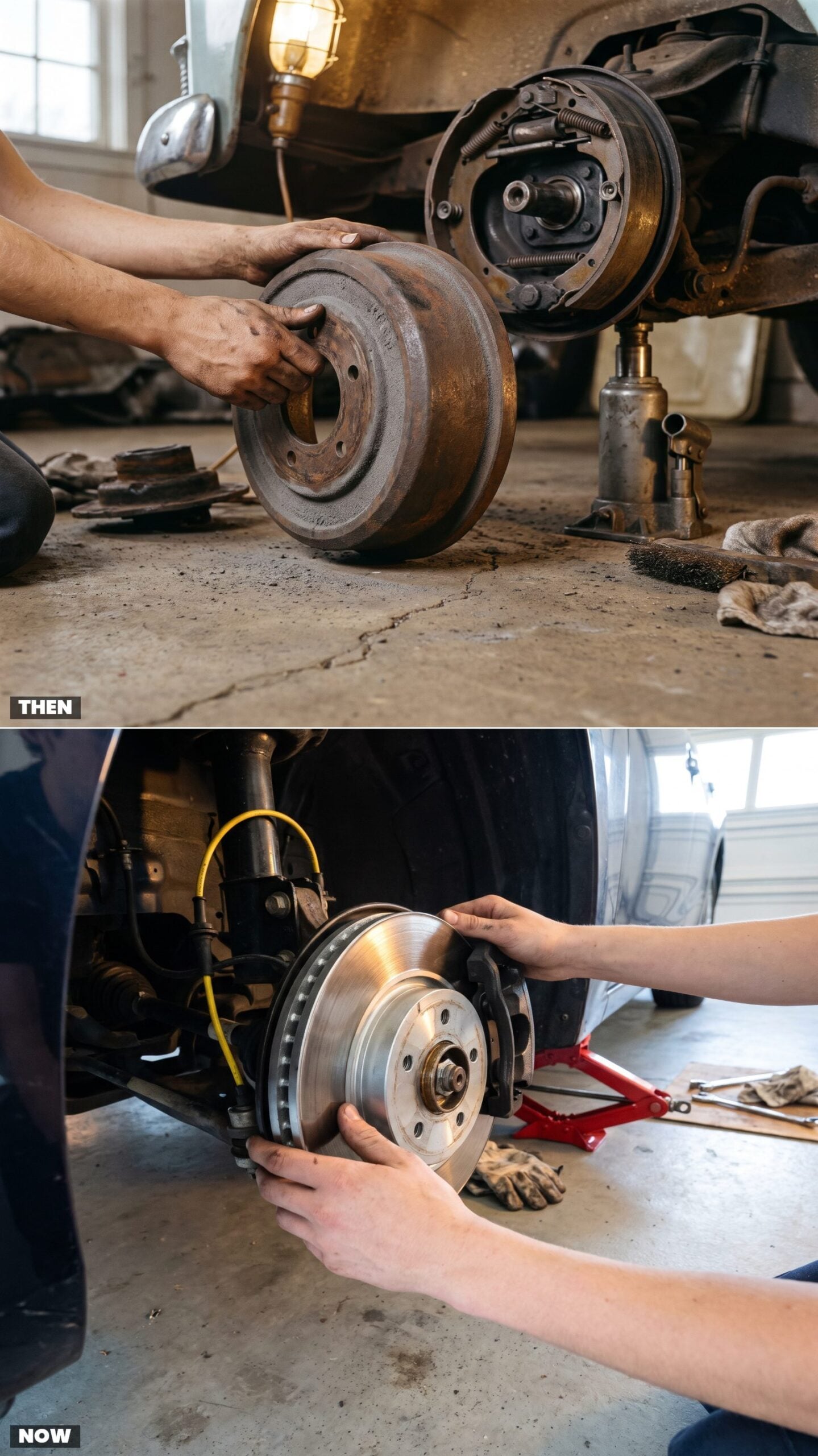
Four-wheel drums were the standard, and they faded. Come down a long hill or haul a carload of friends and the brakes got hot and soft, the pedal sinking closer to the floor each time you pressed it. So you learned to pump them, to downshift, to leave extra room. Stopping an old Chevy was a skill, not a given.
The modern first car has disc brakes that shed heat instead of trapping it, plus anti-lock that pulses the pedal so a panicked teenager can slam it flat and still steer around the thing they’re about to hit. That one difference turns a lot of crashes into near-misses.
6. Armstrong Steering vs. Speed-Sensitive Power Steering
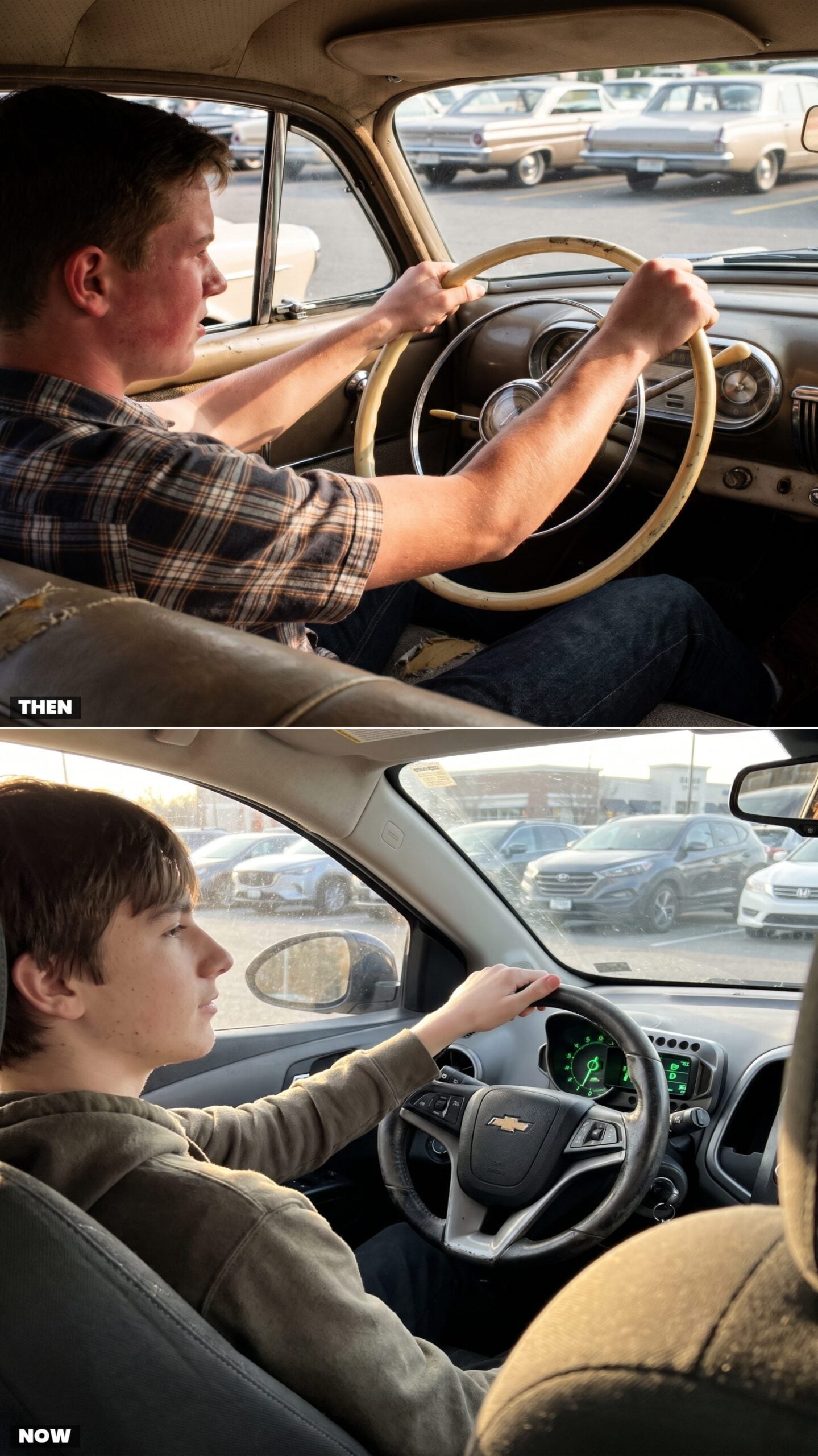
They called it Armstrong steering for a reason. No power assist meant parallel parking a 1953 Chevy was an upper-body event — cranking a huge thin wheel hand-over-hand while standing on the brake. You could tell who drove an old car by the forearms.
The modern first car steers with one finger in a parking lot and firms up at highway speed so it doesn’t feel twitchy. Speed-sensitive assist gives you light effort when you’re crawling and weight when you’re flying. Easier, safer, and completely undramatic. The kid will never understand why Grandpa calls parking a workout.
5. A Mechanical Handbrake vs. an Electronic Parking Brake
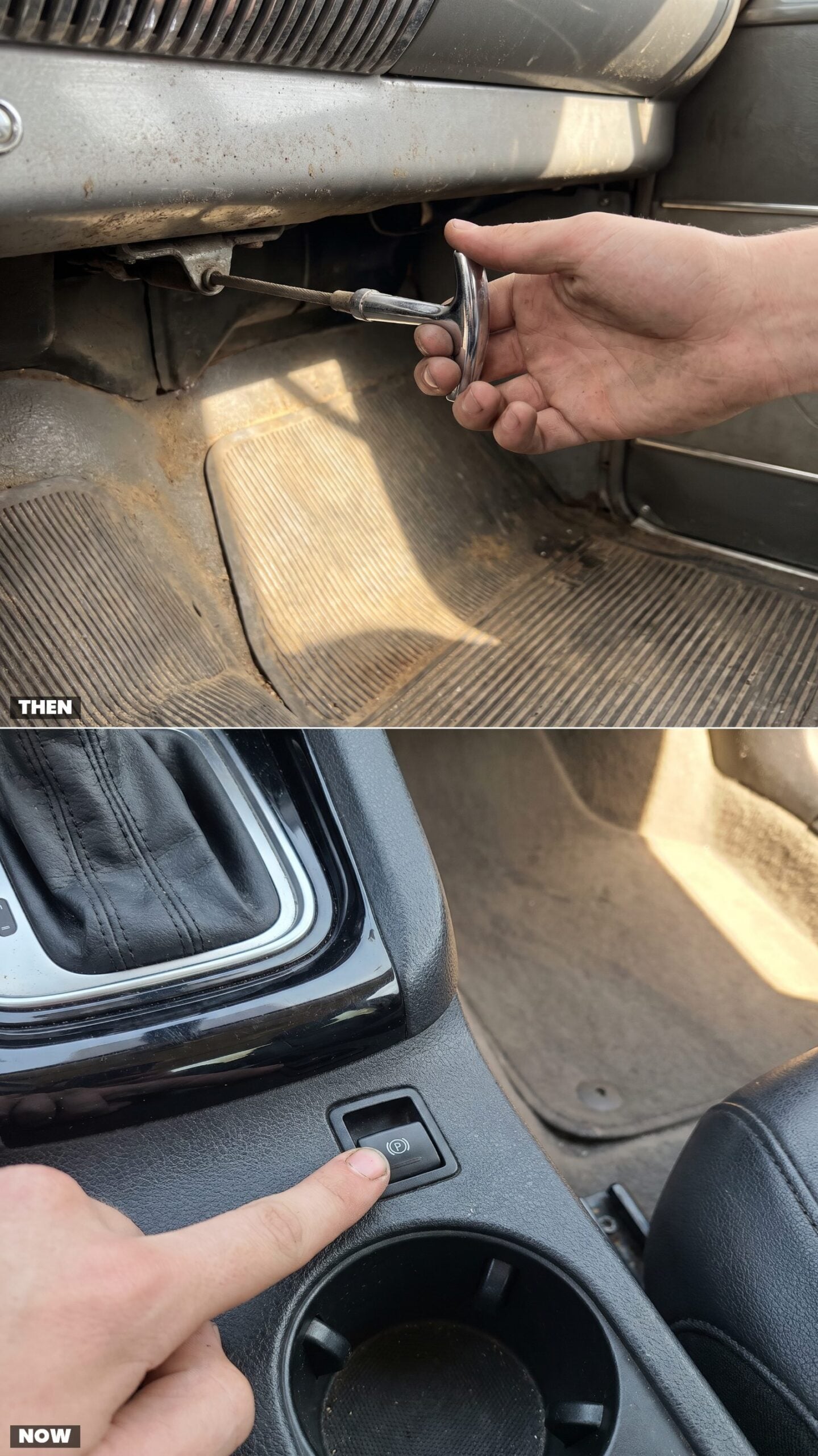
The old parking brake was a thing you felt — a ratcheting lever or a T-handle you yanked until it clicked, and released with a satisfying thunk. On a hill you set it hard and trusted the cable. Half of learning stick shift was the handbrake hill-start, that little dance of clutch, gas, and release that you either nailed or stalled.
Now it’s a button the size of a postage stamp. Press down to set, lift to release, and some cars even release it for you when you drive off. Tidy, quiet, and it killed off a whole genre of teenage parking-lot bragging.
4. Parking by Looking Over Your Shoulder vs. a Rearview Camera
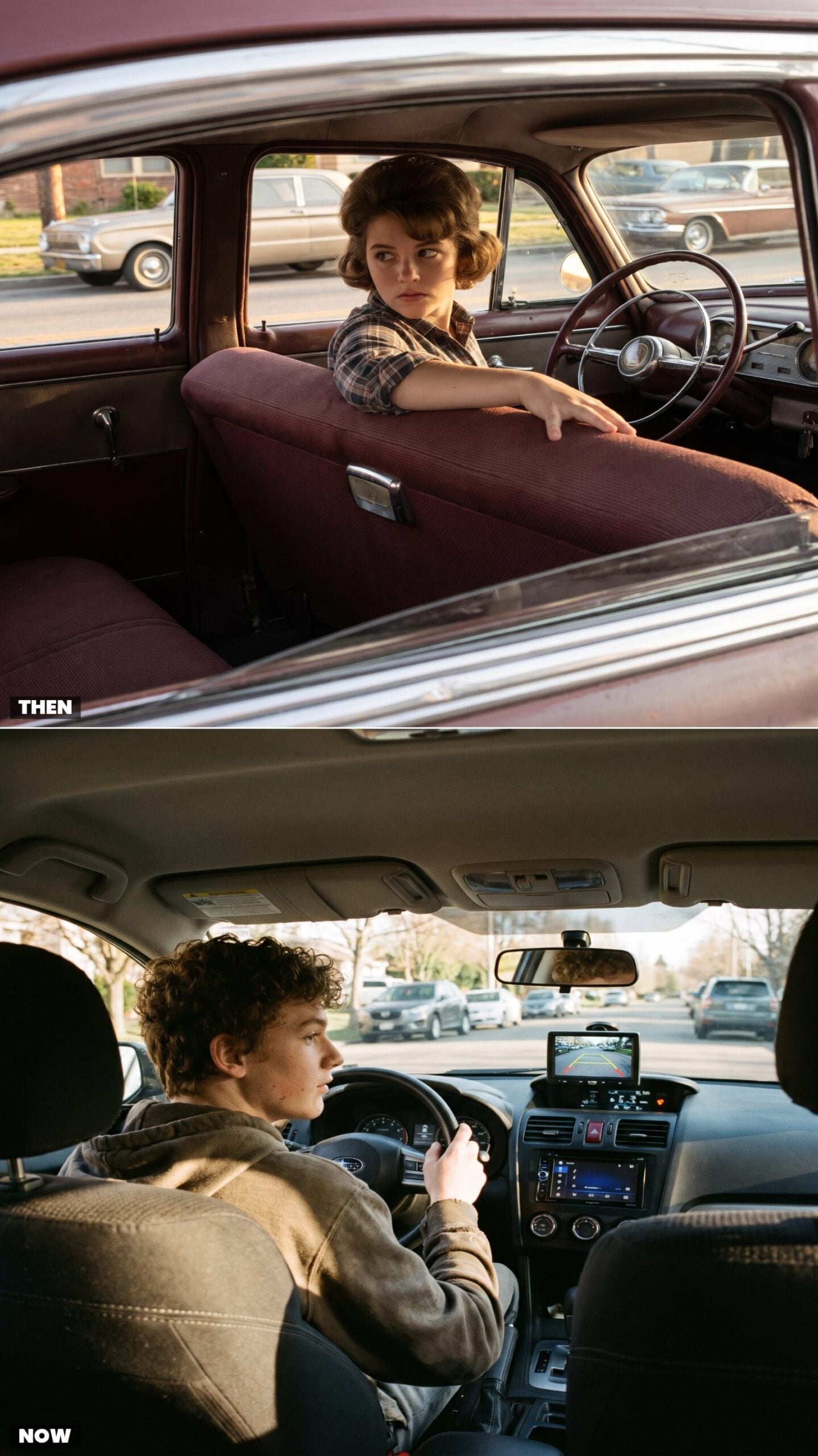
Reversing in 1962 was a full-body move. You threw your arm over the bench seat, craned your neck, and looked straight out the little back window, trusting your gut on where the bumper ended. Backing into a tight spot meant getting out at least once to check. That was normal. Nobody expected the car to help.
The modern first car shows a wide color view of everything behind it, guide lines and all, on a screen the driver barely has to lower their eyes to see. Required equipment on US cars since 2018. The shoulder-check still matters — but that camera caught more fender-benders and worse than anyone wants to count.
3. No Driver Assistance in ’62 vs. a Dashboard That Nags You Today
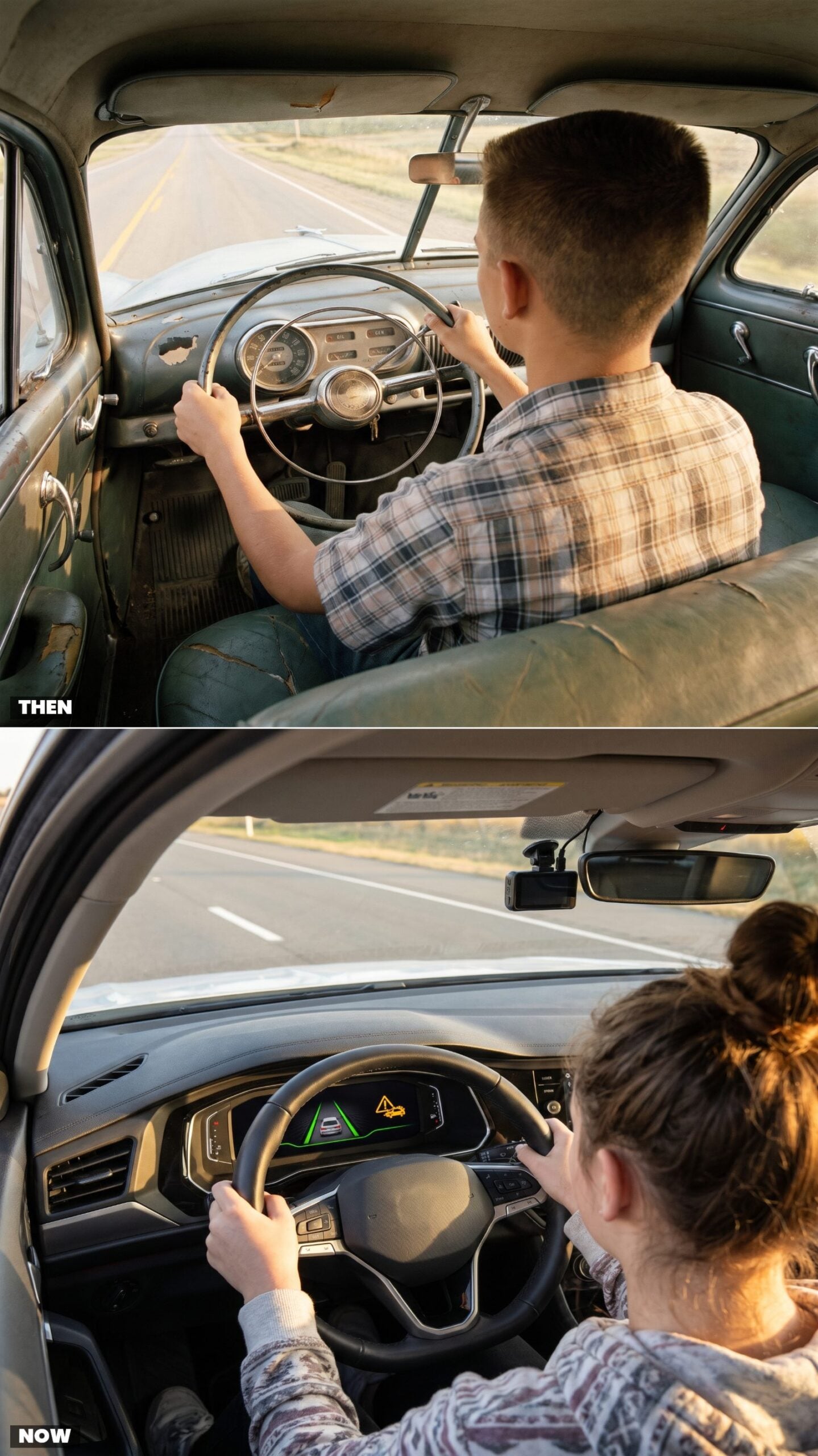
Back in 1962, the car trusted you completely. No beeps, no cameras, no little icon lighting up when you drifted over a line. You stayed in your lane because your mother would hear about it if you didn’t. The 1953 Chevy handed a teenager one speedometer, a steering wheel, and the full weight of consequence. Pay attention or pay for it — that was the safety system, start to finish.
Now the dashboard talks back. Drift an inch and it chirps, follow too close and it flashes, and honestly the thing watches the road harder than most drivers bother to.
2. Fuzzy Dice Swinging From the Mirror vs. a Phone Clamped to the Vent
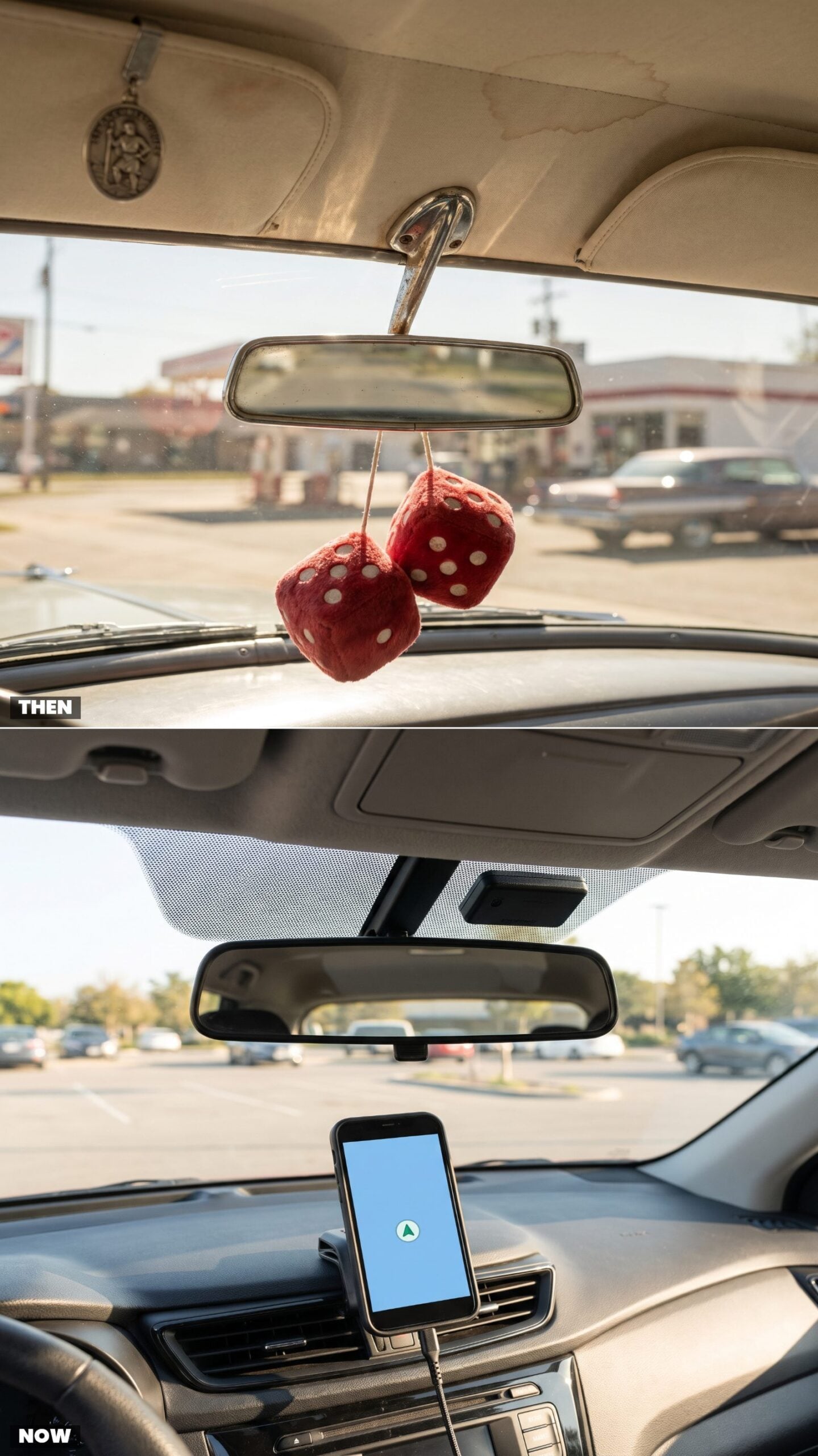
The fuzzy dice meant something. A teenager in 1962 couldn’t change much under the hood, so the personality went where it could reach — a pair of plush dice swinging from the mirror, a St. Christopher on the visor, maybe a wire shifter knob with a lady molded into the plastic. Cheap, loud, and entirely yours.
Today the vent holds a phone, and the phone holds everything. Maps, music, texts, the works. More useful, sure. Also a little less fun, if we’re being honest, because nobody ever bragged about their vent mount.
The dice did nothing and meant everything. The phone does everything and means a cable.
1. A Greasy Tool Roll in the Trunk vs. a Jump Pack the Size of a Paperback
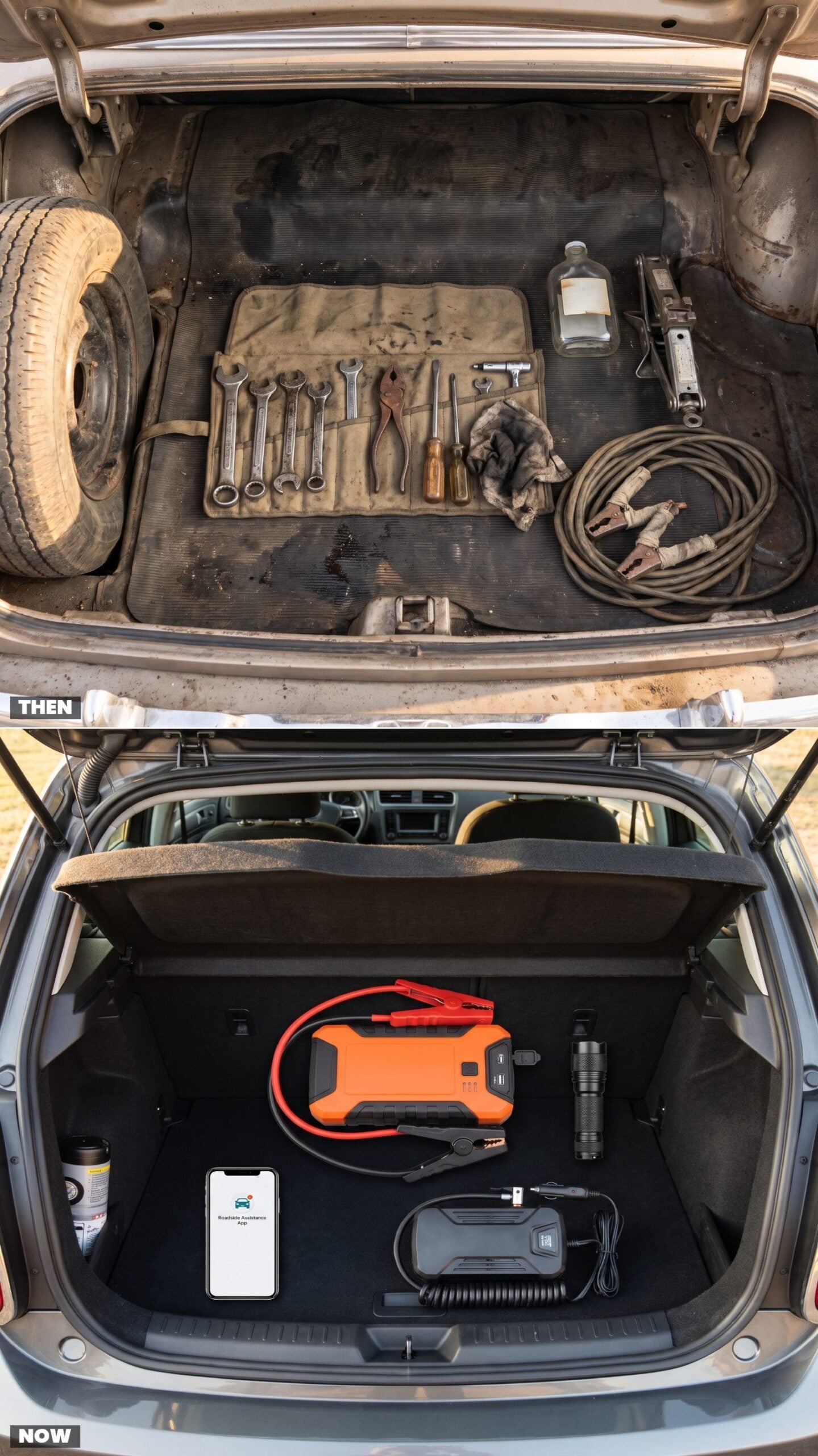
Owning a car in 1962 meant owning the problem too. A teenager kept a canvas tool roll in the trunk because the car would strand you, and probably soon. Wrenches, pliers, a gap gauge, a quart of oil in a glass bottle, and jumper cables thick as garden hoses. You learned to gap a plug on the shoulder of a two-lane road because nobody was coming to do it for you.
Now the whole kit fits in one hand. A lithium jump pack starts a dead battery, charges your phone, and an app summons a flatbed while you wait. Cleaner and easier, and plenty of people never once lift the hood.