
Would you like to save this?
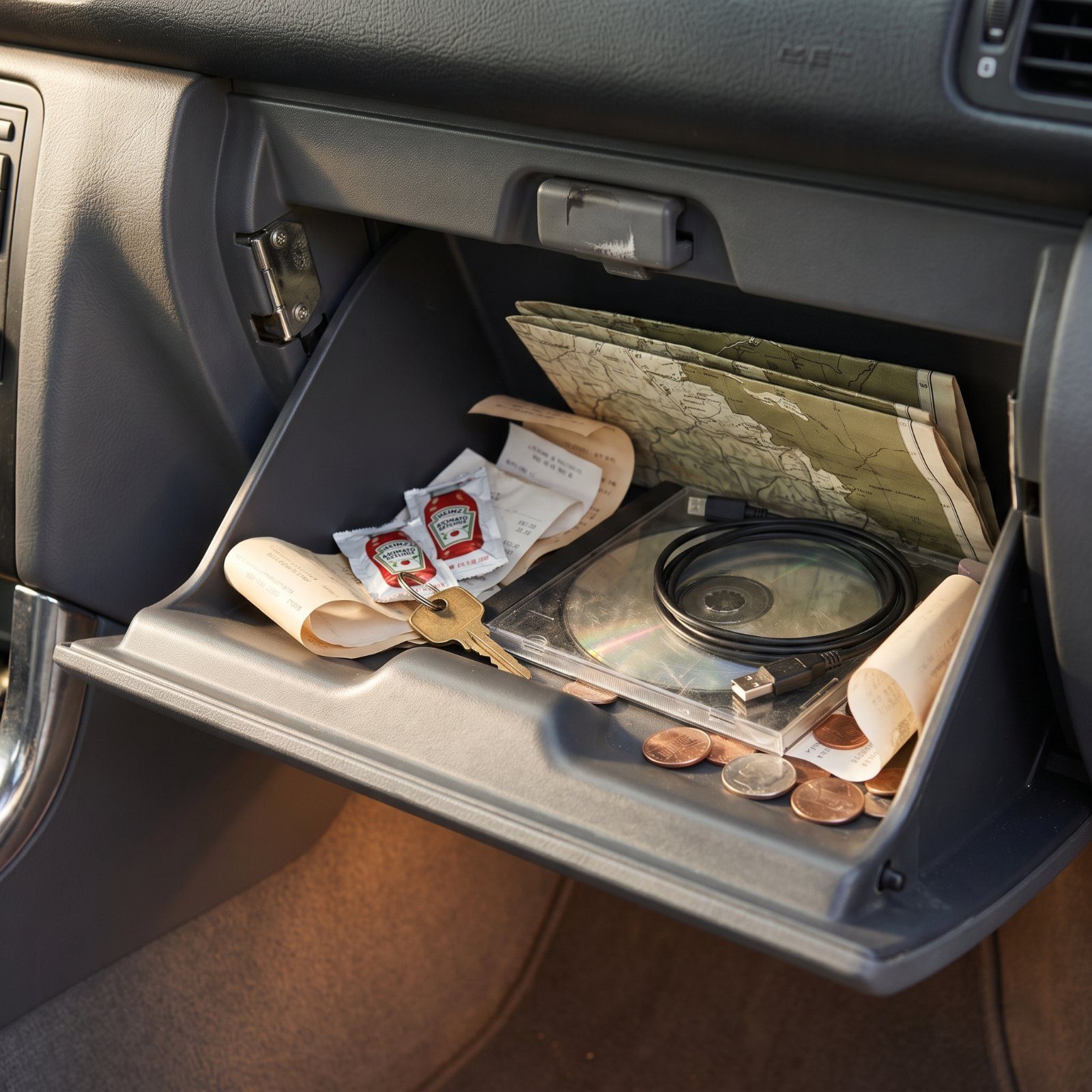
Pop the latch and something falls out. It always does. A crumpled napkin, a receipt from a gas station that closed in 2011, a key you’ve been meaning to identify since who knows when. The glove box is where good intentions go to die and useless objects go to breed. Most of what’s crammed in there is dead weight you’d never miss, though a few things quietly earn their keep. And exactly one item punches so far above its size that leaving home without it borders on foolish. We ranked the whole drawer, worst to best. Some of these you should have tossed a decade ago.
31. The Crusty Ketchup Packets Nobody Has Touched Since the Reagan Years
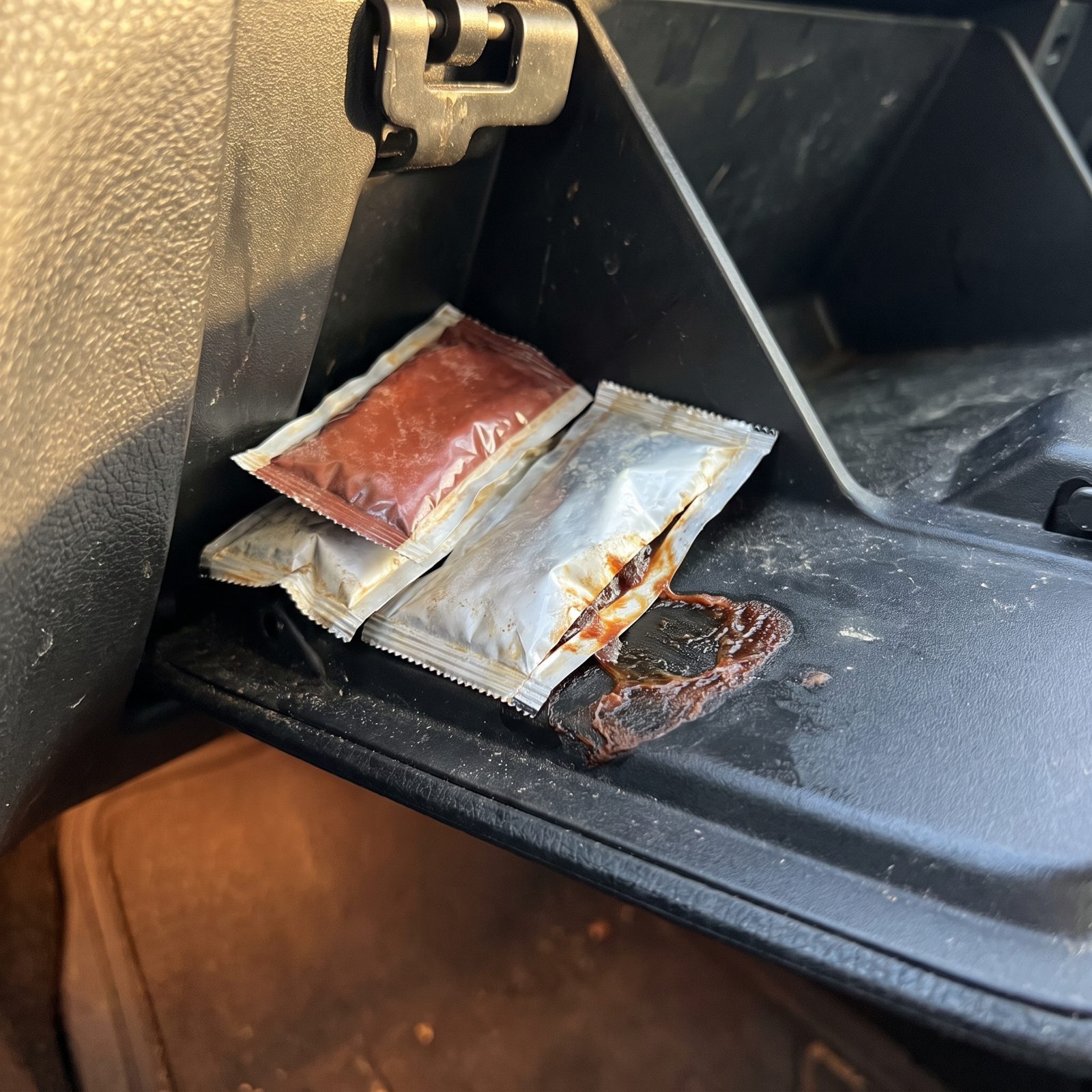
Dead last, and it isn’t close. Those packets have been in there so long the foil has gone soft, and at least one has burst quietly in the summer heat, leaving a smear that smells faintly of a diner parking lot. You kept them for the mythical day you’d need ketchup on the road. That day never came. It never comes.
Toss them. All of them. If you ever genuinely need a condiment mid-trip, that’s a stop, not a supply-chain problem.
30. Faded Gas-Station Receipts You Can No Longer Read
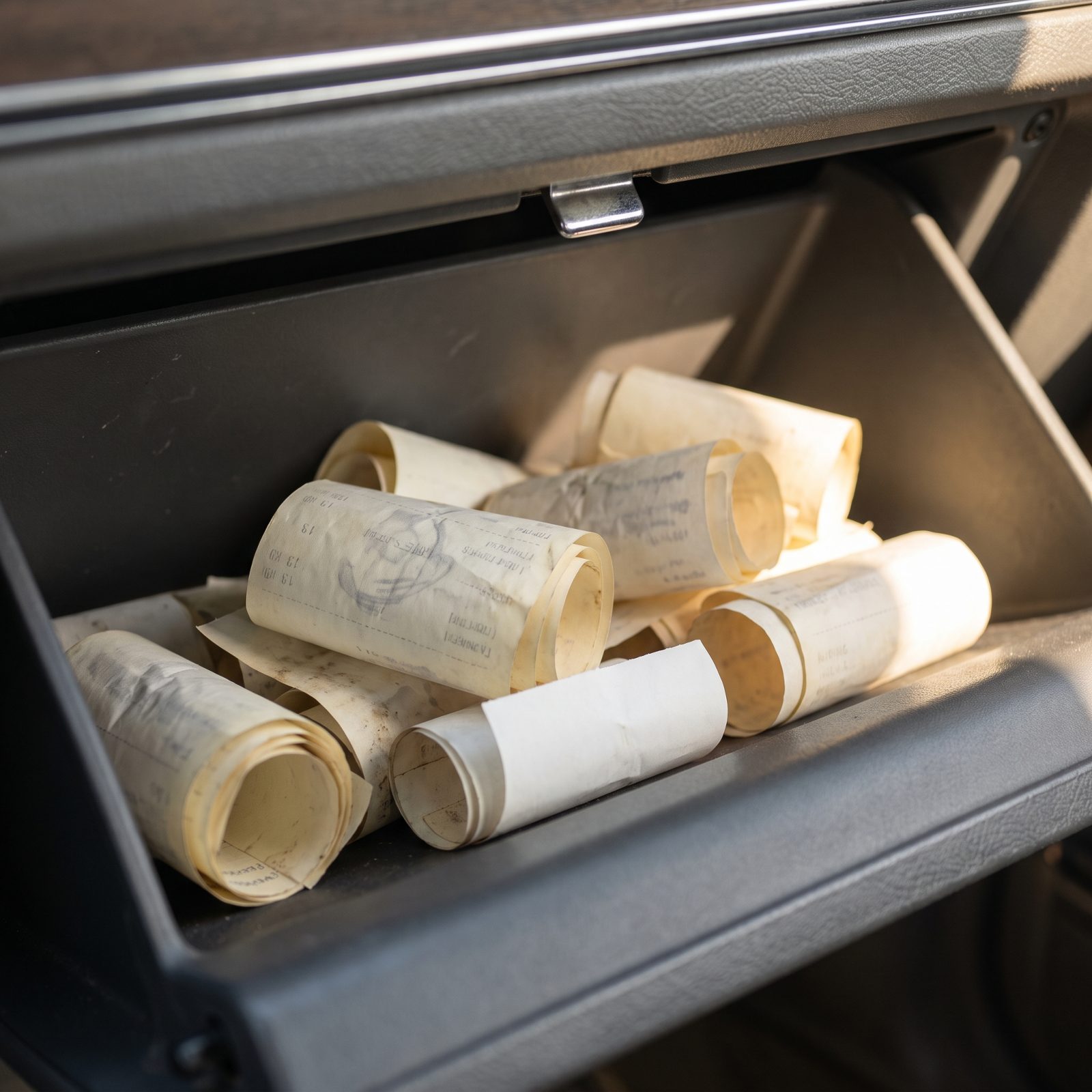
Thermal paper doesn’t age well. A couple of summers baking against the dashboard and the ink surrenders completely, leaving a stack of blank slips that once told you a gallon cost less than a candy bar does now.
You saved them for taxes, or a warranty claim, or some vague reckoning that never arrived. They’re confetti. The only useful thing they do is remind you what gas used to cost, and that just makes you sad.
29. The Ancient Takeout Menu From a Place That Closed
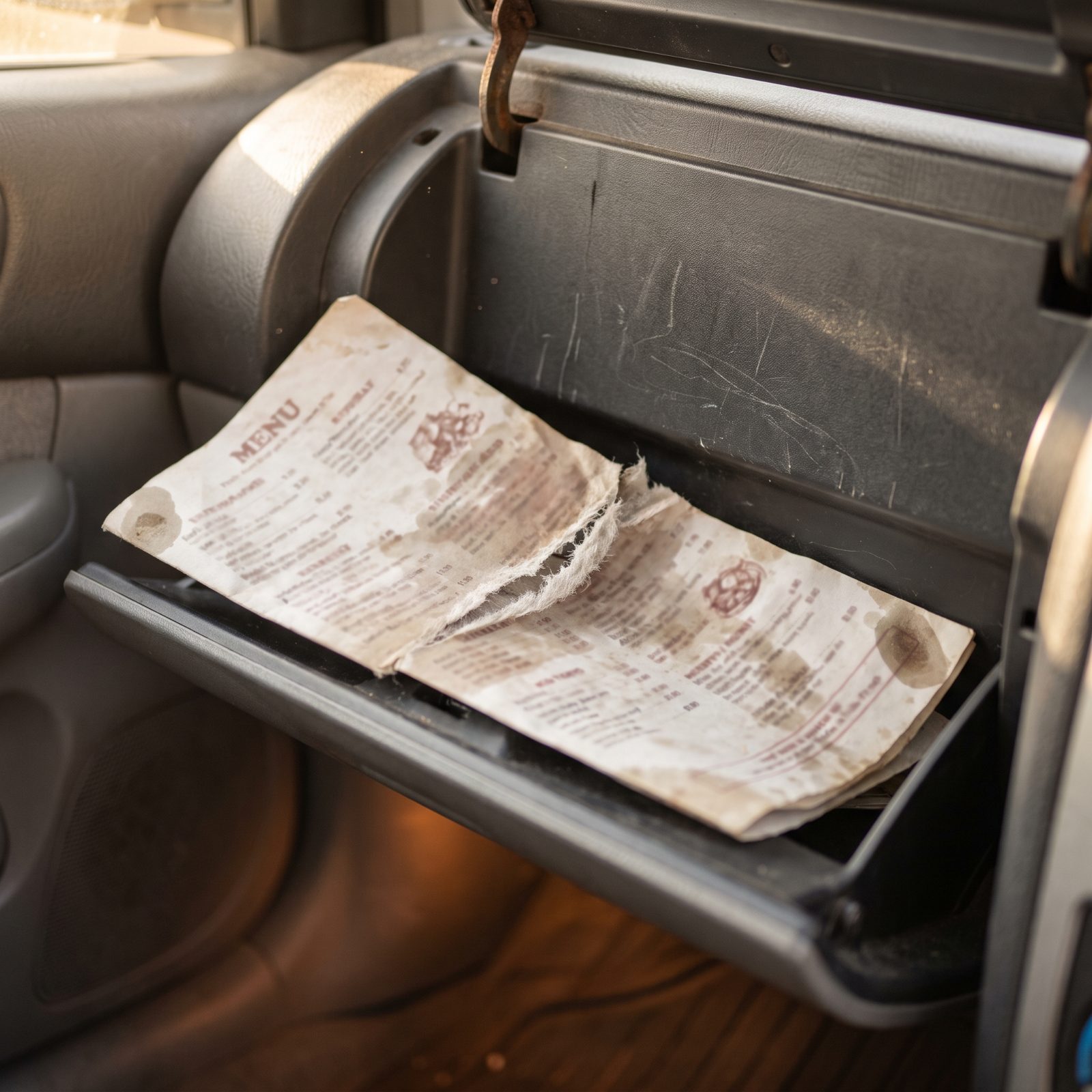
Here’s the joke: the restaurant is gone. Closed, painted over, turned into a nail salon or a vape shop. But the menu lives on, folded into your glove box like a relic of a civilization that once delivered General Tso’s to your door.
Nobody orders from a paper menu anymore. Your phone does it faster and it knows what’s actually still open.
28. The Mystery Key That Opens Absolutely Nothing
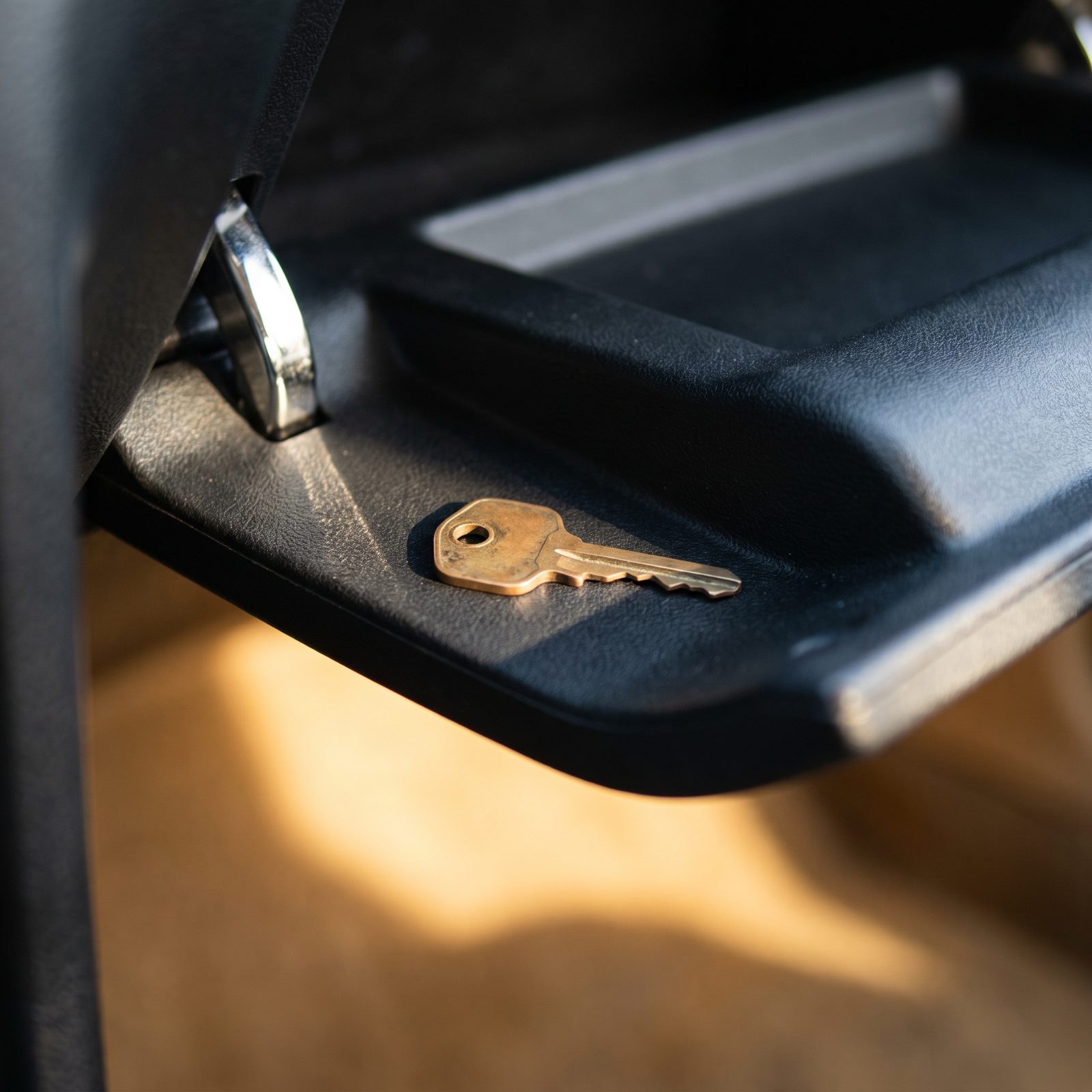
Every glove box has one. A lone brass key, no tag, no memory attached, worn smooth from a lock nobody can name. A shed you sold? A padlock you cut off years ago? The old mailbox at a house two moves back?
You keep it because throwing away a key feels reckless. What if. But there is no what-if. It fits nothing you own — a small metal ghost that’s been haunting that drawer rent-free for a very long time.
27. The Case of Scratched CDs You Can’t Even Play Anymore
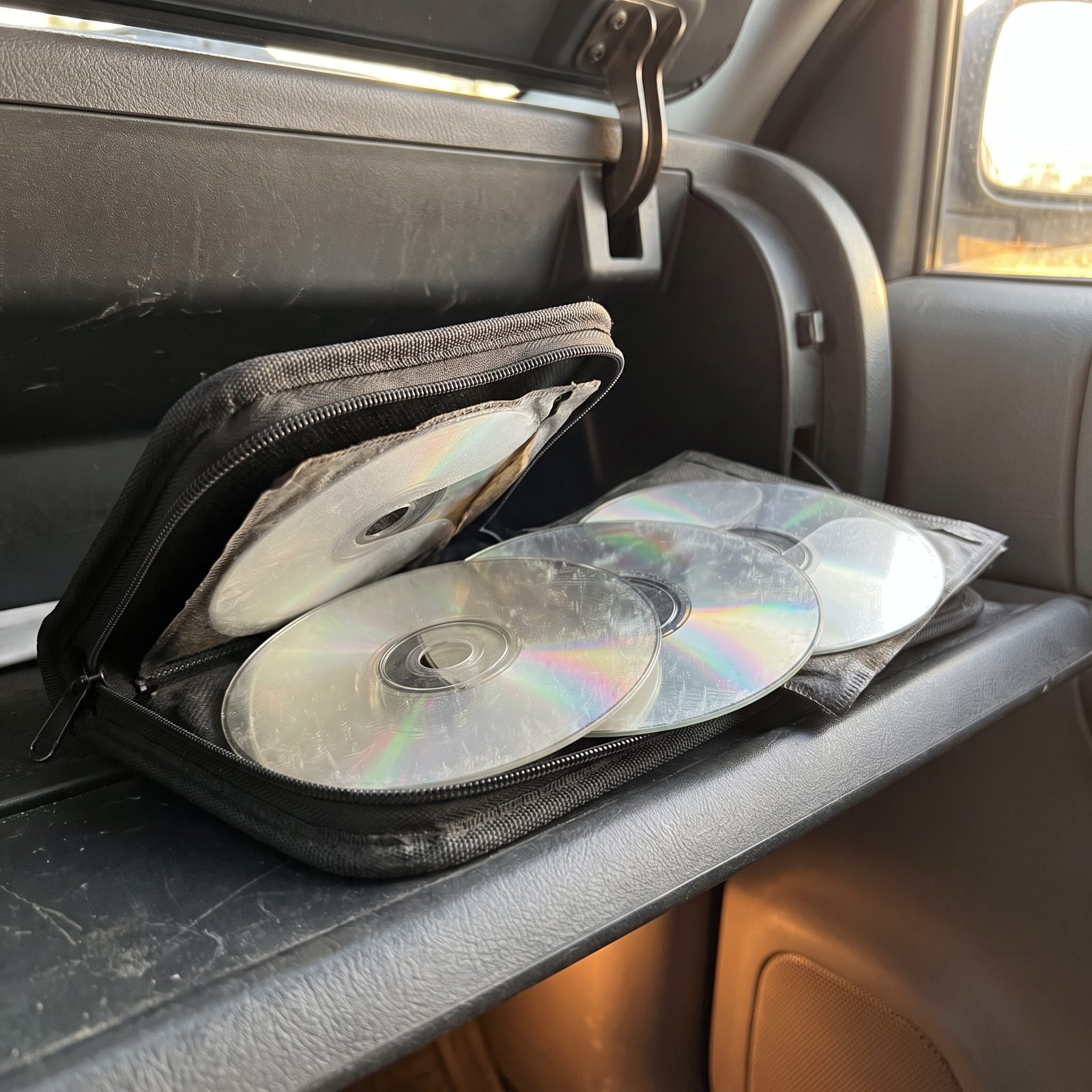
Those discs were a mixtape and a personality once. Now they’re coasters that skip — bottoms hazed with scratches, cases cracked, and half the cars on the road don’t even have a slot to feed them into anymore.
I’ll admit I kept mine longer than I should’ve, out of pure loyalty. But loyalty to a scratched copy of an album I stream for free every day is just clutter wearing a nostalgia costume.
26. The Obsolete Plug-In GPS Unit With the Curly Cord
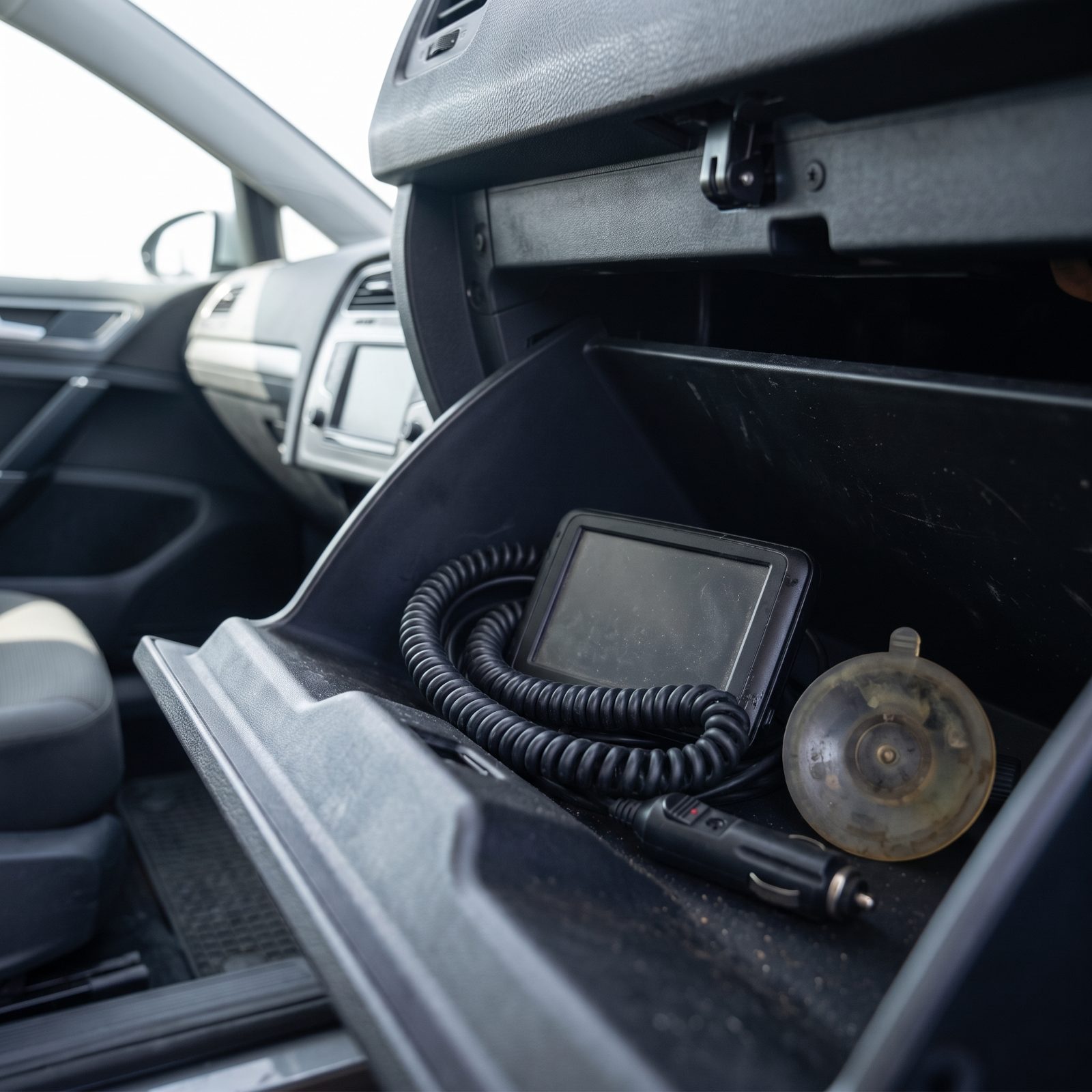
There was a golden window — call it the mid-2000s to the early teens — when a suction-cup GPS on the windshield made you feel like the future had finally shown up. A calm robot voice, a glowing map, no more arguing over the fold-out.
Then the phone in your pocket ate its entire job. Its maps froze in time, roads it’s never heard of now exist, and it wants a paid update for something you get free. Not junk exactly. Just a museum piece that plugs in.
25. The Dried-Out Ballpoint Pen That Betrays You
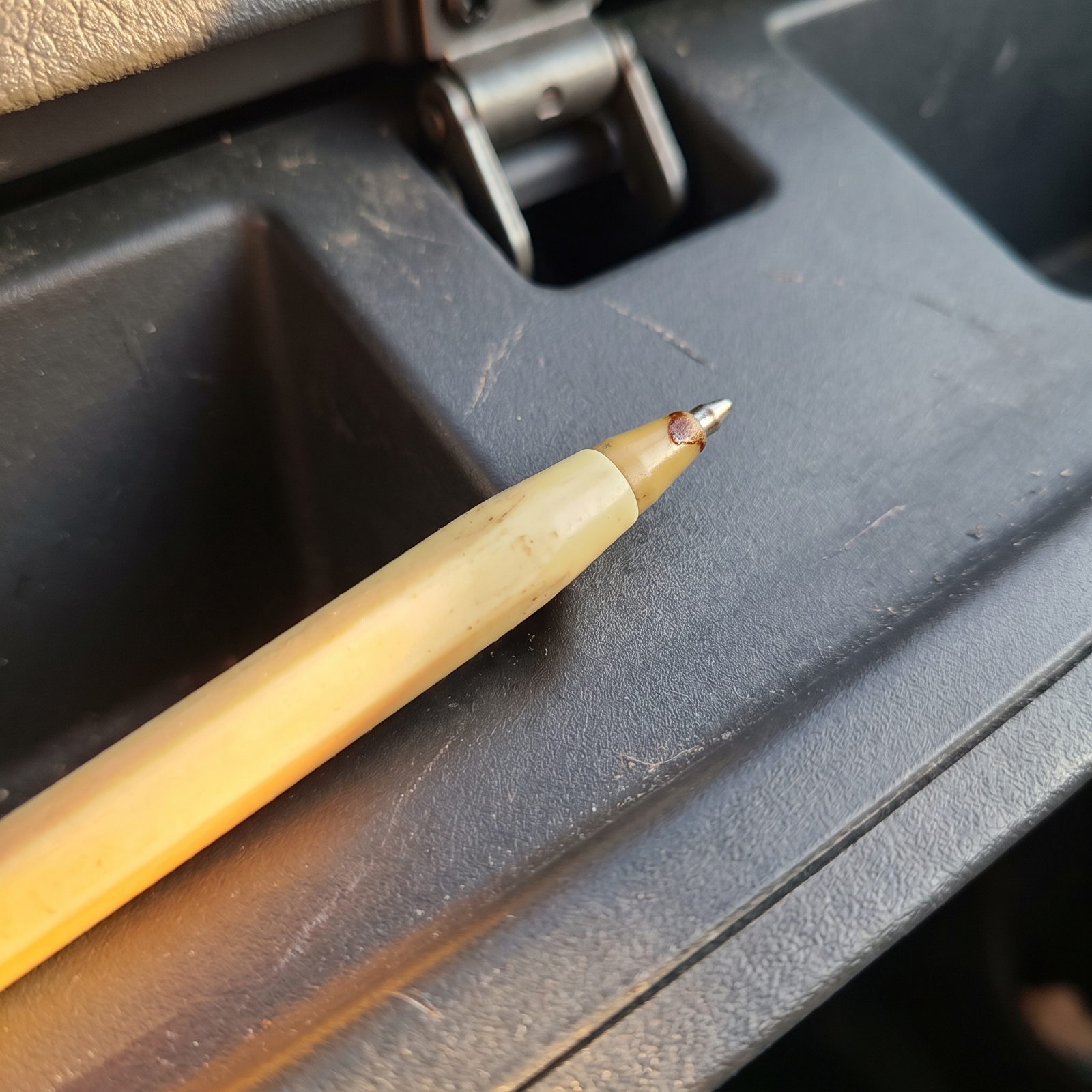
The cruelest object in the drawer. It looks fine. It feels fine. Then you need it — the exact moment a form must be signed or a phone number caught on the fly — and it scratches out a series of colorless ghost lines and nothing more.
A dead pen is worse than no pen, because it costs you the second you’d have spent finding a working one. Scribble-test it. If it fails, out it goes.
24. Loose Toll-Booth Coins Rolling Around the Bottom
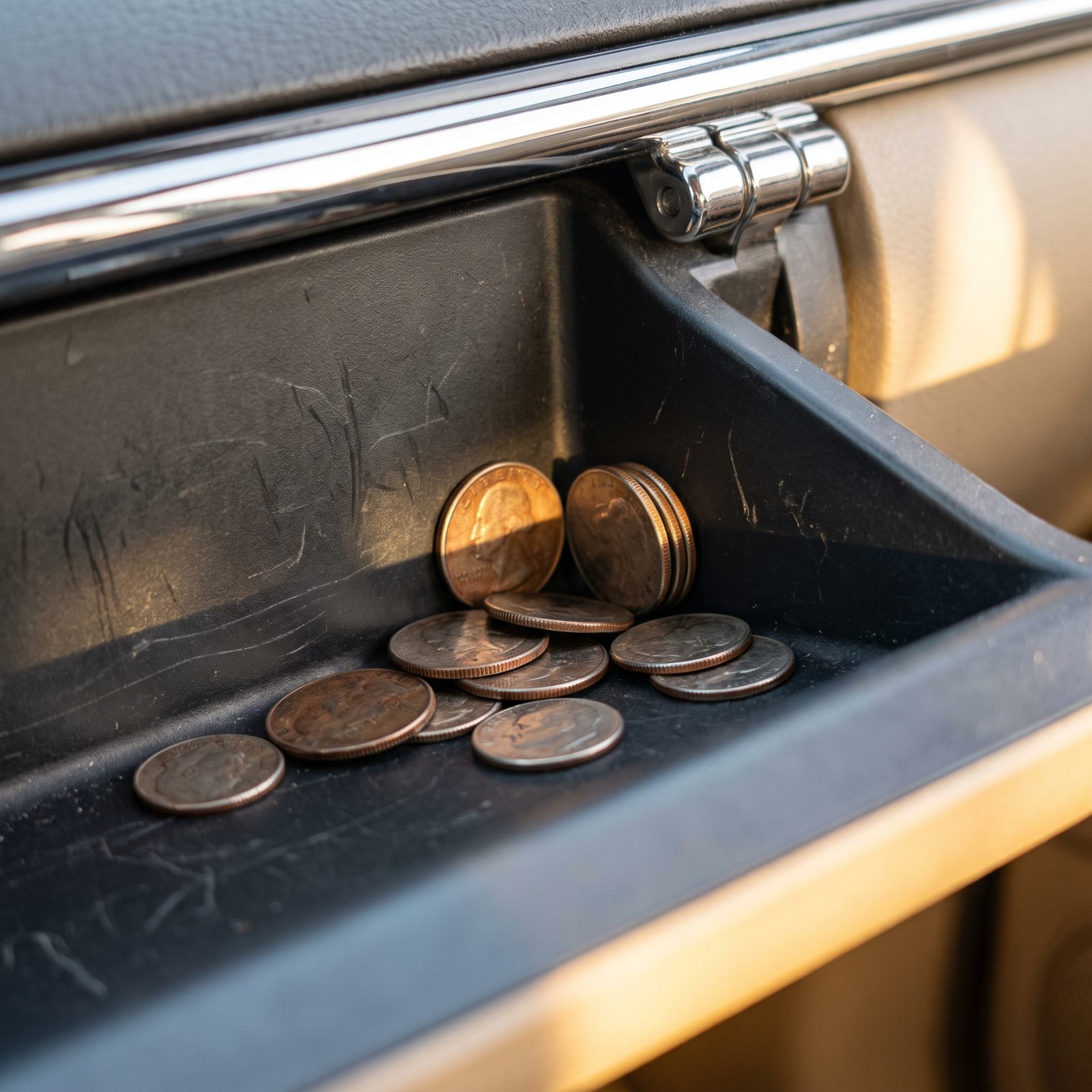
Now we cross into things worth keeping. Those coins clinking in the bottom seem like clutter until you hit a cash-only toll lane at rush hour with a line of horns behind you.
Electronic transponders cover most of it now. But not every bridge, not every rural turnpike, not every parking meter in a town that time forgot. A small handful of quarters is cheap insurance against a genuinely miserable five minutes.
23. A Working Ballpoint Pen (Test It, Then Trust It)
Would you like to save this?
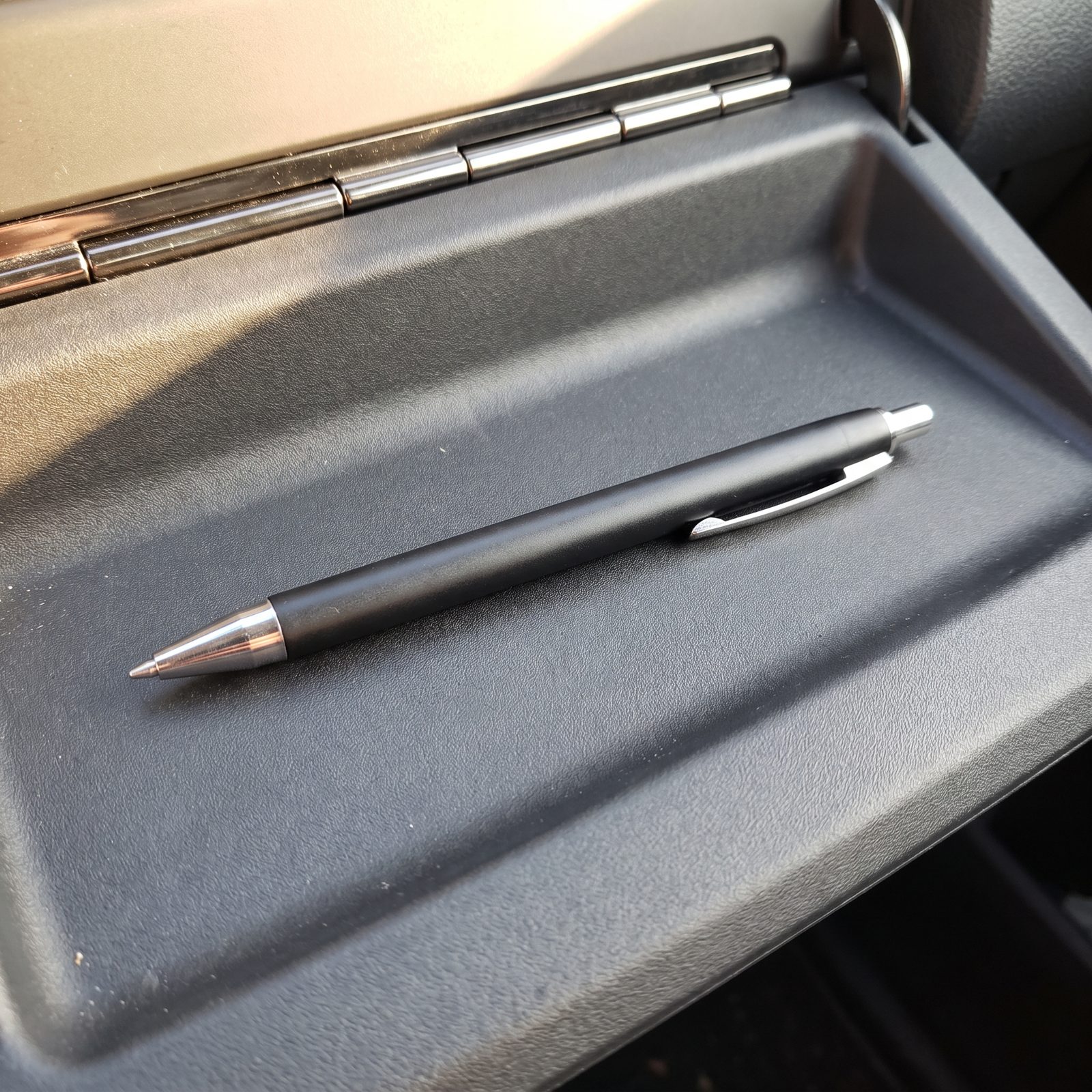
Same object as number 25, one difference that changes everything: this one writes. That’s the whole ranking. A pen that works is a small, quiet hero.
Fender-bender in a parking lot and you need to swap insurance details. A parking permit that wants your plate scrawled on it. A note left on a stranger’s windshield. In every one of those moments, the working pen is the line between handled and helpless. Keep one that writes, and replace it the day it dies.
22. The Printed Road Atlas: The One Thing You Should Never Drop
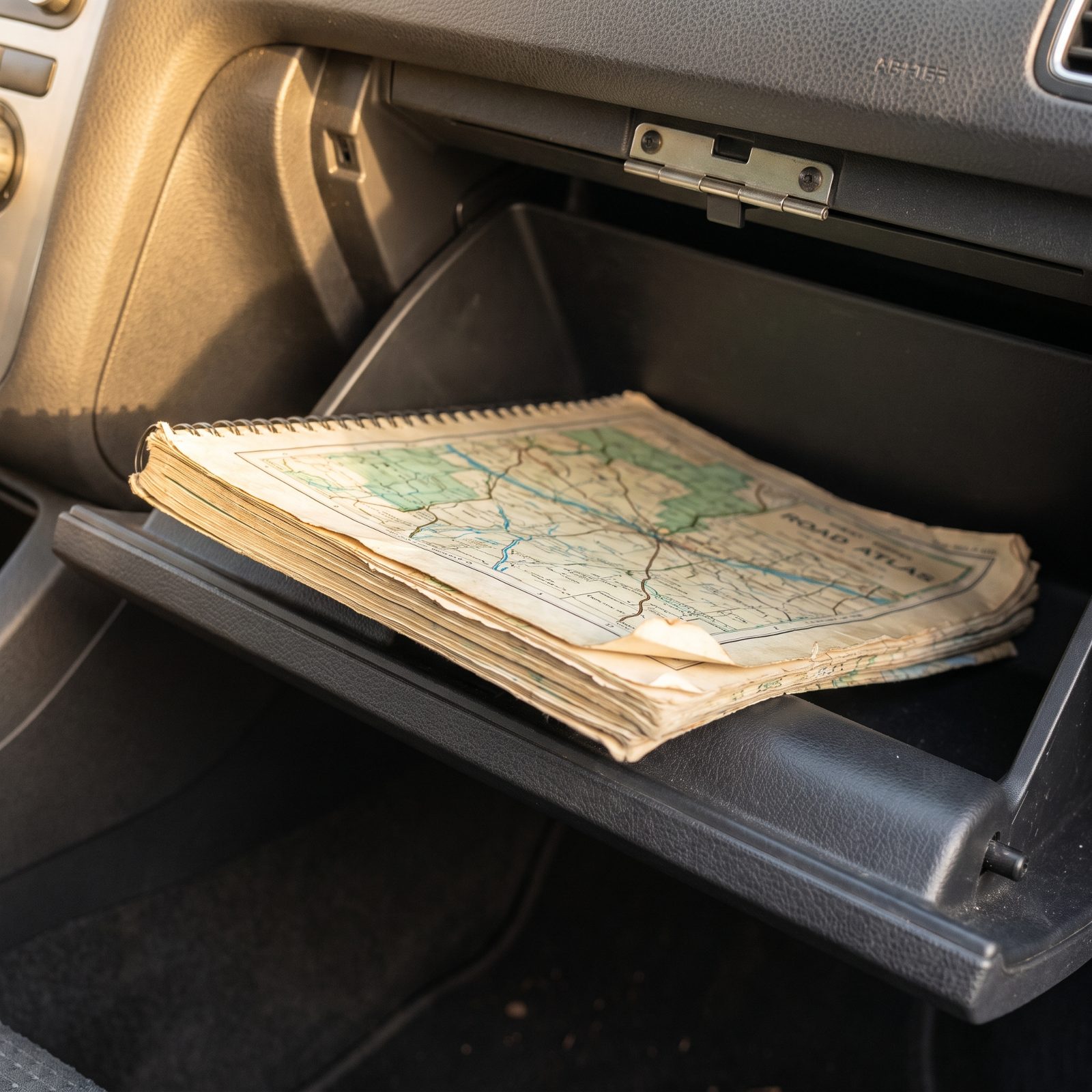
Here’s one every driver should carry, and almost nobody does anymore.
Your phone is a miracle right up until it isn’t. Dead battery. No signal in a dead zone between towns. A dropped charger cable. The moment the little blue dot vanishes, you’re a stranger in a strange place with no idea which way is home. A paper atlas asks for no battery, no bars, and no permission.
The map that works when everything else quits is the only one that ever really mattered.
Buy a current one, fold it once so you can grab it fast, and forget it’s there until the day it saves you hours. That day comes for everyone eventually — usually on a two-lane road at dusk with the fuel light on.
21. The Folded Reusable Shopping Bag Nobody Remembers Packing
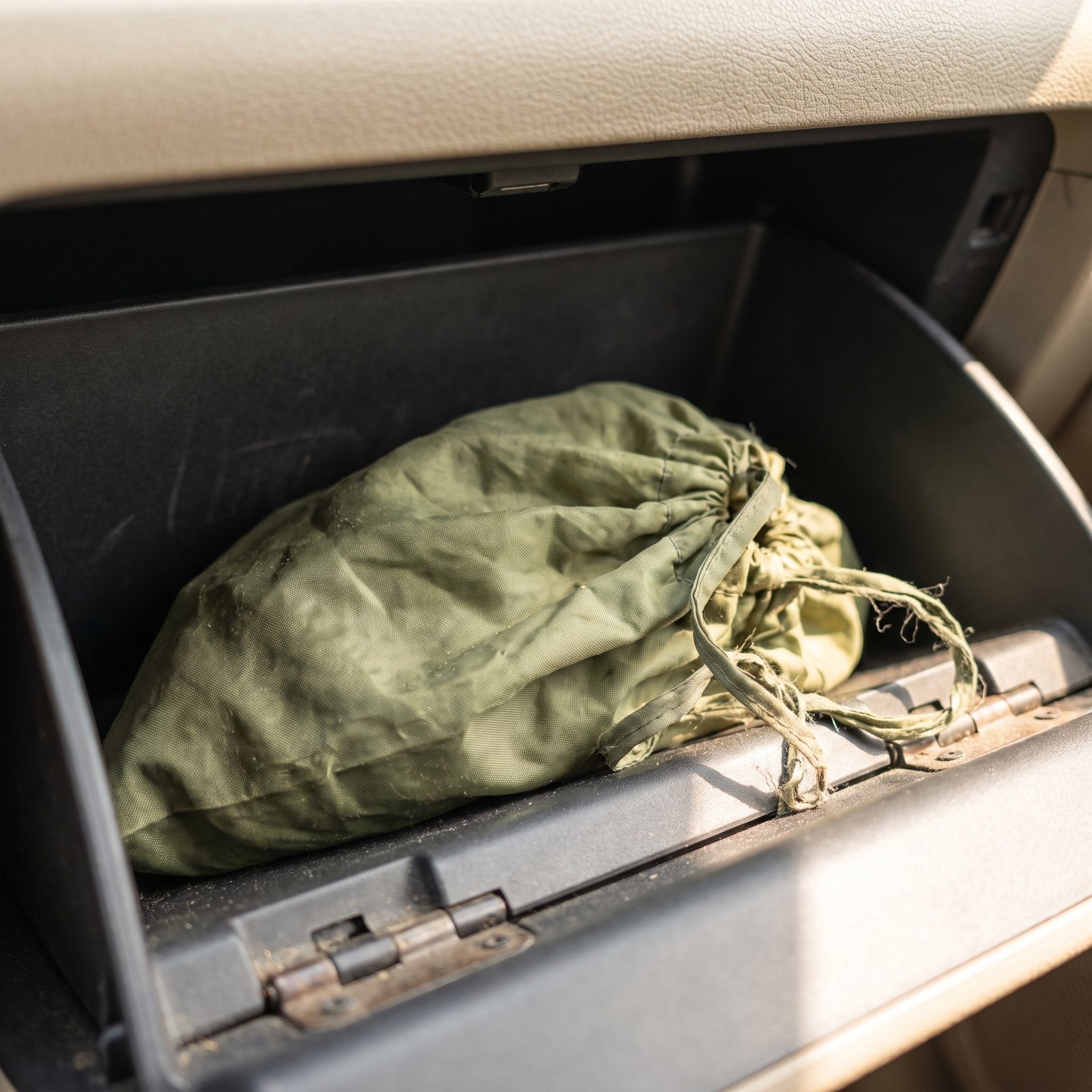
The reusable bag in your glove box works great, right up until the exact moment you need it — at which point it’s sitting home on the kitchen counter. That’s the entire life cycle. It rides around for months as pure ballast, then vanishes from memory the second you actually reach the store.
Useful in theory, dead weight in practice. It lands this low not because the bag is bad but because a glove box is the worst possible place to keep one. Move it to the door pocket where you’ll actually see it.
20. The Microfiber Cloth That’s Doing More Than You Think
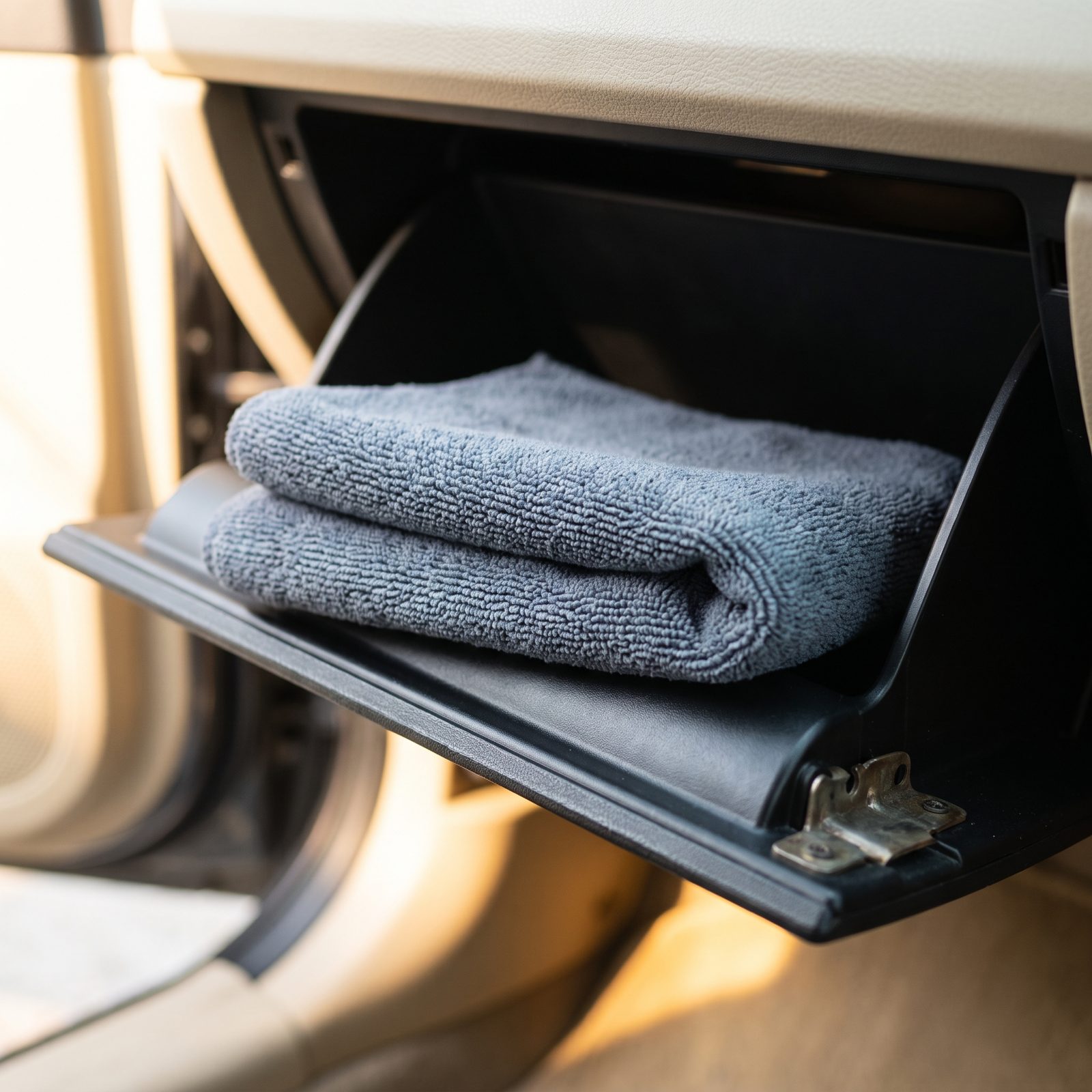
Most people underrate this one. A folded microfiber cloth costs almost nothing and quietly earns its spot every single week — foggy glass at a stoplight, a smeared side mirror before you back out, that greasy thumbprint some passenger left on the touchscreen. It handles all of it without streaking.
Keep it clean and it’s one of the rare glove-box residents that actually improves the drive instead of just riding along.
19. The Travel Pack of Tissues, Half-Crushed and Still Handy
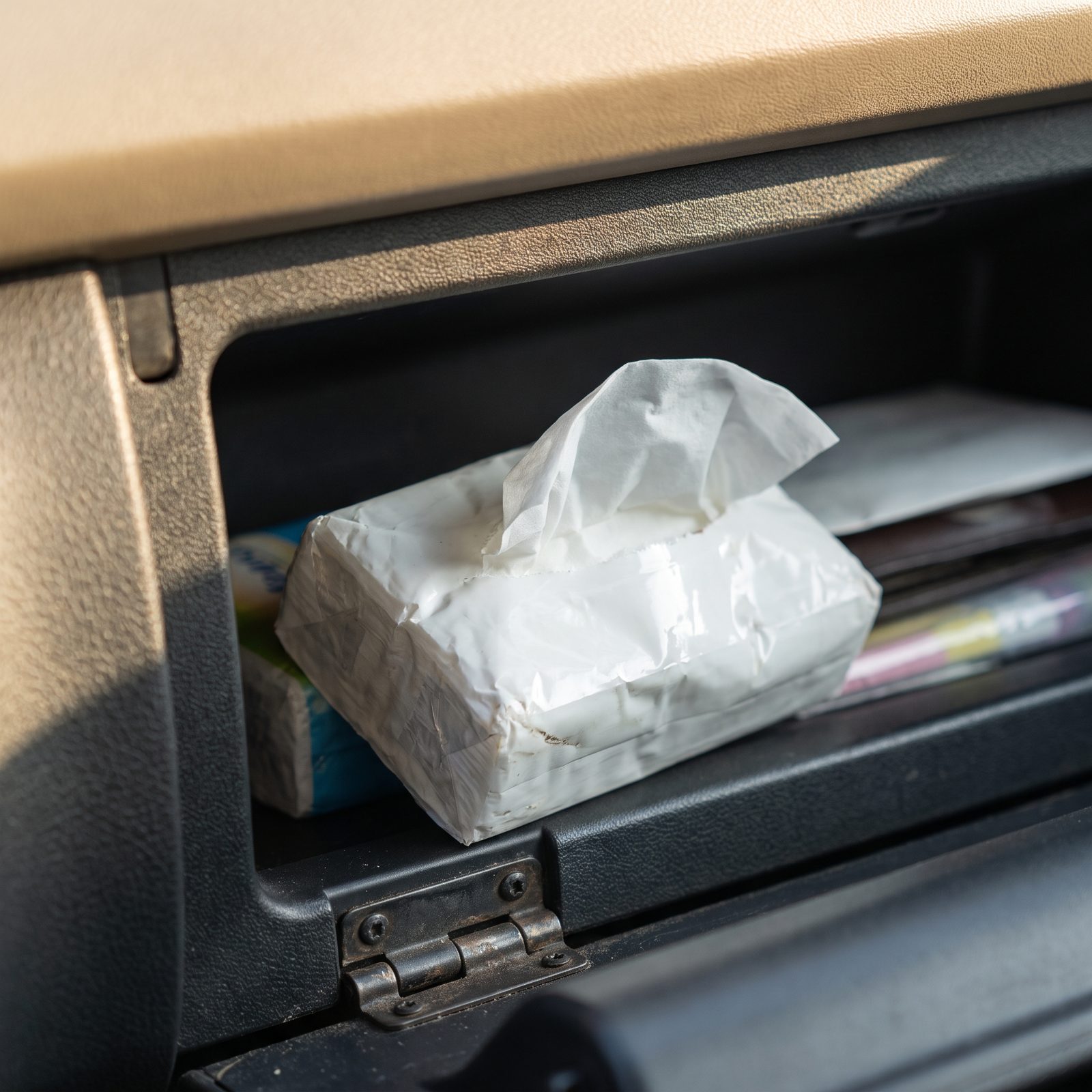
Small, cheap, and it never asks for anything. The travel tissue pack takes a middle spot because it covers the little emergencies that never make the news: a runny nose in January, a spilled coffee, a kid with sticky hands, a mystery drip on the seat.
Won’t save your life. But you’ll reach for it more than almost anything else here, and that counts for something.
18. The Hand Sanitizer That’s Probably Half-Dried Out
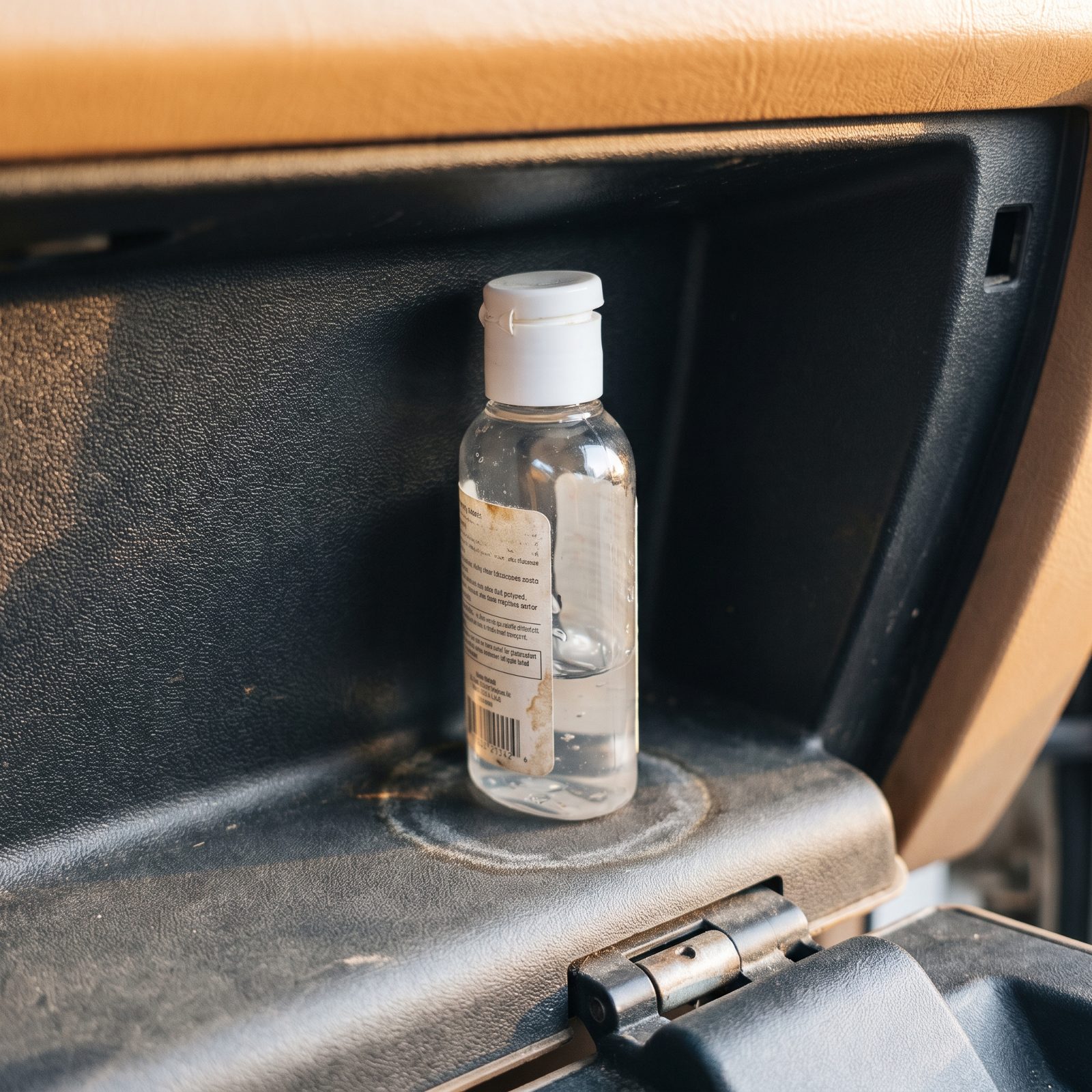
Nobody wants to hear this, but the sanitizer in your glove box is probably shot. Alcohol evaporates. A summer parked in the sun cooks the good stuff right out of it, and what’s left is a sad, thickened gel that smells about right and does half the job.
Handy enough after gas pumps and drive-thru handoffs, so it stays on the list. Just don’t trust the one that’s been baking since last July — swap it when the bottle goes cloudy.
17. The Nitrile Gloves You’ll Be Glad You Kept
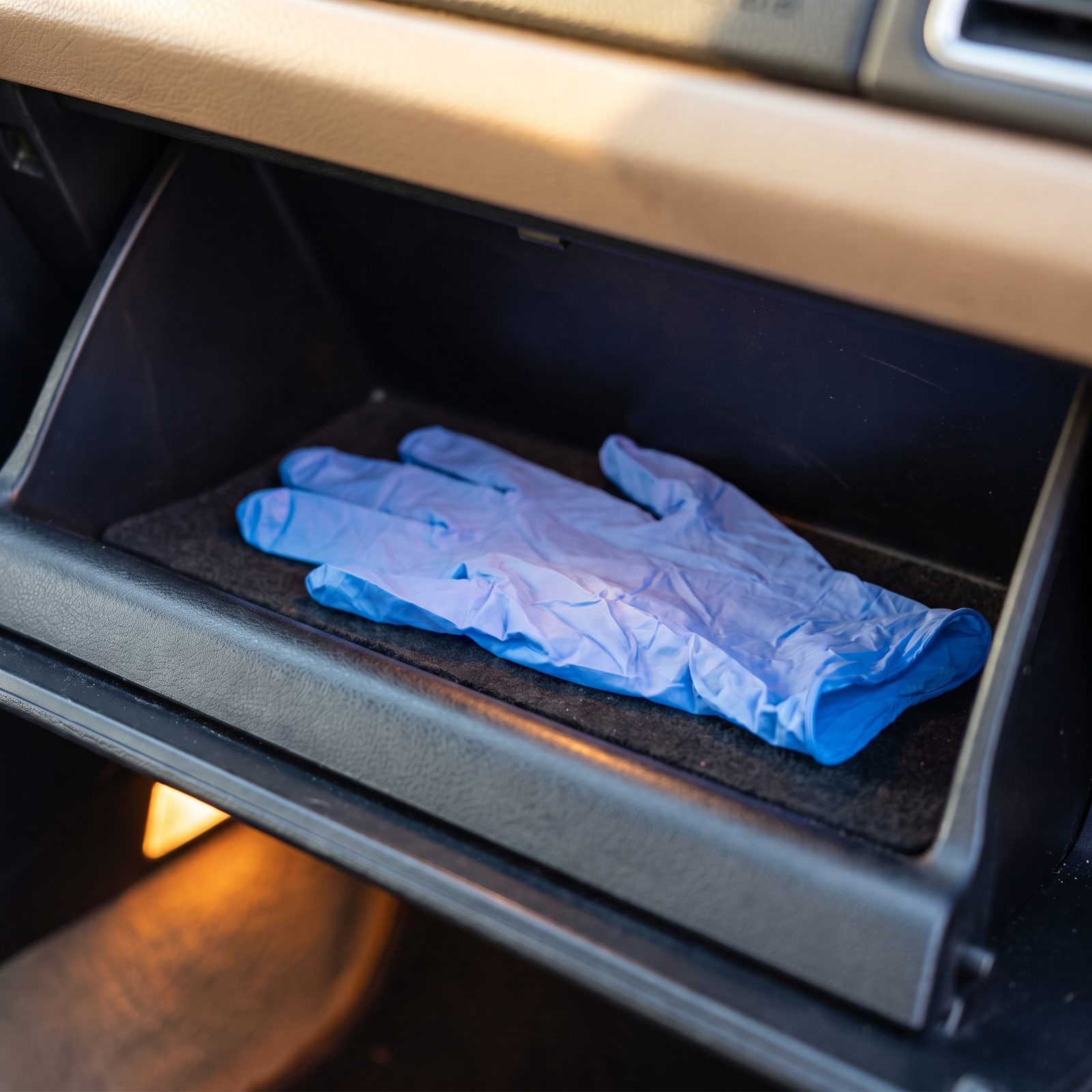
Now the list gets serious. A pair of nitrile gloves takes up no room and lasts for years, which is more than most of what’s crammed in there can claim.
Checking your oil in good clothes. Changing a tire in the rain. Wrestling a battery, a coolant cap, anything that leaves your hands black or worse. They keep the grime off you when there’s no sink for miles. I’ve fished a set out at the worst possible moment and never once regretted it.
16. Sunglasses: The One Piece of Clutter That Fights Fatigue
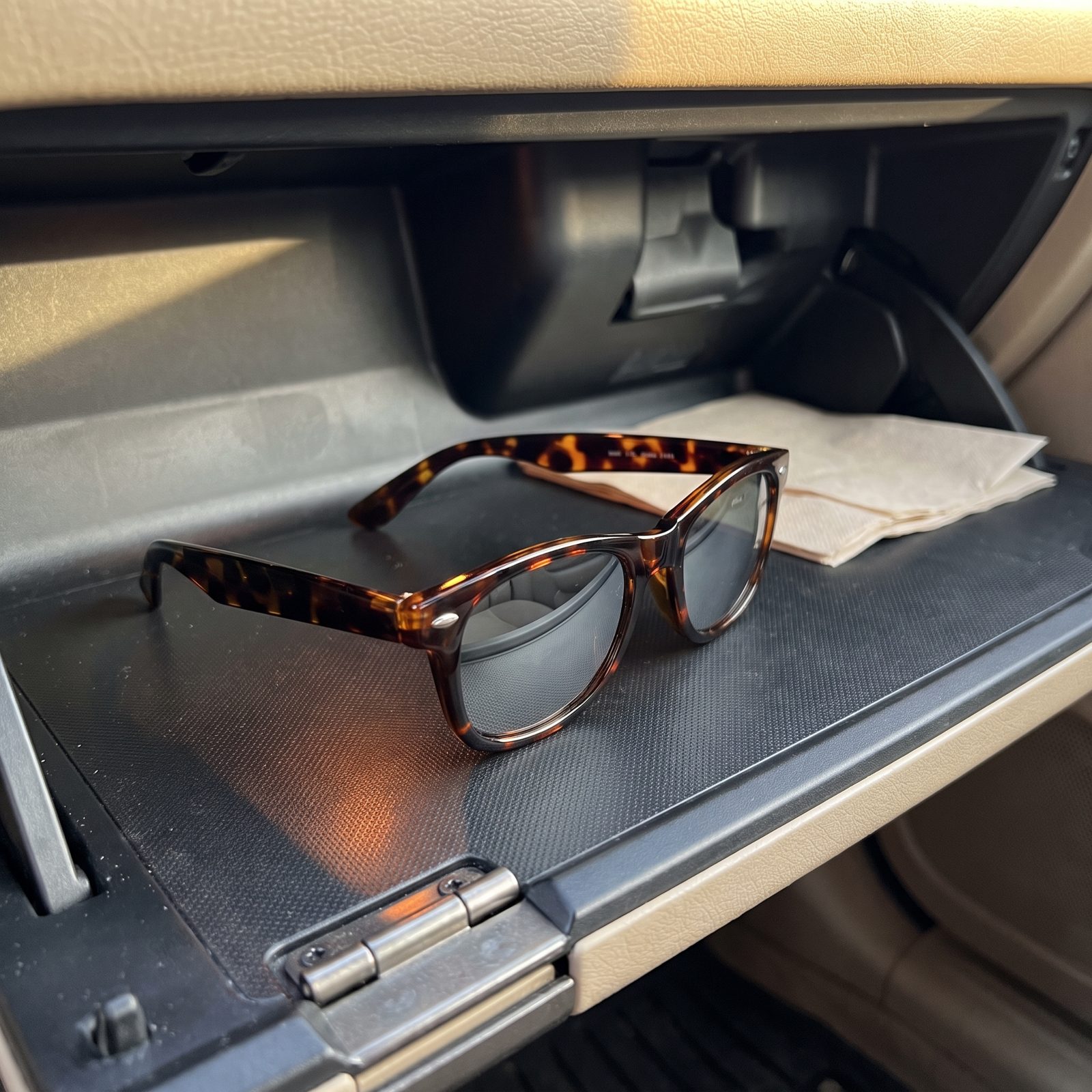
Everyone keeps a pair in there, and almost nobody counts them as safety gear. They should. Low winter sun at 5 p.m. can blank out the road entirely, and an hour of squinting into glare leaves you drained without knowing why.
A backup pair of tortoiseshell sunglasses stashed in the glove box means you’re never caught out on a bright morning drive — worth a real ranking, not the throwaway spot most folks would hand them.
15. The Unopened Water Bottle Standing By For a Bad Day
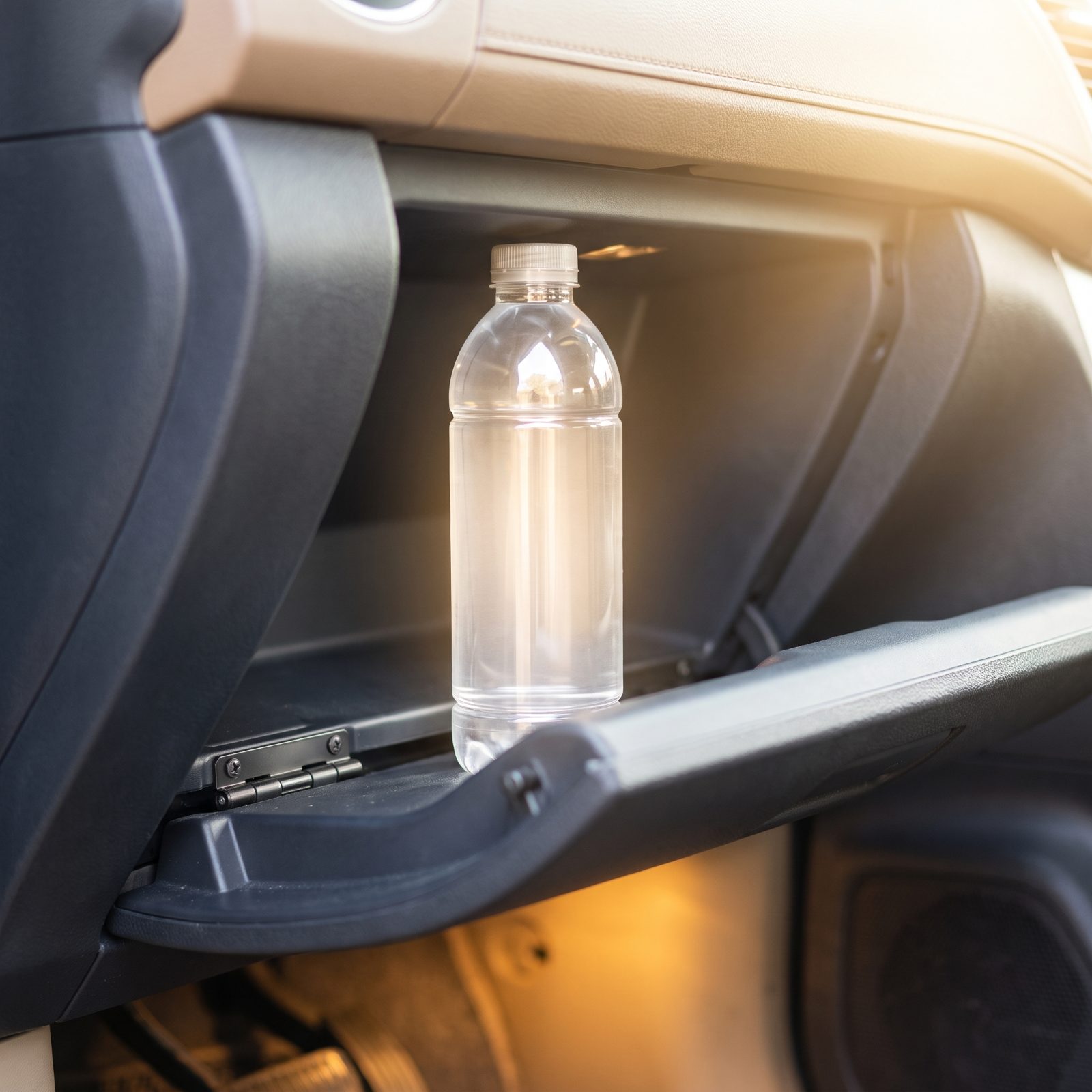
An unopened bottle of water climbs high here because it pulls double duty. On a good day it’s a drink when you’re stuck in traffic with a dry throat. On a bad one — broken down on a hot shoulder with no shade — it’s the line between uncomfortable and genuinely dangerous.
One catch worth knowing: rotate it. A bottle left cooking in the sun for a year tastes like the plastic it came in. Fresh water, swapped every few months, is one of the smartest things you can carry.
14. The Disposable Rain Poncho, Flat and Waiting
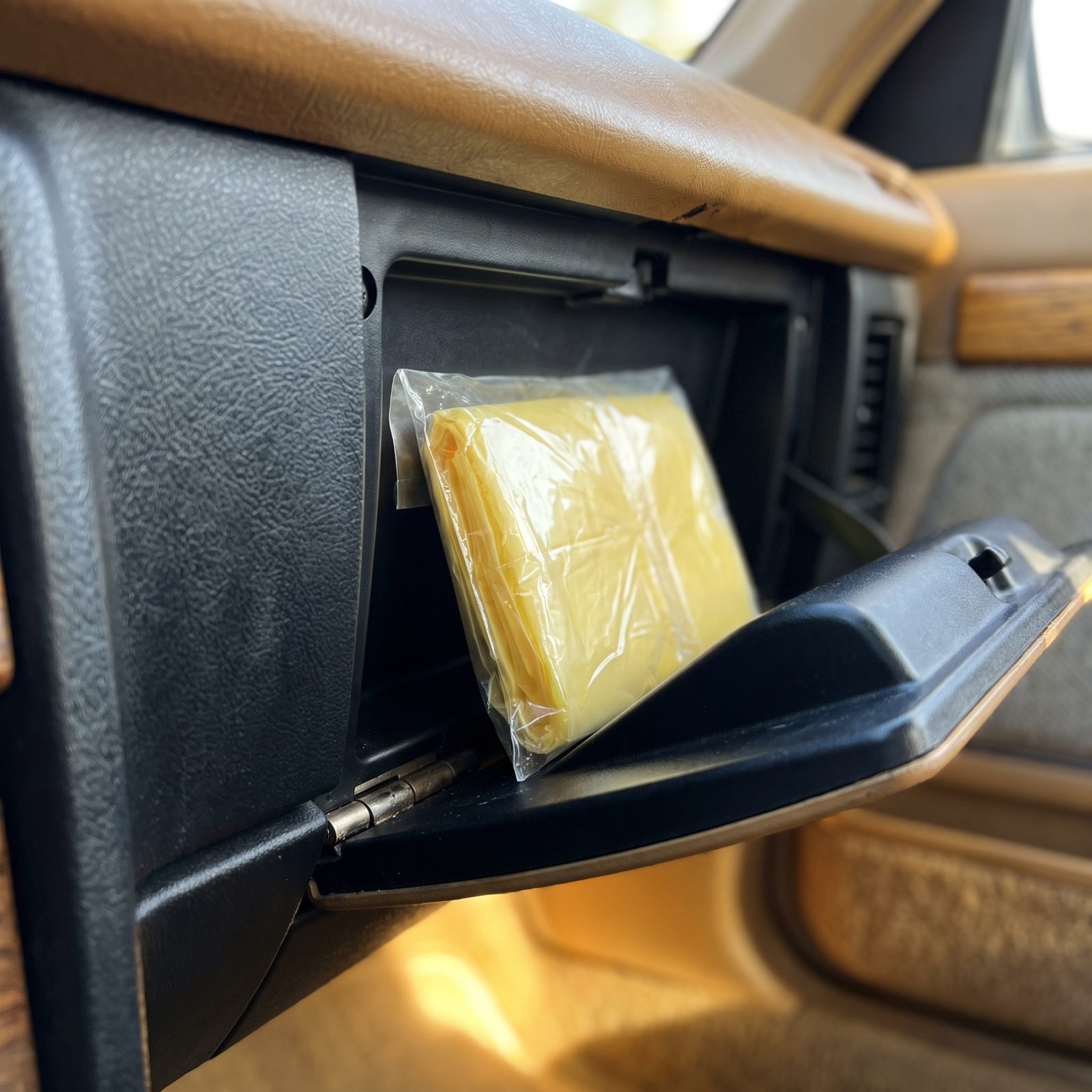
Folds down to the size of a deck of cards and weighs nothing. That’s the whole pitch, and it’s a good one.
Picture a flat tire on the highway shoulder in a downpour. You’re either changing it soaked to the bone, or you spend ten seconds pulling a poncho over your head first. One of those makes a miserable job slightly less miserable. The poncho ranks up here because it does its one job at the exact moment you’d give anything for it.
13. The Compact Emergency Blanket That Punches Above Its Size
Would you like to save this?
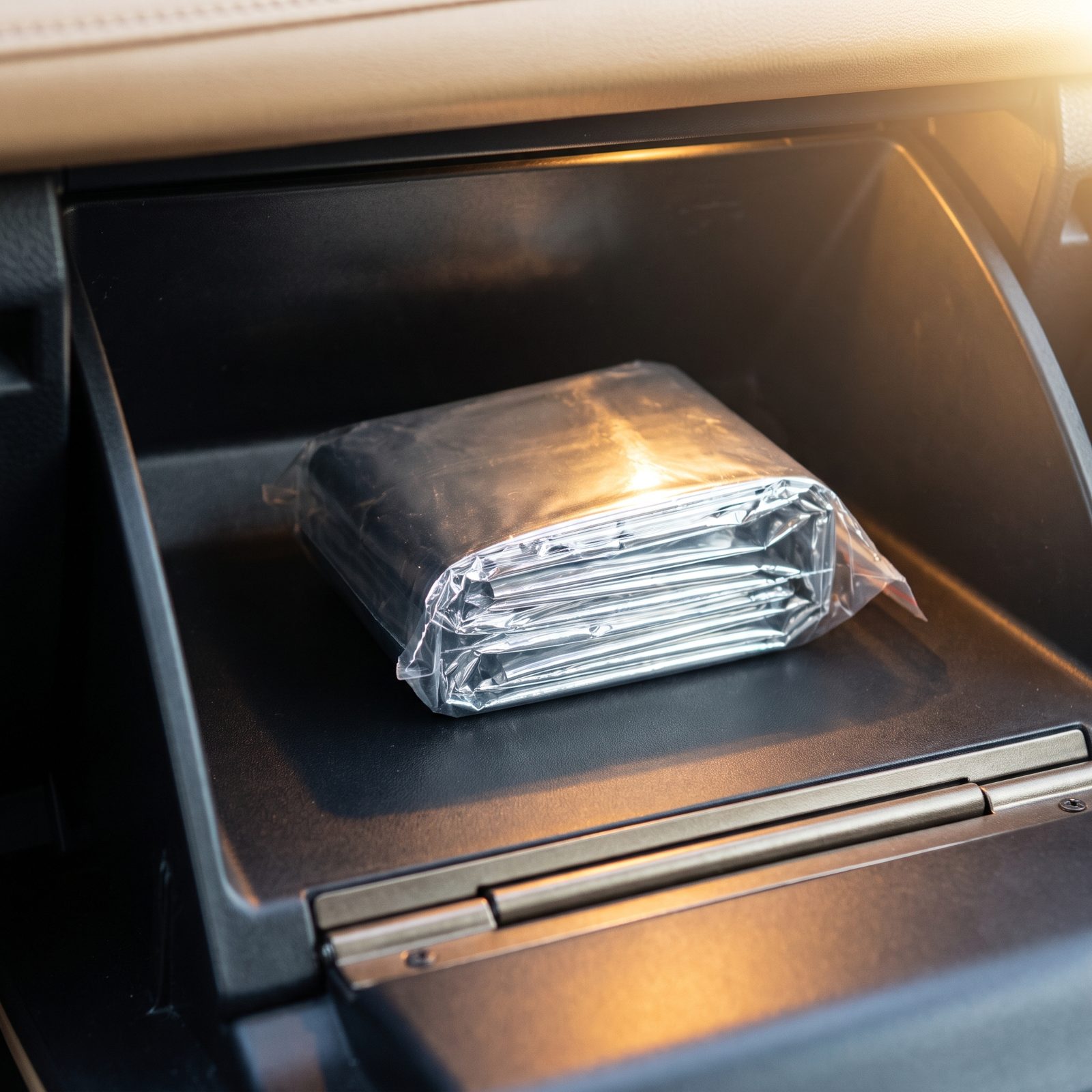
Folded flat it’s barely thicker than a candy bar, yet it holds body heat well enough to matter when you’re stranded in the cold waiting on help. That ratio of size to payoff is why it lands near the top.
Winter breakdown on a rural road, no cell signal, engine off to save fuel — the cabin gets cold fast. A silver mylar emergency blanket is about the cheapest insurance you’ll ever buy against that.
12. The Reflective Safety Vest: The One Item Every Driver Should Carry
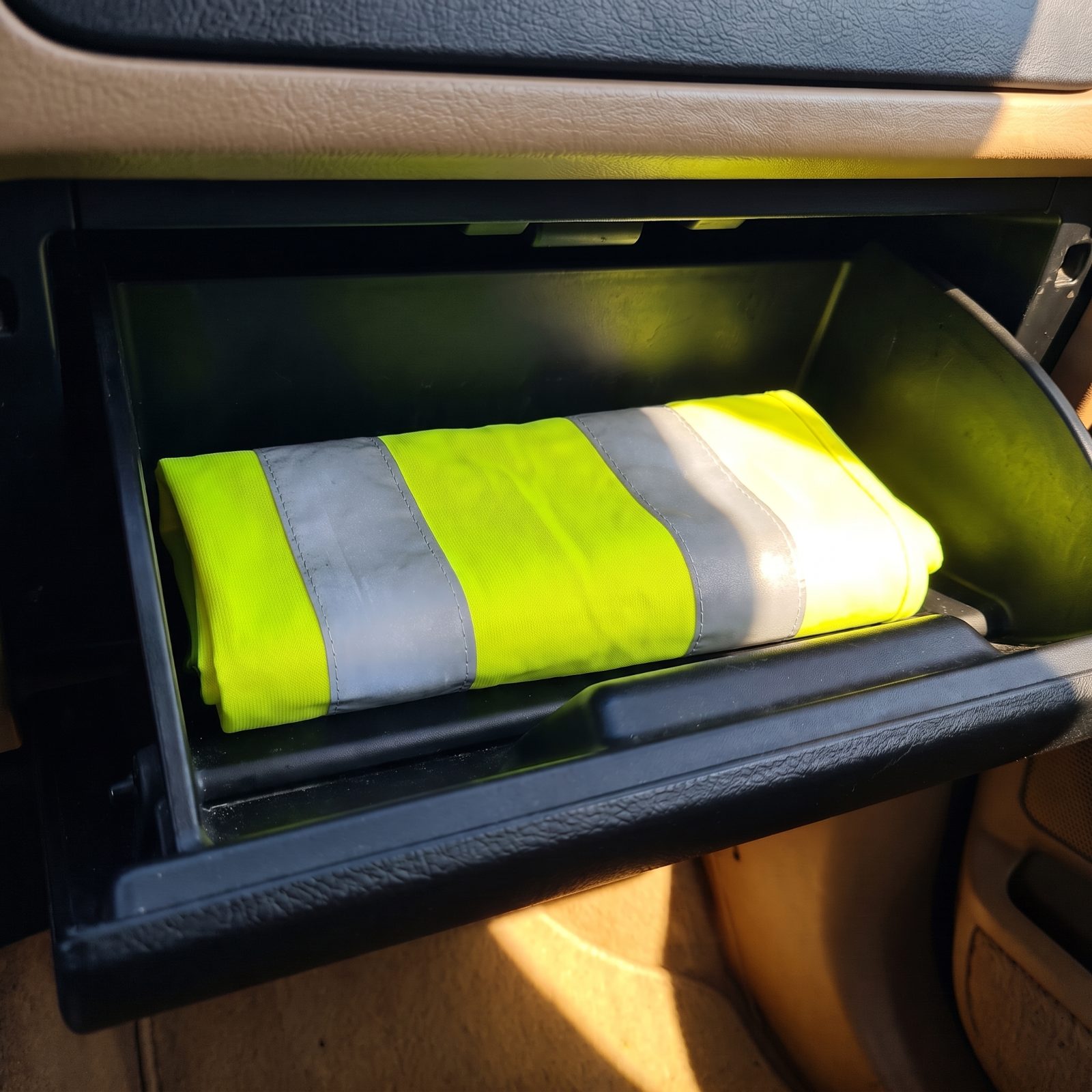
If you keep only a handful of things off this entire list, make this one of them. A reflective vest keeps you alive, not just comfortable.
And the reason it ranks this high is simple. The most dangerous moment in any roadside breakdown isn’t the flat tire or the dead battery — it’s you, standing next to your car in traffic, in the dark, in gray clothes, invisible to some driver doing seventy. A vest turns you from a shadow into something a person can actually spot and swerve around. Firefighters, tow operators, road crews: they all wear them for exactly that reason, and they’re not wrong.
Costs a few dollars. Folds to nothing. Does the single most important job any glove-box item can do. Buy one today, then spend the rest of your life hoping you never need it.
11. The Folding Warning Triangle That Buys You Distance
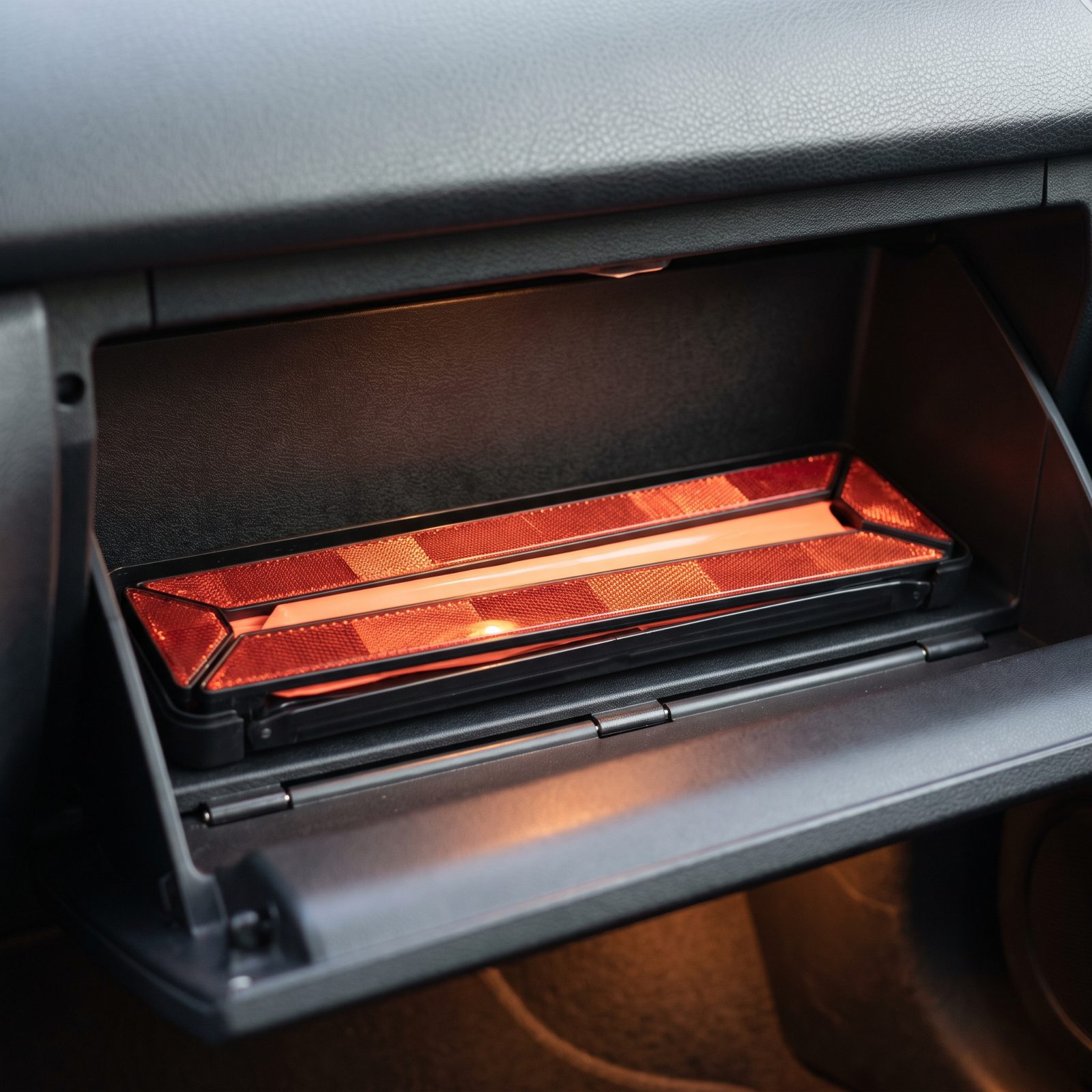
Nobody thinks about a warning triangle until they’re standing on a shoulder at dusk with cars doing seventy past their elbow. That’s the moment it earns its keep, setting up in seconds and giving following drivers a few hundred extra feet of warning — the difference between a slow-down and a pile-up.
It costs almost nothing and takes up less room than a paperback. Flares burn out and roll under the car. A reflective triangle just stands there and does the job in the rain, in the wind, at two in the morning. Keep it somewhere you can grab it without unpacking half your trunk.
10. The Wheel-Lock Key Everyone Forgets Until the Flat
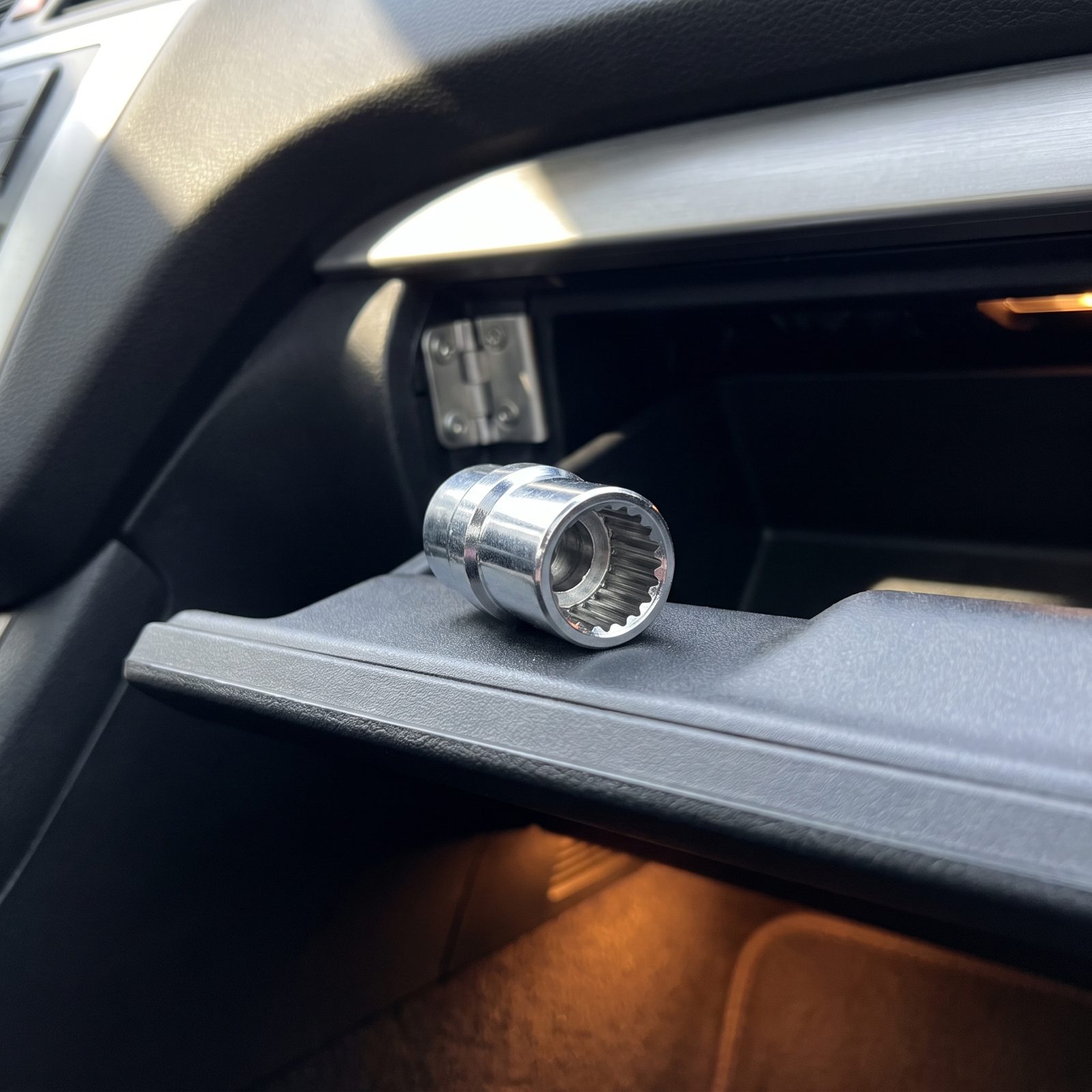
This is the one that ends road trips. You get a flat, you drag out the spare, you reach for the lug wrench — and the locking wheel nut just laughs at you. No key, no wheel off, no matter how strong you are.
The wheel-lock key is a little splined socket about the size of a shot glass, and it lives in the glove box for exactly one reason. Lose it and you’re looking at a locksmith or a dealer visit and a genuinely rotten afternoon. I once watched a fella in a parking lot call three tow companies before he realized the key had been sitting in his center console the whole time. Go check yours today.
9. The Pocket Tire-Pressure Gauge Worth More Than the Fancy Gadgets
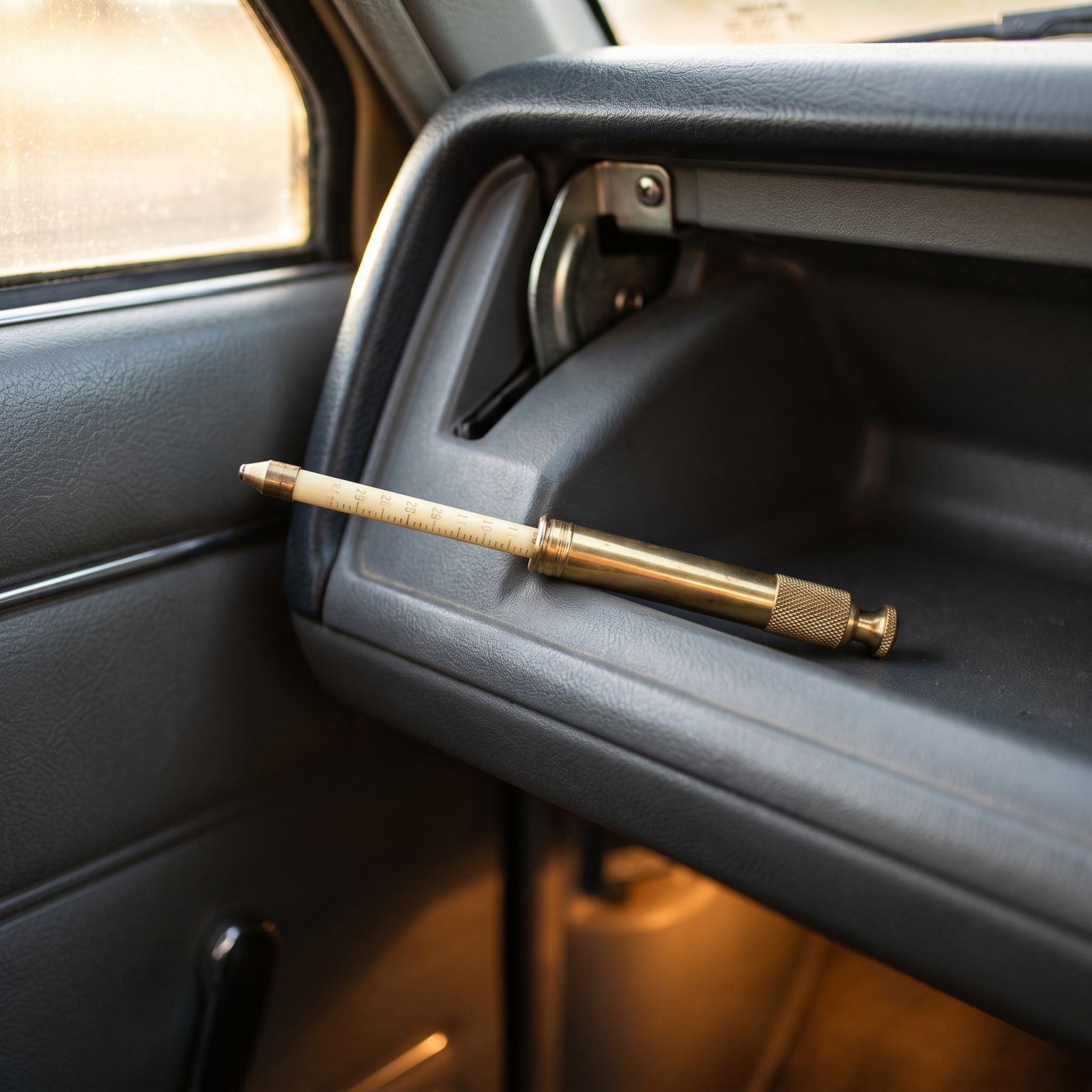
A cheap pencil gauge tells you more about your car’s health than half the warning lights on the dash. Underinflated tires wear fast, drink fuel, and blow out on hot highways. Overinflated ones ride hard and lose their grip in the rain. This little brass thing doesn’t need charging and it never lies. I’ll take one over the digital gauges that flicker and die right when you want a reading.
8. A Charged USB Power Bank for the Dead-Phone Moment
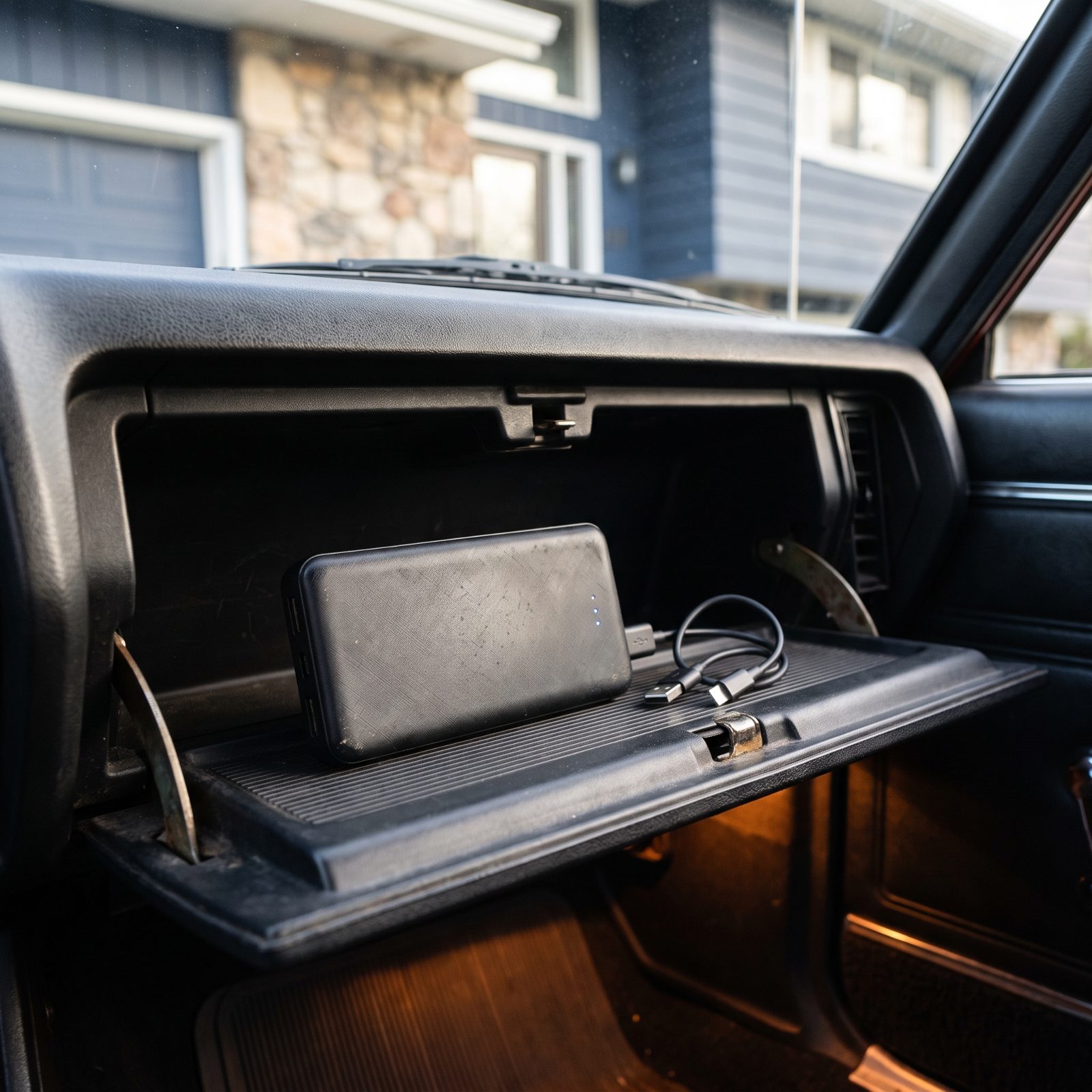
Your phone is your map, your flashlight, your emergency call, and your proof-of-insurance all rolled into one. It’s also the thing most likely to be sitting at four percent when you actually need it.
A charged power bank fixes that — as long as it isn’t dead too. Leave one baking in a hot glove box for six months and it’ll bleed itself flat. Top it off every few weeks, or set a reminder on the very phone it’s meant to rescue. Otherwise you’re carrying a paperweight and a warm feeling.
7. The Seatbelt Cutter and Window Breaker You Hope Never to Use
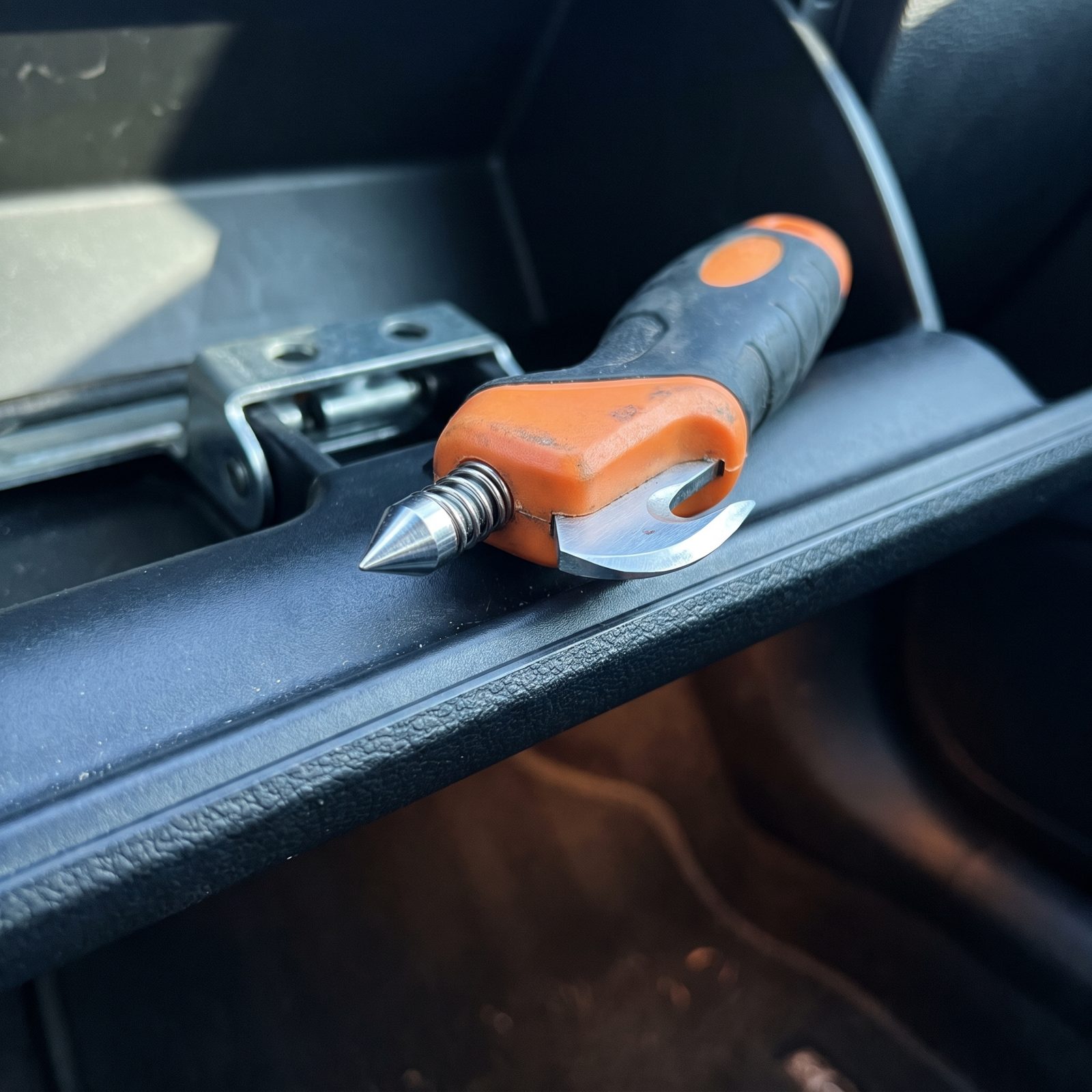
This is the item that separates a scary story from a tragedy. If a belt jams or a car ends up in water, seconds decide everything, and a combination tool cuts the webbing with a recessed blade while shattering tempered side glass with a spring-loaded steel point.
Two rules make it worth carrying. It has to be reachable from the driver’s seat, not buried under the manual and ten years of napkins. And you should know which corner of the window to strike — the center resists, the corner gives.
6. The Owner’s Manual You’ve Never Once Opened
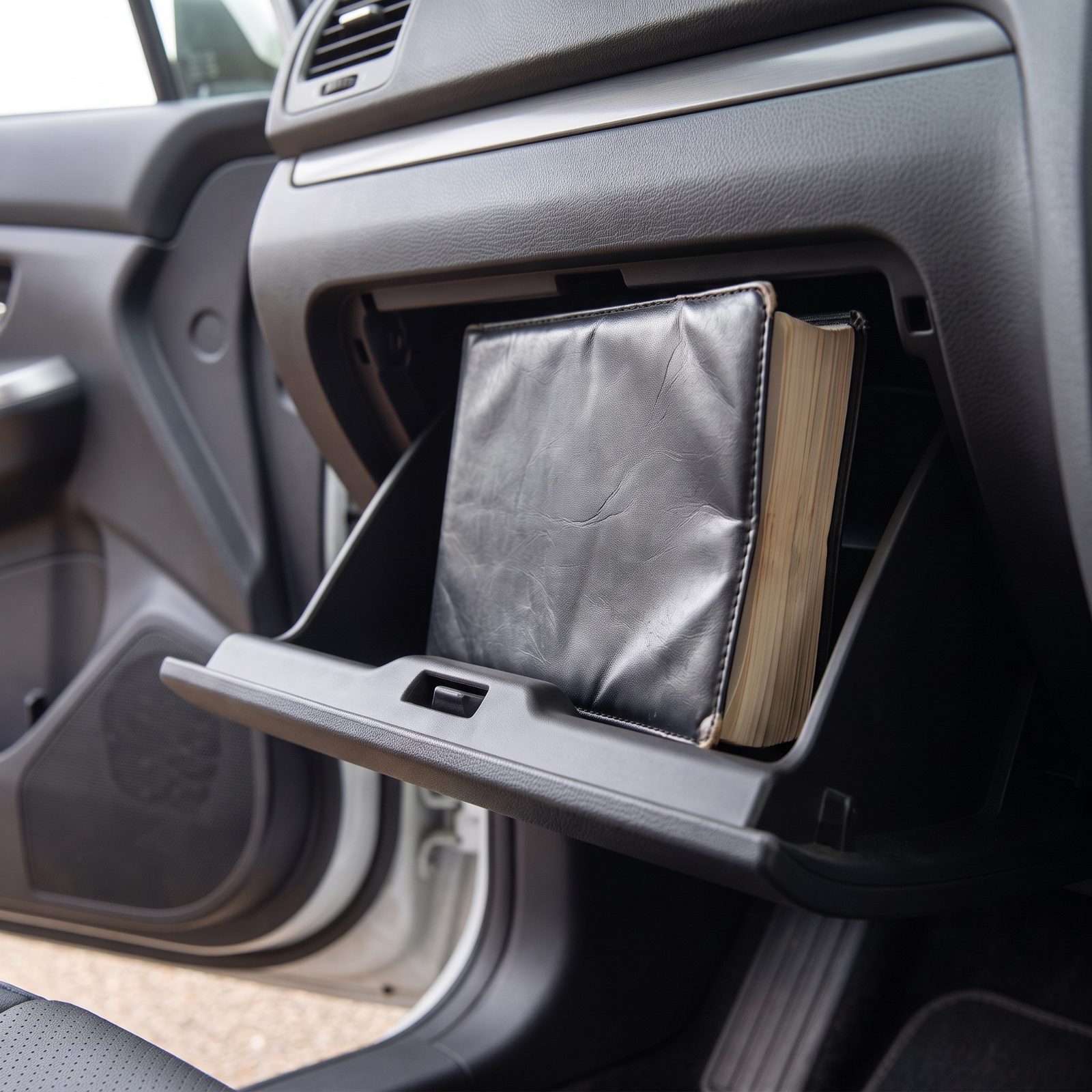
Not glamorous, but not gone. The paper manual eats the most room and gets read the least. Most of what’s in it lives online now, and your phone can pull up the right page faster than you can dig for it under a flashlight.
There’s one moment it beats the internet, though: a dead-zone breakdown with no signal. When you need to know which fuse controls the fuel pump and there are zero bars, paper wins. Keep it if it fits. Just don’t let it crowd out the things that save skin instead of curiosity.
5. A Current Roadside-Assistance Card, Not Last Year’s
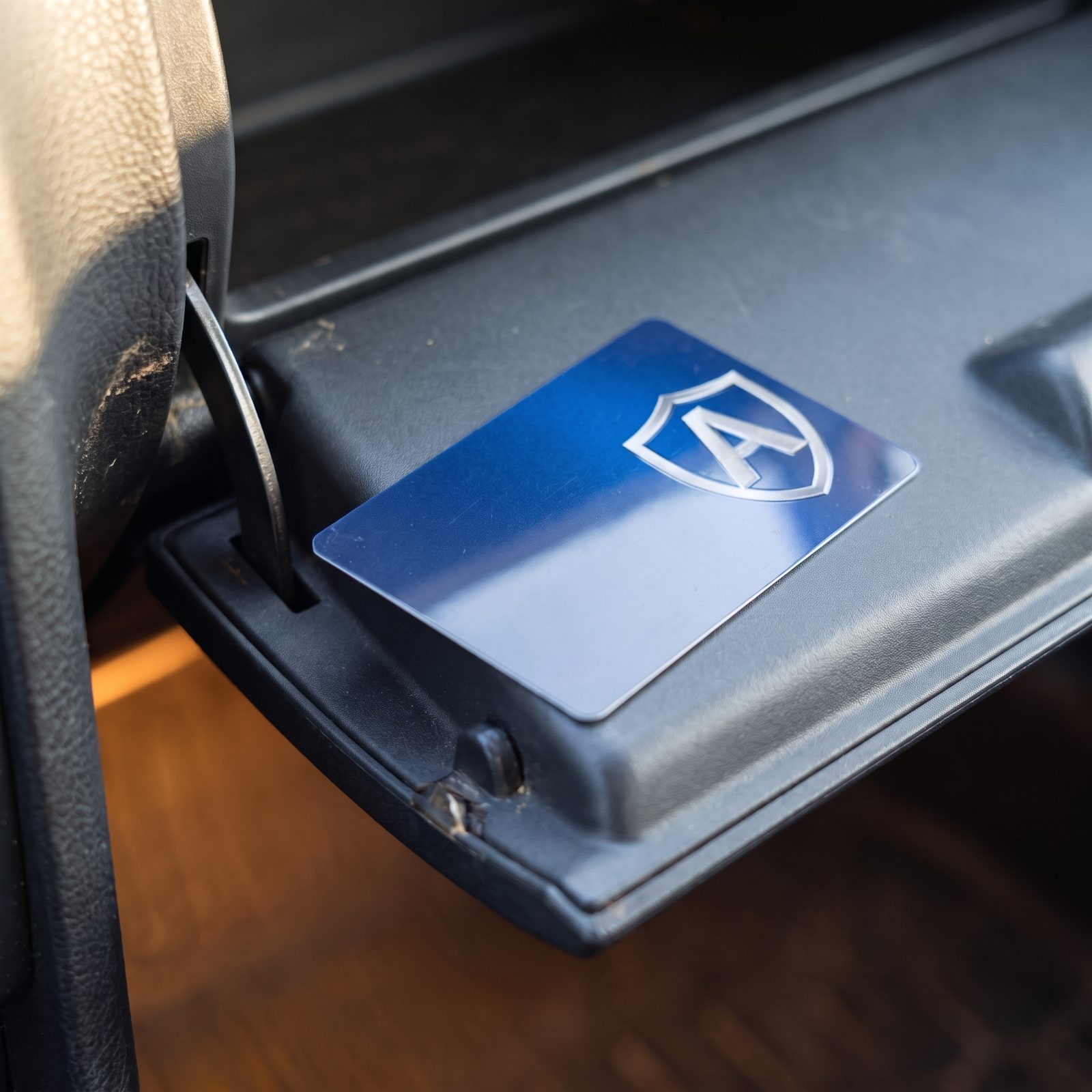
An expired membership card is worse than none, because it fools you into thinking you’re covered. Half the cards riding around in glove boxes lapsed two renewals ago.
What the physical card gives you is the account number and the phone line printed right there when your own phone is dead or dying. Write your policy number on it. Check the date once a year when you renew the registration. A tow at midnight is expensive enough without finding out your coverage quit back in March.
4. A Bright LED Flashlight That Actually Turns On
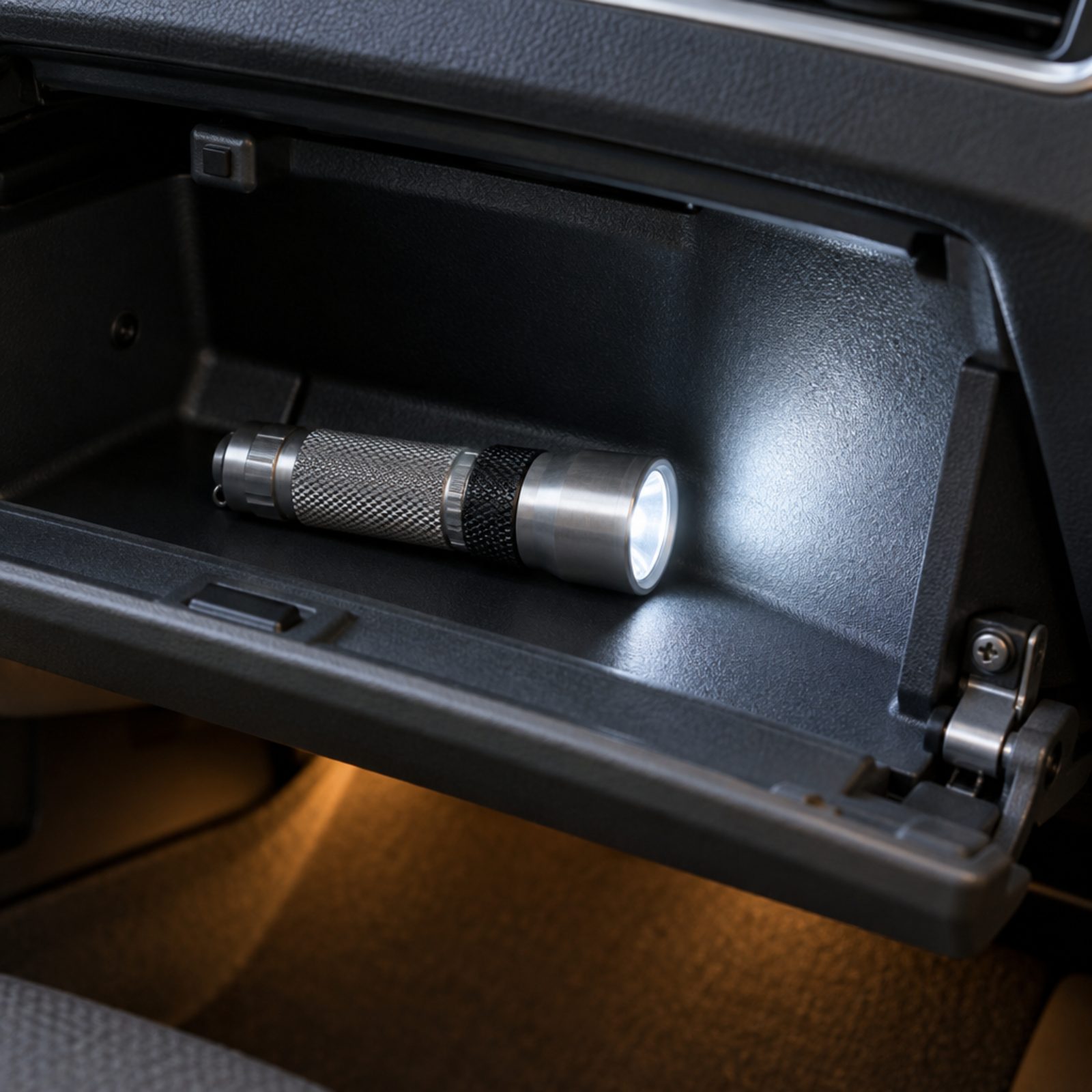
Your phone light drains the phone. A real flashlight does the ugly work — finding the jack point in the dark, reading a road sign, checking under the hood on a black shoulder at midnight.
Same trap that kills power banks, though. A flashlight with corroded batteries is just a metal tube of disappointment. Test it every oil change. And honestly, a cheap aluminum LED that survives years of getting flung around the glove box beats a fancy one you’re too precious to bang up.
3. A Stocked Compact First-Aid Kit, Emphasis on Stocked
Would you like to save this?
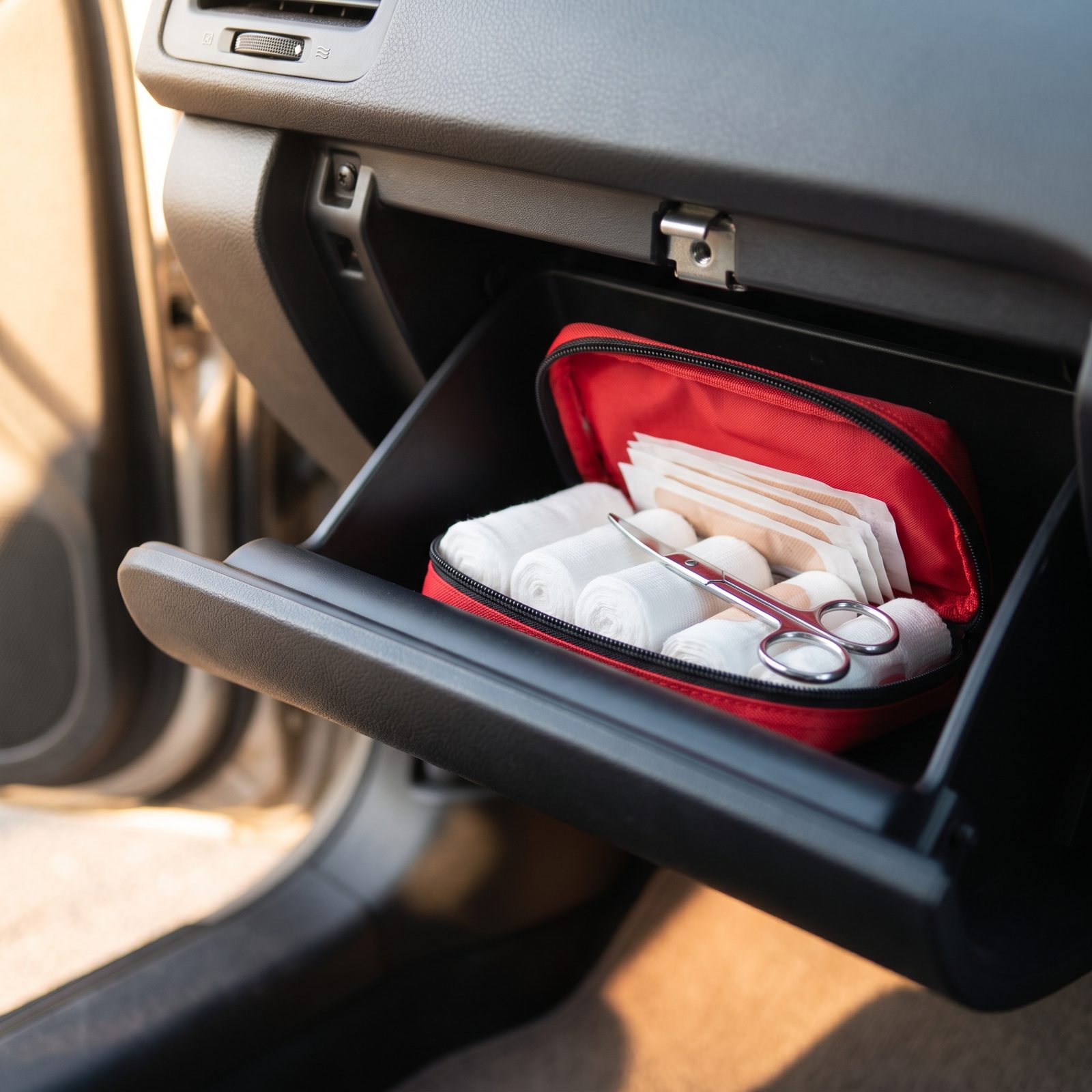
The word doing all the work here is stocked. A kit you bought years back and raided twice for a hangnail isn’t a first-aid kit — it’s a pouch of empty wrappers and one dried-out antiseptic wipe.
A good compact kit handles the real roadside stuff: a bad cut, road rash, a burn, a splinter you can’t ignore. Adhesive dressings, gauze, tape, gloves, small scissors. Open it once a year and actually look inside. Restock what’s gone, toss what’s expired. A full kit does the saving. A graveyard of used bandages just makes you feel prepared while helping nobody.
2. Current Vehicle Registration: The One Item That Belongs There Above All
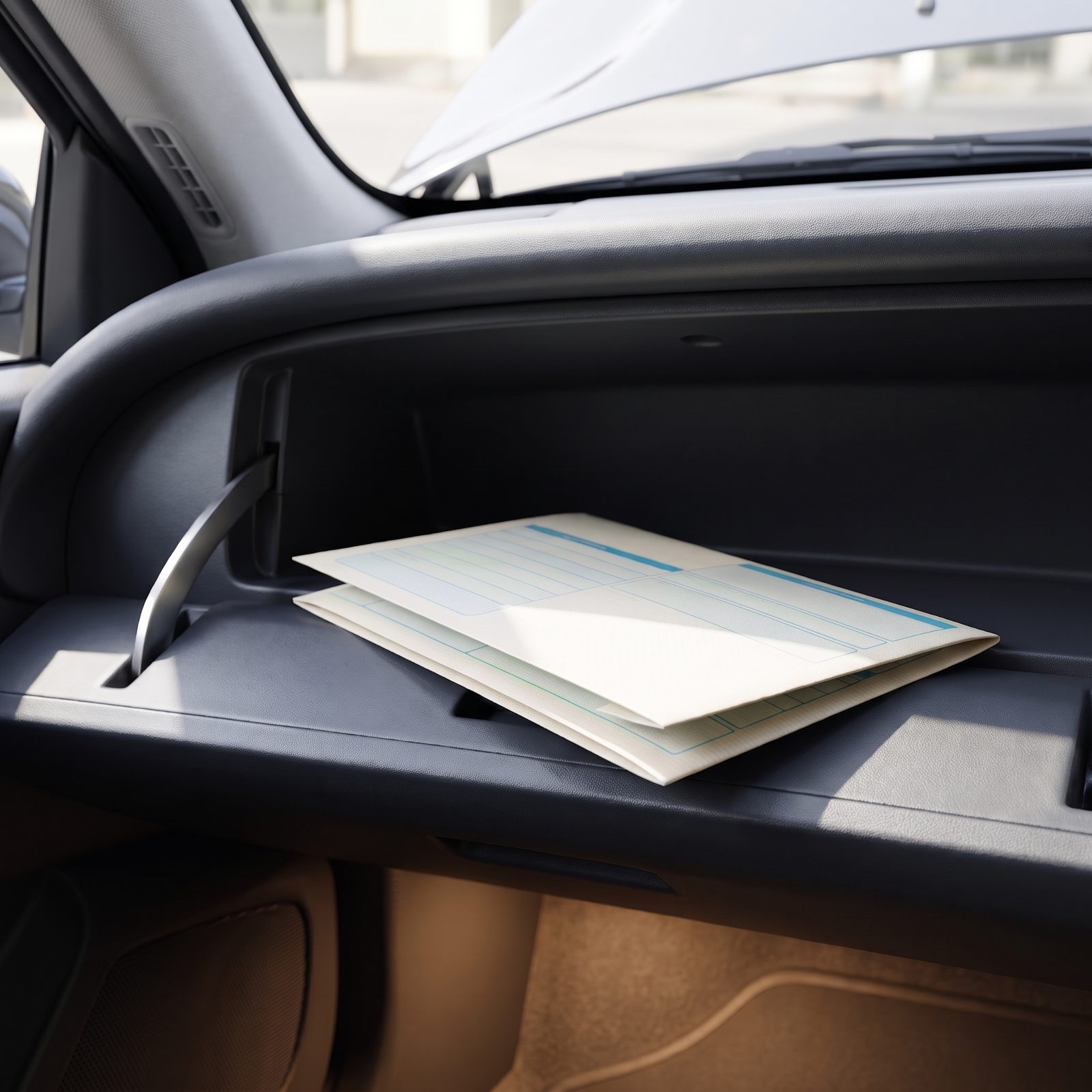
Everything above helps you in an emergency. This one you’re legally required to produce, and the glove box exists for it more than anything else you keep in there.
Get pulled over, get in a fender-bender, and the officer’s first question is for your registration. Fumbling because it expired — or because it’s still in your old car — turns a routine stop into a real problem. Keep the current one on top, folded flat, right where your hand lands first.
The glove box was named for driving gloves nobody wears anymore. Today its real job is holding the one paper the law says you must have within reach.
Update it the day the new sticker shows up. Toss the old one. Right alongside proof of insurance, this is the thing that should never, ever be missing.
1. Current Proof of Insurance: The One Card That Belongs on Top
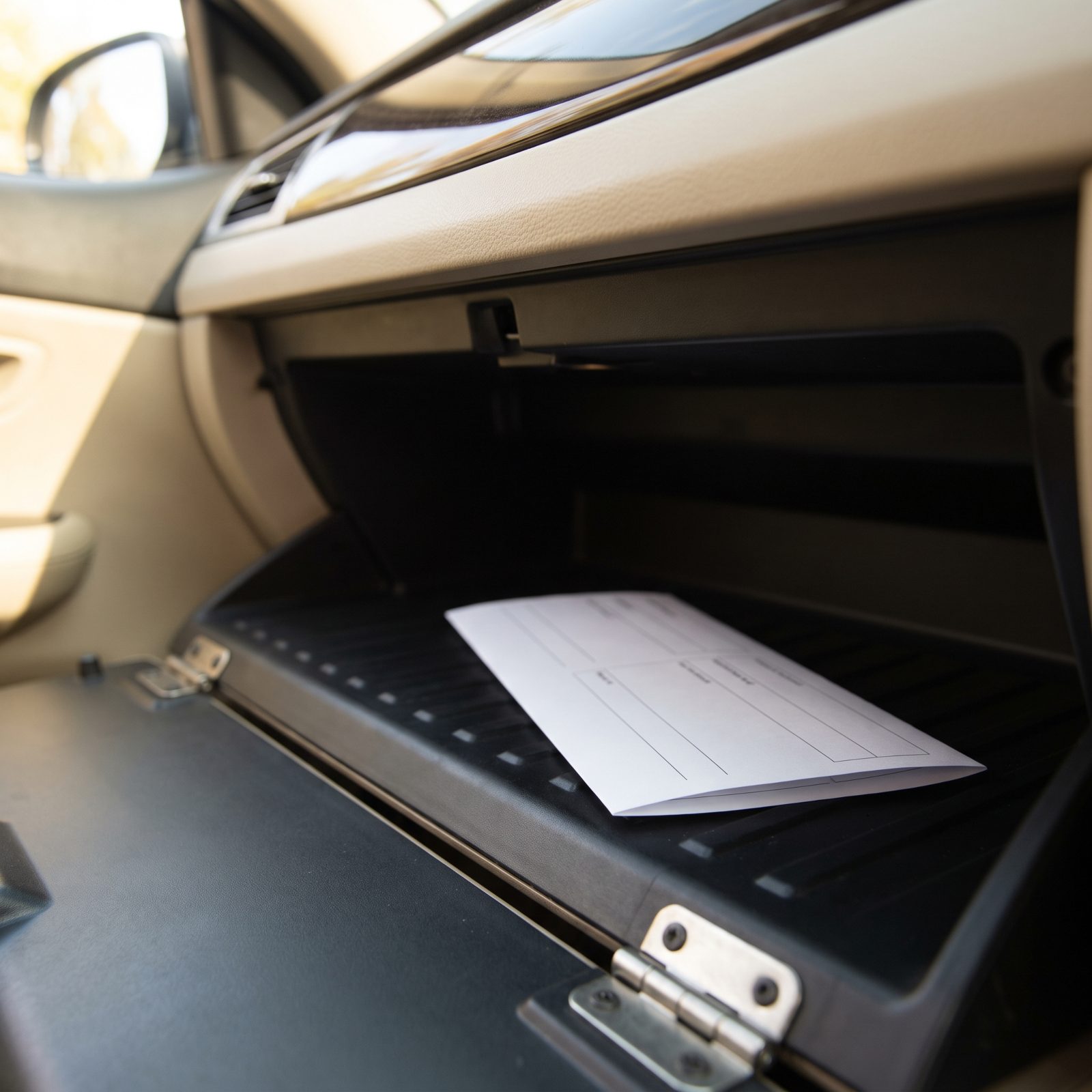
Almost everything else in this compartment is optional. This one isn’t. Get pulled over or clipped in a parking lot, and the officer or the other driver wants proof of coverage before another word passes between you. An expired card? Useless. All it proves is that you carried insurance back when disco was on the radio.
Keep the newest card on top, folded once, right where your hand lands the second the door drops open. Swap it the day the renewal shows up in the mail. Otherwise the old ones pile up like receipts in a coffee can, and one day you’re handing an officer a card that lapsed two policies ago while you sweat through your shirt.