
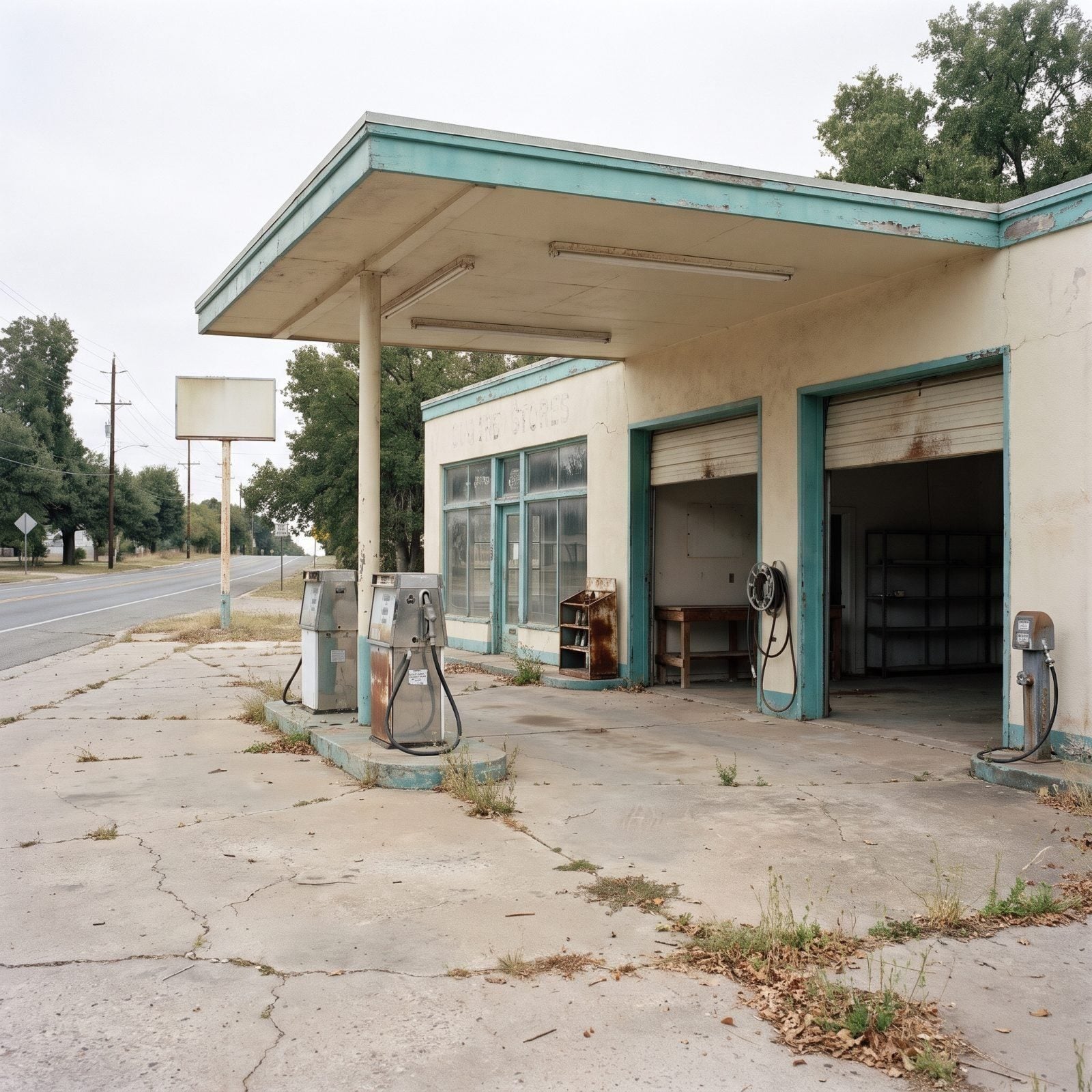
The pumps went dry sometime around the Carter administration. Glass cracked, weeds found the cracks, and a tired tin canopy started sagging over an island that once sold ethyl at 31 cents. We’ve all driven past one, haven’t we — the service bay door rusted shut, a faded shell of a sign, the ghost of a town that packed up and moved to the interstate. So we grabbed one of these forgotten corner stations and dreamed up what it could become if somebody with gearhead blood and a decent budget got hold of it. Same footprint, same canopy, same two bays. A whole lineup of completely different second lives.
Please note that some of the images in this article were created with the assistance of AI.
30. Blacked-Out Hot Rod Fabrication Shop
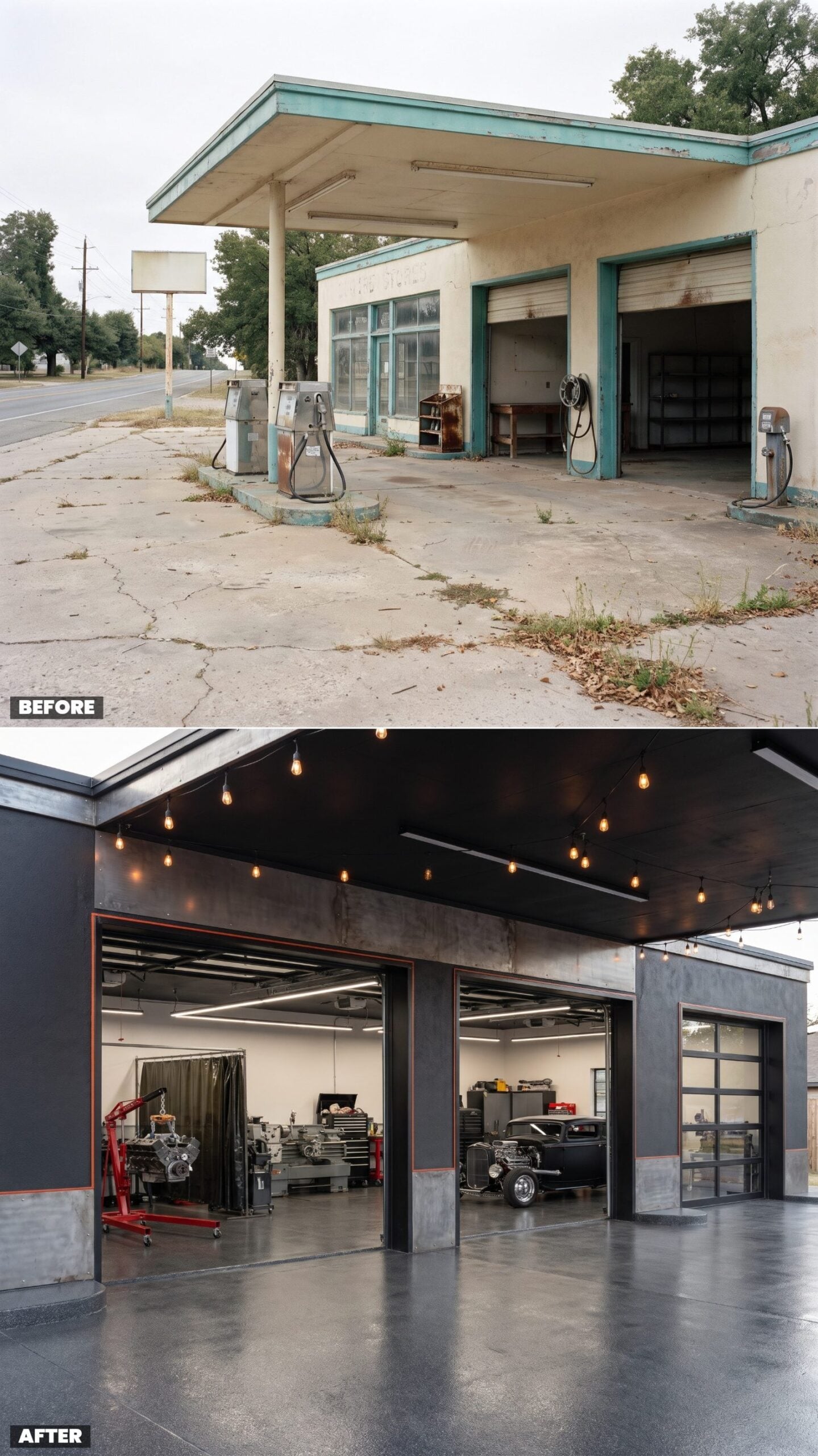
This is where metal gets born again. The matte charcoal skin kills every trace of the sweet nostalgia version and turns the building into something that means business after dark.
The graphite epoxy floor reflects the Edison bulbs like black water. A chopped flat-black ’32 Ford sits mid-build with its chrome engine bared, that orange pinstripe on the fascia the only warm color in an otherwise cold palette. Function wears the decor here — the lathe and the engine hoist aren’t props.
Explaining how to keep a garage floor from lifting under hot tires, an epoxy flooring contractor says “A 100% solids epoxy base with a polyaspartic topcoat, installed over a properly ground slab and cured fully before parking, is built to resist it.”
29. Sun-Washed California Surf Woody Hangout
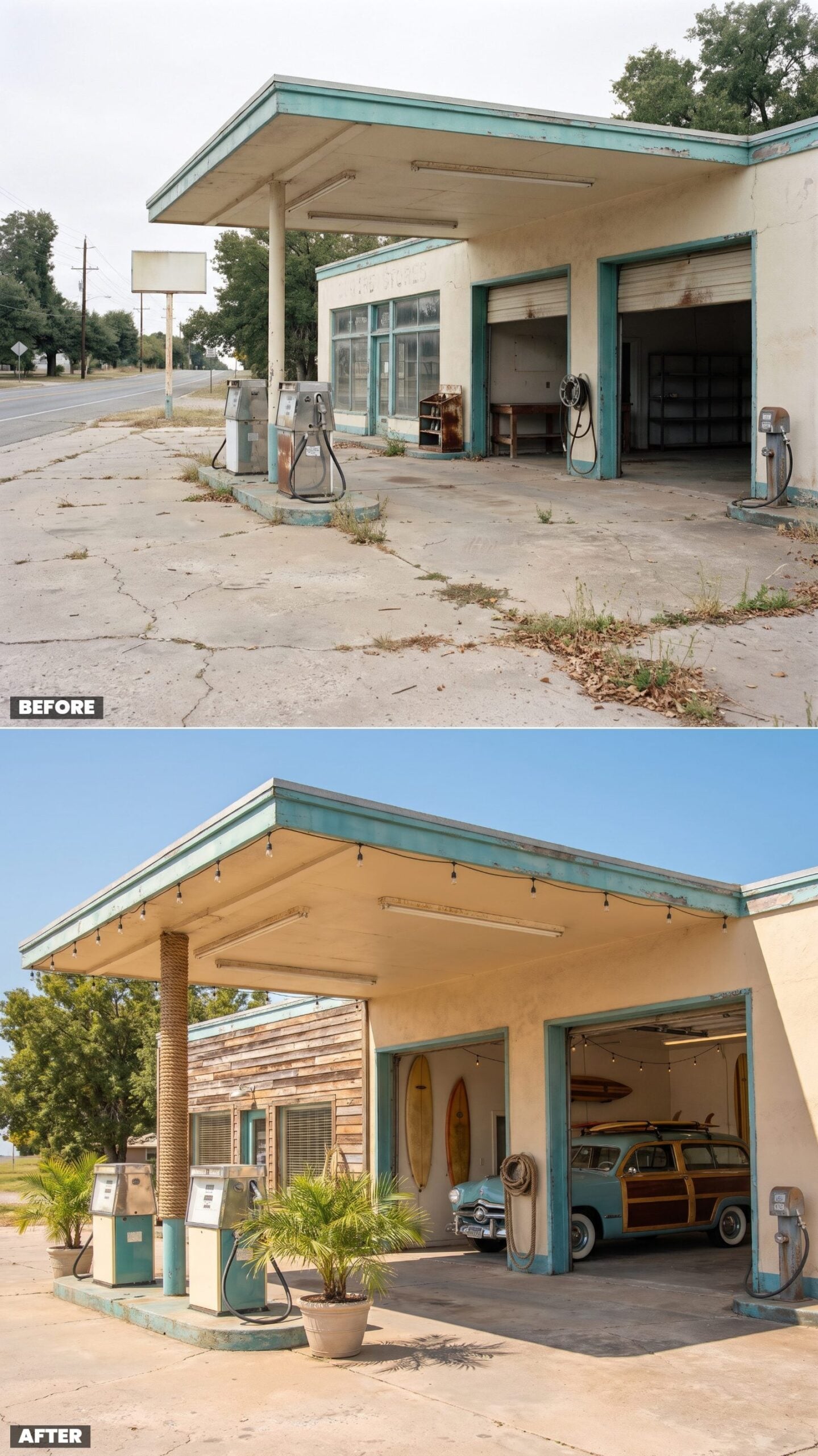
Trade the oil and grit for salt air. Sand-beige stucco and weathered teal trim pull the whole station toward the Pacific Coast Highway circa 1962, and the reclaimed cedar on the office gives it the look of a beach shack that happened to pump gas.
A wood-paneled Ford Woody with boards on the roof rack is the hero, obviously. Surfboards lean along the bay wall, a couple of palms soften the concrete island, and the whole thing feels like a place you’d pull into for a cold bottle and never quite leave.
28. Mid-Century Modern Collector’s Showroom in Glass and Walnut
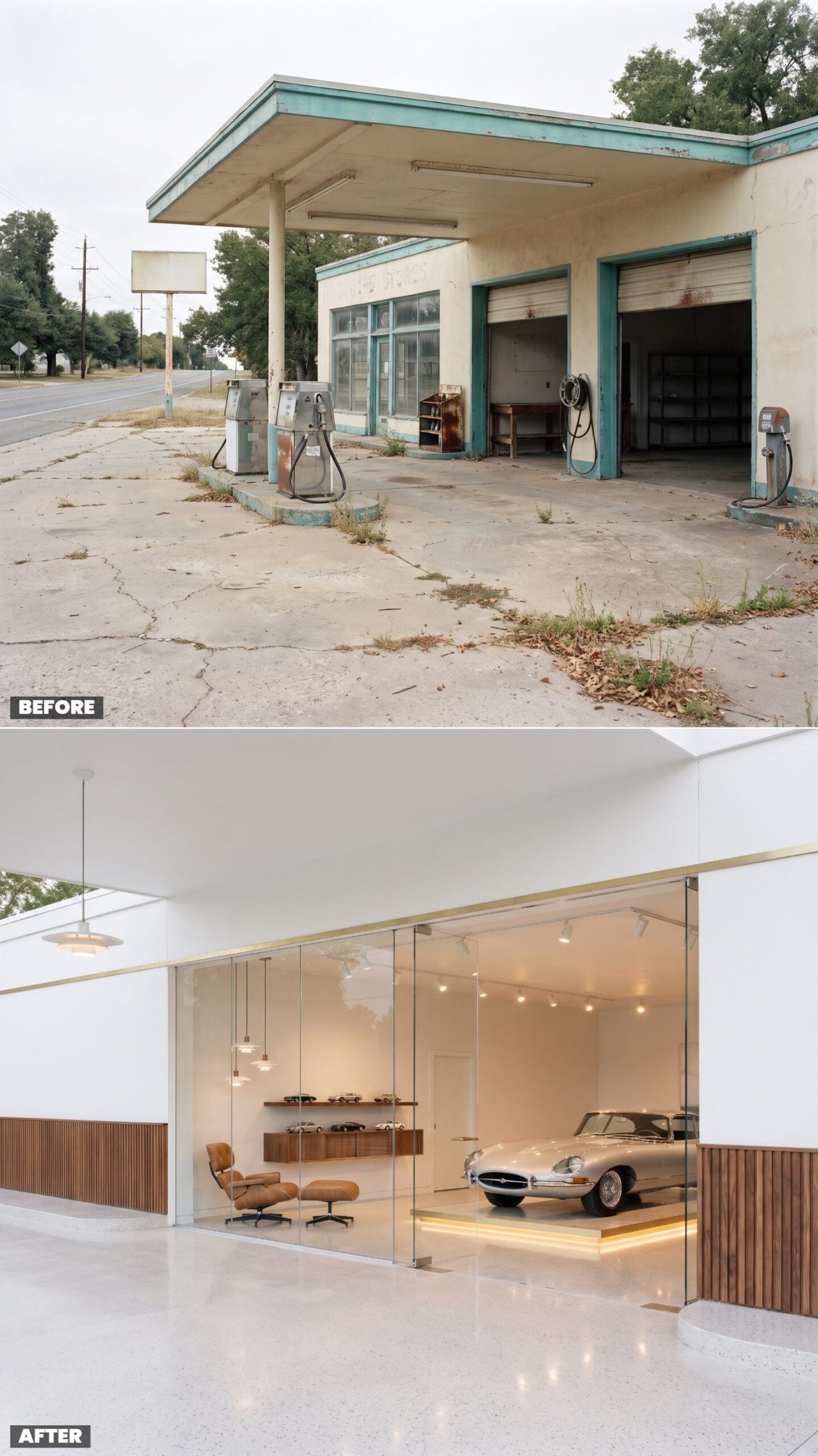
The bay doors vanish into walls of frameless glass, and suddenly a corner filling station carries itself like a boutique. White walls, walnut slats, one hairline of brushed brass along the canopy. Nothing shouts.
A silver E-Type sits alone on a low terrazzo plinth edged in brass and lit from beneath, under warm track lighting, treated like sculpture because, frankly, it is. The Eames-style lounge chair in the corner tells you this is a place to sit and look, not to turn a wrench. Restraint is the whole flex.
27. Route 66 Neon Diner and Gas Stop Reborn
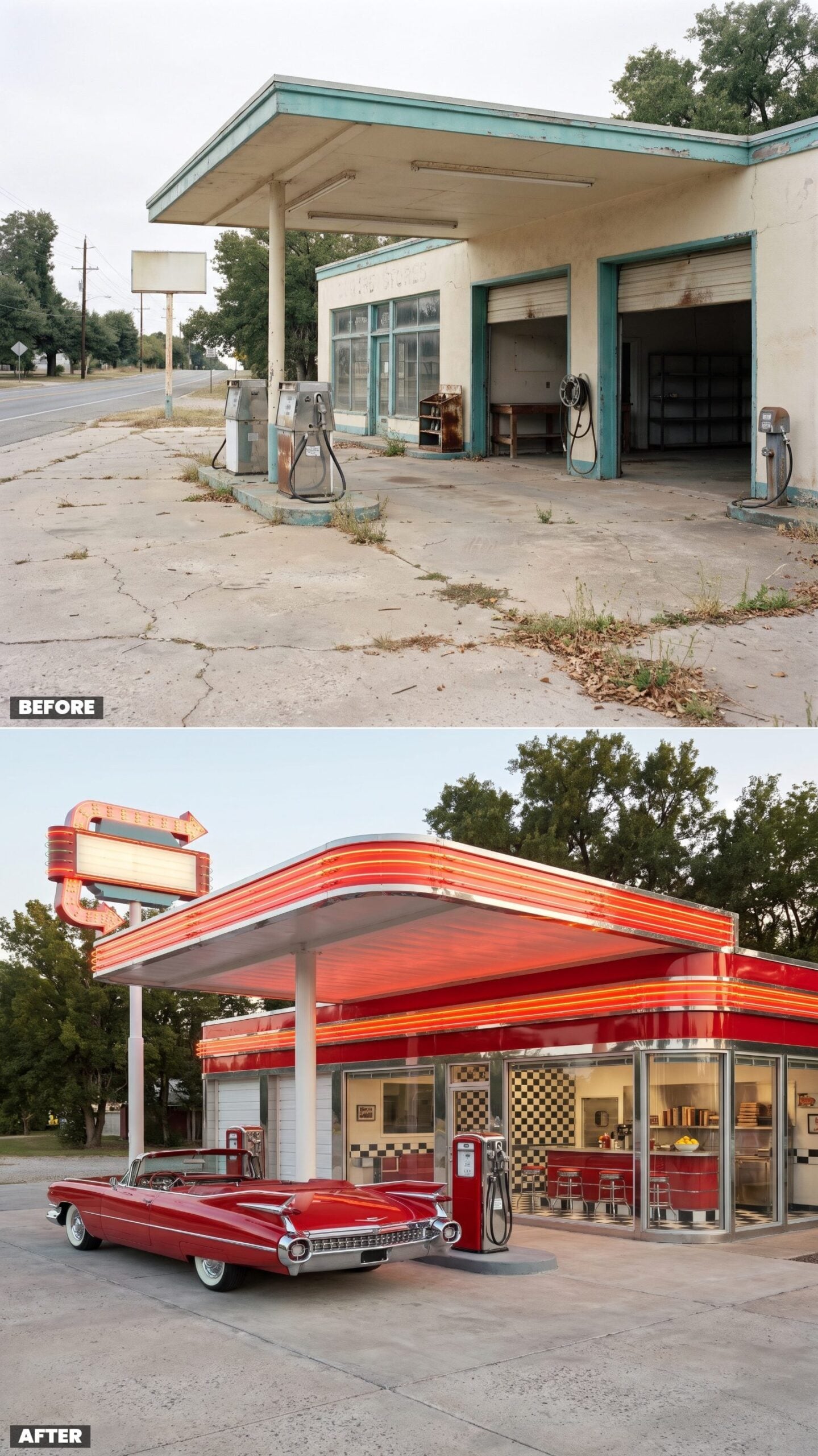
Dusk is when this one earns its keep. Neon traces the entire canopy in a warm electric hum, the kind of light that pulled tired drivers off the Mother Road for sixty years.
Through the corner windows you catch the checkerboard floor and a run of chrome stools at a red counter. Out front, a cherry-red ’59 Caddy convertible — all fins and chrome — sits like it’s posing. This is the stop everybody claims to remember even if they never once saw it.
Describing a park full of restored neon signs from along Route 66, a former tourism bureau director says “All of these signs have been restored. They’re not refurbished; they are the original signs that have been fixed”
What Our Readers Say
- When our readers loved a car photo and tapped a reason, “nostalgic” came out on top at 26%, ahead of body style and “would drive.”
- In Jalopy Talk readers’ heart votes, cars that look like the 1950s or earlier got hearts 81% of the time, versus 75% for the other images in the same articles.
From Jalopy Talk reader polls and votes.
26. Raw Industrial Loft Garage With Reclaimed Brick
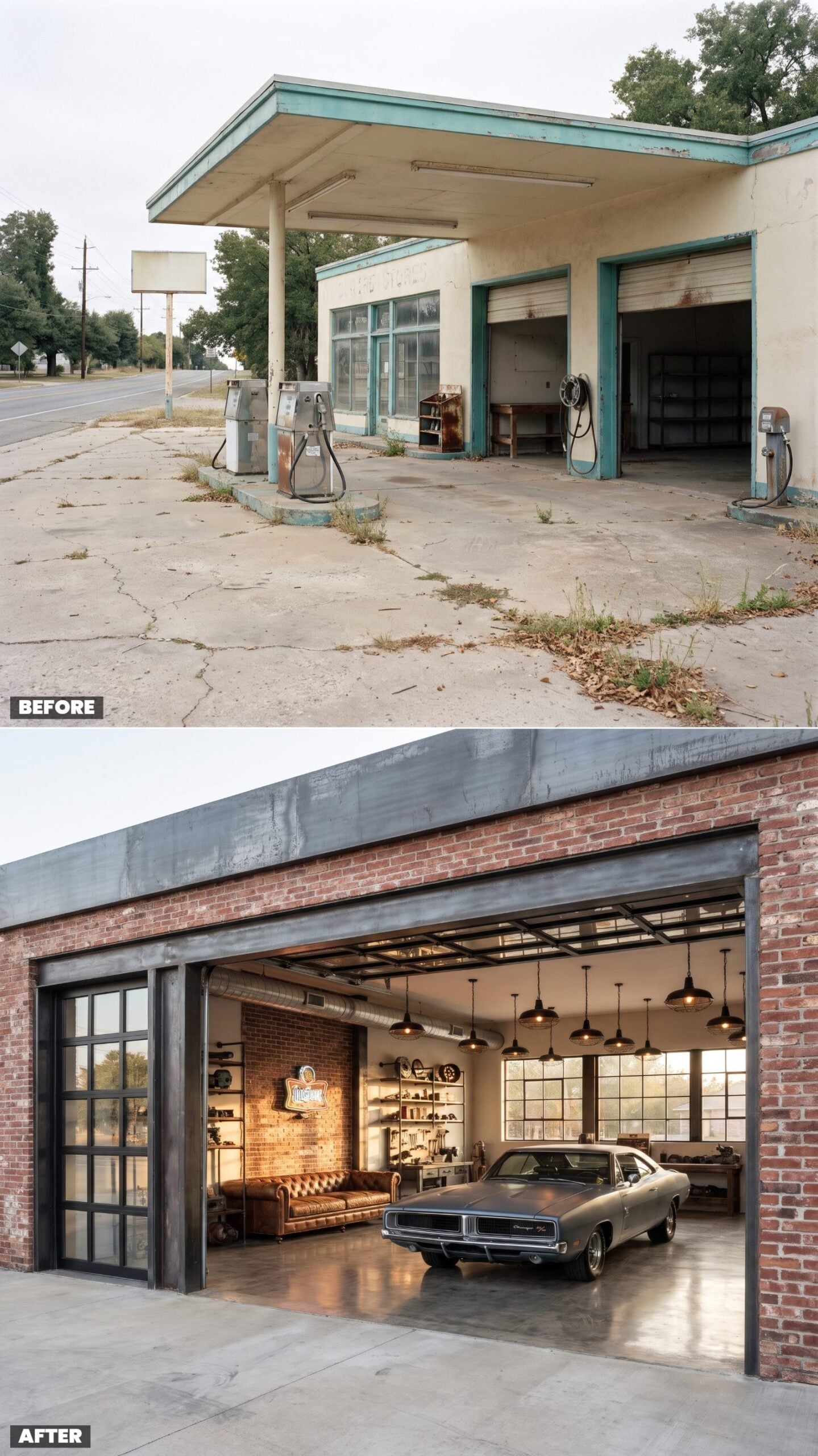
Someone peeled the stucco off and found honesty underneath. Exposed red brick, raw steel beams, factory-glass roll-ups in black frame. The building looks older and tougher than it did when it was new.
A slate-gray Charger crouches under caged lights on polished concrete. There’s a leather chesterfield for the hanging-around that every good garage demands, plus a vintage-style neon sign throwing a little color on the brick. It’s a man-cave that forgot to be cheesy about it.
For anyone stripping stucco to get to old brick, a brick preservation contractor warns “If you encounter a layer of wire mesh, stop immediately. This means wire mesh has been used to cover the surface of the brick to help hold on the stucco.”
25. Warm Woodshop-Meets-Garage Craftsman Workshop
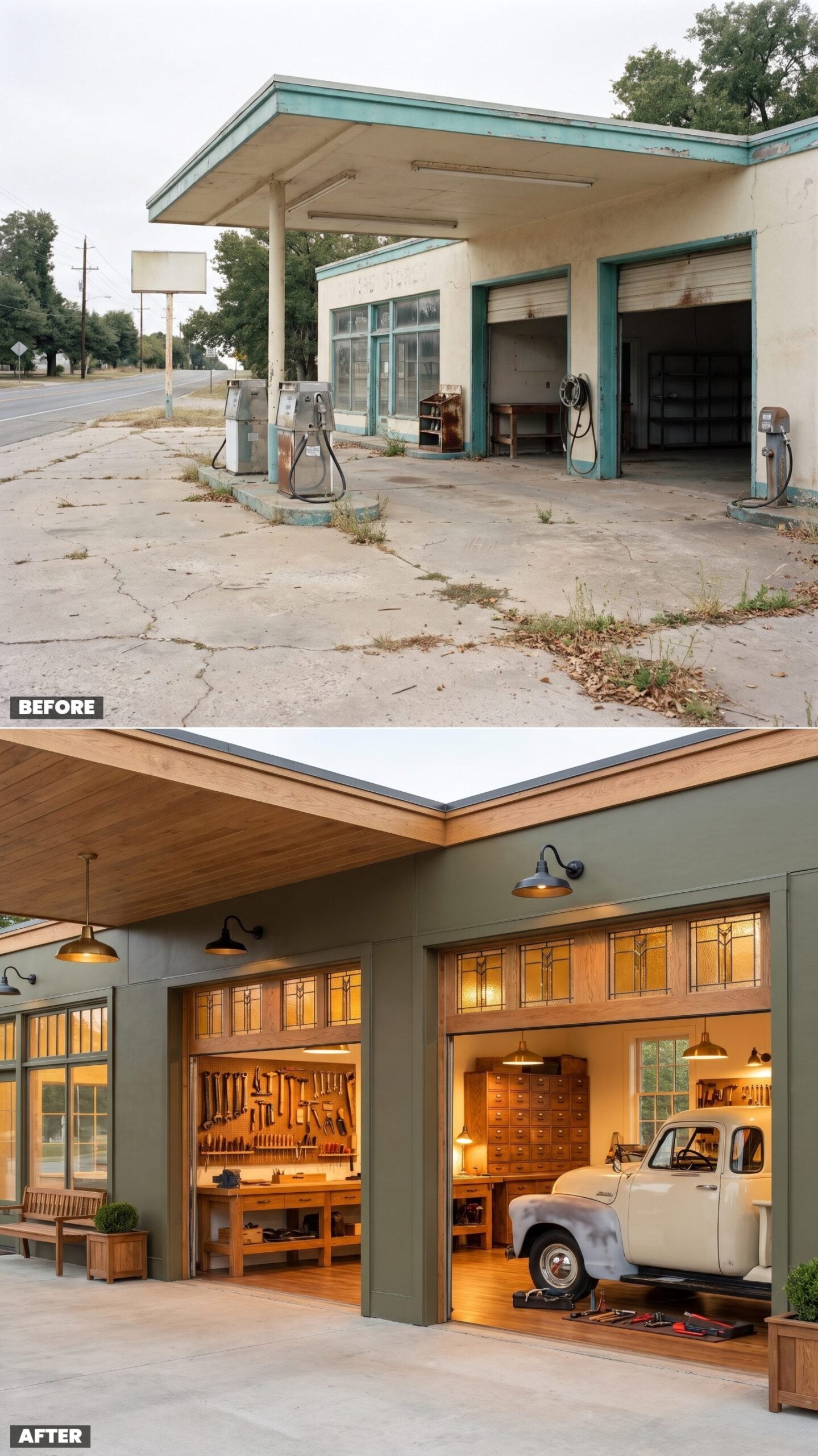
This one smells like linseed oil and patience. Olive-drab walls with oak timber accents turn the station into something closer to a master’s workshop than a quick-lube.
The pegboard wall is the heart of it, every hand tool hung neatly on its own hook, the way your grandfather kept his. A cream 1953 Chevy 3100 pickup sits mid-restoration on oiled hardwood floor, brass pendants throwing warm light down on the oak benches. A place built for slow, careful work.
24. Full-Chrome Lowrider and Custom Culture Garage
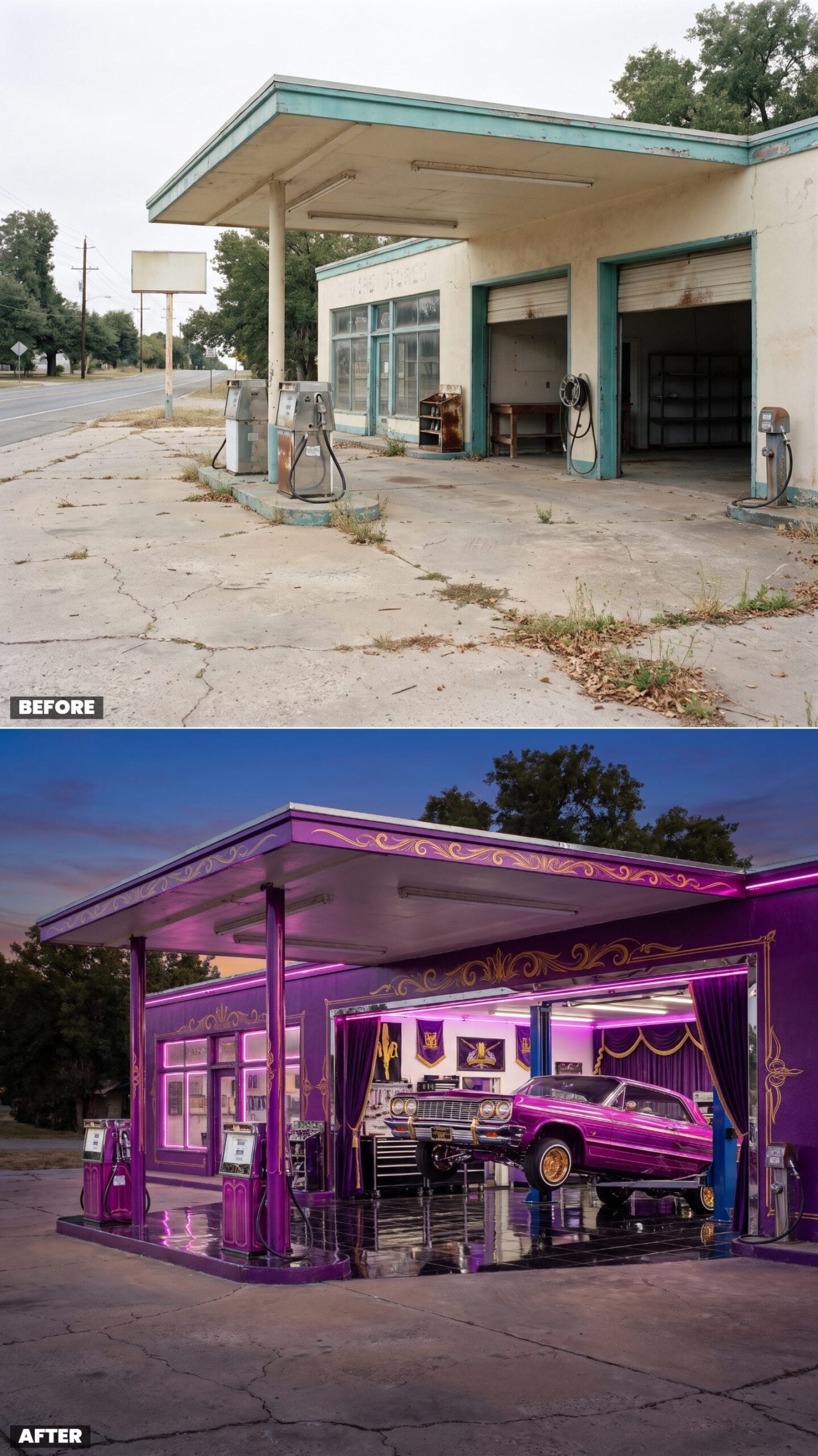
Candy purple with gold-leaf scroll pinstriping, and the station stops whispering entirely. Chrome catches every light source twice. Pink and purple neon pools on glossy black tile.
The centerpiece is a candy-purple ’64 Impala on gold wire wheels, nose-up on its hydraulics mid-hop. This is a culture, not just a car, and the space treats it that way with velvet detailing and mirror finish everywhere you look. Pure West Coast pride, turned up loud.
Interviewed about his work, a lowrider paint artist said some of his elaborate designs take three or four months of careful planning before the final layers and patterns are painted on.
Jalopy Talk readers seem to agree, since car photos with lots of chrome got more hearts than the other images in the same articles, 81% versus 74%.
23. Sun-Faded Route 66 Diner-Garage with Turquoise Trim
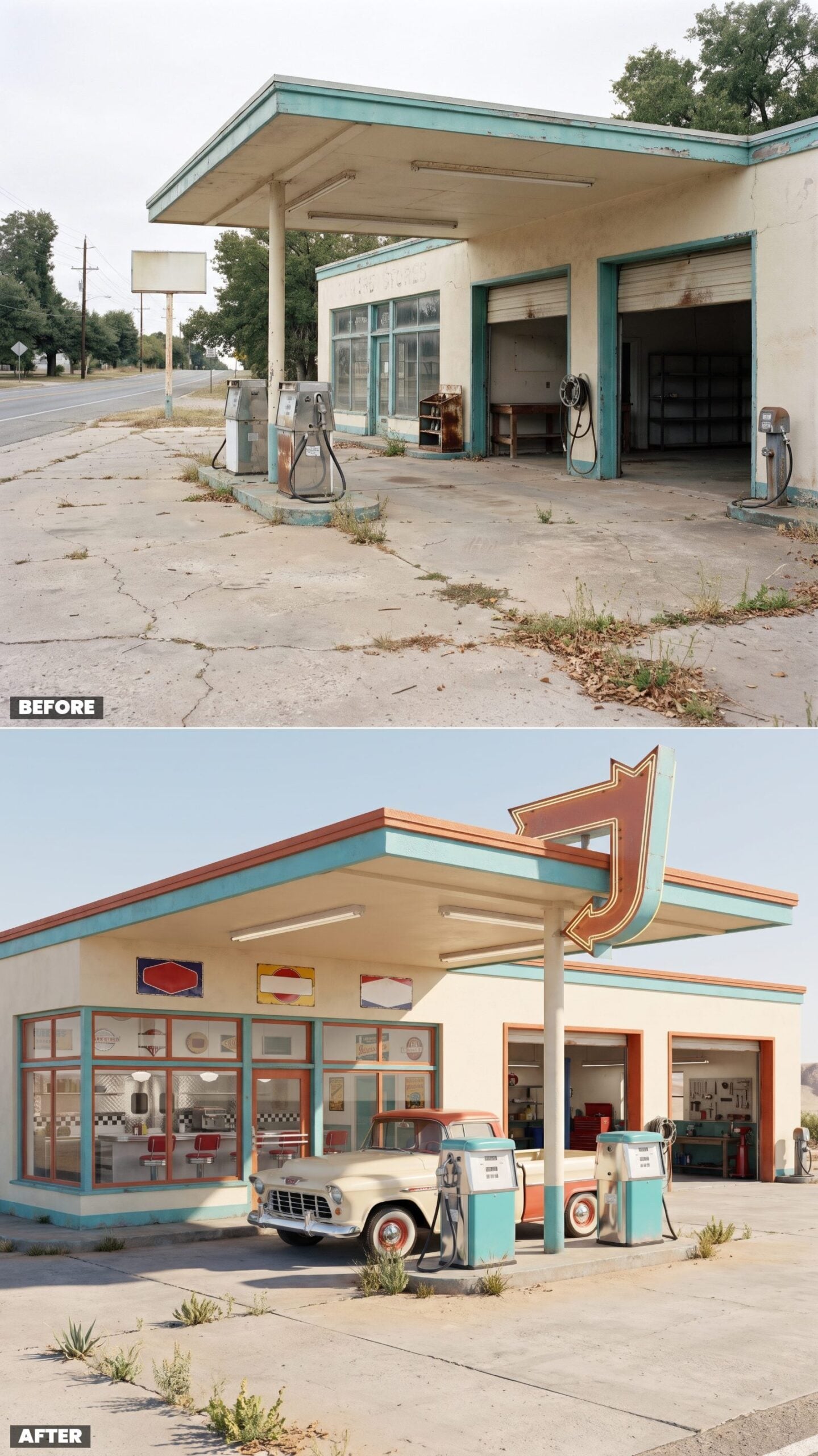
You’ve driven past the dead ones on the old highway. One pump, boarded windows, a ghost of a brand name. This is what those could be again.
Cream with turquoise and rust-orange is pure high-desert, faded on purpose so it looks lived through rather than freshly painted. Half the station pours coffee and half still turns wrenches. Add the neon arrow on the canopy and a coral ’55 pickup at the pumps, and the whole thing smells like a counter diner at 7 a.m. Bad coffee, good eggs, better memories.
In a guide for first-time restorers, a vintage gas pump supplier notes “More experienced collectors even take this up a notch and do a “rustoration”—taking a pump and enhancing the patina, including aging decals and crackled paint.”
22. Pastel Fifties Soda-Pop Garage in Mint and Pink
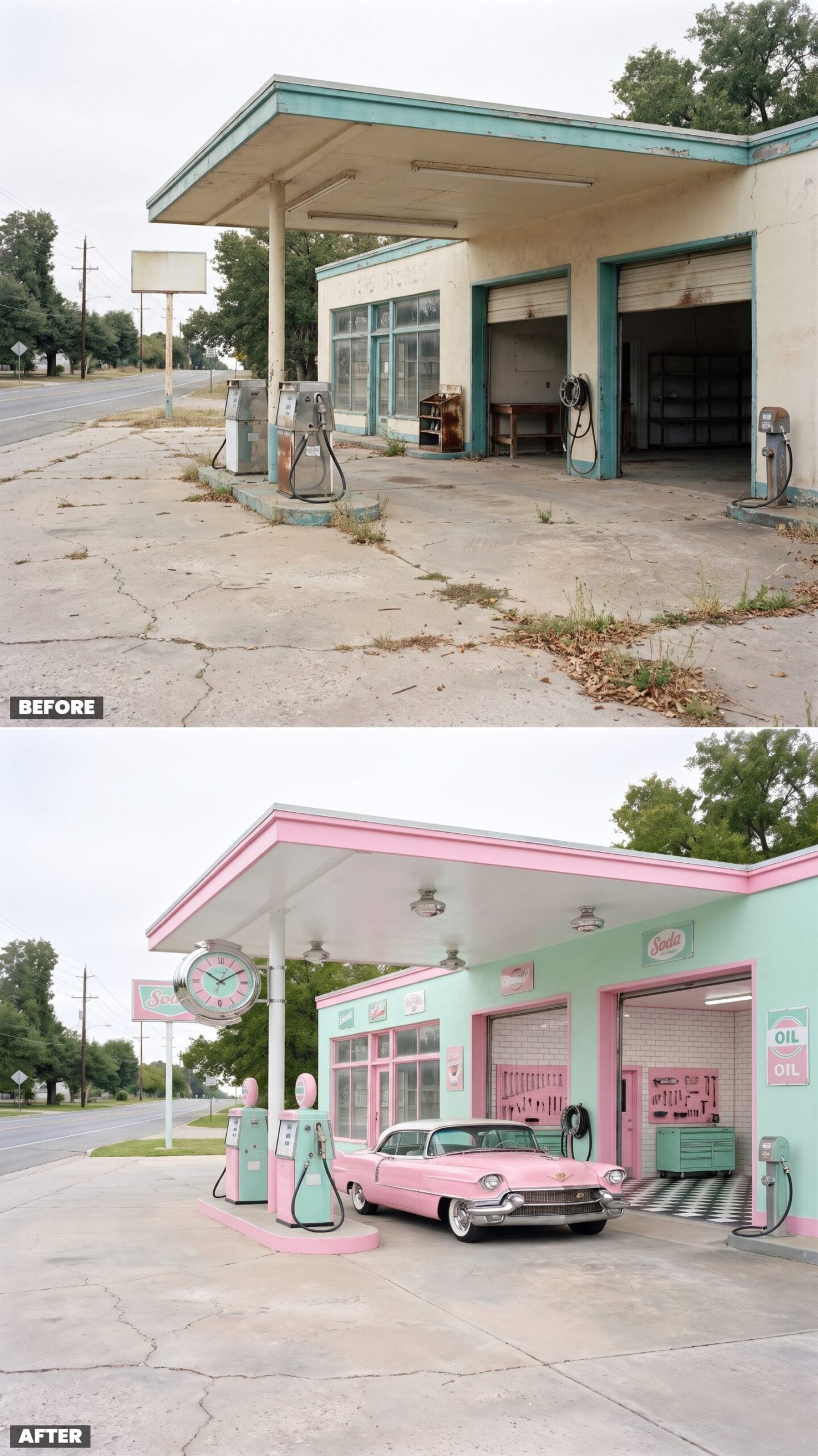
Mint and bubblegum pink on a gas station sounds like a mistake until you see it done right.
The candy palette commits all the way, which is why it lands instead of looking like a theme party. Chrome detailing and a facade clock anchor it firmly in 1956. White subway tile, a pink pegboard full of chrome tools, a pink Caddy at the pumps. Playful without being a joke. I’d drink coffee here every morning and never apologize for it.
21. Raw Industrial Loft Workshop in Concrete and Edison Light
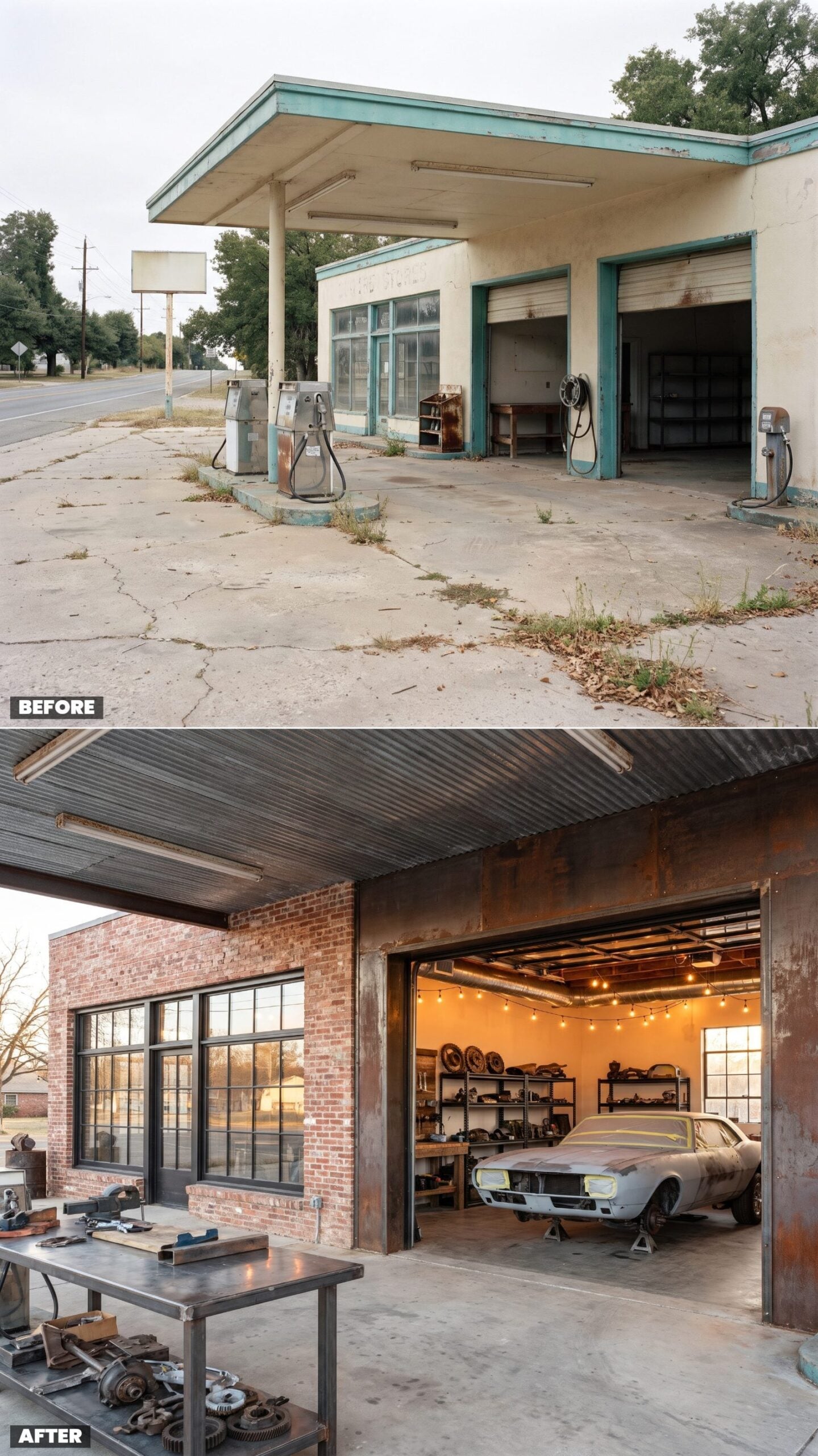
Some stations look best when you quit trying to make them pretty.
Here the move is restraint. Strip to brick and bare steel, seal the floor, string up Edison bulbs, and let the building be honest about what it is. A primer-gray ’67 Camaro mid-restoration, still wearing its masking tape, is the right hero because the room is also a work in progress. Nothing precious. Everything functional. And that reclaimed pump island, now a steel-topped bench, is the kind of reuse that makes you nod.
20. Coastal Woody-Wagon Garage in Weathered Blue and Cedar
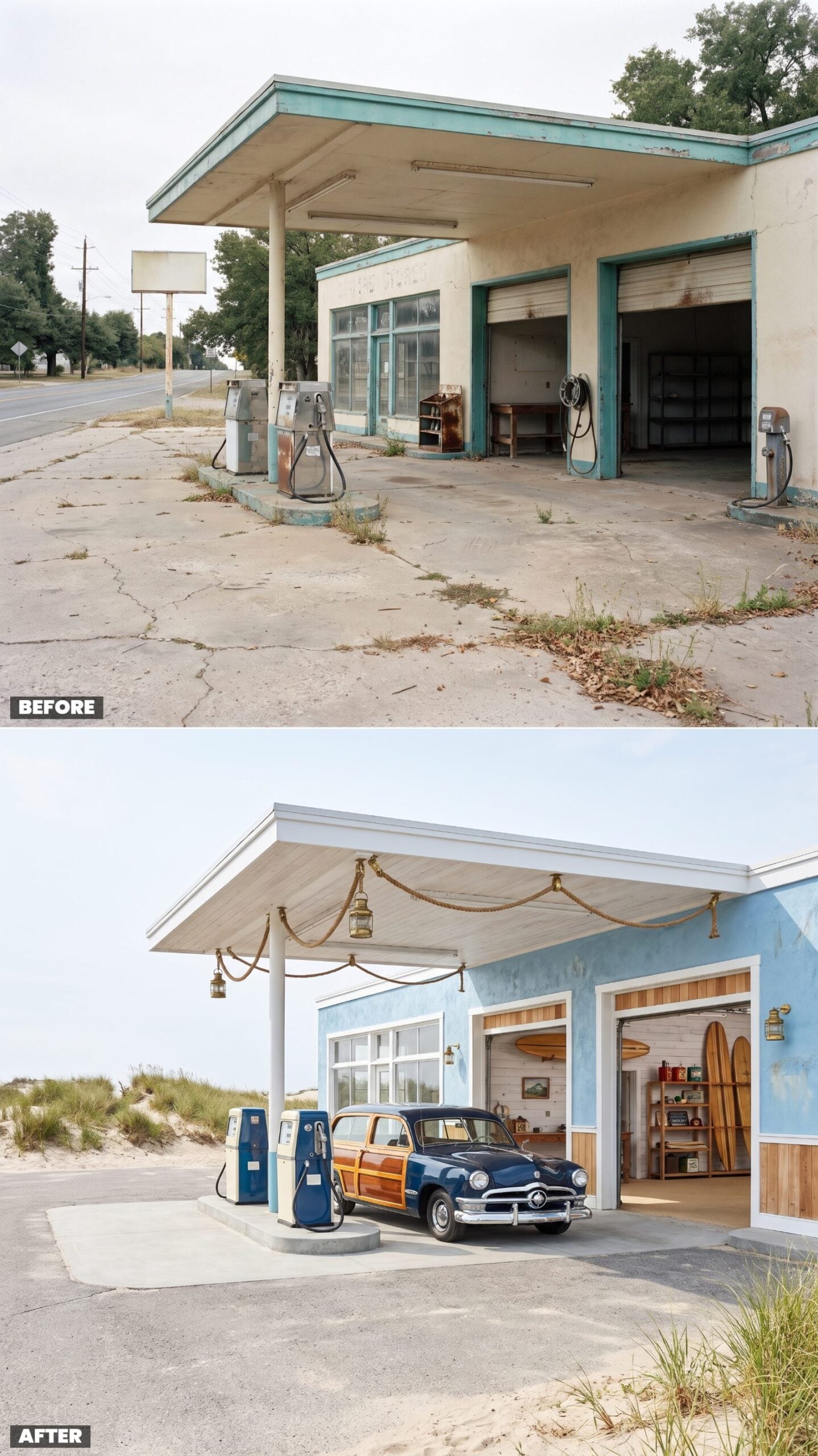
Weathered sky-blue and cedar, and the station forgets it was ever landlocked.
What carries this one is the texture contrast — whitewashed plank walls against varnished cedar, matte paint against the glossy wood of a ’49 Ford woody at the pumps. Salt-air light, open shelving, and a station that feels like it’s been facing the Pacific for seventy years. Breezy without being a costume.
Describing how he rebuilt the wood on a 1948 Ford woody wagon, a woodwork restoration specialist says “Next I made new panels, sanded it, then stained the panels and applied ten varnished coats to all the wood, then hand rubbed and reassembled.”
19. Clean Modern Dream Garage in White, Oak, and Glass
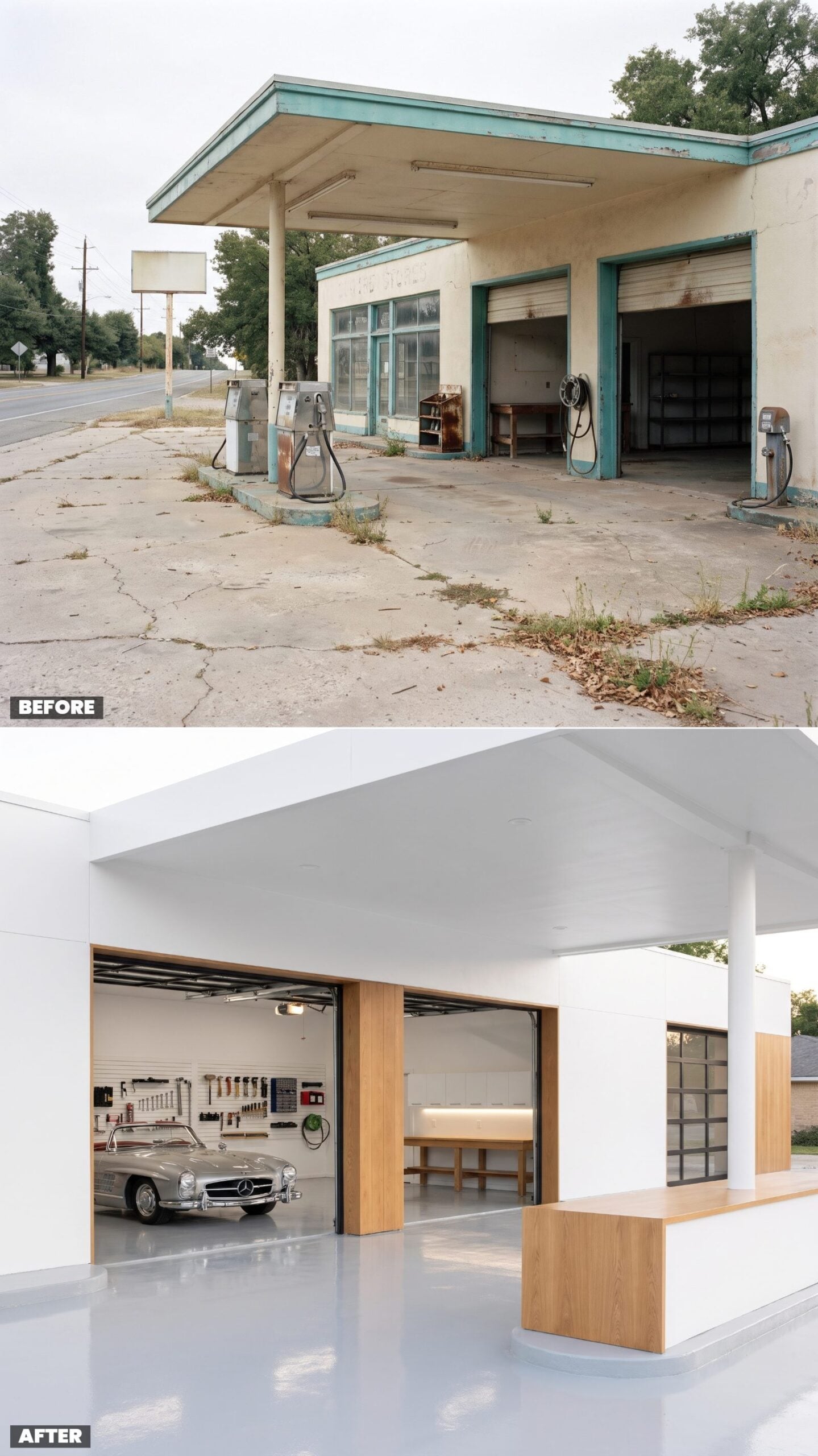
This one takes the station somewhere it’s never been: minimalist.
White, oak, and glass is a palette lifted straight from modern architecture, and dropping it onto a 1950s filling station is the whole thrill. Epoxy-gray floor, white slat-wall storage, a warm oak bench to keep it human. Roll-up bay doors open wide and flood the place with light, with a glass-paneled door off to the side. Park a silver 300SL roadster in the open bay and the old station suddenly looks like it belongs in next year’s design annual. Same footprint, completely different century.
18. A Candy-Colored Diner and Fuel Stop Mashup
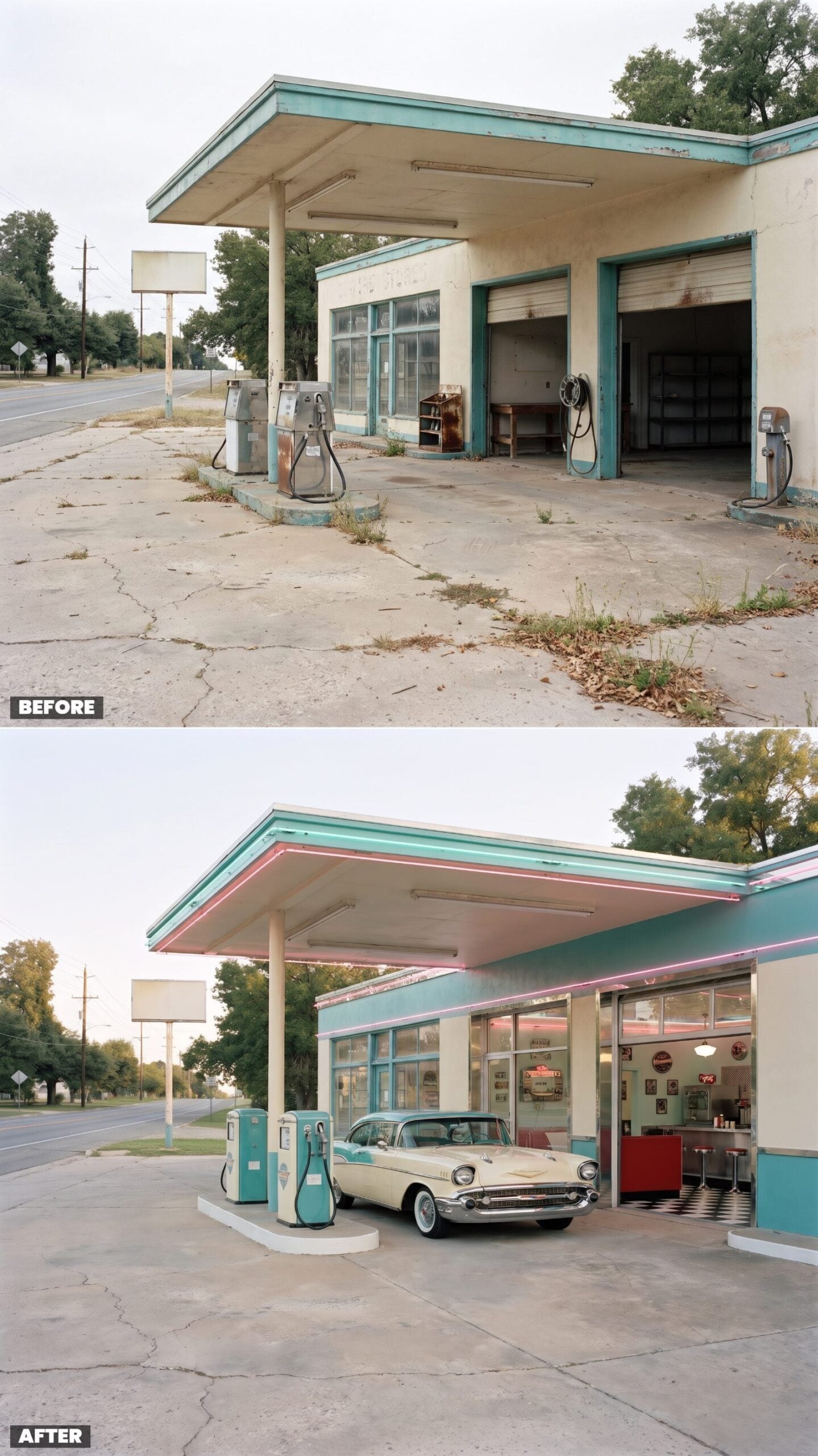
Somebody looked at those twin bays and saw booths.
Both bays become a glassed-in diner, red vinyl booths on one side and a stainless counter with stools on the other, soaking up the neon. Teal and cream outside, pink and aqua tubing tracing the roofline once dusk hits, and the pumps wear the same teal so nothing looks bolted on as an afterthought. You’d pull in for gas and leave an hour later full of pie, wondering where the time went.
17. A Minimalist Collector’s Showroom Behind Glass
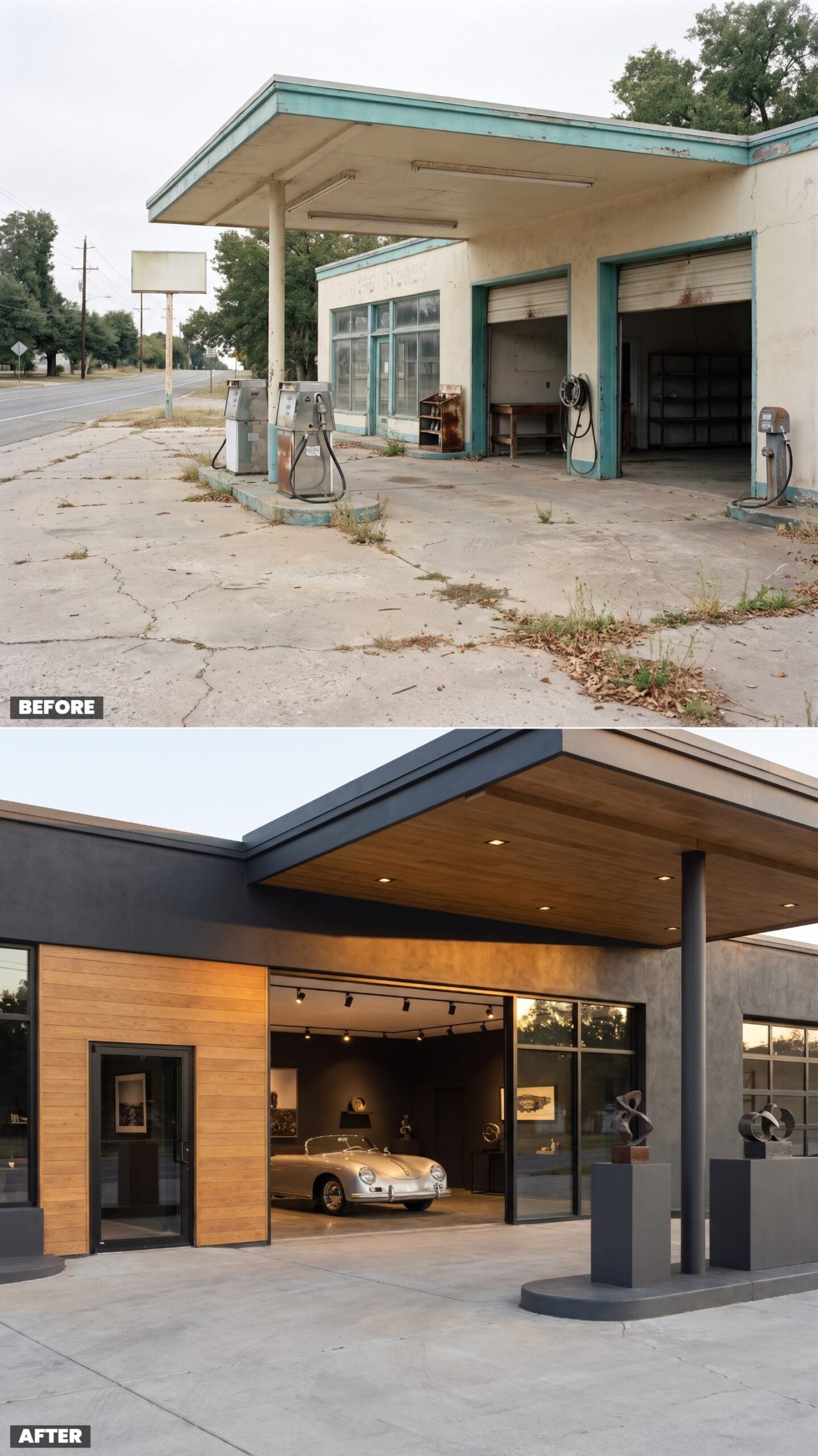
Restraint is the whole play. Charcoal walls, oak paneling, polished concrete, and one car parked dead center like it’s hanging in a gallery.
Swapping the old bay doors for black-framed glass changes everything in a single stroke. The station stops being somewhere you fix cars and becomes somewhere you stand and look at one. At night the warm track lighting turns the forecourt into a lightbox you can see from the road. Fewer things, better things.
16. A Route 66 Roadside Time Capsule
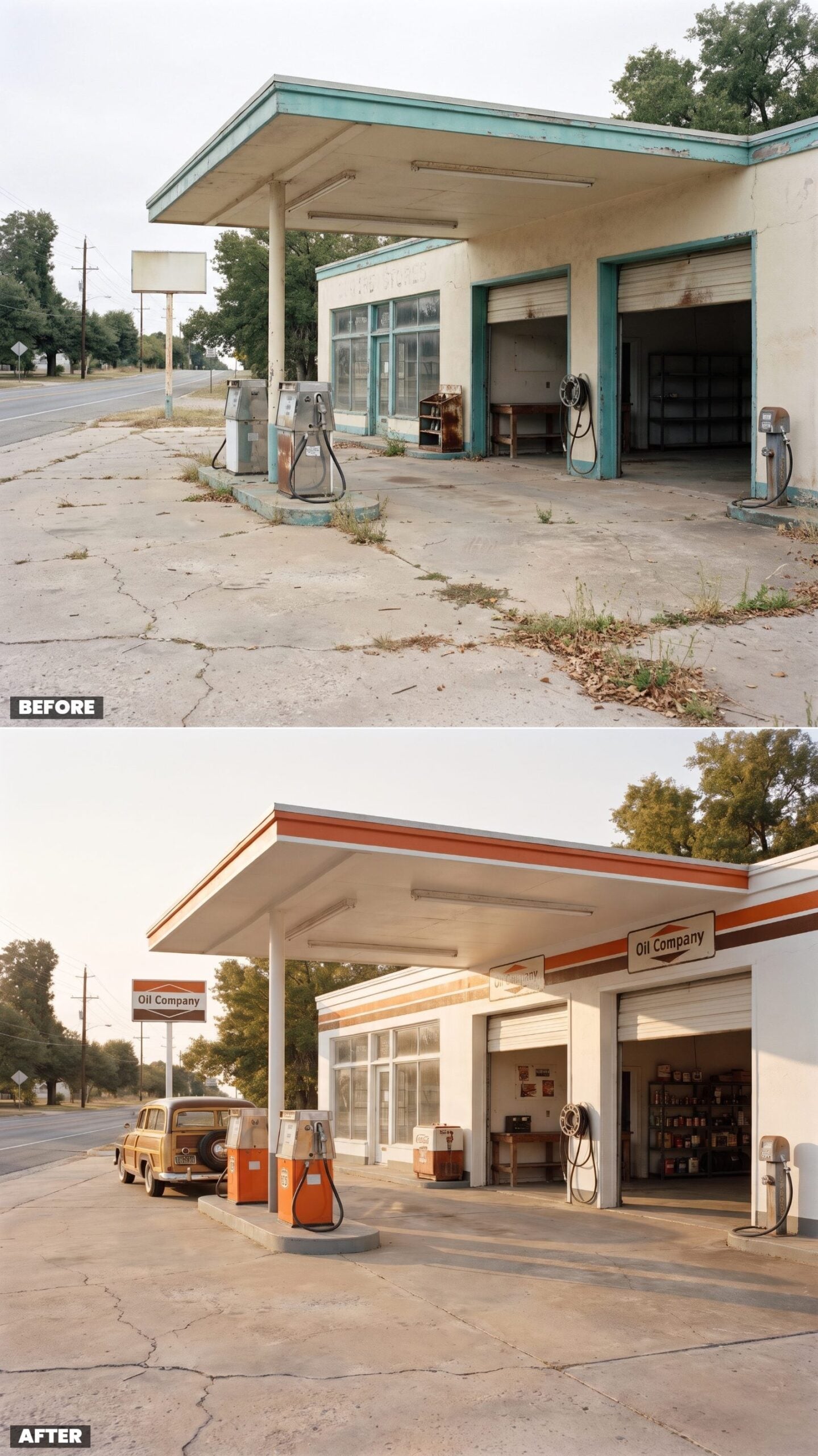
This one refuses to admit the calendar moved. It’s 1955 and proud of it.
White walls split by an orange-and-brown band, painted signage riding above the bays, and a tall pole sign built to be read from a car doing sixty. The forecourt gets loaded up: orange gravity pumps, an air-and-water stand, an enamel soda cooler sweating by the door. Afternoon desert light handles the aging for free. Park a woody wagon at the pump and you’ve built the kind of photograph people detour miles to take.
15. A Blue-and-White Hot Rod Shop With Attitude
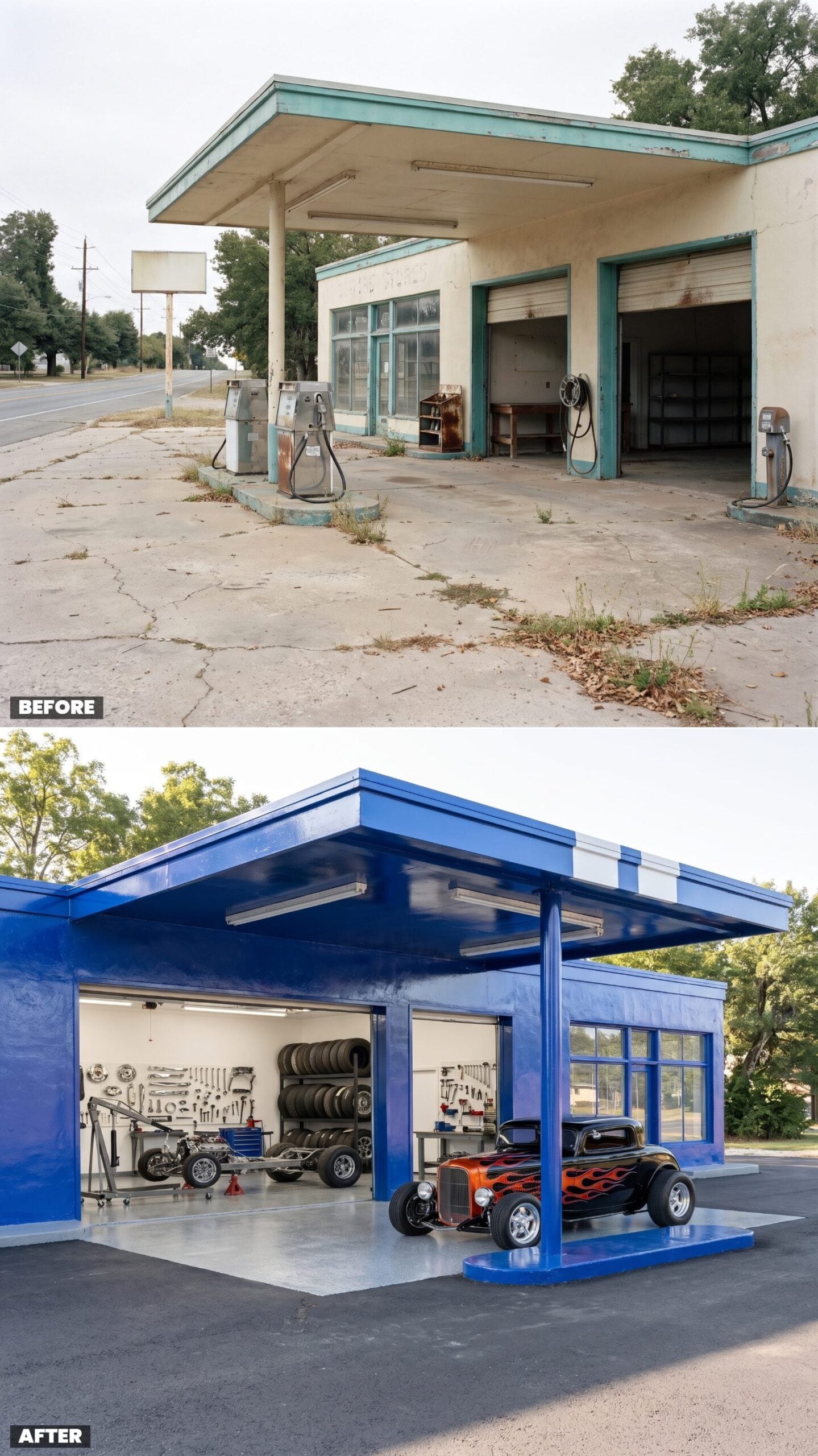
Royal blue, a white racing stripe, and all of a sudden the building has a pulse.
Both bays stand wide open so you can watch the work happen: a bare chassis up on stands, an engine hoist swung into position, pegboard walls bristling with chrome, blackwall tires stacked like cordwood against the far wall. The grey epoxy floor shines bright enough to catch the ceiling in it. Roll a flame-detailed hot rod out front and the shop tells you what it builds before you’ve read a single word painted anywhere.
14. A Warm Woodgrain Woodie and Surf Wagon Haven
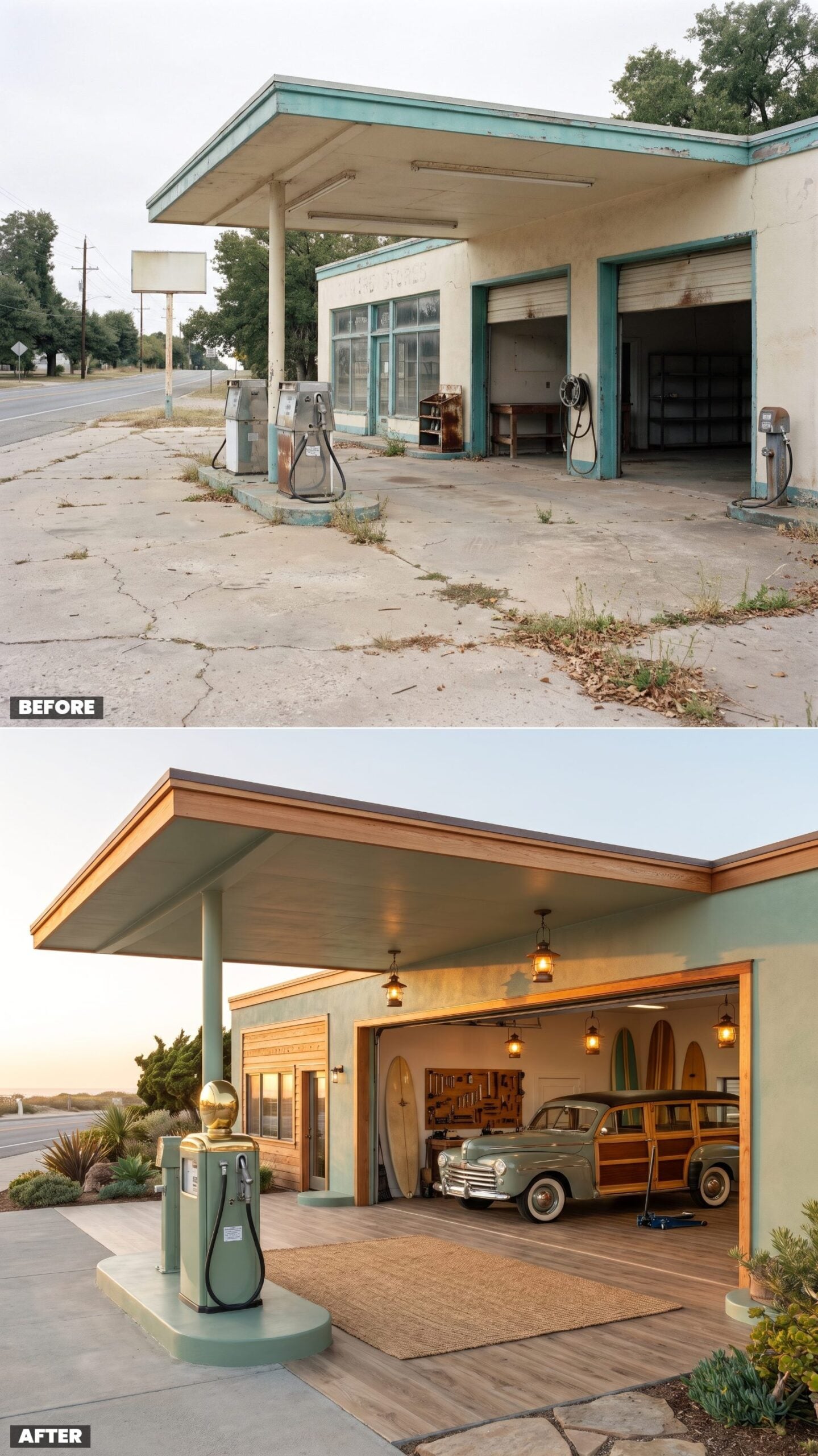
Sage green and cedar where you’d expect steel and grease. A garage that smells like salt and sawdust.
The woodgrain on the wagon carries over into cedar planks on the office wall and warm trim along the canopy, until the whole place reads like one continuous piece of furniture somebody built by hand. Surfboards lean in the corner. Jute underfoot, kerosene lamps swinging low, and late coastal light pouring in to set the brass pump top glowing. It’s a workshop that quietly forgot to be industrial.
Our readers have a soft spot for that look too: cars with wood paneling earned more hearts than the other images in the same articles, 83% versus 73%.
13. A Black-and-Chrome Luxury Detailing Studio
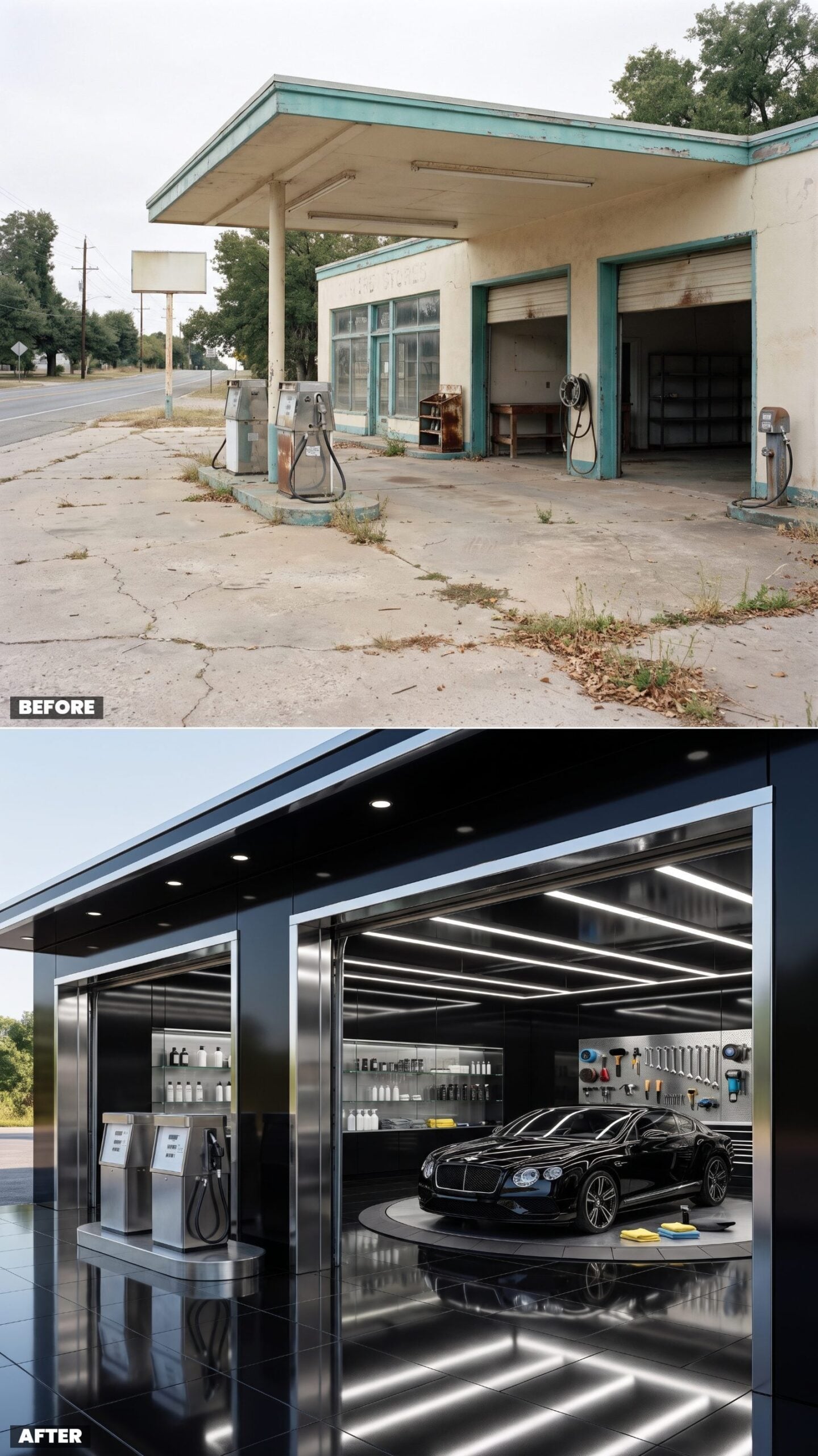
Gloss black and chrome, a floor polished to a mirror, a car turning slow on a turntable while the lights crawl across its paint.
Everything reflects everything else, and that’s the trick the whole room is built on. Black tile below, brushed steel wrapping the pump island, LED strips overhead bouncing off wet-look finishes until you lose track of what’s surface and what’s reflection. Call it the station reborn as a place obsessed with surfaces. Nobody fixes cars here. They make them photograph like jewelry.
12. A Pastel 1950s Family Garage With Checkerboard Charm
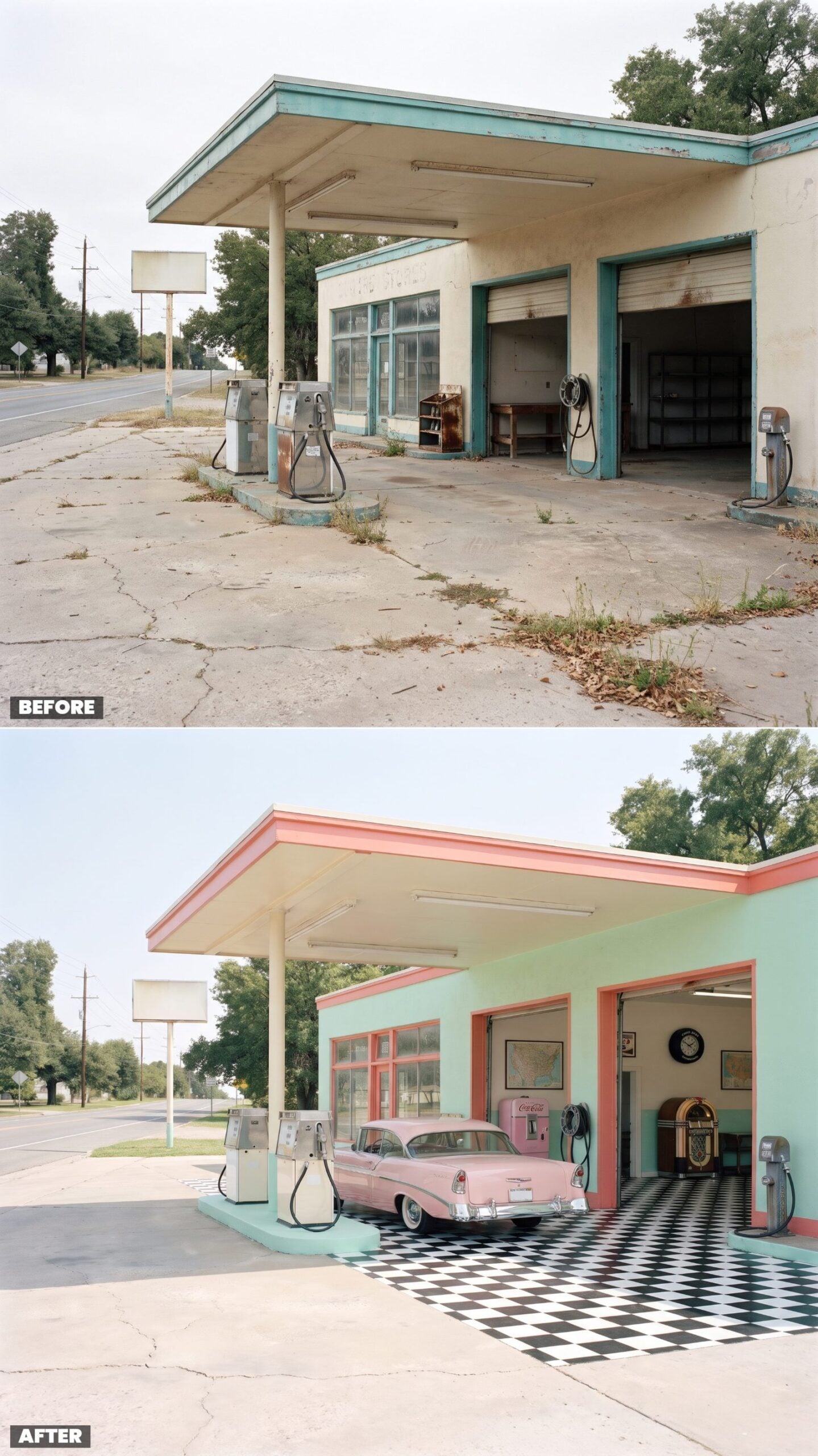
Mint green, coral trim, a floor you’d almost want to dance on. The station as a Saturday-morning memory you didn’t know you kept.
Checkerboard runs wall to wall. A pink soda machine hums in the corner, a jukebox waits by the office door, and old road maps hang framed above a clock shaped like a tire. The palette stays soft on purpose, the kind of pastel that makes a person slow down and grin for no reason. Roll a two-tone sedan up to the pump and the whole scene snaps into place like a postcard nobody ever got around to mailing.
11. A Racing-Green Motorsport Trophy Room and Service Bay
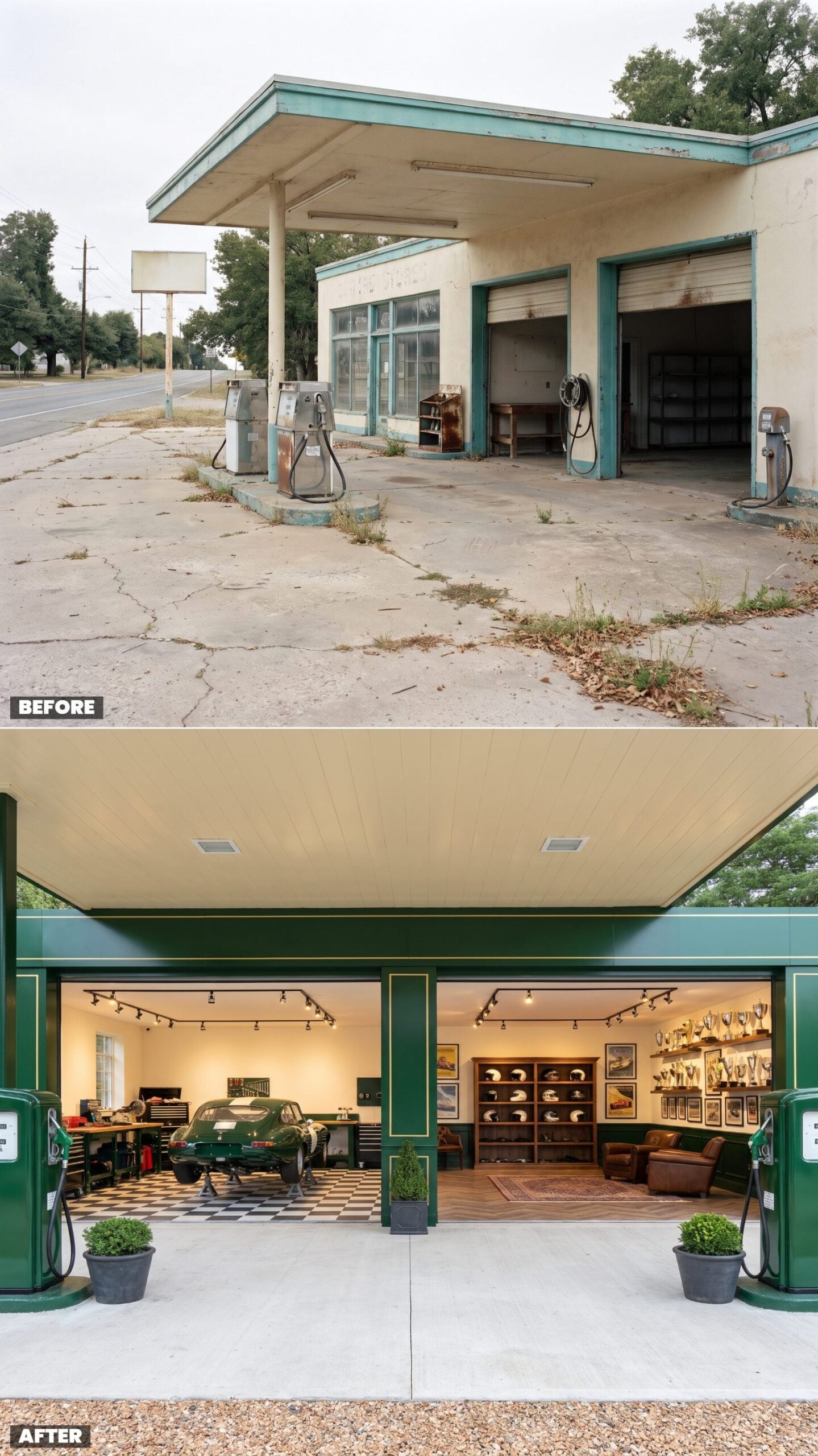
British racing green with a gold pinstripe, and the station sprouts a members-only feel overnight.
That split personality is what closes the deal. One bay stays all business, a race car up on stands over checkered tile. The other goes soft: leather club chairs, a trophy wall catching the light, framed racing posters, a shelf of helmets lined up by decade. Herringbone floor underfoot, warm gallery lighting across the whole room. A garage that knows exactly what it won and feels no need to keep quiet about it.
10. Period-Correct Service Station Reborn in Texaco Red and Black
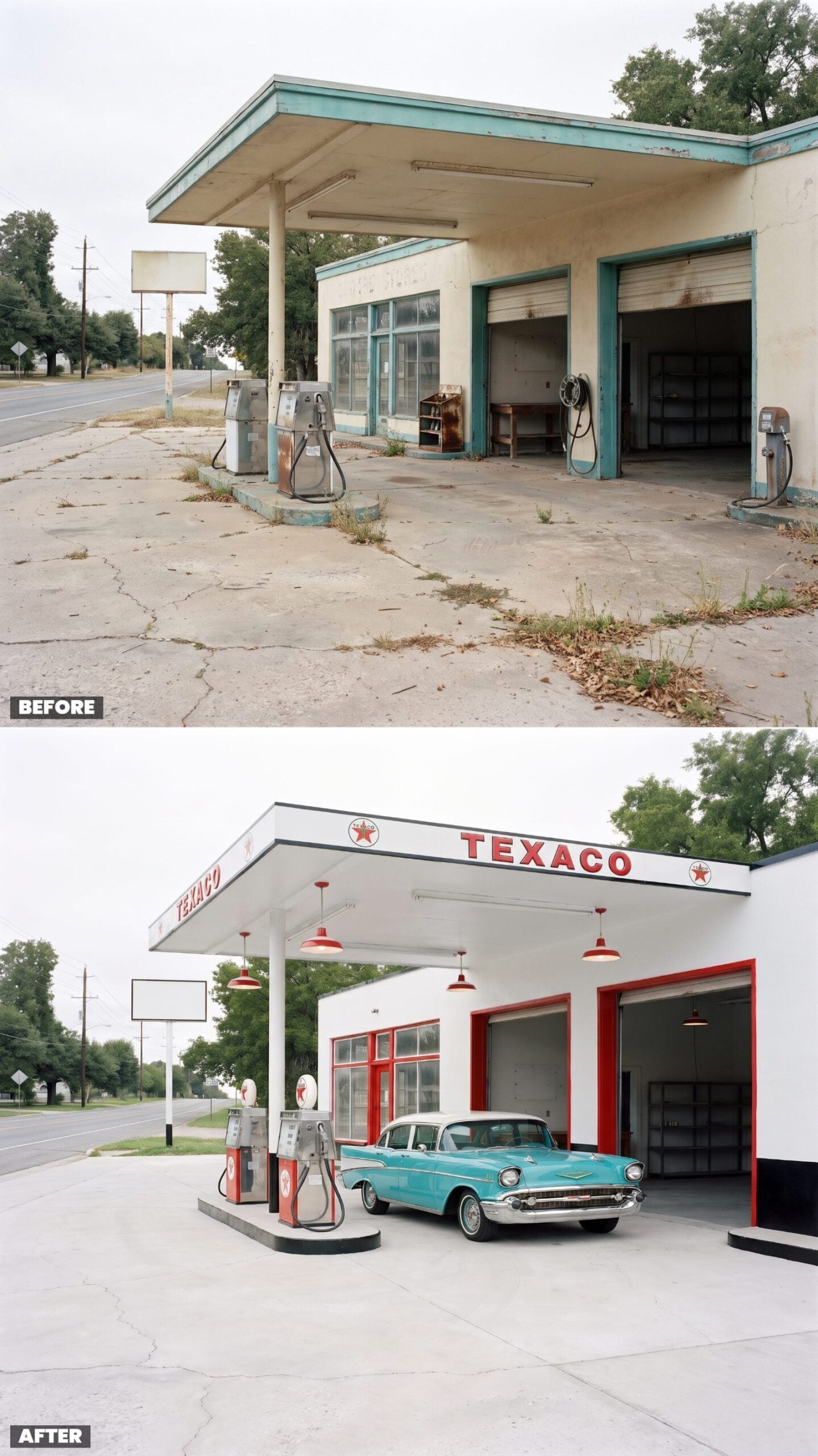
The old station had the bones of a 1950s service stop and nothing else — flaking paint, dead pumps, weeds shoving up through the apron. We took it back to the era it was born in.
That black base stripe does the heavy lifting. It grounds the white stucco and makes the red trim read as deliberate instead of random. And restoring the stainless computing pumps turns the forecourt back into the main event, which is exactly what it was in 1957.
9. Working Hot-Rod Shop in Hammered Steel and Signal Orange
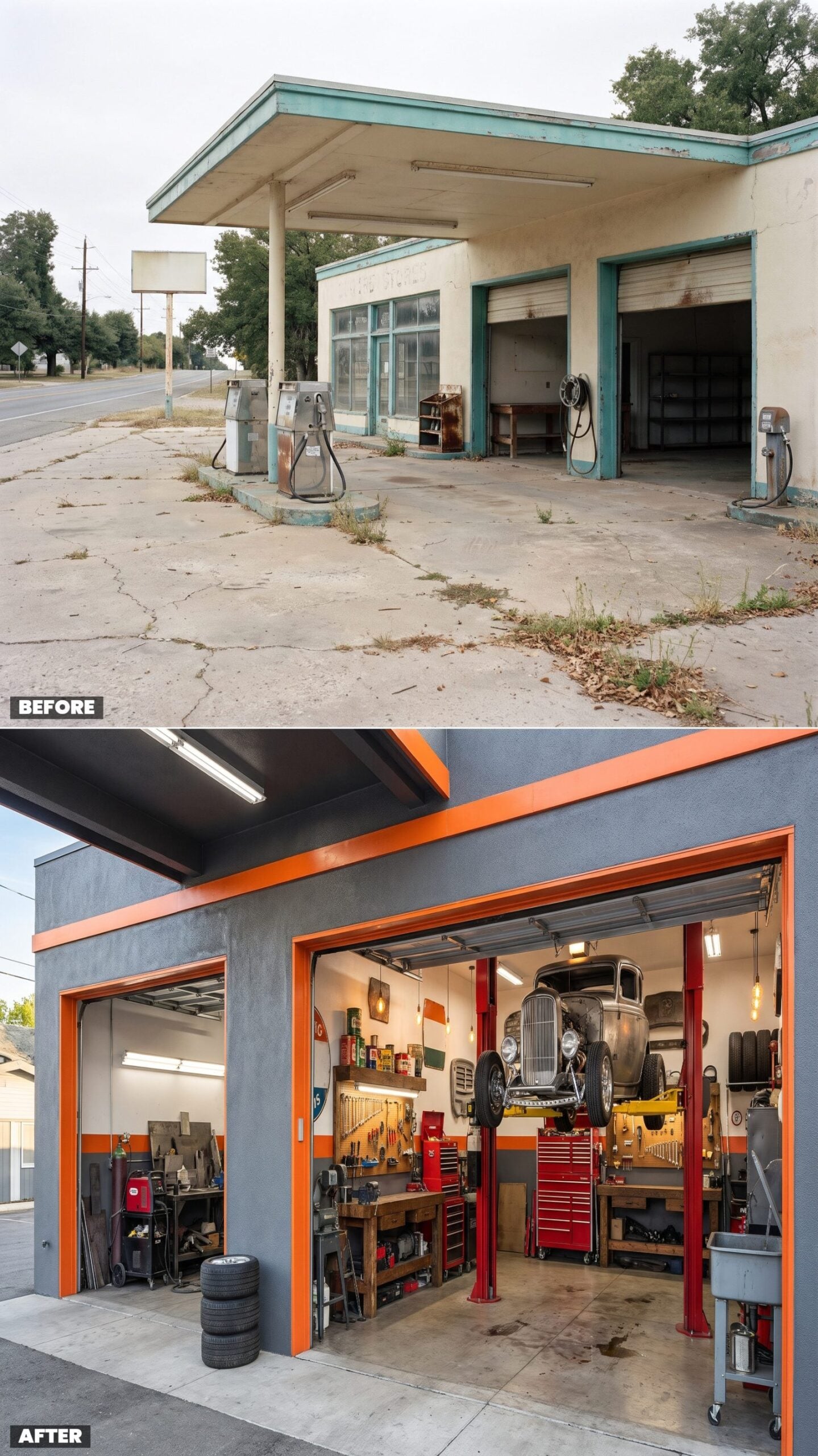
Not every station wants to be a museum. This one went the other way — back into actual work.
Signal orange against gunmetal gray looks industrial without looking cheap. The bands on the canopy fascia echo the bay door frames, so your eye ties the whole forecourt together before you even clock the lift inside.
The bare-metal ’32 Ford mid-build is the honest centerpiece. A finished car would’ve been a showroom move. A car in progress tells you the lights actually come on in the morning.
8. Art Deco Gulf-Inspired Filling Station in Cream and Deep Blue
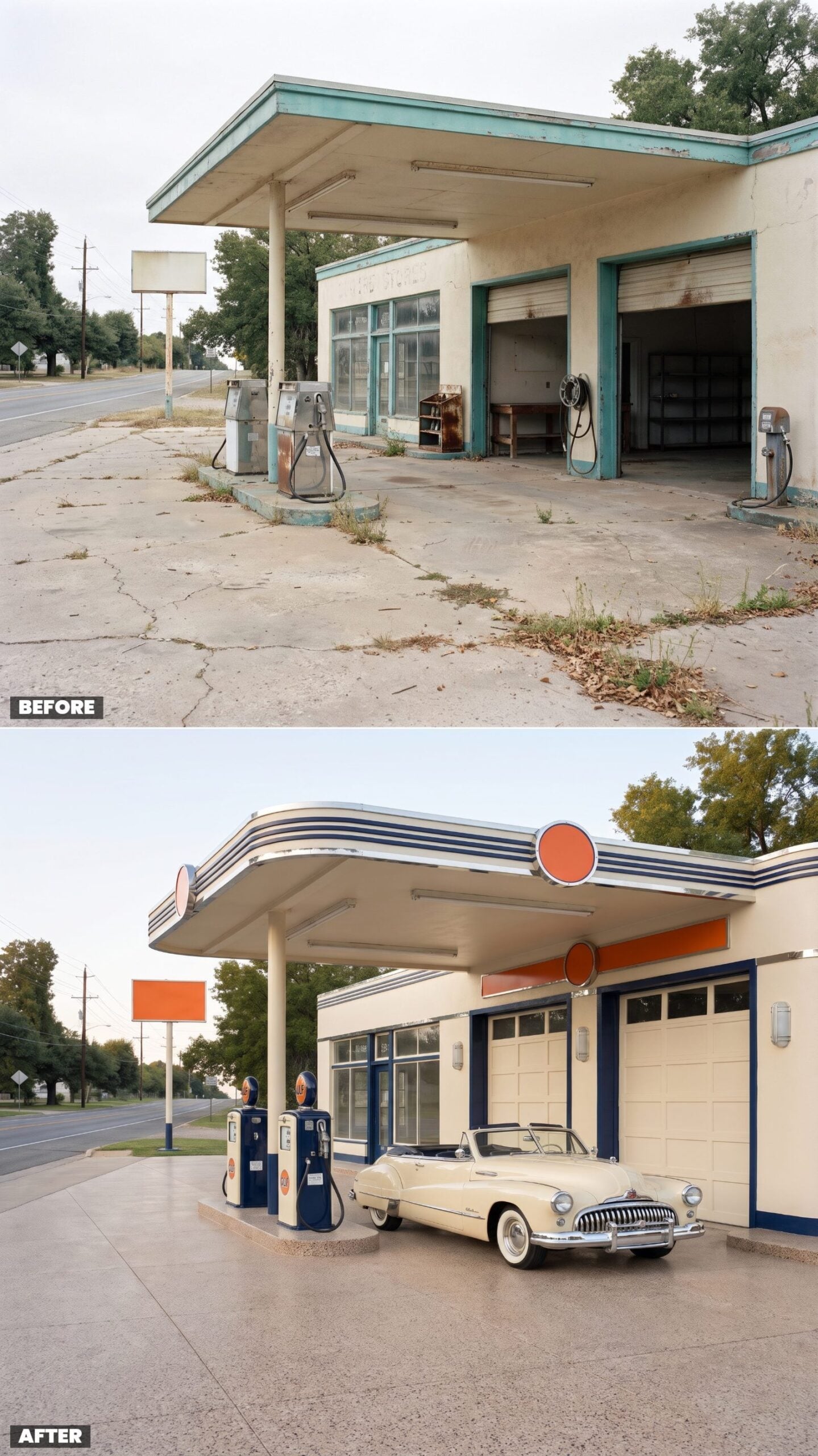
Those navy speed stripes wrapping the corners are pure late-deco optimism. They make a boxy little station look like it’s moving even while it sits dead still.
Cream against deep blue is a calmer palette than the usual red-white service-station shout, and the chrome keeps it from going soft. Restoring the clockface pumps instead of modern dispensers was the right call. Those round faces are the entire personality of the place.
7. Family Home Garage and Workshop in Barn Red and Pine
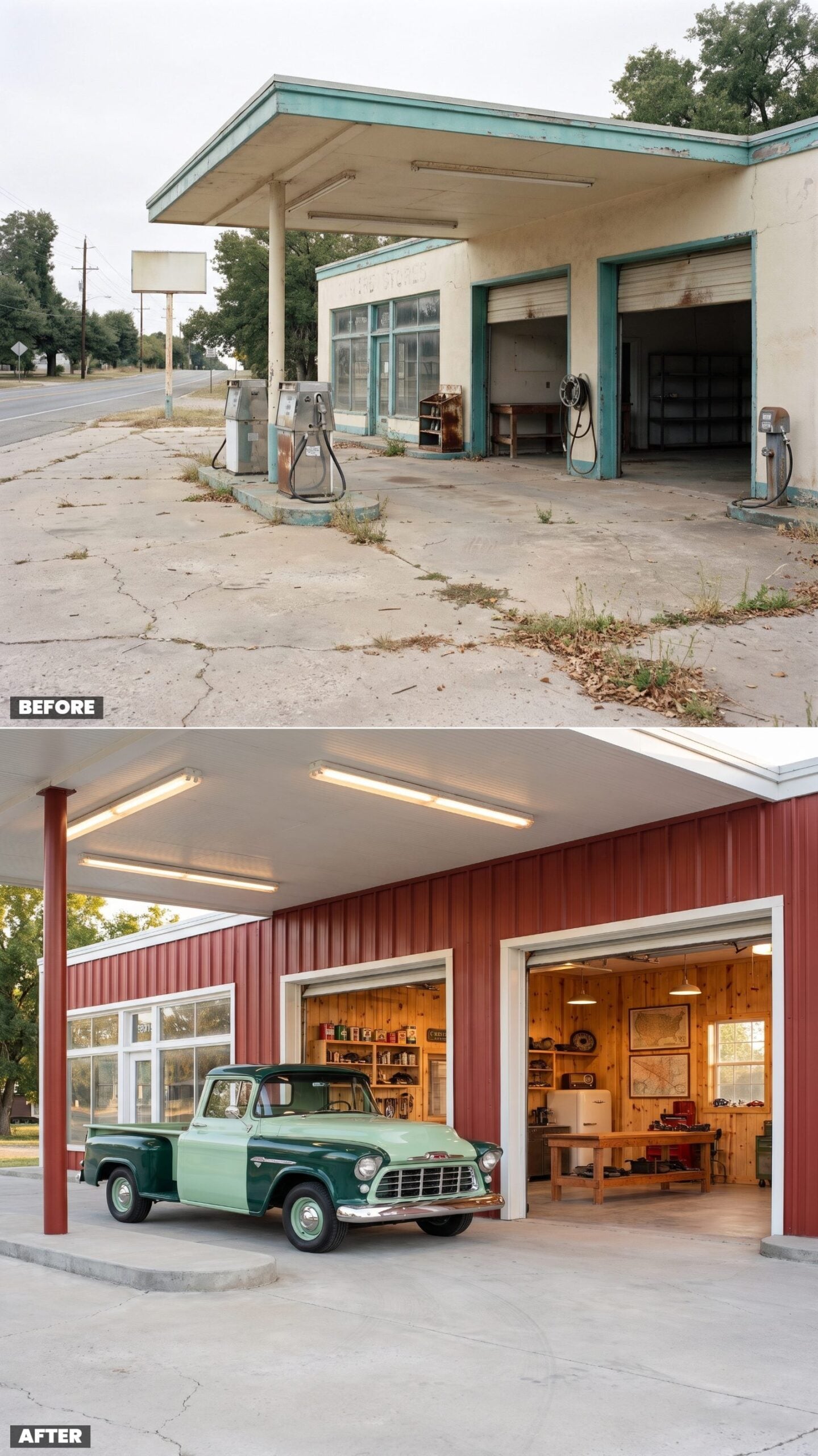
Barn red and white is the color of every good weekend. It makes the building feel like somewhere you’d want to burn a Saturday, not a business you’d pull into for gas.
Knotty pine inside is the move that warms the whole thing up. Concrete and metal say shop; pine and a radio say home. And the green ’55 pickup under the canopy ties it to the yard it probably sat in for forty years anyway.
6. Roadside Diner Conversion in Chrome and Cherry Red
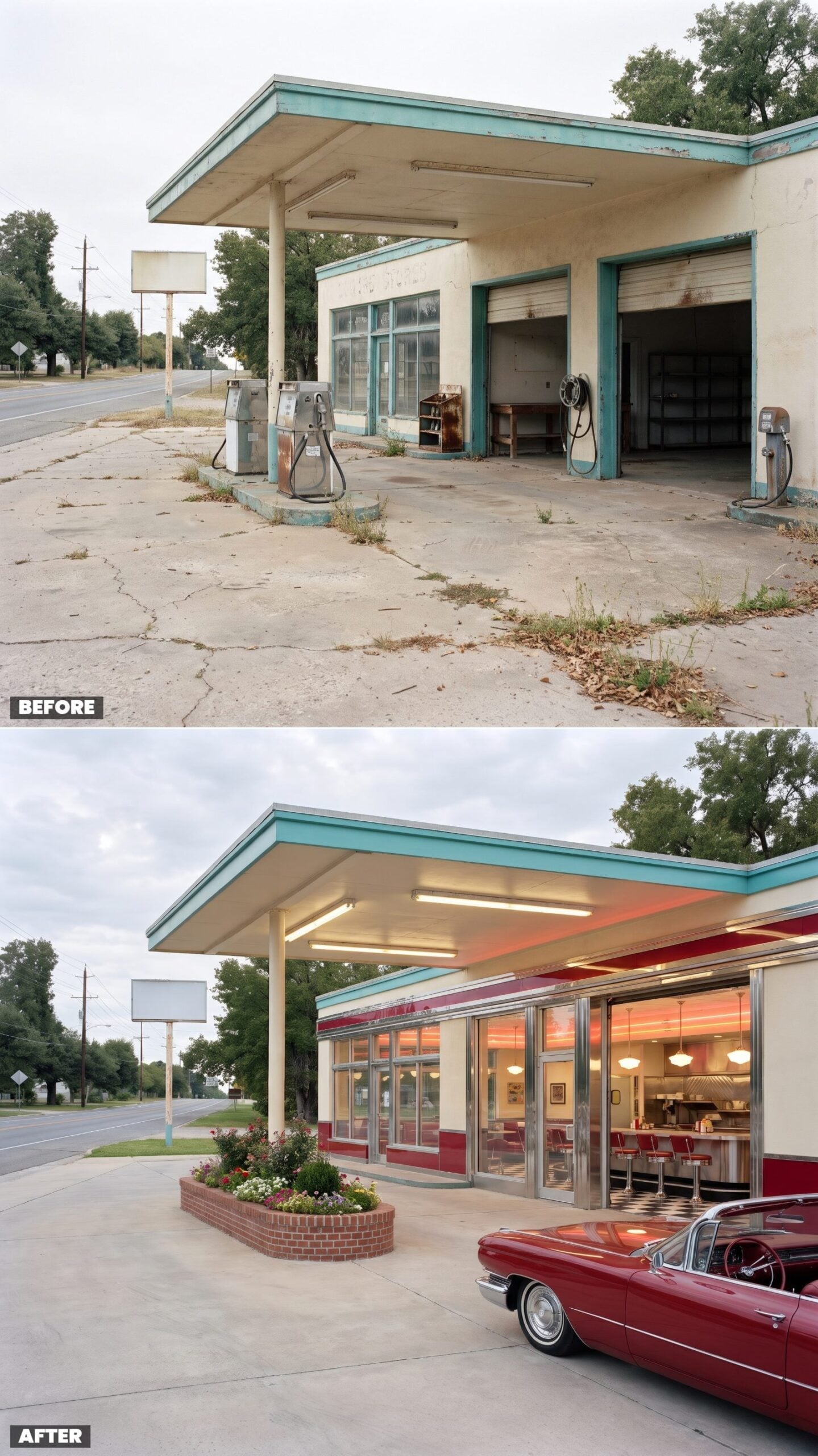
The canopy that once sheltered gas pumps now shelters a brick planter full of flowers. Same roof, completely different reason to pull in.
Cherry red and chrome is the obvious diner language. The real decision was that wide open glass-and-chrome front — it opens the building up so the checkerboard floor and red counter stools reach out and grab you from the road. And the ’59 Caddy parked out front isn’t decor. It’s the whole advertisement.
5. High-End Collector Lounge in Forest Green and Brass
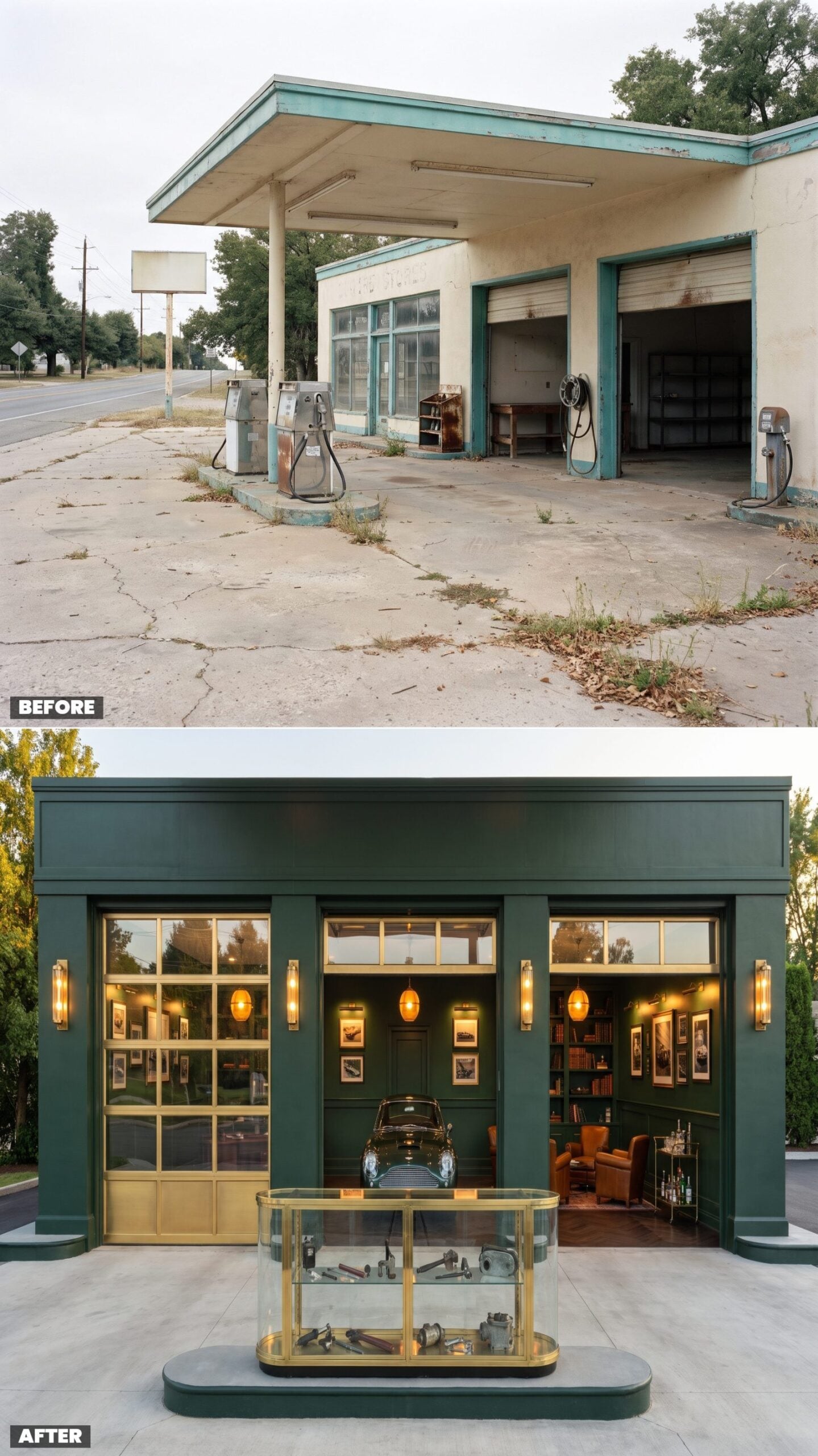
This is the station that put on a dinner jacket.
Forest green and brass is the palette of a good library or an old members’ bar, and dropping it onto a filling station is the whole joke and the whole charm at once. Cognac leather club chairs and a bar cart turn the sales floor into a room you’d genuinely sit in for a while.
Keeping the pump island as a brass-and-glass display case is the detail that sells it. The building admits what it was while quietly announcing what it’s become. That dark green Aston behind glass? The flex nobody has to point out.
4. Classic Motorcycle Shop in Cream, Oxblood, and Chrome
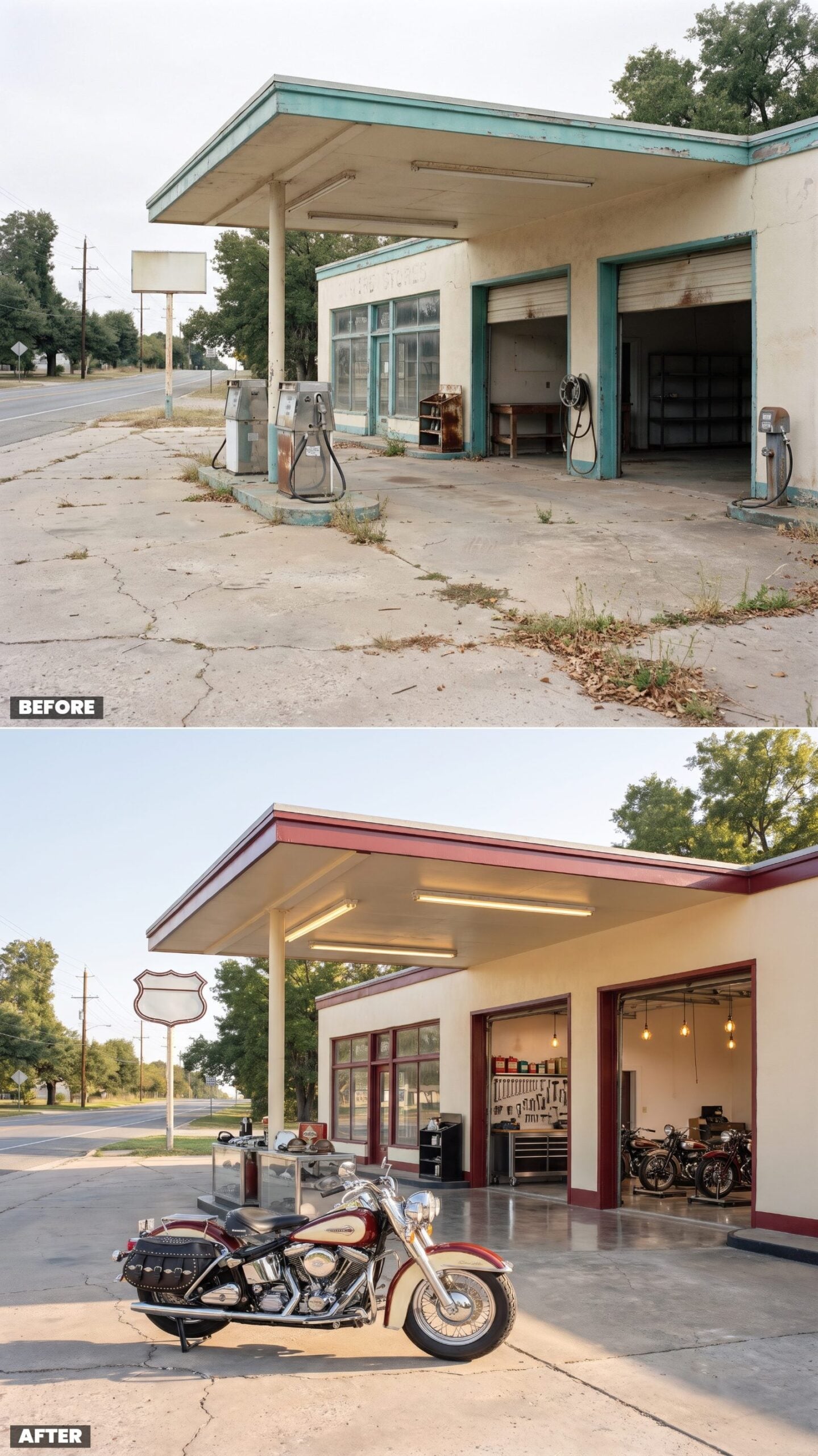
Cream and oxblood is the color of old leather saddlebags and painted tanks, which is exactly why it lands on a bike shop.
The pump island becomes a parts counter — a small change that completely rewires how you move through the forecourt. Instead of fueling up and leaving, you pull in and stay. Chrome against warm cream keeps the whole thing from going too dark, and that row of bikes on stands turns the old service bay into a lineup worth walking.
3. Full-Service Throwback in Petroliana Red and Cream
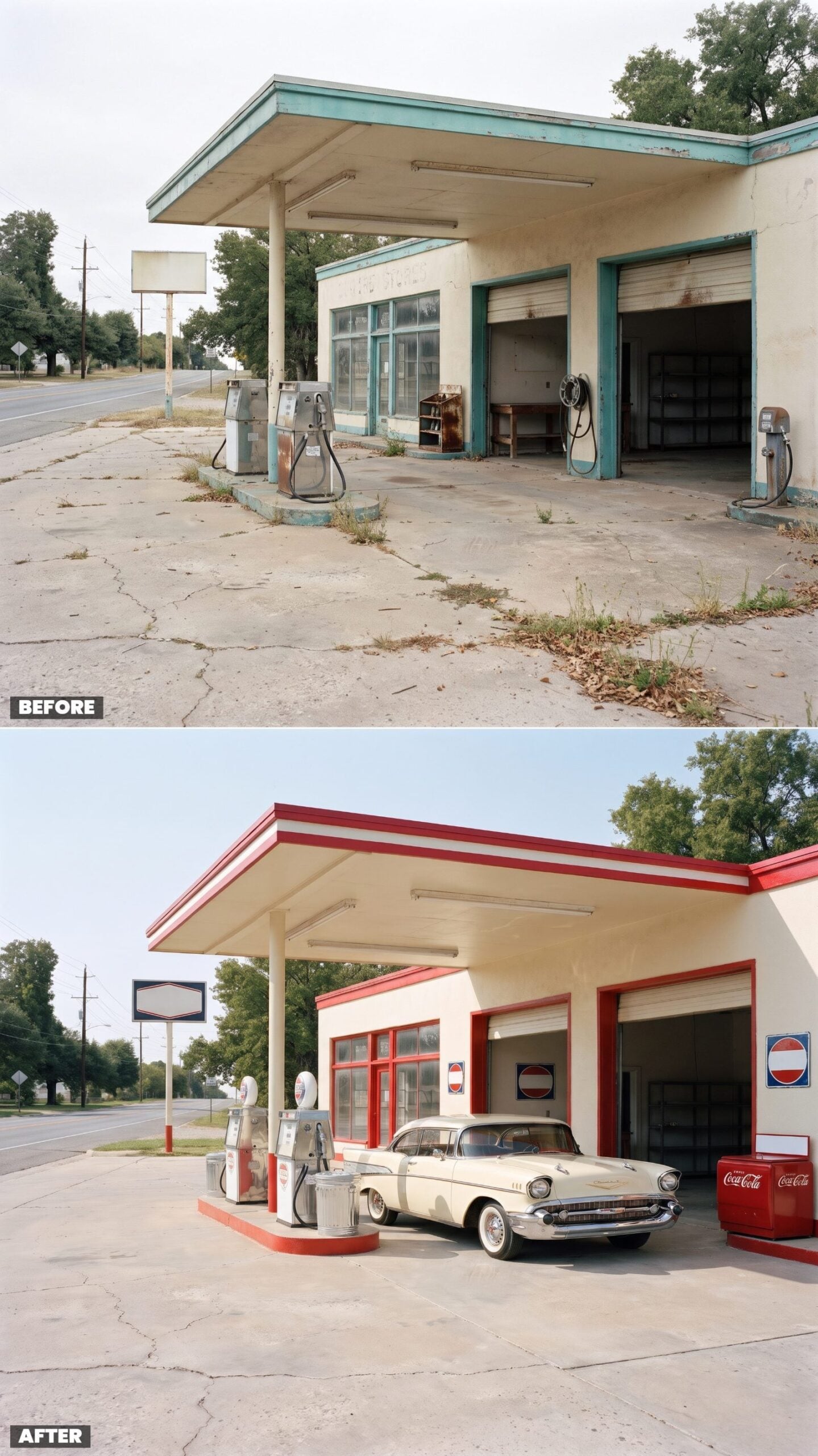
The bones were always a full-service station, so leaning into that identity was the honest move. Cream stucco cools the whole lot down, and the fire-engine-red trim does the shouting the faded old paint never could.
Restored enclosed computing-style pumps with glass globes anchor the island like they never left. The red Coca-Cola cooler and enamel oil signs aren’t decoration — they’re the vocabulary of the place. A cream 1957 Bel Air at the pumps closes the loop.
2. Blacked-Out Speed Shop with Checkered Attitude
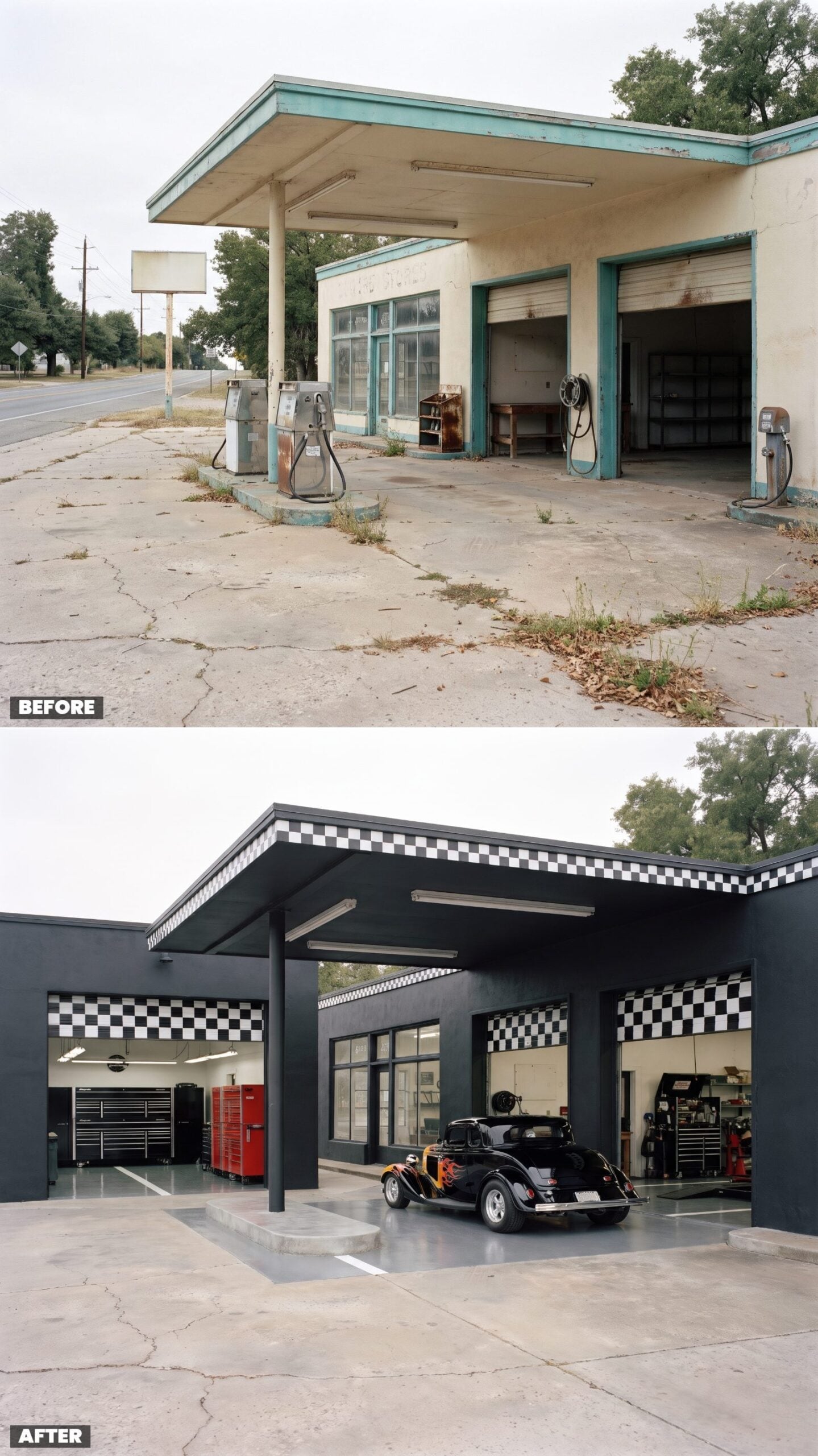
Flat charcoal turns the old building menacing in the best possible way. And that checkered band running the canopy and bay headers? It gives the eye a rhythm the tired beige never had.
Step inside. The polished grey epoxy with a painted centerline reads like a strip of track pulled indoors, black-and-chrome black rolling tool chests line the bays, and a flamed black coupe sits right where cars once got their oil changed. Loud without saying a word.
1. Mid-Century Showroom in Teal, Terrazzo, and Glass
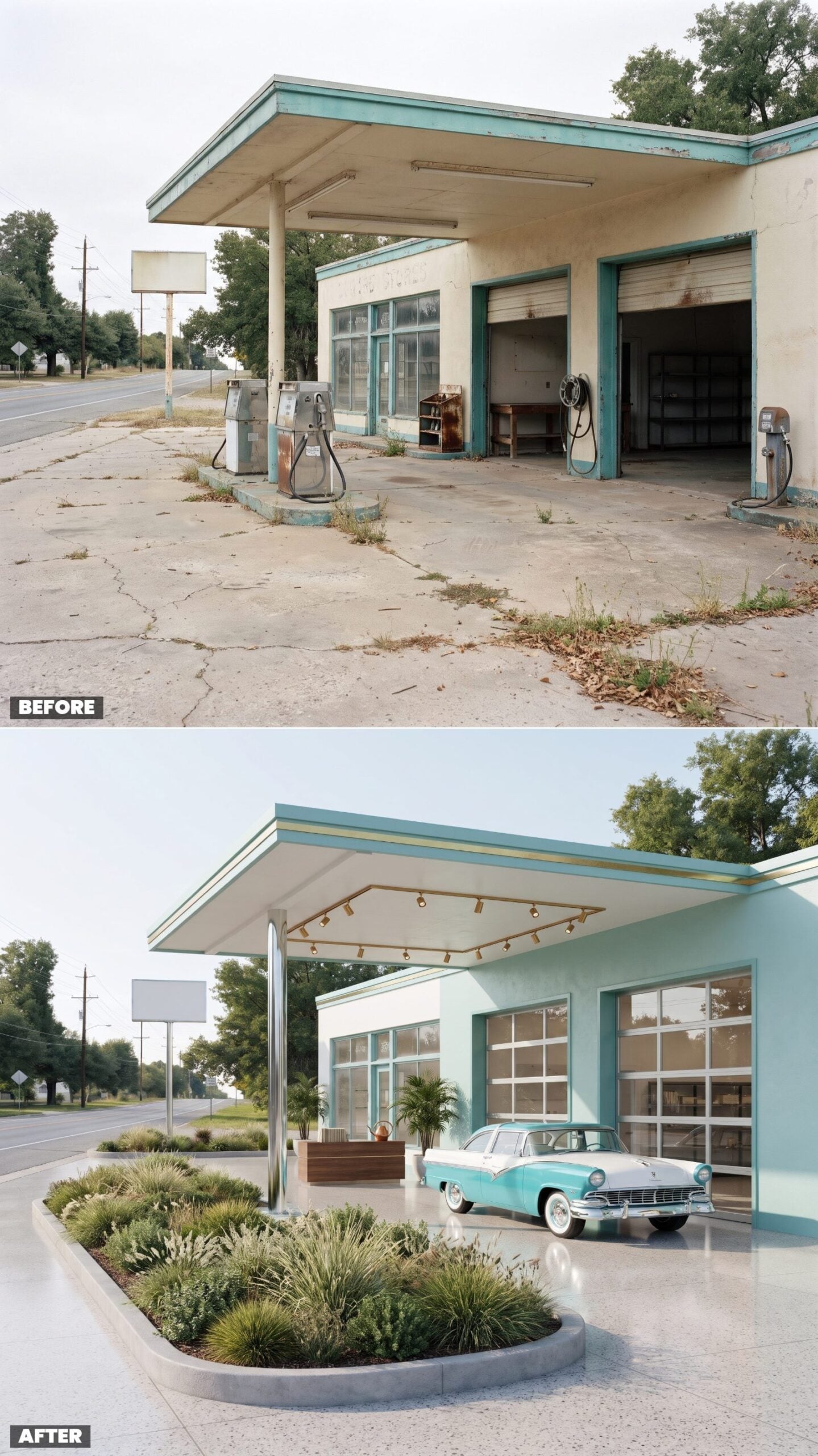
This is the version that trades grease for glass. Swap the bay doors for full-height plate glass and the whole station becomes a display case, with soft teal on the outside keeping it from going cold and clinical.
Polished terrazzo inside catches the light the way a good showroom floor should. The old pump island? Now a planter with a single chrome light pole — a quiet nod to what used to stand there. A turquoise-and-white ’56 Fairlane poses on the floor like it’s for sale and knows it. Honestly, I’d buy it.