
Would you like to save this?
The bell dinged twice when your tires rolled over the rubber hose, and a kid in a bow tie and striped cap came out before you’d even shifted into park. Full tank, windshield wiped, oil checked, all while you sat there. That whole ritual is gone, replaced by a touchscreen asking if you want a loyalty discount. Here are the gas-station features from 1965, stacked against what stands in their place today.
Please note that some of the images in this article were created with the assistance of AI.
50. Attendants Filling Every Tank vs. Pay-at-the-Pump Self-Service
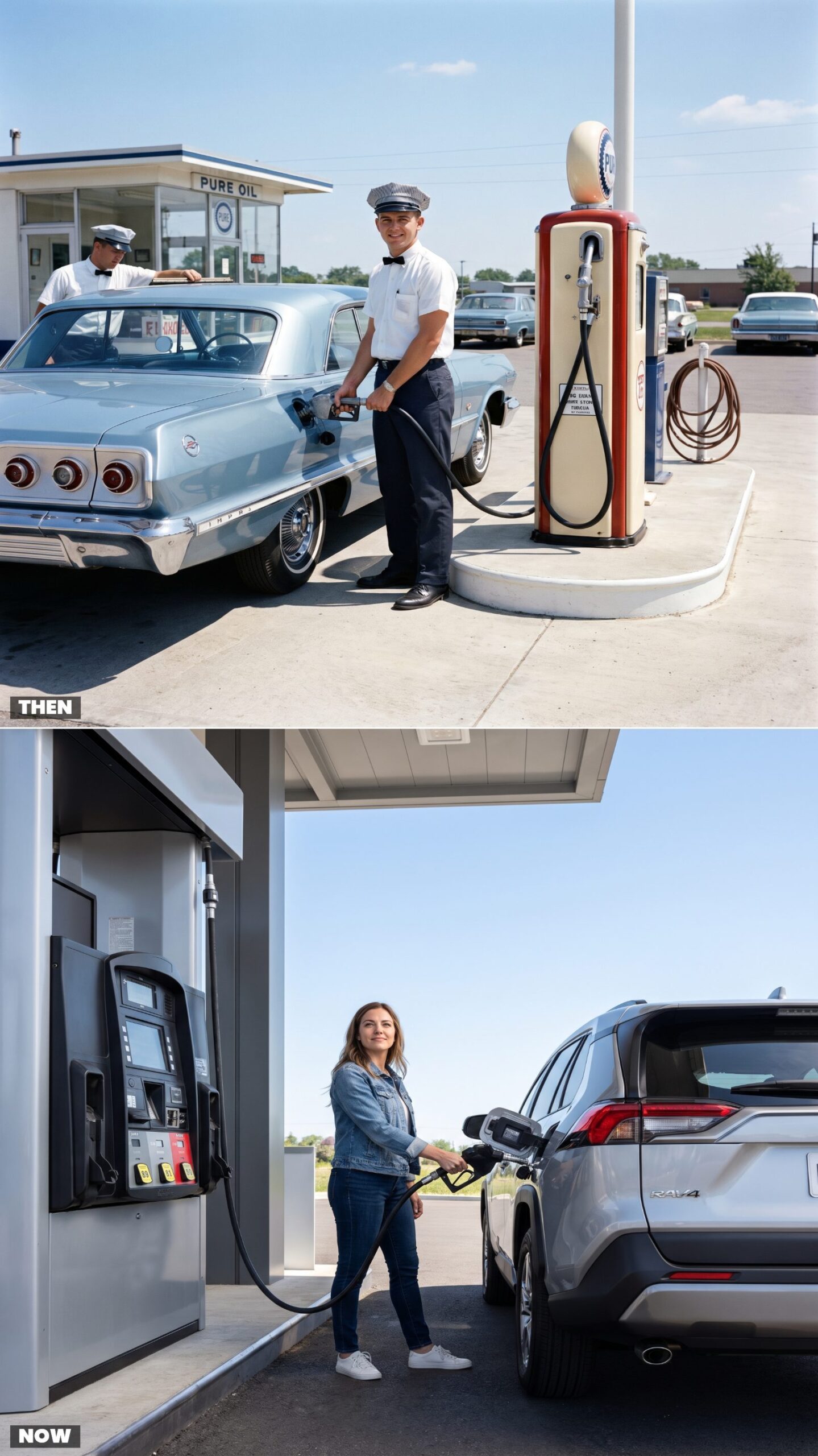
In 1965 you never touched a nozzle. You pulled in, the bell dinged, and a kid came running to pump your regular, clean your glass, and check your oil without being asked. You tipped him a quarter and felt like royalty.
Now you pump your own, in the rain, while a screen asks if you’d like to round up for charity. Full service didn’t just disappear — it took a certain kind of small-town courtesy out the door with it.
49. Towering Porcelain Brand Signs vs. Digital Roadside Pylons
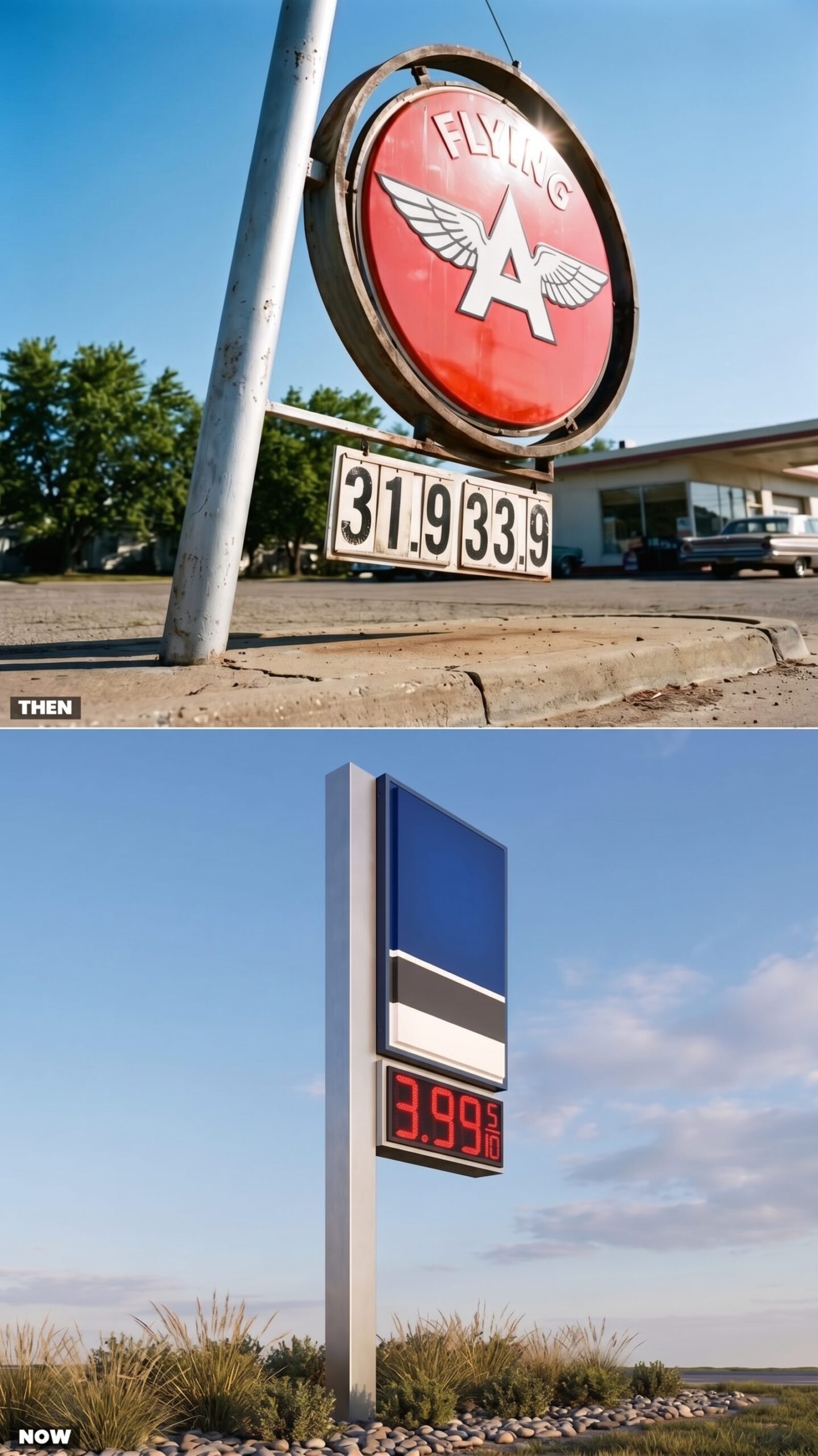
A 1965 brand sign was a slab of porcelain enamel baked onto steel, round as a dinner plate and tough as a skillet. The colors glowed. The edges chipped over the years and showed black metal underneath, and nobody minded one bit. Collectors now pay thousands for the ones that survived a half-century of weather and wrecking balls.
Today? A backlit plastic pylon with an LED price panel that updates itself. Efficient. Visible from the highway. About as soulful as a parking meter.
48. Hand-Changed Fuel Price Boards vs. LED Price Displays
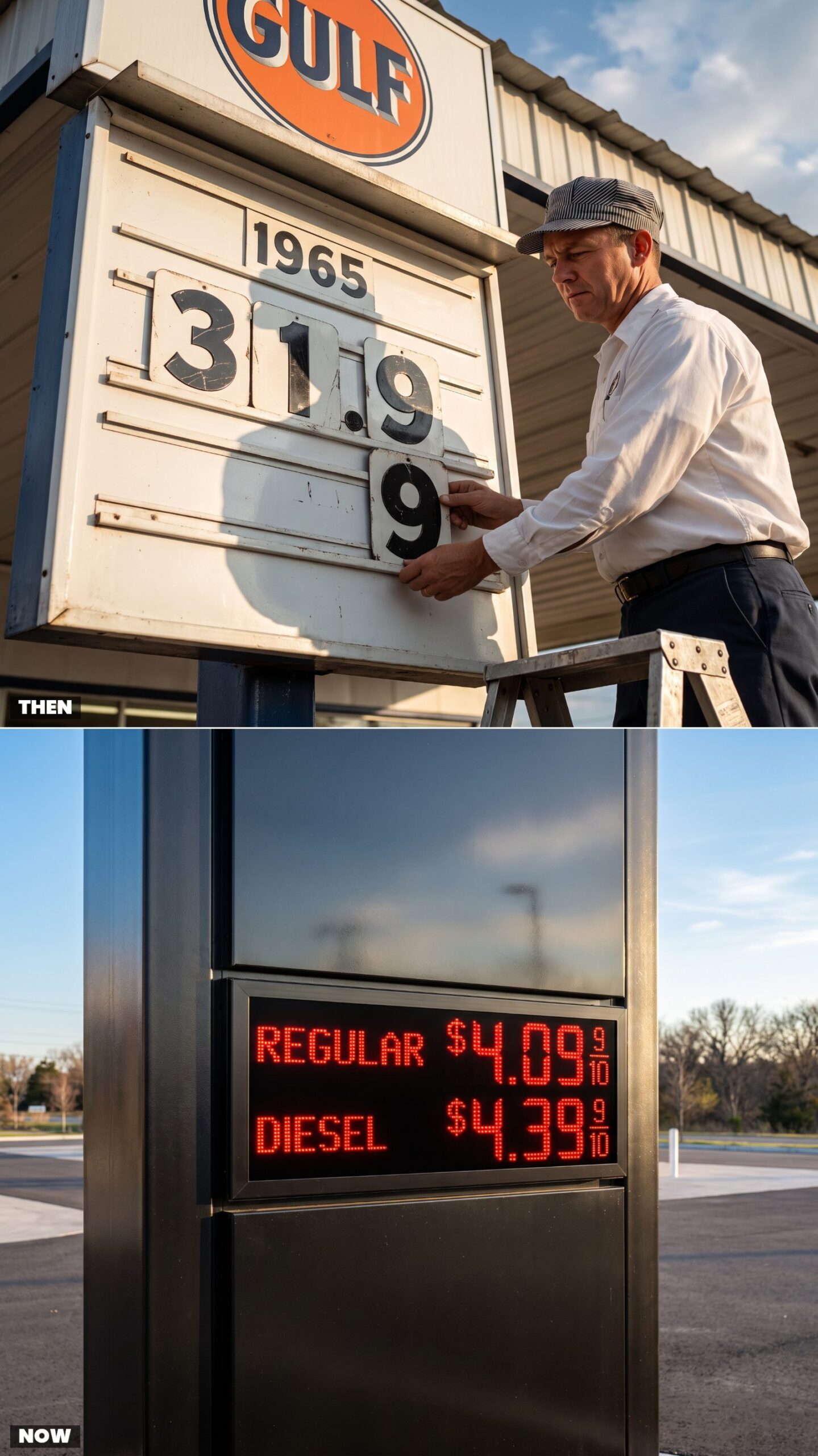
Changing the price in 1965 meant climbing a ladder and sliding numbered cards into metal slots by hand. When gas jumped two cents, somebody physically walked out there and did it. The numbers were enamel and heavy, and now and then one got dropped on the concrete and scratched to pieces.
Now a manager taps a phone and every pylon in the region flips at once, the red LED digits changing before you’ve finished reading them. Faster, sure. But nobody ever got misty-eyed over a digital seven.
47. Regional Oil-Company Logos vs. Consolidated Convenience-Store Branding
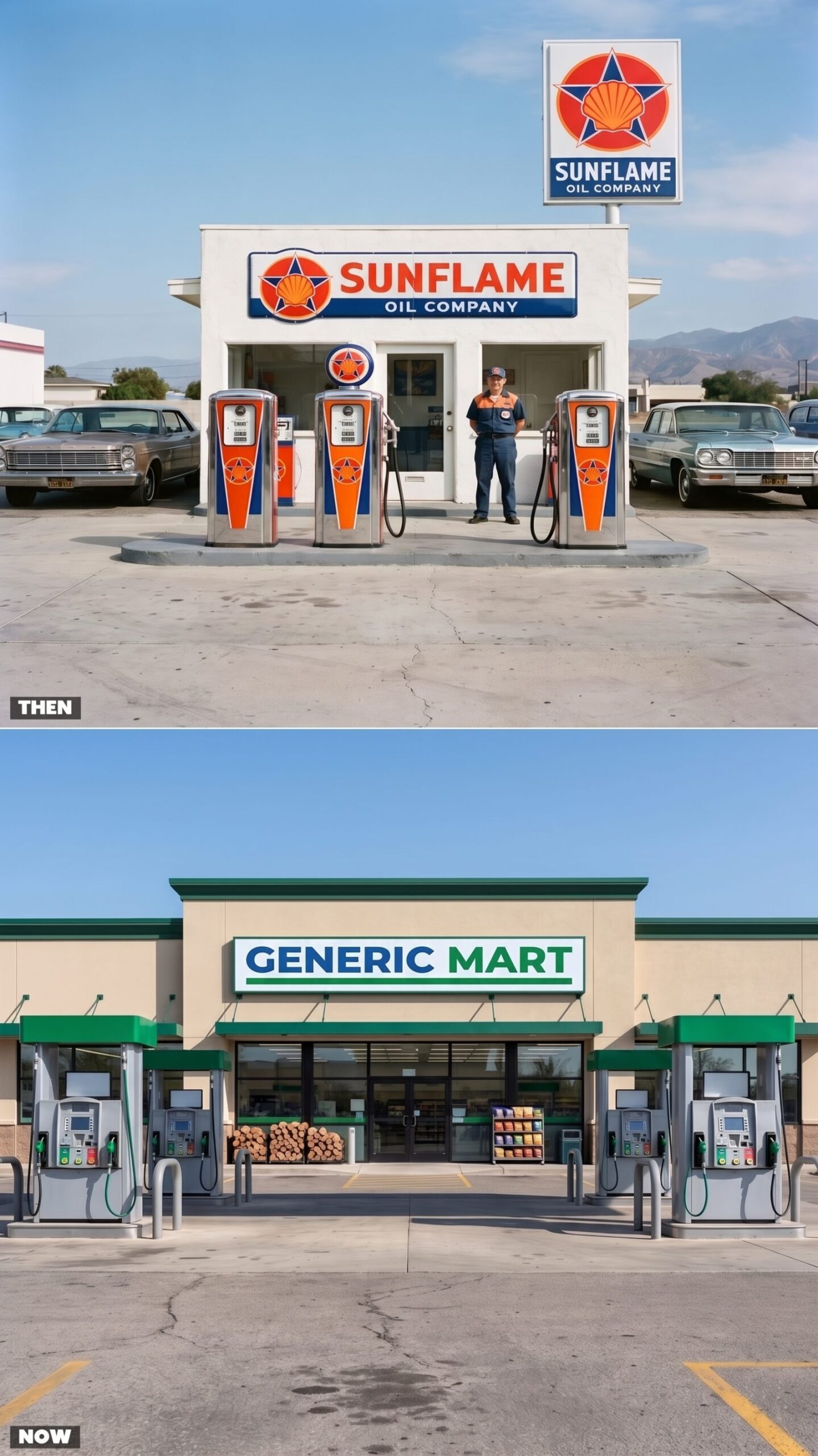
Once upon a time you could tell which part of the country you were in by the gas sign. A hundred regional brands, each with its own star, shell, flying horse, or diamond, splashed across the building, the pumps, and the attendant’s uniform. Driving cross-country meant collecting them like baseball cards out the window.
Now the same three or four national chains line every interstate exit, and the building in Ohio is identical to the one in Arizona right down to the font. Convenient. Also completely forgettable.
46. Flat-Roof Service Stations vs. Oversized Modern Canopies
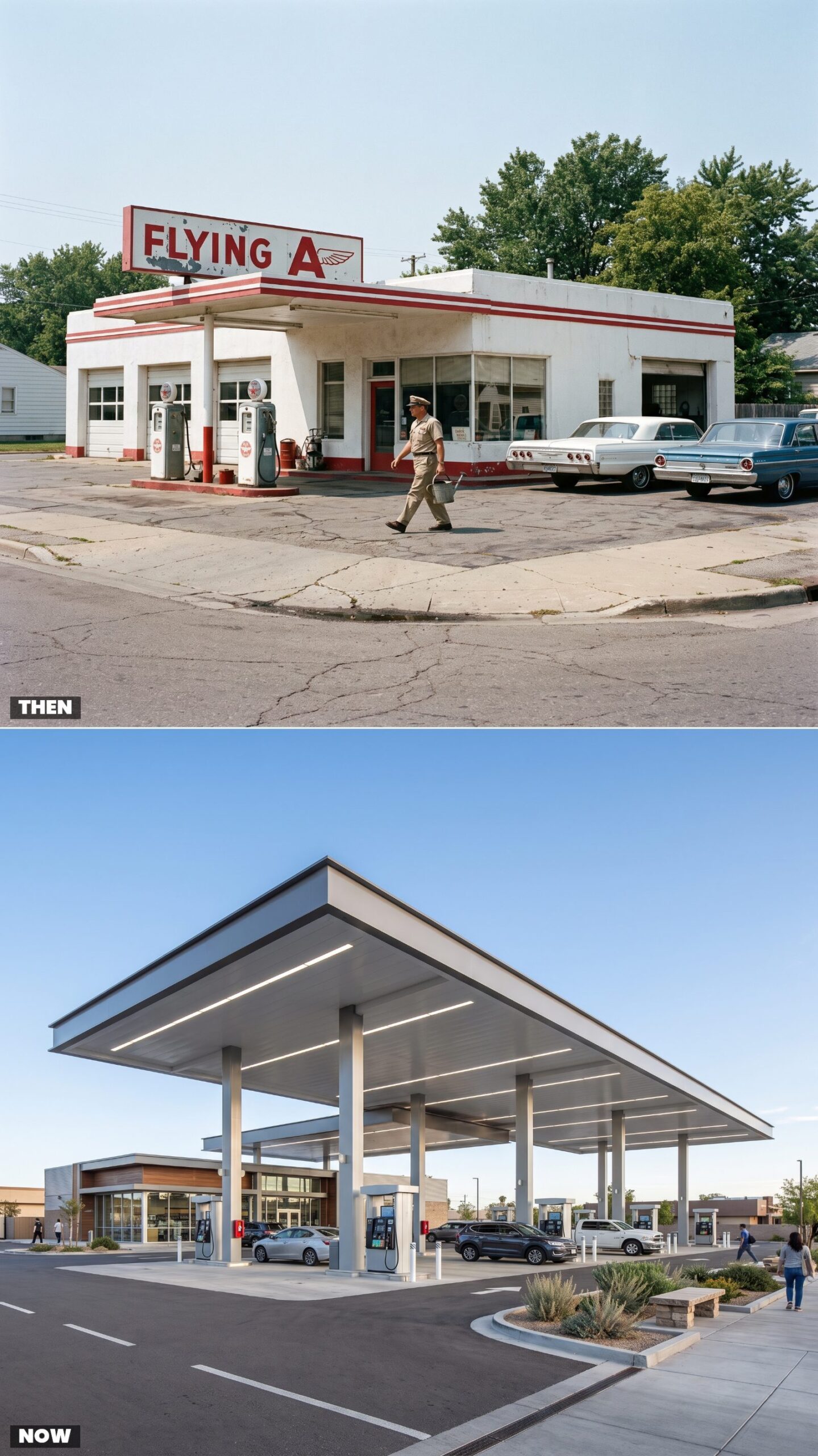
The 1965 station fit the neighborhood. Flat roof, small overhang, just enough shelter to keep the attendant dry while he worked, and the building stood about the same height as the pumps. It looked like it belonged on the corner.
The modern version is a flat steel canopy the size of a basketball court, propped on columns and lit up like a night game. It keeps the rain off and announces itself from half a mile away. Subtlety left with the bow ties.
45. Small Glass-Front Offices vs. Supermarket-Size Convenience Stores
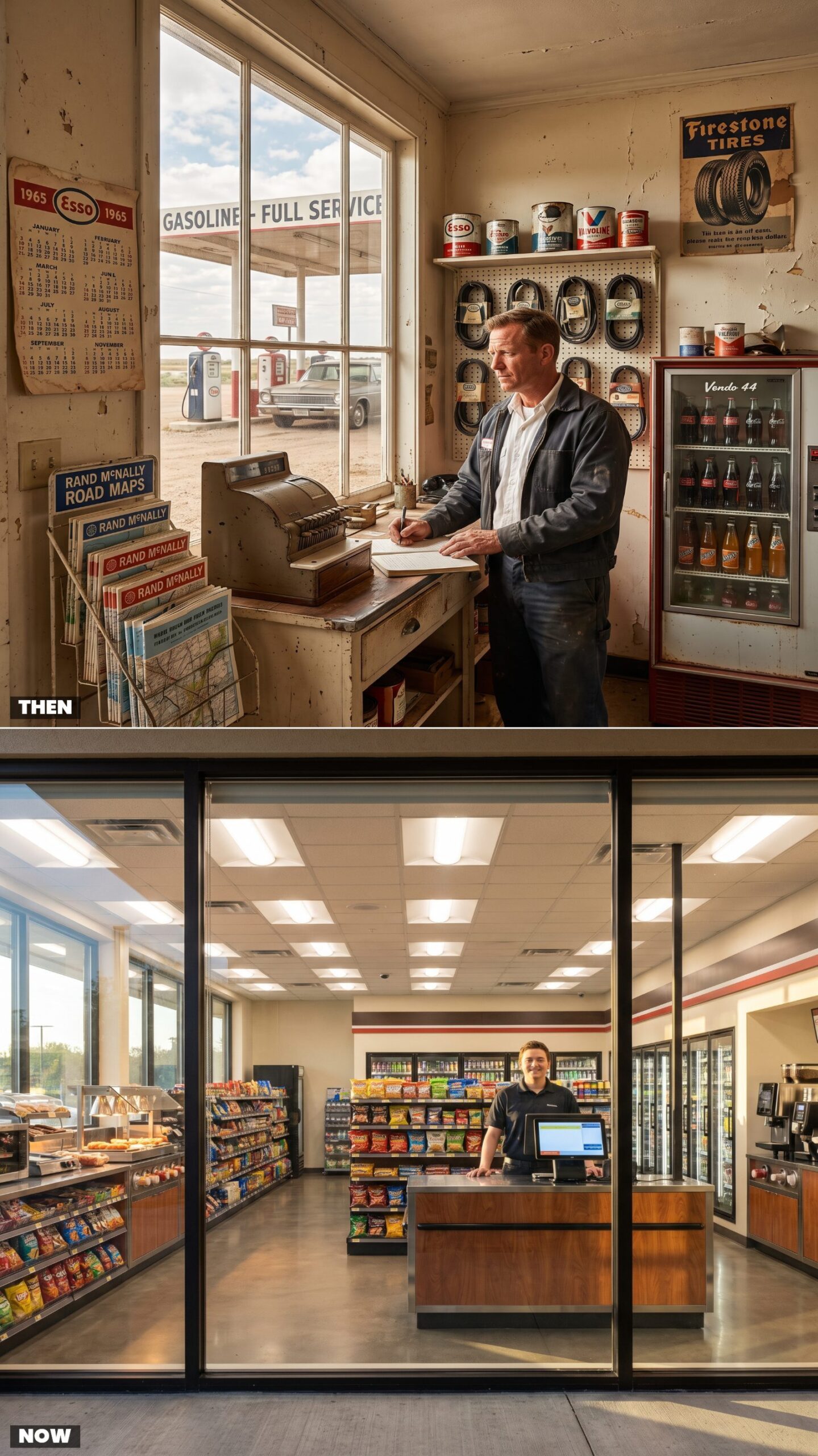
The old station office was barely bigger than a bedroom: a desk, a cash drawer, a rack of folding road maps, a few quarts of oil on the shelf, and a soda machine that dropped glass bottles for a dime. You went in to pay and maybe grab directions.
Today the store is the whole business. Twelve coffee options, a taquito roller, a wall of energy drinks, and the fuel is almost an afterthought. The gas pays the rent. The beef jerky pays the profit.
44. In-Ground Service-Bay Lifts vs. Stations Without Repair Facilities
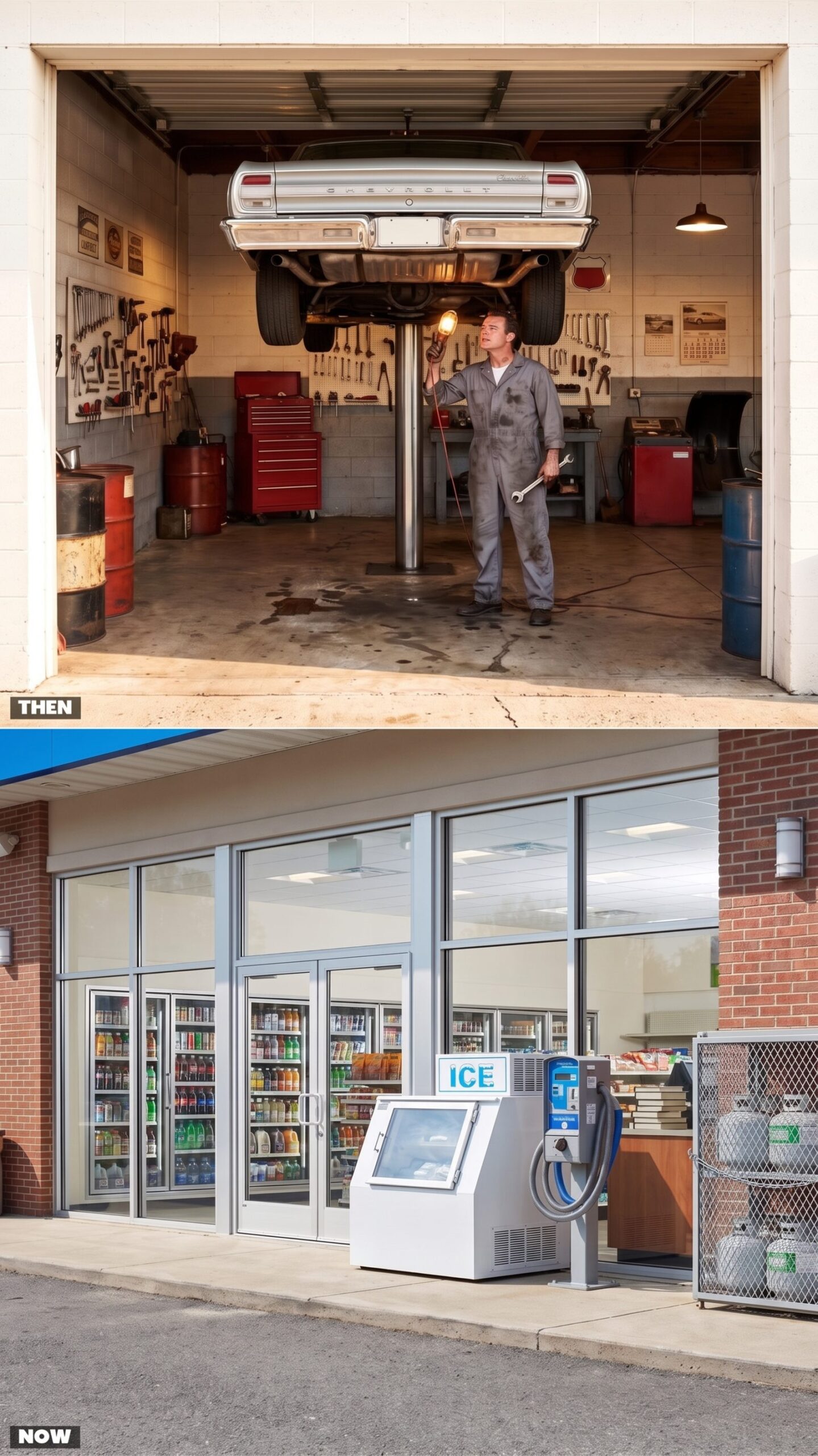
Every real station in 1965 had bays. Behind the office, the concrete floor was stained black, a car hung on the lift, and a mechanic in coveralls actually fixed things. You could get a flat patched, a muffler hung, or a tune-up while you waited on a folding chair.
Most stations today don’t turn a single wrench. The bays are gone, swapped for more cooler space and a propane cage. If something breaks on the road now, you’re calling a tow and a dealership, and the guy who could diagnose your engine by ear retired without a replacement.
The station used to fix your car. Now it sells you a lottery ticket while your car waits for a tow.
43. Narrow Pump Islands vs. Wide Multi-Fuel Forecourts
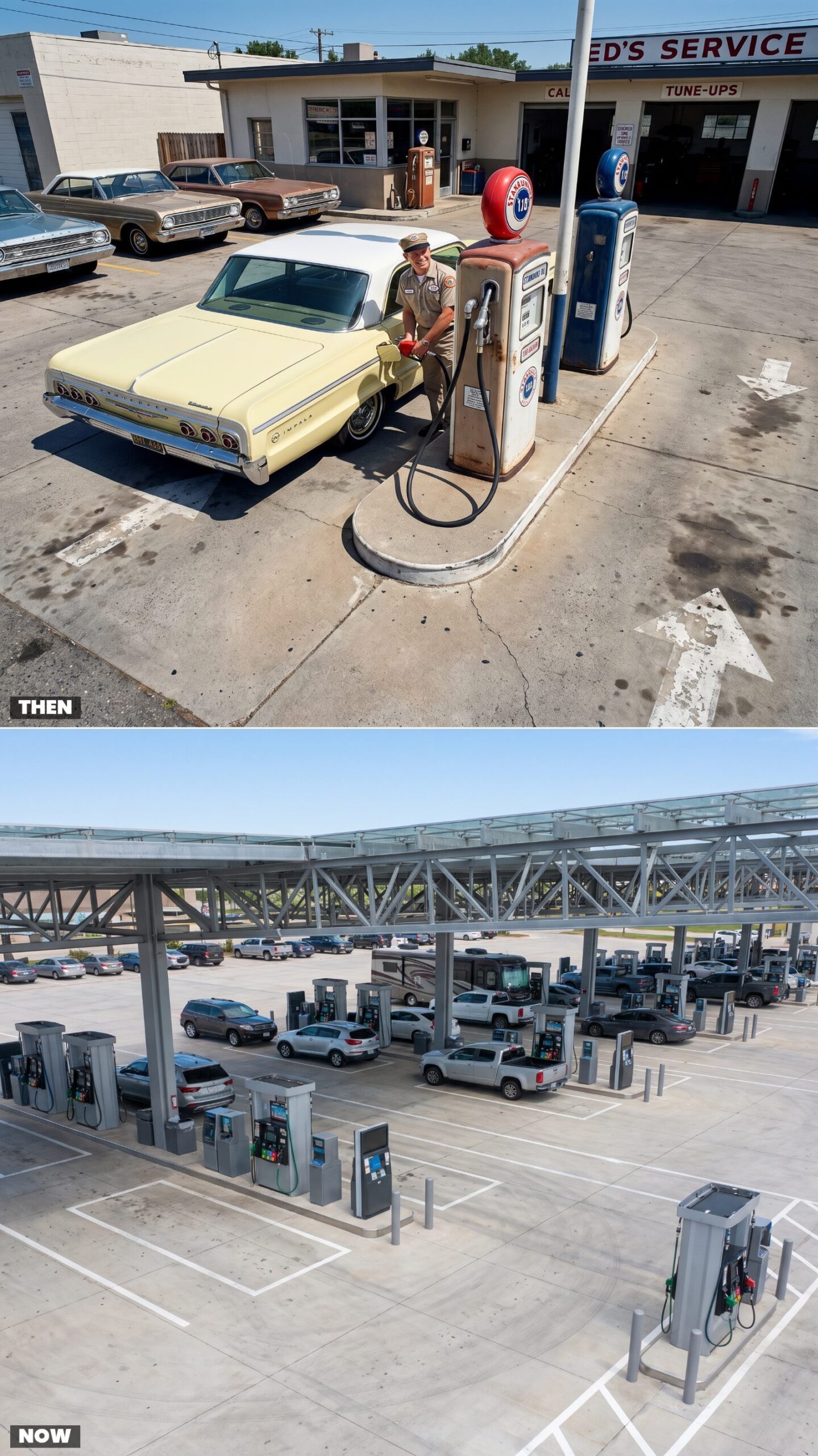
A 1965 island was snug. Two pumps, room for a car on each side, and that was plenty for a town where everybody drove sedans and nobody was in a hurry. Pull in, wait your turn, chat with the guy ahead of you about the weather or the ball game.
Now the forecourt sprawls across half an acre: eight lanes, regular, mid, premium, diesel, high-flow for the big rigs, and enough room to swing an RV through without clipping a bollard. More capacity, less conversation. You can gas up next to a stranger and never once make eye contact.
42. Mechanical Pump Dials vs. Digital Touchscreens
Would you like to save this?
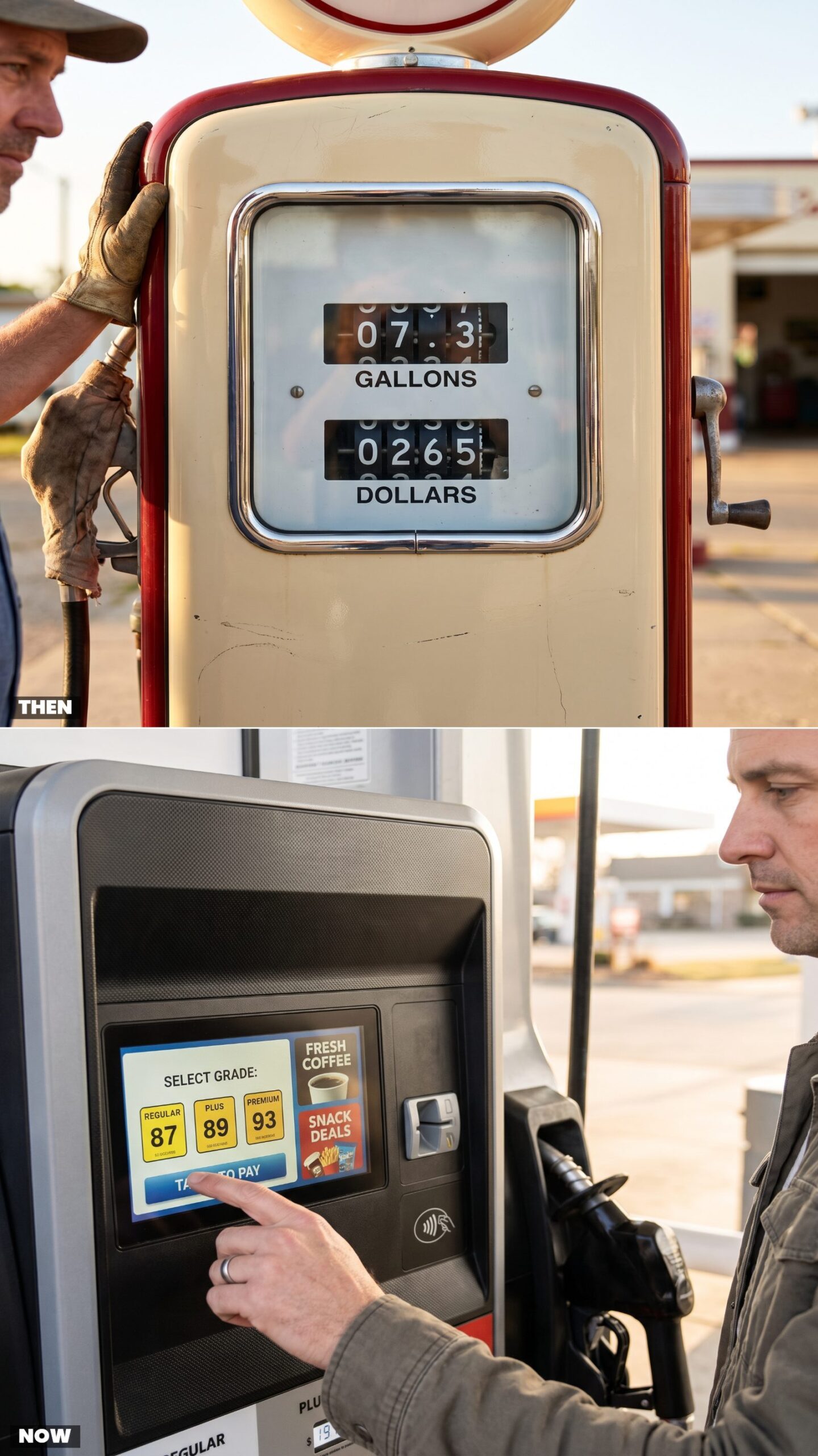
The old pump counted out loud, almost. Two mechanical dials spun behind glass, one clicking off gallons, one rolling up dollars, the numbers physically turning on little drums you could watch. Your money disappeared in real time, and there was something honest about seeing it go.
Now it’s a backlit touchscreen playing an ad for a breakfast sandwich while you wait for authorization. It remembers your loyalty number and tries to upsell you a car wash. The dials never once asked if you wanted a receipt.
41. Illuminated Gas-Pump Globes vs. Canopy-Mounted Pump Numbers
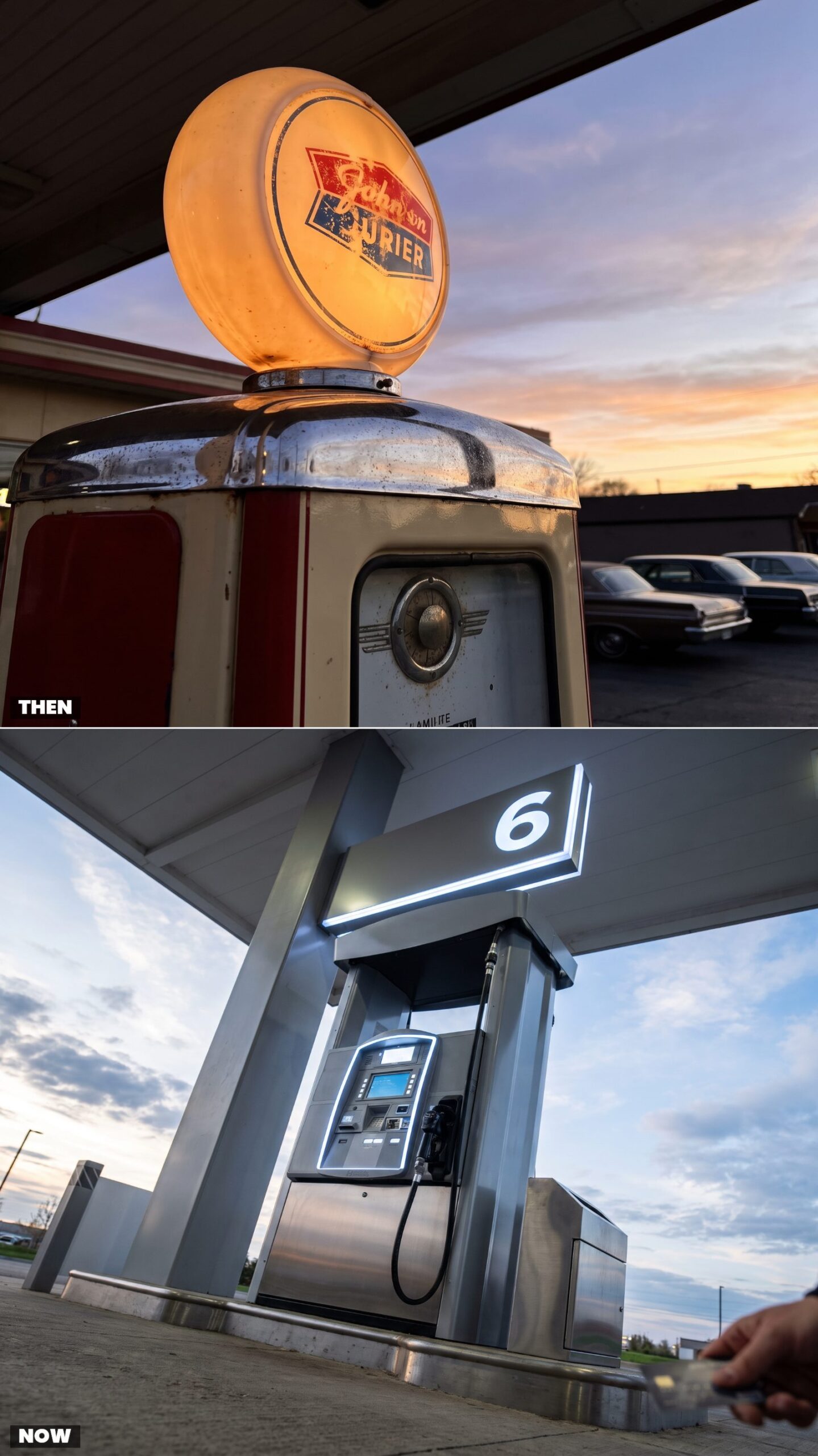
Before anyone thought to number the pumps, each one wore a glowing glass globe on top like a crown. Milk-glass, lit from inside, showing the brand’s emblem, it threw a warm amber light across the lot at dusk, and you could spot your favorite station from blocks away just by the glow of it.
Today the globe is gone and a flat lit number hangs on the canopy column so the cashier knows which pump you’re on. Purely functional. The light is white and cold and tells you nothing except that you are, in fact, at pump six.
40. Separate Pumps for Each Grade vs. One Multi-Grade Dispenser
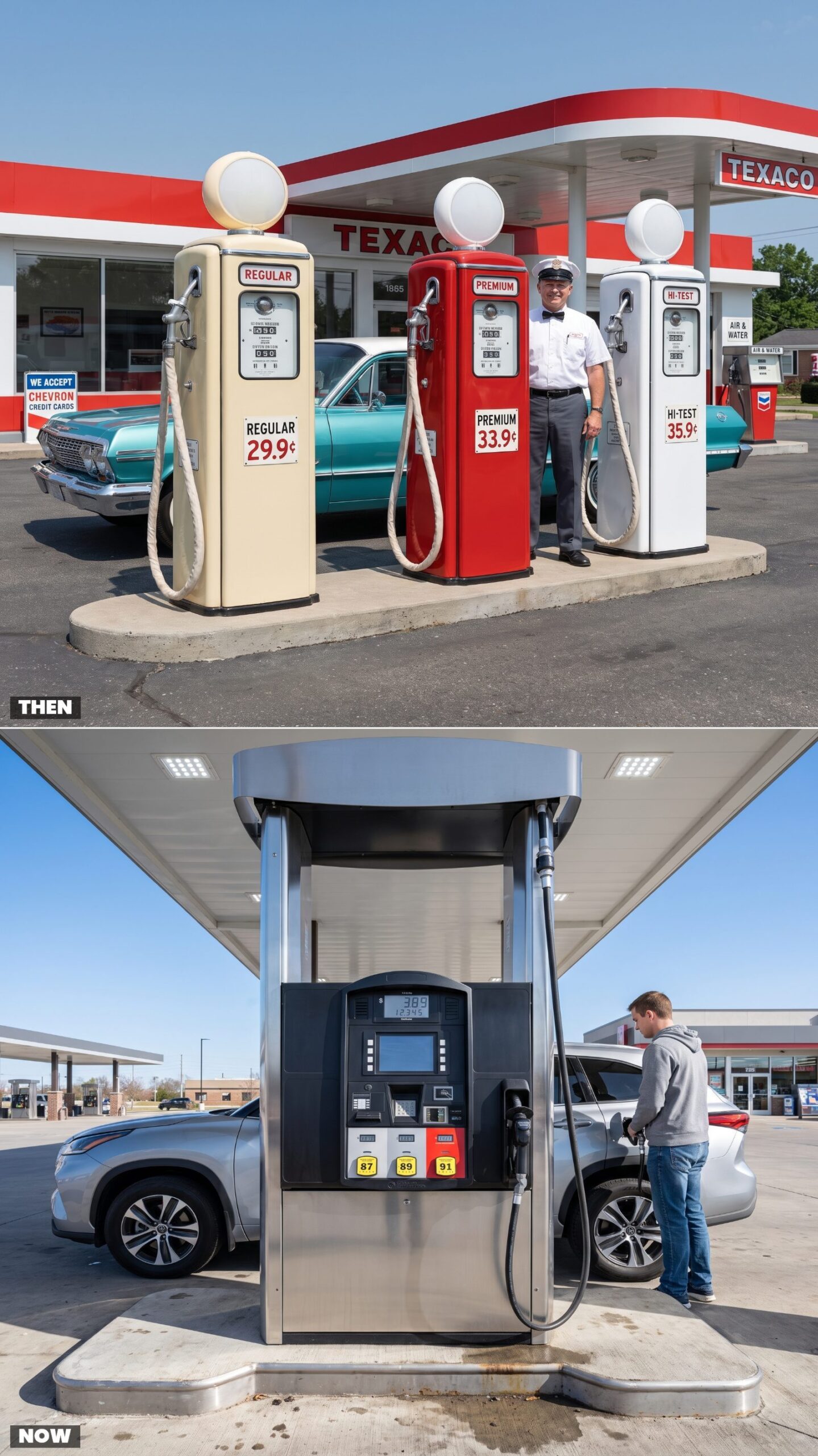
Three pumps, three colors, three grades, each parked on the island like its own jukebox. You pulled up in 1965 and the attendant walked to whichever one matched the grade you asked for. Regular, ethyl, premium — all separate iron.
Now it’s one box. You thumb a button for your octane, the price scrolls across a backlit screen, and the whole contraption squeezes into the footprint a single old pump used to claim. Efficient, sure. A little lonelier too. Nobody names a globe anymore.
39. Prominent Leaded-Gas Labels vs. Ethanol-Blend Notices
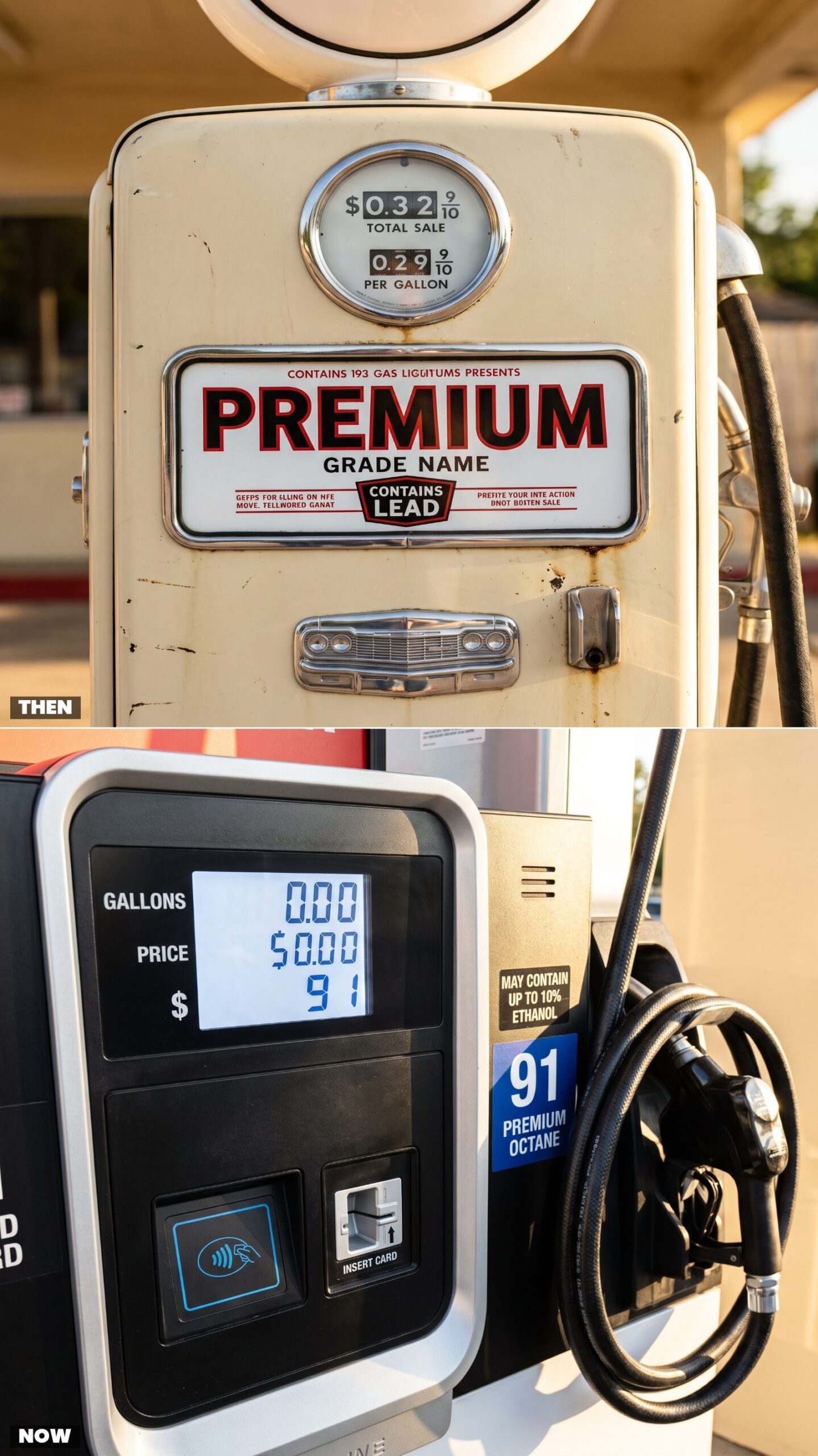
The old pumps warned you without saying much. A red-and-black plate announced the grade, and tucked somewhere on it sat the quiet word that defined an era: lead. It made engines run smooth and poisoned the air, and nobody blinked at that for decades.
Today the sticker is a tidy yellow square telling you there’s up to ten percent ethanol sloshing in the tank. Corn, not lead. Progress you can read in a half-inch of federal font.
38. Driveway Bell Hoses vs. Motion Sensors and Security Cameras
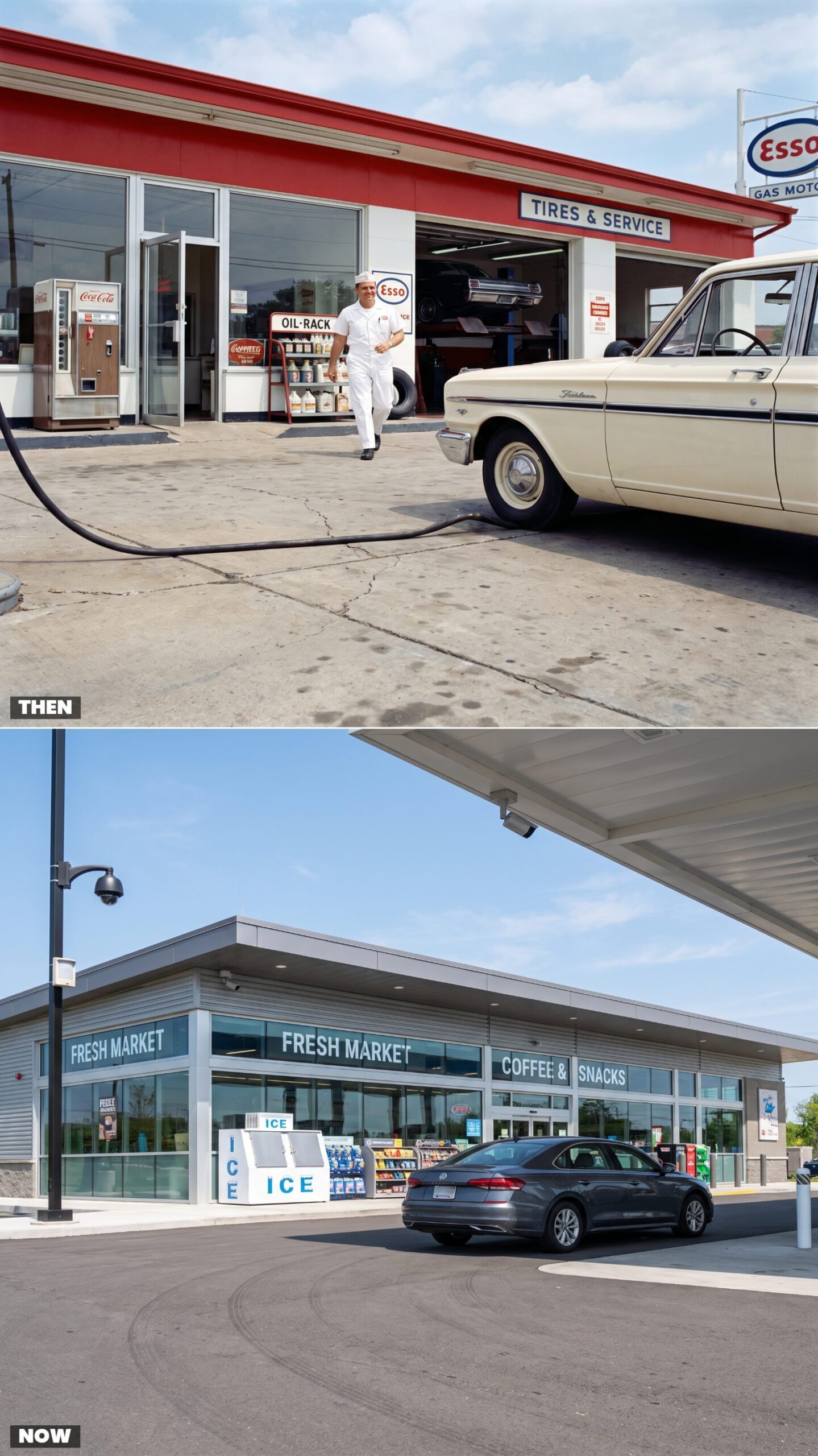
That rubber hose across the driveway did one job, and it did it beautifully. You rolled over it, a bell dinged inside, and a man was out the door before you’d shifted into park. The bell was a promise — somebody heard you arrive.
The hose is gone now. A camera clocks you, a motion sensor logs you, and nothing dings except maybe your phone. You’re watched more than ever and welcomed less than ever.
The ding meant someone was coming. The camera just means someone is watching.
37. Complimentary Windshield Cleaning vs. Communal Squeegee Buckets
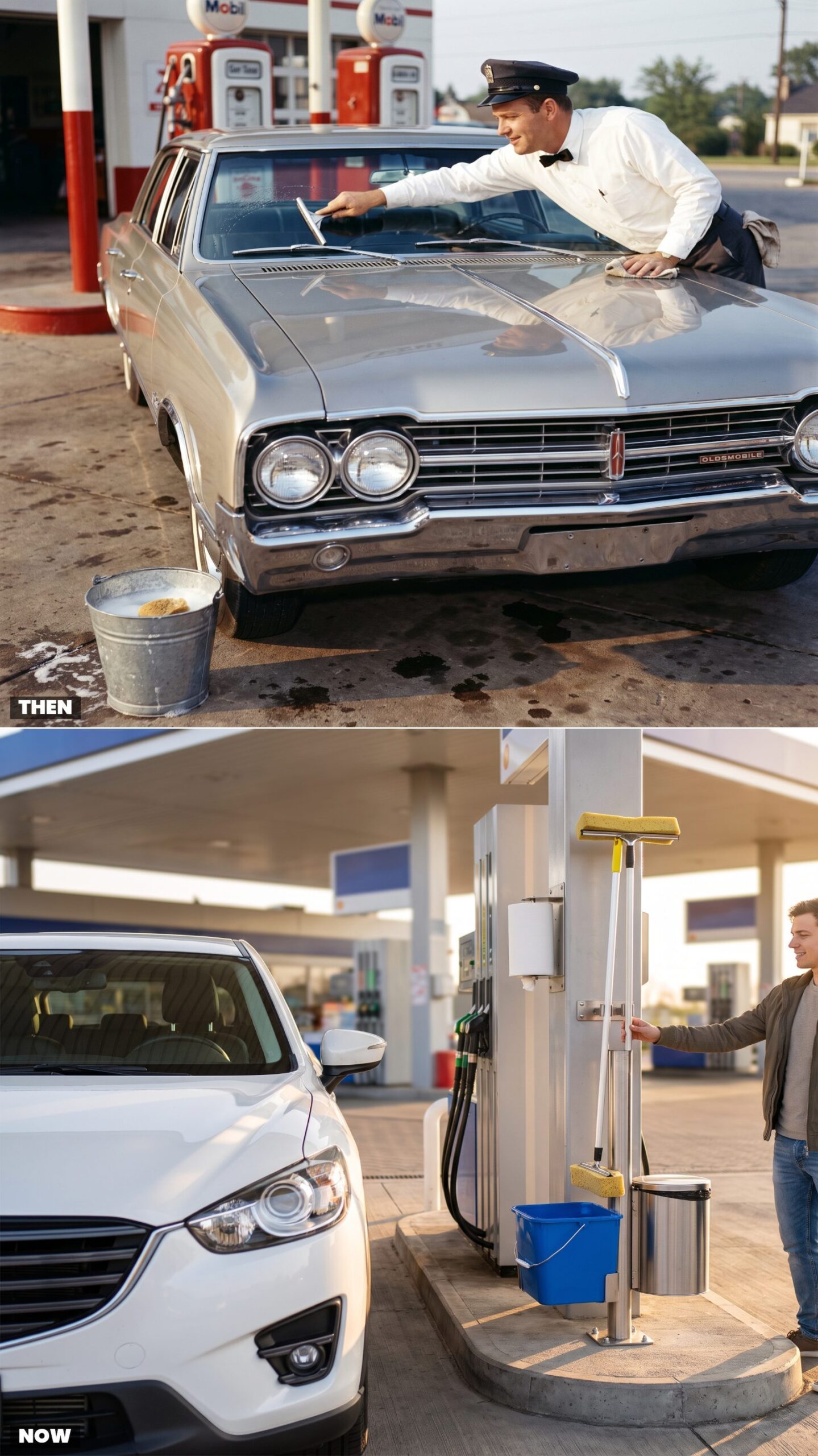
Nobody asked for it and you always got it anyway. The attendant wiped your windshield while the tank filled, swept the bugs off the glass with one practiced swipe, and checked the wipers before you could think to mention them. It cost you nothing because it wasn’t a service. It was manners.
These days there’s a bucket of blue fluid and a squeegee that’s seen better years — half of them with a torn sponge. You do it yourself, standing in your own gas fumes. The glass still gets clean. The gesture’s gone.
36. Under-Hood Oil Checks vs. Convenience-Store Oil Shelves
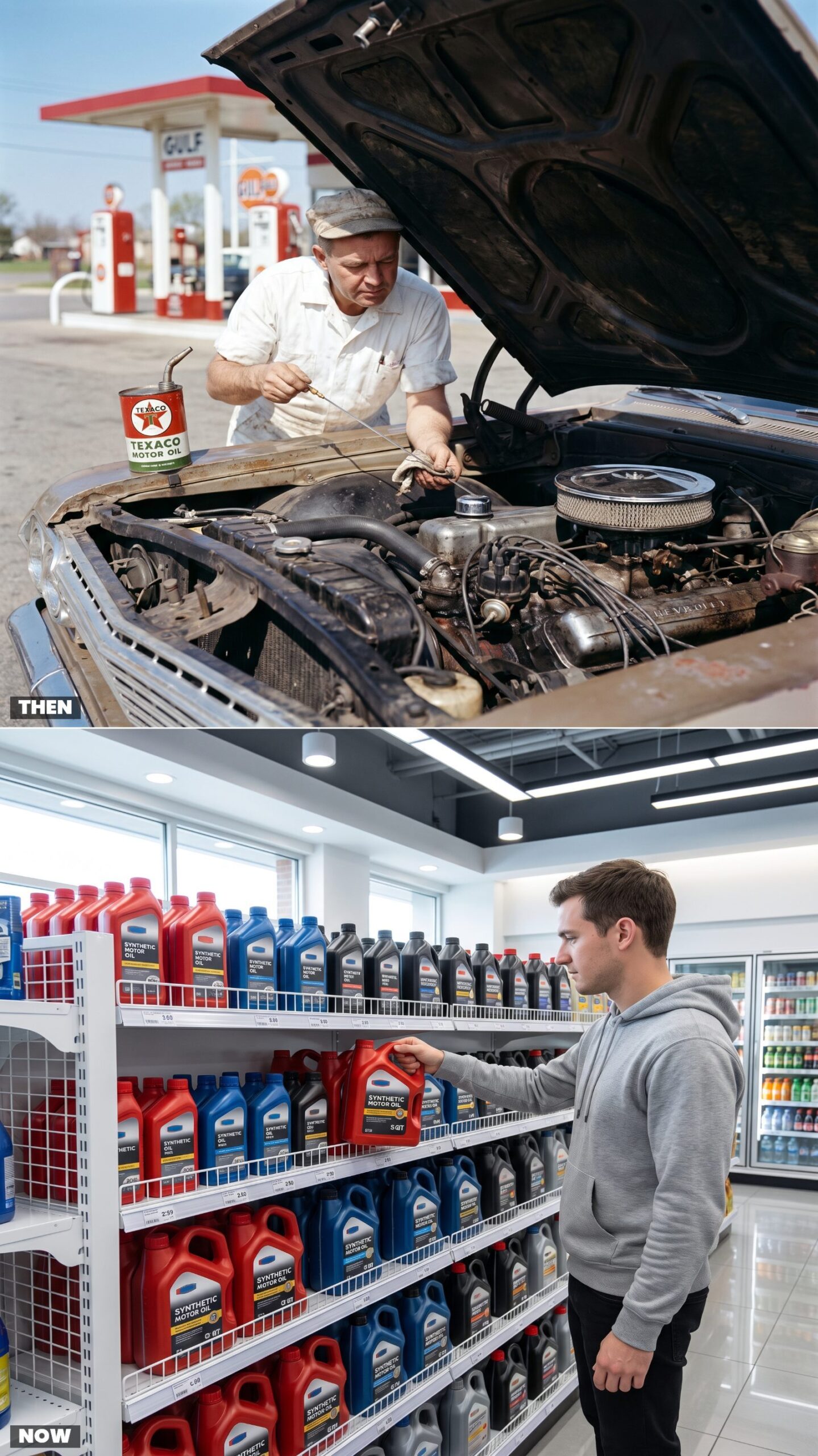
Up went the hood, out came the dipstick, and a man who’d done it ten thousand times read your oil like a letter. He’d wipe it, dip it again, show you the line, and top it off from a metal can with a spout. You learned your car’s health from somebody else’s hands.
Now the oil lives on a shelf between the energy drinks and the wiper blades, bottled in plastic you lug home and sort out yourself. The hood stays shut unless something’s already wrong. Usually that’s too late.
35. Attendant-Checked Tire Pressure vs. Digital Inflation Stations
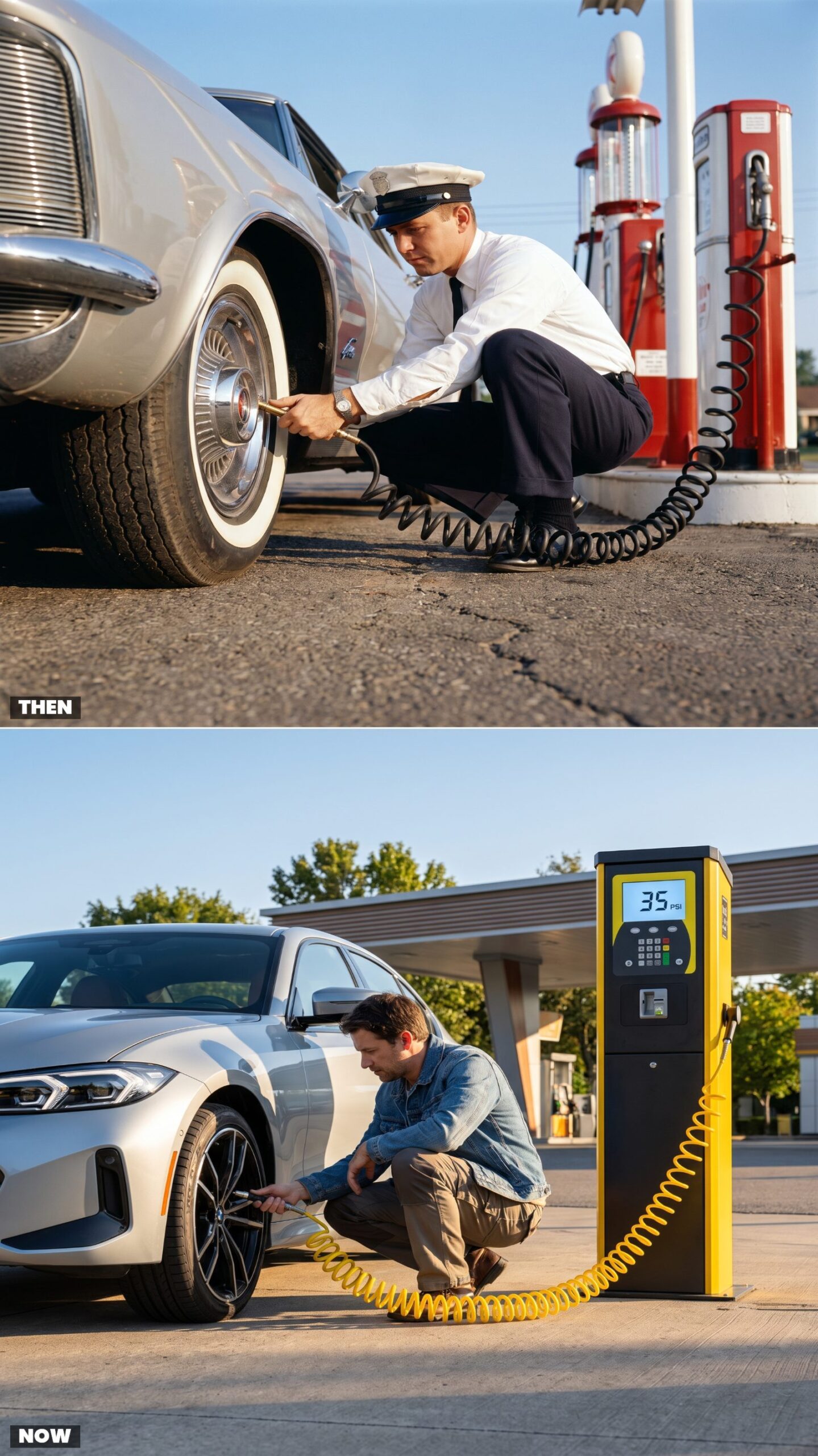
A brass pencil gauge, a knee on the concrete, a number read out loud. The attendant checked all four without being asked, topped off whatever ran low off the station’s air tower, and you never lifted a finger. Thirty-two pounds all around, have a good one.
The gauge is a machine now — yellow box, digital readout, set your number, feed it quarters or tap a card, and wait for the beep. Works fine. It just doesn’t know your name, or that your left rear always runs a little soft.
34. Radiator Top-Off Service vs. Sealed Modern Cooling Systems
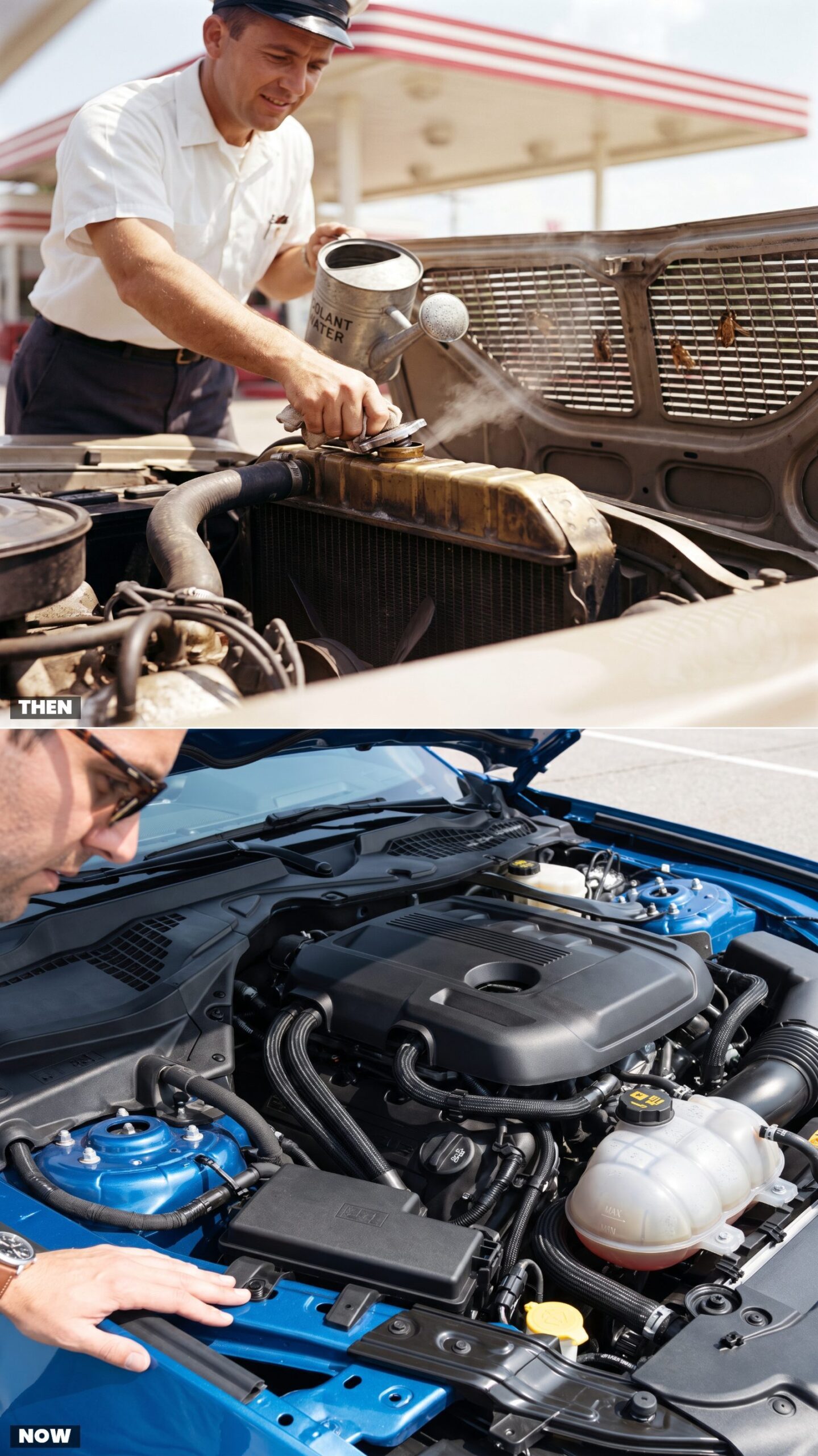
Every summer a radiator ran low, and every station knew the drill. Off came the chrome cap with a rag and a cautious hand, in went water from a can, and a little steam curled off the hot engine like it was catching its breath. Routine maintenance and a small ritual, rolled into one.
Modern cooling systems are sealed shut. A plastic overflow tank with MIN and MAX lines, a cap you’re warned off when hot, and a dash light that does the worrying for you. You add coolant every couple of years, maybe. The steam, the chrome, the whole quiet drama — retired.
33. Free Foldout Road Maps vs. Smartphone Navigation
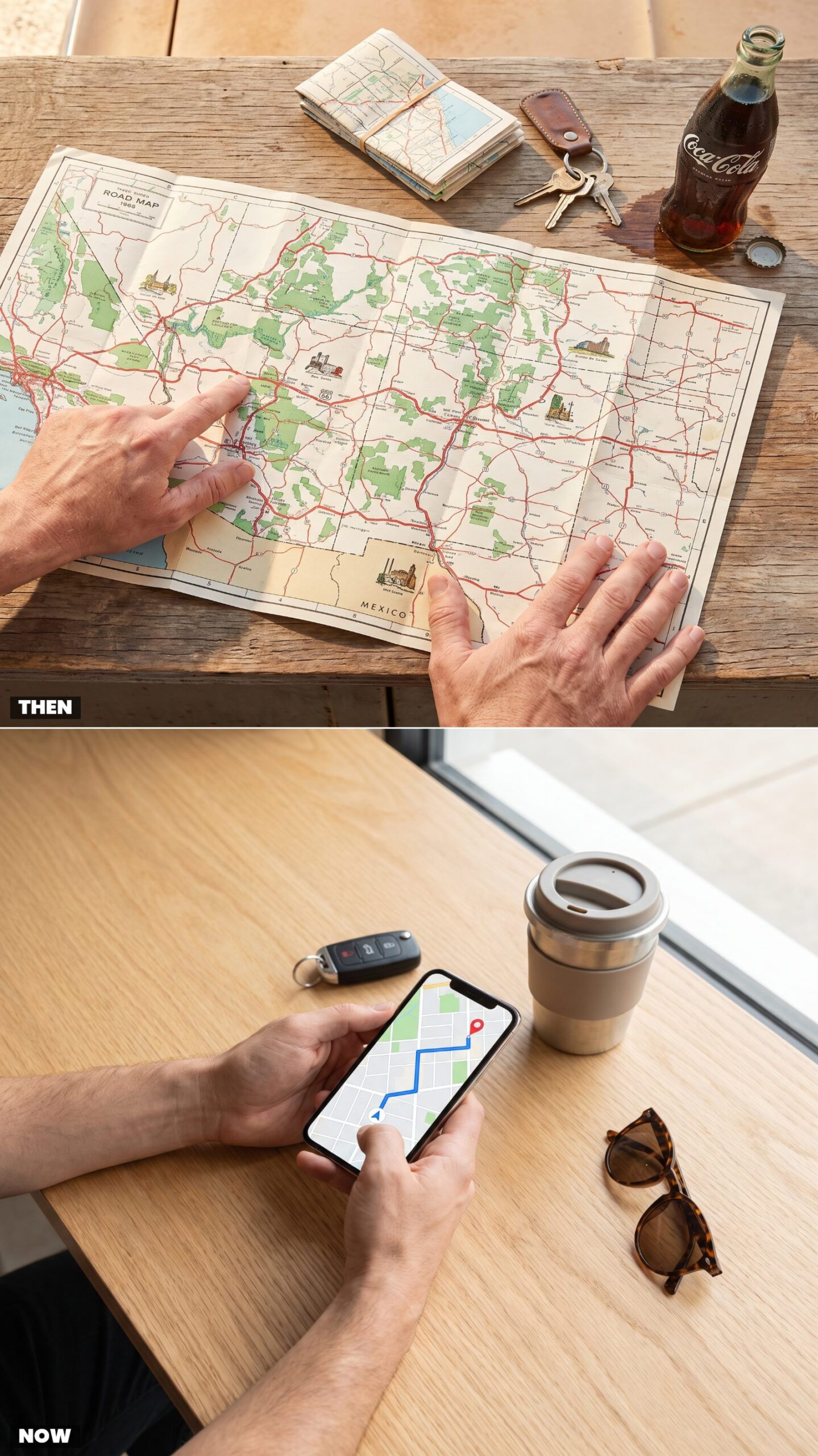
The maps were free and the racks were always full. You grabbed one at the counter, spread it across the hood, and traced your route with a finger while the attendant worked the pump. Half the folds never went back right, and you kept a glovebox stuffed with them anyway, soft at the creases from a hundred wrong turns.
Now the map lives in your palm and talks back. A blue line, a calm voice, recalculating every time you blow the exit. Faster, smarter — and you’ll never again argue with somebody in the passenger seat about which way is north.
32. Metal Charge Plates vs. Contactless Card Readers
Would you like to save this?
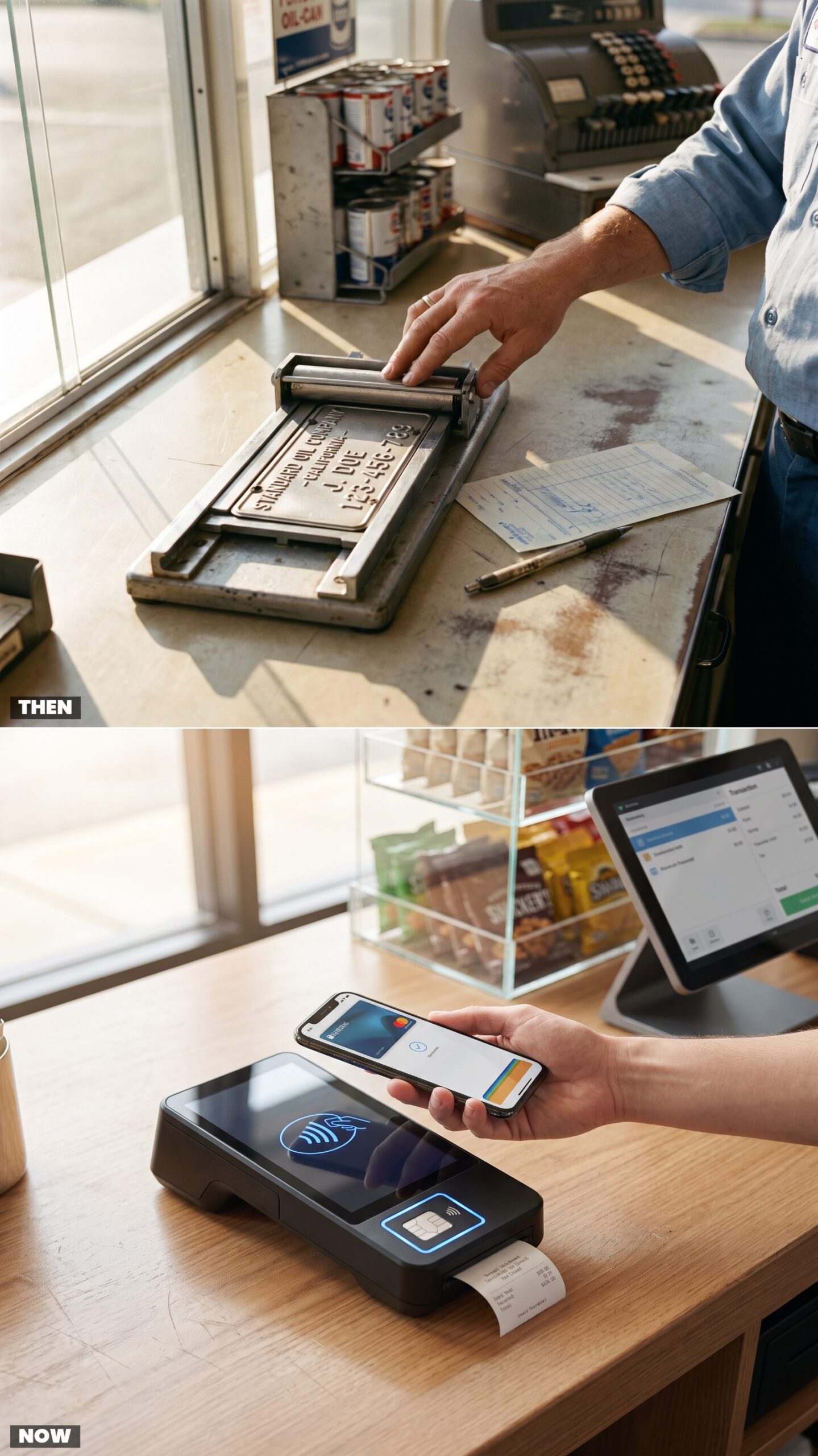
Before plastic there was metal. A little embossed charge plate on your keyring, slid into an imprinter, one firm pull of the roller, and your name pressed through carbon paper with a sound like a tiny printing press. Ka-chunk. That was your receipt.
Now you tap and it’s done before your arm’s fully extended. No signature, no carbon, no ka-chunk. A reader that talks to a chip that talks to a bank, all of it finished in under a second. Nobody misses the carbon paper. Plenty of us miss the sound.
31. Countertop Cash Registers vs. Integrated Point-of-Sale Terminals
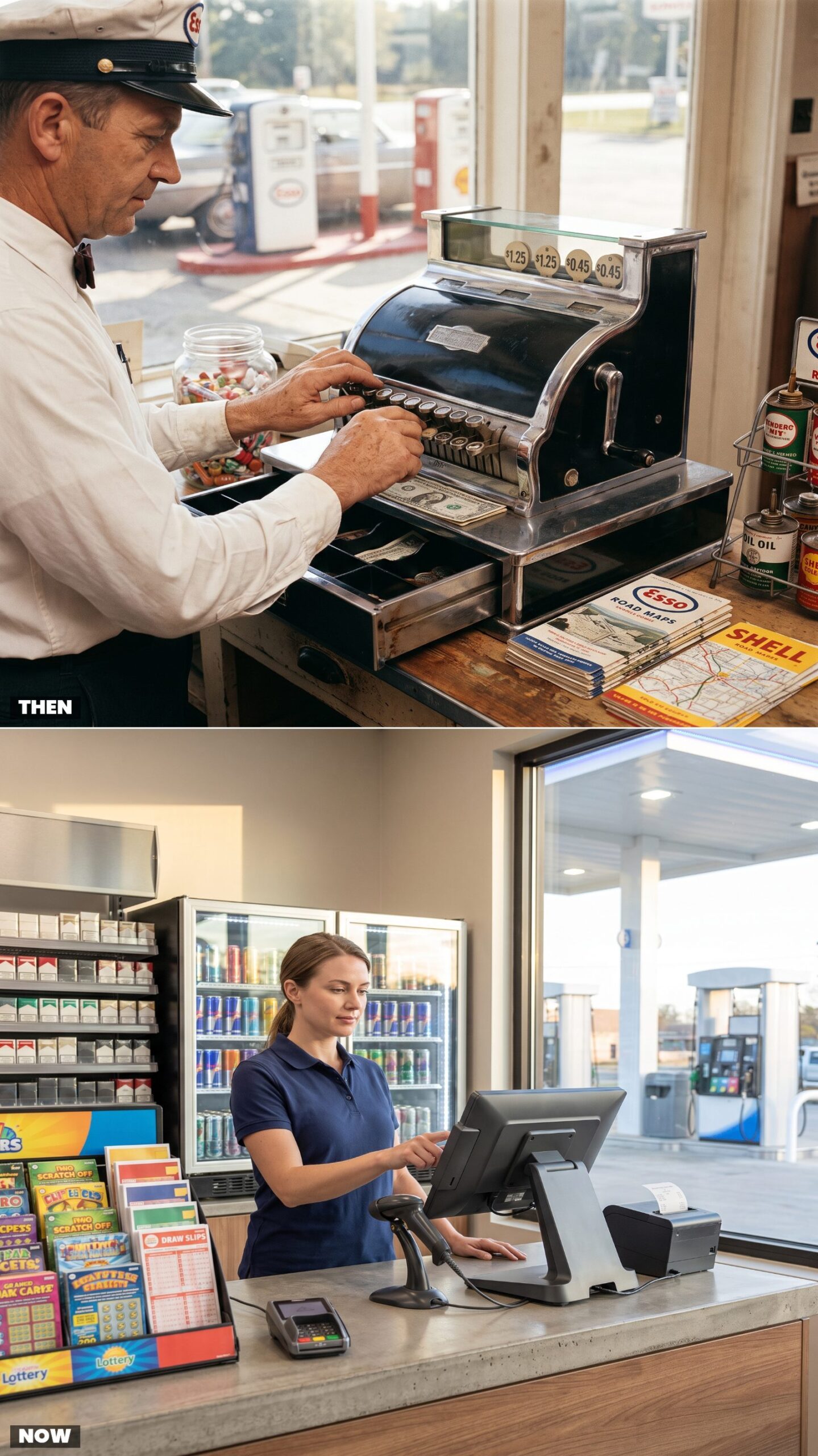
The register weighed as much as a small engine and sounded like one. Chrome keys, pop-up number flags behind glass, a drawer that shot open with a bell every time the attendant rang you out — you could hear a sale from clear across the lot. It counted money and nothing else, and it did that for forty years without ever once asking for a software update.
Today it’s a touchscreen juggling fuel, lottery, scratch tickets, coffee rewards, and your carwash code all at once. Faster, obviously. It also freezes sometimes, which the old chrome monster never managed to do. One beeped. The other blinks.
30. Glass Phone Booths vs. Public Wi-Fi Hotspots
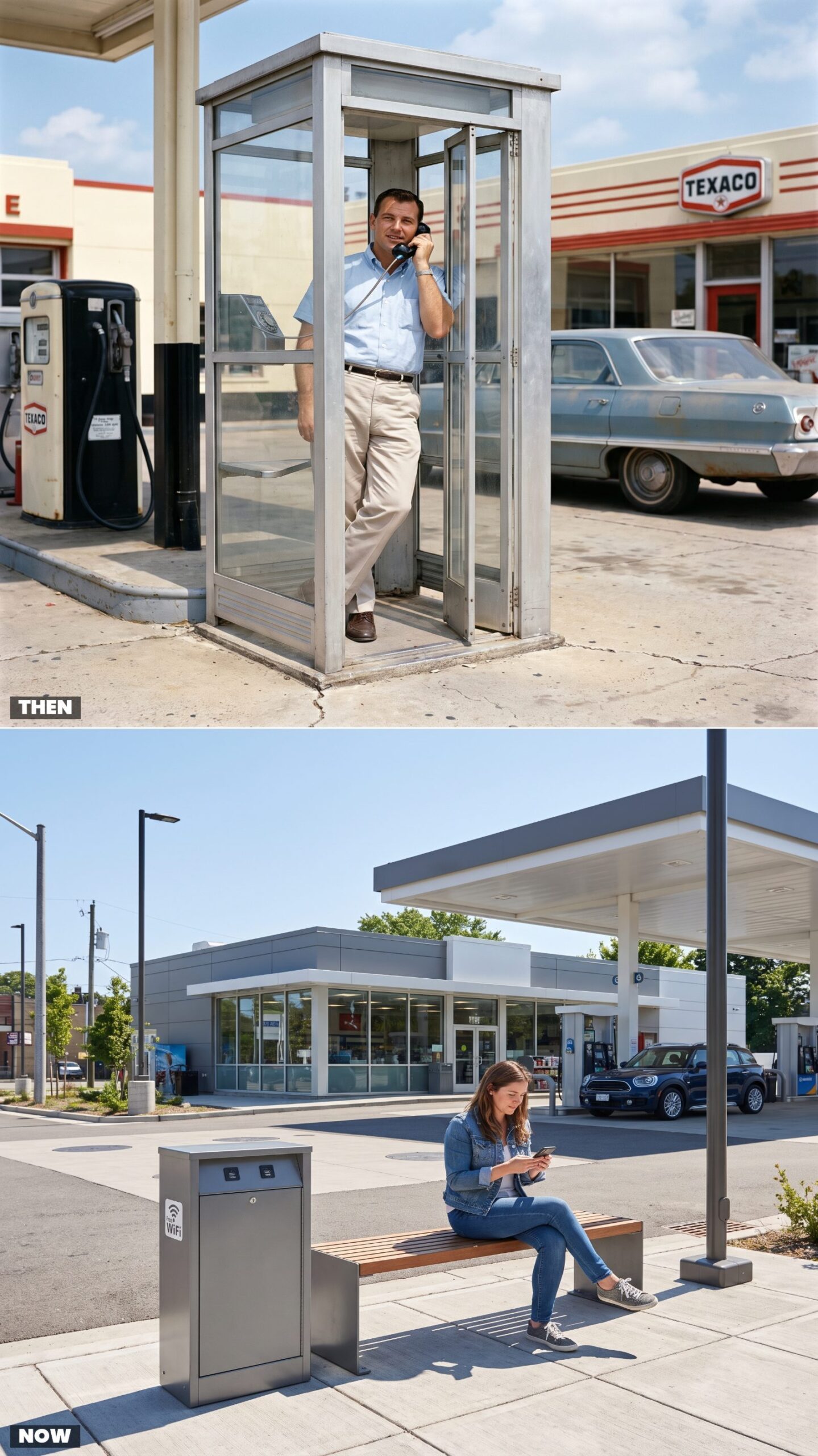
A dime, a folding glass door, and the smell of warm aluminum baking in the sun — that was a phone call in 1965. The booth sat right on the apron, lit from inside at night, a little private room you could pull a door shut on. You called home collect and looked up a number in a book chained to a shelf.
Now the booth is gone and nobody mourned it. The modern equivalent is a decal on a post and a bench near the charging ports. You stand in the same spot, staring at a glowing screen instead of through glass, having a louder conversation than anyone in 1965 would’ve dared.
29. Exterior Restroom Doors vs. Indoor Customer Restrooms
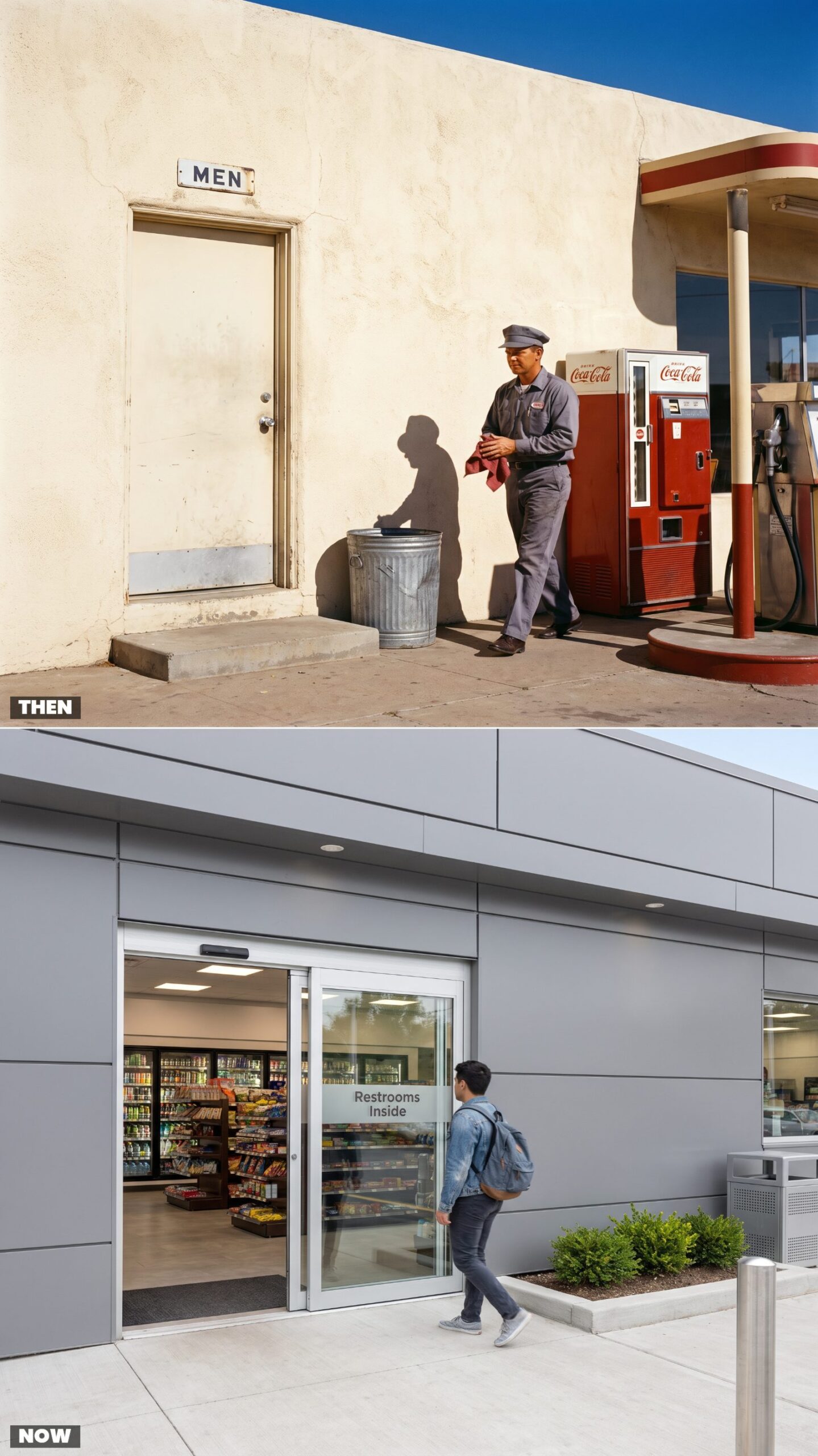
The restroom was outside. Around the side of the building, its own door, its own weather — you walked past the trash can and the pop machine to reach it, and in January you felt every step. Painted steel, a little scuffed near the handle, with an enamel sign that said MEN or WOMEN and nothing else.
Today you walk in through the same front doors as the snacks. The restroom lives down a hall inside, climate controlled, tucked in with the rest of the store. Nobody steps into the cold to use the facilities anymore, and honestly, good.
28. Restroom Keys on Large Fobs vs. Keypad Access Codes
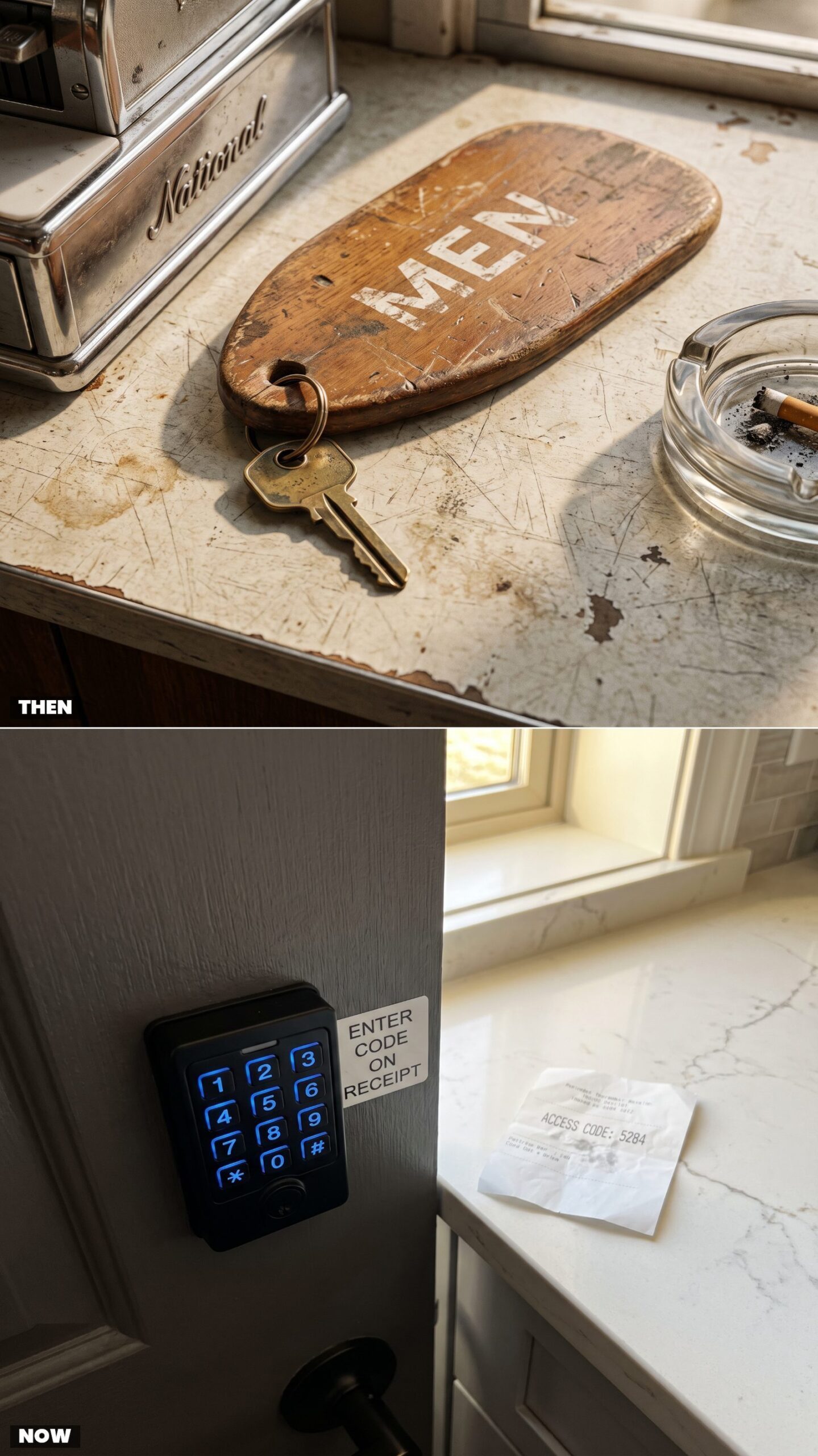
You asked for the key and got a block of wood. The fob was absurd on purpose — a paddle the size of a canoe oar with MEN painted on it, so you couldn’t pocket it and wander off. The brass key hung off a split ring worn smooth by a thousand hands.
Now the code prints at the bottom of your receipt, or waits on a keypad by the door. Cleaner. Smarter. And a little less funny. I kind of miss watching some poor soul try to look casual hauling a two-foot wooden paddle across a parking lot.
27. Bottle-Type Soda Machines vs. Walls of Refrigerated Drinks
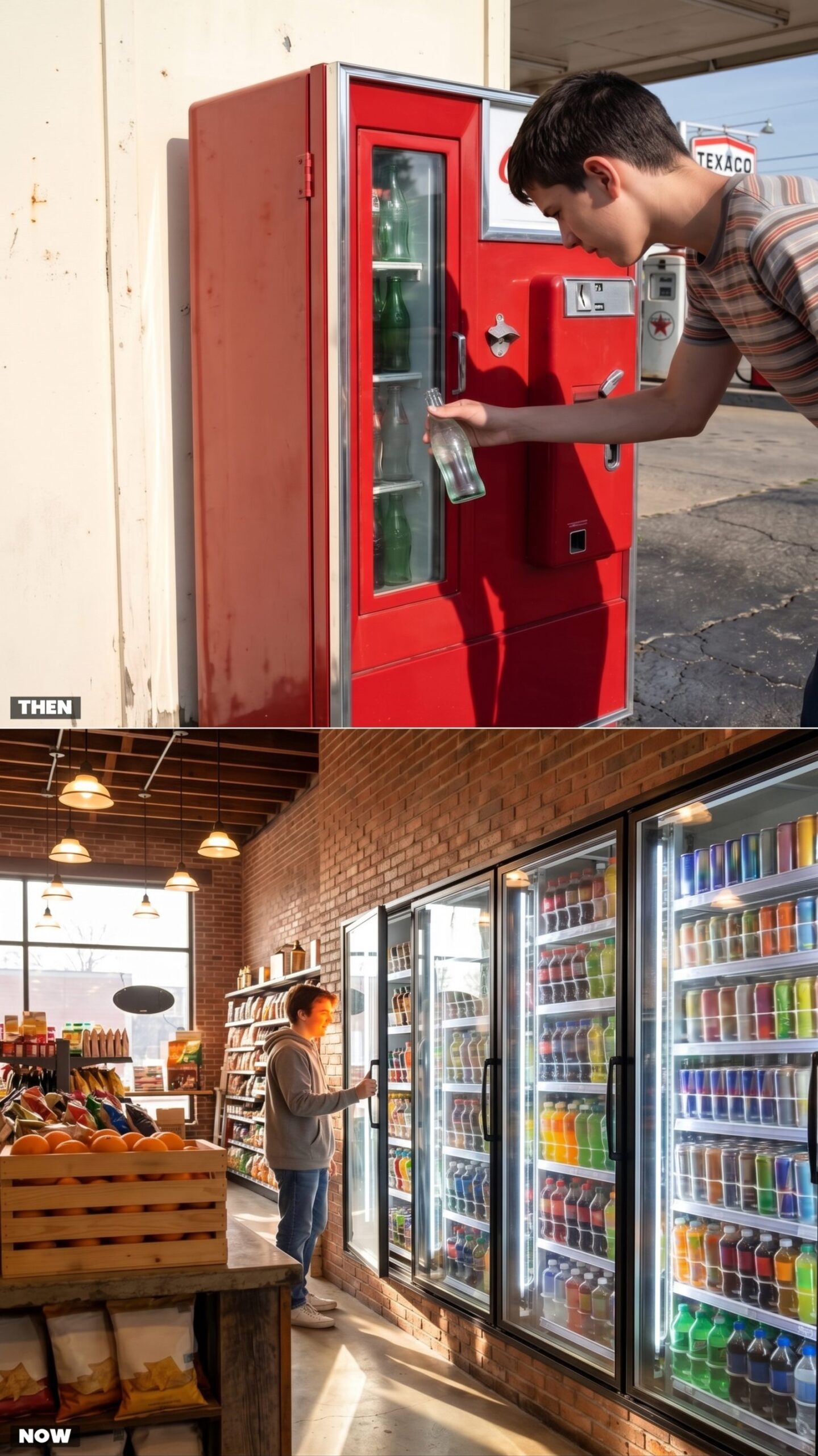
The sound still lives in your ears if you were there — the clunk of the bottle dropping, the hiss of the cap coming off against the opener bolted to the machine. One red box. A short list of choices. Everything in glass, everything cold, a little over six ounces of carbonation and sugar.
Walk in today and you face a wall of glass doors, hundreds of options, LED-lit and humming. More choice than anyone could want. But nobody ever stood in front of a thirty-door cooler and felt the thing you felt holding one sweating glass bottle in the sun.
26. Peanut and Candy Machines vs. Full Convenience-Food Aisles
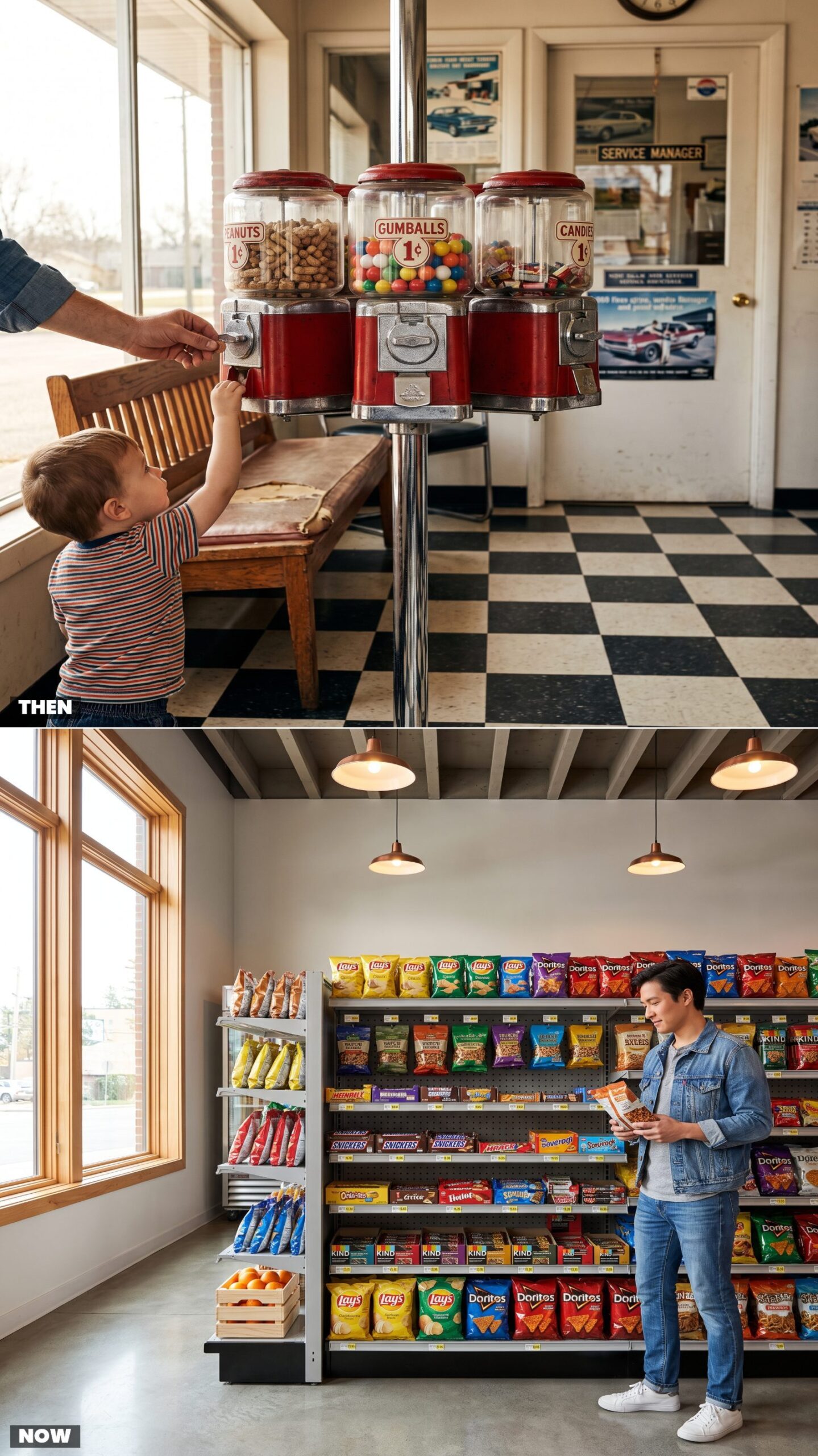
A penny bought a palmful of peanuts out of a glass globe. The machines stood in a little chrome huddle by the office door, and you cranked the knob and heard the candy tumble down. That was the whole snack selection — peanuts, gumballs, maybe a handful of those chalky candy pellets.
Now you walk a full aisle. Chips at eye level, candy bars by the register, nuts in resealable bags with nutrition labels. The penny machine couldn’t compete and quietly disappeared. The impulse it fed never did.
25. Porcelain Drinking Fountains vs. Bottled-Water Coolers
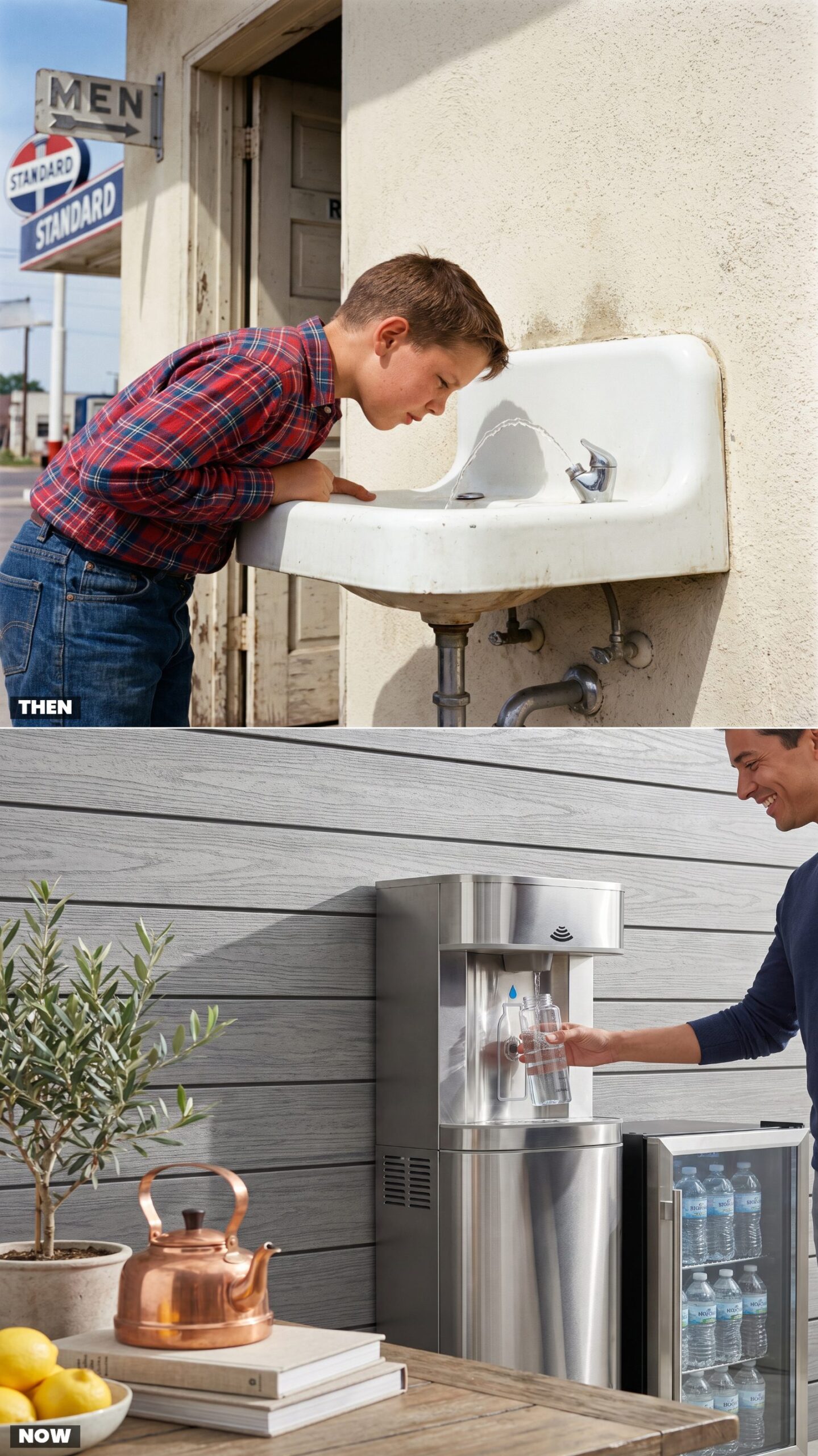
Water was free and came out of a white porcelain fountain bolted to the wall. You pushed the chrome button, bent down, and drank straight from the arc — nobody thought twice. The basin had a little rust ring near the drain and the water was always slightly warm in summer.
Today you buy it by the bottle, or refill at a touchless station. Water became a product with a barcode. Convenient, sure. But there was something honest about a spigot that asked nothing of you but a thumb.
24. Outdoor Waiting Benches vs. Quick-Service Dining Areas
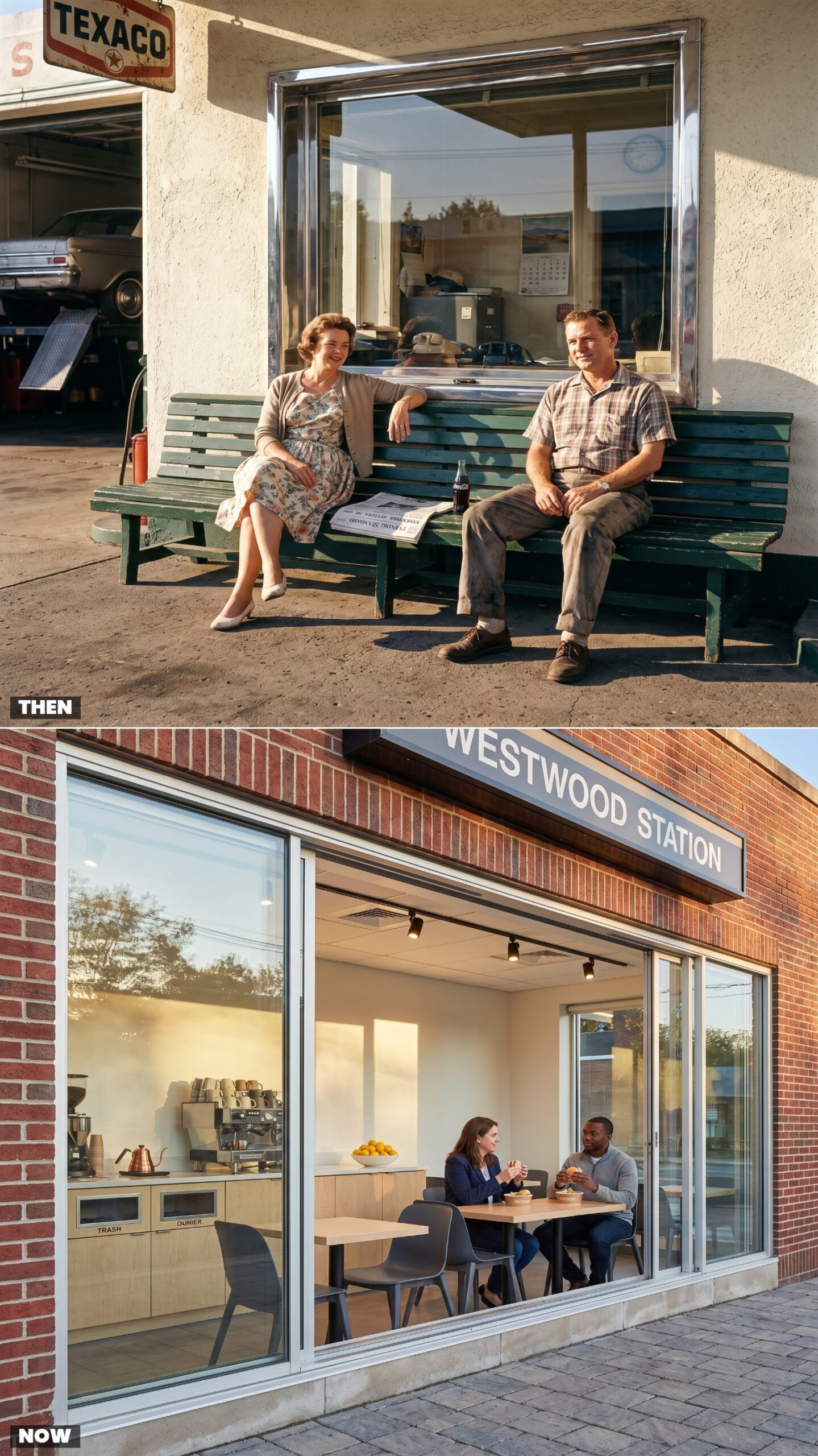
You waited on a bench — a long green wooden one against the wall, out front where you could watch your car on the lift and smell the gasoline. You read the paper. You talked to whoever was sitting next to you, because there was nothing else to do and no screen to hide behind.
The modern version is a little indoor dining nook with laminate tables and a coffee counter. You wait with a sandwich and your phone instead of a newspaper and a stranger. Comfortable. Quieter. A touch lonelier, if I’m being honest.
23. Candy Bars at the Counter vs. Hot-Food Kitchens and Coffee Bars
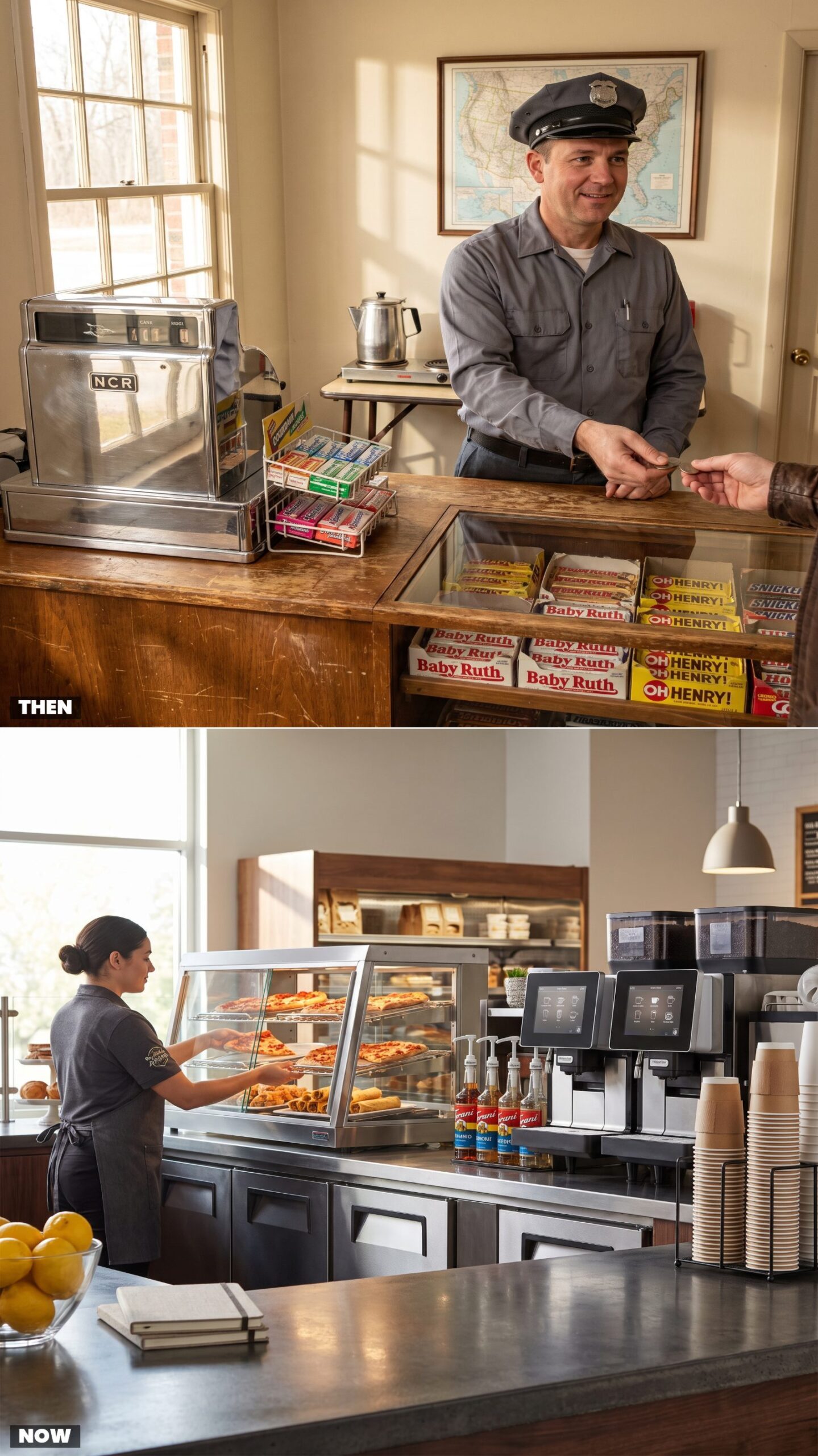
Food in 1965 meant a candy bar and a cup of coffee from a percolator that had been on the hot plate since breakfast. The counter held a glass box of chocolate bars in paper wrappers and a gum rack. That was dinner on a long drive if you weren’t near a diner.
Now the gas station feeds you. Hot cases of pizza and taquitos, touchscreen coffee machines with eight flavors, syrup pumps and self-serve cups everywhere. The place that once sold gas and gum turned into a restaurant that happens to sell gas.
22. Roofline Neon vs. Programmable LED Accent Lighting
Would you like to save this?
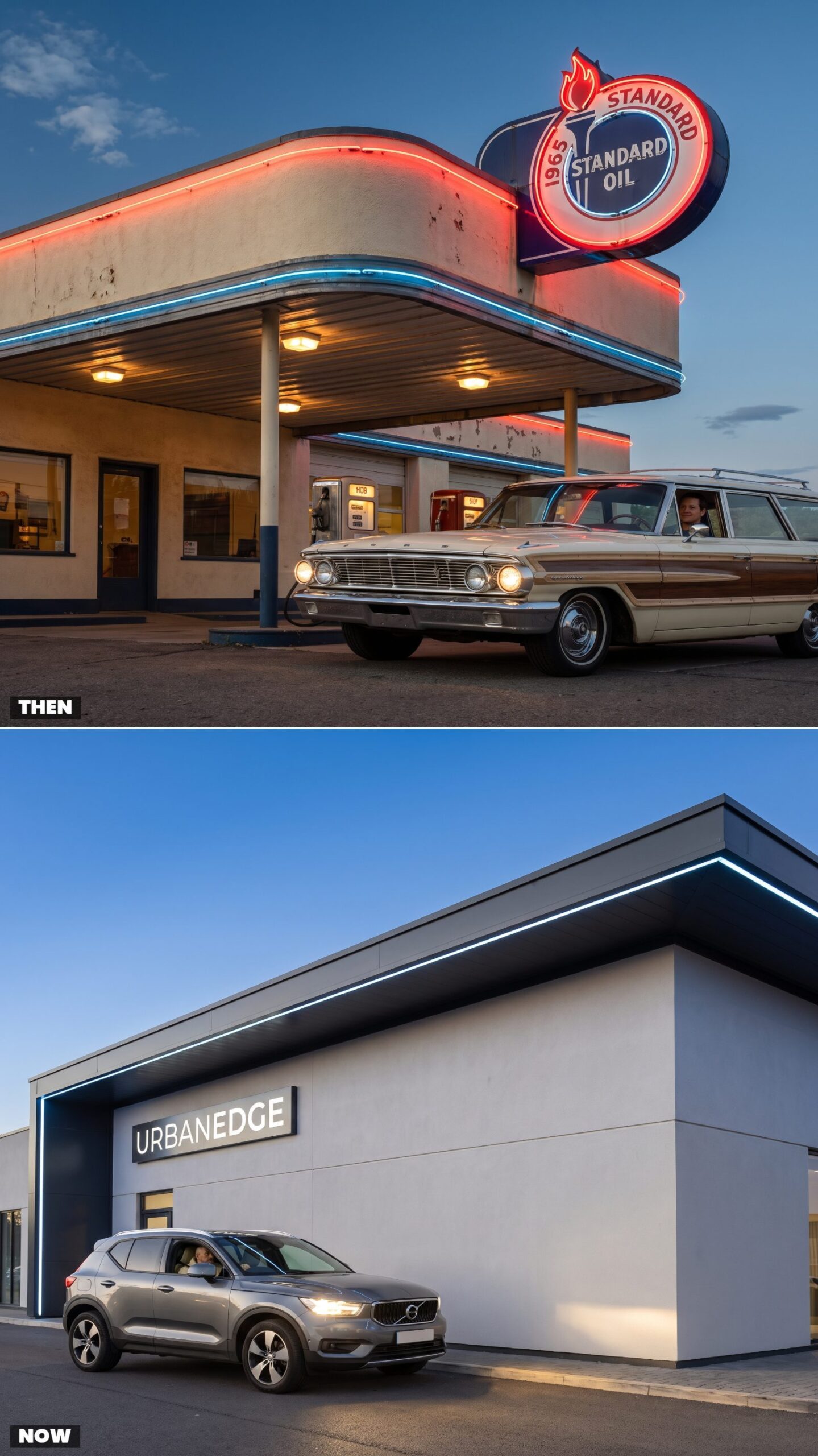
At dusk the roofline came alive. Red and blue neon traced the fascia and wrapped the round sign, humming faint and warm, throwing color across the stucco — you could spot a station from a mile off by its glow. Neon had a personality. It buzzed, it flickered, it felt handmade because it was.
LED strips do the same job now and do it better. Crisp, programmable, color-changing, no buzz, no burnout, longer life. But a perfect even glow doesn’t have the character of a tube that someone bent by hand over a flame.
21. Gooseneck Floodlights vs. Flat-Panel Canopy Lighting
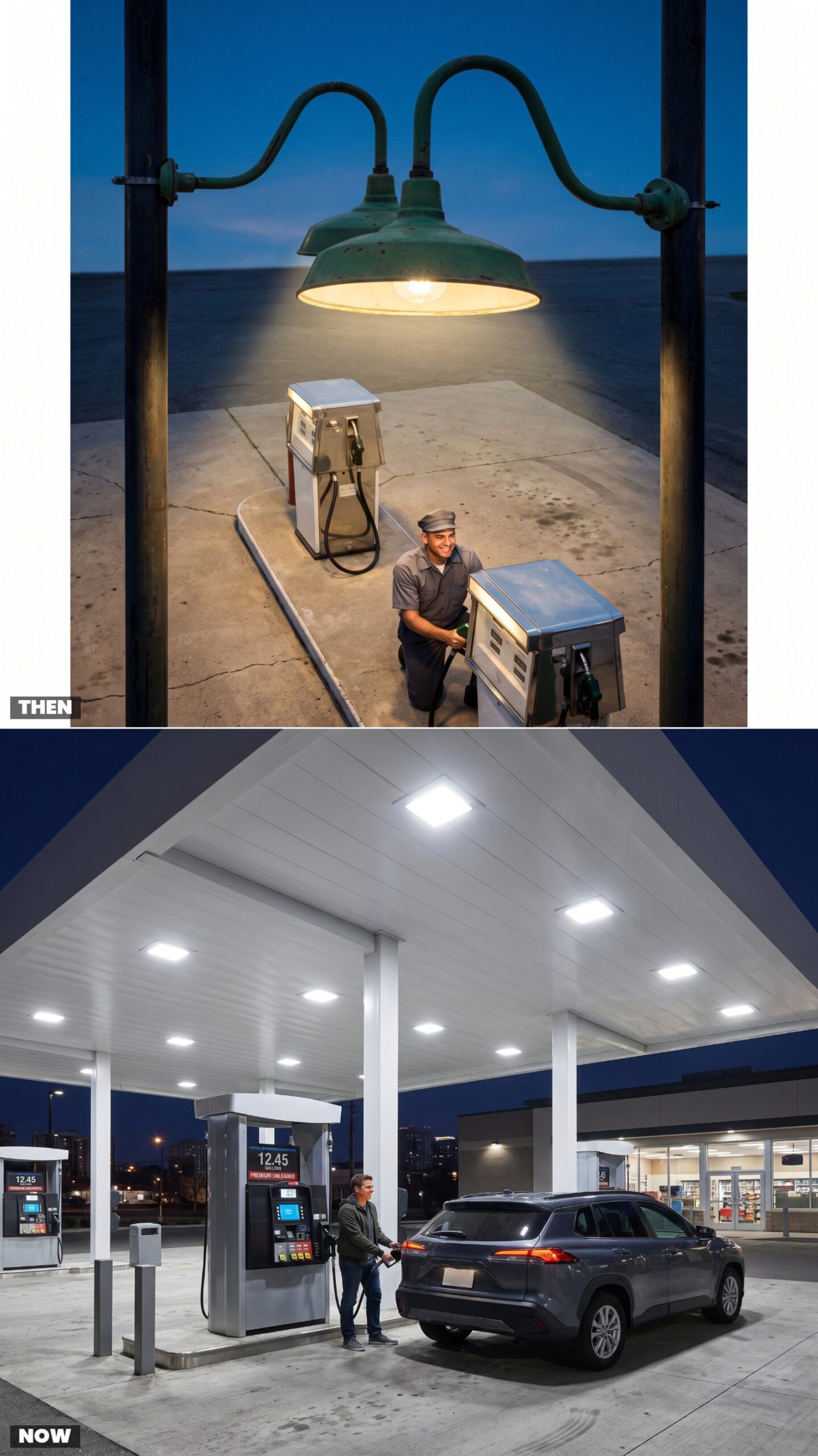
Light came from goosenecks in 1965 — curved steel arms on tall posts, bulbs hanging off the ends, throwing warm yellow pools down onto the pumps. The light was uneven, bright in the middle and fading at the edges, with soft shadows where one lamp couldn’t quite reach.
Now a flat canopy spreads cold even light across the whole island, recessed LED panels tucked flush into the ceiling. Brighter, safer, no dark corners. The gooseneck is gone, and with it the warm pooled glow that made a gas station at night feel like a small lit stage on a dark road.
20. Informal Parking Along the Building vs. Striped Parking Stalls
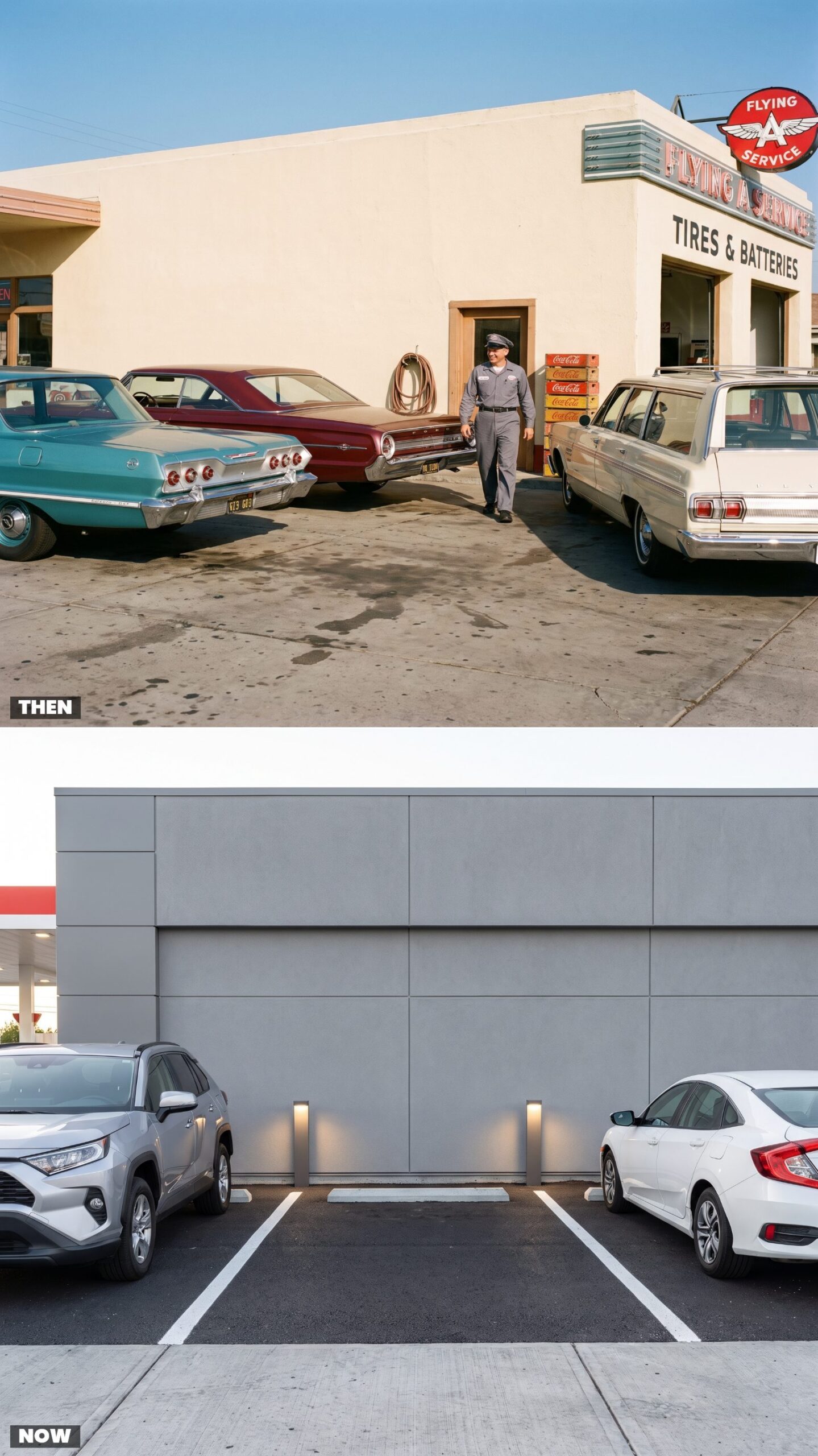
In 1965 you pulled in wherever looked right and nobody thought twice, cars angling against the service-bay wall like horses at a rail, half of them crooked and one always a foot too close to the Coke rack. Parking was instinct, not instruction.
Today every space is measured, striped, and wheelstopped, with white paint telling you exactly where the front bumper stops. Tidier, sure. But something got lost when the lines showed up and the guessing went away.
19. Flower Beds and Trimmed Hedges vs. Low-Maintenance Landscaping
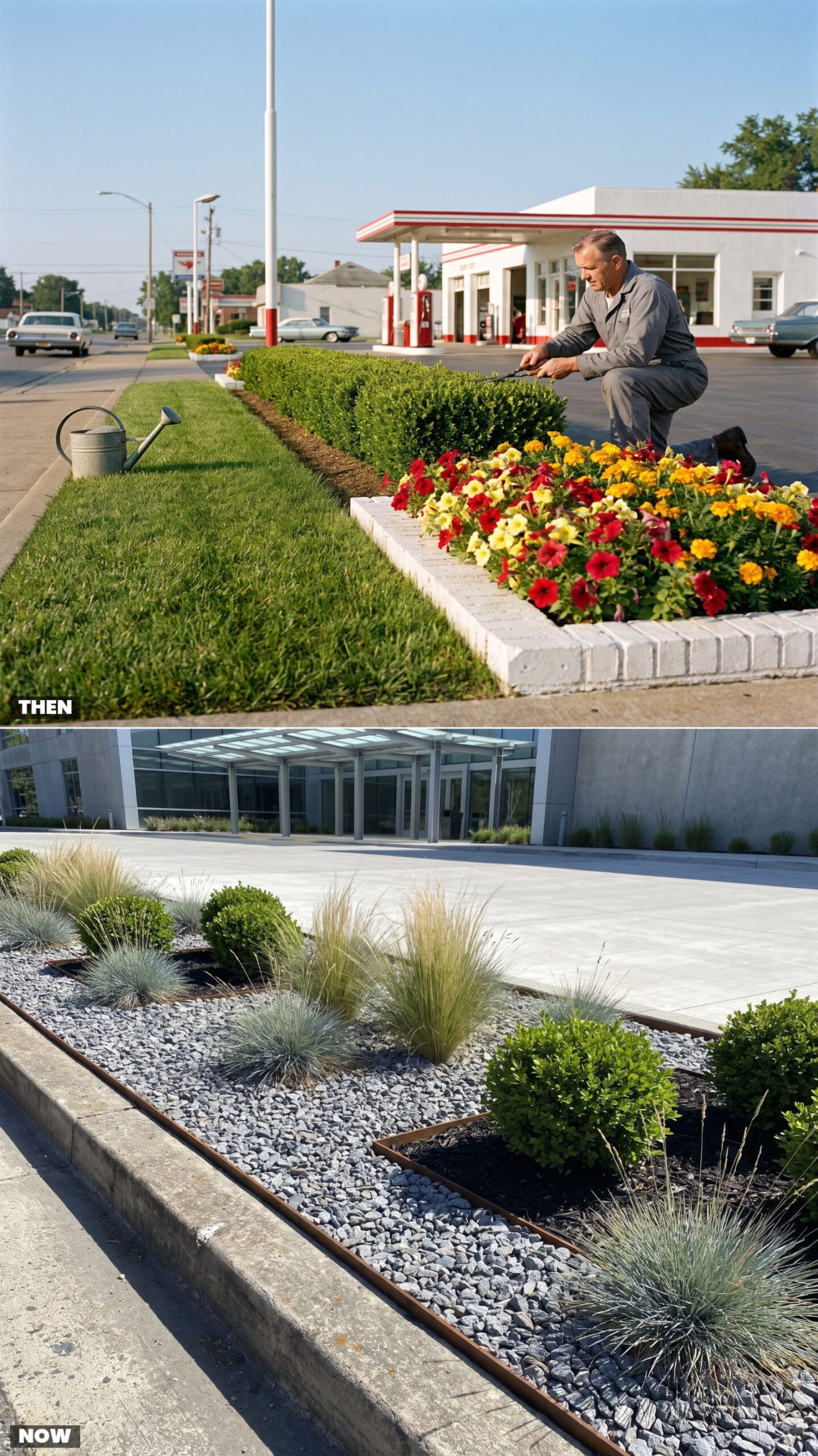
Someone used to garden at the gas station. Petunias and marigolds in a bed along a clipped boxwood hedge, watered by hand, trimmed on slow afternoons by the same fellow who pumped your gas and then pulled the weeds between fill-ups.
Now it’s gravel, mulch, and three ornamental grasses chosen because they survive on neglect. Nobody kneels with shears anymore. The planting is built to be ignored, and it looks exactly like that.
18. Rows of National and Checkered Flags vs. Branded Feather Banners
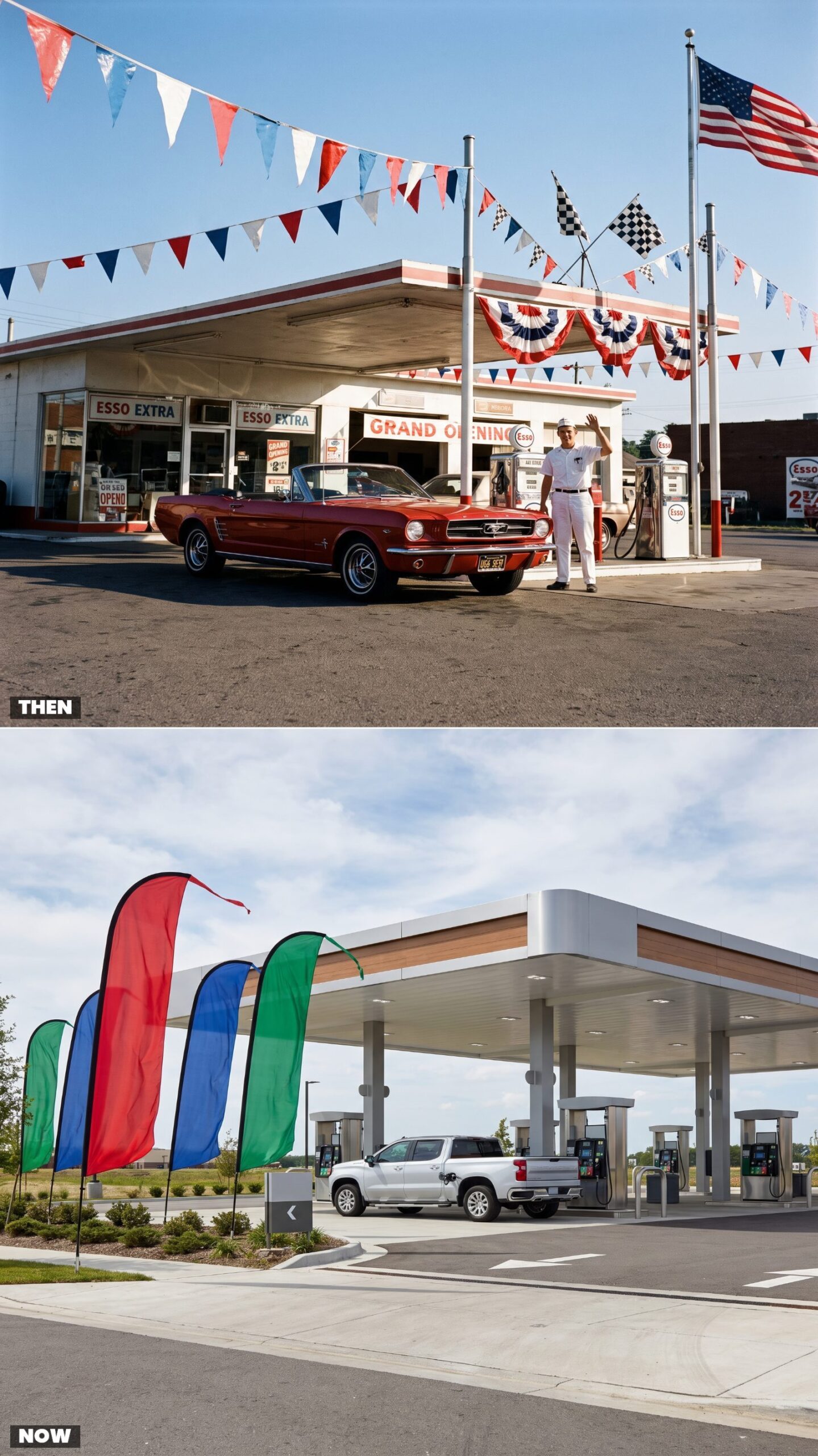
A string of pennants snapping over the pumps meant something was happening. Red, white, blue, and a few checkered flags for the speed lovers, all tied between two poles and left to flutter. Festive without trying.
Those gave way to the feather banner, that tall teardrop thing bending by the entrance. One color, one word, staked in the dirt. It does the job. It just doesn’t make you want to pull over the way a row of snapping flags once did.
17. Wire Motor-Oil Racks vs. Organized Automotive-Supply Shelves
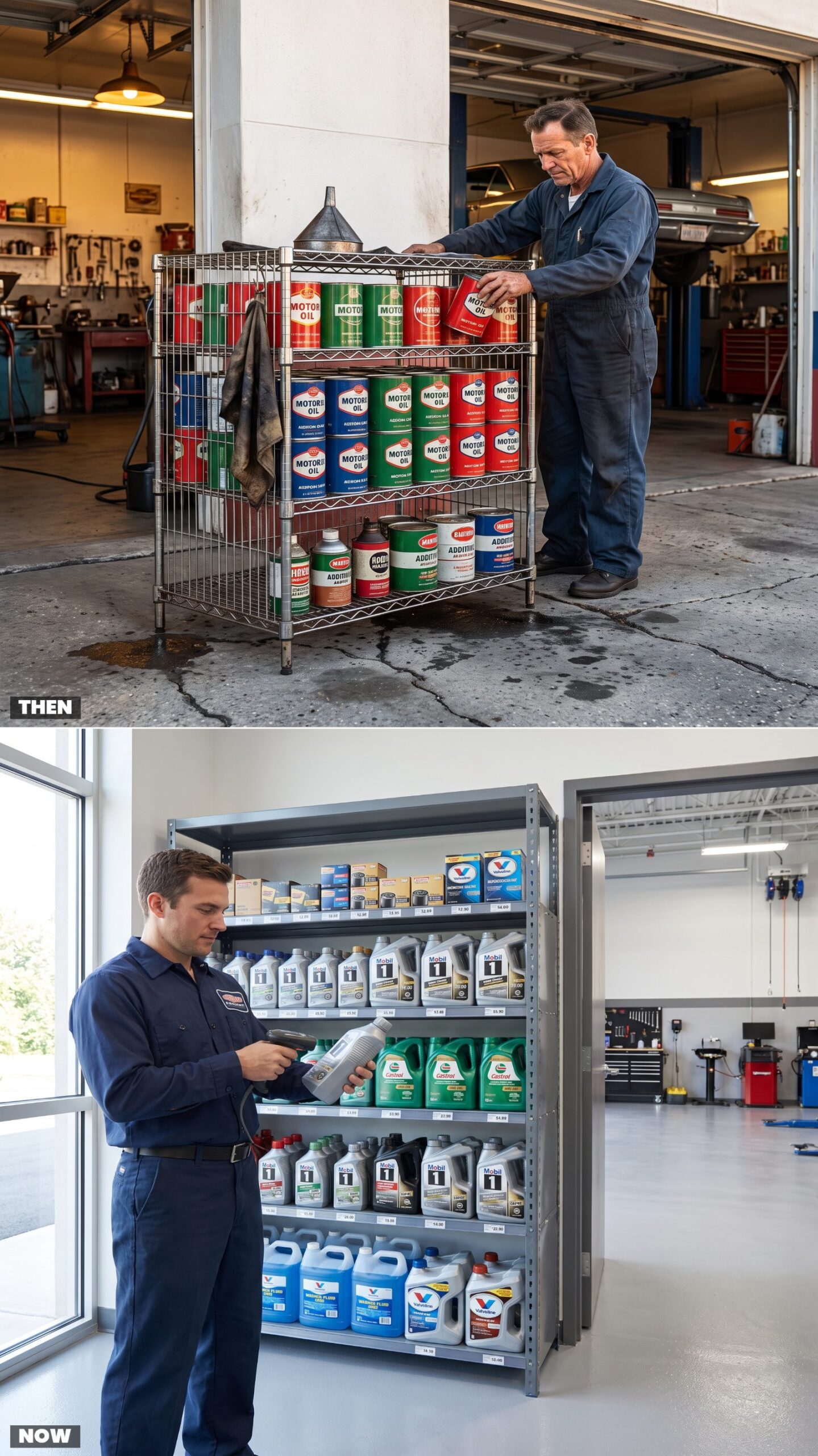
The oil rack was its own little landmark: a chrome wire stand parked by the bay door, loaded with quart cans in reds and greens and blues, a funnel resting on top and a grease rag slung over the corner. You knew the brands by their colors before you could read a word of the label.
The modern version is a powder-coated steel shelf with pricing strips and barcodes, everything squared and inventoried. More products, cleaner floor, less soul. Efficiency doesn’t smell like anything, and that’s the trouble with it.
16. Quart-Size Metal Oil Cans vs. Molded Plastic Bottles
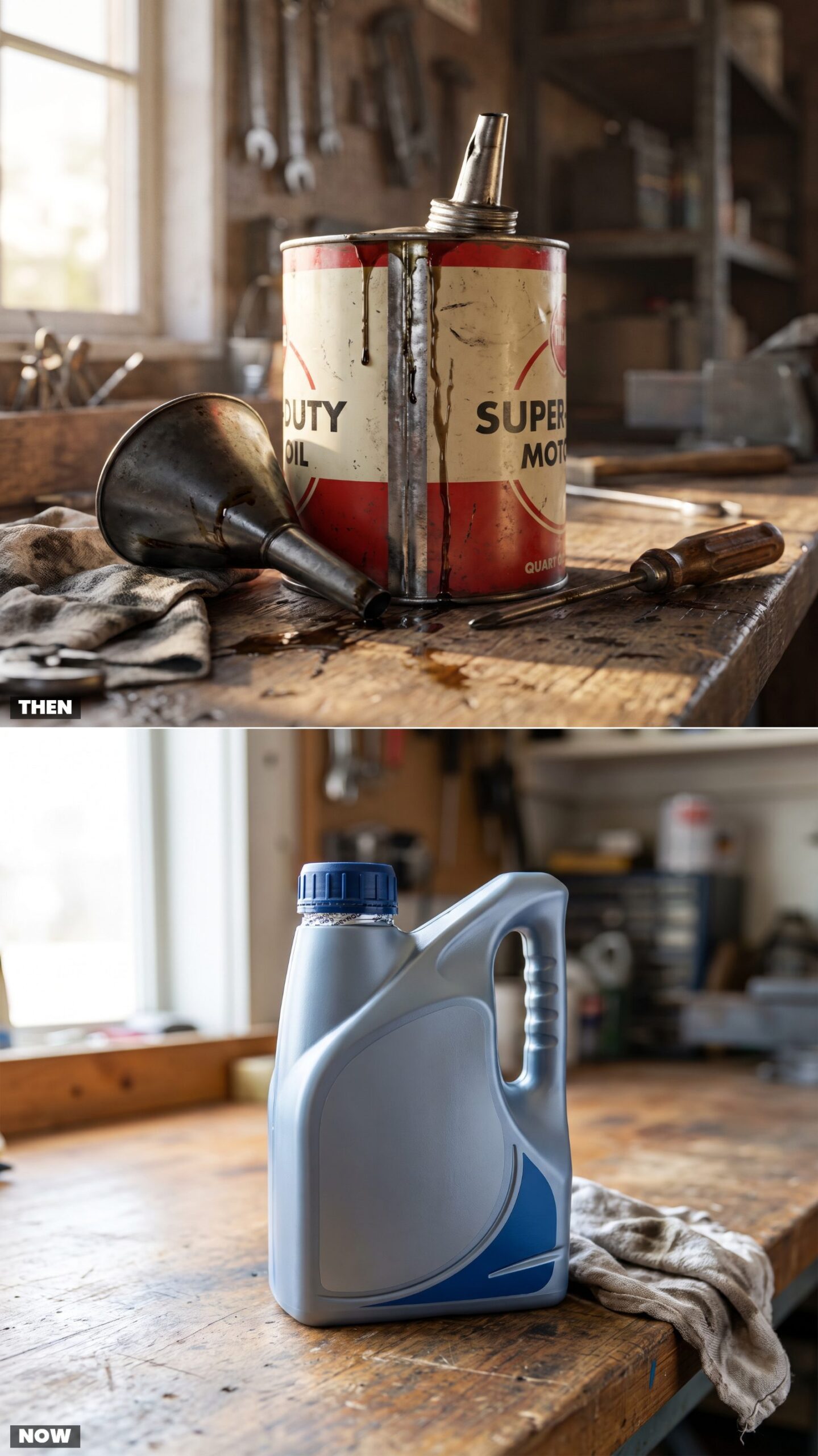
You needed a church key to open a quart of oil in 1965. A tin can, a punched spout, and the whole thing dripped no matter how careful you were. It had weight in your hand. The pour had a rhythm to it.
Now it’s a molded plastic bottle with a built-in handle and a screw cap, no tool required, spill mostly contained. Easier in every way. I still miss the sound a metal spout made going into tin.
The can had weight. The bottle has a handle. Progress, mostly.
15. Whitewall Tires Stacked Outside vs. Enclosed Tire Displays
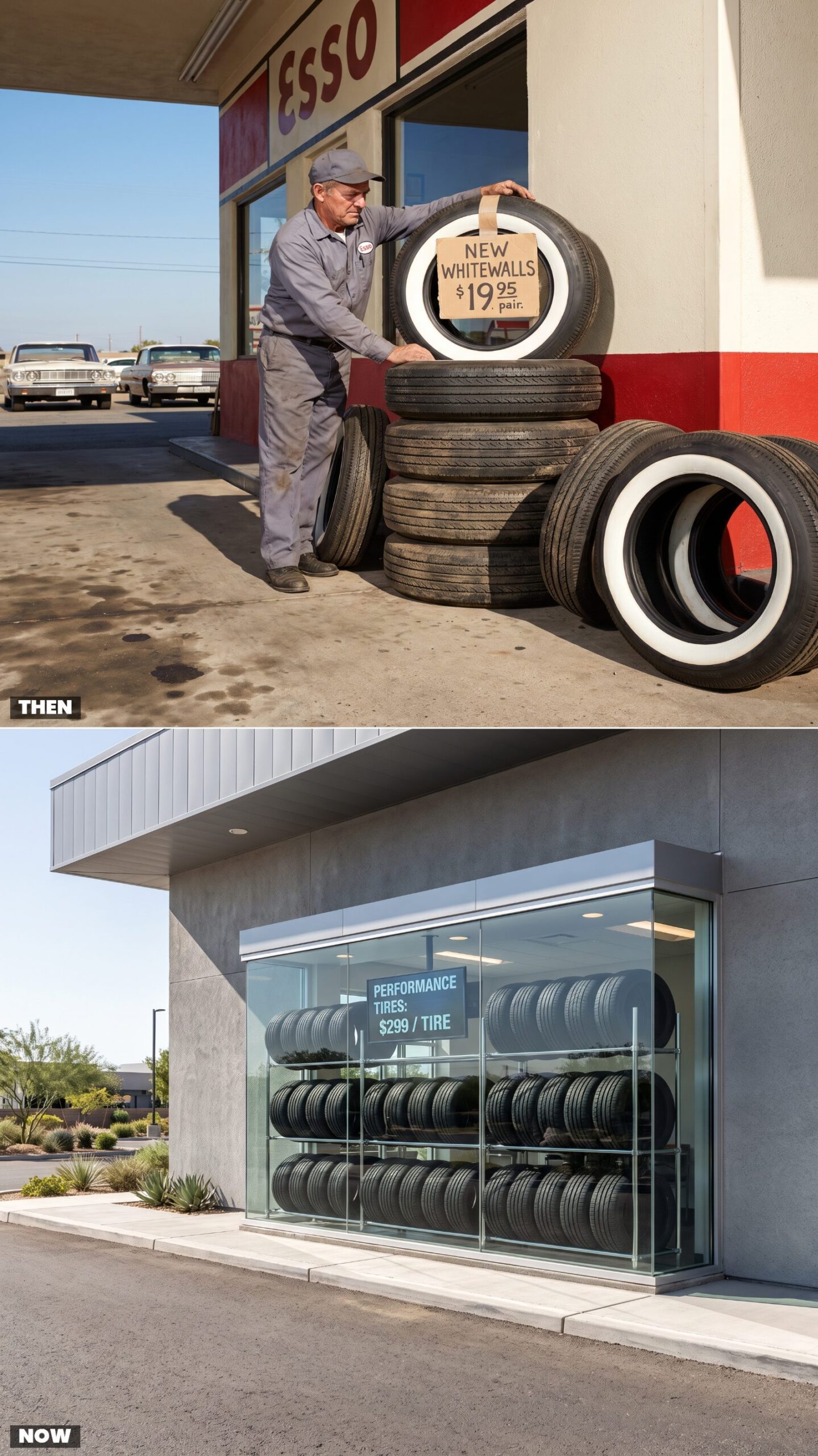
Whitewalls stacked out in the open air, white sidewalls facing the road, a hand-lettered price card leaning on top. Sun bleached them, dust settled on the bottom few, and nobody minded one bit. The sidewalk itself was the display.
These days tires live behind glass in a climate-controlled showroom, black low-profiles mounted upright with a digital price tag. Cleaner, drier, safe from the weather. Also completely sealed off from the hand that used to reach out and thump one to check it.
14. Bubble Wheel Balancers vs. Computerized Tire Machines
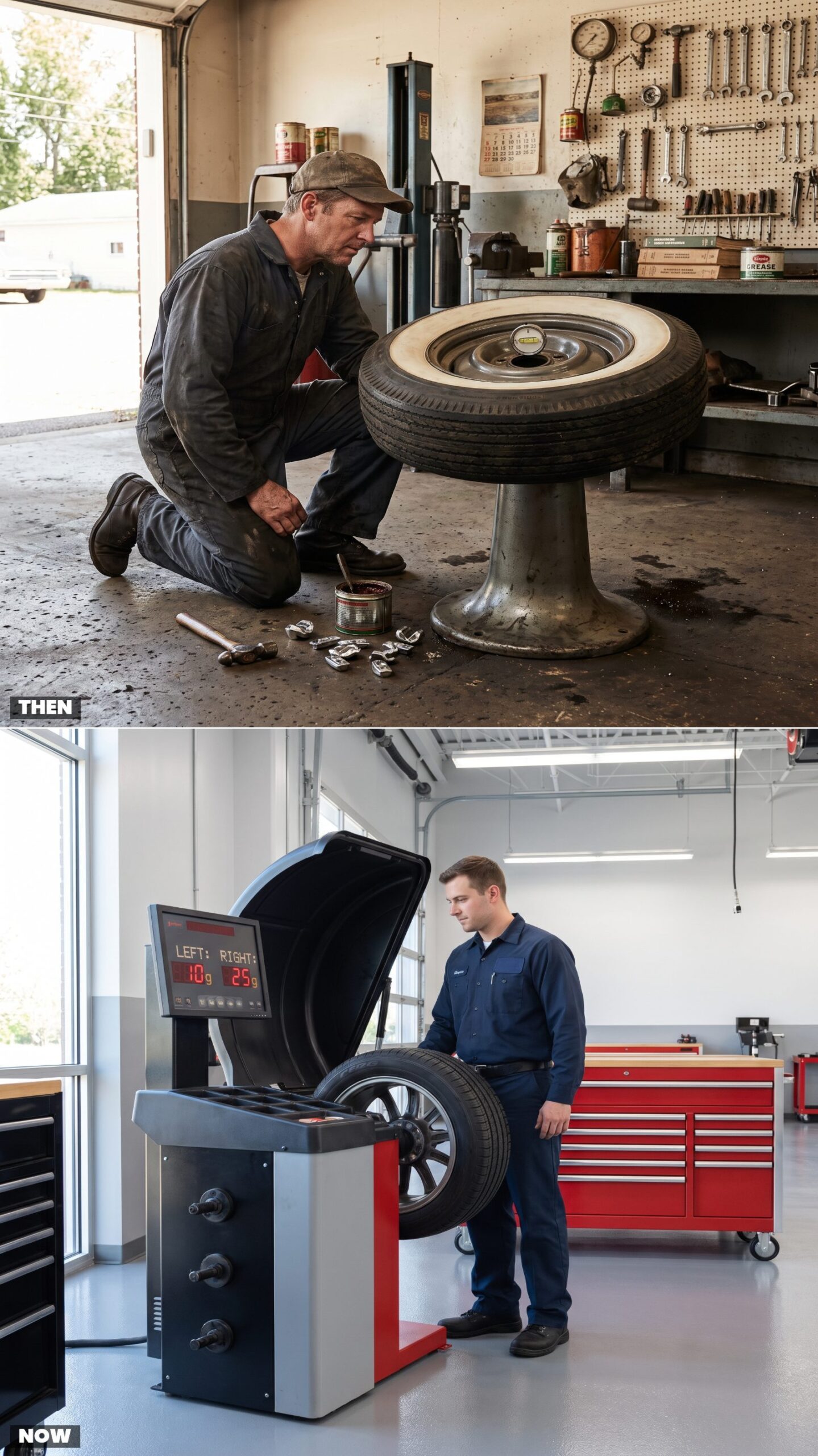
Balancing a wheel in 1965 meant laying it flat on a pedestal, watching a little spirit bubble settle, then tapping on lead weights by hand and by eye. Part science, part feel. The good mechanics could read that bubble like a barometer.
Now a spinning spindle and a digital readout tell you exactly where to clip the weight. Faster, more accurate, no guesswork. The bubble is in a museum, and the feel went with it.
13. Attendant-Operated Vacuums vs. Self-Service Vacuum Islands
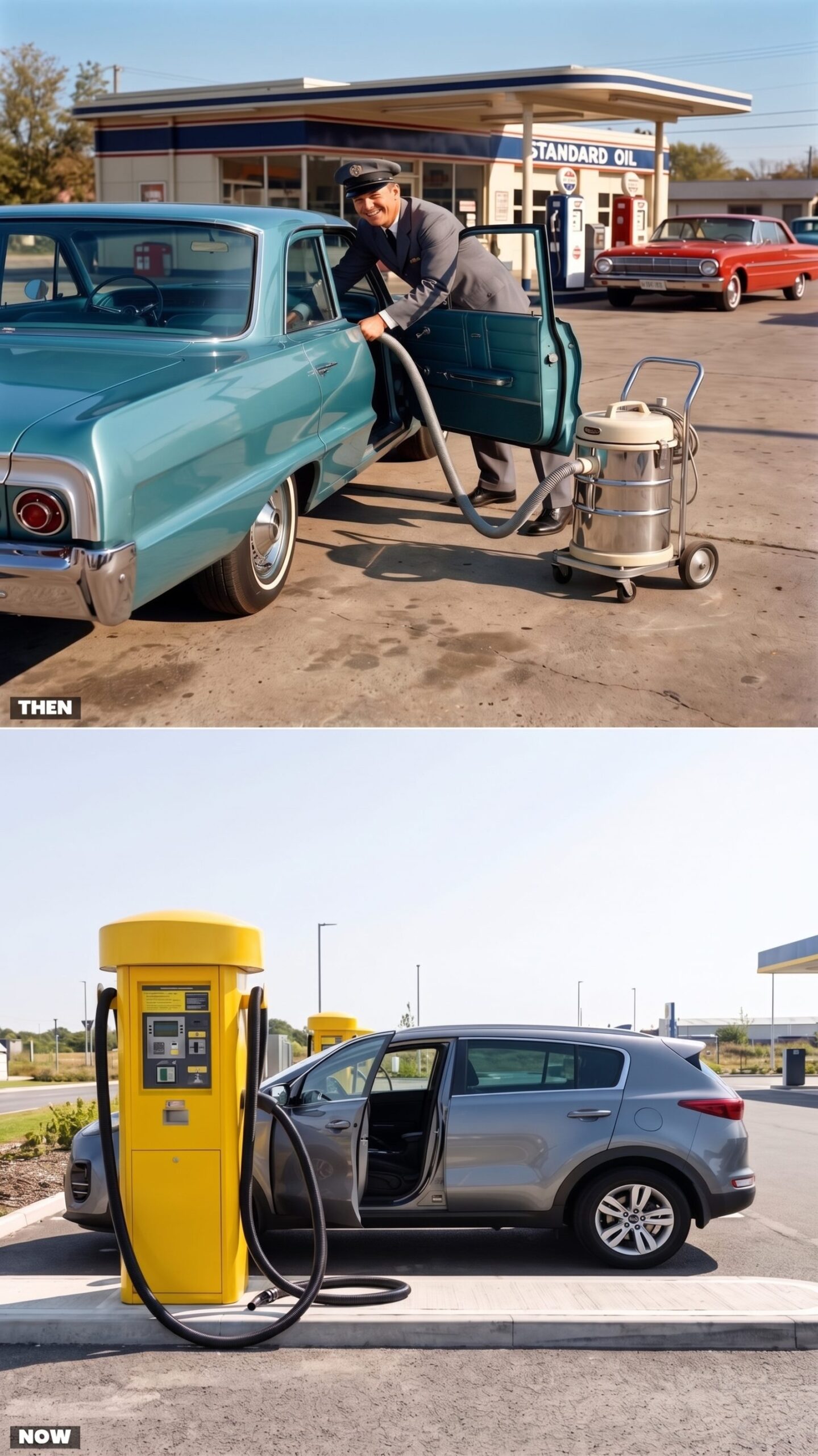
You didn’t vacuum your own car in 1965. The attendant walked over with a canister unit, opened your door, and cleaned the floor mats while you paid. Service meant someone else did the work.
Now it’s a yellow island, a card swipe, and a countdown clock. You park, you pay, and you drag the hose around yourself before the minutes run out. We call it self-service, which is a polite way of saying nobody serves you anymore.
12. Unmarked Parking Areas vs. Accessible Spaces and Curb Ramps
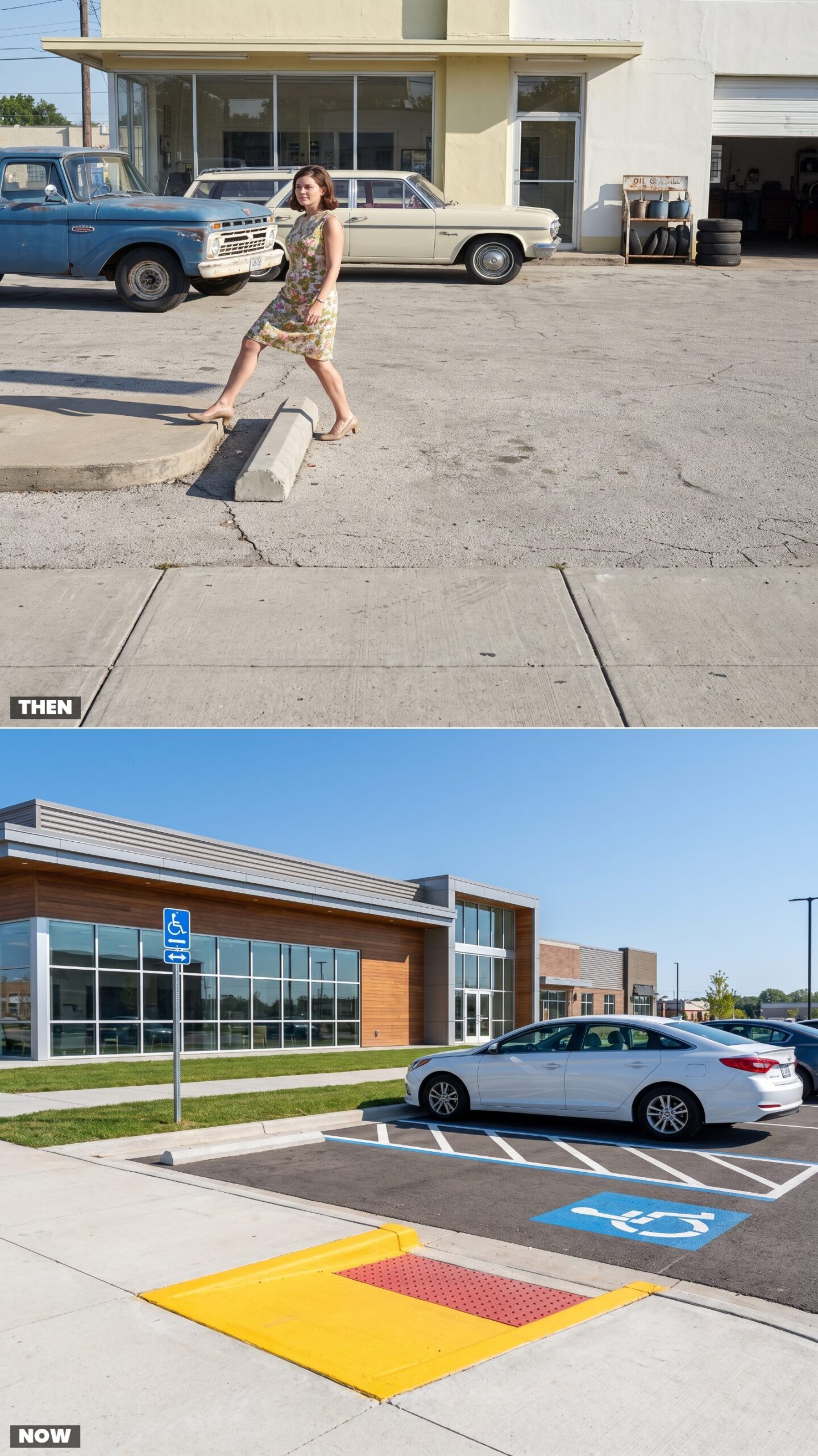
A 1965 forecourt was a flat field of concrete with a square curb and not much thought given to who couldn’t step up it. No markings, no ramps, no blue signs, just park wherever and climb whatever was there.
Modern stations stripe an accessible space, post the sign, cut a curb ramp with those bumpy yellow warning pads, and build the whole approach so anyone can use it. This is one change nobody should feel nostalgic about. The old way simply left people out.
11. Sand-Filled Standing Ashtrays vs. Smoke-Free Forecourts
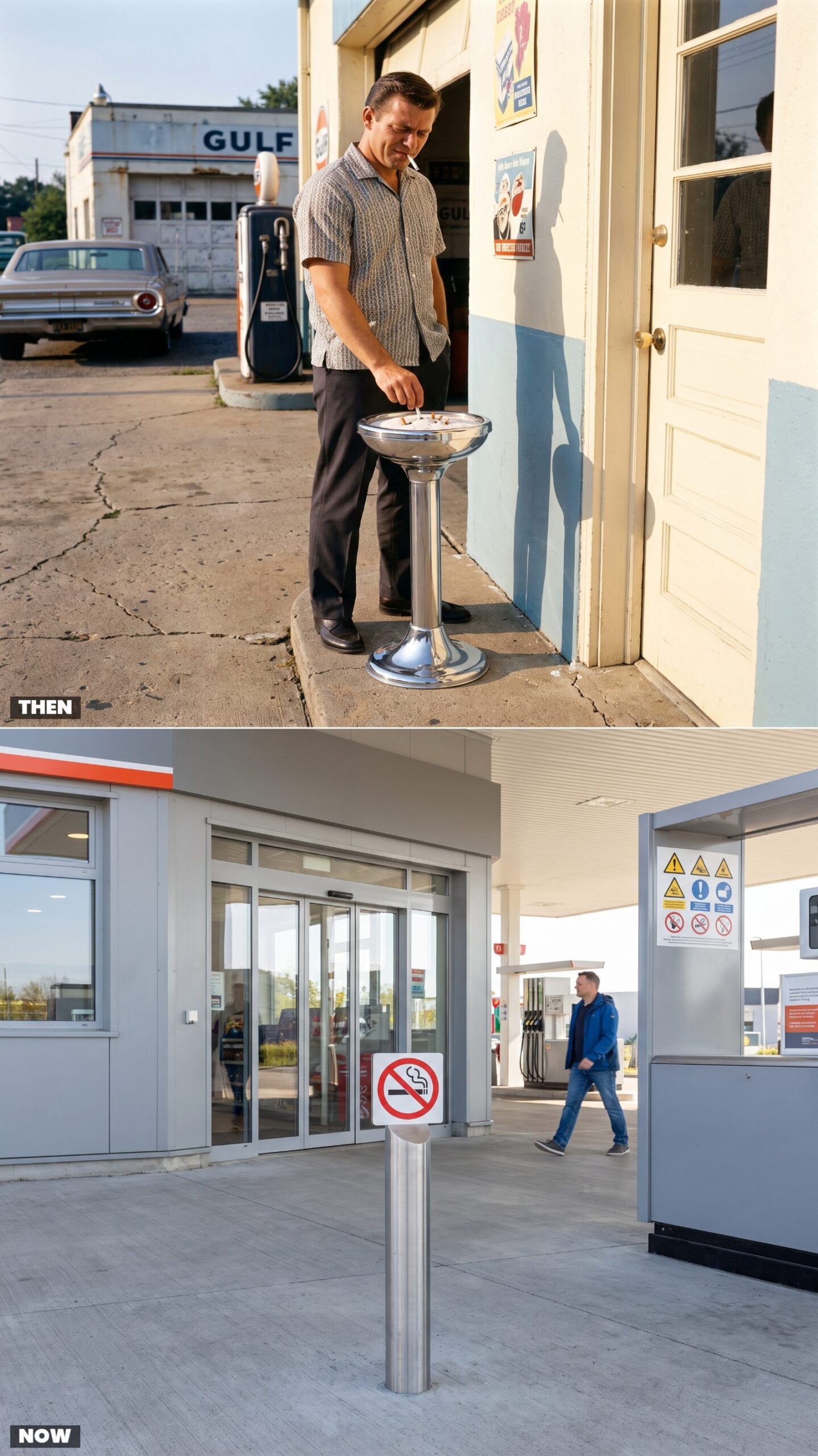
There was a chrome ashtray by every door, a sand tray on top with butts pressed into it, and nobody blinked at a lit cigarette standing twenty feet from the pumps. Men smoked while they pumped. It’s a wonder more stations didn’t go up like a torch.
Today the forecourt is a smoke-free zone, with red warning signs bolted near every nozzle and no ashtray in sight. This one isn’t nostalgia. It’s common sense catching up with gasoline, and about time. That chrome ashtray was charming right up until you remembered what it was sitting next to.
10. Station-Owned Tow Trucks vs. App-Dispatched Roadside Assistance
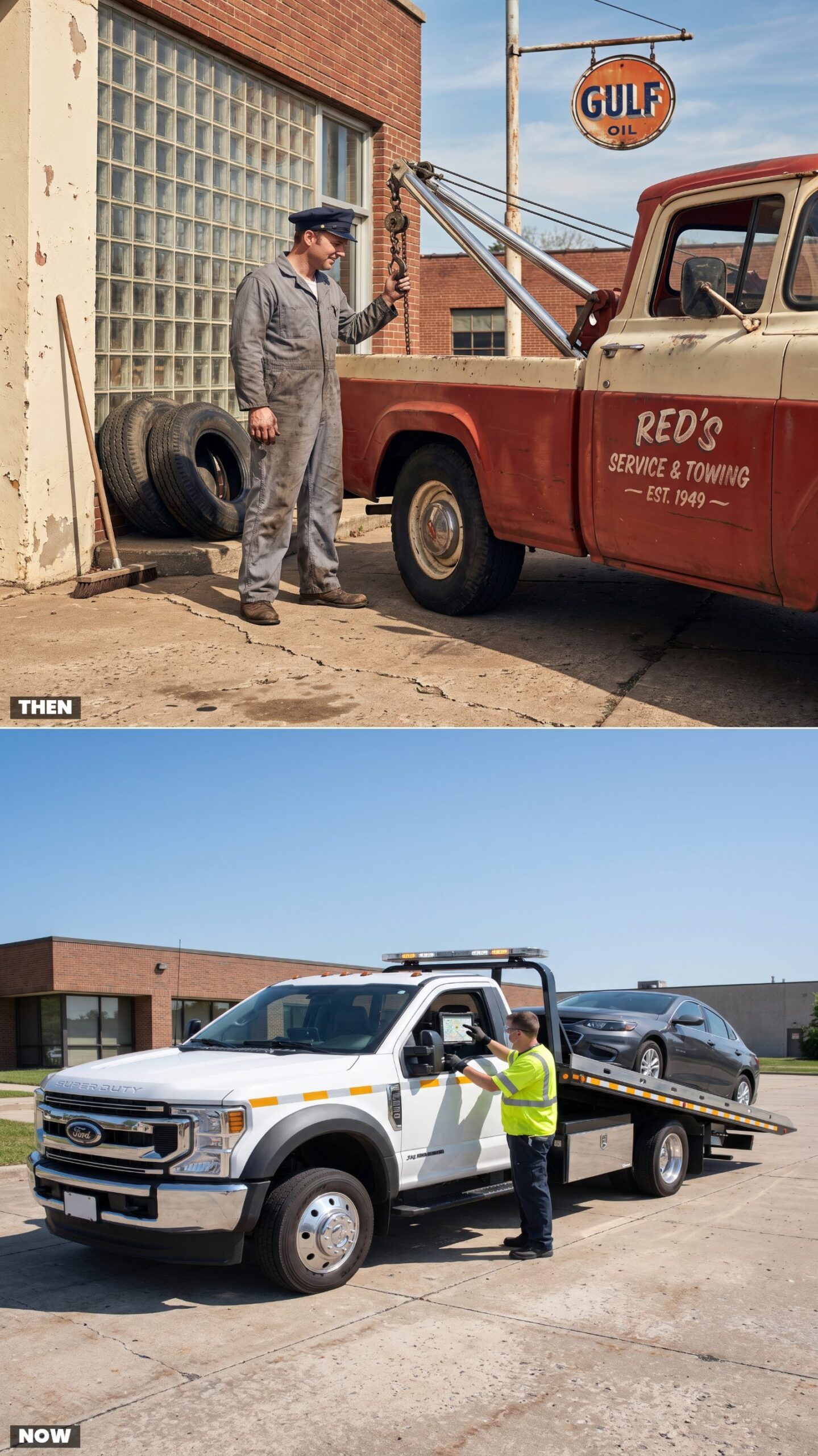
In 1965, when your radiator let go on a two-lane highway, you called the station from a payphone and a guy you probably knew by first name rolled out in the house tow truck. Boom, chain, a handshake, a tow back to the bay he worked in every day.
Now the whole thing happens on your phone before anyone says a word. You tap the app, watch a little truck icon crawl across a map, and get a text with the driver’s name and a photo. The flatbed shows up, winches you on hydraulically, and you never learn where it’s based. Faster, cleaner, and somehow lonelier.
9. Finned Sedans at the Pumps vs. SUVs and Crossovers
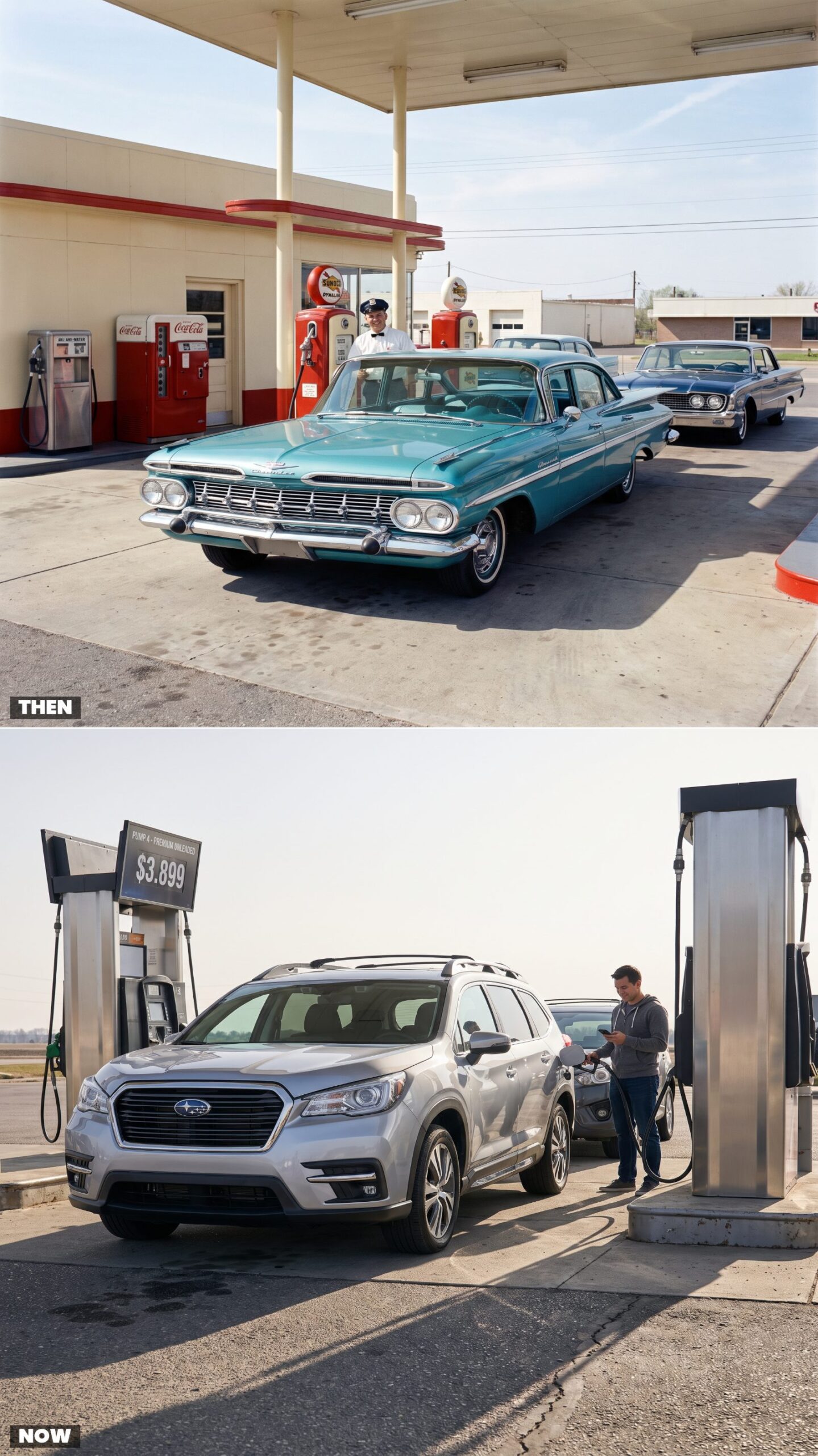
Look at what rolled up to the pumps in 1965: a slab of chrome and sheet metal wider than a modern parking space, riding on whitewalls, those tailfins pointed at the sky like the car was ready for takeoff. Form first, function somewhere down the list.
Pull into the same forecourt today and it’s a wall of crossovers. Tall, upright, mostly gray or white, built for cargo and ground clearance nobody ever uses. The fins are gone and so is the swagger. We traded showmanship for a cupholder count and a backup camera.
8. Hand-Painted Business Hours vs. Illuminated 24-Hour Signage
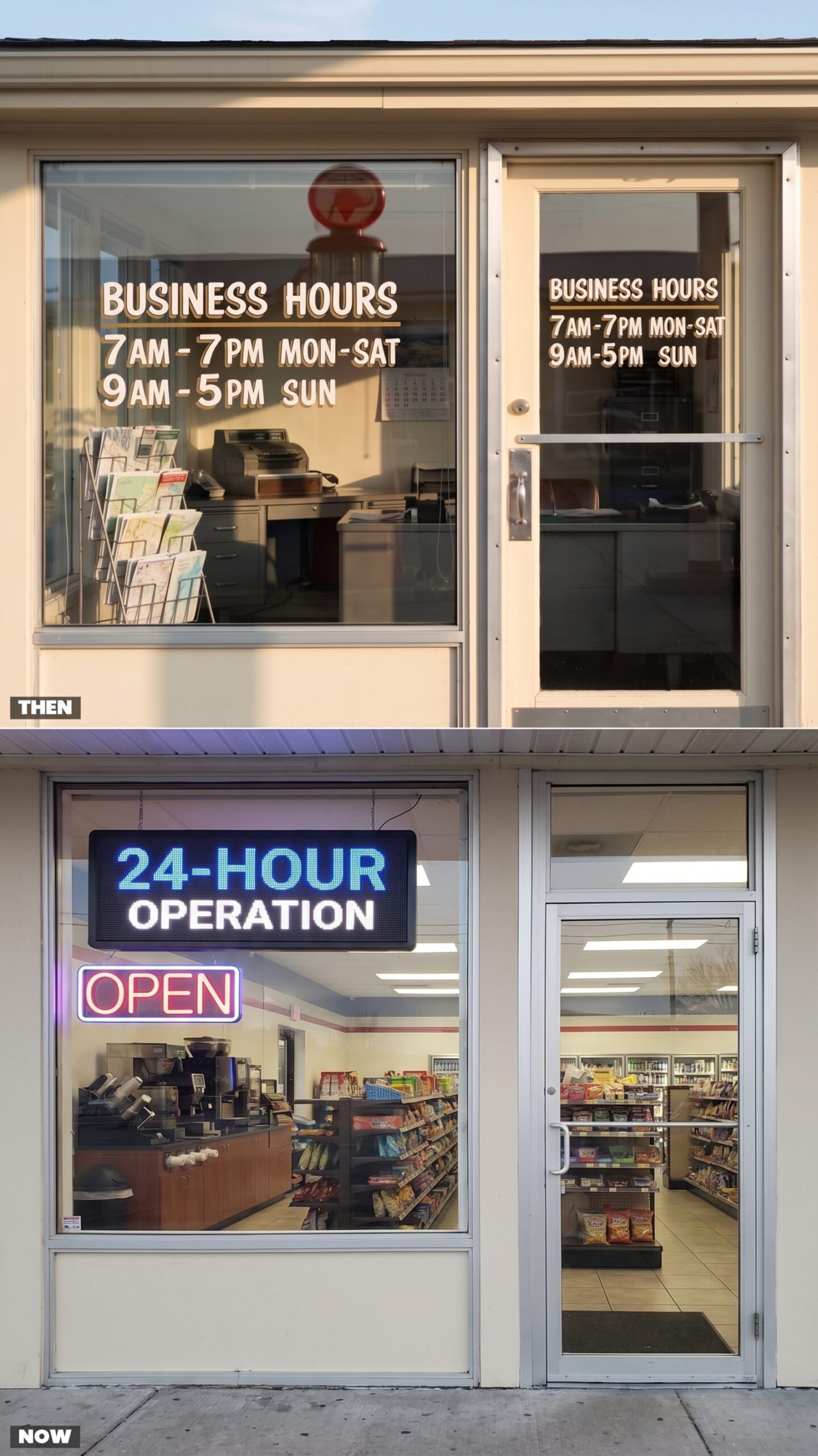
A sign painter stood on a stepladder with a quart of One Shot enamel and a sable brush, and the station’s hours went up on the glass by hand. Slightly imperfect letters with gold drop shadows, a craft that took years to learn and years more to get good at.
Today the hours never close, so there’s nothing to paint. An LED dot-matrix panel glows around the clock in a font some corporate committee picked. Efficient, legible, and completely untouched by a human hand.
7. Free Glassware Giveaways vs. Digital Rewards Points
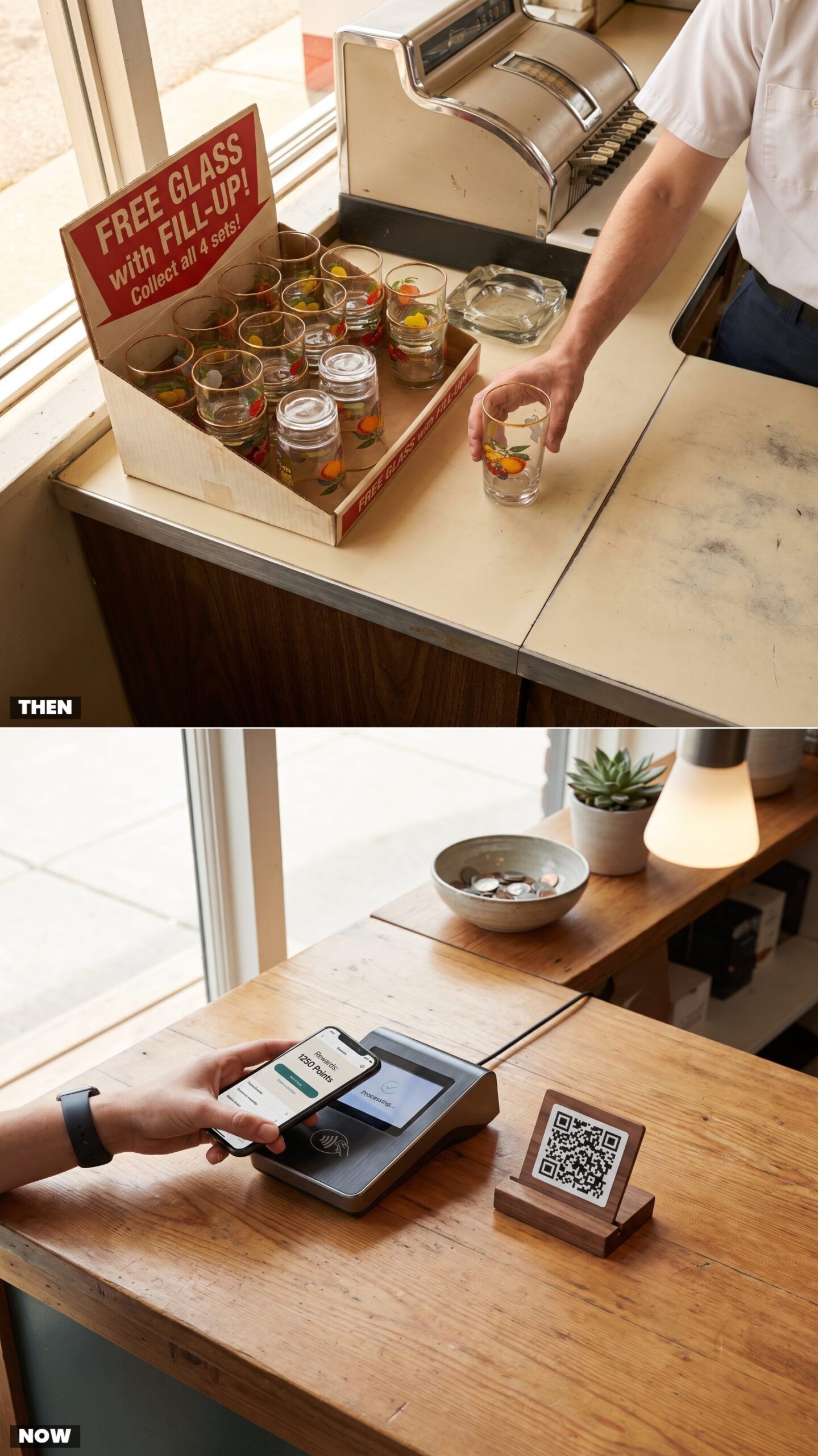
Fill the tank, walk out with a drinking glass. That was the deal at thousands of stations, and whole kitchen cabinets got stocked one fill-up at a time with gold-rimmed tumblers and fruit-pattern juice glasses. Some of those sets fetch real money from collectors now.
The reward still exists, it just lives in your phone. Points accrue invisibly, you shave a few cents off a gallon, and nothing ever lands in your hand. And honestly? A glass you drank iced tea from for thirty years beats a push notification about your tier status.
6. Steel Desks and Rotary Phones vs. Back-Office Computer Stations
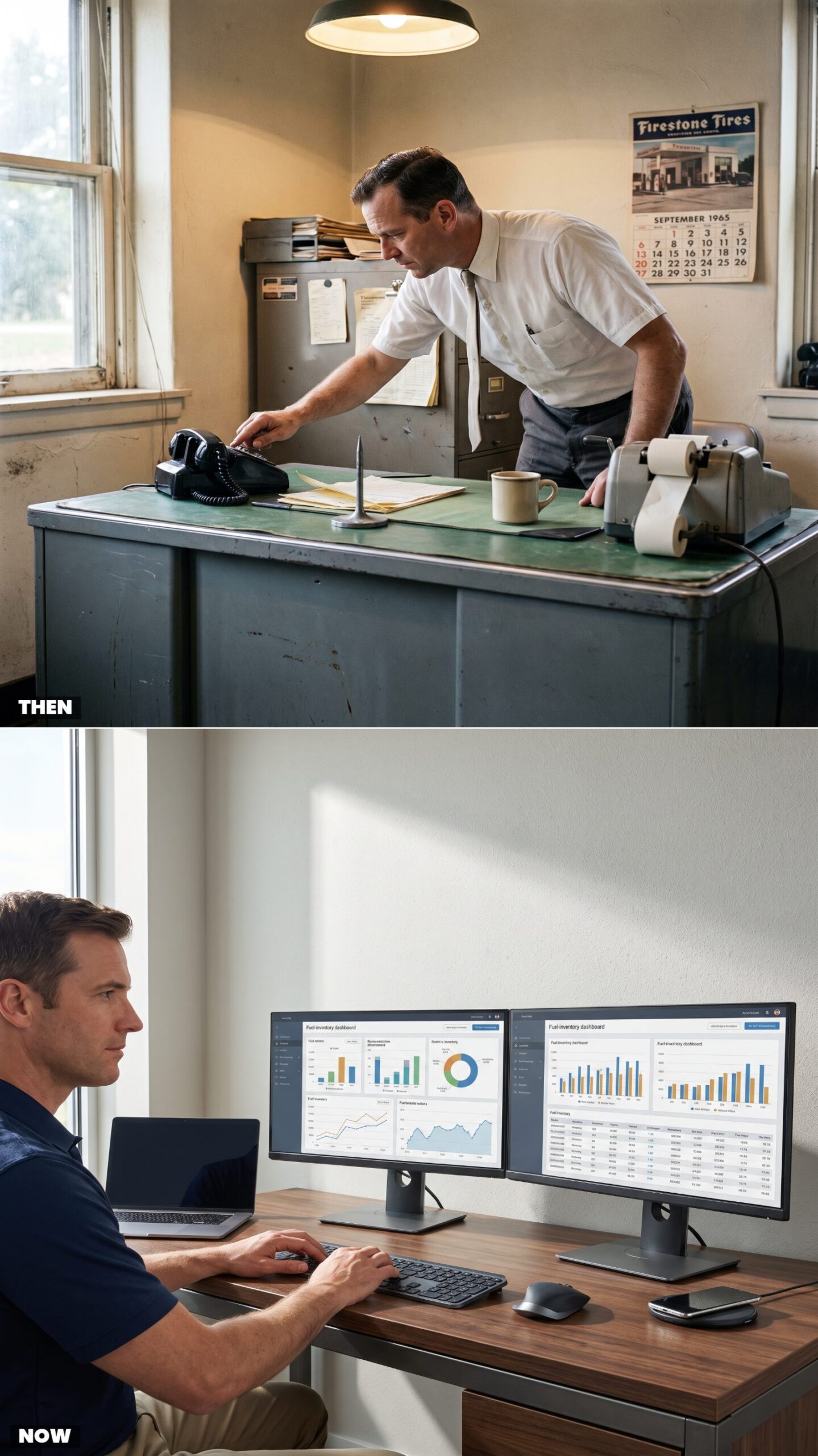
The brains of a 1965 station ran on a gray steel desk, a black rotary phone, and an adding machine that chattered out numbers on a paper roll. You called your fuel supplier by spinning a dial and waiting for it to click back, and records went on a spike.
The desk is still there in spirit, but now it hums. Dual monitors track tank levels, card settlements, and fuel pricing that shifts by the hour. That rotary phone sat on the old desk for decades without ever needing an update. The dashboard needs one Tuesday.
5. Unprotected Pump Bases vs. Steel Crash Bollards
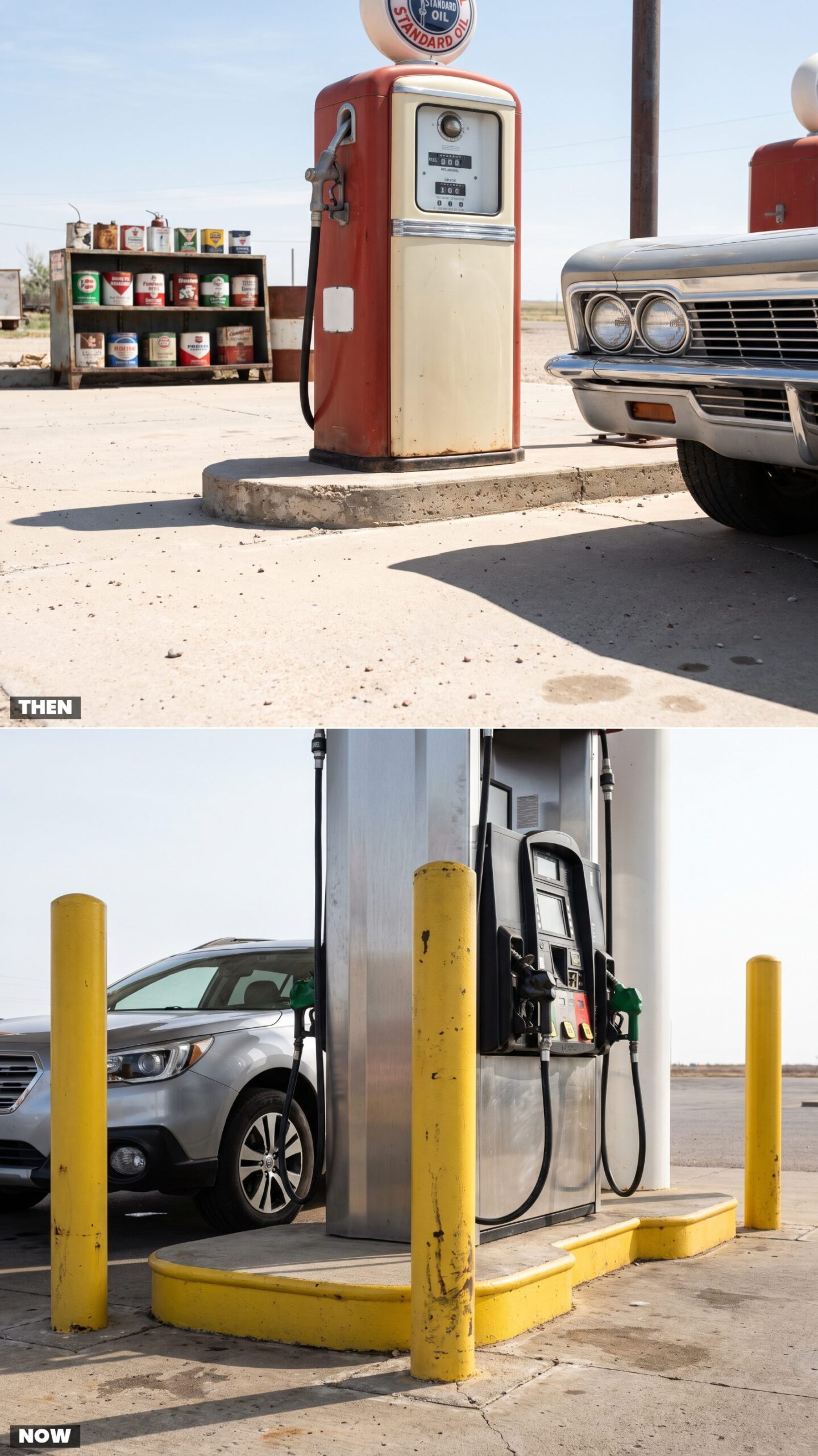
Here’s a detail nobody noticed in 1965, because nothing was there to notice: the pump sat on open concrete, bare to the world. One misjudged turn into the island and you clipped the dispenser dead-on. People drove enormous cars with drum brakes and somehow this seemed fine.
Walk a modern forecourt and every pump wears a cage of yellow steel bollards and a raised safety curb. Dull, industrial, and the single biggest quiet safety upgrade on the lot.
4. Standalone Automatic Car Washes vs. Subscription Tunnel Washes
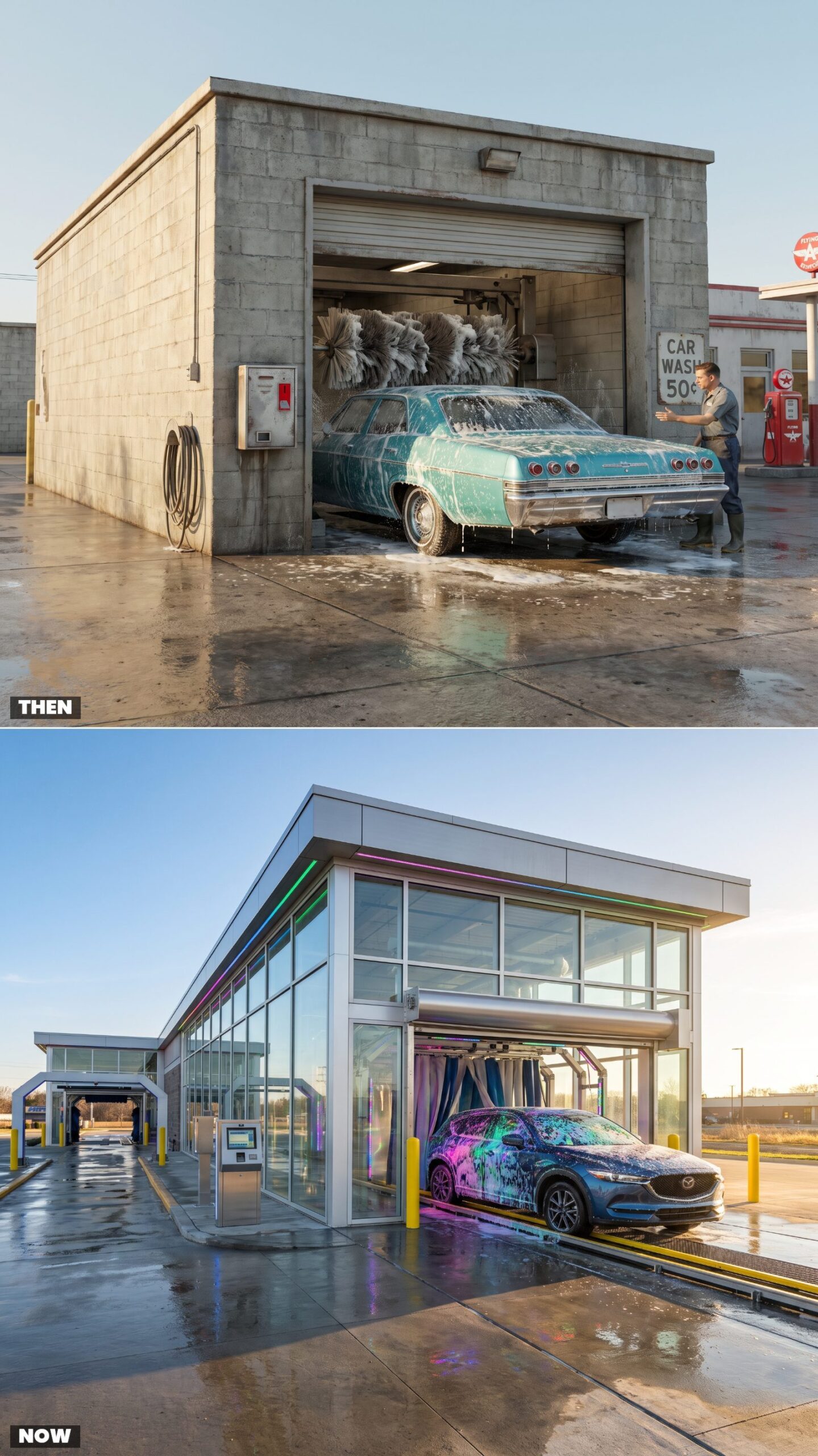
You fed coins into a box, a cloth brush swung down, and your car rolled through a single block bay in about a minute and a half. No membership, no plan, no app. You paid, you got clean, you drove off.
Now the wash is a glowing tunnel with colored foam, a conveyor, and a license-plate reader that knows you’re a member before you reach the entrance. The pitch is unlimited washes for a monthly fee, which sounds great until you realize you’re paying in January for a car you won’t touch until April. We’ve all signed up and forgotten to cancel.
3. Plain Metal Canopies vs. Solar-Panel Canopies
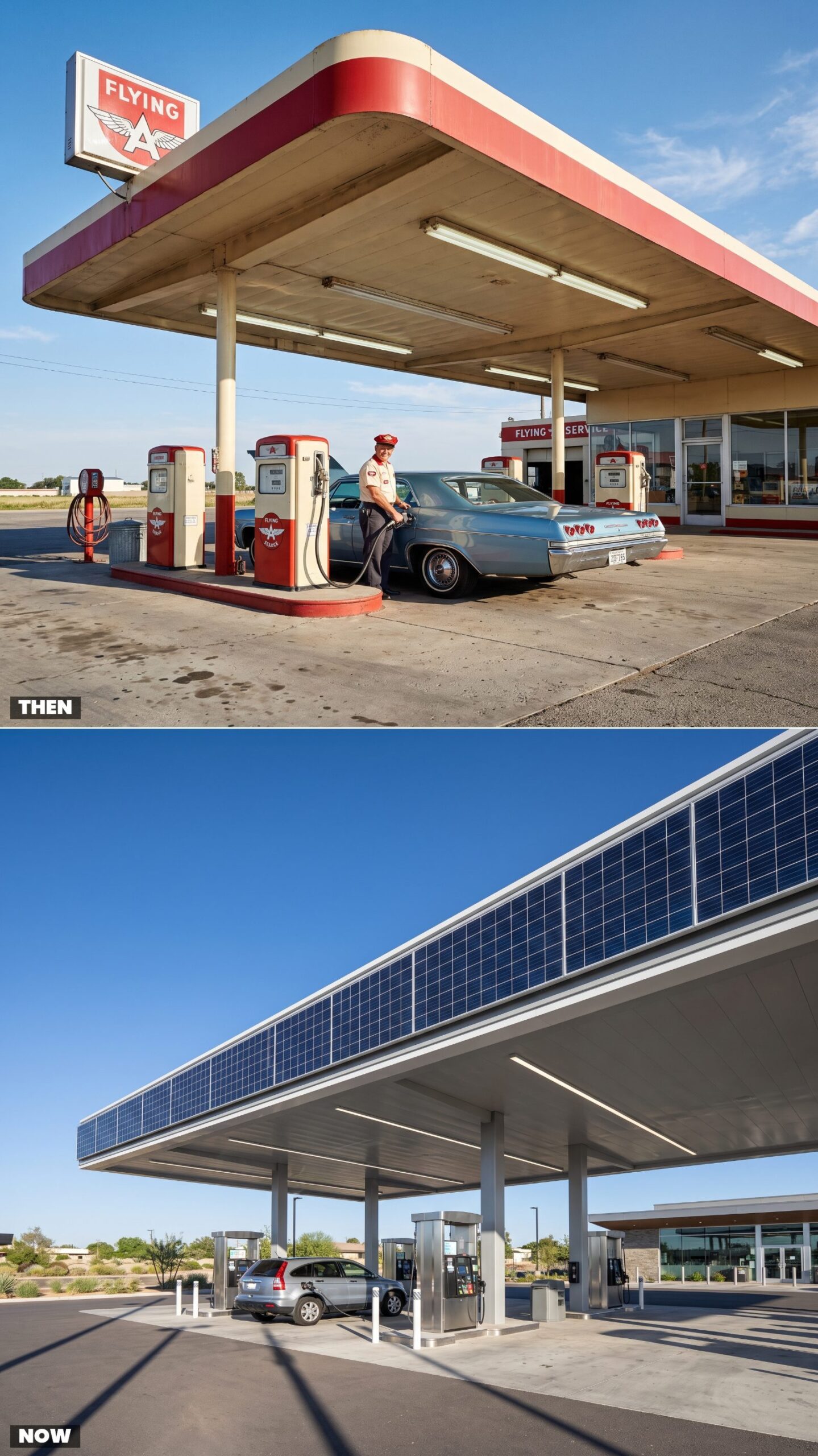
The 1965 canopy had exactly one job. Keep the rain off the attendant and the customer. A flat sheet of painted metal, a red fascia, a globe sign on the corner, fluorescent tubes underneath, and nobody ever expected it to earn its keep.
The modern version pulls double duty. Its roof is a field of solar panels soaking up the same sun that used to just bounce off the paint, feeding the lights, the pumps, and more and more the chargers below. A roof that pays rent. Hard to argue with that.
2. Static Pump Advertisements vs. Video Screens at Every Dispenser
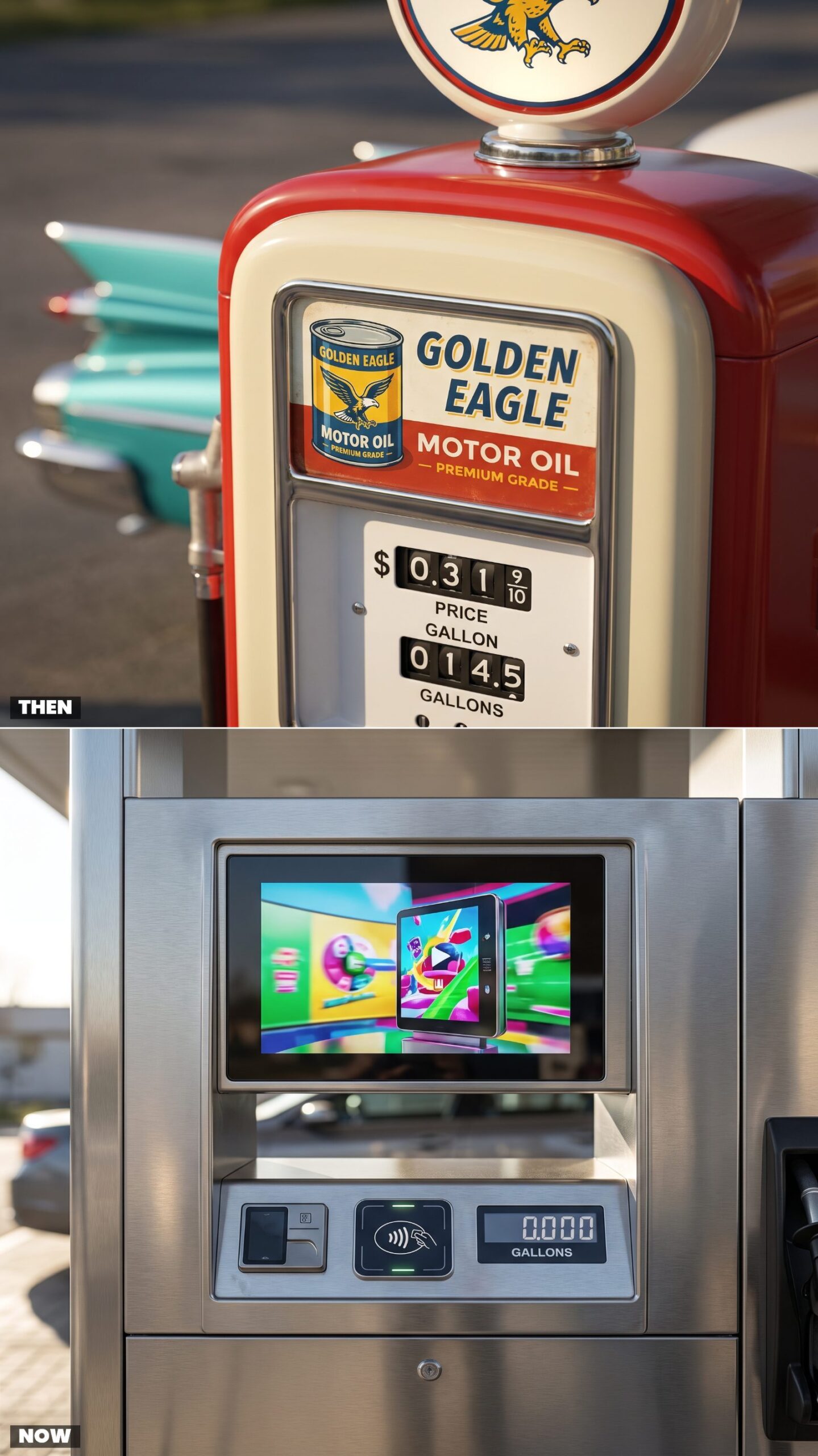
The old pump sold you something while you fueled, but it did it quietly. A printed metal placard with a painted ad slotted into a frame, a globe sign up top, and that was the whole pitch. You could ignore it completely.
Now every dispenser is a television you can’t turn off, blaring a video loop at eye level the entire time you pump. Car insurance, a two-for-one on energy drinks, a jingle on repeat. I will die on this hill: a painted oil placard never once interrupted me with a commercial.
1. Gasoline-Only Islands vs. EV Fast-Charging Stalls
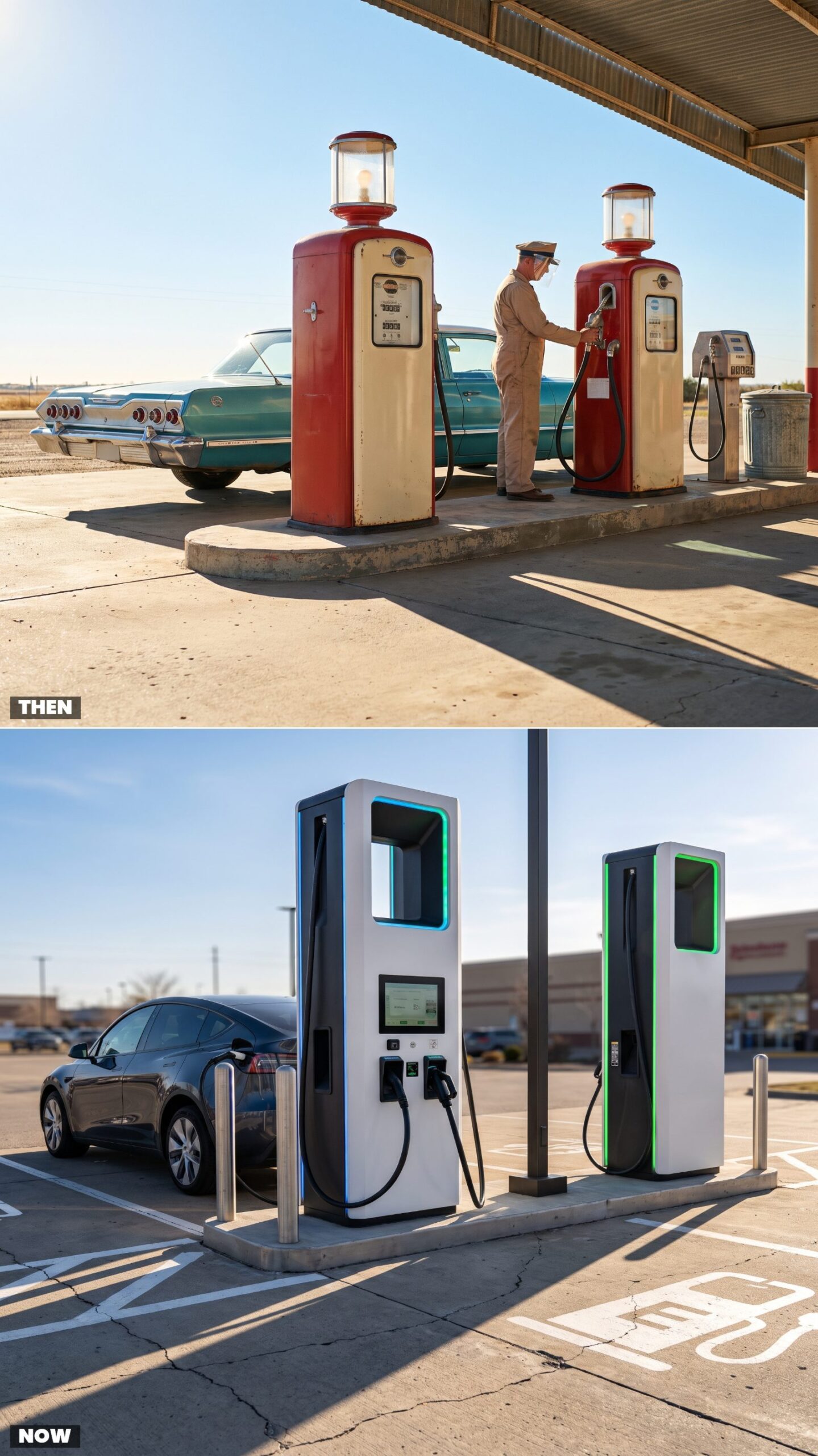
For nearly a century the island meant one thing. Gasoline. Maybe a diesel pump off to the side if trucks came through. You rolled up, filled up in a couple of minutes, and left.
That same slab of concrete now carries EV fast chargers, tall and white, glowing with status lights, cables as thick as your wrist hanging in holsters. A fill-up that used to take a couple of minutes now runs the better part of half an hour, which is why there’s suddenly a coffee bar inside. The whole business model got rebuilt around a longer wait.